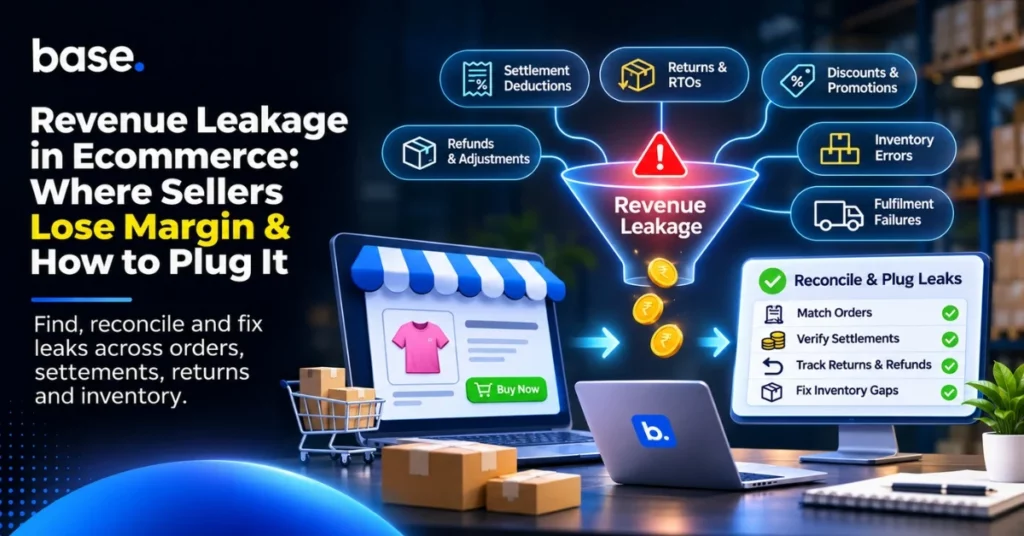
Revenue leakage in ecommerce is the loss of sales value or margin that could have been avoided if money, orders, inventory and operating records matched. The difference could be in a marketplace settlement, a refund, a return-to-origin (RTO), an oversold SKU or a discount that was applied incorrectly for an Indian seller. The individual difference may seem insignificant, but discrepancies can add up across orders and channels.
These leaks can be plugged by tracing each sale from order to fulfilment, settlement and bank credit and investigating the differences against source records. Payment reconciliation can help to detect settlement variances, and inventory and order controls can help to avoid unnecessary cancellations, incorrect refunds and fulfilment mistakes. This guide will help you determine where to look, how to reconcile an illustrative payout and which operational checks will help maintain margin.
What does revenue leakage in ecommerce mean?
Revenue leakage in ecommerce is the difference between the revenue or margin that a seller should be keeping and the revenue or margin that the seller is keeping after making valid adjustments and costs. It can be caused by missed or wrong charges, settlement mismatch, avoidable returns, fulfilment failures, pricing mistakes or inventory discrepancies.
Not all deductions are leaks. A marketplace fee that is collected under your agreement, a customer refund that is owed, or a tax amount withheld and properly recorded is a valid transaction. Leakage is the failure to record an amount due, an incorrect deduction, or a transaction in a manner that does not reflect the true financial position.
One good place to begin is to trace an order through its entire financial and operating cycle:
- The customer orders.
- Order is completed, cancelled, returned or refunded.
- The channel logs the appropriate charges and adjustments.
- A settlement is determined.
- The net settlement is credited to the seller’s bank account.
- The seller records and reconciles the transaction.
If there is a missing step between these steps, it can be difficult to spot an error. For instance, an order might be marked as fulfilled in one system and the refund or adjustment might be listed in a subsequent settlement report.
What are the revenue or margin leaks for ecommerce sellers?
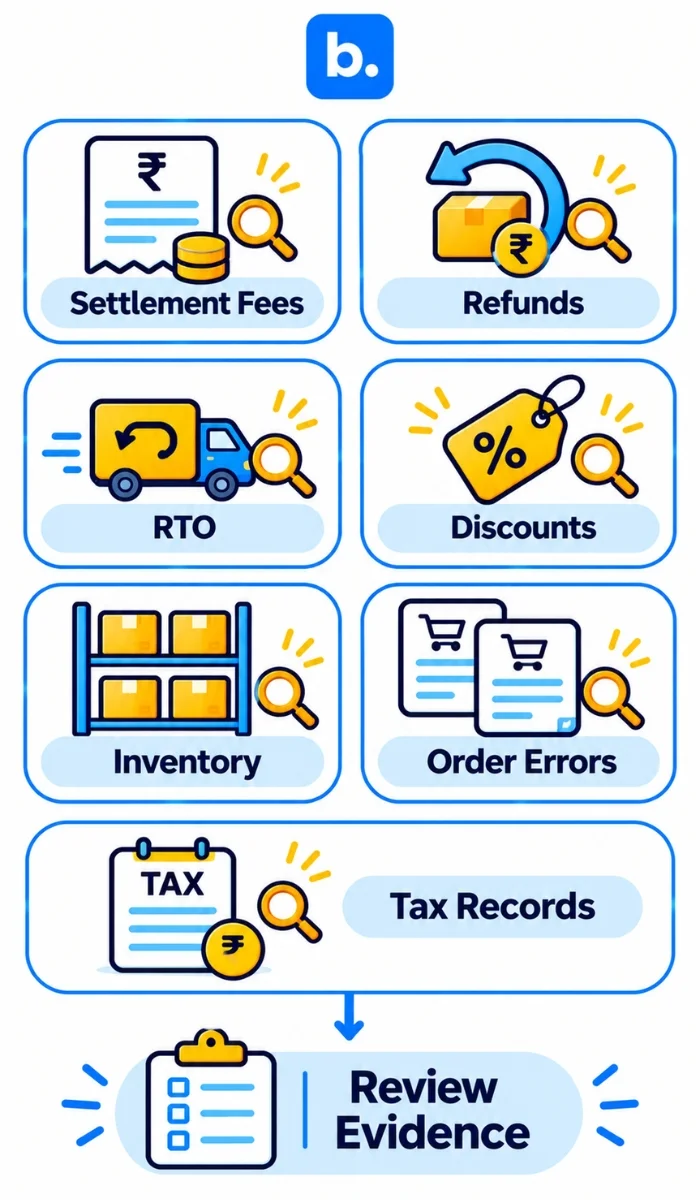
There are multiple points in the order and settlement process where revenue can be lost. Here are some of the more typical areas to check; the cause and monetary treatment will rely on your channel agreement and records.
| Leakage area | What to compare | What can be a sign of trouble |
|---|---|---|
| Settlement deductions | Settlement report, agreed fee schedule and order records | A charge or adjustment that is not in line with the agreement or transaction |
| Refunds and returns | Original order, refund record, returned item and stock disposition | A return with no related event, or stock returned that is not documented during inspection. |
| RTO and failed delivery | Shipment tracking, return status, carrier charges and inventory | Charges or inventory movements that do not match the parcel’s known history. |
| Discounts and promotions | Listed price, seller-funded offer and order-level discount | Discounts outside the promotion terms or pricing rules |
| Inventory errors | Physical count, system quantity and channel availability | Overselling, avoidable cancellation, stock mismatch or a unit missing from available stock |
| Order processing | Channel order, internal order, invoice and fulfilment record | Duplicate, missed or incorrectly processed orders |
| Tax and statutory adjustments | Settlement statement, tax records and applicable documentation | An amount that is missing, duplicated or incorrectly classified as a withheld or reported amount. |
Be careful with tax deductions. A tax withholding is not necessarily a loss: reconcile it with the appropriate statements and records and verify the treatment with your finance or tax adviser.
How does payment reconciliation work?
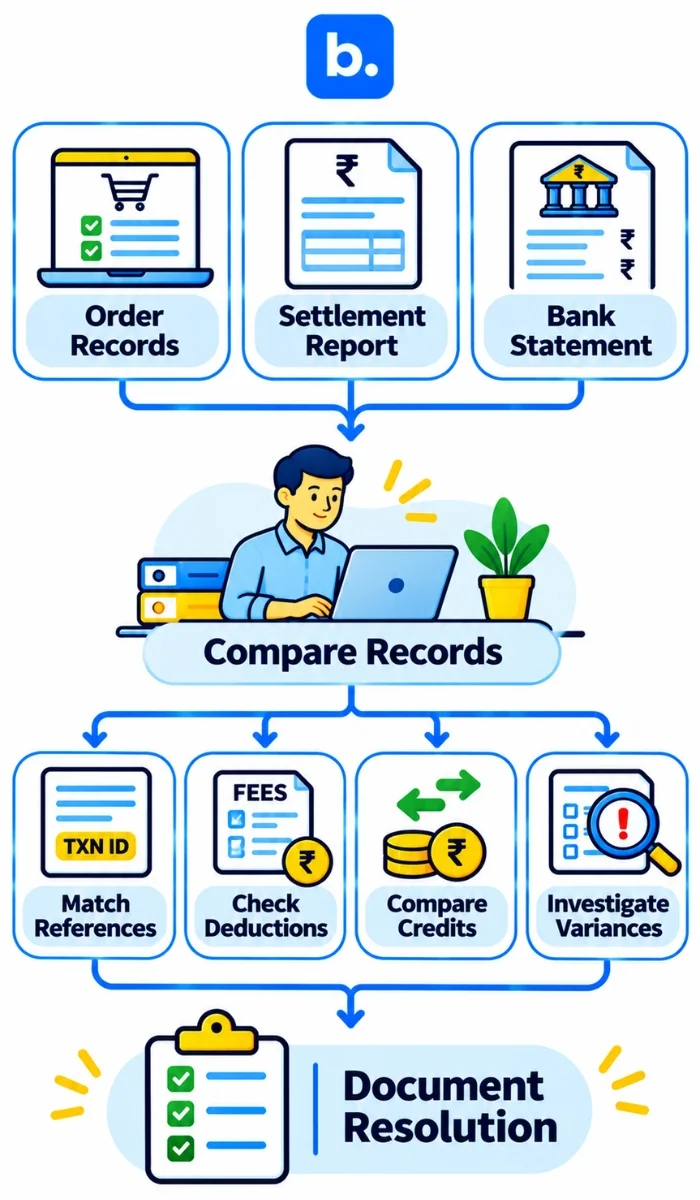
Payment reconciliation for D2C brands in India involves comparing payment and settlement information with the sales, refunds, fees, adjustments and bank credits. Ecommerce payment reconciliation is the same process but for online orders and their respective settlements in a store, marketplace or payment channel.
In the case of a marketplace, marketplace payment reconciliation typically involves comparing the marketplace’s transaction or settlement report with the seller’s order, refund, fee and bank records. The platform’s report details the transactions in its statement; your order and finance records help determine if the transactions are expected and properly recorded.
A practical definition of reconciliation of payments is to compare the records of the amounts due, deducted and received and then investigate any discrepancy. To do this reliably:
- Use reports of the same settlement period and currency.
- Match transactions using order, settlement or payment references where available.
- Separate sales, refunds, fees, adjustments and tax related entries.
- Compare the net amount with the bank credit.
- Explain the rationale and justification for each variance.
- Follow up on unresolved items to a correction, credit or documented explanation.
Ecommerce reconciliation software, such as automated payment reconciliation software, can help to organise and match records. A payment reconciliation system is useful only if source data is complete, references are consistent and exceptions have clear handling rules.
What is an example of payment reconciliation?
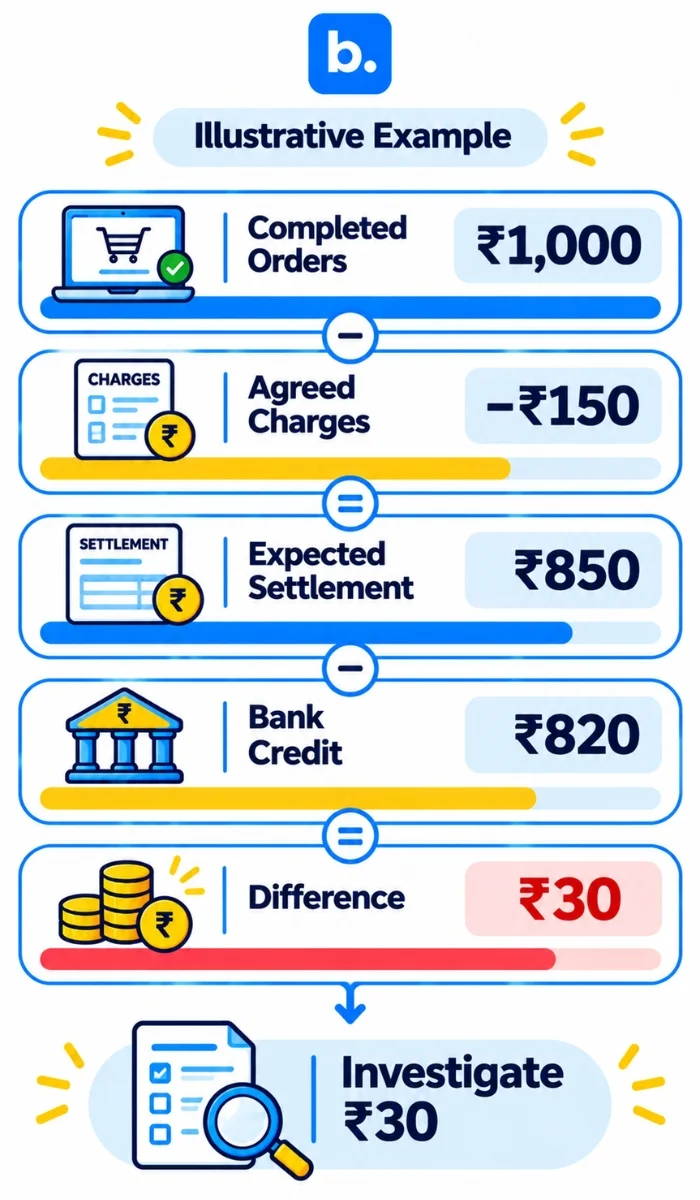
Let’s take a look at this simplified payment reconciliation example. The prices listed below are indicative.
| Item | Illustrative amount |
|---|---|
| Completed order value | ₹1,000 |
| Agreed platform and fulfilment charges | −₹150 |
| Expected settlement before taxes and other adjustments | ₹850 |
| Bank credit received | ₹820 |
| Difference to investigate | ₹30 |
The seller should not presume that the ₹30 is an error or a fee without evidence. Look for a separate adjustment, tax-related entry, refund, charge or timing difference on the settlement statement. Then compare the statement with the order record and bank credit. If no matching explanation is found, escalate the individual transaction with the platform or payment provider and record the resolution.
Use the actual agreement and statement for a real reconciliation. For simplicity, tax treatment, refunds and other potential adjustments are not included in the example.
What are the ways to detect and repair frequent leaks?
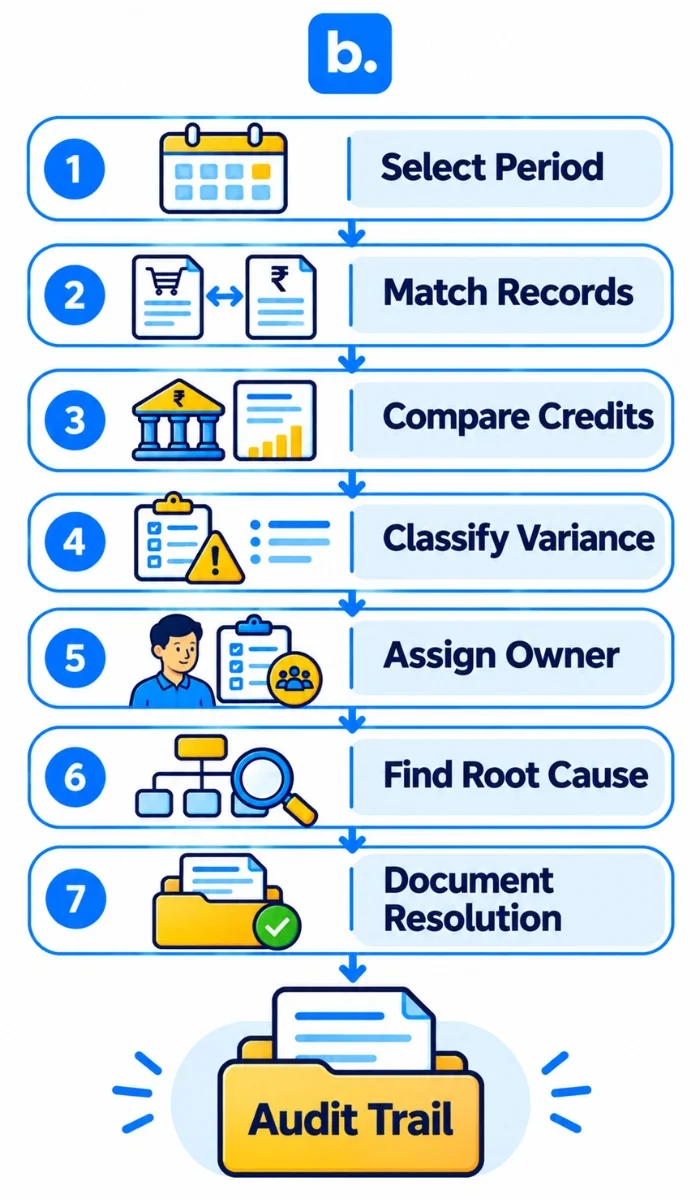
Begin with exceptions that are related to a particular order, transaction, SKU or settlement period. A vague “payout mismatch” is difficult to decipher, but a list of unmatched transactions with dates, amounts and references gives finance and operations a helpful trail to follow.
Use this process:
- Select a period and channel. Reconcile one settlement period at a time and do not combine unrelated statements.
- Match order and settlement records. Determine sales, cancellations, refunds, fees and adjustments for each applicable transaction.
- Compare expected and actual credits. Check the platform’s net payable against the bank statement, accounting record and settlement date.
- Classify each variance. Note if it is a timing difference, valid deduction, refund, charge dispute, missing transaction or unresolved item.
- Set an owner and due date. Finance may hold settlement variances, operations may require dispatch, delivery or returned stock verification.
- Look for repeated causes. Comparable variations between orders could indicate a SKU mapping error, a pricing rule, a workflow problem, or a recurring charge problem.
- Document resolution. Ensure evidence, explanation and correction are kept together to avoid repeated investigation of the same issue.
Distinguish between preventable leakage and a valid cost that requires improved forecasting. Reconciliation is not about challenging every deduction, it’s about making sure that every deduction is anticipated, properly calculated and documented.
What are some operational controls that can minimize leakage?
Settlement checks detect differences after they have happened. Operational controls can also minimize the mistakes that result in unnecessary losses.
- Order accuracy: Compare orders received from each channel with the internal order record. Check for missed imports, duplicates, cancellations and incorrect status changes.
- Inventory accuracy: Verify the stock and channel availability. Maintain separate records for physical, dispatched, returned and available stock. For more details on stock records and controls, refer to Inventory Management System in India.
- Returns and RTO: Link each return or failed delivery to the original order, refund and inventory disposition. Returned goods may require inspection prior to re-availability.
- Pricing and promotions: Check price rules and seller-funded promotions prior to activation. Check selling price and discount terms against price charged.
- Process ownership: Determine who reviews channel orders, settlement statements, returns and open variances. Set up a review schedule to prevent items from getting lost between finance, operations and customer service.
These checks minimize avoidable order and inventory errors, and are not a substitute for settlement or bank reconciliation.
How about an order management system?
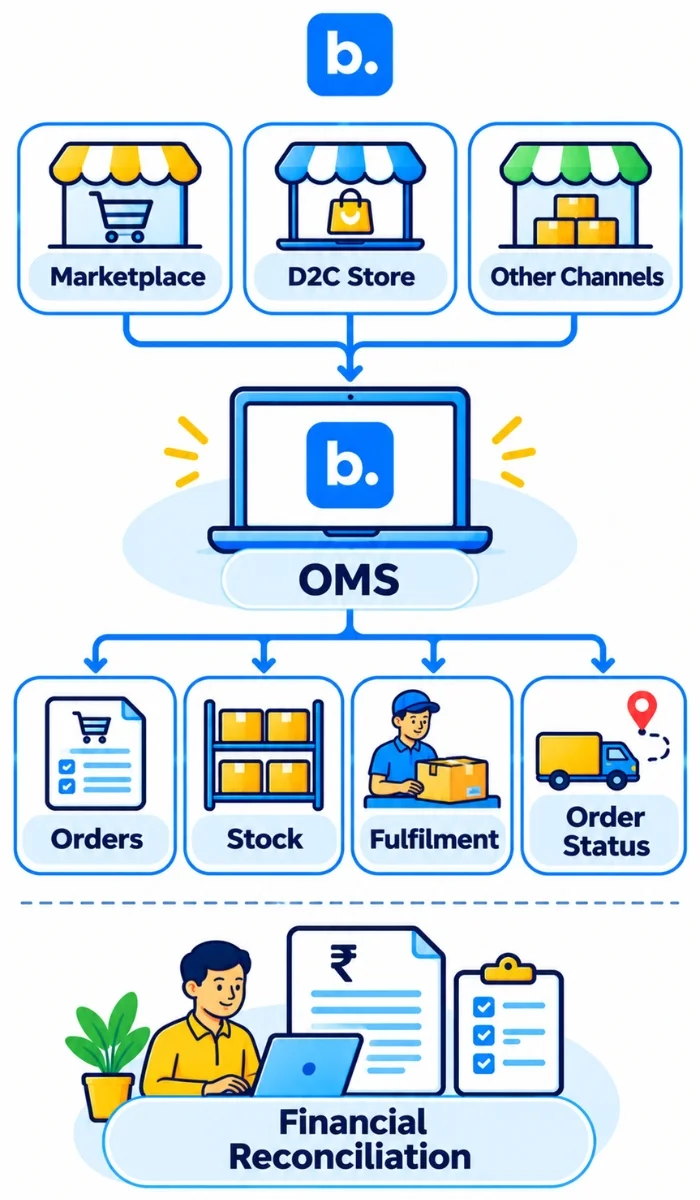
Order management system (OMS) software is a system that handles order data and order fulfilment across integrated sales channels. It can help with operational accuracy by integrating supported orders into a common workflow, minimizing manual order handling and assisting teams to track order status.
We offer an Order Manager for orders from connected stores and marketplaces at base.com. Our Order Management System page outlines our order processes. Order management is not a bank reconciliation or accounting service.
Refer to Order Management Systems in India and Best Order Management Software for Ecommerce Businesses in India for related guidance. Our Business Plan provides operational characteristics for growing businesses. Assess any plan or tool according to the workflows you need, not marketplace settlements.
What should be monitored on a weekly and monthly basis?
A regular review will help teams to see a pattern before it becomes a larger issue. Keep an eye on a few indicators:
- Unmatched settlement transactions by channel and settlement period.
- The difference between the expected settlement and bank credit.
- Refunds, Cancellations and RTOs with no operational record.
- Stockout/cancellation because of inventory changes and overselling.
- Unresolved discrepancies, their age and their assigned owner.
- Repeat fee, price or fulfilment deviations per channel or SKU.
Use thresholds that are appropriate for your volume. Review the number and magnitude of the differences: If there are many small differences, it could be a process issue; if there is one large difference, it may require immediate investigation.
Conclusion
Revenue leakage in ecommerce can occur when settlement entries, order records, returns, inventory and bank credits don’t match. Match each settlement to the underlying transactions, break out valid costs from unexplained differences and assign owners to open issues. Order and stock errors can be minimised by operational controls and payment reconciliation verifies what was charged and received. At base.com, we enable connected order operations via Order Manager. The appropriate finance process or tool should be used for settlement and accounting reconciliation.