Automated vs manual payment reconciliation in India is a comparison most D2C founders do not make until the damage is already done. The brand is growing. Orders are up. GMV is increasing. But the bank balance is not growing at the rate it should. Somewhere between the customer paying ₹799 on Flipkart and that ₹799 reaching the founder’s bank account, money is disappearing, in small, invisible increments that no one is systematically tracking.
That is the payment reconciliation problem in Indian D2C. And the automated vs manual payment reconciliation India debate sits at the centre of it.
Based on reconciliation data across Indian marketplace sellers, 2-3% of gross payment volume is typically lost through deduction errors that go undetected in unreconciled settlements. For a brand doing ₹1 crore per month in marketplace GMV, that is ₹2-3 lakh per month in silent losses. Annually: ₹24-36 lakh. Not from bad marketing. Not from poor product-market fit. From a reconciliation gap.
This post explains exactly where that money goes, why manual reconciliation cannot catch it at scale, what automated reconciliation recovers, and how Base.com’s integrated accounting module closes the automated vs manual payment reconciliation gap for Indian D2C brands.
The Scale of the Problem: What Indian D2C Brands Are Actually Losing
Before resolving the automated vs manual payment reconciliation India debate, the financial stakes need to be specific.
E-commerce sellers lose 2-3% of gross payment volume to fee errors that never get audited. Commission category misclassification, volumetric weight overcharges, incomplete return reversals, and incorrect TCS calculations compound silently across thousands of orders. For a seller processing ₹5 crore GMV per month, that translates to ₹10-15 lakh in annual leakage from settlement report discrepancies alone.
Manual reconciliation processes can lead to significant mismatches, with error rates of 5-10%, making them unsustainable for high-volume ecommerce operations.
A seller processing 500 orders per day across Amazon, Flipkart, and Meesho receives settlement reports with 15-20 different fee line items per order. Commission rates, shipping charges, closing fees, fixed fees, TCS deductions, and return adjustments are each computed independently by the marketplace. When any one of these calculations is wrong, the error repeats across every affected order until the seller identifies it. Most sellers never do.
The automated vs manual payment reconciliation in India question is therefore not a process question. It is a revenue recovery question with a calculable annual answer for every brand above 500 orders per month.
The Six Fee Categories Where Money Leaks
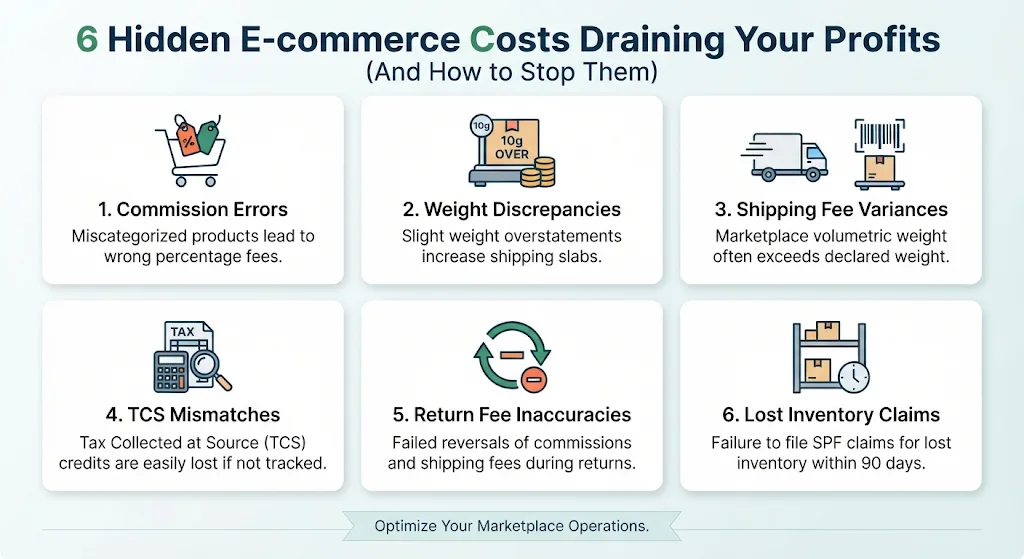
Indian marketplace reconciliation involves six distinct fee categories on every order. Each can be wrong. Each has a different claim window. Each requires a different matching logic.
- Referral commission. Charged as a percentage of the order value, varying by category. A fashion item and a health supplement have different commission rates. If a product is miscategorized in the marketplace system, the wrong commission rate is applied to every order in that category. A packaging discrepancy of 10 grams can push an order into the next weight slab, adding ₹15-30 per shipment. Across 10,000 shipments per month, a systematic 10-gram overstatement costs ₹1.5-3 lakh monthly.
- Shipping fee. Calculated on actual weight or volumetric weight, whichever is higher. Marketplace systems apply the weight recorded at their fulfillment center, not the weight declared by the seller. Systematic overstatement by even 50-100 grams per order at scale is a material cost.
- Technology and platform fees. Fixed or variable fees are applied per transaction, and sometimes changed without prominent notification. Manual reconciliation that uses last quarter’s expected fee schedule misses rate changes from the current month.
- TCS (Tax Collected at Source). A seller with ₹50 lakh gross monthly sales across two marketplaces may have ₹50,000 in TCS each month. If this is not tracked and claimed correctly, it becomes a permanent credit loss. TCS must be matched to Form 26AS and claimed correctly in GST filings. Manual reconciliation that treats TCS as a bulk deduction rather than an order-level item consistently misses mismatches.
- Return fee reversals. When a customer returns an order, the marketplace should reverse the commission, closing fee, and shipping charge. In practice, reversals are often incomplete. Amazon’s November 2025 policy change stopped reimbursing closing fees on returned orders. Refund administration fees are retained even on legitimate returns where the seller was not at fault. Each unreversed fee is typically ₹20-50 per order, but at 8-12% return rates on fashion and lifestyle categories, the aggregate impact is significant.
- SPF claims and lost inventory. Marketplace-stored inventory can be lost or damaged. The brand is entitled to reimbursement, but only if a claim is filed within the window. Amazon allows 90 days of self-service. Missing these timelines means the eligible amount may never be recovered.
Why Manual Reconciliation Cannot Catch These at Scale
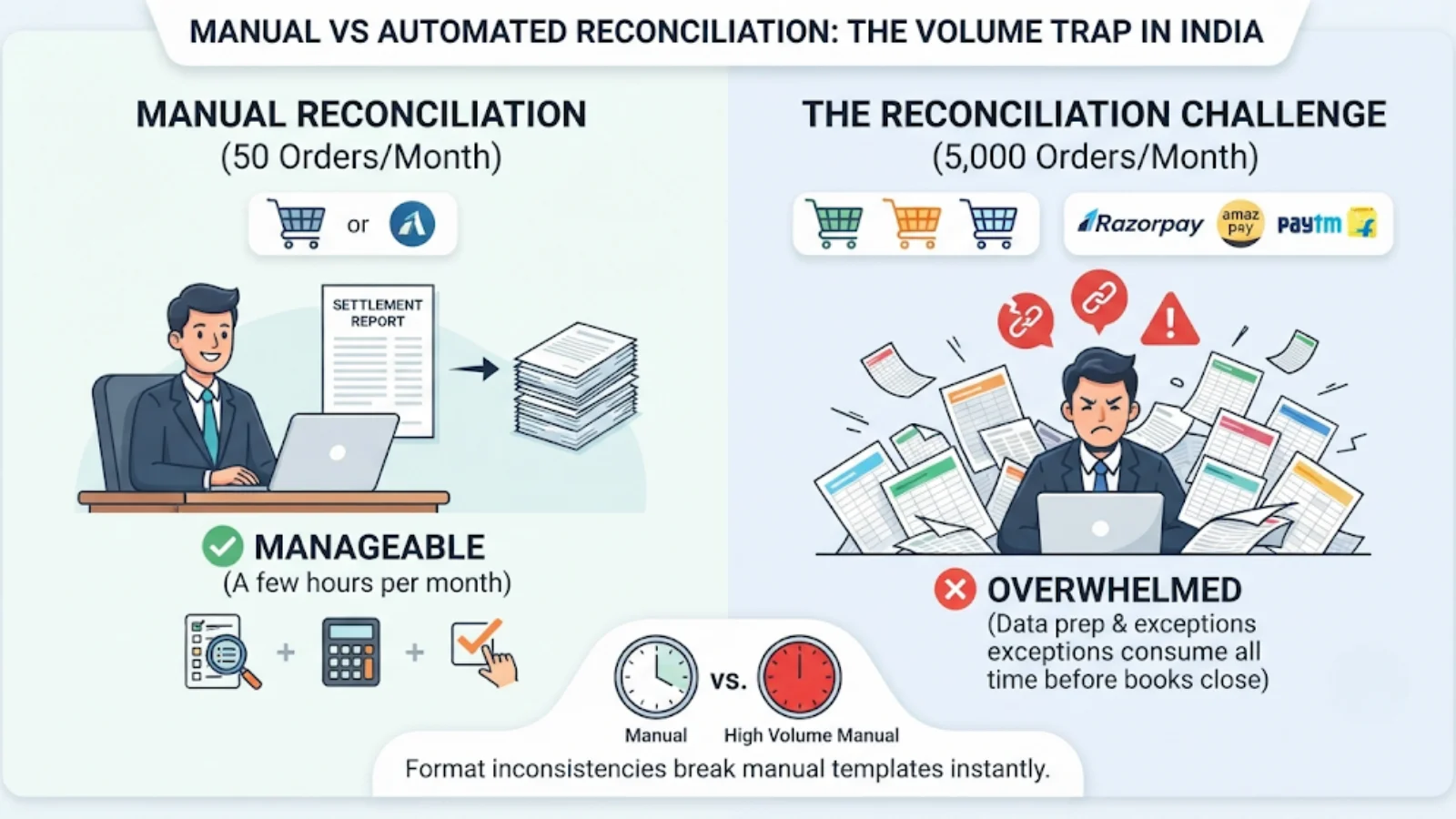
The automated vs manual payment reconciliation India comparison starts with an honest assessment of what manual reconciliation can actually do at different order volumes.
At 50 orders per month across one channel, a finance executive can pull the settlement report, check the order list, verify the net payout, and flag anomalies in a few hours. The process is imperfect but manageable.
At 5,000 orders per month across three channels, it is not because the matching is conceptually difficult, but because the data preparation, format normalisation, and exception classification consume more time than the team has before the books need to close.
Each aggregator uses a different settlement file format. Razorpay’s settlement detail export has different column names, settlement groupings, and refund handling than PayU or Cashfree. Amazon’s settlement report uses a different structure entirely from Flipkart’s. A team managing three channels manually maintains three different spreadsheet templates, and when any platform changes its settlement file format, which happens without notice, all three templates break simultaneously.
The practical manual process for a brand doing 2,000 orders per month across four channels:
- Download four separate settlement reports in four different formats.
- Download COD remittance reports from two to three courier partners.
- Export order data from the OMS or internal system.
- Build or update a master reconciliation spreadsheet, mapping order IDs across all sources.
- Match expected payment per order against actual settlement received.
- Flag discrepancies and manually create claims on each marketplace portal.
- Track claim status in a separate tracker.
- Repeat monthly, or let it slip to quarterly.
Total time: 15-25 hours per month for a finance team member, at a brand this size. At 10,000 orders per month, the same process takes 40-60 hours. At this scale, manual reconciliation either becomes a full-time role or gets deprioritized, and deprioritization means claim windows close before discrepancies are found.
The automated vs manual payment reconciliation India answer at 2,000+ orders per month is therefore not ambiguous: manual reconciliation is either consuming unaffordable finance team hours or silently leaving recoverable revenue uncollected.
The COD Reconciliation Problem Is Layered on Top
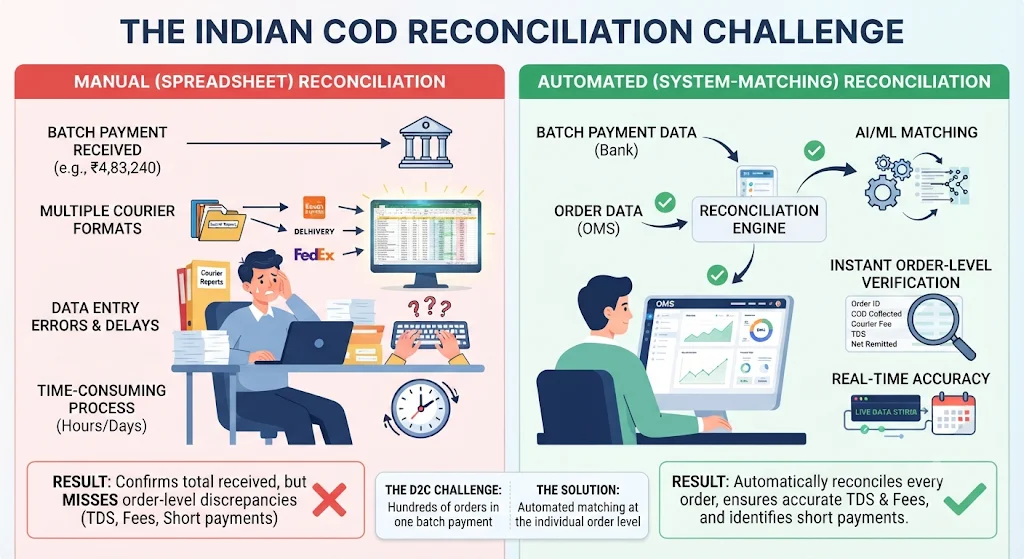
The automated vs manual payment reconciliation India challenge for Indian D2C brands has an additional complexity that Western ecommerce operations do not face: COD remittance reconciliation.
When a courier collects ₹799 cash from a customer and remits it to the brand 10-14 days later, that remittance arrives as a batch payment covering hundreds of orders. Each courier has a different remittance report format. Each deducts its remittance fee differently. Each applies TDS at the applicable rate before transferring.
Matching a batch COD remittance of ₹4,83,240 from Ecom Express to the specific orders it covers, verifying which delivered orders were included, which failed deliveries were excluded, and whether any short payments exist, requires order-level data from the OMS, not just a bank statement line.
Manual reconciliation at the bank statement level confirms that the batch amount was received. It does not confirm whether the correct orders were included, whether the correct COD amounts were remitted per order, or whether TDS was applied correctly. These are order-level questions that require order-level data, and order-level data in a manual process means a spreadsheet that is always hours or days behind the live OMS.
Automated vs manual payment reconciliation in India on COD: automated systems track expected COD per order at dispatch. When the batch arrives, each order’s expected amount is matched automatically. Discrepancies surface at the order level within hours. Manual systems discover the same discrepancy at the next monthly reconciliation, after the courier’s dispute window has closed.
How Automated Reconciliation Works at the Order Level
The automated vs manual payment reconciliation India comparison is most clearly understood by mapping what each approach does at the transaction level.
Manual: Batch-Level Matching With Sample Checks
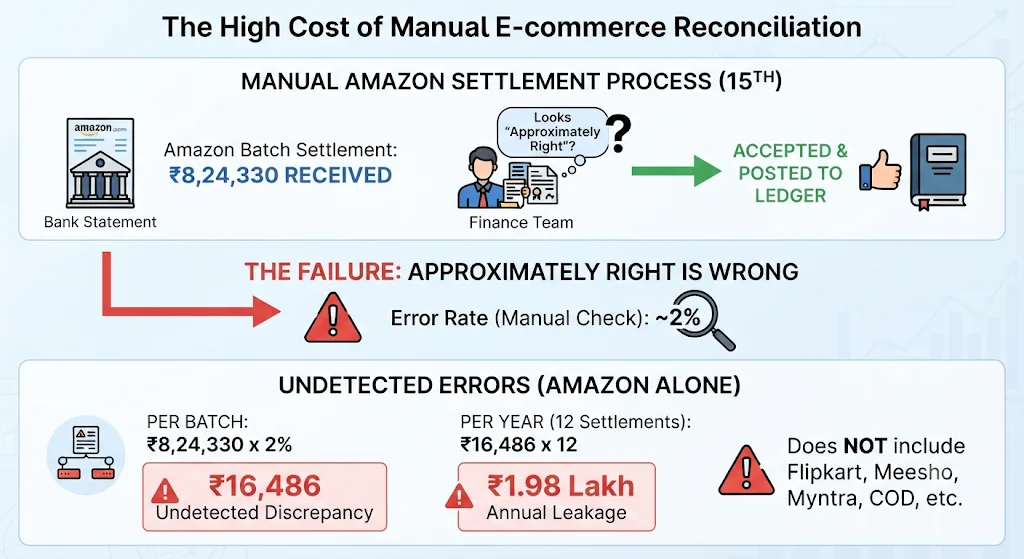
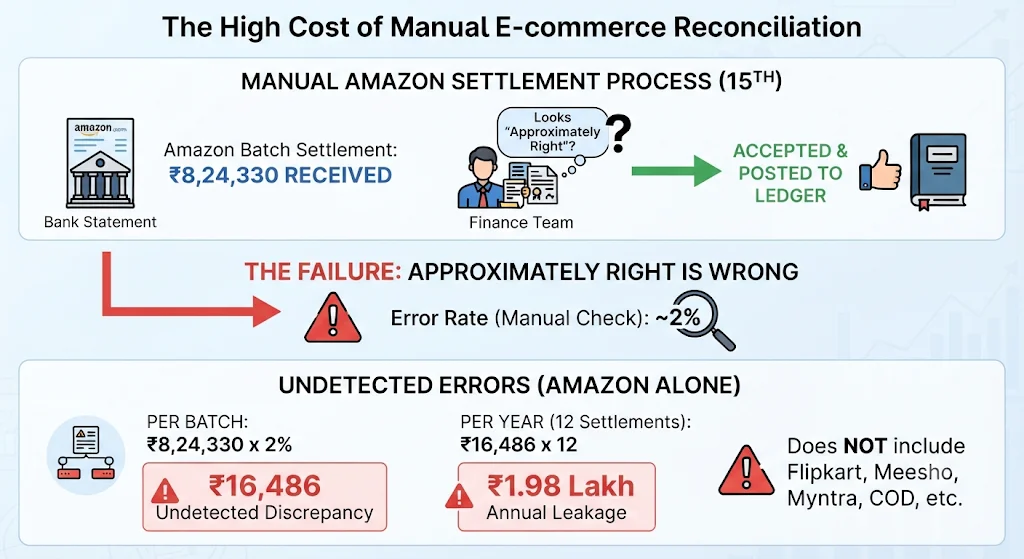
The manual process works backward from the bank statement. A batch settlement of ₹8,24,330 arrives from Amazon on the 15th. The finance team checks whether ₹8,24,330 is approximately right given the orders shipped in the settlement window. If it is roughly correct, the settlement is accepted, and the ledger entry is posted.
The approximately right check is the failure. An error rate of 2% on ₹8,24,330 is ₹16,486 in undetected discrepancies. Across twelve Amazon settlements per year, that is ₹1.98 lakh in undetected errors, from Amazon alone, before Flipkart, Meesho, Myntra, and COD remittances are included.
Automated: Order-Level Matching With Exception Flagging
An automated reconciliation system works forward from the order. At the point of dispatch, the expected payout per order is calculated: sale price minus expected commission minus expected shipping fee minus expected platform fee minus expected TCS. This expected payout is stored against the order ID.
When the Amazon settlement arrives, the system matches actual payout per order against expected payout per order, line by line, across every order in the settlement. Orders where actual matches are expected are marked and reconciled. Orders where the actual diverges from expected by more than a defined tolerance are flagged as exceptions with the specific fee component that diverged.
Claims automation automatically generates claims for valid deductions, damaged goods, returns, or overcharges within defined timelines and tracks claim status seamlessly from submission through to settlement.
The exception queue, not the full settlement report, is what the finance team reviews. Instead of manually combing through 3,000 rows, the team reviews 47 flagged exceptions. Each exception has the order ID, the expected amount, the actual amount, and the specific fee component causing the discrepancy. The review takes 2-3 hours instead of 20-25 hours. And it happens within 48 hours of settlement receipt, while claim windows are still open.
How Base.com Enables Automated vs Manual Payment Reconciliation in India
Base.com addresses the automated vs manual payment reconciliation India problem from within the unified OMS and WMS platform, not as a bolt-on reconciliation tool but as an integrated financial layer.
1. Automatic Order-to-Ledger Sync
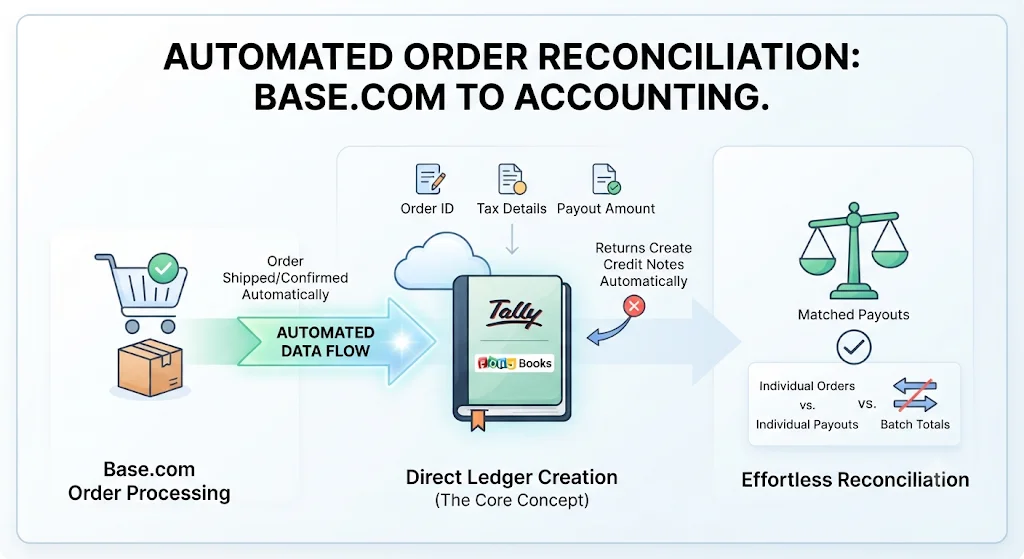
Every order confirmed and shipped on Base.com creates a ledger entry automatically in Tally or Zoho Books. The entry carries: order ID, channel, sale amount, applicable tax, and expected payout net of fees. Returns create corresponding credit notes automatically. There is no CSV export, no manual import, no format conversion.
This is the foundational step that makes automated vs manual payment reconciliation in India practically achievable at scale. Without order-level ledger entries, reconciliation is always a batch exercise comparing totals rather than an order-level exercise comparing individual payouts.
2. Payment Tracking at the Order Level
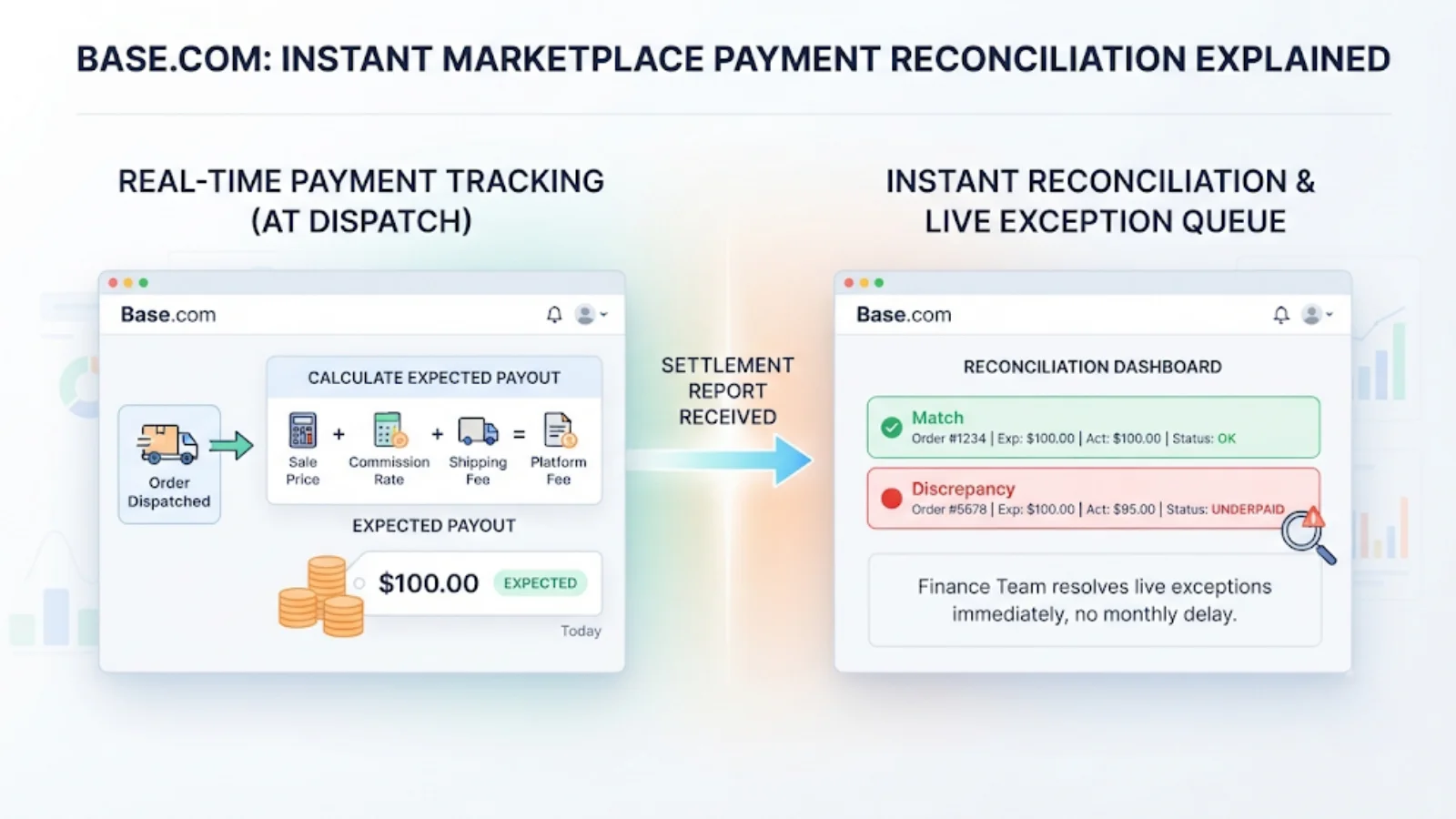
Base.com’s payment tracking module records the expected payout per order at dispatch. For marketplace orders, this includes the sale price, the channel-specific commission rate for the product category, the applicable shipping fee based on weight and zone, and the platform fee for the relevant fulfillment model.
When marketplace settlement reports arrive, they are matched against these per-order expected amounts. Discrepancies surface immediately, not during the next monthly close. The finance team works from a live exception queue, not a historical settlement report downloaded four weeks after the discrepancy occurred.
3. Invoice Creation and Corrections Within the Platform
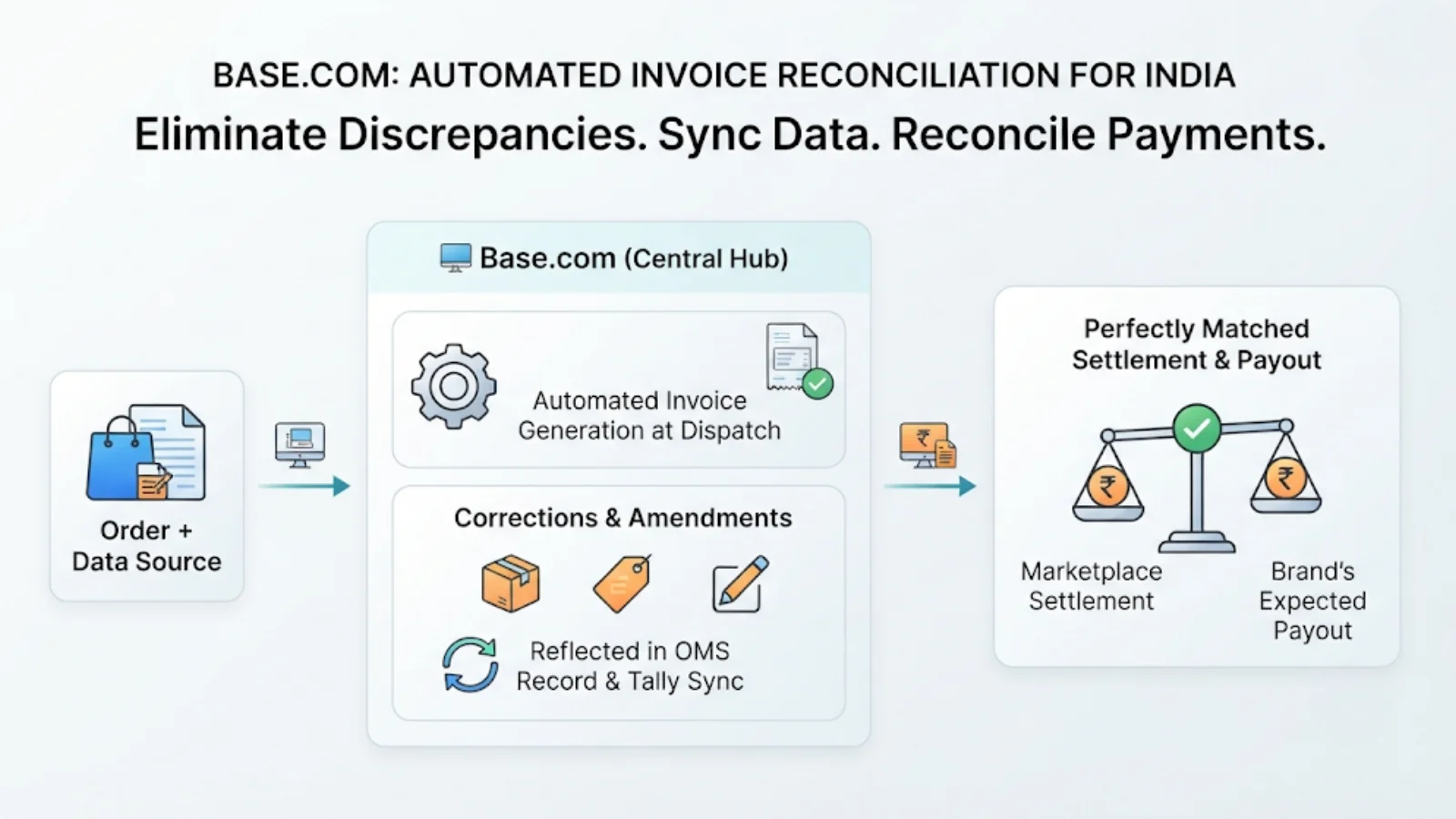
Base.com generates invoices automatically at dispatch. Invoice corrections, for order amendments, return processing, or pricing adjustments, are handled within the platform and reflected in both the OMS record and the accounting sync to Tally.
This matters for automated vs manual payment reconciliation in India because invoice errors are a common source of settlement discrepancies. If the invoice amount does not match the order amount, the marketplace’s settlement calculation starts from a different base than the brand’s expected payout calculation. Base.com’s invoice creation from the same data source as the order record eliminates this discrepancy source.
4. Multi-Currency Support for Cross-Border Sellers
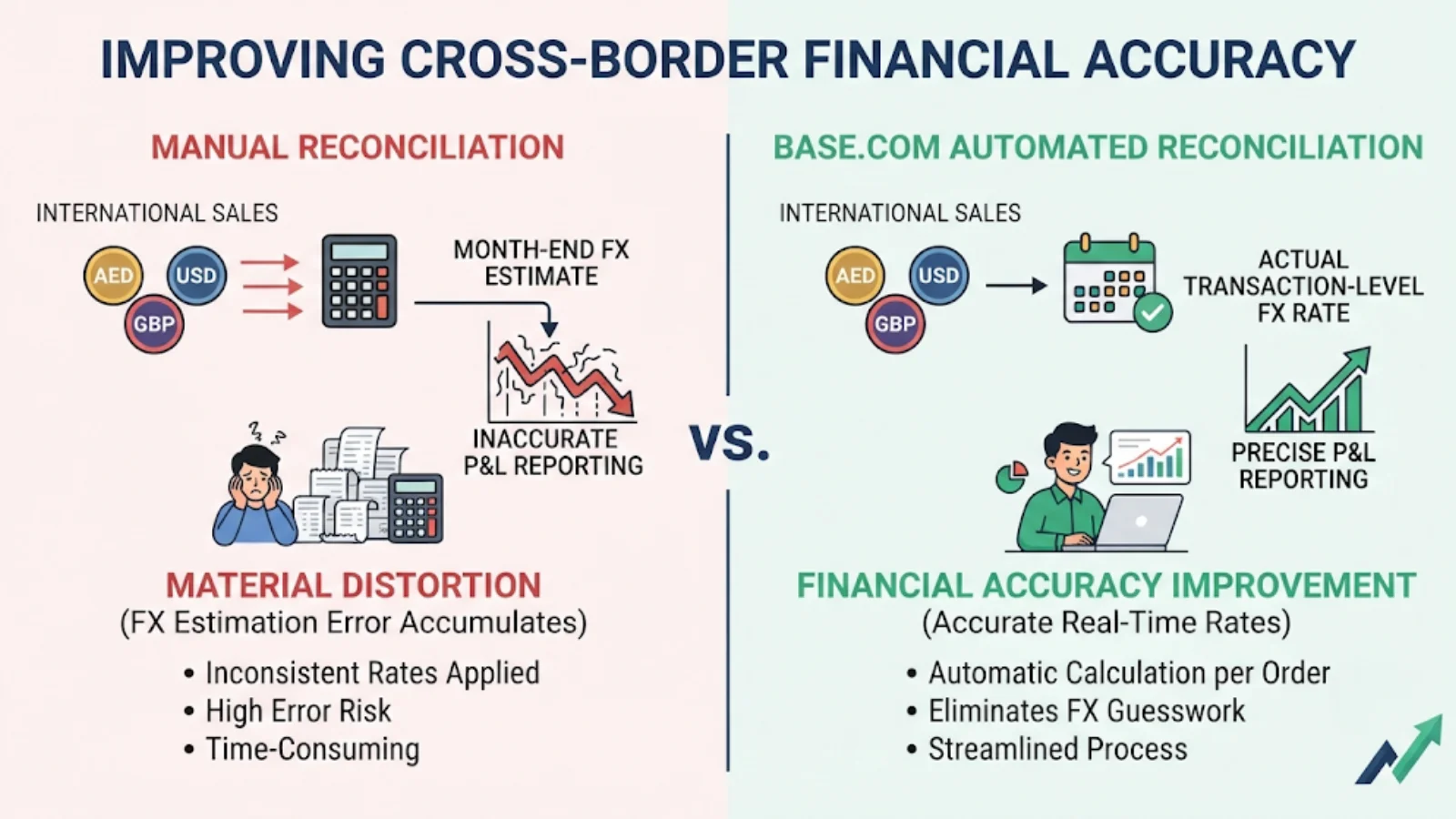
Brands selling on Amazon UAE, Noon, or international channels receive settlements in AED, USD, or GBP. Manual reconciliation applies a month-end exchange rate estimate that diverges from actual transaction-level rates. Over a full year of international sales, this FX estimation error accumulates into a material P&L distortion.
Base.com’s multi-currency support records the exchange rate at the transaction level. Each international order’s INR equivalent is calculated at the actual rate on the day of settlement. The automated vs manual payment reconciliation India comparison for cross-border sellers shows this as a specific financial accuracy improvement, not just a time-saving one.
5. The Total Business P&L Dashboard: Connecting Reconciliation to Margin
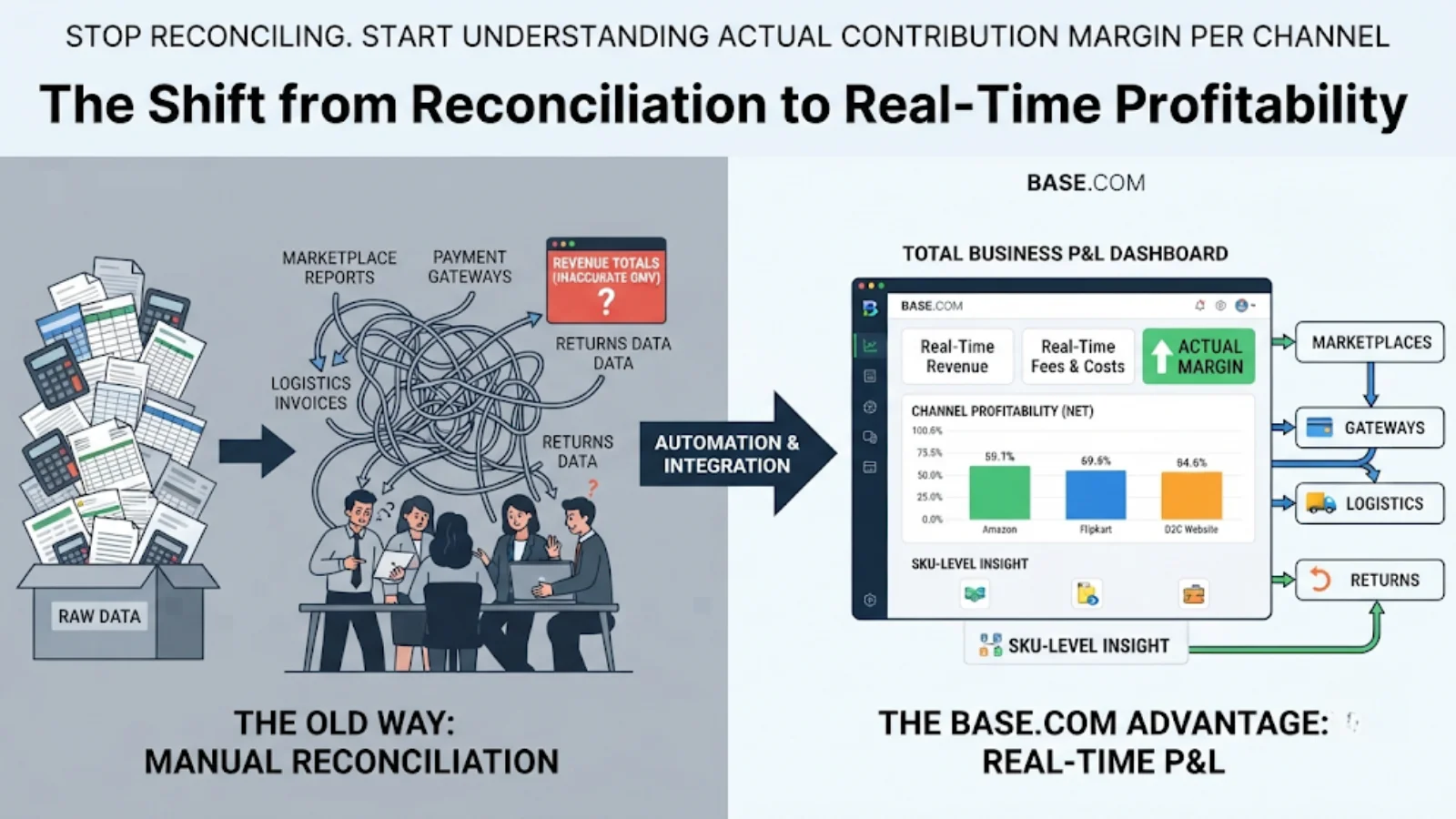
The automated vs manual payment reconciliation in India question is ultimately a margin question. The finance team’s goal is not to reconcile for its own sake. It is to know the actual contribution margin per channel, net of all fees, returns, and fulfillment costs, accurately, in real time.
Real-time, SKU-level reconciliation enables profitability insight by product, channel, and geography, not just revenue totals.
Base.com’s Total Business P&L Dashboard connects the reconciliation layer to the margin layer. Channel-wise realized revenue, net of marketplace fees, returns, shipping costs, and fulfillment costs, is visible without building a separate Excel model from exported reports. The number the founder or CFO sees is the actual margin, not the gross GMV.
This is the end state of solving the automated vs manual payment reconciliation India problem: not just recovering lost fees, but having a real-time, accurate picture of which channels are actually profitable after all costs.
6. The GST and TCS Loop

The automated vs manual payment reconciliation problem in India has a specific compliance dimension that distinguishes it from international ecommerce reconciliation.
Every Indian marketplace deducts TCS (Tax Collected at Source) at 1% of the net sale value before remitting. This TCS is creditable against the brand’s GST output tax liability, but only if the correct TCS amount appears in the brand’s GSTR-2A and is claimed in the GST return.
Sellers should verify that TCS is not being computed on the gross settlement amount, including GST. Additionally, the intra-state and inter-state split must match actual delivery addresses, not the seller’s registered address.
Manual reconciliation that does not track TCS at the order level misses these verification steps. TCS credits are either over-claimed (creating compliance risk) or under-claimed (leaving ITC uncollected). Automated reconciliation that tracks TCS per order, per marketplace, and per GSTIN makes the monthly GSTR-2A matching a systematic check rather than a retroactive audit.
Base.com’s tax calculation module captures GST and TCS at the transaction level. The Tally sync carries this data into the accounting system, where the CA uses it for GST filings. The automated vs manual payment reconciliation India difference on GST compliance is not abstract; it is the difference between ITC claims that are accurate and verifiable versus ITC claims that are estimated and exposed to audit risk.
The Real Cost Comparison: Manual vs Automated at Scale
To make the automated vs manual payment reconciliation India comparison concrete, here is the financial picture for a brand doing ₹50 lakh monthly marketplace GMV across three channels.
- Revenue leakage from undetected fee errors: 2-3% of ₹50 lakh = ₹1-1.5 lakh per month. Annual: ₹12-18 lakh.
- Finance team hours on manual reconciliation: 20-30 hours per month at a fully loaded cost of ₹400-600 per hour. Monthly cost: ₹8,000-18,000. Annual: ₹96,000-2.16 lakh.
- Claim windows missed: Amazon allows 90 days of self-service. Flipkart’s return discrepancy window is 14 days post-receipt for some claim types. A monthly reconciliation cycle misses Flipkart’s 14-day window on claims from orders earlier in the month. Conservative estimate of unrecoverable amounts from missed windows: ₹20,000-50,000 per month. Annual: ₹2.4-6 lakh.
- TCS credit unclaimed or mismatched: 1% TCS on ₹50 lakh = ₹50,000 per month. If 10% is misclaimed due to computation errors: ₹5,000 per month. Annual: ₹60,000.
- Total annual cost of manual reconciliation at ₹50 lakh monthly GMV:
- Revenue leakage: ₹12-18 lakh
Finance team cost: ₹1-2.16 lakh
Missed claims: ₹2.4-6 lakh
TCS errors: ₹60,000 - Estimated total: ₹16-27 lakh per year from a brand doing ₹6 crore annual marketplace GMV.
The automated vs manual payment reconciliation in India ROI case does not require a complex model. The leakage rate is established at 2-3% of GMV. The finance team’s hours are measurable. The missed claim losses are trackable once you start tracking them.