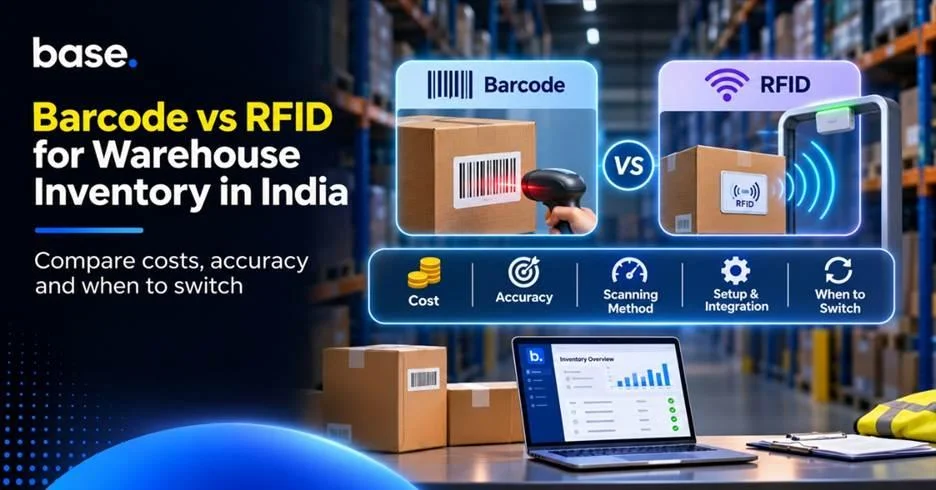
Barcode inventory management uses printed codes and optical scanners to identify products, SKUs or locations. RFID uses radio-frequency tags and readers to identify compatible items without the same direct line of sight. Barcodes are generally less expensive and work well for structured receiving, picking and stocktaking. RFID can make bulk identification faster in suitable environments, but adds tags, readers, integration and implementation costs. The right choice depends on inventory volume, warehouse processes, identification requirements and expected return on investment.
This is a choice between identification methods, not between a barcode and a warehouse management system. A warehouse management system (WMS) uses identification data to support inventory and physical operations. Either technology may feed a WMS, if the hardware and software are compatible.
What is barcode inventory management?
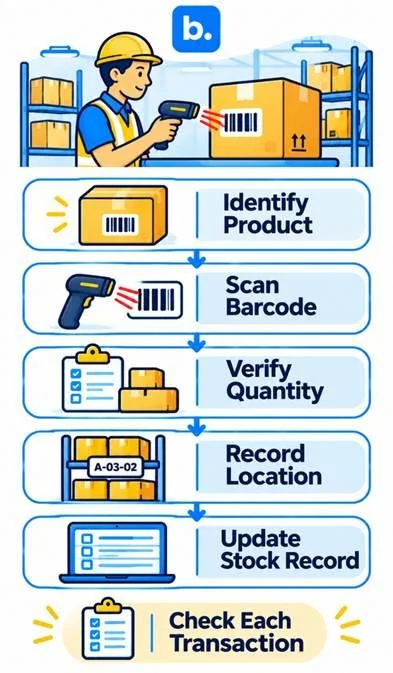
Barcode inventory management uses printed machine-readable codes and compatible scanners to identify products, SKUs, cartons or warehouse locations and record transactions. A scanner or mobile device reads encoded information and passes the identifier to connected inventory software or a WMS.
A code may identify a product type or a uniquely labelled unit. Do not assume every barcode contains a batch number, serial number or expiry date; these must be encoded or linked to the product record.
For example, on receipt of 50 units, staff scan the product code, verify quantity and record the receipt against the SKU and location. This reduces repeated manual entry, but does not replace checking the delivery.
Barcodes support receiving, put-away, transfers, picking, packing, cycle counts, stocktakes and dispatch. Scanning both a product and its destination bin records where stock was placed; a pick scan can help confirm the item matches the order. One-dimensional codes are common; two-dimensional codes such as QR can carry additional information. Labels must remain visible and readable.
The benefit is structured identification without repeatedly typing details. Staff still need to locate and scan each code. Damaged labels, incorrect or duplicate scans, and transactions left incomplete can all create discrepancies.
What is RFID inventory management?
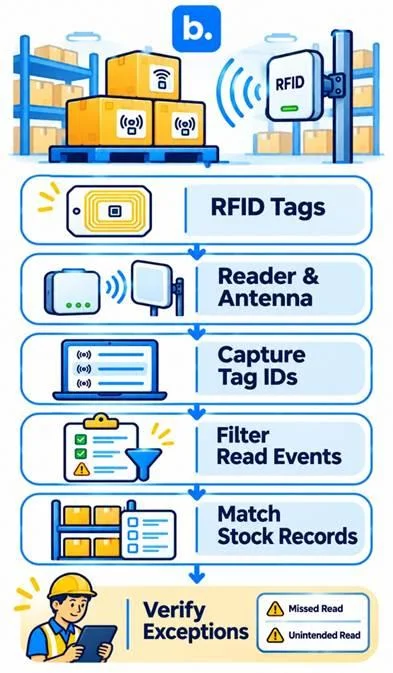
RFID inventory management uses Radio Frequency Identification tags and readers to identify tagged products through radio waves. A tag’s chip and antenna communicate an identifier to a reader; software connects the captured data to stock records. Readers may be handheld or fixed at selected points.
Unlike barcode scanning, RFID does not require direct visual access to each label, and compatible readers can identify multiple tags in one event. GS1 US advises evaluating the use case, partner capabilities and return on investment before choosing a system.
RFID types differ. Passive tags have no battery and draw energy from the reader; passive UHF is often considered for bulk inventory identification. Active tags have their own power source and can transmit farther depending on the system, making them suitable for some asset-tracking applications. Battery-assisted passive tags use a battery to support the chip but still communicate through a reader. Do not treat passive, active, HF and UHF as interchangeable categories.
Reads depend on distance, tag design and placement, orientation, reader position and surrounding materials. Liquids and metal can affect performance; see the GS1 RFID FAQ. Test with actual goods. Software must also associate reads with the right receiving, count or dispatch event, and handle duplicate, missed or unexpected data.
Barcode vs RFID: what is the difference?
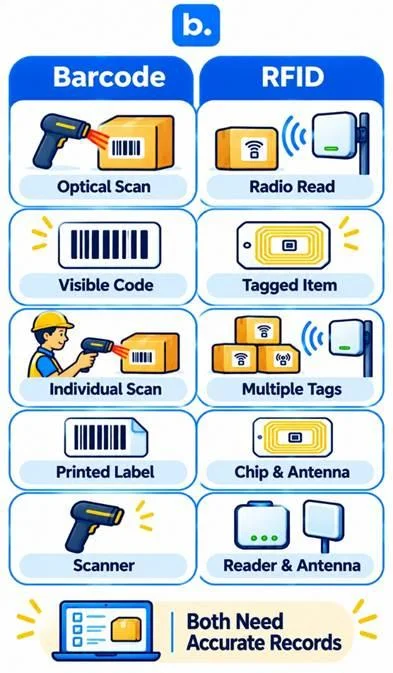
Barcodes optically scan a printed code, usually with direct visibility. RFID uses radio communication and can identify multiple compatible tags within range.
| Factor | Barcode | RFID |
|---|---|---|
| Read method | Optical | Radio frequency |
| Visibility | Usually needed | Not for suitable systems |
| Typical read | Individual scan | Multiple tags in range |
| Identifier | Printed code | Chip and antenna tag |
| Equipment | Labels, scanners or phones | Tags, readers, antennas, software |
| Entry investment | Usually lower | Usually higher |
| Unit-level ID | Depends on code | Supports unique serialisation |
| Limits | Label damage or obstruction | Materials, placement, reader setup |
| Good fit | Routine warehouse transactions | Selected bulk-reading tasks |
Both are automatic identification technologies and can coexist. RFID does not guarantee every tag is read: tag quality, materials, reader placement and configuration matter. Faster identification alone does not improve inventory accuracy; product records and processes must also be sound.
At receiving, a worker scans each barcode and verifies quantity. RFID may capture several tagged products in one event, reducing individual scans, but staff still confirm the delivery and resolve exceptions.
Barcode vs RFID costs in India
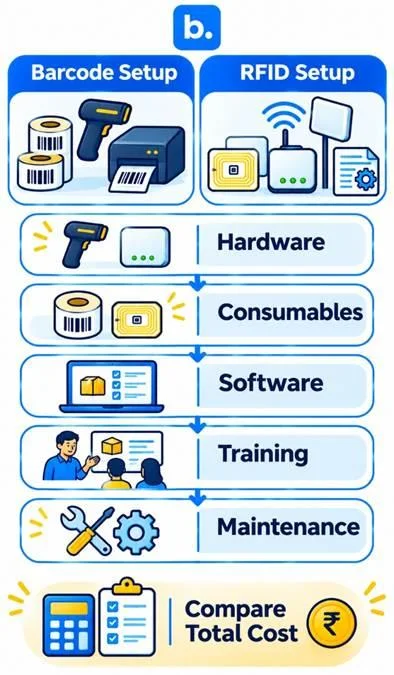
Barcodes generally cost less to introduce because they need printed labels and compatible scanners. RFID adds tags and readers, and may need antennas, data processing, integration and testing. The table below gives indicative prices from Indian listings to make the comparison more concrete. These are equipment examples, not like-for-like system quotes; actual costs depend on scale, products and existing equipment.
| Cost consideration | Barcode | RFID |
|---|---|---|
| Consumables | Printed or pre-printed labels | Tags for items, cartons or reusable containers |
| Reading hardware | Handheld scanners or compatible mobile devices | Handheld or fixed readers and antennas |
| Printing | Label printer and consumables if produced on-site | RFID printer-encoder if tags are printed and encoded on-site |
| Installation | Often simpler device setup | Reader positioning and site testing may be required |
| Software | Scanner and inventory-system configuration | RFID data processing and WMS integration |
| Training | Scanning and transaction procedures | Tag handling, reader use and exception management |
| Ongoing costs | Label replacement and device upkeep | Tag replacement, hardware upkeep and system support |
For a practical starting point, Indian listings show handheld barcode scanners at roughly ₹1,400–₹10,600. A Mumbai retailer lists desktop barcode label printers at about ₹9,500–₹16,800. These are examples of equipment prices, not a complete barcode system quote.
| Equipment | Indicative listed price | Source |
|---|---|---|
| Barcode scanner (handheld) | ₹1,400–₹10,600 for listed handheld models | barcode scanner listings |
| Barcode label printer | About ₹9,500–₹16,800 for examples listed by a Mumbai retailer | label printer listings |
| UHF RFID labels / tags | ₹6–₹9 per paper label; ₹45–₹90 per on-metal tag, plus GST | RFID hardware price guide |
| RFID readers | ₹30,000–₹68,000 per handheld; ₹30,000–₹1,45,000 per fixed four-port reader, plus GST | RFID hardware price guide |
| RFID antenna | About ₹8,000 each, plus GST (listed 9 dBi antenna) | RFID hardware price guide |
RFID equipment is a larger upfront expense. An Indian supplier’s November 2026 catalogue lists UHF paper labels at ₹6–₹9 each and on-metal tags at ₹45–₹90 each. Handheld readers are listed at ₹30,000–₹68,000, fixed four-port readers at ₹30,000–₹1,45,000, and a 9 dBi antenna at about ₹8,000. The RFID prices are before 18% GST; tag prices are subject to a 500-piece minimum order. See the linked supplier price guide in the table.
For RFID, an Indian supplier’s November 2026 catalogue lists UHF paper labels at ₹6–₹9 each and on-metal tags at ₹45–₹90 each. Handheld readers are listed at ₹30,000–₹68,000, fixed four-port readers at ₹30,000–₹1,45,000, and a 9 dBi antenna at about ₹8,000. These RFID prices are before 18% GST; tag prices are subject to a 500-piece minimum order. The supplier’s RFID hardware price guide.
Treat these figures as indicative catalogue snapshots, not fixed market rates. They exclude some or all software, middleware, WMS/ERP integration, installation, cabling, training, maintenance and, where applicable, barcode consumables. Confirm GST treatment, minimum order quantities, delivery and compatibility with the supplier before budgeting. RFID project costs can vary substantially with the number of read points and the site layout.
Compare total cost of ownership, not a single label or tag price:
Total cost of ownership = Hardware + Tags or labels + Software + Integration + Training + Maintenance
Assess both options over the same period, such as three years, using comparable volume, labour and equipment assumptions. This is a framework, not a complete accounting model. Low-cost tags may still require multiple readers and integration; existing phones may make barcode improvements inexpensive.
Compare costs with potential value from stocktake time, identification labour, discrepancy investigation or checkpoint visibility. Treat savings as hypotheses: measure the current process, then test whether changes justify ongoing costs.
Which technology offers better inventory accuracy?
Neither barcode nor RFID guarantees better inventory accuracy in every warehouse. Both support reliable records when technology, software and processes are configured correctly. RFID may improve speed and coverage; barcode scanning provides a deliberate item-by-item check.
Barcode errors can come from missed or duplicate scans, damaged labels or delayed transactions. Scanning at receiving, picking and stocktaking reduces manual entry, but each movement still needs to be recorded. A scan confirms identification, not that the entire transaction was completed correctly.
RFID can miss tags or capture those outside the intended transaction. For example, a reader at receiving may detect goods in a nearby staging zone. If every read becomes a receipt, the stock record is wrong. Define read zones, filter duplicates and resolve exceptions before posting movements.
Test representative goods and packaging. Vary RFID tag placement, orientation and distance, and check reads from adjacent areas. For barcodes, test damaged labels and normal scanning conditions. Measure missed identifications and exception-resolution time; results depend on products and setup, not a universal accuracy rate.
When should a warehouse switch from barcode to RFID?
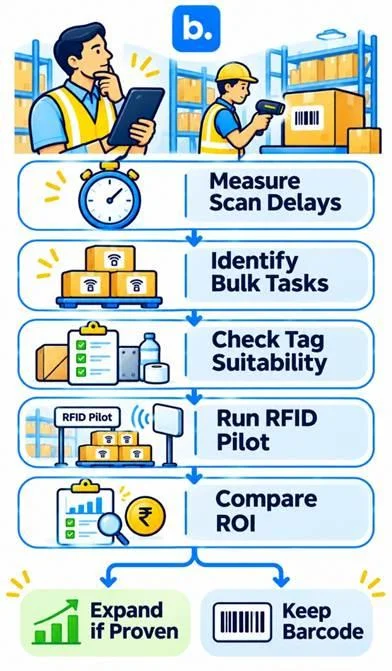
Consider RFID when individual barcode scanning creates measurable delays and faster identification or added visibility could justify the investment.
● High-volume receiving or counts: Bulk reads may save steps when many reliably tagged items are handled.
● Frequent stocktakes: Faster identification may help, but exceptions still need investigation and reconciliation.
● Checkpoint visibility: Readers at receiving, dispatch or controlled exits can identify goods at that point. Passive RFID is not continuous location tracking throughout a warehouse.
● Item traceability: RFID can support unique item IDs in apparel or electronics. Barcodes can also be uniquely serialised, so compare the full workflow.
● Credible return: Weigh expected handling or count-time value against tags, equipment, integration and maintenance.
Pilot one product group, zone or task first. Record current completion time and error types, then measure identified items, missed and unintended reads, investigation effort and operating cost. Include exception handling. Expand only if actual conditions support the business case.
When should a warehouse stay with barcodes?
Retain barcode inventory management when scanning is reliable, affordable and fast enough. RFID is not worthwhile simply because it is newer.
Barcodes may suit manageable volumes, straightforward layouts, tight budgets, difficult-to-tag products or suppliers who do not support RFID. They are also sufficient when existing visibility meets operational needs.
Fix process basics first. If SKU records, location labels or movement procedures are inconsistent, RFID may capture data faster without correcting the record. Better labels, scanner access, staff training or WMS configuration may offer more value.
Can barcodes and RFID work together in the same warehouse?
Yes. Retain barcodes for routine work and use RFID for selected bulk counts or receiving. A phased trial in one zone or product category avoids replacing every workflow at once.
For example, barcodes can remain in picking and packing while RFID checks selected high-volume stock. Products without RFID tags can keep barcode labels.
Both technologies should update shared stock records using common identifiers where possible. Define the authoritative ID for each task, duplicate-read handling and exception reconciliation. Separate databases risk creating another source of discrepancy.
How a warehouse management system supports barcode inventory management
A WMS connects identification with warehouse transactions, using product and location scans to support receiving, storage, picking, stocktakes and inventory updates. Capabilities vary, so check the specific workflow.
| WMS capability | Why it matters |
|---|---|
| Barcode scanning | Identifies products and locations |
| Receiving verification | Records incoming stock |
| Location management | Links stock to storage |
| Picking checks | Confirms selected products |
| Stocktake support | Compares physical and system quantities |
| Integration | Connects compatible hardware and data |
Barcode support does not make a WMS RFID-capable. RFID needs compatible readers, tag-data processing and integration to the correct transaction. Confirm hardware, data format and exception handling with the provider. Our WMS explainer covers the system’s wider role; see also our India WMS overview.
How our WMS supports barcode-based warehouse inventory management
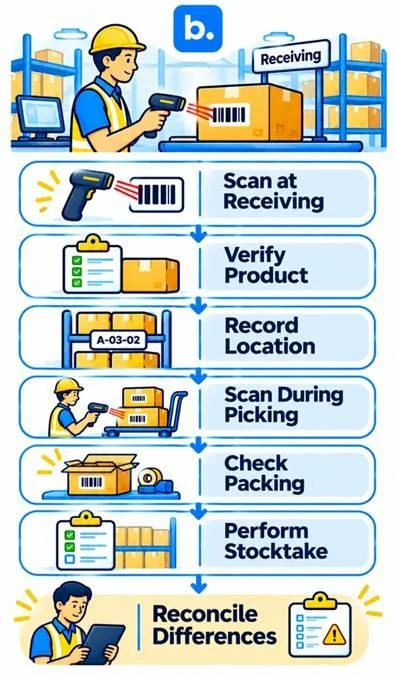
Barcode scanning is most useful when it is part of a consistent warehouse process. Our Base WMS supports barcode workflows across goods receiving, picking, packing, returns and stocktaking. Teams can perform full or partial stocktakes manually or with a barcode scanner, while the WMS app helps verify products and storage locations during warehouse operations. Scanning connects product identification with recorded stock movements, helping teams maintain accurate warehouse inventory records.
If you are considering RFID for your warehouse, get in touch with us to discuss your requirements and explore the right solution for your operations. Meanwhile, explore our WMS to learn more about our barcode-enabled warehouse management capabilities.
How to evaluate barcode and RFID before investing
Use these questions to structure a purchase decision:
- How many products or cartons need to be identified daily, and where is staff time spent?
- What missed scans, misidentifications or discrepancies occur?
- Is SKU-level identification enough, or is unique item-level identification needed?
- Will products and packaging support reliable RFID reads, and are suppliers able to tag them?
- Can the WMS process the data, manage exceptions and update the correct records?
- What are the full hardware, consumable, integration, training and maintenance costs?
- Can a controlled pilot show measurable improvement, and what payback period would justify investment?
Test representative products and workflows before committing. Keep a manual exception process during the pilot, and compare like-for-like tasks rather than comparing an RFID trial with an inefficient barcode process.
Conclusion
Barcodes remain a practical, lower-cost choice for many warehouse operations. RFID can offer faster, non-line-of-sight, multi-item identification in suitable environments, but requires tags, readers, integration and testing. Choose based on the operational problem and measured business case, not which technology sounds newer. Our WMS supports barcode-based receiving, picking and stocktaking for businesses building or improving those workflows.