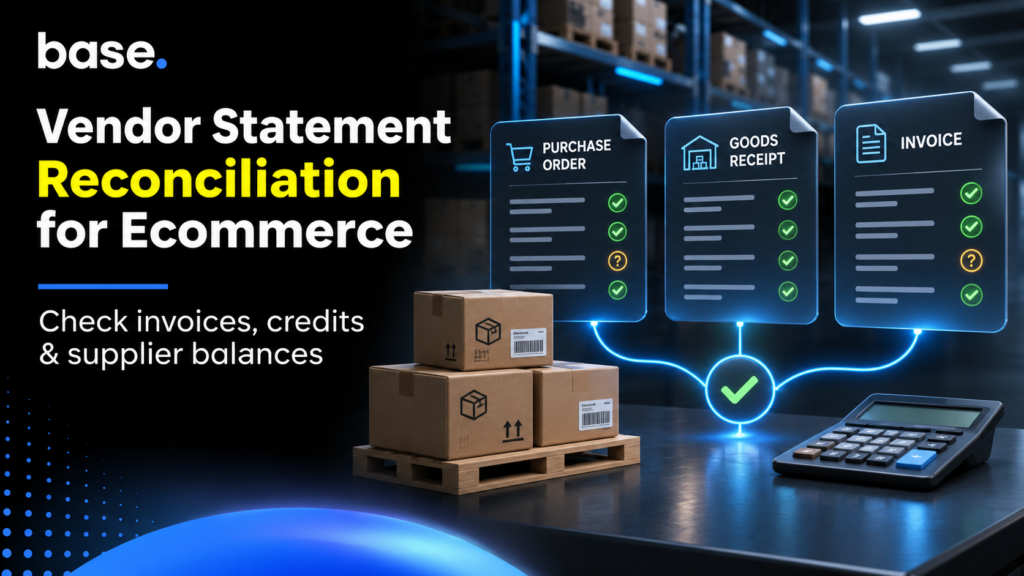
Vendor statement reconciliation for ecommerce compares a supplier’s statement of account with your purchase orders, goods receipts, shipment records and invoices. It establishes which amounts are supported, which belong in the period and which need a query before payment. It covers suppliers, 3PLs and couriers.
Supplier bills are document-based; 3PL and courier charges depend on operational events. A storage or freight line needs evidence that the service occurred.
What is accounts payable reconciliation for ecommerce brands?
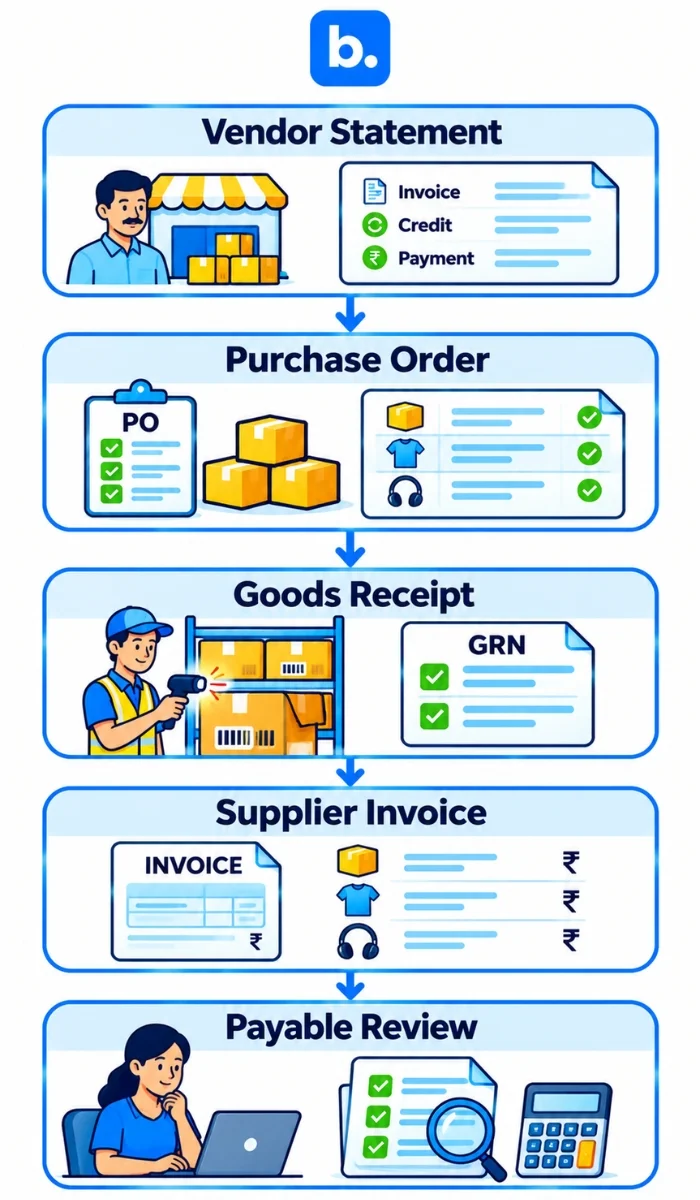
Payment reconciliation is when you match up two records to ensure they match for the same amount, identify why they don’t match and then find evidence to resolve the discrepancy. For ecommerce payables this is done by matching your ledger to your vendors statements and evidence. The purpose is to establish that liabilities are complete, correctly valued and recorded in the proper period.
A vendor statement lists invoices, credits and payments on a supplier account for a stated period. A purchase order (PO) is the buyer’s approved request to purchase goods or services. A goods receipt records items received and checked. The supplier’s invoice records the amount charged.
| Product vendors | Fulfilment partners | Couriers |
|---|---|---|
| Suppliers and manufacturers | 3PLs and warehouses | Carriers and aggregators |
| Goods and freight | Handling, storage and fulfilment | Freight and COD charges |
This will confirm that everything on the purchase order, goods received note and invoice is correct. It will also allow you to confirm that everything has been included in your payable ledger from your vendors statement. You will be able to see if you have missed any invoices, credits or payments.
Why ecommerce payables are hard to reconcile
Part deliveries may be received resulting in multiple goods receipts.
The invoice may not match the purchase order. There may be differences in price, quantity or taxes. You should keep a copy of what approved/contract change was made to allow this difference.
Returns may be recorded by the buyer before a credit note is issued.
Within the 3PL statement there may be multiple items included. This could include days in stores, individual pick, packing materials, inbound handling and returns.
Courier charges may vary. This could include differences in weight charged, RTO, reverse freight and COD charges.
At month end, the dates may not all be in the same period. There may be a difference between receipt, invoice, payment and credit dates.
| Vendor type | What they bill | Common mismatch |
|---|---|---|
| Product vendor | Goods and freight | Partial receipt, price change or unrecorded return |
| 3PL or warehouse | Handling, storage and picks | Count, date or service event differs |
| Courier or aggregator | Freight, weight, RTO and COD | Weight evidence, shipment status or fee differs |
An invoice absent from the books may also be absent from goods and services tax (GST) records. Ask a chartered accountant (CA) to verify current input tax credit (ITC) eligibility and supporting documents. A statement match, by itself, does not establish a tax claim.
How to reconcile accounts payable: vendor statement reconciliation for ecommerce, step by step
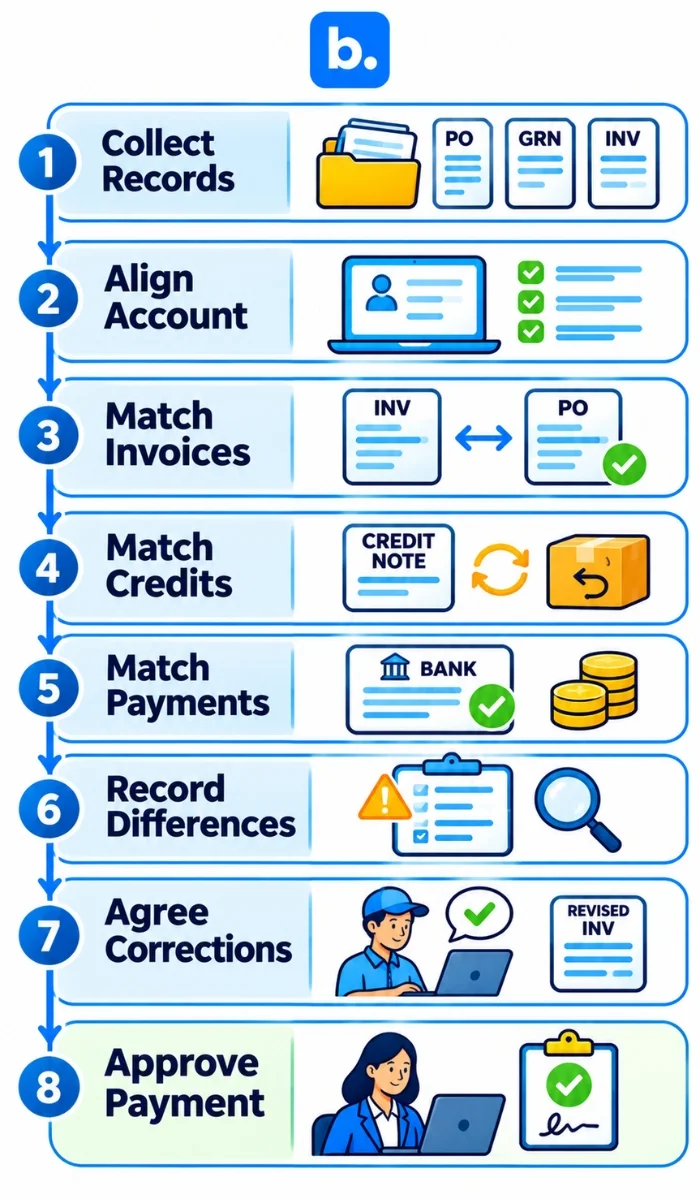
Reconcile one vendor per period. Preserve source files and work from copies.
- Collect records. Obtain the vendor statement, ledger, invoices, POs, receipts, credits and payment evidence. Confirm that the files cover the same period.
- Align the account. Verify vendor name, account number, currency, opening balance and statement dates.
- Match invoices. Link statement lines to ledger entries and relevant POs and receipts. Compare invoice number, date, amount, quantity and tax.
- Match credits and returns. Link credits to the original invoice and return evidence; check for duplicate adjustments.
- Match payments. Compare bank evidence with the vendor’s allocation. Identify unapplied payments and payments made after the statement cut-off.
- Record reconciling items. A reconciling item is a timing difference, omission or dispute that explains a variance. Record the amount, cause, evidence, owner and due date.
- Agree corrections. Request a vendor correction where necessary. Amend the ledger only when source documentation supports the treatment.
- Approve payment. Recalculate the supported balance, review open items and route the amount due for approval.
Process Flow: Collect, match invoices, match credits, match payments, record discrepancies, agree corrections, authorise.
Key vendors should be reconciled on a monthly basis, increasing to more frequent for high volume accounts where necessary.
Vendor reconciliation in accounts payable: a worked example
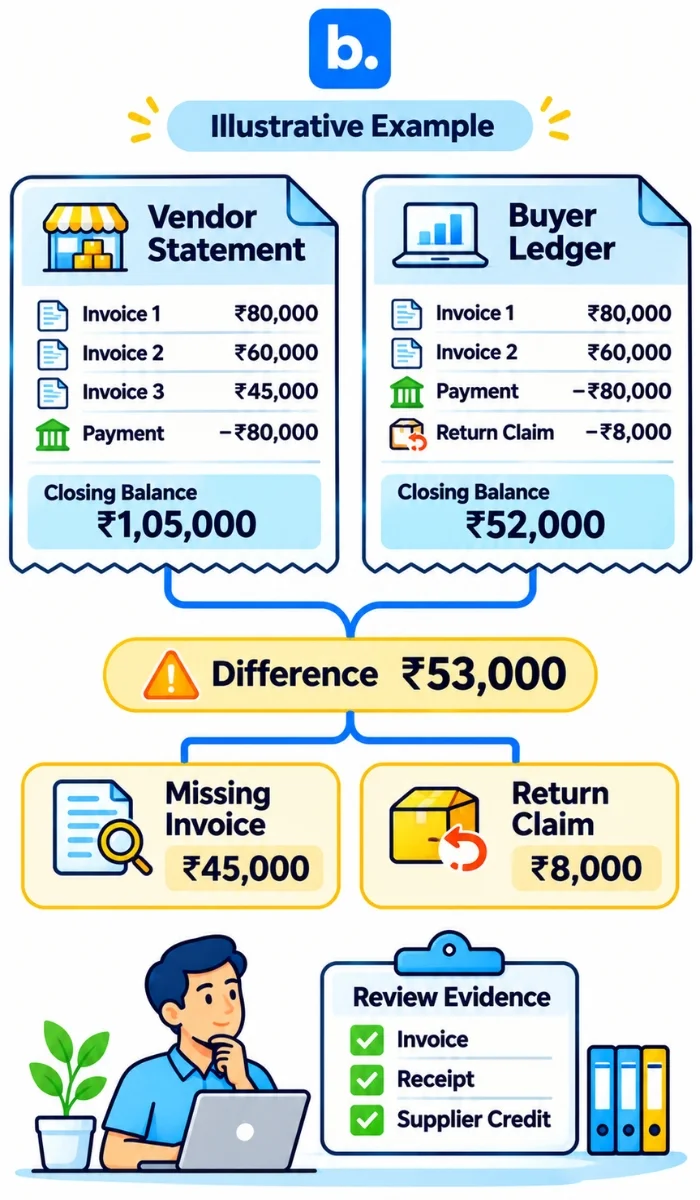
Assume the opening balance is zero. Supplier statement shows three invoices of ₹80,000, ₹60,000 and ₹45,000. The supplier has made a payment of ₹80,000 so closing balance is ₹1,05,000. Buyer’s ledger shows first two invoices, a payment and a debit note of ₹8,000 so closing balance is ₹52,000. Credit notes from suppliers reduce the value of an invoice.
| Line | Vendor statement | Your ledger | Difference | Action |
|---|---|---|---|---|
| Invoice 1 | ₹80,000 | ₹80,000 | — | Matched |
| Invoice 2 | ₹60,000 | ₹60,000 | — | Matched |
| Invoice 3 | ₹45,000 | — | ₹45,000 | Verify invoice, receipt and cut-off |
| Payment | −₹80,000 | −₹80,000 | — | Match bank evidence and allocation |
| Return claim | — | −₹8,000 | ₹8,000 | Request supplier credit note |
| Closing balance | ₹1,05,000 | ₹52,000 | ₹53,000 | Resolve both items |
Variance is 45,000 + 8,000 = 53,000. Ensure the date on receipt and invoice are the same so that the missing invoice can be correctly allocated to the right period. Send evidence of return and request 8,000 credit note.
Correct Entries (If supported). Debit inventory/expense account and credit accounts payable 45,000 depending on the tax breakdown on the invoice. Credit note from supplier should match the return that has been booked. Do not double post. You will have two entries posted. One for the invoice and one for the credit note. Both will have a balance of 97,000 (1,05,000 – 8,000 = 52,000 + 45,000). If not supported leave the return as a dispute. These figures are just examples. Ensure that someone else checks that the calculation has been done correctly.
This is a debit note from the buyer. Not a GST debit note from the supplier. Ask your CA to check the tax adjustments match the source documents.
3PL and Warehouse Invoicing
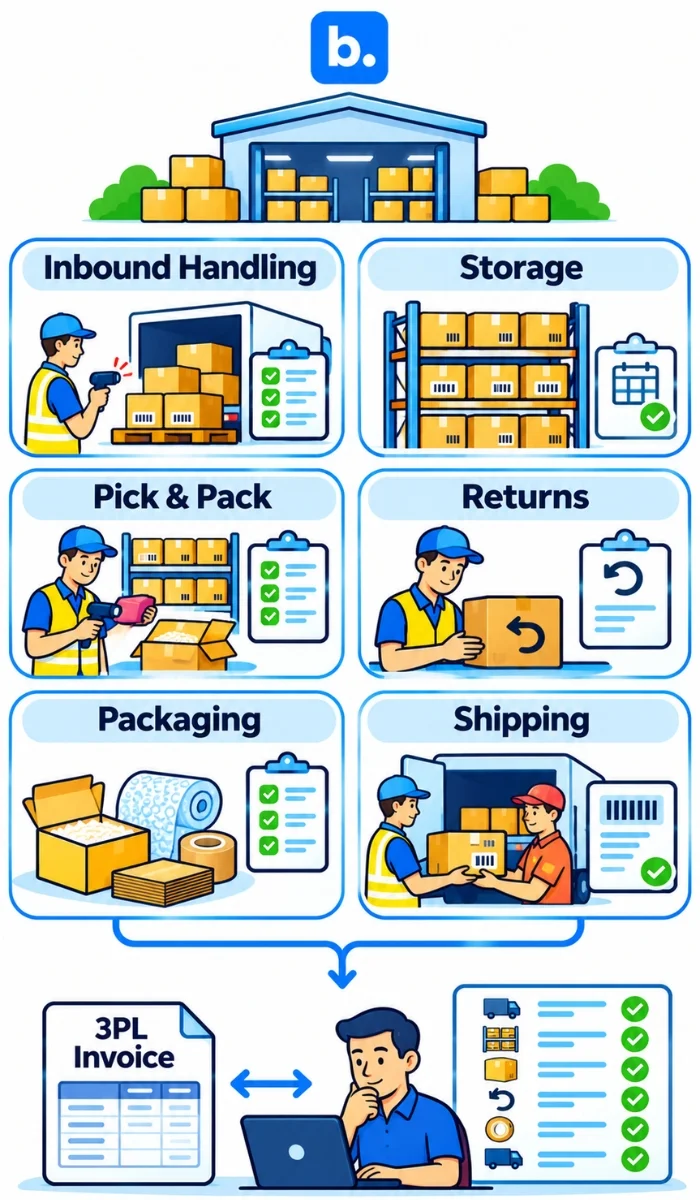
3PL companies will want to charge for the handling of goods into the warehouse, storage, picking, packing, returns, packaging and shipment. You need to make sure you can track what charges are being applied for each activity. For example how many units have been received, how many days in storage, how many orders have been picked, how many returns processed or shipments invoiced.
| Charge | Evidence | Typical dispute |
|---|---|---|
| Inbound handling | Receipt and unit count | Billed quantity differs |
| Storage | Inventory by date | Wrong SKU, count or storage days |
| Pick and pack | Order and pick list | Duplicate or incorrect order count |
| Returns handling | Return and inspection record | Return absent or counted twice |
| Packaging | Material issue log | Unapproved material or quantity |
| Shipping pass-through | Shipment ID and carrier bill | Duplicate or incorrect amount |
Internal warehouse documentation provides the evidence.
Courier invoice and COD reconciliation
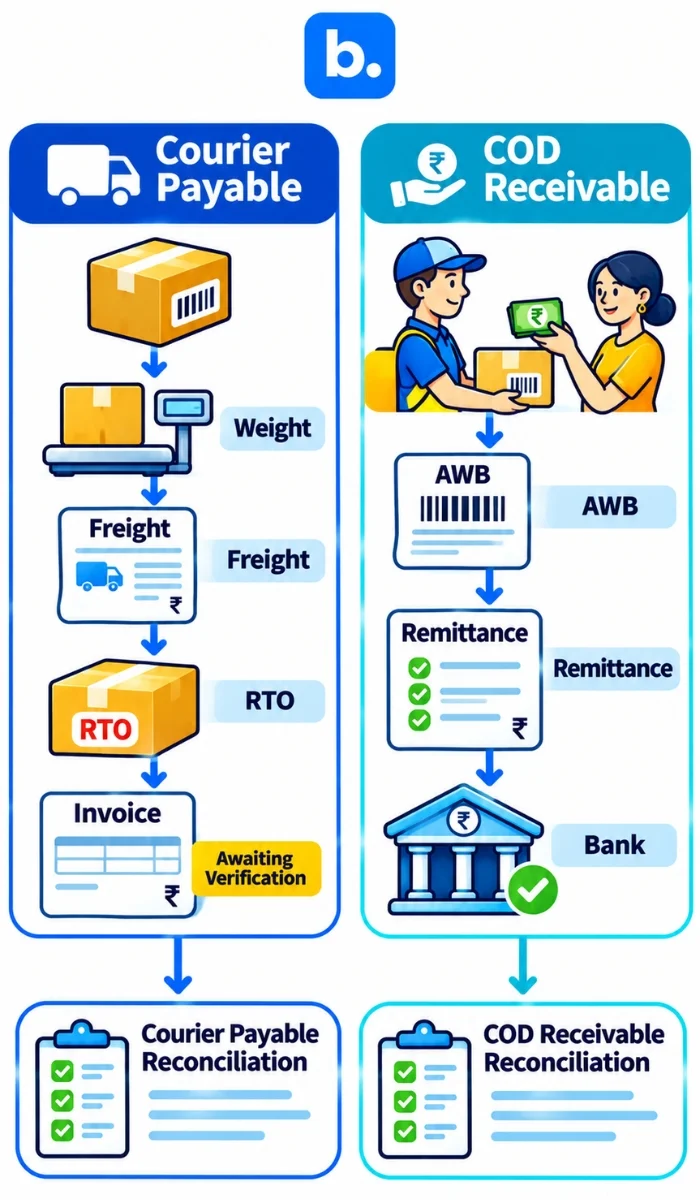
The invoices can include additional costs such as freight, surcharge, weight adjustments, RTO or reverse freight, plus COD and non-delivery costs. Each line should be checked against shipment documentation, declared weight and current carrier charge out terms.
| Charge | Check | Likely dispute |
|---|---|---|
| Freight | Service, zone, declared and billed weight | Wrong service or duplicate |
| Weight difference | Scale weight and dimensions | Billed weight lacks evidence |
| RTO or reverse freight | Status, attempts and return scan | No matching return event |
| COD fee | COD amount and fee terms | Incorrect fee base |
| Failed delivery | Attempt log and shipment status | No billable attempt record |
There are two parts to this. One is paying the courier for freight and the second is receiving money from them for COD collected. You can reconcile the invoice and remittance separately and ensure they match up with the bank. See the payment reconciliation guide and the verified Shopify–Shiprocket integration overview. Confirm current billing terms in the relevant courier documentation.
Handling differences and closing them with the vendor
Differences may concern timing, price, quantity, tax, unapplied payment or missing credit. A buyer return claim does not establish vendor acceptance.
| Difference | Likely cause | Action |
|---|---|---|
| Timing | Receipt, invoice or payment after cut-off | Check dates; carry a valid open item |
| Price | Change or contract mismatch | Compare PO, approval and invoice |
| Quantity | Partial delivery or shortage | Check receipt or shipment evidence |
| Tax | Invoice or reporting mismatch | Request correction; consult CA |
| Unapplied payment | Missing or incorrect reference | Send bank proof; request allocation |
| Missing credit | Return not accepted or processed | Send evidence; request credit note |
A supplier’s statement is its account of the balance, not an instruction to post or pay every line. Classify each variance before adjusting the ledger:
- Accepted and due: source documents support the amount and period; record and pay under policy.
- Timing: the event is valid but falls across periods; document the cut-off and carry the item forward.
- Disputed: price, quantity, service or credit is unresolved; obtain evidence before posting or payment.
This separates accounting cut-off from commercial disagreement and keeps unsupported charges out of the payable balance.
To reconcile accounts payable, assign each open item an owner and next action. A dispute email should identify:
- Vendor, account, period, reference and disputed amount.
- Evidence: PO, receipt, return scan, bank proof or contract.
- Requested correction, credit, allocation or statement update; response date and contact.
File the statement and reply; carry unanswered items forward with an owner and status.
Reconcile accounts payable and receivable together
Accounts payable is money the business owes; accounts receivable is money owed to it. A courier or marketplace net settlement may include both, but each side requires separate reconciliation.
| Question | Payable side | Receivable side |
|---|---|---|
| Counterparty | Courier, 3PL or supplier | Courier COD account or marketplace |
| Source | Invoice or vendor statement | COD remittance or payout report |
| Typical difference | Freight, storage or service fee | Missing collection, refund or held payout |
| Owner | AP or operations | Payments, ecommerce finance or operations |
When a courier deducts freight from COD remittance, review the payable invoice and receivable in the same close. A marketplace may also deduct fees from a payout; marketplace payment reconciliation checks the transactions, deductions and bank credit. Keep the ledger sides distinct. See the payment reconciliation guide for the payout process.
Where an order management system fits in accounts payable reconciliation
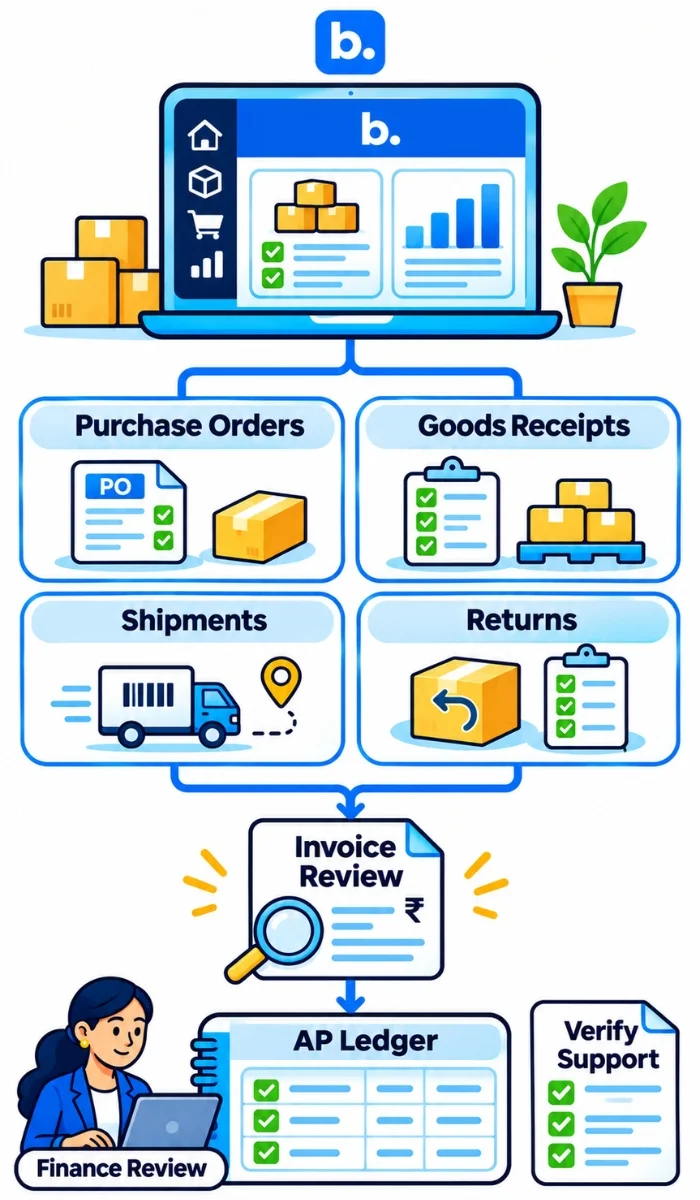
An order management system (OMS) collects channel orders, tracks inventory and fulfilment, and may hold shipment, return and cost data that finance needs. The available records depend on the product and its integrations.
Such data can help verify courier invoices against shipment IDs and weights, and vendor or 3PL invoices against receipts and returns. OMS software supplies operational evidence; it does not establish that a payable is valid or replace the accounts payable ledger.
From shipment and receipt to the vendor statement
Document trail: Purchase order → goods receipt → invoice → statement check → payment.
A Base OMS connection should be included in this process only after the product team confirms in writing which PO, receipt, shipment and return records it holds. Treat it as an evidence source, not a replacement for the payable ledger.
How to choose accounts payable systems and a payment reconciliation system
Evaluate the records, controls and outputs supported, rather than relying on integration counts alone. The checklist should include:
- Statement import and vendor identifiers across your accounts payable systems.
- Invoice, credit and payment matching to ledger lines.
- Three-way match of PO, goods receipt and invoice.
- Tax and TDS (tax deducted at source) fields with review controls.
- Exception notes, owner, status and due date.
- Links to receipt, return, shipment and courier data.
- Audit trail, user roles and period sign-off.
- Setup, support and mapping maintenance.
Ask which file formats and systems are supported, whether matching is line-level, how unapplied or disputed items remain visible, what posts automatically and which approvals remain manual. Test anonymised files and confirm export and retention terms.
| Route | Best for | Limits | Typical effort |
|---|---|---|---|
| Spreadsheet | Few vendors and simple statements | Manual entry and version control | Low setup; recurring review |
| Accounting payables module | Invoice and payment control | May lack shipment evidence | Configure accounts and approvals |
| Payables automation tool | Many invoices or exceptions | Verify formats, rules and exports | Map documents and workflows |
| OMS software or WMS data feeding accounts | Receipt, return and shipment evidence | Does not replace the ledger | Connect records and ownership |
Confirm the operational data available and the accounting hand-off in writing before selecting a tool.
Common vendor reconciliation mistakes and how to avoid them
| Mistake | Why it hurts | Fix |
|---|---|---|
| Paying from invoices, not statement | Credits or unapplied payments stay hidden | Compare statement before approval |
| Skipping returns and credits | Payable remains overstated | Match return to vendor response |
| Reconciling only annually | Old items lose supporting evidence | Set cadence by volume and risk |
| Ignoring weight disputes | Unsupported freight passes through | Retain weight and shipment proof |
| No cut-off rule | Timing items appear missing | Record receipt, invoice and payment dates |
| No owner for open items | Differences roll forward | Assign owner, due date and status |
| Duplicate invoice payment | Same liability is paid twice | Check vendor, number, amount and status |
Who sees what: how Base OMS and Base WMS serve the AP clerk, the ops lead and the finance head
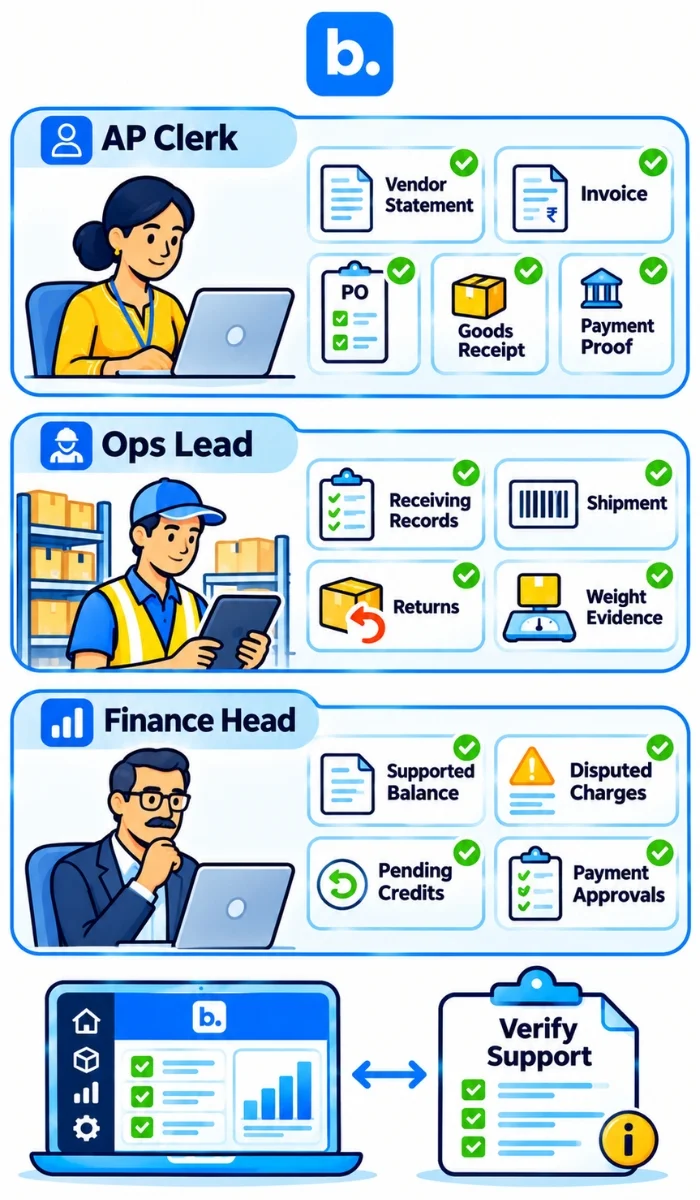
| Role | What they need | Where Base provides it |
|---|---|---|
| AP clerk | Evidence for statement lines | Base WMS documents purchase orders and goods receiving; vendor-statement import and line matching are not publicly confirmed |
| Ops lead | Shipment, receipt and return data | Base WMS documents receiving, inventory and returns; Order Manager documents shipment creation and tracking; courier invoice-cost capture is not publicly confirmed |
| Finance head | Amount due, disputed or awaiting credit | Order Manager documents sales reports and invoice forwarding to online accounting; AP balances, disputes and vendor-statement exports are not publicly confirmed |
The AP clerk traces lines to invoices, POs, receipts or payment proof. Base OMS surfaces [confirmed order and shipment fields after sign-off]. The ops lead checks the charge event. Base WMS tracks [confirmed inventory, receipt and returns fields after sign-off]. The finance head reviews due, disputed and pending-credit amounts.
An OMS platform can make operational evidence easier to locate; it cannot verify a supplier balance. The product team must confirm which of Base OMS or Base WMS holds PO and receipt records, captures courier costs, supports the returns workflow and reporting module, provides a unified dashboard, and exports to accounting. No verified screenshots or customer results were supplied. Book a Base demo to review the workflow.
Conclusion
Vendor statement reconciliation for ecommerce is a repeatable close control: collect the statement and ledger, align periods, match invoices, credits and payments, record reconciling items, agree corrections and approve the supported amount. Apply the same discipline to product vendors, 3PLs and couriers, using receipt, shipment and payment evidence. Keep disputes open with an owner rather than forcing a balance to match. Start with one key vendor, test the checklist and set a cadence suited to transaction volume.