
Dead stock management means finding inventory with little or no meaningful demand, deciding what value can still be recovered and changing the decisions that allowed it to build up. Unsold goods tie up working capital and take space from products customers are buying. But slow-moving does not always mean dead: a seasonal line, profitable spare part or product that completes a range may still earn its place. SKU rationalisation gives businesses a way to decide what to retain, reduce, replace or discontinue, using sales, margin, stock age and expected demand rather than guesswork. Clearing shelves helps once. Better buying and range decisions address why the stock stopped moving.
Dead stock, slow-moving, excess and obsolete inventory
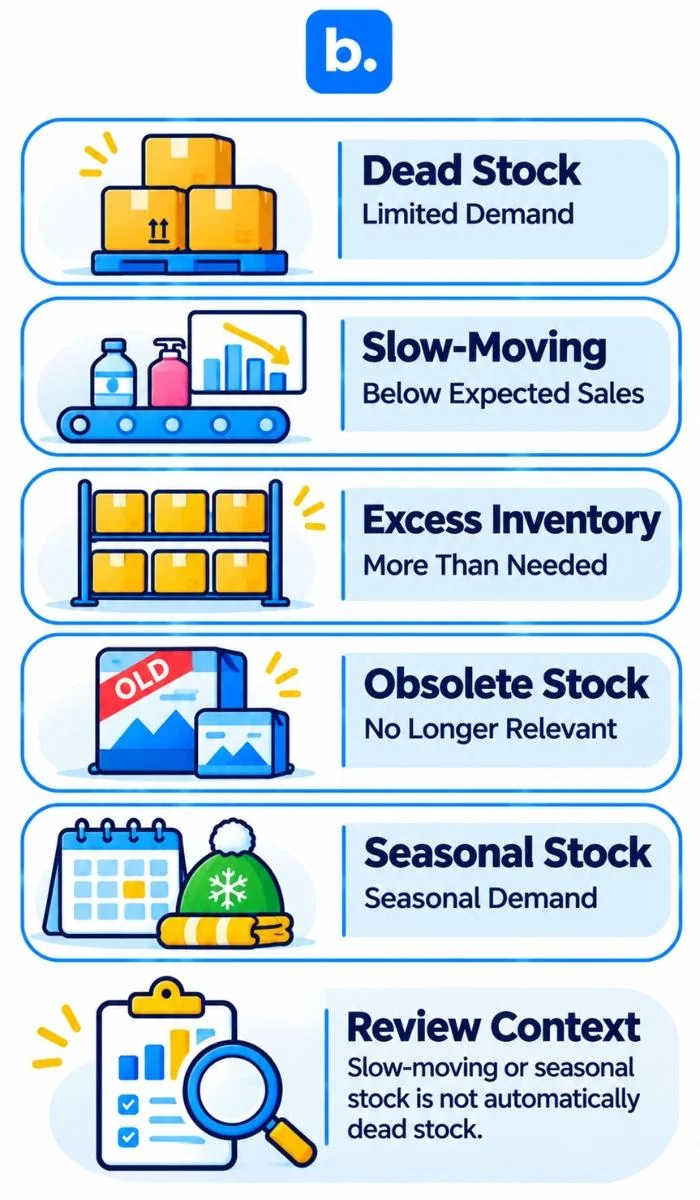
These terms describe different inventory problems, even when they overlap. Dead stock has had little meaningful movement or demand over a relevant period and is unlikely to sell through normal sales activity without intervention. There is no fixed day count for calling a product dead stock. Set the review period around its lifecycle, seasonality, demand pattern and your stock policy.
| Inventory category | Meaning | Typical concern |
|---|---|---|
| Dead stock | Little or no meaningful movement, with limited expected demand | Capital tied up in stock with poor sales prospects |
| Slow-moving stock | Sells or moves less often than expected | Longer holding time and possible future obsolescence |
| Excess inventory | Quantity held exceeds expected demand or operating needs | Avoidable storage and working-capital commitment |
| Obsolete inventory | Outdated, discontinued, expired or no longer commercially usable | Reduced or no practical recovery value |
| Seasonal inventory | Demand is concentrated in particular periods | Stock may remain after its selling season |
Categories can overlap: slow-moving stock may become dead stock, while discontinued products may be obsolete even if some units remain saleable. Excess inventory can still sell if demand continues. A transfer is warehouse movement, not customer demand.
Why the distinction matters
A slow-selling SKU is not automatically a candidate for a discount or discontinuation. It might be seasonal, carry a strong margin, serve as a replacement part or complete a bundle customers value. Look at demand, profitability and the product’s role together. A temporary lull is not the same as a product that has lost relevance.
Why dead stock accumulates in ecommerce warehouses
Dead stock often reflects forecasting, purchasing, assortment and inventory visibility decisions made before products reach the warehouse.
Overestimating demand
An optimistic sales estimate can lead to an order the business cannot sell through. Promotions and marketplace events can also create a short-lived spike. If that becomes the new baseline, the next purchase may arrive after the extra demand has passed. Compare promotional sales with ordinary trading before setting replenishment quantities.
Weak demand forecasting
Forecasts can miss seasonal swings, changing preferences or differences between a brand’s website and marketplaces. A new SKU has little history to draw on, and last season’s peak may not return. Check the forecast against actual sales and adjust when the two drift apart.
Range expansion without review
New colours, sizes and product lines can broaden an offer, but each variant needs forecasting, purchasing, storage and counting. The range gets harder to manage when new SKUs keep arriving and older ones are never reviewed.
Bulk buying and supplier constraints
Minimum order quantities, long lead times and volume discounts can all push a buyer towards a larger order. The lower unit price only helps if the goods sell. Weigh the saving against likely sell-through, time in storage and the chance the product will lose relevance.
Product changes and market shifts
A new model, changing preferences, technology, packaging or specifications can weaken demand, as can a supplier discontinuing a line. Review remaining stock when product relevance changes, rather than waiting for routine reports.
Weak inventory visibility
When records sit in separate spreadsheets or update late, teams may not see what is already on hand. A buyer can reorder a product held in another location because its stock is missing from the view. Good warehouse and inventory management starts with records people can trust across the locations they use.
How to identify dead stock in a warehouse
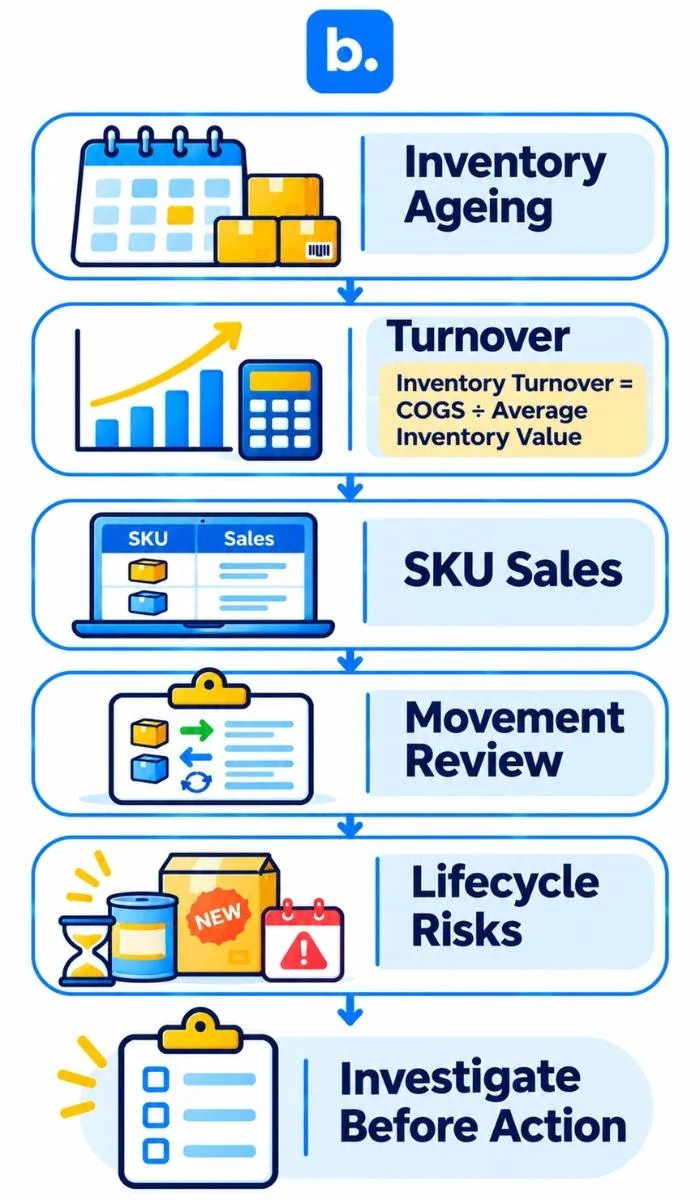
Use stock age as a prompt, not a verdict. To identify potential dead stock, compare SKU-level movement with customer sales, product relevance and likely future demand. No single metric can tell you whether an item has no value left.
1. Review inventory ageing
Inventory ageing shows how long stock has been held. Set review bands to suit the product lifecycle and your policy, rather than using one cut-off for every SKU.
| Ageing group | What to investigate |
|---|---|
| Recently received | Is the product selling at the expected rate? |
| Moderate ageing | Is demand tracking the purchasing forecast? |
| Long-held inventory | Are sales slowing or quantities excessive? |
| Very old inventory | Could discounting, return, bundling or discontinuation be appropriate? |
Review a long-life household item differently from seasonal clothing or fast-changing electronics, and revisit thresholds when the lifecycle changes.
2. Calculate inventory turnover
Inventory turnover measures how often stock is sold or used during a defined period. A common formula is:
Inventory Turnover Ratio = Cost of Goods Sold (COGS) ÷ Average Inventory Value
Use COGS and inventory value from the same period and on the same basis. Opening and closing balances give a basic average; monthly values show fluctuations more clearly. Oracle’s inventory turnover guidance describes comparing item movement across periods.
A higher ratio can mean faster movement, but the useful level depends on the product. A low ratio may flag excess stock or weak sales. Turnover is not a dead-stock formula: a healthy warehouse average can hide variants that are not selling.
3. Analyse SKU-level sales and movement
For each SKU, check last sale date, units sold, quantity and age, order frequency, margin, seasonality, returns and supplier lead time.
Units sold alone can mislead. A few high-margin sales may justify stock, while a frequent seller may contribute little after costs. Compare items with their own history and relevant peers.
4. Investigate products with no recent movement
Filter items with no recent sales or warehouse activity, then check what the field records. A transfer, adjustment or receipt is movement, not customer demand. Review sales separately before changing the range.
5. Check expiry and lifecycle risks
Check expiry, seasonality, model changes and packaging or specification updates. An item can be commercially obsolete before any accounting write-off. Follow relevant product requirements when expiry or regulation is involved.
How SKU rationalisation reduces dead stock
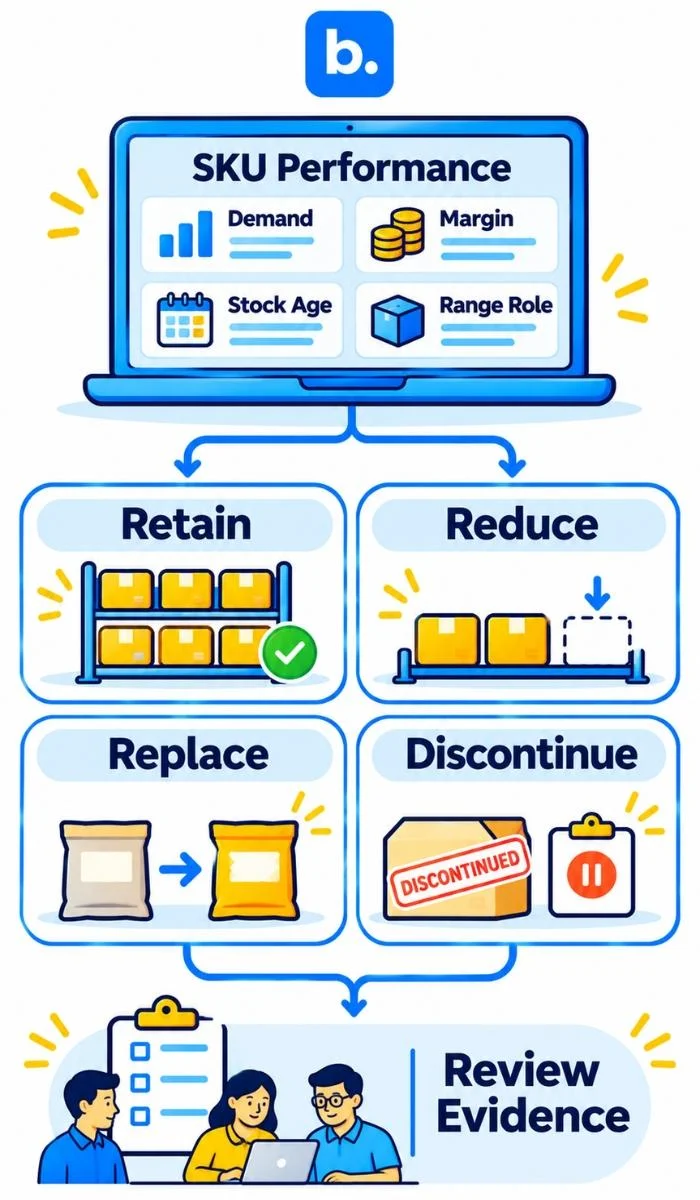
SKU rationalisation is a deliberate review of which SKUs to keep, reduce, replace, combine or discontinue. It is not about cutting the catalogue for its own sake. It is about keeping a range customers want without inventory complexity the business cannot justify.
1. Build a complete SKU performance view
Bring together sales, margin, stock quantity and age, picking frequency, returns, supplier lead time, seasonality and product lifecycle. Have commercial, purchasing and warehouse teams review the picture together before deciding an item has no role.
2. Classify products using an explicit method
ABC analysis can help prioritise reviews, as long as the categories use a clear measure. In an annual consumption value analysis, usually based on units used multiplied by unit cost, A items account for the highest value, B for a middle share and C for a lower share. Some businesses classify by sales value or margin instead. None of these is the same as picking velocity: a high-value SKU is not necessarily a fast mover. Check stock age and strategic importance as well.
3. Decide whether to retain, reduce, replace or discontinue
Use the table as a starting point, checking customer commitments and remaining stock.
| SKU performance | Possible action | What to consider |
|---|---|---|
| Strong demand and healthy margin | Retain and replenish appropriately | Avoid unnecessary stockouts |
| Strong demand but low margin | Review pricing and purchase costs | Does volume justify the contribution? |
| Low demand but strategic importance | Retain with controlled quantities | Customer need and range role |
| Low demand with excess stock | Reduce future orders and plan sell-through | Prevent repeat overbuying |
| No meaningful demand or future role | Consider discontinuation | Remaining stock and customer commitments |
| Replaced by a newer version | Review replacement and liquidation | Compatibility and demand for old model |
4. Review supplier and replenishment decisions
Check minimum order quantities, supplier lead times, reorder points, order frequency and any return terms. Smaller, more frequent orders can help where suppliers and costs allow. But changing the range will not solve the problem if buying practices keep bringing in more stock than it can sell.
5. Make reviews routine
Review performance regularly, and after a launch, seasonal peak or demand shift. Give purchasing, sales and operations clear roles in checking order quantities, customer demand and stock conditions. The right frequency varies by category.
Ways to recover value from dead stock
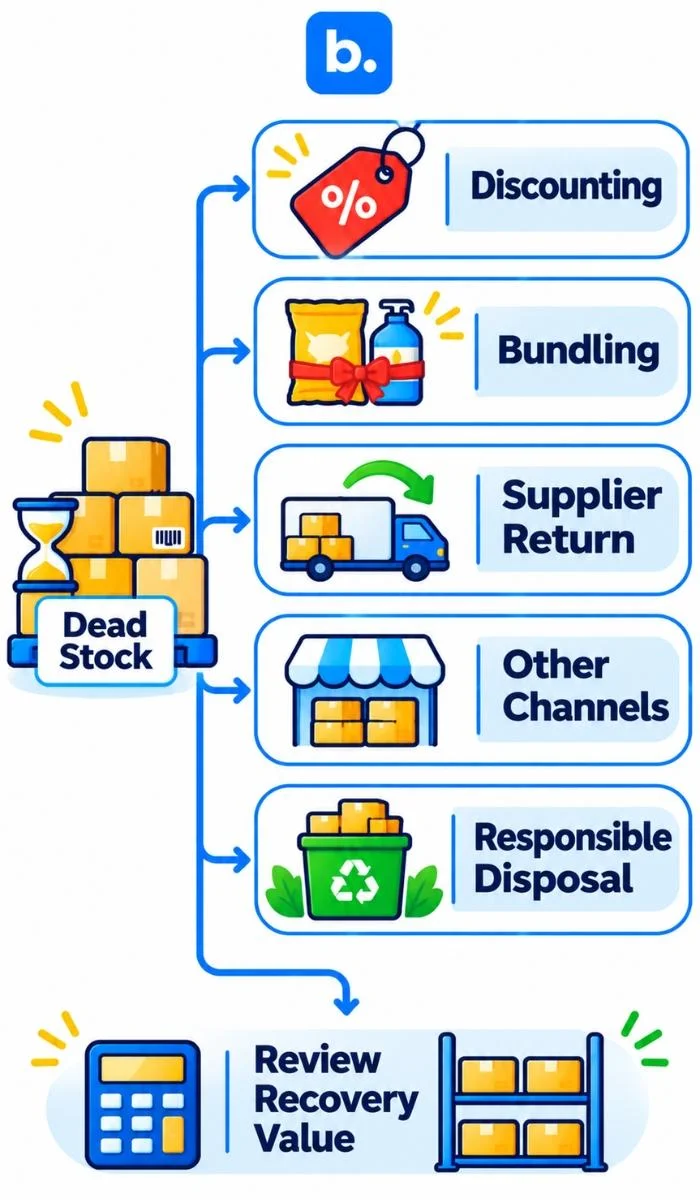
The appropriate route depends on product condition, remaining demand, shelf life, margin and supplier terms. Recovery can mean freeing space or reducing further losses, not necessarily recovering the full purchase cost.
- Controlled discounting: Mark down items that still have a plausible market. Check the margin impact and avoid training customers to wait for repeated discounts.
- Relevant bundles: Pair a slow seller with a popular product only when the combination offers real customer value. Bundling is not guaranteed to clear stock.
- Supplier return or exchange: Ask whether the supplier agreement allows eligible returns or swaps. Suppliers are not automatically obliged to accept unsold goods.
- Alternative channels: Consider suitable clearance marketplaces, wholesale buyers or business-to-business channels, subject to product fit and terms.
- Write-off or responsible disposal: Some stock has no practical resale route. Consult the business’s accounting and tax advisers and follow applicable product, environmental and disposal requirements. Requirements vary, so do not assume every item can be donated or recycled.
How to prevent dead stock building up again
Preventing dead stock means changing buying and range decisions, not just clearing unsold units.
Improve forecasting and purchasing
Build forecasts from sales history, seasonality, planned promotions and supplier lead times. Treat a one-off spike differently from repeatable demand, then compare the forecast with actual sell-through. Recording why a quantity was ordered makes the next review more useful than simply repeating last time’s numbers.
Set practical reorder points and safety stock
Reorder points and safety stock help balance availability against excess. Set them around each product’s demand and supply uncertainty rather than copying one default across the catalogue. A buffer should protect against variation, not become stock that no one reviews. Revisit it when lead times or demand change.
Monitor ageing and slow movement
Use SKU-level reports to spot ageing stock early. When an item is flagged, have someone check its sales, margin, role in the range and future orders. The review should lead to an action, even if that action is simply to watch the next selling period before reordering.
Control new SKU introductions
Before adding a variant or product line, check what sets it apart, likely demand, supplier terms and the stock commitment. Set a review point to compare actual sales and returns with launch assumptions.
Coordinate sales, buying and warehouse teams
Purchasing may be reacting to a discount while sales has limited demand evidence and warehouse teams absorb the resulting stock. Share inventory and sales visibility, define who approves purchases and agree how exceptions are escalated. Warehouse and inventory management improves when the people ordering, selling and handling stock work from consistent records.
How inventory software and a WMS help
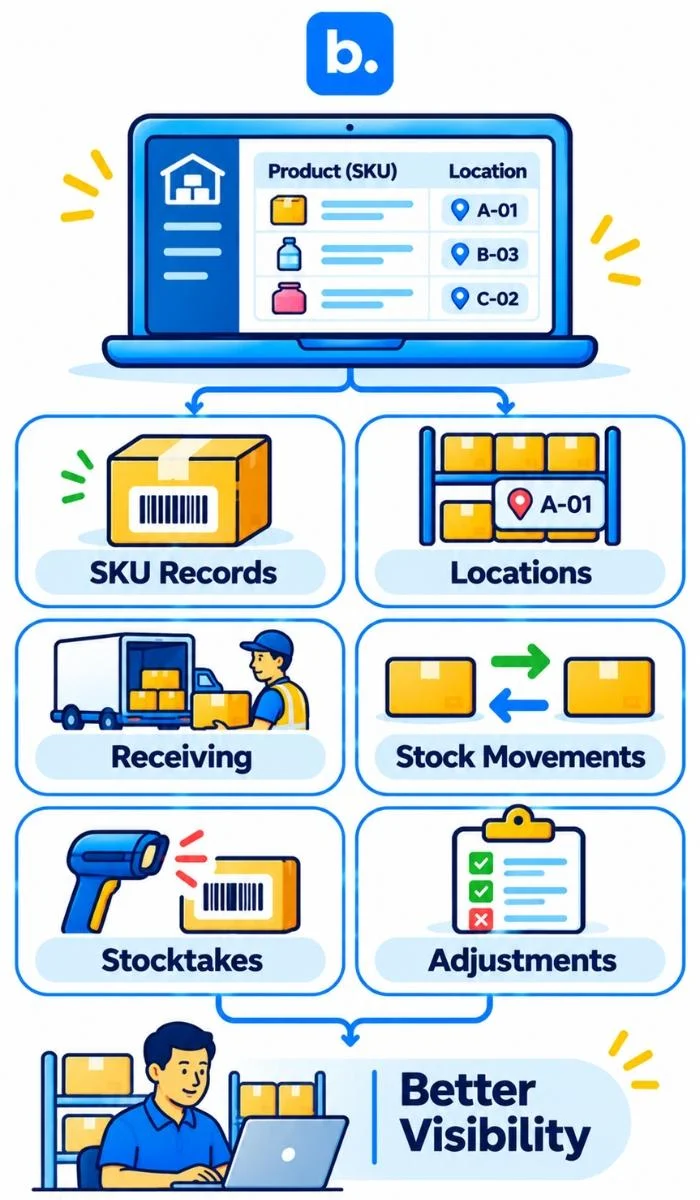
An inventory management system for a warehouse can maintain SKU and location records; warehouse inventory management software may also report movements and stock. A warehouse management system focuses on execution, including receiving, storage, picking, packing and stocktaking. Software can improve visibility, but it cannot alone decide whether a product belongs in the range.
When evaluating warehouse and inventory management software, check for:
- SKU and location-level records, plus movement or ageing reports where supported.
- Stocktakes, discrepancy checks and documented adjustments.
- Barcode-assisted processes if your team needs them.
- Reports or exports that can be compared with sales and margin data.
Confirm what is recorded, how it is updated and which information must come from sales, finance or procurement systems.
How our WMS supports inventory visibility
At base.com, our WMS provides product and location-level stock visibility and supports receiving, stock movements and full or partial stocktakes. Teams can scan stock, compare physical counts with system records and document adjustments. See the current capabilities on our warehouse management system page.
These records help investigate stock position and discrepancies; they do not automatically identify dead stock or recommend discontinuation. Assortment, pricing and purchasing decisions need wider commercial evidence. For more context, read what a warehouse management system does and warehouse management system in India.
A practical SKU decision framework
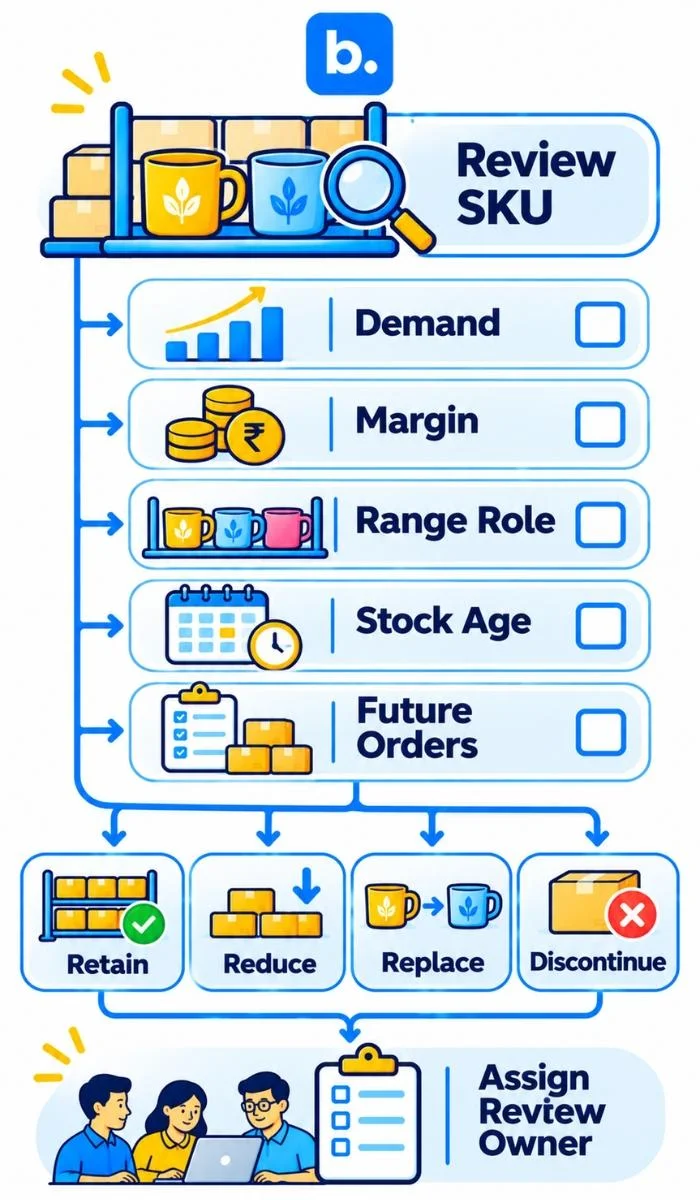
Consider a homewares seller with an ageing colour variant. Before dropping it, the team checks seasonal sales, margin, returns and whether the colour still completes the range. If demand is seasonal, it may keep fewer units; if the variant has no clear role, it can pause orders and plan a clearance. Stock age alone is not the decision.
For any SKU, check demand, contribution, range role, obsolescence risk and whether future orders or recovery options can change. Then decide to retain, reduce, replace or discontinue, and assign an owner to review the outcome.
Conclusion
Dead stock management starts by understanding why inventory stopped moving. Combine ageing with SKU-level sales, margin and product lifecycle, then rationalise the range without discarding products that still serve customers. Better forecasting, purchasing discipline and warehouse records help prevent repeat accumulation.