Selling online often starts with excitement. You list your products, orders start coming in, and the dashboard shows healthy revenue numbers. Everything looks fine at first glance. But after a few weeks or months, a strange feeling sets in. The bank balance does not match the effort. Cash feels tight even though sales are growing. This is the point where many Indian sellers pause and start asking questions.
The reason is simple. Revenue is visible, but costs are scattered. Fees are deducted quietly, returns eat into margins, ads demand more spend, and logistics costs keep changing. When all of this happens together, it becomes hard to understand where the money is actually going. Most sellers are not bad at selling. They just do not get a clear picture of their finances early on.
This confusion is common across categories, whether you sell apparel, beauty products, electronics, or home essentials. Marketplaces simplify selling but complicate profitability. D2C gives control but demands planning. Without understanding this difference, sellers keep working harder without seeing real growth.
How Marketplaces and D2C Actually Work Day to Day
Before comparing margins and profits, it helps to understand how money actually moves in both models once real order volume starts building. On the surface, marketplaces and D2C both let you sell online. But after 500 to 1,000 monthly orders, the cash flow behaviour in each model starts feeling very different. That difference slowly shapes your profitability, working capital cycle, and even how much inventory you can afford to hold.
What Selling on Marketplaces Really Means in Practice
For many Indian sellers, Amazon and Flipkart are the easiest entry points. You list a product, plug into their logistics network, and orders start coming. Trust is already built. Traffic is already there. Conversion rates are often higher than a new website.
But here is what most new sellers do not fully calculate.
Marketplace fees in India are not just commission. The effective deduction per order often goes far beyond the headline percentage. For example, if your category commission is 18%, you may assume that is your total fee. But add these layers:
- Closing fee per unit
- Shipping fee slab based on weight and zone
- Collection fee or payment processing fee
- Pick and pack fee in FBA or Flipkart Fulfilled
- Return shipping charge even on customer rejections
- High return handling charges in apparel or electronics
- Sponsored ads to stay visible
Now here is what many Indian sellers overlook. Return cost on marketplaces is usually double-sided. If a customer returns a product, you may pay forward shipping, reverse shipping, and still lose packaging value. In some categories, the total impact of a single return can be 1.5x the original shipping cost.
Another hidden pressure is advertising dependency. Organic visibility on marketplaces drops sharply once competition increases. Many sellers end up spending 8% to 15% of revenue on marketplace ads just to maintain page ranking. That is rarely included in basic margin calculation.
When you add all these, effective marketplace deductions in India can quietly reach 30% to 45% of selling price, especially in competitive categories. High order volume feels exciting, but payout statements tell a different story. Cash flow becomes dependent on weekly settlement cycles and performance score thresholds.
What D2C Selling Actually Looks Like at Scale
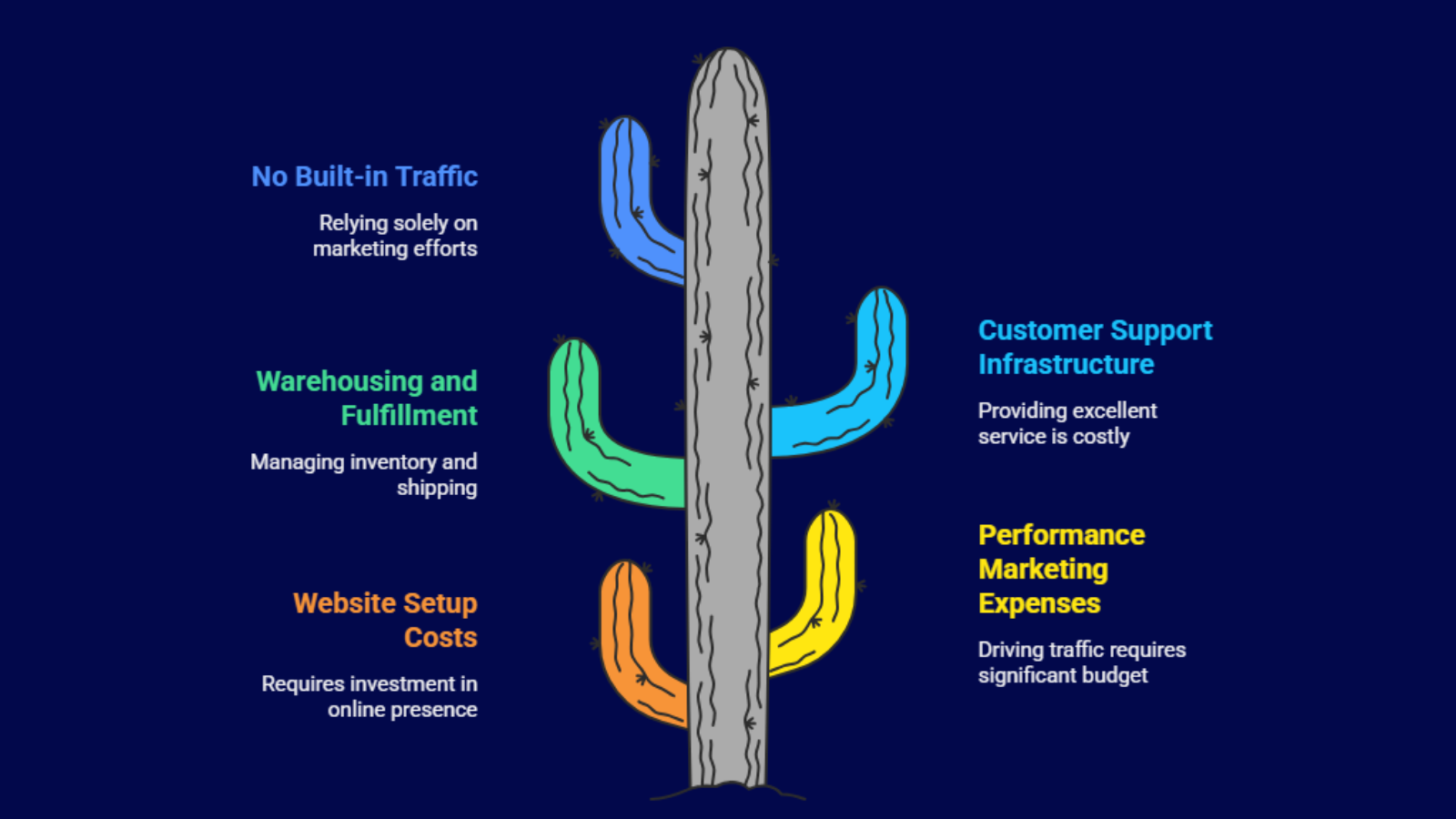 D2C feels expensive initially because you must build everything yourself. You pay for website setup, performance marketing, warehousing, and customer support. There is no built-in traffic.
But here is what Indian sellers often do not realise.
In D2C, costs are more transparent and controllable. Payment gateway charges are typically 2% to 3%. Shipping rates can be negotiated once volumes increase. Marketing efficiency improves over time through retargeting and repeat customers.
Unlike marketplace fees in India, which apply mechanically to every single order, D2C cost behaviour changes as you scale. For example:
- Repeat customers reduce blended CAC
- Bundled orders reduce per-unit shipping cost
- Owned data lowers remarketing expense
- Direct communication reduces return rates through better expectation setting
Another advantage many sellers underestimate is customer data ownership. On marketplaces, you rarely get full customer contact access. In D2C, every purchase builds your CRM asset. Over 6 to 12 months, this lowers dependency on paid traffic.
D2C margin comparison improves when repeat purchase rate crosses 25% to 30%. That is when customer acquisition cost per lifetime order drops significantly.
For Indian sellers who think only in per-order margin terms, this long-term margin compounding is often missed.
Marketplace selling gives speed and initial scale. D2C gives control, data ownership, and margin flexibility. The real difference is not just in fees. It is in how predictable and optimisable your economics become over time.
Marketplace & D2C Fees India Explained With Actual Numbers
Most Indian sellers do not underestimate marketplace fees in India because they are careless. They underestimate them because these costs are never shown together in one clear view. Each fee is deducted at a different stage, often across multiple reports. As a result, sellers see strong revenue numbers but feel constant pressure on cash flow.
To understand this better, let us walk through a simple and realistic example that many Indian sellers can relate to.
Example: Selling a ₹1,000 Product on a Marketplace
Imagine you sell a product priced at ₹1,000 on a marketplace. The order is delivered successfully, and the customer is happy. On the surface, it feels like a good sale. But once you look at the payout, the picture changes.
Here is how marketplace fees in India typically break down for a mid-range product:
| Cost Component | Approx Amount |
|---|---|
| Commission (15%) | ₹150 |
| Shipping Fees | ₹70 |
| Fixed Fee | ₹30 |
| Payment Charges | ₹20 |
| Ads and Visibility | ₹50 |
| Returns Buffer | ₹40 |
| Total Fees | ₹360 |
Each of these charges comes from a different place. The commission is charged for access to the platform. Shipping fees depend on weight and delivery zone. Fixed fees apply regardless of order value. Ads are often needed to stay visible among competitors. Returns and refunds add another layer of uncertainty.
 After all marketplace fees in India are deducted, the seller receives around ₹640. From this amount, product cost, packaging, warehousing, and staff expenses still need to be covered. This is where many sellers feel the gap between revenue and profit.
The biggest issue with marketplace fees in India is timing. Fees are deducted before payouts reach your bank account. This means sellers must fund inventory and operations upfront while receiving reduced payouts later.
Over time, this creates cash flow stress. Sales may grow, but available working capital does not. This is why many sellers look for alternatives or start comparing margins more closely as they scale.
Example: Selling a ₹1,000 Product Through D2C
In a D2C setup, there is no marketplace taking a commission on every order. Instead, sellers spend on areas that help run and grow their own store. These costs are more visible and easier to track, which improves clarity in D2C margin comparison.
Here is a realistic cost breakdown for a D2C sale in India:
| Cost Component | Approx Amount |
|---|---|
| Payment Gateway | ₹25 |
| Shipping | ₹80 |
| Marketing Spend | ₹120 |
| Tech and Tools | ₹20 |
| Customer Support | ₹15 |
| Total Costs | ₹260 |
Each cost plays a clear role. Payment gateway charges apply only when a transaction is successful. Shipping costs are similar to marketplaces but easier to optimise over time. Marketing spend brings traffic, but it can be controlled and improved as performance data grows. Tech and support costs remain mostly fixed.
After D2C costs, the seller keeps around ₹740 before product cost. That is ₹100 more than a marketplace selling the same product. At first, this difference may not feel dramatic. But as order volume increases, the impact becomes significant.
For a seller doing 1,000 orders a month, this means ₹1 lakh more available before product costs. This extra margin can be reinvested into marketing, inventory, or customer experience. Over time, this is what helps D2C brands grow faster and more sustainably.
This is why D2C margin comparison becomes a turning point for Indian sellers who want better control over profits, not just higher sales numbers.
Why Marketplace Fees Feel Smaller but Hurt More Over Time
Marketplace fees in India often feel harmless at the beginning. But, if your bank balance doesn’t match your sales dashboard, marketplace fees are the reason. The charges are deducted automatically, so sellers never physically pay them. There is no moment when money leaves your bank account. This creates a sense that the cost is manageable. Sales keep coming in, dashboards look busy, and payouts arrive regularly.
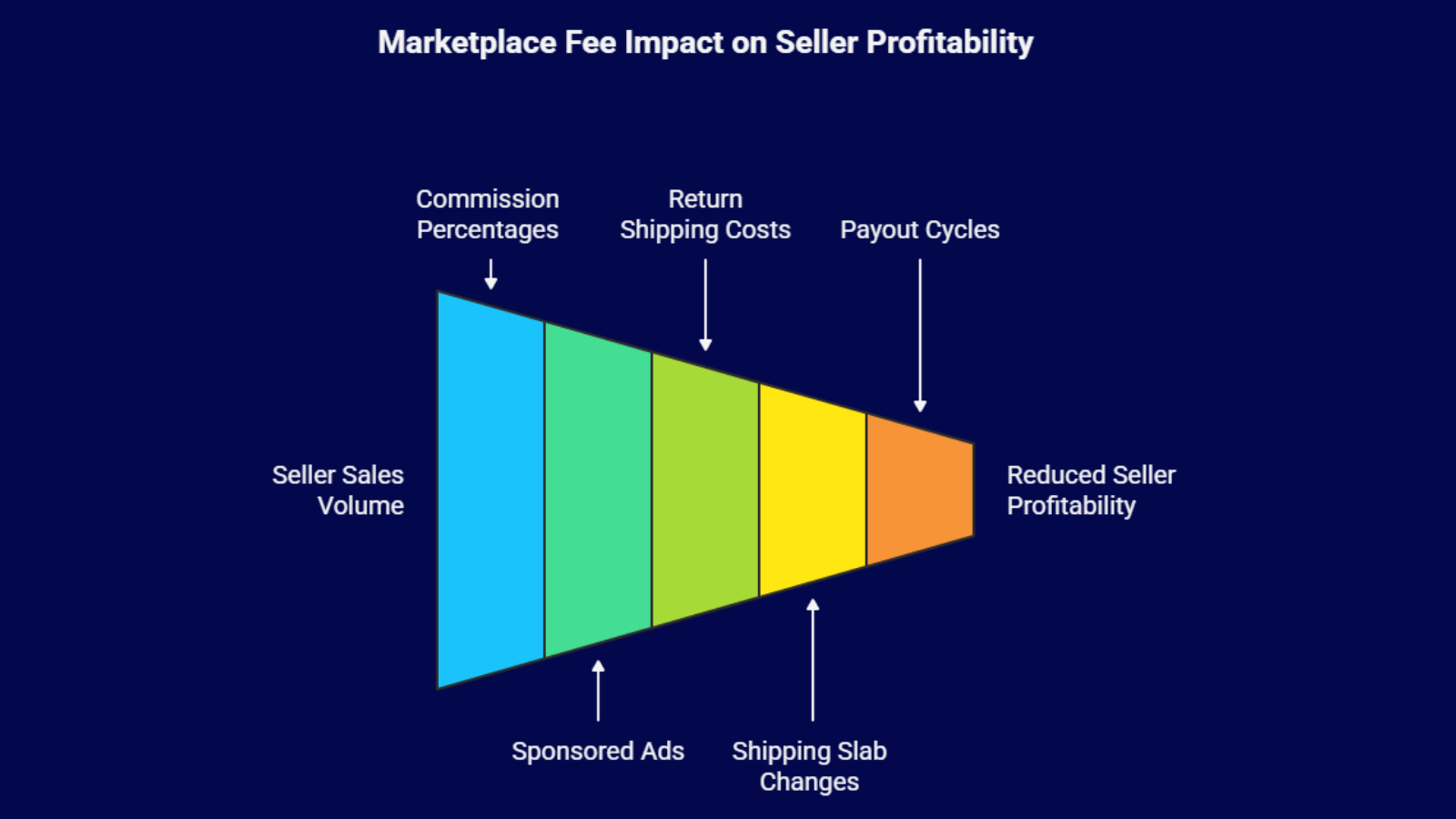 The problem starts when scale kicks in. As orders grow, fees grow faster. Advertising becomes mandatory to stay visible. Return costs increase with volume. Commission slabs rarely reduce, no matter how loyal or successful you become on the platform. Your dependency increases, but your control does not.
Key reasons marketplace fees in India hurt margins include:
- Commission percentages rarely reduce even as your volume grows
- Sponsored ads become essential to maintain visibility, not optional
- Return shipping and damage costs are absorbed by the seller
- Shipping slab changes increase effective per-order cost
- Payout cycles delay cash while ad spend is immediate
- Customer data remains with the marketplace, limiting retention
Over time, sellers realise an uncomfortable truth. Growth does not automatically mean profit. In many cases, it simply means higher working capital pressure.
Why D2C Margins Improve Over Time and How Smart Sellers Balance Both Models
One of the biggest differences sellers notice when they compare selling models is how margins behave over time. In every D2C margin comparison, D2C may look expensive at the start, but it becomes more stable and predictable as the business grows. Early on, marketing costs feel high, tools seem like an added burden, and logistics require constant attention. But unlike marketplaces, these costs do not keep increasing with every order.
As D2C brands mature, efficiency improves naturally:
- Marketing cost per order reduces as targeting improves
- Repeat customers increase, lowering dependency on ads
- Logistics rates improve with higher shipping volumes
- Technology costs remain largely fixed as sales grow
- Brand trust builds, improving conversion rates
This is why serious brands treat D2C as a long-term profit engine. Marketplaces help with visibility, but D2C builds stability. Over time, D2C margin comparison clearly favours direct selling.
 Indian D2C brands across categories have already proven that this shift works. Each category faces different challenges, but the margin story remains consistent when sellers own the customer relationship.
1. Fashion and Apparel Brands
Fashion sellers face some of the highest return rates on marketplaces. Size issues, fit expectations, and impulse buying make marketplace fees in India especially painful.
D2C helps fashion brands by:
- Offering detailed size guides and fit-related content
- Reducing returns through better product pages
- Retaining customers for repeat seasonal purchases
Most fashion brands see a stronger D2C margin comparison within six to nine months of building their D2C channel.
2. Beauty and Personal Care Brands
Beauty and personal care brands depend heavily on repeat purchases. Marketplaces limit brand recall and make it harder to build loyalty.
D2C helps beauty brands by:
- Capturing customer data for remarketing
- Offering subscriptions for regular reorders
- Bundling products to increase average order value
- Running loyalty programs for repeat buyers
These options are limited on marketplaces and directly improve margins.
3. Electronics and Accessories Brands
Electronics sellers often face high commissions and strict pricing policies on marketplaces, which squeeze margins early.
By shifting key products to D2C:
- Warranty registrations become easier to manage
- Upselling accessories becomes more natural
- Customer trust increases through direct support
For these categories, D2C margin comparison clearly favours owning the full customer journey.
When Marketplaces Still Make Sense
This conversation is not about choosing one model and rejecting the other forever. Marketplaces still play a useful role, especially in the early stages of a business. They work well when you are launching a new product, testing demand, or trying to reach customers quickly across India without heavy upfront investment.
Marketplaces also offer operational simplicity at the start, with built-in logistics, payments, and customer support. The challenge begins when sellers stay dependent for too long. Relying only on marketplaces keeps businesses locked into rising marketplace fees in India, limited customer ownership, and very little control over long-term margins.
The Smart Hybrid Model Most Brands Use
Most successful brands today do not choose between marketplaces and D2C. They combine both models with clear intent. Brands use marketplaces for customer discovery, high-volume sales, and clearing slow-moving inventory. They use D2C for brand building, higher margins, and customer retention.
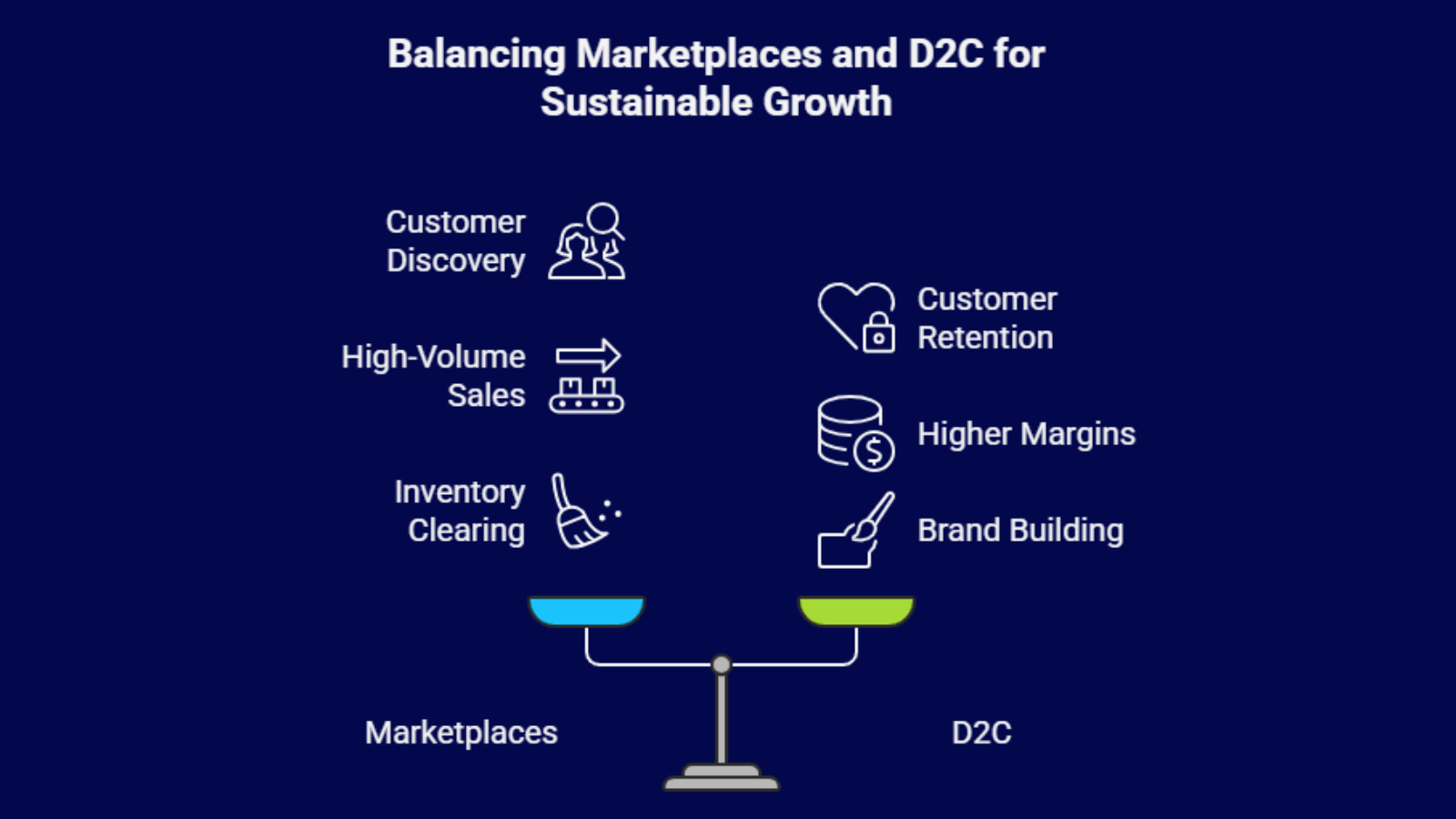 This balance allows sellers to grow reach without sacrificing profitability. Over time, this approach delivers a healthier D2C margin comparison, giving brands both scale and stability instead of choosing one at the cost of the other.
Most sellers do not fail because of poor products. They struggle because they misunderstand how modern ecommerce money actually behaves. The mistakes today are not basic accounting errors. They are structural blind spots that quietly damage margins over time.
Here are some new-age financial mistakes Indian sellers make that are far more common than they realise:
- Celebrating 3x or 4x ROAS without checking contribution after returns, logistics, and discounts gives a false picture of profitability.
- Scaling ads without adjusting for higher return rates from cold traffic distorts real CAC and margin.
- Treating COD revenue as safe growth ignores RTO losses and working capital blockage.
- Ignoring effective realised price after coupon stacking and cashback inflates reported revenue.
- Expanding SKU count without tracking contribution per product silently reduces blended margin.
- Managing multi-channel pricing and stock manually instead of using systems like Base.com leads to margin leakage and overselling errors.
Fixing these mistakes early changes how money flows through the business. Instead of chasing revenue, sellers start protecting contribution margins. That shift alone improves cash flow stability, strengthens decision-making, and supports sustainable scale in today’s competitive ecommerce environment.
How to Calculate Your Real Profit Correctly
To truly understand Marketplace Fees vs D2C Margins, sellers need to move beyond payout summaries and start calculating profit at the order level. Payout reports only show what reaches your bank account, not what it actually costs to fulfil that order. This is where many Indian sellers lose visibility and assume they are doing better than they really are.
Real profit comes from tracking every cost linked to a sale. This includes the selling price, all platform and marketplace fees in India, logistics and fulfillment expenses, return and refund impact, marketing spend per order, and fixed operational costs such as tools and team expenses. Each of these costs may appear small on its own, but together they decide whether an order is profitable or not.
When these numbers are tracked together in one view, sellers gain clarity on what is actually working and what is silently draining margins. This clarity changes decision-making. Instead of chasing higher revenue, Indian sellers can focus on smarter growth, invest money where it delivers returns, and build businesses that are profitable in reality, not just busy on dashboards.
Building Profitable D2C Growth With the Right Systems
 As D2C brands start scaling, day-to-day operations quickly become harder to manage. Orders come in from multiple channels, inventory moves faster, and fulfillment errors become more costly. Many sellers feel stretched here because their systems cannot handle growth—not because demand is low. This is exactly where platforms like Base.com play an important role.
Base.com helps brands bring structure to their D2C operations. It allows sellers to manage orders from all sales channels in one place, track inventory in real time, and reduce mistakes that lead to delays or cancellations. When fulfillment runs smoothly, customer experience improves, and return rates drop. Clear dashboards also help sellers see true profitability, not just revenue. With better visibility, D2C margin comparison becomes easier to understand and optimise over time. Instead of guessing where money is lost, sellers can take informed actions that protect margins.
If you are serious about building a profitable D2C channel, Base.com gives you a stable foundation. It helps you scale without losing control, clarity, or efficiency, which are critical as volumes grow.
Understanding Marketplace Fees vs D2C Margins is not about choosing one model and rejecting the other. It is about knowing exactly where your money goes in each setup. Marketplace fees in India reduce margins quietly and consistently. D2C margins, on the other hand, grow steadily with planning and effort.
Sellers who understand both models build businesses that last, not just stores with high sales numbers. The sooner you analyse D2C margin comparison properly, the faster you move from survival mode to confident, sustainable growth.
FAQs
1. Are marketplace fees in India the same across all platforms?
No. Marketplace fees in India vary widely based on the platform, product category, and logistics model. Commission rates, shipping charges, fixed fees, and advertising costs differ. Sellers should always calculate the total deductions per order, not just the headline commission percentage.
2. Is D2C profitable for small and new sellers?
Yes. D2C can be profitable even for small sellers if costs are tracked properly from the start. Brands that focus on controlled marketing spend and repeat customers usually see a better D2C margin comparison after the initial setup phase.
3. How long does it take to become profitable in D2C?
Most Indian D2C brands start seeing improved margins within four to six months. As marketing becomes more efficient and repeat purchases increase, the D2C margin comparison improves steadily over time.
4. Can sellers run both marketplaces and D2C at the same time?
Yes. A hybrid model works best for most sellers. Marketplaces help with reach and discovery, while D2C improves margins, customer ownership, and long-term brand value.
5. What is the biggest hidden cost sellers face on marketplaces?
Returns and advertising are the highest hidden costs. Both increase quietly as sales grow and significantly impact marketplace fees in India, often reducing real profits more than sellers expect.