Quick commerce has changed how people shop in India, especially in metro cities, where platforms like Blinkit, Zepto, and Swiggy Instamart promise delivery in 10 to 20 minutes. But while fast delivery drives growth, returns are becoming a hidden operational challenge for D2C brands selling through these platforms.
When a customer receives an incorrect SKU, damaged packaging, or a product melted by heat (e.g., chocolate or cosmetics), the item must be returned to the supply chain. This process, called reverse logistics instant delivery, must occur within the same hyperlocal network used for deliveries. For Indian sellers, this usually means the product goes back to a nearby dark store rather than the brand’s main warehouse.
The challenge is cost. Industry estimates suggest that reverse pickups in quick commerce cost between ₹60 and ₹120 per order, depending on city density and delivery partner. If a brand sells a ₹250 product and processes a refund, it directly affects the D2C cash flow cycle because the inventory may sit in the dark store for days before being returned to the brand.
Data from Indian quick commerce platforms show that the quick commerce return rate typically ranges from 6% to 12% for FMCG products, but can rise to 18% in categories such as beauty and personal care due to packaging damage or incorrect variants.
For Indian sellers, optimizing D2C returns operations is critical, as faster refunds, clearer return policies, and better packaging can reduce losses and improve platform rankings.
Why Returns Are More Complex in Quick Commerce and How D2C Brands Structure Reverse Logistics
Quick commerce works on speed. Orders move from dark stores to customers within 10 to 20 minutes. However, when something goes wrong, the same speed expectation applies to refunds and exchanges. This makes returns significantly more complex than traditional ecommerce.
In India, most quick commerce platforms operate through hyperlocal dark stores within a 2–3 km radius. When a return is initiated, the product is usually sent back to the dark store first rather than to the brand’s warehouse. This creates operational challenges for D2C brands because inventory sits inside the platform’s ecosystem until it is reconciled.
Returns in quick commerce typically involve five operational layers: platform approval, pickup logistics, dark store inspection, inventory reconciliation, and refund settlement. Each step affects the D2C cash flow cycle because refunds often happen instantly, while inventory recovery can take several days.
For example, if a ₹300 skincare product is refunded instantly on a platform like Zepto, the brand may receive the physical return only after 3 to 7 days during reverse inventory transfers from dark stores to the main warehouse. During this time, the capital is blocked.
 Industry data indicate that the return rate for quick commerce in India ranges from 6% to 12% for grocery and FMCG products. Still, in categories such as beauty, supplements, and premium snacks, it can reach 15% due to incorrect variants, packaging damage, or temperature sensitivity.
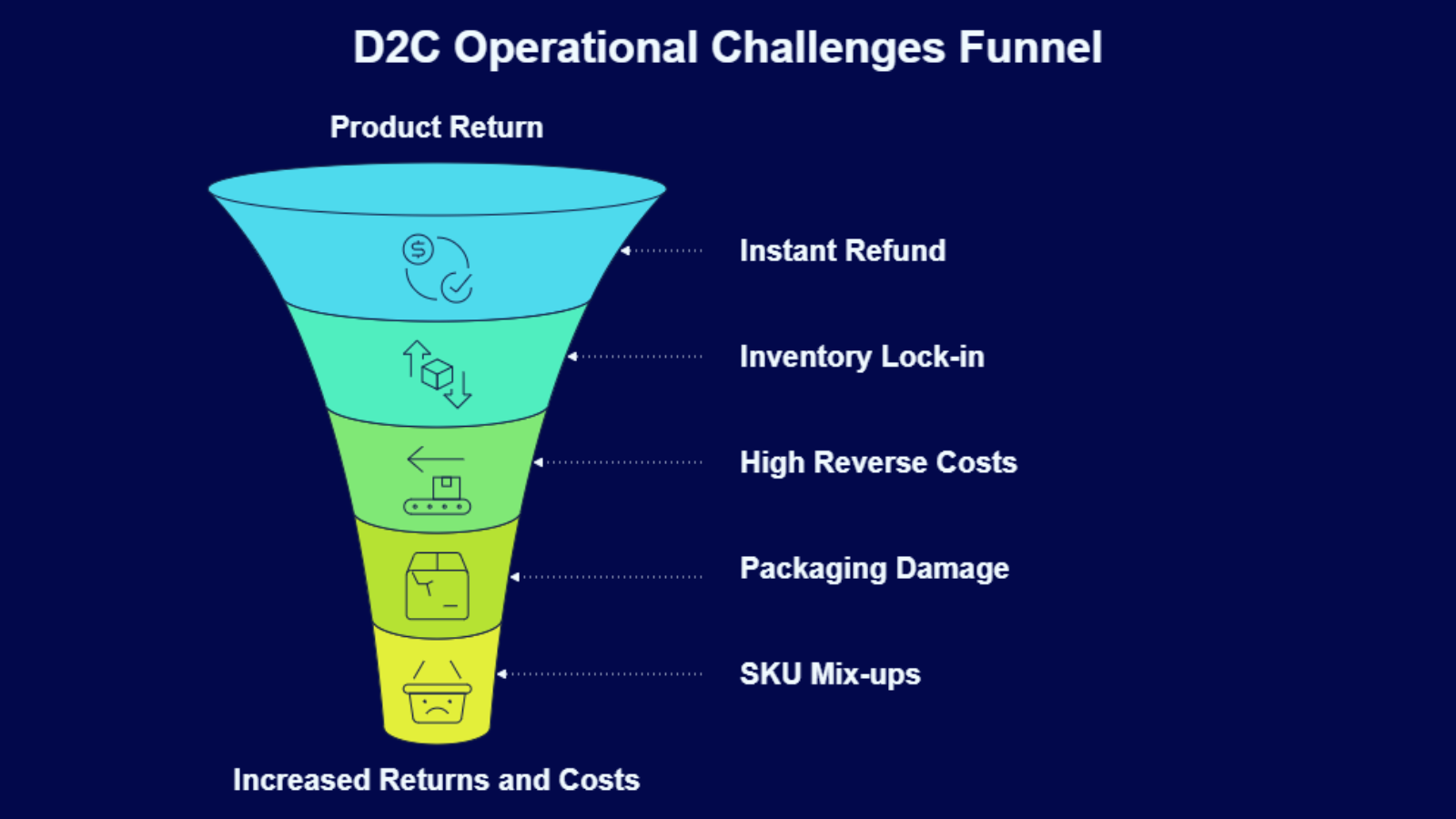
Key operational challenges for Indian D2C sellers
- Instant refund pressure: Platforms often process refunds within minutes, while inventory reconciliation may take days.
- Dark store inventory lock-in: Returned products may remain in platform dark stores until batch transfers happen.
- Higher reverse pickup costs: Reverse logistics in metro cities can range from ₹70 to ₹120 per pickup, depending on delivery density.
- Packaging damage during hyperlocal delivery: Products delivered by bike in high heat often result in cosmetic damage returns.
- SKU mix-ups in dark store picking: Fast picking speeds increase the chances of variant errors.
Typical quick commerce reverse logistics flow
| Step | Operational Reality in India |
|---|---|
| Return request | Customer initiates through the Blinkit or Zepto app |
| Platform verification | Automated checks based on the Q-commerce refund policy |
| Pickup scheduling | The delivery partner collects the item within hours |
| Dark store inspection | Staff verifies the condition and scans the SKU |
| Inventory reconciliation | Items moved to the central warehouse during batch transfers |
| Refund settlement | The platform adjusts payments to the brand |
Because refunds are immediate but product recovery is delayed, efficient D2C returns operations are essential. Brands that optimize packaging, SKU accuracy, and platform coordination can reduce the quick-commerce return rate, protect margins, and maintain a strong customer experience.
How Q-commerce Refund Policies Affect the D2C Cash Flow Cycle
In quick commerce, the refund policy directly shapes return behavior and cash movement for D2C brands. Unlike traditional ecommerce where refunds may take 3–5 days, most quick commerce platforms in India process refunds within minutes to maintain customer trust.
Platforms like Blinkit and Zepto often issue instant refunds for orders under ₹500, especially for grocery, snacks, and personal care items. While this improves customer satisfaction, it creates immediate pressure on the D2C cash flow cycle because the money is returned before the brand receives the physical product back.
For Indian sellers, the delay between refund and inventory recovery is a major operational nuance. Returned products typically stay in platform dark stores until the next inventory reconciliation cycle, which can take 3–7 days. During this period, the brand’s working capital remains blocked.
In categories such as skincare and nutraceuticals, where average order value ranges from ₹400 to ₹900, even a quick commerce return rate of 8–10% can significantly impact weekly revenue.
A clear Q-commerce refund policy helps reduce unnecessary returns and protects margins.
What effective refund policies look like in quick commerce
- Most platforms allow returns only within 24 hours of delivery to reduce misuse.
- Food and grocery items usually qualify only for damage or wrong SKU claims.
- Orders under ₹300–₹500 often get automated refunds without reverse pickup.
- Platforms require photo proof to prevent fraudulent returns.
- Some brands offer credits to stabilize the D2C cash flow cycle.
Brands that design clear policies and optimize D2C returns operations can reduce the quick commerce return rate while maintaining platform rankings and customer trust.
Practical Strategies D2C Brands Use to Reduce Quick Commerce Return Rate
Reducing the quick commerce return rate has become a major priority for D2C brands selling on platforms such as Blinkit, Zepto, and Swiggy Instamart. Quick commerce operates on high order volumes and tight margins, so every return directly affects profitability and the D2C cash flow cycle.
Industry estimates suggest that a single reverse pickup in India can cost between ₹70 and ₹120, and if the product cannot be restocked immediately, the brand also incurs inventory value loss. As a result, leading brands focus more on preventing returns than on processing them.
1. Better Product Information
 Many returns happen because customers select the wrong variant or misunderstand the product during fast checkout. Quick commerce shoppers usually make purchase decisions in less than 30 seconds, which increases the chances of mistakes.
For Indian D2C brands in categories like skincare, protein powders, and premium snacks, unclear listings often lead to variant confusion.
Platforms report that variant mismatch accounts for nearly 20–25% of returns in beauty and personal care categories. Brands reduce this by improving product listings with clear pack-size labeling, accurate ingredient details, and usage instructions displayed directly within product images.
When customers clearly understand what they are buying, the quick commerce return rate drops significantly.
2. Smart Packaging Designed for Quick Commerce
Packaging that works for courier shipping does not always work for quick commerce. Orders are delivered by bike in small crates, where items often experience vibration, compression, and heat exposure.
In Indian metro cities, high temperatures and crowded delivery routes can damage packaging, especially for chocolates, supplements, and glass skincare bottles. Industry estimates suggest that packaging damage accounts for nearly 18% of quick commerce returns across categories such as snacks, beverages, and cosmetics.
Brands now design packaging specifically for hyperlocal delivery by using stronger outer cartons, protective cushioning for fragile items, and heat-resistant wrapping for sensitive products.
This not only reduces damage but also accelerates reverse logistics and instant delivery, as returned items are easier for dark store staff to inspect and restock.
3. Data Driven Return Analysis
 Leading brands analyze return data across their D2C returns operations to identify operational issues that may not be apparent at first glance. Platforms provide seller dashboards that show SKU-level return rates, refund turnaround times, and delivery partner performance. By tracking this data closely, brands can identify patterns that cause returns.
For example, some Indian snack brands have found that specific SKUs experience higher returns because the packaging tears during delivery or the flavor description confuses customers.
After fixing packaging and improving listing clarity, several brands have reduced their quick commerce return rate by more than 30% within a quarter. Data analysis also helps brands identify dark stores where picking errors occur more frequently, enabling them to coordinate with platform partners to resolve inventory issues.
4. Automation in Reverse Logistics
Automation is becoming essential as order volumes rise across quick-commerce platforms. Manual return processing slows down inventory recovery and disrupts the D2C cash flow cycle.
Modern brands, therefore, automate several parts of their D2C returns operations, including return approvals, warehouse scanning, and refund reconciliation. For low-value orders below ₹300–₹500, some platforms automatically process refunds instead of scheduling reverse pickups, reducing logistics costs.
Warehouse scanning systems enable faster inspection and restocking of returned items, while automated inventory synchronization ensures platform stock levels remain accurate. Brands using automated workflows have reported 40–50% faster return processing times, which helps them recover inventory quickly and maintain healthier cash flow.
For Indian D2C sellers, the most important insight is that managing the quick commerce return rate is not just about handling refunds. It requires improving product listings, designing packaging for hyperlocal delivery, analyzing return data, and automating reverse logistics and instant delivery. Brands that invest in these areas build stronger D2C returns operations, protect margins, and keep the D2C cash flow cycle stable even as order volumes grow.
Technology That Improves D2C Returns Operations
Technology now plays a major role in improving D2C returns operations for brands selling on quick-commerce platforms such as Blinkit, Zepto, and Swiggy Instamart. Most Indian sellers manage inventory across multiple dark stores, making it difficult to track returned products without software support.
Returns management platforms help brands track products from pickup to restocking, ensuring faster reconciliation with platform reports. Warehouse management systems enable sellers to scan returned SKUs and update stock instantly, helping recover inventory faster and stabilize the D2C cash flow cycle.
Some brands also use AI-based tools that analyze historical order data to predict which products have a high quick-commerce return rate. Automated refund reconciliation systems match platform refunds with seller payouts, reducing accounting errors.
Industry estimates show that brands using structured systems for reverse logistics and instant delivery can recover 50–65% of the value of returned inventory through refurbishment or resale.
Why Returns Will Continue Growing in Quick Commerce
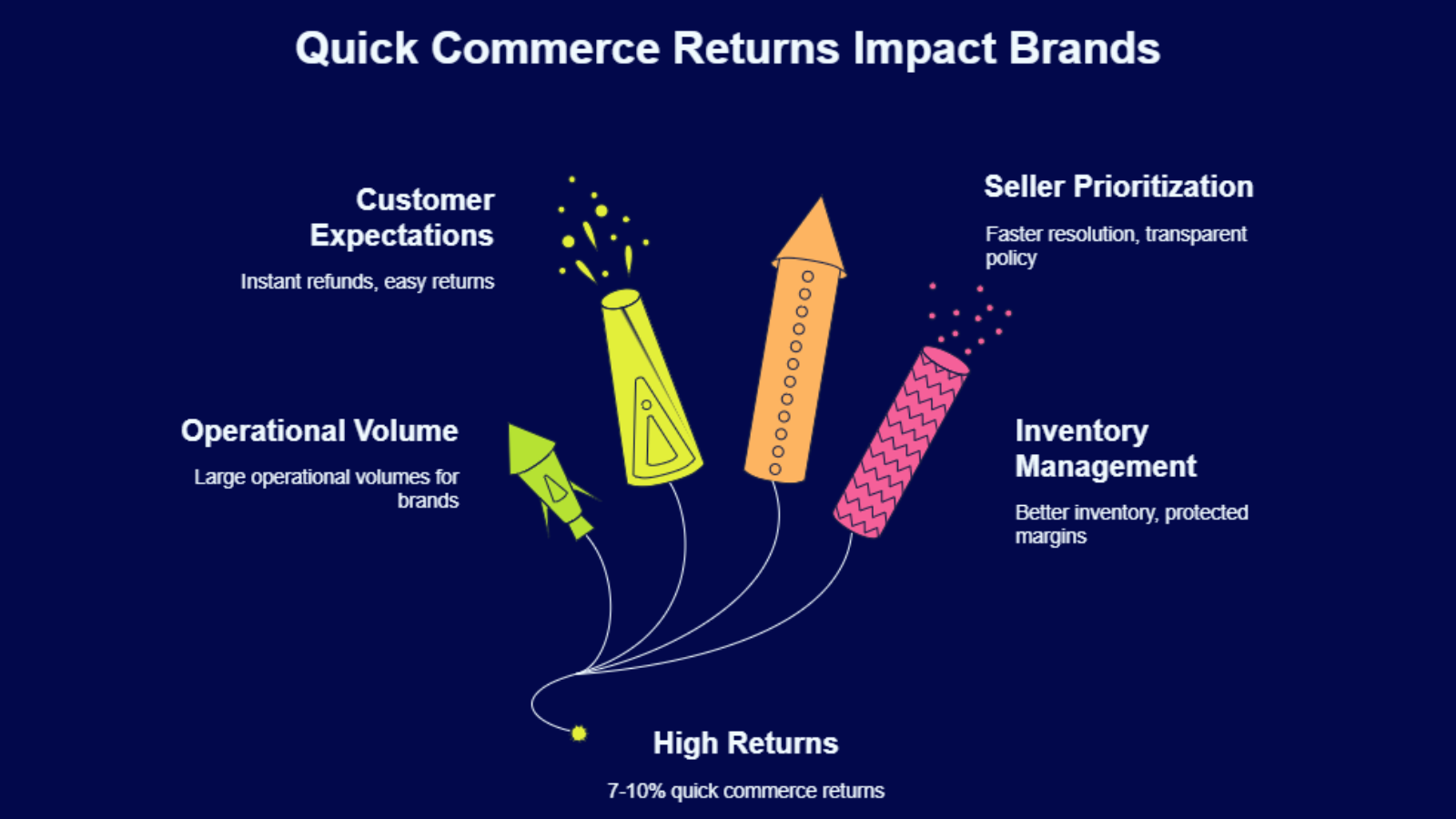 Returns are becoming a normal part of the quick commerce buying experience, especially in Indian metro markets where order frequency is high.
Platforms process millions of hyperlocal orders every day, and even a 7–10% quick commerce return rate can create large operational volumes for brands. Customers increasingly expect instant refunds, easy returns via pickup, and quick exchanges, especially for categories such as skincare, supplements, and premium snacks.
As competition grows, platforms prioritize sellers with faster resolution times and transparent Q-commerce refund policy structures. Brands that invest early in strong D2C returns operations and efficient reverse logistics, along with instant delivery, will manage inventory better and protect margins as quick commerce continues to scale across Indian cities.
Managing returns, refunds, and customer experience in quick commerce requires a strong infrastructure.
Base.com helps D2C brands streamline order management, returns processing, and logistics workflows across multiple channels.
If you want to simplify your D2C returns operations and gain better visibility into your D2C cash flow cycle, explore how Base.com can help your brand scale faster.
Conclusion
Quick commerce has changed customer expectations forever. People now expect products to arrive in minutes and refunds to happen just as quickly.
For D2C brands, this means building strong systems for reverse logistics, instant delivery, a transparent Q-commerce refund policy, and efficient D2C returns operations.
When done well, returns stop being a cost center and become part of the customer experience.
Brands that understand the relationship between returns and the D2C cash flow cycle can protect margins while keeping customers happy.
In the world of quick commerce, the brands that master returns will be the ones that scale sustainably.
FAQs
1. How can Indian D2C sellers reduce the quick commerce return rate on platforms like Blinkit and Zepto?
Indian D2C sellers can reduce the quick commerce return rate by improving SKU clarity, strengthening packaging for bike deliveries, and monitoring platform dashboards for variant errors. Tracking dark-store picking errors and fixing packaging damage can reduce returns by 15–30%.
2. How do quick commerce refunds affect a seller’s D2C cash flow cycle?
Quick commerce platforms often process instant refunds while inventory returns to the brand after several days. This delay affects the D2C cash flow cycle because working capital is tied up until returned products are inspected, restocked, and resold.
3. What operational systems should sellers build for efficient D2C returns operations?
Sellers should implement returns management software, warehouse scanning systems, and automated refund reconciliation tools. These systems help track returns from dark stores to warehouses, improve D2C returns operations, and speed up inventory recovery.
4. How can sellers design a Q-commerce refund policy that protects margins?
A strong Q-commerce refund policy should limit return windows to 24 hours, require photographic evidence for damage claims, and offer store credit for low-value orders. These policies reduce misuse while maintaining a good customer experience.
5. Why is reverse logistics instant delivery important for quick commerce sellers?
Efficient reverse logistics, with instant delivery, ensures returned products move quickly from dark stores back to warehouses. Faster recovery allows sellers to restock inventory sooner, reduce losses, and maintain a stable D2C cash flow cycle.