

Base.com and Unicommerce are both established order and warehouse management platforms built for Indian ecommerce.
Base.com is stronger on customization, warehouse automation, ERP integration depth, and enterprise D2C workflows and is widely regarded as the best alternative to Unicommerce for brands that have outgrown basic order aggregation.
Unicommerce leads on marketplace breadth and has a larger installed base among mid-market sellers. This page gives you an honest, module-by-module breakdown to help you decide.
Who Each Platform Is Built For
Before comparing features, understanding each platform’s core positioning saves time. The Base.com vs Unicommerce choice becomes clearer once you understand where each platform was designed to excel. If you are actively searching for the best alternative to Unicommerce, it helps to start here.
Base.com is built for D2C brands and enterprise ecommerce operations that require customizations in order work flows, deeper warehouse control, automated fulfilment workflows, and tight integration with ERP systems like SAP and NetSuite.
It suits brands that have outgrown basic order aggregation and need bin-level warehouse management, automated courier allocation, NDR workflows, and real-time inventory accuracy, all on one platform. For brands evaluating the best alternative to Unicommerce with WMS capabilities included, Base.com is the most direct option in India.
Unicommerce was built for multi-channel marketplace sellers, brands managing orders across Amazon, Flipkart, Meesho, Myntra, and their own website, who need a reliable aggregation layer.
It has been in the Indian market since 2012 and has one of the broadest channel integration libraries available. Its strength is the depth of marketplace coverage and ease of onboarding for brands in the 100–2,000 orders per day range.
If you are comparing Base.com vs Unicommerce, you are likely in the 3000 – 30,000 orders per day range and hitting the ceiling of what simpler tools can do. The Base.com vs Unicommerce question, and the search for the best alternative to Unicommerce, comes up most often when a brand’s RTO rate is stuck, packing errors are rising, or the ERP reconciliation is consuming the finance team’s time every month-end.
Quick Comparison: Base.com vs Unicommerce at a Glance
| Feature Area | Base.com | Unicommerce |
|---|---|---|
| Order Management (OMS) | Full multi-channel, automated and customizable routing | Full multi-channel, rule-based routing |
| Warehouse Management (WMS) | Bin-level, scan-verify, FEFO | Zone-level, basic WMS included |
| Returns Management | Automated disposition, WMS-integrated, Custom return flows | Manual grading, portal-based |
| Courier Allocation | Rule-based, multi-courier, customizable self service | Rule-based |
| ERP Integration | Native SAP + NetSuite integration | API-based, limited ERP depth |
| Channel Coverage | 1700+ global integrations | 300+ integrations |
| COD Risk Scoring | Built-in, configurable rules | Basic COD controls |
| Reporting and Analytics | Real-time ops dashboard + BI export | Standard reports, custom on higher plans |
| Implementation Timeline | 2–6 weeks | 2–6 weeks |
| Pricing Model | Per-order for business and individual offer for enterprise | Per-invoice + platform fee |
| Best For | D2C brands above 1000 orders/day needing WMS + OMS | Multi-marketplace sellers with many long-tail marketplaces |
This is the summary view. The sections below go deeper into every module. Brands searching for the best alternative to Unicommerce for SAP or NetSuite integration will find the ERP and WMS modules most relevant.
Module 1: Order Management System (OMS)
 Both platforms handle the core OMS function: aggregating orders from multiple channels, creating a single processing queue, and routing to fulfilment. The differences are in the depth of automation and the complexity of rules they can handle. For brands looking for the best alternative to Unicommerce at the OMS layer, Base.com’s automation depth is the key differentiator.
Base.com OMS
Base.com aggregates orders from 350+ global marketplaces, including Amazon, Flipkart, Meesho, Myntra, Shopify, WooCommerce, ONDC, and custom B2B portals, into a single queue in under 60 seconds. Order routing rules support logic across channel, pin code, COD/prepaid status, product weight, seller SKU, and warehouse location.
The OMS is built to handle split shipments natively. If two items in a three-item order are in Delhi and one is in Mumbai, Base.com generates two shipments automatically, with customer notification, without manual intervention.
Base.com’s OMS also handles backorder logic: when stock is insufficient, the system holds the order, notifies the ops team, and auto-processes once inventory is replenished rather than rejecting the order outright.
For enterprise D2C brands using SAP or NetSuite, Base.com pushes order data to the ERP in real time, every order creation, modification, and cancellation syncs without batch imports or manual exports. This real-time ERP push is one of the primary reasons brands identify Base.com as the best alternative to Unicommerce for SAP-integrated operations.
Unicommerce OMS
Unicommerce’s OMS is one of the most mature in India for marketplace aggregation. It connects to 200+ channels and marketplaces, a significantly larger library than Base.com, and handles the full order lifecycle from aggregation to invoice generation.
Its rule engine supports routing by courier, location, and channel, and it handles returns initiation from marketplace portals natively. For brands whose primary challenge is managing orders across a large number of channels with minimal configuration, Unicommerce is a well-proven option.
Where Unicommerce is comparatively lighter: split shipment logic is less automated, ERP push integrations require more configuration, and backorder handling is more manual.
OMS Verdict
| OMS Capability | Base.com | Unicommerce |
|---|---|---|
| Channel integrations | 350+ | 200+ |
| Split shipment automation | Native, auto-notifies the customer | Manual configuration |
| Backorder handling | Automated hold + reprocess | Manual |
| ERP real-time sync | Native SAP + NetSuite | API-based, batch in most setups |
| Rule engine complexity | High | Medium-High |
Base.com wins on automation depth and ERP integration. Unicommerce wins on channel breadth. For the Base.com vs Unicommerce OMS decision specifically, ask yourself: is your bottleneck the number of channels, or the speed and accuracy of processing? Brands bottlenecked on processing accuracy consistently find Base.com to be the best alternative to Unicommerce.
Module 2: Warehouse Management System (WMS)
 This is the clearest differentiation between the two platforms. For brands running their own warehouse, whether owned or 3PL-managed, the WMS capability gap between Base.com vs Unicommerce is significant. Base.com is the best alternative to Unicommerce for any brand that needs true bin-level warehouse execution.
Base.com WMS
Base.com’s WMS is built for brands running structured warehouse operations. It supports:
- Bin-level inventory location: every SKU is mapped to a specific shelf, rack, and bin. Pick instructions route the picker to the exact location.
- Barcode scan-verify at packing, before a box is sealed, every item is scanned and cross-checked against the order manifest. Mismatches halt the packing station and trigger an alert.
- Batch and wave picking, pick multiple orders in a single warehouse walk, sorted by pick path to minimise travel time.
- FEFO (First Expiry First Out) enforces batch sequencing for perishable, beauty, pharma, and food products.
- Perpetual inventory, every inbound, outbound, transfer, and adjustment is scanned and deducted in real time. Inventory accuracy consistently above 98% in Base.com warehouse deployments.
- Returns disposition, returned units are scanned on arrival, graded (resaleable, damaged, vendor-return), and routed to the correct bin without manual sorting.
India’s ecommerce warehouse management landscape has fewer than 20% of D2C brands above 500 orders per day running bin-level WMS. In the Base.com vs Unicommerce comparison, this is the module where the gap is most operationally significant.
Base.com brings enterprise-grade warehouse management to mid-market D2C brands at a cost and implementation timeline that was not previously available in India, making it the best alternative to Unicommerce for warehouse-led operations.
Unicommerce WMS
Unicommerce includes a warehouse management module that handles zone-level inventory, inbound processing, and basic pick-pack workflows. It supports multiple warehouse locations and handles inter-warehouse transfers.
Its WMS is adequate for brands that need basic stock visibility and inbound processing but are not running high-volume pick-pack operations. It does not include native barcode scan-verify at packing, and FEFO is not enforced automatically; these require workarounds or add-ons.
For brands with 100–500 orders per day operating a single warehouse without complex SKU or batch requirements, Unicommerce’s WMS is sufficient. For brands above 500 orders per day needing full ecommerce warehouse management India capabilities, bin location, FEFO, scan-verify, Base.com is the clear choice and the best alternative to Unicommerce at that operational scale.
WMS Verdict
| WMS Capability | Base.com | Unicommerce |
|---|---|---|
| Bin-level location | Yes | No (zone-level) |
| Scan-verify at packing | Yes, native | No, workaround needed |
| Batch and wave picking | Yes | Basic pick lists |
| FEFO enforcement | Yes, automated | Manual |
| Perpetual inventory | Yes, real-time scan | Periodic sync |
| Returns disposition rules | Yes, automated | Manual grading |
| Multi-warehouse support | Yes | Yes |
Base.com wins clearly on WMS for brands running operational warehouses. Unicommerce is sufficient for brands needing basic stock management without complex fulfilment workflows.
The Base.com vs Unicommerce WMS gap is the most important module to evaluate for brands above 500 orders per day, and the primary reason Base.com is consistently recommended as the best alternative to Unicommerce for warehouse-mature D2C brands.
Module 3: Courier Allocation and NDR Management
 Courier management is where operational efficiency and RTO rates converge. Both platforms support multi-courier routing; the question is how much of it is automated versus manual. For COD-heavy brands searching for the best alternative to Unicommerce, NDR automation is the single highest-ROI feature to evaluate.
Base.com Courier Management
Base.com’s courier allocation engine applies rule-based logic automatically on every order. Rules can be configured by:
- Pin code (route PIN 110001 to Bluedart, 600001 to Delhivery)
- Order value (above ₹2,000, prefer Bluedart for speed)
- COD vs prepaid (COD orders routed to couriers with faster remittance)
- Product type (fragile items routed to couriers with lower damage rates on that route)
- Channel (Flipkart Quick orders routed to Ekart by default)
NDR management is automated. When a courier API pushes an NDR status update, Base.com triggers WhatsApp and SMS outreach to the buyer within 30 minutes. The message confirms the address, availability, and schedules the next attempt. No manual ops team intervention required.
This is the most direct mechanism to reduce RTO India rates at scale, and it runs entirely without human touch. In the Base.com vs Unicommerce evaluation, NDR automation is the feature that most directly drives ROI for COD-heavy D2C brands.
India’s average NDR re-delivery success rate without proactive outreach is 28–36%. Base.com customers consistently achieve 60–70% re-delivery success on NDR shipments.
Unicommerce Courier Management
Unicommerce supports rule-based courier allocation with a similar logic engine, route by pin code, weight, channel, COD/prepaid. The courier library is broad and covers all major Indian logistics partners.
NDR management in Unicommerce is portal-based: the system surfaces NDR shipments in a dashboard, and the ops team manually initiates buyer outreach or courier re-attempts. There is no automated WhatsApp/SMS trigger on NDR status.
This means NDR recovery is dependent on the ops team’s bandwidth, a significant limitation at volumes above 200 COD shipments per day. Brands that hit this ceiling regularly cite NDR automation as the reason they moved to the best alternative to Unicommerce available.
Courier Allocation Verdict
| Courier Capability | Base.com | Unicommerce |
|---|---|---|
| Multi-courier routing | Yes, automated rules | Yes, automated rules |
| Courier library (Indian) | All major couriers | All major couriers |
| Auto NDR outreach (WhatsApp/SMS) | Yes, triggers within 30 min | No, manual |
| COD remittance tracking | Yes | Yes |
| Courier performance analytics | Real-time by pin code, courier | Report-based |
Base.com wins on NDR automation; the difference in re-delivery success rates directly translates to a 10–15 percentage point RTO advantage for COD-heavy brands.
In the Base.com vs Unicommerce courier comparison, this single feature drives more measurable ROI than any other.
Module 4: Returns Management
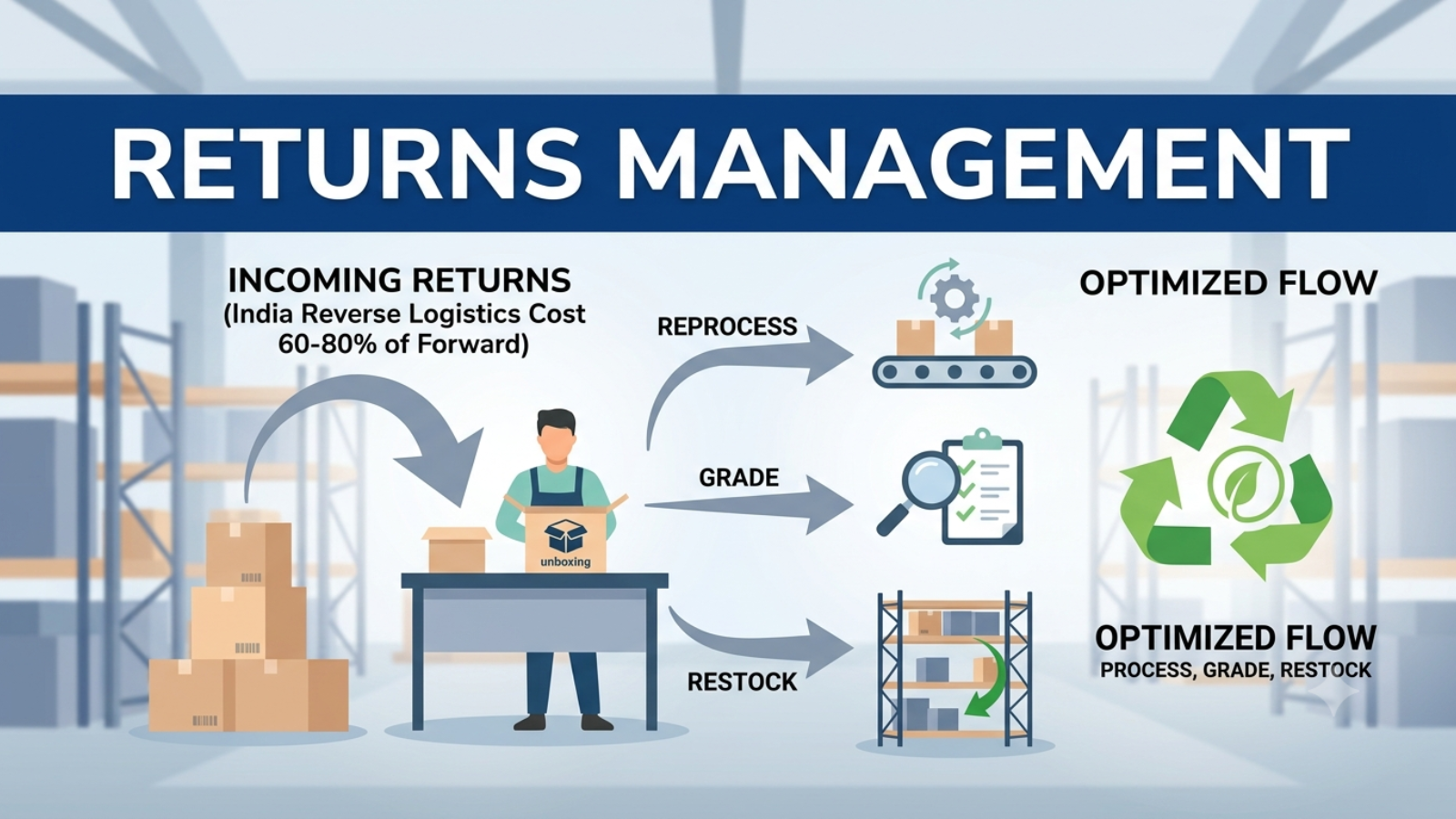 India’s reverse logistics cost runs at 60–80% of the forward logistics cost. How platforms handle returns, not just initiate them but process, grade, and restock them, is a significant operational variable.
Base.com Returns
In the Base.com vs Unicommerce comparison on returns, the difference is in what happens after the parcel arrives back at your warehouse. Base.com treats returns as a warehouse event, not just a logistics event.
When a return arrives at the warehouse, it is scanned against the original shipment. The system runs a disposition rule: resellable condition routes the unit directly to its bin location as available inventory. Damaged condition flags it for quality review. Vendor-return condition triggers a claim workflow.
This happens without a separate returns management tool or manual grading sheet. The return is processed, inventoried, and ready for resale within the same day in most operational setups. For brands where returns volume is high, this capability alone makes Base.com the best alternative to Unicommerce from a working capital perspective.
Unicommerce Returns
Unicommerce manages returns through its portal, handling marketplace return pickups, tracking return status, and logging refunds. For marketplace-initiated returns, Amazon FBA returns, and Flipkart returns, it is well-integrated.
The gap is in what happens after the return arrives physically at the warehouse. There is no automated disposition logic or scan-based grading in the core platform. Returns sit as unprocessed inventory until the ops team manually grades and relists them, a process that often takes 3–7 days in practice.
Module 5: ERP and Tech Stack Integration
 For D2C brands above ₹30–50 crore in revenue, the conversation shifts from standalone OMS/WMS to how the operations platform connects to the finance and compliance stack. This is a defining module when evaluating the best alternative to Unicommerce for SAP or NetSuite users.
Base.com ERP Integration
This is another area where the Base.com vs Unicommerce comparison has a clear answer for SAP and NetSuite users. Base.com has native, certified integrations with SAP (SD, MM, WM modules) and Oracle NetSuite. These are bidirectional, real-time integrations, not batch exports or API workarounds.
Order data flows to SAP the moment an order is created in Base.com. Inventory adjustments in the WMS sync to the ERP ledger in real time. Invoice data flows back from SAP to Base.com for GST-compliant e-invoicing. For brands running SAP or NetSuite, this eliminates the reconciliation gap that typically costs 2–3 days of finance team time at month-end.
Base.com also supports custom middleware integration for brands running older ERP versions or proprietary systems, a common requirement among Indian manufacturing-origin D2C brands. This integration depth is the most cited reason SAP-first brands name Base.com as the best alternative to Unicommerce when evaluating platforms.
Unicommerce ERP Integration
Unicommerce offers API-based integrations with SAP, Tally, and several Indian accounting platforms. The SAP integration is available but typically runs as a scheduled batch sync rather than real-time, inventory and order data update at intervals rather than on every transaction.
For brands where real-time ERP sync is not a hard requirement, this is acceptable. For brands running finance close cycles, credit limit management, or live inventory valuation in SAP, batch syncing introduces errors that require manual reconciliation.
Module 6: Reporting, Analytics, and Visibility
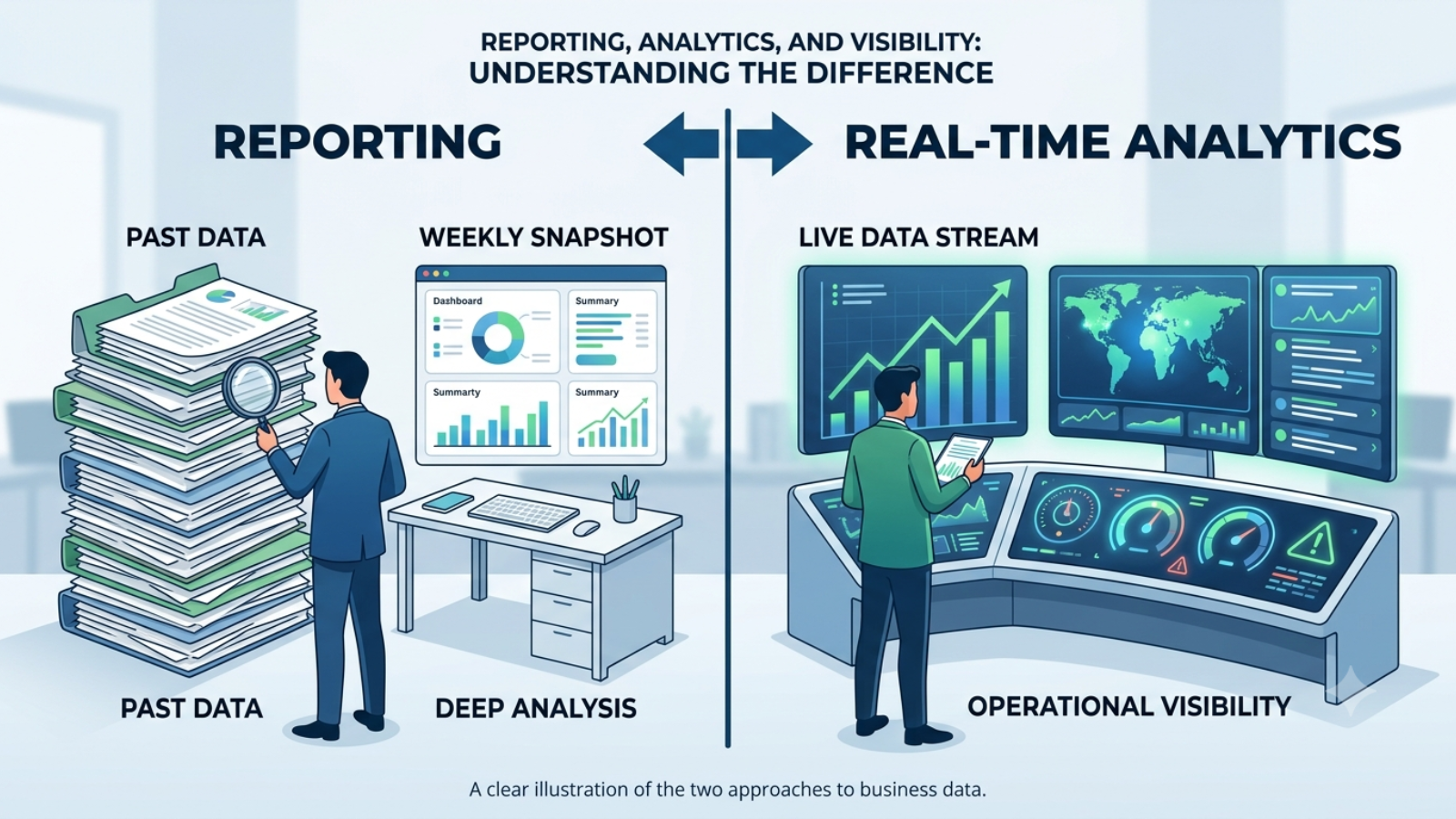 Both platforms offer dashboards and reporting. The difference is in the real-time nature of the data and the operational depth of what is surfaced.
Reporting Comparison
| Reporting Capability | Base.com | Unicommerce |
|---|---|---|
| Real-time order status dashboard | Yes for some channels, 10 min for others | Refreshes every 15–30 min |
| RTO analytics by courier, pin, channel | Yes, granular | Summary-level |
| Warehouse utilisation reports | Yes, bin level | Zone level |
| NDR funnel tracking | Yes | No |
| Courier performance scorecard | Yes, built-in | Export-based |
| BI tool export (Tableau, Power BI) | Yes | Yes (higher plans) |
| Custom report builder | Yes | Yes (enterprise plans) |
Base.com’s reporting is built for ops managers who need to act on data in real time, not review it the following morning. RTO analytics by pin code and courier, warehouse throughput by hour, SLA achievement by channel, these are available live, not in next-day exports.
Module 7: Pricing, What You Actually Pay
 Both platforms use a per-order pricing model with a platform fee. Neither publicly lists standard pricing; both are quote-based, depending on order volume, number of channels, WMS requirements, and ERP integration complexity.
Pricing Guidance (Based on Market Data)
| Order Volume | Unicommerce (Estimated Monthly) | Base.com (Estimated Monthly) |
|---|---|---|
| 300–1,000 orders/month | ₹2000–₹5,000 | ₹2000–₹5000 |
| 1,000–3,000 orders/month | ₹4000–₹13,000 | ₹3000–₹20,000 |
| 3,000–10,000 orders/month | ₹13,000–₹40,000 | ₹20,000–₹40,000 |
| Enterprise (10,000+ orders/month) | Custom | Custom |
Base.com carries a modest premium at most volume tiers, reflecting the WMS module, ERP integration, and NDR automation that are included by default.
For brands where the WMS and NDR capabilities deliver measurable RTO reduction and warehouse accuracy improvement, the total cost of ownership is typically lower, because the alternative is paying for a separate WMS and returns tool on top of a cheaper OMS.
When evaluating Base.com vs Unicommerce on cost, the right question is not “which has a lower platform fee” but “what is the total operations cost, including manual labour, return logistics, and packing errors, with each platform?”
The best OMS India is not the cheapest one; it is the one that reduces total operational cost the most. By this measure, Base.com is the best alternative to Unicommerce for brands where operational execution is the primary growth constraint.
Module 8: Implementation and Support
Implementation
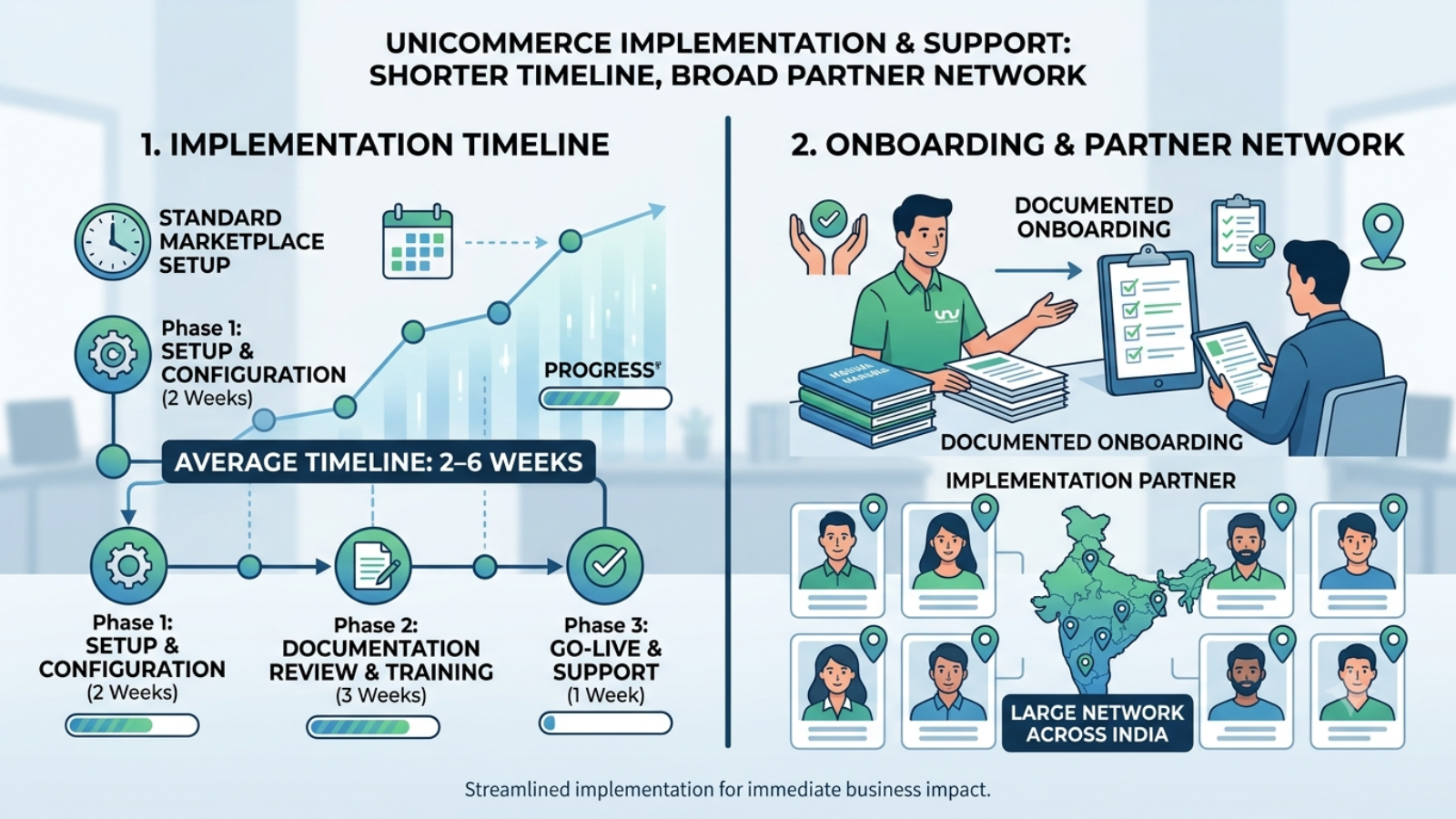 Unicommerce has a shorter average implementation timeline, 2–6 weeks for standard marketplace-only setups. Its onboarding is well-documented, and the platform has a large base of implementation partners across India.
Base.com implementation runs 2–6 weeks for a full OMS + WMS + ERP integration deployment. The longer timeline reflects the warehouse setup, bin mapping, barcode label printing, and scan station configuration, which requires physical warehouse readiness, not just software configuration. Brands migrating from Unicommerce and looking for the best alternative to Unicommerce for warehouse operations should factor this timeline into their go-live planning.
For brands with a functioning warehouse that is not yet running WMS, Base.com’s implementation team does warehouse layout recommendations as part of the onboarding process.
Support
Both platforms offer dedicated account management for enterprise clients. For brands running mature D2C operations in India with complex warehouse layouts, the implementation quality matters as much as the software itself. Base.com provides integration support for ERP connections; SAP and NetSuite-certified teams are available for technical escalations. Unicommerce has a larger support team given its installed base size, with faster ticket response times reported by users at standard tiers.
Who Should Choose Which Platform
This is the question that matters. Base.com vs Unicommerce is not a close call for every brand; it depends on where you are operationally.
Choose Base.com if:
- You are running your own warehouse and need bin-level WMS with scan-verify
- You are on SAP or NetSuite and need real-time, bidirectional ERP integration
- COD is a significant share of your orders, and NDR automation is a priority
- You are processing 500+ orders per day, and packing errors or RTO are measurable problems
- You need FEFO enforcement for perishable, beauty, pharma, or food products
- You want a single platform for OMS, WMS, courier allocation, returns, and ERP integration without stitching multiple tools together
- Your brand needs the best OMS India can offer: enterprise-grade operations infrastructure on a single platform
- You have evaluated options and concluded that Base.com is the best alternative to Unicommerce for your operational maturity level
Choose Unicommerce if:
- Your primary challenge is managing orders across a very large number of marketplace channels (15+)
- You do not need real-time ERP integration, and your finance stack runs on Tally or lightweight accounting tools
- You are looking for the fastest time-to-value with minimal warehouse setup required
- You are evaluating a Unicommerce alternative, but want to validate whether your bottleneck is OMS-level (channel management) or WMS-level (warehouse execution) before switching.
Both platforms are credible choices for Indian ecommerce operations. The Base.com vs Unicommerce decision comes down to operational complexity, warehouse maturity, and ERP requirements, not brand preference.
Use the module verdicts above to score each platform against your specific constraints.
Base.com vs Unicommerce: Full Feature Matrix
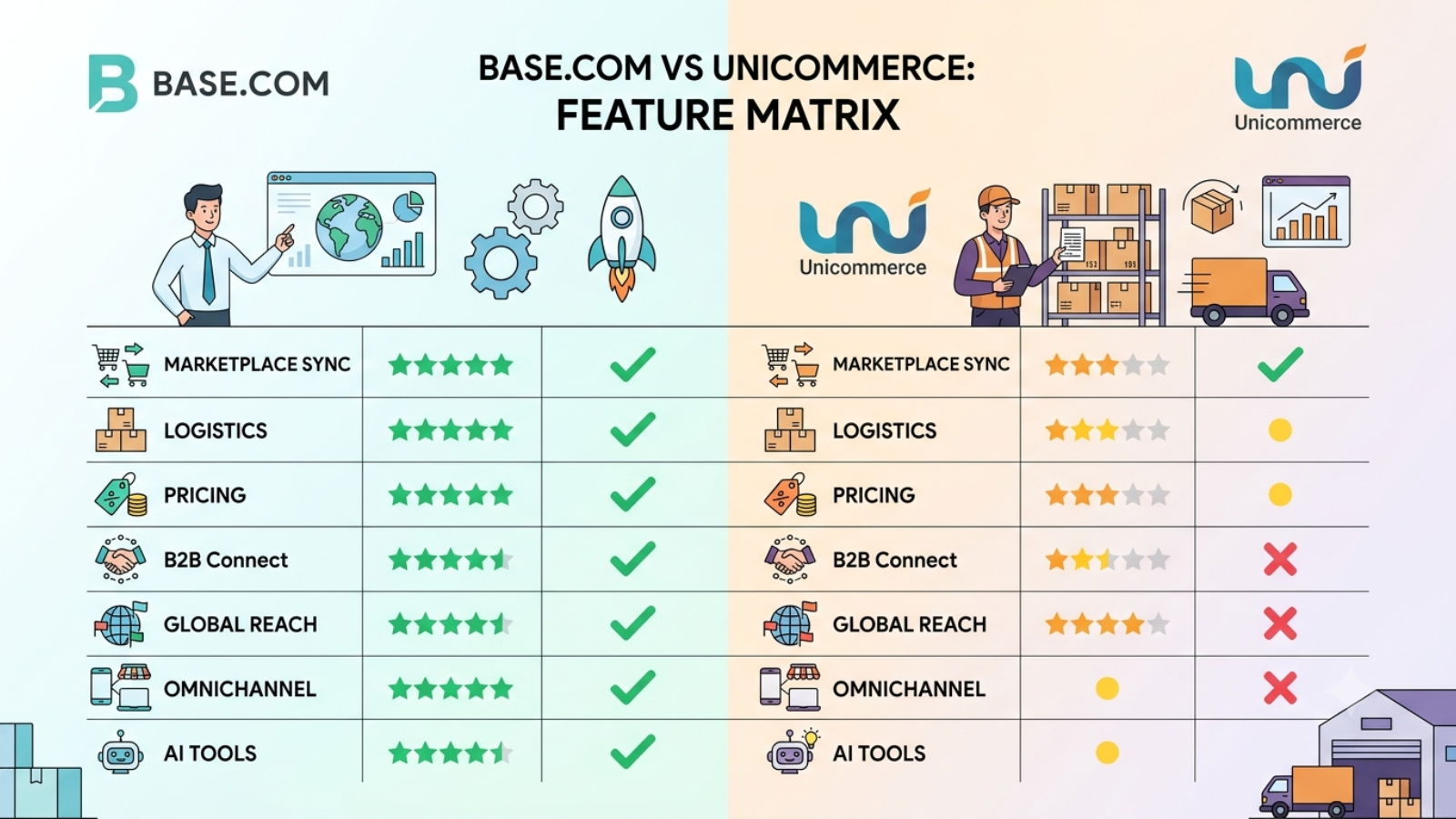 The table below covers every major capability in the Base.com vs Unicommerce comparison. Use it to score both platforms against your specific requirements. For brands shortlisting the best alternative to Unicommerce, this matrix is the fastest way to identify where Base.com closes gaps.
| Module | Feature | Base.com | Unicommerce |
|---|---|---|---|
| OMS | Multi-channel aggregation | ✓ (350+ channels) | ✓ (200+ channels) |
| OMS | Real-time order sync | ✓ | Batch (2–5 min) |
| OMS | Split shipment auto | ✓ | Manual config |
| OMS | Backorder automation | ✓ | Manual |
| OMS | B2B order support | ✓ | ✓ |
| WMS | Bin-level location | ✓ | ✓ |
| WMS | Scan-verify at packing | ✓ | ✓ |
| WMS | FEFO enforcement | ✓ | ✓ |
| WMS | Wave/batch picking | ✓ | Basic |
| WMS | Perpetual inventory | ✓ | Periodic |
| Courier | Auto allocation rules | ✓ | ✓ |
| Courier | Auto NDR outreach | ✓ | ✗ |
| Courier | NDR re-delivery rate | 60–70% | 28–40% |
| Returns | Auto disposition rules | ✓ | ✗ |
| Returns | Same-day restocking | ✓ | 3–7 days typical |
| ERP | SAP native integration | ✓ (real-time) | ✓ (batch) |
| ERP | NetSuite native | ✓ | API-based |
| Reporting | Real-time dashboard | ✓ | 15–30 min lag |
| Reporting | NDR funnel | ✓ | ✗ |
| Reporting | Courier scorecard | ✓ | Export-based |
| Pricing | Transparent listing | Quote-based | Quote-based |
| Implementation | Standard timeline | 2–6 weeks | 2–6 weeks |
| Support | ERP-certified support | ✓ | Limited |
One of the most significant differences often overlooked in Base vs Unicommerce comparisons is the level of customization available to growing eCommerce brands. While both platforms handle order management and inventory synchronization, Base extends far beyond traditional OMS functionality.
It includes automated product listing capabilities, a built-in Product Information Management (PIM) system, a dedicated B2B CRM, marketplace and dropshipping network access through Base Connect, and marketplace repricing features. These capabilities allow brands to manage catalog operations, wholesale relationships, and pricing strategies from a single platform rather than relying on multiple third-party tools.
The customization advantage becomes even more apparent in operational reporting and business intelligence. Base allows businesses to fully customize reports and operational documents, including Purchase Orders (POs), Invoices, Goods Receipt Notes (GRNs), Delivery Challans (DCs), and Lorry Receipts (LRs), making it easier to align workflows with internal processes.
Additionally, its P&L Dashboard with AI-assisted analytics provides deeper visibility into profitability, operational performance, and decision-making. These features position Base as a broader commerce operations platform, whereas Unicommerce remains primarily focused on order, inventory, warehouse, and fulfillment management workflows.
Base.com is an order and warehouse management platform built for Indian D2C and enterprise ecommerce brands. It integrates with 50+ sales channels, all major Indian logistics providers, and ERP systems, including SAP and NetSuite. Learn more at base.com.
Frequently Asked Questions
Q1: Is Base.com better than Unicommerce for D2C brands in India?
Base.com is better for brands needing WMS, ERP integration, and NDR automation in one platform. Unicommerce suits channel aggregation. For D2C brands above 500 orders/day, execution becomes the bottleneck, making Base.com the stronger choice.
Q2: What does Unicommerce do better than Base.com?
Unicommerce offers 200+ marketplace integrations and faster onboarding (2–3 weeks). It works well for brands selling across many channels or needing quick setup, supported by a larger partner ecosystem.
Q3: Can I use Base.com as an Unicommerce alternative if I am already on SAP?
Yes. Base.com integrates natively with SAP (SD, MM, WM), removing batch sync issues. It is ideal for brands needing real-time operations and stronger warehouse execution beyond Unicommerce’s capabilities.
Q4: What is the pricing difference between Base.com and Unicommerce?
Both are quote-based. Base.com is typically 15–25% higher but includes WMS, NDR automation, and ERP integration. Total cost often favors Base.com due to reduced RTO, labour, and operational inefficiencies.
Q5: How long does it take to migrate from Unicommerce to Base.com?
Migration takes 4–8 weeks. OMS setup completes in 1–2 weeks, while warehouse setup, bin mapping, and training take longer. Base.com provides dedicated migration support for a smooth transition.