When Indian omnichannel brands compare Base.com vs Vinculum, the decision is not just about features; it is about which platform can actually keep up with India’s ecommerce pace.
Base.com vs Vinculum is one of the most searched comparisons among D2C and enterprise brands evaluating order management software in India today. Brands actively searching for the best alternative to Vinculum consistently land on Base.com as the top contender, and this blog gives you a direct, data-backed answer so you can make the right call.
India’s ecommerce market is on track to hit $226 billion by 2026. Brands running multi-channel operations across Amazon, Flipkart, Shopify, Blinkit, and Meesho need an OMS that handles the full order lifecycle without breaking.
That is where the Base.com vs Vinculum comparison gets critical, and why so many scaling brands are evaluating Base.com as the best alternative to Vinculum for their operational stack.
What Each Platform Does
Before going deeper into Base.com vs Vinculum, here is what each platform is built for.
Base.com is an AI-powered order and supply chain management platform designed for Indian D2C and enterprise brands. It connects your sales channels to your ERP, SAP, NetSuite, or Tally in real time. It manages orders, inventory, warehouse operations, invoicing, and returns from one platform. Base.com is built for the way Indian ecommerce actually works: multi-channel, COD-heavy, and ERP-dependent. For brands evaluating the best alternative to Vinculum with native ERP integration, Base.com is the most direct replacement.
Vinculum is a Noida-based OMS and WMS vendor that has been operating in India since 2007. Its core product is Vin eRetail, an omnichannel commerce platform covering order management, warehouse management, and marketplace integrations. Vinculum has a broad integration library and has served large Indian retailers across fashion, FMCG, and electronics.
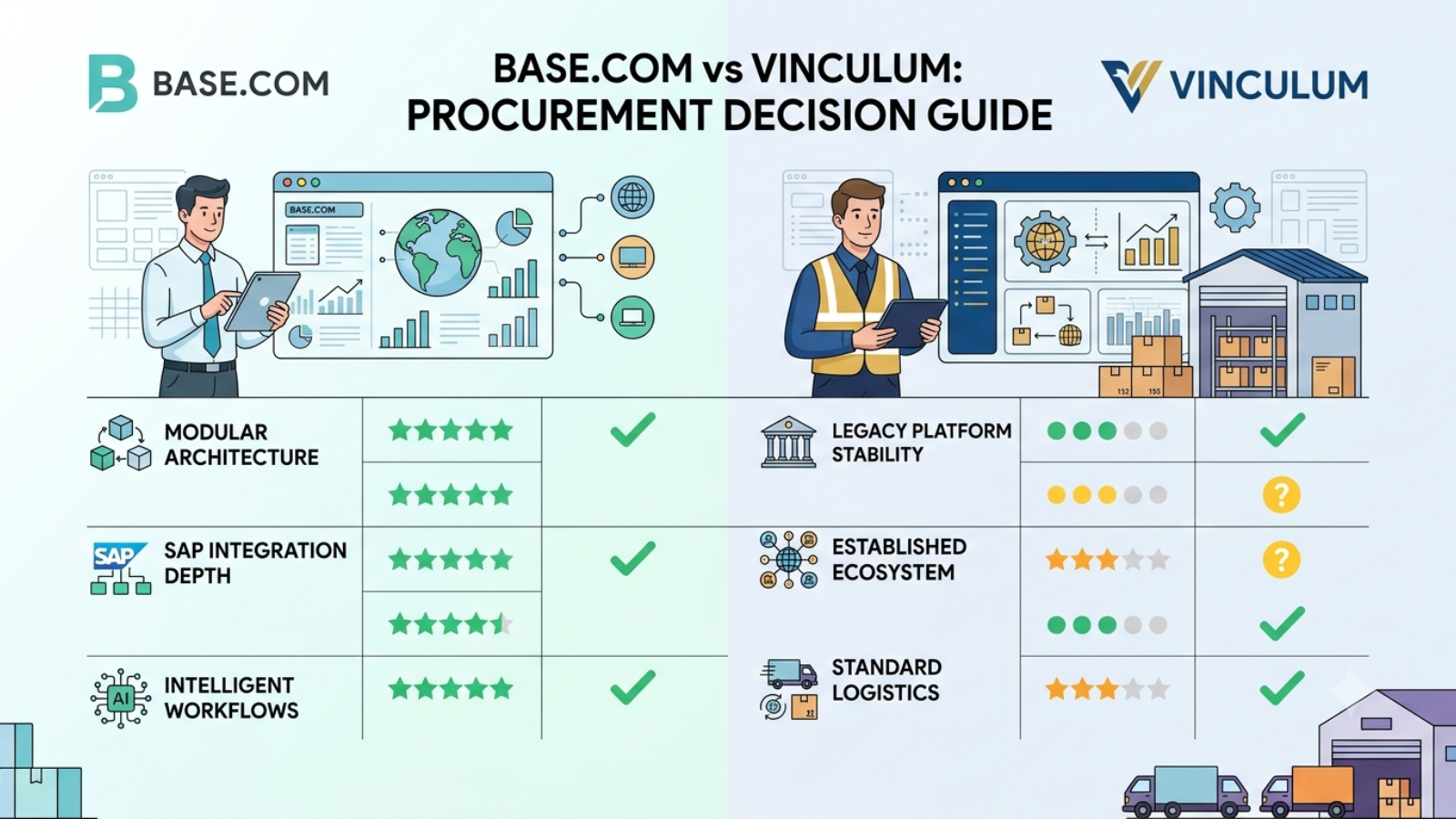 Both platforms target the Indian market. But the architecture, integration depth, and operational intelligence they offer are very different, which is exactly why Base.com vs Vinculum keeps coming up in procurement discussions, and why Base.com is frequently shortlisted as the best alternative to Vinculum for D2C and SAP-integrated brands.
Base.com vs Vinculum: Full Feature Comparison
This table gives you the complete picture across every dimension that matters for Indian omnichannel operations. Brands using this table to identify the best alternative to Vinculum should pay particular attention to the ERP integration, AI intelligence, and quick-commerce rows.
| Feature | Base.com | Vinculum |
|---|---|---|
| ERP integration (SAP / NetSuite) | Native, real-time, bi-directional | Batch-sync requires custom middleware |
| AI-powered fulfillment intelligence | Yes, proactive error detection | No, reactive, report-based |
| Quick-commerce (Blinkit, Zepto, Swiggy) | Fully supported, SLA routing | Limited; needs custom configuration |
| COD reconciliation | Automated, remittance-level | Semi-manual, report-based |
| Real-time inventory sync | Yes, all channels and warehouses | Yes, some channels |
| D2C brand suitability | Built for all types: D2C, mid-market and enterprise users | Built for enterprise WMS users |
| Onboarding time | 4-6 weeks | 8-12 weeks |
| Customer support model | Dedicated account management | Ticket-based; |
| Pricing model | Modular, pay per module | Volume licensing |
| SAP S/4HANA Cloud | Native import interface supported | Partial; not out-of-the-box |
| Pack configuration (L1-L5 hierarchy) | Supported with UOM alignment | Basic SKU-level only |
| GST invoicing and e-way bill | Available via Zoho | Available; additional setup needed |
| RTO reduction intelligence | Custom workflow builders | Partially available |
| Returns management | Automated reverse logistics workflows | Operational; no predictive layer |
| Customizations in OMS and workflows | Self service and included in pricing | Additional costs |
| Dynamic repricing | Available for some marketplaces | Not available |
| AI based listing agents | Available | Not available |
| B2B Connect (Dropshipping/marketplace backend) | Available | Not available |
| B2B CRM | Available natively | Available through partners |
In the Base.com vs Vinculum comparison, Base.com leads on integration quality, AI intelligence, and D2C readiness. Vinculum leads on legacy WMS depth for very large 3PL operations.
For most Indian D2C and omnichannel brands, Base.com is the best alternative to Vinculum on total operational value.
1. ERP Integration: The Most Important Technical Difference
 The biggest gap in Base.com vs Vinculum is how each platform connects to your ERP. For SAP and NetSuite users, this single dimension is what makes Base.com the best alternative to Vinculum in the Indian market.
Base.com integrates natively with SAP ECC, SAP S/4HANA (including Cloud), and NetSuite. Orders flow from your sales channels into SAP automatically. Sales Order creation, Outbound Delivery generation, invoice posting, and credit note management happen via direct API calls, not file uploads or batch scripts.
When a Base.com customer receives an order on Amazon, here is what happens without human intervention:
- Stock is validated in real time against SAP inventory
- The Sales Order is created in SAP with the correct UOM, pricing, and tax codes
- Outbound Delivery is triggered after warehouse confirmation
- The GST-compliant invoice is posted to SAP and sent to the customer
- The marketplace is updated with tracking details automatically
Vinculum’s SAP integration depends on scheduled batch runs and middleware scripts. For SAP S/4HANA Cloud specifically, Vinculum does not offer a native import interface. Brands on SAP Cloud need custom development, which means additional cost, longer timelines, and ongoing maintenance overhead.
This middleware dependency is the primary technical reason SAP-first brands identify Base.com as the best alternative to Vinculum when upgrading their operations stack.
For any Indian brand where ERP accuracy is non-negotiable, such as FMCG, pharma, and consumer electronics, this difference in Base.com vs Vinculum is decisive.
2. OMS for D2C Brands India: Where Base.com Pulls Ahead
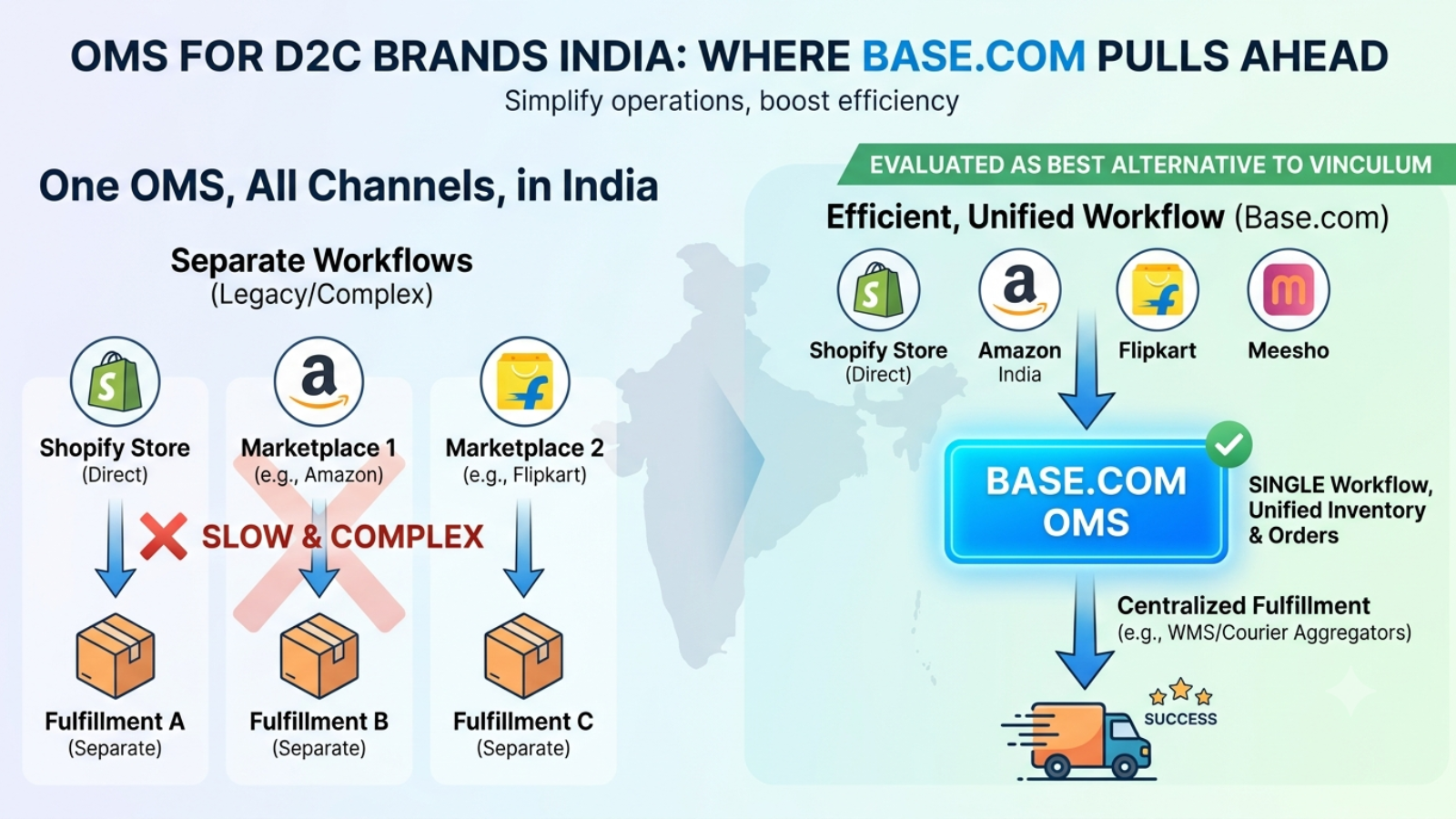 India’s D2C segment is growing at a 40% CAGR. Brands selling on their own Shopify store while also listing on Flipkart, Amazon, and Meesho need an OMS that does not require separate workflows for each channel. This is a core reason Base.com is evaluated as the best alternative to Vinculum for D2C-first operations.
Base.com unifies this with a single order queue, a single inventory pool, and a single fulfillment workflow across all channels. Whether the order comes from your Shopify store, Meesho, or Blinkit, it is processed identically, with channel-specific compliance rules handled at the platform level.
Vinculum requires separate configuration for D2C versus marketplace orders. For a brand managing 1,000-10,000 orders per day across six channels, that fragmentation adds up to real operational overhead.
Base.com’s D2C-specific capabilities:
- Native Shopify and WooCommerce integration with real-time sync
- SLA-based carrier allocation across Delhivery, Bluedart, Shiprocket, Ecom Express
- Pre-shipment barcode QC checks
- Auto-generated GST-compliant invoices per order
- RTO risk scoring per order before dispatch
COD returns in India run at 25-30% across most categories. That is your single biggest controllable cost. Base.com addresses it before the package leaves the warehouse. Vinculum does not have this capability, which is why D2C brands with high COD share consistently evaluate Base.com as the best alternative to Vinculum for their growth stage.
3. Reduce RTO India with the Best OMS in India
 RTO (Return to Origin) is the most expensive recurring operational cost for Indian ecommerce brands. Every undelivered order means paying for forward shipping, return shipping, and reprocessing, with zero revenue to show for it.
In the Base.com vs Vinculum comparison, this is where the difference is most tangible for operations teams. For any brand where reducing RTO India is a top operational priority, Base.com is the best alternative to Vinculum with a purpose-built intelligence layer.
Base.com scores every order for delivery risk before dispatch using:
- Address completeness and pin code serviceability check
- Customer order history, repeat buyer vs first-time order
- Payment mode, COD vs prepaid signals
- Channel and time-of-day origin data
High-risk orders are automatically flagged. Operations teams can trigger COD verification calls, switch orders to prepaid-only, or hold for manual review, before the shipment leaves the warehouse. This is embedded in the standard Base.com workflow, not an add-on module.
Vinculum handles returns operationally, return receipt, reverse QC, and re-stocking, but has no pre-dispatch intelligence layer. If reducing RTO is a top-three priority for your business, the Base.com vs Vinculum answer is straightforward: Base.com is the best alternative to Vinculum for any operations team that wants to stop paying for preventable RTO.
4. Omnichannel Channel Coverage: Base.com vs Vinculum
| Channel | Base.com | Vinculum |
|---|---|---|
| Amazon India | Full API, real-time | Full API, real-time |
| Flipkart (including Flipkart Minutes) | Yes, quick-commerce SLA supported | Basic integration only |
| Blinkit / Zepto / Swiggy Instamart | Yes, SLA routing, pack size validation | Limited; custom config required |
| Myntra / Ajio | Supported | Supported |
| Shopify / WooCommerce | Native real-time sync | Available; some sync lag |
| Meesho | Supported | Supported |
| Modern trade / B2B (via SAP) | Native through ERP integration or Base Custom orders module | Requires custom development |
For quick-commerce specifically, the Base.com vs Vinculum gap is significant. Blinkit, Zepto, and Swiggy Instamart require sub-30-minute order-to-dispatch workflows with strict pack validation rules.
Base.com’s architecture handles this natively. Vinculum’s batch-processing model creates latency that quick-commerce SLAs cannot absorb. For brands expanding into quick-commerce, Base.com is the best alternative to Vinculum that can handle these SLAs out of the box.
5. Warehouse Management: Comparing the WMS Modules
 Both platforms include warehouse management. Here is how they compare for Indian brand operations.
Base.com WMS:
- Barcode scanning for inbound receipts and outbound dispatch
- Multi-pack hierarchy support, L1 to L5, with full UOM alignment
- Bin-level inventory tracking across multiple DCs
- Pick-pack-ship workflows with QC checkpoints
- Cycle counts and stock reconciliation are built in
Vinculum WMS:
Vinculum’s WMS is one of its stronger modules. For brands running very large 3PL operations with 100,000+ SKUs across multiple distribution centres, Vinculum has more battle-tested floor management workflows at scale. This is genuinely where Vinculum has an edge.
However, for mid-market Indian brands with INR 10 crore to 200 crore annual GMV, Base.com’s WMS is the right fit. The key advantage is that in Base.com, OMS and WMS are not two separate products integrated. They are on the same platform.
Inventory updates from the warehouse floor are reflected in the order management layer instantly, with no sync delay. This unified architecture is what makes Base.com the best alternative to Vinculum for brands that need OMS-WMS-ERP to behave as one system.
In the Base.com vs Vinculum WMS comparison, the deciding factor is whether you need large-scale 3PL depth (Vinculum) or tight OMS-WMS-ERP integration (Base.com).
6. Pricing: What Indian Brands Should Know
 Neither platform publishes public pricing. Both are enterprise SaaS products priced on order volume, channel count, and module selection.
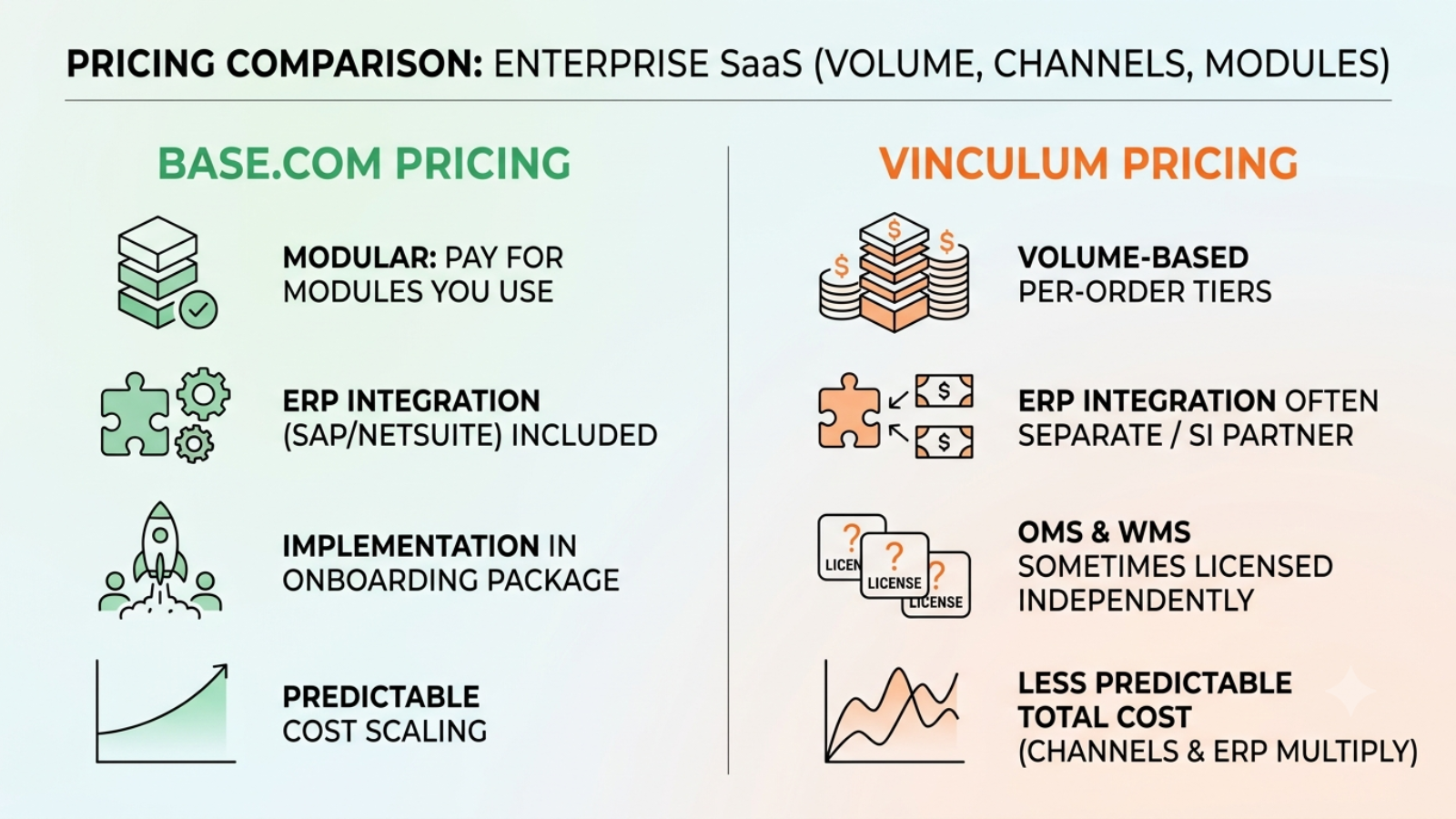
Base.com pricing:
- Modular, activate and pay for only the modules you use
- ERP integration (SAP/NetSuite) is included in the platform, not a separate charge
- Implementation included in onboarding package
- Predictable cost scaling as order volumes grow
Vinculum pricing:
- Volume-based licensing with per-order tiers
- ERP integration is often priced separately or requires SI partner engagement
- OMS and WMS are sometimes licensed independently, depending on the deal structure
- Total cost becomes less predictable as channels and ERP touchpoints multiply
For brands scaling from 1,000 to 50,000 monthly orders, Base.com’s modular model is consistently more cost-efficient in the Base.com vs Vinculum pricing comparison. Vinculum’s model works better for very large operations where volume discounts offset the complexity cost.
On total cost of ownership, including ERP connector fees, middleware maintenance, and implementation overhead, Base.com is the best alternative to Vinculum for brands in the INR 10-500 crore GMV range.
7. Implementation and Migration
 Many Indian brands currently on Vinculum are actively evaluating migration to Base.com. If you are searching for the best alternative to Vinculum that offers a structured migration path, Base.com provides a dedicated team for the full transition. The standard migration path covers:
- SKU master data, customer master, price lists, and pack configuration transfer
- Channel re-mapping, marketplace API keys, warehouse zone assignments
- ERP connector setup, validation testing (SO creation, OBD sync, invoice posting)
- Parallel run mode before full cutover
A typical Base.com vs Vinculum migration completes in 6-8 weeks with a dedicated implementation team. Base.com does not charge separate professional services fees for standard integrations. Vinculum migrations tend to run 8-14 weeks due to middleware complexity and ERP reconfiguration requirements.
Indian Client Results on Base.com
Base.com has live deployments across Indian brands in FMCG, consumer goods, retail, and D2C. Documented outcomes include:
- Order processing time reduced from 3 hours to 30 minutes
- Packing error rates reduced from 3-4% to effectively 0%
- Multi-channel inventory visibility achieved in real time across all channels
- SAP SO creation is fully automated, with zero manual data entry
These numbers are from actual Base.com deployments in India, not benchmarks or estimates. When brands evaluate Base.com vs Vinculum and ask for proof of outcomes, these are the numbers Base.com brings to the table.
They are also the reason brands that have gone through a structured evaluation consistently conclude Base.com is the best alternative to Vinculum for operationally mature D2C brands.
Which Platform Should You Choose?
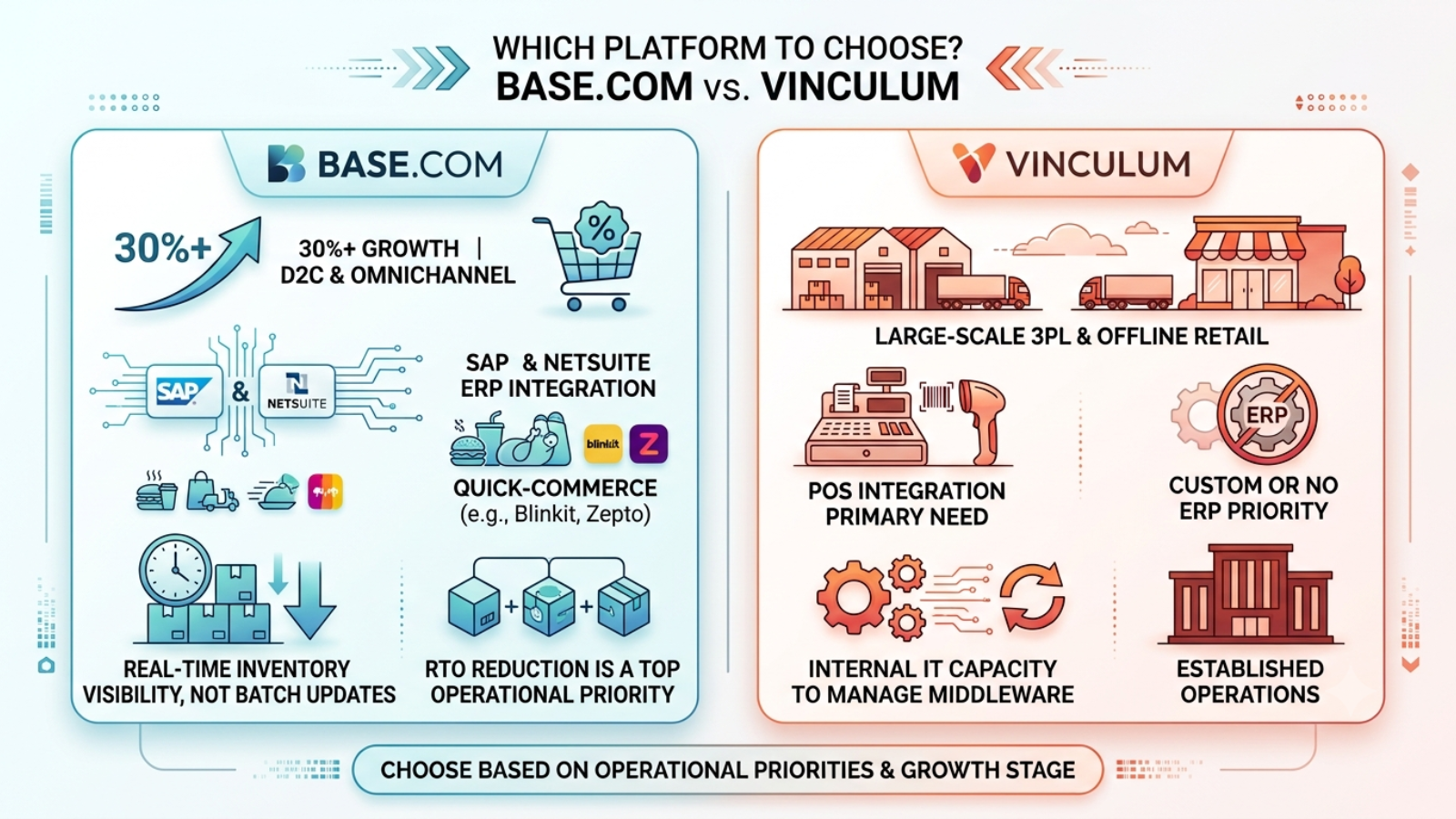 The choice between Base.com and Vinculum comes down to your operational priorities and growth stage.
Choose Base.com if:
- You are a D2C or omnichannel brand growing at 30%+ annually
- You use SAP (ECC or S/4HANA) or NetSuite as your ERP
- You sell on Blinkit, Zepto, Swiggy Instamart, or other quick-commerce platforms
- RTO reduction is a top operational priority
- You want OMS, WMS, and ERP integration in one platform
- You need real-time inventory visibility, not batch updates
- You have evaluated the market and concluded that Base.com is the best alternative to Vinculum for your growth stage
Choose Vinculum if:
- You are running a large-scale 3PL or established offline-first retailer
- ERP integration is not a priority, or you have a custom ERP
- POS integration for physical retail is your primary need
- You have internal IT capacity to manage middleware and batch sync
For most Indian D2C and omnichannel brands in the INR 10 crore to 500 crore GMV range, Base.com is the right answer. In the Base.com vs Vinculum decision, Base.com is the best OMS India brand at this growth stage, and the best alternative to Vinculum for any brand that has outgrown Vinculum’s integration model.
Summary
| Criterion | Base.com | Vinculum |
|---|---|---|
| Best for | D2C, omnichannel, SAP/NetSuite brands | Large-scale retail, 3PL operations |
| ERP integration quality | Native, best-in-class | Custom middleware required |
| Quick-commerce readiness | Yes, fully supported | Limited |
| RTO reduction | AI-powered pre-dispatch scoring | Not available |
| Implementation speed | 4-6 weeks | 8-12 weeks |
| Support quality | Dedicated account management | Ticket-based |
| Pricing flexibility | Modular | Volume license |
| Real-time inventory | Yes | Batch updates |
The Base.com vs Vinculum comparison consistently favours Base.com for any Indian brand that is scaling, ERP-integrated, or operating across quick-commerce and D2C channels simultaneously.
Vinculum remains a viable option for very large 3PL operations where WMS floor management depth outweighs integration agility. For every other segment, Base.com is the best alternative to Vinculum available in the Indian market today.
If you are evaluating Base.com vs Vinculum for your business, the best next step is to request a Base.com demo with your specific channel and ERP stack, and benchmark it directly against your current Vinculum setup.
Frequently Asked Questions
Q1: Is Base.com better than Vinculum for D2C brands in India?
Yes. Base.com is built specifically for Indian D2C and omnichannel operations, with native SAP and NetSuite integration, quick-commerce support, and pre-dispatch RTO reduction. Vinculum is better suited to large-scale 3PL and offline-first retail operations. For D2C brands evaluating the best alternative to Vinculum, Base.com is the most purpose-built option in India.
Q2: Which is the best OMS in India for Shopify brands selling on multiple marketplaces?
Base.com. It offers native Shopify integration with real-time order sync, automated GST invoicing, and multi-channel inventory management from one platform. It is the best order management software India Shopify brands can use to scale without ERP disconnects, and the best alternative to Vinculum for Shopify-first D2C operations.
Q3: Can Base.com replace Vinculum for SAP-integrated brands?
Yes. Base.com supports SAP ECC and SAP S/4HANA (including Cloud) natively, making it the best alternative to Vinculum for any brand where ERP integration quality is a hard requirement. Migration from Vinculum typically completes in 6-8 weeks, covering all master data, ERP connectors, and channel re-mapping.
Q4: How does Base.com reduce RTO for Indian ecommerce brands?
Base.com scores every COD order for delivery risk before dispatch, using address validation, customer history, payment mode, and channel signals. High-risk orders are flagged automatically so operations teams can intervene before the shipment leaves the warehouse. This pre-dispatch intelligence layer is one of the clearest reasons Base.com is the best alternative to Vinculum for COD-heavy brands.
Q5: Which platform has better pricing for Indian brands scaling from 1,000 to 50,000 monthly orders?
Base.com. Its modular pricing model charges only for the modules activated, with ERP integration included. Vinculum’s volume-based licensing becomes less predictable as channels and ERP touchpoints increase. On total cost of ownership, Base.com is the best alternative to Vinculum for brands in this growth range.