Quick commerce has changed how people shop in India. Today, customers expect groceries, personal care products, and medicines to arrive within 10 to 20 minutes. Platforms like Blinkit, Zepto, and Swiggy Instamart have built their promise around this speed. But behind this convenience lies one of the biggest operational challenges for brands: last mile delivery in quick commerce.
For Indian sellers entering these platforms, the economics are very different from traditional eCommerce. In quick commerce, the final delivery leg from a dark store to the customer often represents 40 to 50 percent of the total logistics cost. This is mainly because orders are small. The average quick commerce basket size in India is ₹450 to ₹600, yet each delivery still requires a rider, fuel, and dispatch coordination.
Another factor Indian sellers often miss is inventory placement. Quick commerce platforms operate through micro warehouses of 2,000 to 5,000 sq. ft. located within dense urban areas. If a seller’s products are not stocked in these dark stores, they simply do not appear in the app for that delivery zone.
For example, FMCG brands entering Blinkit typically need 15 to 20 dark store placements per metro city to achieve consistent visibility and reduce last-mile logistics costs.
Because of this structure, improving delivery cost optimization is not only a logistics decision but also an inventory and demand planning strategy within the Q-commerce logistics model.
Understanding the Economics of Last Mile Delivery in Quick Commerce
At first glance, last-mile delivery in quick commerce looks simple. A rider collects an order from a nearby dark store and delivers it to the customer within minutes. However, the system behind this process is complex and expensive. For Indian D2C brands selling through platforms like Blinkit, Zepto, and Swiggy Instamart, understanding this Q-commerce logistics model is critical to maintaining margins.
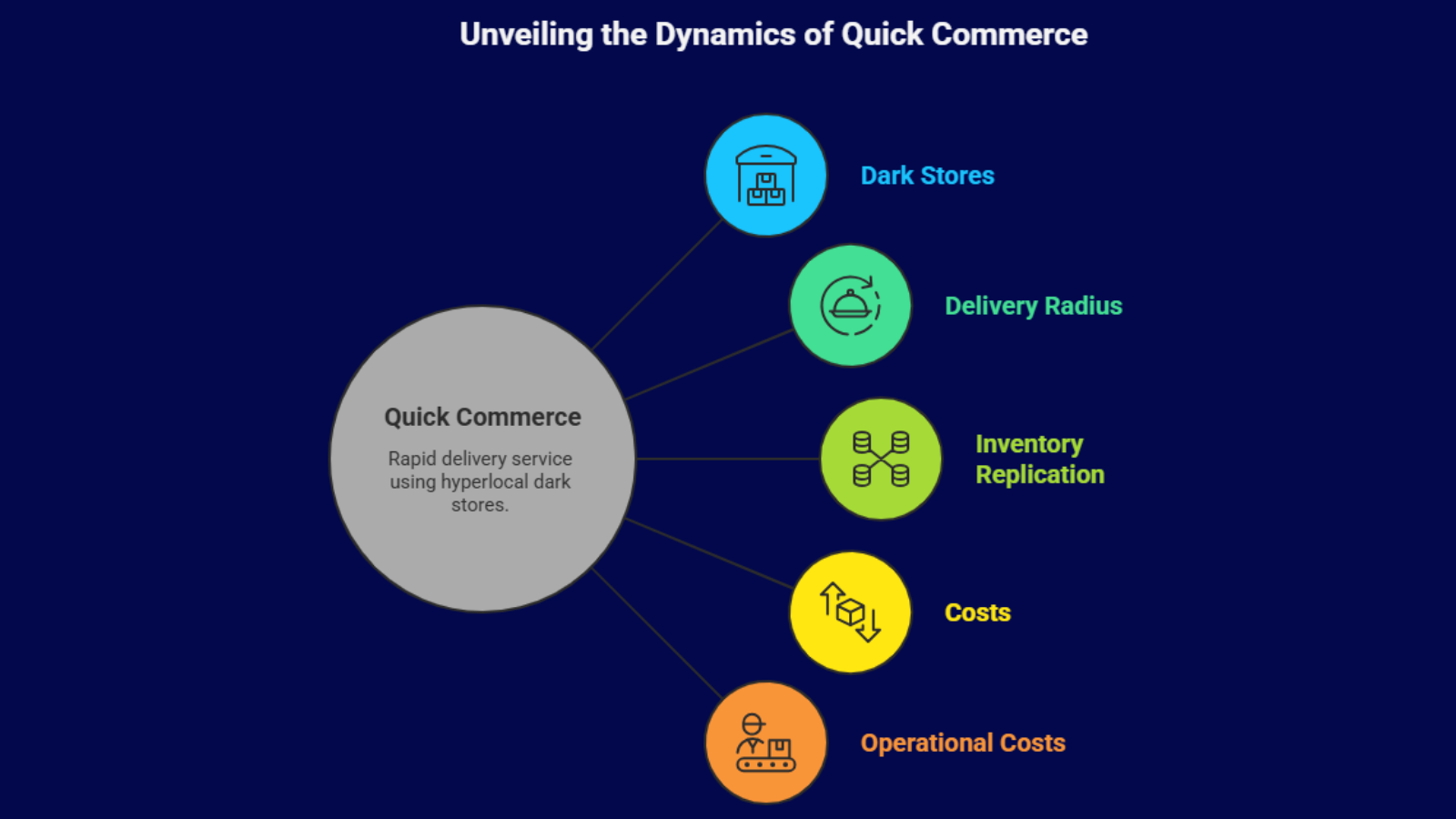 Quick commerce operates through hyperlocal micro fulfillment centers called dark stores, typically ranging between 2,000 and 5,000 sq. ft. Each dark store covers a delivery radius of about 1.5 to 3 km to maintain the 10 to 20 minute delivery promise. This means inventory must be replicated across multiple locations.
For example, a snack or beverage brand selling in Bangalore may need 20 to 30 dark store placements to cover major residential clusters. While this improves product visibility, it also increases inventory carrying costs and the last-mile logistics costs tied to replenishment and delivery.
In addition, every order requires manual picking and dispatch before it even reaches a rider, which adds operational costs to quick delivery ops.
Key Cost Components in the Q-Commerce Logistics Model
| Cost Component | Average Cost Range (India) | Impact on Operations |
|---|---|---|
| Delivery rider payout | ₹25 – ₹40 per order | Major contributor to last mile logistics cost |
| Dark store picking & packing | ₹8 – ₹15 per order | Adds operational cost before dispatch |
| Fuel and vehicle maintenance | ₹6 – ₹12 per order | Increases with frequent short-distance trips |
| Inventory duplication across dark stores | 15–30 locations per metro | Higher working capital for D2C brands |
| Failed delivery attempts | ₹120 – ₹180 per failed order | Increases delivery inefficiency |
Because orders in quick commerce are small, typically ₹450 to ₹650 average order value, these costs significantly affect profitability. This is why last-mile delivery in quick commerce often becomes the most expensive stage of the supply chain.
What This Means for Indian D2C Brands
| Operational Factor | Impact on Brands | Strategic Action |
|---|---|---|
| Low basket value orders | High logistics cost relative to product price | Create bundled SKUs or combo packs |
| Multi dark store inventory | Higher inventory investment | Maintain a 7 to 10-day stock per location |
| Hyperlocal demand variation | Uneven sales across zones | Track dark store level sales data |
| High rider delivery cost | Reduced margin per order | Focus on fast-moving SKUs |
For Indian D2C brands, success in last-mile delivery in quick commerce depends on designing products and supply chains specifically for this environment. Brands that optimize SKU size, dark store inventory placement, and demand density will see better delivery cost optimization within the Q-commerce logistics model.
Why Last Mile Delivery in Quick Commerce Is So Expensive
 The high last-mile logistics cost in quick commerce is not caused by a single issue. It comes from multiple operational constraints inside the q-commerce logistics model that most Indian brands underestimate when entering platforms like Blinkit, Zepto, and Swiggy Instamart.
Unlike traditional ecommerce where deliveries are planned hours or days in advance, last-mile delivery in quick commerce operates within extremely tight timelines. Orders must be picked, packed, and delivered within 10 to 20 minutes. This operational pressure increases the delivery cost per order significantly.
For Indian D2C sellers, the challenge is deeper. Quick commerce orders are smaller, delivery zones are hyperlocal, and inventory must sit inside multiple dark stores across a city. If brands do not understand how these systems work, their products may sell well but still lose money due to high last-mile logistics costs.
Below are the real operational reasons driving these costs and the specific implications for Indian D2C brands.
1. Small Order Sizes Reduce Delivery Efficiency
Traditional logistics systems rely on shipment consolidation. A truck might carry hundreds of orders before reaching a city hub. Quick commerce does the opposite.
Orders are extremely small.
Industry data shows that the average quick commerce order value in India ranges between ₹450 and ₹650, with most orders containing only 2 to 4 items.
But the delivery infrastructure is the same regardless of order value.
Each order still requires:
- A delivery rider
- Fuel cost
- Dispatch management
- Order picking inside the dark store
Because of this structure, the last-mile delivery in quick commerce becomes financially inefficient.
For example, if a brand sells a ₹120 snack pack through a quick commerce platform, the logistics cost can easily reach ₹60 to ₹90 per order once picking, packing, and rider delivery are included.
What Indian D2C sellers should do
- Focus on bundled SKUs instead of single low-value items
- Create quick commerce exclusive packs priced between ₹199 and ₹399
- Design products optimized for impulse buying
Brands like Yoga Bar and The Whole Truth Foods increased their quick commerce conversion by launching mini bundle packs specifically designed for dark store channels.
This improves order value and reduces the relative last-mile logistics cost.
2. Ultra Fast Delivery Limits Route Optimization
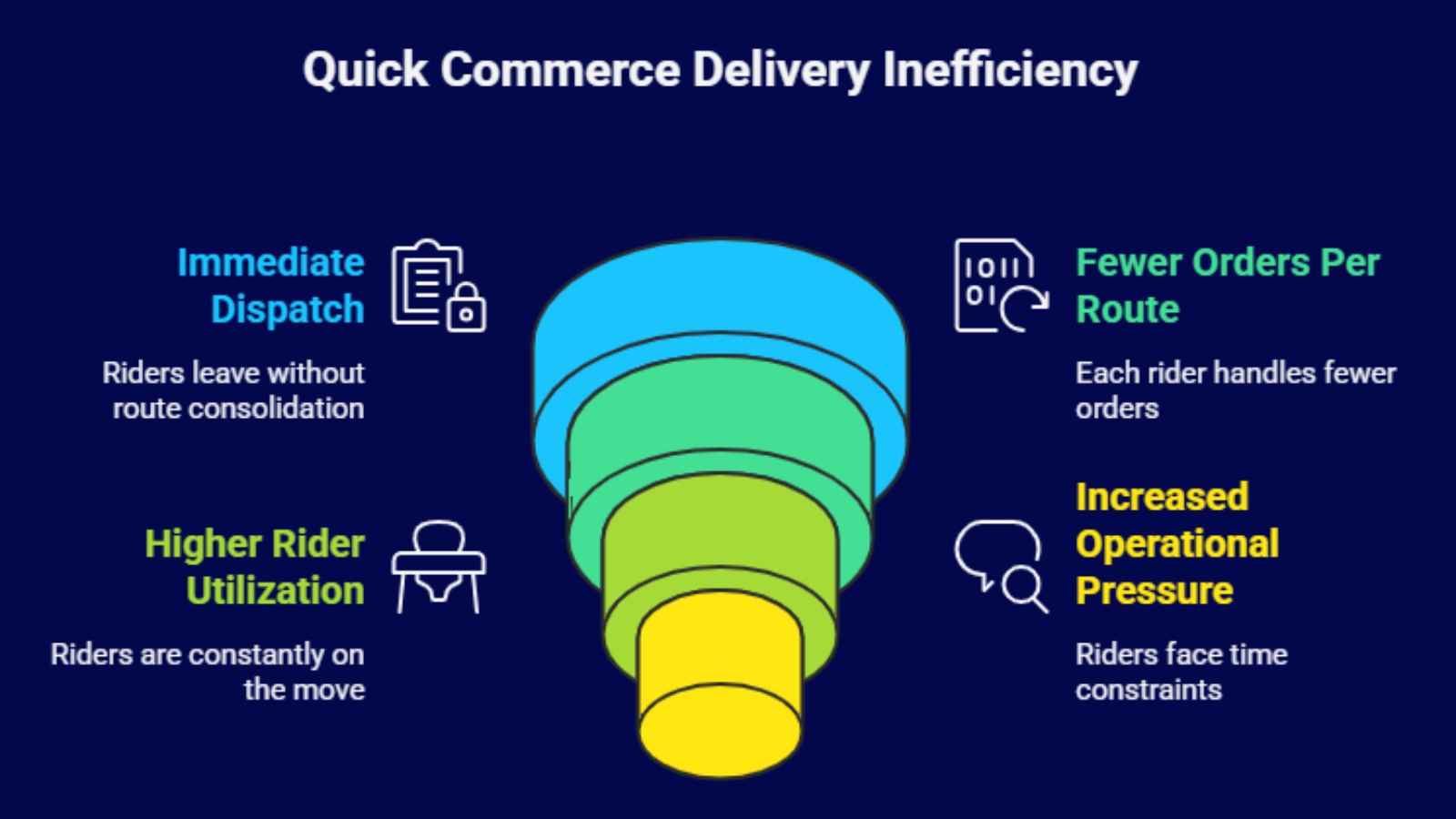 One of the biggest inefficiencies in quick delivery ops is the lack of route consolidation.
In traditional ecommerce, delivery companies combine 30 to 50 orders into a single route before dispatching vehicles.
Quick commerce cannot do that.
When platforms promise delivery in 10 to 20 minutes, riders must leave immediately after an order is packed.
This means:
- Fewer orders per delivery route
- Higher rider utilization
- Increased operational pressure
Data from Indian logistics operators shows that quick commerce riders often deliver only 2 to 3 orders per hour, compared to 10 to 15 orders per hour in traditional e-commerce last-mile delivery.
This drastically increases last mile logistics cost.
What Indian D2C sellers should do
Brands can indirectly support delivery cost optimization by improving demand clustering.
This includes:
- Running location-targeted promotions inside delivery zones
- Supporting dark store-specific demand campaigns
- Offering limited-time bundles for high-density areas
Higher-order density improves route efficiency inside the Q-commerce logistics model.
3. Dark Store Infrastructure Adds Hidden Costs
Quick commerce depends on micro warehouses called dark stores located inside residential neighborhoods.
Most dark stores in India range between 2,000 and 5,000 square feet and carry about 2,000 to 4,000 SKUs.
Operating these facilities is expensive.
Costs include:
- Real estate rent in high-density areas
- Inventory holding costs
- Staff for picking and packing
- Inventory replenishment logistics
Platforms like Zepto operate over 350 dark stores across India, while Blinkit has more than 400 micro fulfillment centers.
Each dark store must maintain high product availability to support quick delivery ops.
For D2C brands, this creates a major nuance.
If your product is not stocked inside the dark store nearest to the customer, it will not appear in search results.
What Indian D2C sellers should do
To reduce last-mile delivery inefficiencies in quick commerce:
- Ensure multi-dark store inventory placement
- Maintain a minimum of 7 to 10 days of stock coverage per dark store
- Track sell-through rates by micro location
Brands that optimize inventory placement reduce unnecessary replenishment and improve delivery cost optimization.
4. High Labor Dependency in Quick Delivery Ops
 Labor is the largest operational expense in quick delivery ops.
Quick commerce riders are paid through a combination of:
- Base pay
- Per order incentives
- Surge bonuses during peak hours
In cities like Bangalore and Mumbai, delivery riders can earn ₹25 to ₹40 per order, depending on the platform.
If a rider completes 25 deliveries per day, the labor cost alone can reach ₹800 to ₹1,000 daily per rider.
At scale, this becomes a major component of last mile logistics cost.
The challenge is even bigger because India faces a rider shortage.
Industry studies show over 35 percent of logistics companies struggle to hire enough delivery drivers, which forces platforms to increase incentives.
What Indian D2C sellers should do
Brands should focus on high-velocity SKUs.
Products that sell frequently improve rider productivity and reduce idle time inside the Q-commerce logistics model.
Good examples include:
- Ready-to-eat snacks
- Energy drinks
- Instant noodles
- Convenience grocery packs
These categories generate high-order frequency and support efficient last-mile delivery in quick commerce.
5. Urban Traffic Slows Delivery Productivity
Quick commerce operates mostly inside metro cities where traffic congestion is severe.
In cities like Bangalore, Mumbai, and Delhi:
- Average urban traffic speed ranges between 18 and 22 km per hour
- Delivery riders often travel less than 1.5 km per order
Even small traffic delays reduce rider productivity and increase last-mile logistics costs.
For example, if a rider loses 10 minutes in traffic, they may complete two fewer deliveries per hour.
Over thousands of daily deliveries, this significantly increases operational expenses.
What Indian D2C sellers should do
Brands should prioritize geo demand clustering.
This means:
- Running campaigns focused on specific apartment complexes
- Targeting dense residential clusters
- Supporting neighborhood-level demand spikes
Higher-order concentration improves delivery cost optimization.
6. Failed Deliveries and Order Cancellations
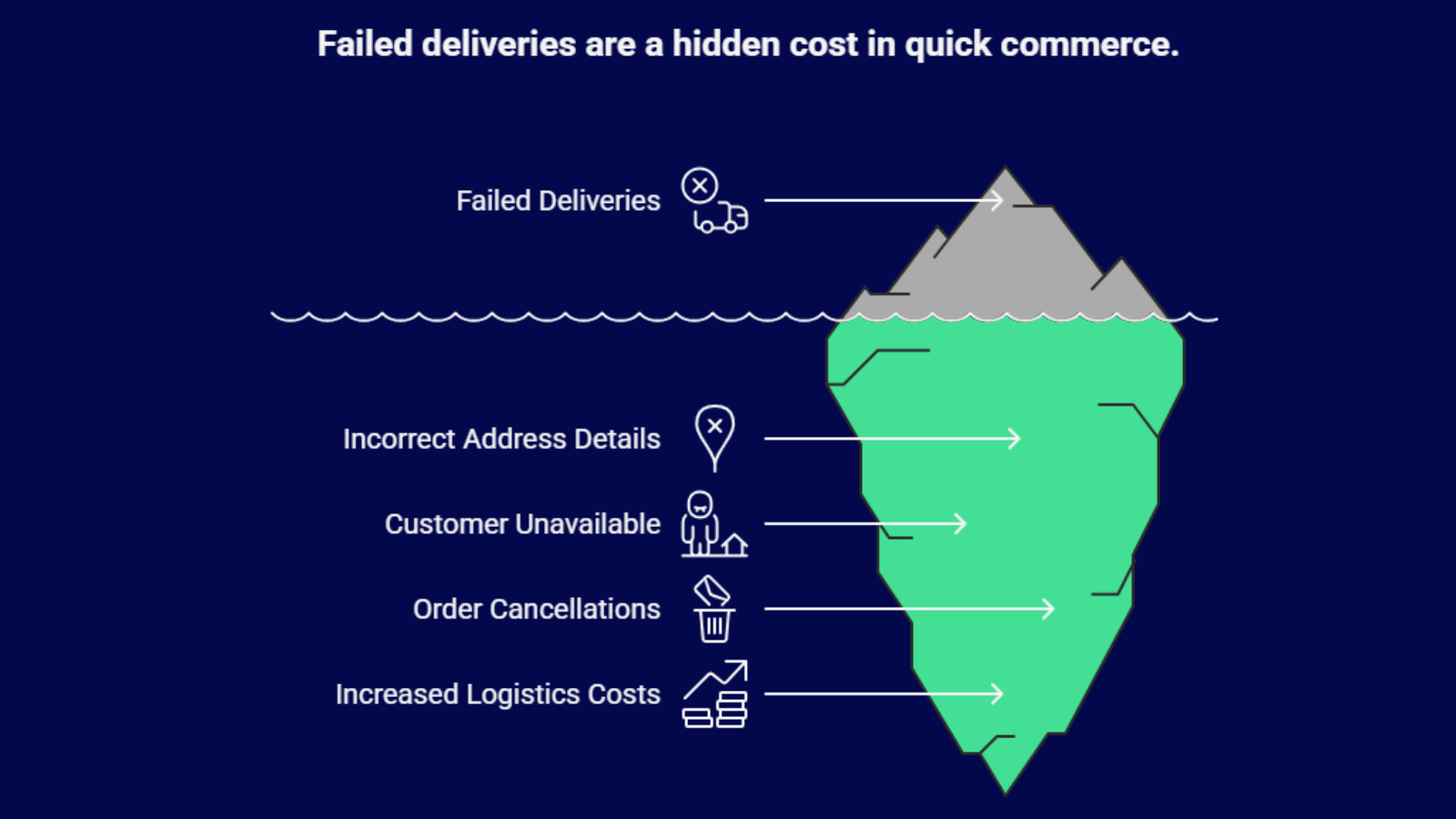 Failed deliveries are a hidden but serious issue in last-mile delivery in quick commerce.
Even a small failure rate increases logistics costs.
Industry data suggests that 4 to 6 percent of quick commerce deliveries fail, often due to:
- Incorrect address details
- Customer unavailable
- Order cancellations after dispatch
Each failed delivery costs logistics operators between ₹120 and ₹180 per attempt.
These costs directly increase last mile logistics cost across the system.
What Indian D2C sellers should do
Brands should minimize cancellation risks by:
- Providing clear product images
- Accurate product descriptions
- Transparent pricing
When customers clearly understand what they are buying, cancellation rates drop, which improves delivery cost optimization.
7. Low Order Density Per Dark Store
Order density is the most important variable affecting last-mile delivery in quick commerce.
A dark store serving 3,000 daily orders operates efficiently.
A dark store serving 800 orders per day struggles with high logistics costs.
Low order density creates several issues:
- Idle delivery riders
- Poor route efficiency
- Higher last-mile logistics cost per order
For platforms, increasing order density is critical to improving quick delivery ops.
What Indian D2C sellers should do
Brands can support density growth by:
- Launching dark store exclusive SKUs
- Running flash deals inside quick commerce apps
- Participating in platform growth campaigns
These strategies increase order frequency and strengthen the q-commerce logistics model.
The Future of the Q-Commerce Logistics Model and the Role of Technology
 The future of last-mile delivery in quick commerce will be shaped by technology that improves efficiency at scale. In India, quick commerce platforms already process 3 to 4 million daily orders, and this number is expected to double in the next three years. Without automation, the last-mile logistics cost will continue to rise.
One major shift is the adoption of electric delivery fleets. Platforms like Blinkit and Zepto are gradually replacing petrol scooters with EVs. EV deliveries can reduce fuel costs by 30 to 40 percent per kilometer, which directly improves delivery cost optimization in dense urban areas.
Another major improvement comes from AI-powered demand prediction. Quick commerce companies analyze historical ordering patterns to predict demand at the neighborhood level. For example, snack and beverage sales in Indian metro cities typically spike between 7 PM and 10 PM, so dark stores pre-stock these SKUs to support faster quick delivery ops.
For Indian D2C sellers, this creates a unique opportunity. Brands that integrate with logistics and order orchestration platforms can track demand across multiple dark stores, improve replenishment cycles, and reduce stockouts.
Technology platforms that combine order management, routing intelligence, and inventory analytics help sellers reduce last-mile logistics costs while scaling efficiently within the Q-commerce logistics model.
Build Smarter Quick Commerce Operations with Base.com
If your business operates in quick commerce, optimizing the q-commerce logistics model is essential for long term profitability.
Base.com helps companies streamline quick delivery ops, automate fulfillment workflows, and improve delivery cost optimization through intelligent logistics orchestration.
If you want to reduce last-mile logistics cost while scaling last-mile delivery in quick commerce, explore how Base.com can support your operations.
Frequently Asked Questions
1. How much margin should D2C brands expect on quick commerce platforms like Blinkit or Zepto?
Most Indian D2C brands operate on 15 to 25 percent effective margins after platform commissions, dark store margins, and marketing spends. Because last-mile delivery in quick commerce is expensive, brands must price products strategically to remain profitable.
2. How many dark stores should a brand be present in to see meaningful sales?
For a metro city, brands typically need placement in 15 to 30 dark stores to achieve consistent visibility. Limited placement reduces discoverability and increases inventory movement costs inside the Q-commerce logistics model.
3. What SKU sizes work best for quick commerce sales?
Products priced between ₹150 and ₹400 usually perform best. These price points balance impulse buying and logistics economics, helping platforms manage last-mile logistics costs while keeping basket values healthy.
4. Why do some products sell well on Amazon but struggle on quick commerce apps?
Quick commerce customers mostly buy immediate consumption products like snacks, beverages, personal care, and convenience foods. Slow-moving or high-consideration products reduce order velocity and disrupt quick delivery ops.
5. How can D2C brands reduce stockouts across dark stores?
Brands should track daily sell-through per dark store, maintain 7 to 10 days of inventory coverage, and replenish frequently. Better inventory planning improves availability and supports efficient delivery cost optimization across the network.