If a brand is doing ₹50 crore in annual revenue, it sounds impressive, but revenue does not mean profit. That is why many ₹50Cr D2C brands are unprofitable today.
In India, customer acquisition costs have increased sharply across Meta and Google, especially in beauty, fashion, and health categories. While CAC rises, average order value often stays between ₹1,200 – ₹2,000, which limits contribution margin.
At the same time, marketplace sales come with layered costs. Beyond referral fees, sellers pay for platform ads, shipping, warehousing, and returns. If 40 percent of revenue comes from marketplaces, real margins shrink faster than expected.
Then comes COD. In many Indian categories, RTO rates can touch 20 to 25 percent. That means double shipping costs and blocked working capital.
When high CAC, marketplace expenses, COD returns, and aggressive discounting combine, brands face clear D2C profitability issues, even at ₹50 crore revenue.
₹50Cr Sounds Big, But Margins Tell the Truth
When we analyse why many ₹50Cr D2C brands are unprofitable, the first thing to understand is contribution margin.
A typical ₹50Cr brand may look like this:
| Particulars | % of Revenue | Approx Value (₹ Cr) |
|---|---|---|
| Gross Revenue | 100% | 50 |
| Cost of Goods Sold | 40% | 20 |
| Gross Margin | 60% | 30 |
| Ad Spend | 25% | 12.5 |
| Shipping & RTO | 8% | 4 |
| Discounts | 10% | 5 |
| Marketplace Fees | 8% | 4 |
| Salaries & Fixed Costs | 15% | 7.5 |
Now look at what is left.
Nothing.
This is the reality of D2C profitability issues for businesses. Even with strong revenue, the brand is barely breaking even, or worse, burning cash.
So if you are wondering why many ₹50Cr D2C brands are unprofitable, the math itself gives the first answer.
Why Many ₹50Cr D2C Brands in India Struggle With Profitability
 If a brand is doing ₹50 crore in annual revenue, it feels like it has cracked the code. Orders are flowing in. Ads are scaling. Marketplaces are contributing steady sales. But when founders sit with their finance team at the end of the year, they realise profits are missing.
This is the uncomfortable reality behind D2C profitability issues in India. At the ₹50Cr stage, small inefficiencies become large leaks.
Margins get squeezed from ads, marketplaces, operations, and poor retention systems. Let us break this down in a practical way, with numbers and fixes that Indian sellers can actually implement.
1. Rising Customer Acquisition Costs Are Breaking Unit Economics
Over the last three years, CAC in India has increased significantly across Meta, Google, and YouTube. In competitive categories like skincare, haircare, protein supplements, and fashion, CPM inflation has pushed acquisition costs from ₹300 to ₹400 earlier to ₹800 to ₹1,500 today.
Now look at real math.
If your AOV is ₹1,800 and gross margin is 60 percent, you get ₹1,080 gross contribution. Remove:
- ₹1,000 CAC
- ₹120 shipping
- ₹150 average return impact
You are negative before salaries and overheads.
Indian sellers often look at ROAS instead of contribution margin. A 3x ROAS may look healthy, but after COD RTO, platform fees, and discounts, real profitability disappears. This is a core driver of D2C profitability issues.
Fix this by:
- Setting a maximum allowable CAC based on contribution margin, not ROAS.
- Increasing AOV through combo packs priced above ₹2,499.
- Building strong 30-day retention flows through WhatsApp and email to improve LTV.
- Separating new customer CAC from repeat CAC and tracking both weekly.
Without CAC discipline, ₹50Cr revenue only multiplies losses.
2. Discount Addiction Is Quietly Destroying Margins
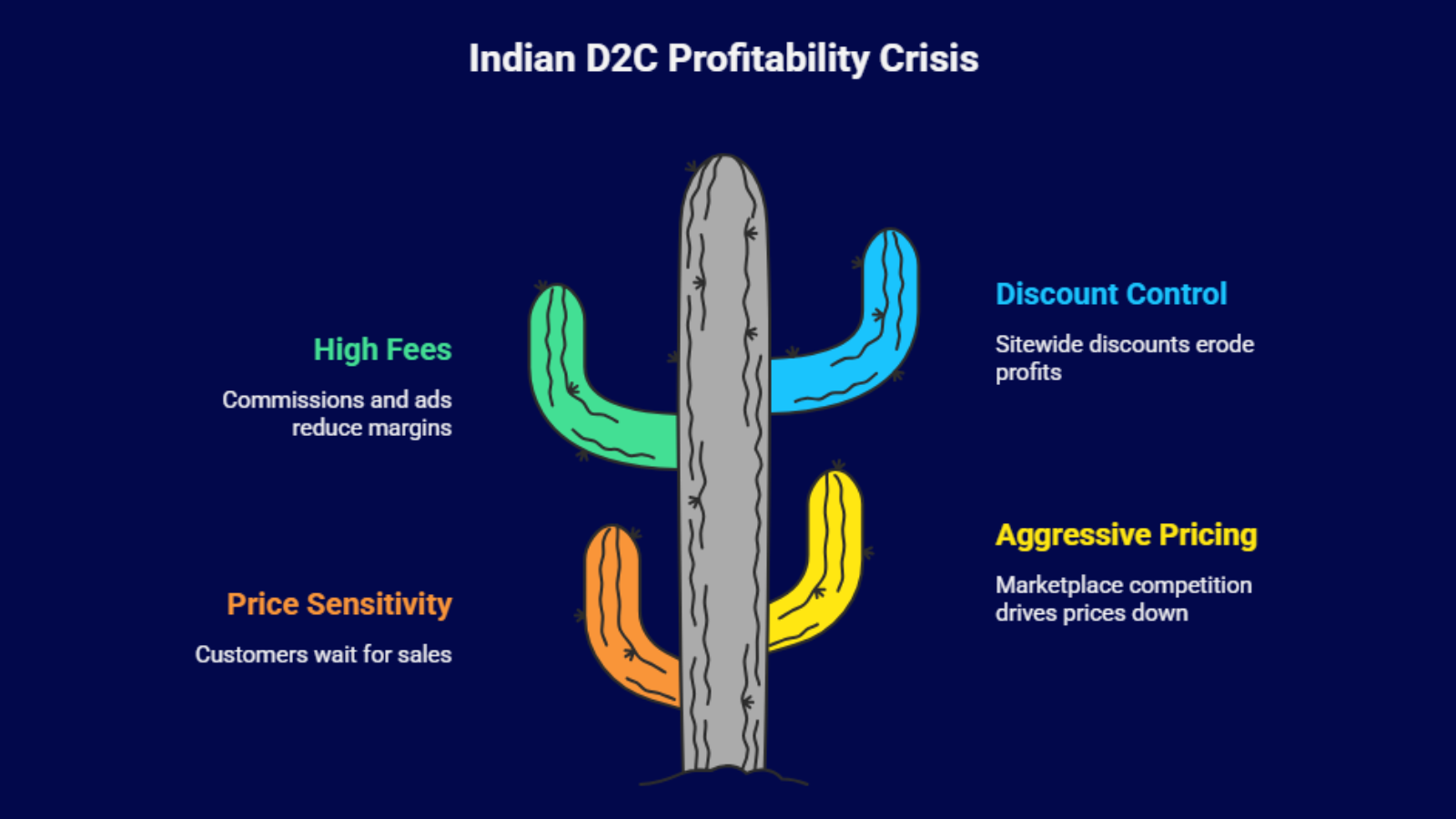 Indian consumers are highly price-sensitive. Over time, many brands trained customers to wait for sales.
Typical structure:
- 20 percent first-order discount
- 10 percent prepaid incentive
- 15 to 25 percent festive sale
- Influencer coupon codes
Effective discounting easily crosses 25 to 30 percent annually.
Now, combine this with marketplace participation. On Amazon and Flipkart, sellers often need aggressive pricing to win visibility. If MRP is ₹1,999 and the selling price drops to ₹1,399 after discounts, and referral commission plus ads take another 20 to 25 percent, the real margin falls below 35 percent.
This is how D2C profitability issues deepen.
Specific fixes:
- Remove sitewide discounting and switch to segmented offers.
- Use bundles instead of price cuts to increase perceived value.
- Create marketplace-exclusive SKUs to avoid price wars with your own website.
- Track “net realised price” after all discounts and fees.
Discount control alone can improve EBITDA by 5 to 8 percent at ₹50Cr scale.
3. Weak Repeat Rate Is Forcing Paid Growth Dependence
Most brands assume repeat will naturally improve. In reality, true 90-day repeat in many Indian D2C categories is between 20 and 30 percent. For consumables, it should ideally cross 35 percent.
If repeat stays low:
- CAC never drops.
- Paid ads remain the only growth engine.
- Lifetime value stays weak.
COD customers, especially, have lower repeat rates compared to prepaid customers. Many ₹50Cr brands have 60 percent or more COD orders, which increases churn risk.
This drives long-term D2C profitability issues and challenges.
How to fix this:
- Push prepaid using small cashbacks or loyalty credits.
- Introduce subscription models for replenishable products.
- Build automated reorder reminders at 25 to 40 days.
- Track cohort-based repeat instead of the overall repeat percentage.
If repeat does not strengthen by year two, profitability becomes very difficult.
4. Operational Leakages: RTO, Inventory, and Working Capital
 Operational inefficiencies silently eat margins.
1. High RTO Rates: In COD-heavy categories like fashion or impulse purchases, RTO can touch 20 to 25 percent. That means double shipping costs and blocked inventory for 10 to 15 days.
2. Inventory Planning Issues: Overstock locks working capital. Understock increases emergency manufacturing and air shipping costs.
3. SKU Complexity: Many ₹50Cr brands carry 80 to 150 SKUs, but only 20 percent generate most revenue. Low-velocity SKUs increase warehousing costs and forecasting errors.
Solutions:
- Reduce the COD share gradually below 40 percent.
- Implement WhatsApp order confirmation before shipping COD.
- Conduct SKU-level margin audit every quarter.
- Focus on 20 to 30 high-velocity SKUs for marketing scale.
- Maintain 45 to 60 days of inventory for top SKUs only.
Operational tightening can recover a 5 to 10 percent margin.
5. Marketplace Dependency and Growth Pressure
Many ₹50Cr brands derive 40 to 70 percent revenue from marketplaces. While this drives volume, cost layers stack up:
- 15 to 25 percent referral commission
- Fulfillment and storage charges
- Platform advertising to stay visible
- High return handling fees
Plus, there is no ownership of customer data, which weakens the long-term retention strategy.
Add investor growth pressure. Many brands scaled with the mindset: grow fast, fix margins later. But when funding slows, broken unit economics surface clearly.
This creates persistent D2C profitability issues are difficult to repair.
Fix this by:
- Setting channel-wise contribution margin benchmarks.
- Building website revenue to at least 40 to 50 percent of the total mix.
- Creating exclusive packs for marketplaces.
- Aligning internal KPIs to net profit, not just revenue growth.
At ₹50Cr, brands do not fail because of a lack of demand. They struggle because margins are unmanaged. High CAC, heavy discounting, low repeat, operational inefficiencies, and marketplace pressure together create loss-making D2C outcomes.
The brands that survive are not the ones that grow fastest. They are the ones who control contribution margin daily and design growth around profitability, not vanity revenue.
The Real Fix: Shift From Revenue Thinking to Profit Thinking
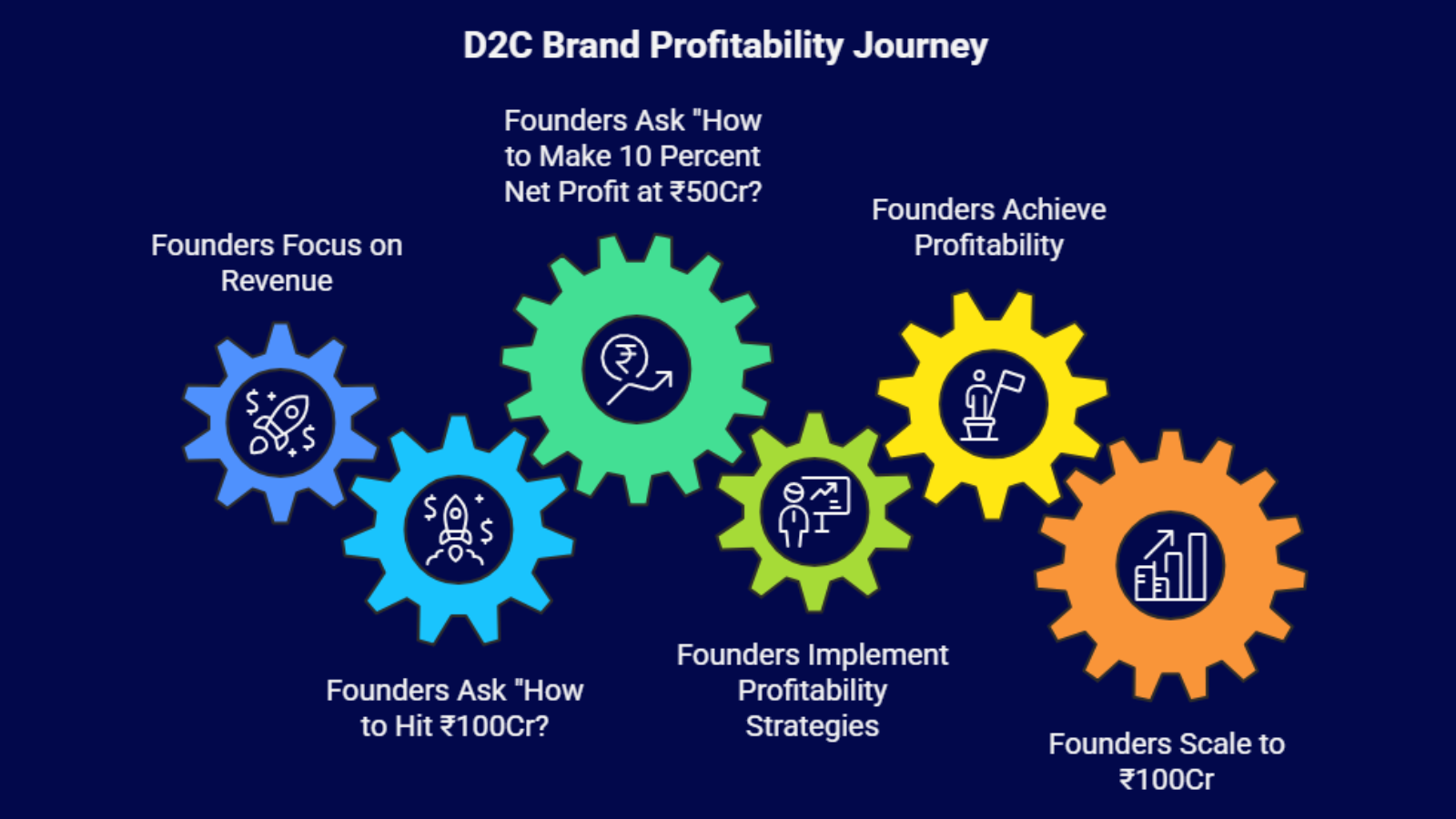 The biggest shift required is a mindset. Most founders ask, “How do we hit ₹100Cr?” Very few ask, “How do we make 10 percent net profit at ₹50Cr?” That difference changes decisions daily. Because unless D2C profitability issues are addressed and solved at ₹50Cr, scaling to ₹100Cr only doubles the losses. Profitability is not accidental. It is designed through discipline in CAC, discounting, channel mix, and operations.
Take the example of an Indian skincare brand doing ₹52Cr in revenue. On paper, growth looked strong at 70 percent year-on-year. But net profit was negative 6 percent. After a detailed audit, they found blended CAC at ₹1,050, COD at 62 percent with 23 percent RTO, and 110 SKUs where only 28 drove real revenue.
Instead of pushing growth, they paused scaling for two quarters. They cut 40 low-margin SKUs, pushed prepaid incentives to reduce COD to 45 percent, increased AOV from ₹1,650 to ₹2,300 through bundles, and capped CAC based on contribution margin, not ROAS.
Within 12 months, revenue grew modestly to ₹58Cr, but net profit moved to 9 percent. That is the real shift. Solve D2C profitability issues first, then scale with confidence.
Final Thoughts
If you look closely, the answer to why many ₹50Cr D2C brands are unprofitable is not one dramatic mistake. It is the accumulation of small financial leaks. Rising CAC, which has moved from ₹300–₹400 to ₹800–₹1,500 in many Indian categories, directly eats into contribution margin. Founders often track ROAS, but what really matters is contribution after ads, shipping, returns, and payment gateway fees. Without that clarity, scale becomes expensive.
Then comes discounting. Many brands effectively give away 25–30 percent of revenue through first-order offers, festival sales, and influencer codes. On marketplaces, stacked costs like referral fees, fulfillment, ads, and returns can take 25–35 percent of the selling price. Sellers often underestimate how deeply this affects net realised margin and working capital cycles.
Retention is another blind spot. True 90-day repeat rates in many categories sit at 20–30 percent. Low repeat means constant paid acquisition, which increases dependency on rising ad costs and weakens lifetime value.
Operationally, COD RTO of 20–25 percent, long inventory holding periods, and too many low-velocity SKUs block cash flow. Profit disappears not in one big event, but in daily inefficiencies.
At Base.com, we rebuild profitability from the ground up. We audit SKU-level margins, set channel-wise CAC caps, improve prepaid mix to reduce RTO, and design retention systems that strengthen LTV. We help brands move from revenue obsession to structured profitability. Revenue attracts attention. Profit builds businesses.
Frequently Asked Questions
1. Why are many ₹50Cr D2C brands still loss-making?
Because high revenue hides weak contribution margins. Rising CAC, heavy discounting, marketplace commissions, and low repeat rates reduce profits. Without strong unit economics, revenue growth alone cannot create sustainable profitability.
2. What is the biggest reason behind D2C profitability issues?
Customer acquisition cost is usually the biggest factor. When CAC increases but average order value and retention stay flat, margins collapse. Brands end up spending more to maintain the same revenue levels.
3. Can a ₹50Cr D2C brand become profitable?
Yes, but it requires strict control on CAC, better inventory planning, stronger retention strategies, and lower dependency on discounting. Profitability improves when contribution margin is tracked daily, not monthly.
4. Does marketplace revenue hurt profitability?
It can. High commissions, ad spends inside marketplaces, and heavy discounting reduce margins significantly. Brands relying too much on marketplaces often face long-term D2C profitability issues.
5. What should founders focus on to avoid losses?
They should focus on contribution margin, repeat rate, CAC control, and operational efficiency. Profit must be built into the system early. Waiting to fix margins after scaling usually increases financial pressure.