

Running several seller panels is four different jobs depending on who you are. A brand with two entities, a distributor carrying forty catalogues, an agency serving twelve clients, and an exporter listing in three countries all need different software.
The best multi-seller account management software in India separates by control model rather than feature count. This guide groups the best multi-seller account management software in India by the kind of operator running it, because that decides which one fits.
Why does the type of operator decide which multi-panel platform fits you?
Multiple panels create three distinct problems, and the best multi-seller account management software in India solves them in different proportions for different operators. Consolidation gathers orders into one queue. Separation keeps each account’s data, stock, and finances distinct. Delegation controls who sees which account.
A brand running two of its own entities needs consolidation most. An agency serving twelve clients needs separation and delegation far more, because mixing client data is a commercial failure rather than an inconvenience.
India’s ecommerce market runs at roughly $226 billion, and multi-panel operators handle a meaningful share of marketplace listings.
| Operator type | Dominant need | Panels typically managed |
| Brand with multiple entities | Consolidation of orders and stock | Two to six |
| Distributor or reseller | Catalogue volume across many brands | Five to twenty |
| Agency or service provider | Client separation and access control | Ten or more |
| Exporter or cross-border seller | Multi-country compliance and currency | Three to eight |
What should you confirm about marketplace policy before adding more panels?
Marketplaces restrict how sellers operate multiple accounts, and no amount of the best multi-seller account management software in India changes those rules, which differ by platform and change periodically. Software cannot override a policy restriction, so confirm your position before building infrastructure around it.
Amazon generally expects a legitimate business reason for additional seller accounts, and other marketplaces apply their own conditions. Check the current policy on each platform directly, or with your category manager, rather than relying on any article including this one.
Legitimate multi-panel operations are common in India. Distributors carrying separate brand entities, agencies managing client accounts, and exporters running country-specific registrations all operate multiple panels routinely and openly.
Which platforms suit brands that run several seller entities of their own?
Group one covers brands operating more than one seller account across separate legal entities, categories, or channel strategies. Most of the best multi-seller account management software in India targets exactly this operator. Consolidation matters most here, since all the stock ultimately belongs to you.
1. Base.com

Base.com pulls orders from every connected seller account into one operational queue while keeping entity-level records distinct underneath. Your team works from a single dispatch list rather than rotating through panels, and reporting still separates by entity when finance needs it.
Because warehouse execution and returns run on the same platform, a single facility serves several panels without the stock confusion that usually follows.
Consolidates: orders, inventory allocation, warehouse dispatch, and returns across connected accounts.
Control model: unified operations with entity-level separation preserved for reporting and reconciliation.
Where it stops: catalogue creation and listing content still happen in each marketplace panel.
2. Unicommerce

Unicommerce carries India’s most extensive marketplace connector library, which matters disproportionately at multiple accounts. Each additional panel multiplies your exposure to connector failure, so maturity reduces risk rather than adding features.
Its configuration depth supports different rules per account, useful when entities serve different categories or regions.
Consolidates: orders and inventory across many accounts and marketplaces simultaneously.
Control model: central configuration with account-level rules applied independently.
Where it stops: configuration complexity grows with each account, requiring an owner.
3. EasyEcom
EasyEcom reconciles settlements per account while consolidating operations, which matters when each entity files its own returns. Finance sees what each panel actually earned rather than a blended figure.
Its B2B handling suits brands whose entities sell to each other or to distributors.
Consolidates: orders, inventory, and settlement data across accounts and B2B flows.
Control model: operational consolidation with financial separation by entity.
Where it stops: warehouse depth trails specialist platforms at very high throughput.
Which platforms suit distributors and resellers carrying many brand catalogues?
Group two covers operators listing products they did not manufacture, often across dozens of brands, where the best multi-seller account management software in India must track margin per principal. Catalogue volume and margin tracking per brand dominate here rather than warehouse throughput.
4. Vinculum

Vinculum handles multi-entity and multi-brand structures with separate inventory pools under one system. Distributors representing several principals keep each relationship’s stock and reporting distinct.
Its omnichannel capability extends this to physical distribution alongside marketplace selling.
Consolidates: inventory, orders, and catalogue data across brands and channels.
Control model: entity-separated pools within a single administrative structure.
Where it stops: enterprise implementation effort exceeds what smaller distributors need.
5. Ginesys

Ginesys brings retail ERP, accounting, and GST capability alongside marketplace order handling. Distributors already running it for physical trade extend the same ledger to online panels.
Its strength lies in financial accuracy across entities rather than marketplace operational depth.
Consolidates: inventory, accounting, and GST across entities and sales channels.
Control model: ERP-led structure with marketplace panels connected downstream.
Where it stops: marketplace-specific operational features trail dedicated platforms.
6. Marg ERP

Marg ERP serves distributors with strong batch, expiry, and multi-godown handling, particularly in pharma and FMCG. Operators with distribution roots often already run it across entities.
Marketplace panel management depends on connectors rather than native capability, so pair it accordingly.
Consolidates: stock, batch, and billing data across godowns and entities.
Control model: distribution ledger with marketplace data connected in.
Where it stops: limited native marketplace operational handling.
Which platforms suit agencies that manage marketplace accounts on behalf of clients?
Group three covers operators running panels they do not own, the case where the best multi-seller account management software in India is judged on separation rather than consolidation. Separation and access control matter more than consolidation, because a client data leak ends the relationship.
7. Browntape
Browntape aggregates marketplace orders and inventory simply enough for an agency to onboard a client quickly. Low setup cost matters when each new client needs their own configuration.
Its simplicity limits how much complexity a single client can bring before the platform strains.
Consolidates: marketplace orders and inventory per connected account.
Control model: per-account setup suited to separate client configurations.
Where it stops: limited warehouse and multi-location capability per client.
8. Primaseller
Primaseller syncs inventory across marketplaces, retail and wholesale at modest scale, which suits agencies whose clients are small sellers rather than large brands. Setup stays quick and predictable.
Automation depth remains limited, so agencies handling operational volume outgrow it.
Consolidates: inventory and basic order flow across channels per account.
Control model: straightforward per-account structure with minimal configuration.
Where it stops: insufficient automation for clients scaling quickly.
Which platforms suit exporters running seller panels across several different countries?
Group four covers operators with country-specific registrations and panels, where the best multi-seller account management software in India must handle currency and tax structure as well as orders. Currency, tax structure, and cross-border logistics dominate, and domestic-only platforms handle none of it well.
9. Anchanto

Anchanto operates across Asia-Pacific with genuine multi-country, multi-entity and multi-currency capability. Exporters manage Indian and overseas panels from one instance rather than running separate systems.
Its 3PL orientation also suits operators managing accounts on behalf of several brands.
Consolidates: orders, inventory and billing across countries, entities and client brands.
Control model: multi-tenant structure with strict separation between entities.
Where it stops: India-specific returns handling runs lighter than local-first platforms.
10. Omniful

Omniful builds for India and the Gulf, so brands expanding into the Middle East can manage both regions in one place. Its recent architecture handles quick commerce alongside marketplace panels.
Its connector library is younger, so verify coverage for each specific marketplace you run.
Consolidates: orders and inventory across regions, channels, and quick commerce.
Control model: multi-region configuration with channel-specific rules.
Where it stops: shorter track record at very high volumes in either market.
How should access and permissions work when several people run your panels?
Access control causes more multi-panel problems than integration does, and the best multi-seller account management software in India should let you set it precisely. Decide these five questions before adding users rather than afterwards.
- Who can change inventory? Restrict this tightly, since a single wrong adjustment propagates across every connected panel immediately.
- Who sees financial data? Settlement and margin figures rarely need to reach warehouse or support staff.
- Can one user work across accounts? Convenient for brands, unacceptable for agencies handling competing clients.
- Who holds marketplace panel credentials? Platform access and marketplace login should not sit with the same person by default.
- What happens when someone leaves? Offboarding must revoke platform and marketplace access together, not one at a time.
Write these rules down before go-live. Retrofitting permissions onto an active operation is considerably harder than setting them at the start, because you end up removing access people already rely on.
Review the list quarterly. Account count grows, teams change, and permission structures decay faster than anyone expects.
What breaks first when sellers run multiple panels without proper software
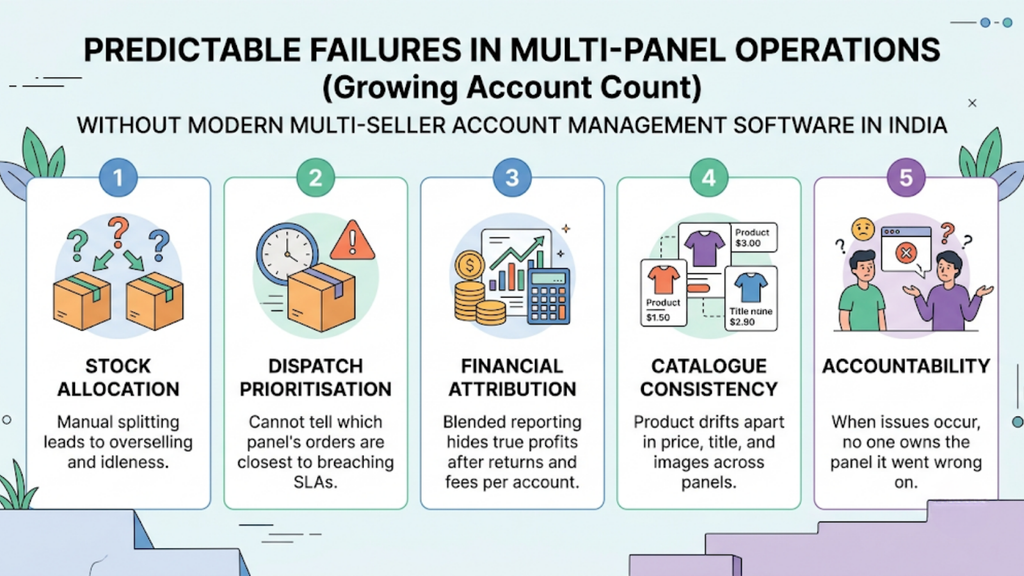
Multi-panel operations without the best multi-seller account management software in India fail in a predictable sequence. These five failures arrive roughly in this order as the account count grows.
- Stock allocation between panels. Manual splitting across accounts guarantees one panel oversells while another sits idle.
- Dispatch prioritisation. Nobody can tell which panel’s order is closest to breaching its SLA.
- Financial attribution. Blended reporting hides which account actually earns money after returns and fees.
- Catalogue consistency. The same product drifts apart across panels in price, title, and images.
- Accountability. When something goes wrong, no one owns the panel it went wrong on.
The first two cost money immediately through cancellations and SLA penalties. The remaining three cost money quietly, which is why they persist far longer before anyone acts on them.
Catalogue drift deserves particular attention. When the same product carries different prices across panels, marketplaces notice, and price-parity expectations on some platforms make that a commercial risk rather than a cosmetic one.
How do you know your multi-panel setup has outgrown manual management?
The signals appear in coordination overhead rather than in system errors. These five show the arrangement now costs more than software would.
- Your team maintains a shared spreadsheet of panel logins. Credential sprawl is the first sign that account count exceeded the process.
- Stock gets allocated between panels by meeting. Weekly discussions about which account holds which units mean allocation has no system.
- Nobody can state profit by panel. If entity-level profitability requires a week of finance work, reporting has already failed.
- One panel consistently underperforms on SLA. Usually the one your team checks last rather than the one with genuine problems.
- Adding an account feels daunting. When a new panel means weeks of setup, expansion decisions start following convenience instead of strategy.
Two of these together justify evaluating software. Four or more means the coordination cost already exceeds a platform fee.
How should you sequence the rollout when connecting several panels?
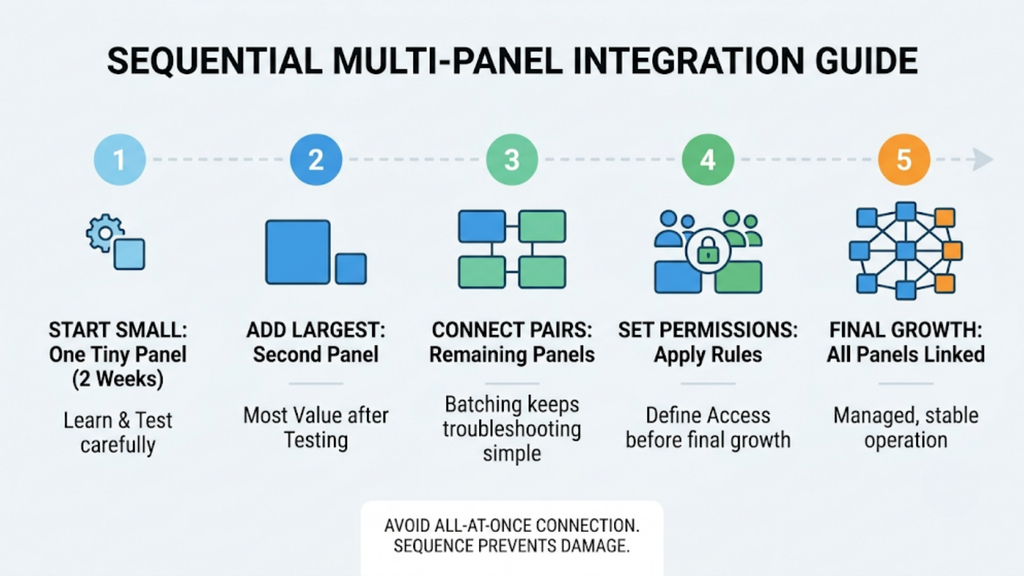
Connecting every panel at once is the most common multi-panel implementation mistake. Sequencing contains the damage when something breaks.
- Start with your smallest panel. Learn the platform’s behaviour on the account where errors cost least.
- Run it alone for two weeks. Confirm orders, stock, and returns all behave before connecting anything else.
- Add your largest panel second. Once the process is proven, move the account where consolidation delivers most value.
- Connect remaining panels in pairs. Batching two at a time keeps troubleshooting manageable if a connector misbehaves.
- Set permissions before the final panel. Access rules are far easier to apply while the operation is still small.
Avoid connecting any panel within six weeks of a festive sale. Marketplace volume spikes are the worst possible conditions for discovering a configuration error.
Checklist before you shortlist any multi-panel management platform
Run these five checks against every option. They test the specific things that break at multiple accounts rather than at one.
- Ask how accounts are separated. Confirm whether separation is genuine or a filtered view of shared data.
- Test adding an account yourself. Onboarding effort multiplies by account count, so a slow process compounds quickly.
- Check per-account reporting. Confirm you can see profitability by panel rather than only in aggregate.
- Confirm connector maintenance. Ask which marketplace connectors the vendor maintains directly for each account type.
- Ask about a customer at your account count. A platform proven on two panels tells you nothing about twelve.
How do pricing models change when you run multiple seller panels?
Pricing behaves differently at multiple accounts, and vendors rarely lead with this. Confirm the structure before you count accounts, since the wrong model scales badly.
| Model | How multi-panel pricing usually works | Watch for |
| Per-order | Orders pool across accounts | Usually the most predictable at scale |
| Per-account | Each panel carries a fee | Cost rises with every account you add |
| Per-seat | Users, not accounts, drive cost | Agencies with many staff pay more |
| Tiered SaaS | Banded by combined volume | Crossing a band mid-month |
Ask specifically whether additional accounts carry setup fees. Among the best multi-seller account management software in India, per-account charges frequently appear only in the contract rather than the proposal.
Conclusion
Base.com suits operators who own the stock behind every panel. Its design assumes one operational team serving several accounts from shared infrastructure, which describes most brands running multiple entities.
That focus makes it less suited to agencies managing competing clients, where strict separation outweighs operational consolidation. Choosing the best multi-seller account management software in India means matching that control model to your actual relationship with the accounts.
For brands, the consolidation argument is straightforward. One dispatch queue, one stock pool, and one returns process serving several panels removes the coordination overhead that multiple accounts otherwise create.