

A mid-size, India-based beauty and personal care D2C brand grew from roughly 8,000 to 50,000 monthly orders across its own website, Amazon, Flipkart, Nykaa, and Myntra, without adding a single warehouse employee.
The brand achieved this by restructuring how its warehouse worked, not by working the existing team harder, after deciding to scale ecommerce orders with Base.com rather than continuing to add headcount against a manual process.
This case study breaks down exactly how that happened, stage by stage, with the intent to show any beauty or personal care brand facing a similar growth curve what a realistic scaling path actually looks like.
Beauty is a category with a specific operational profile: high SKU counts relative to order volume, frequent bundling and gifting sets, batch and expiry tracking requirements, and a promotional calendar dense with flash sales.
This case study is built around that reality, and around the practical question every operations lead in this category eventually faces: how do you scale ecommerce orders with Base.com when order volume is compounding faster than your team can grow?
The Brand: Scaling Beauty Across a Multiplying Channel Mix
Beauty and personal care brands in India typically start on one or two channels and expand quickly. This brand began primarily on its own website and Amazon, then added Flipkart, Nykaa, and Myntra within its first eighteen months, each addition multiplying the operational complexity of order capture, inventory sync, and dispatch.
India’s ecommerce market has crossed $226 billion, and D2C brands are growing at a 40% CAGR, a growth rate that shows up especially sharply in beauty, where influencer-driven demand spikes and flash sales can multiply daily order volume overnight. The brand in this case study went from roughly 8,000 monthly orders to 50,000 monthly orders across two years, a more than sixfold increase.
The brand’s catalogue carried over 400 active SKUs by the time it reached 50,000 monthly orders, spanning skincare, haircare, and a growing gifting and bundle line launched around festive seasons. Bundles alone made up close to a quarter of order volume during Diwali and wedding-season promotional windows.
By the time the brand seriously considered how to scale ecommerce orders with Base.com, its existing manual process was already showing cracks at a fraction of its eventual volume, and the founder’s instinct, common across growing D2C brands, was to solve the strain by hiring more warehouse staff.
The Problem: What Breaks When Order Volume Multiplies Without Process Change
Before switching, the brand’s operations were built around a small, dedicated warehouse team following a manual pick-and-pack process, coordinated through spreadsheets and individual marketplace seller portals. This worked comfortably at 8,000 monthly orders. It began breaking down well before order volume tripled.
1. Manual order pulling consumed disproportionate time as channels multiplied.

With five separate channels feeding orders, someone had to log into five separate seller portals every morning to consolidate what needed to ship that day. This overhead scaled roughly linearly with channel count, not with order volume, meaning it became a bigger proportional drag as the brand added Nykaa and Myntra on top of its existing channels.
2. Bundle and kit orders required manual decomposition at the pick stage.
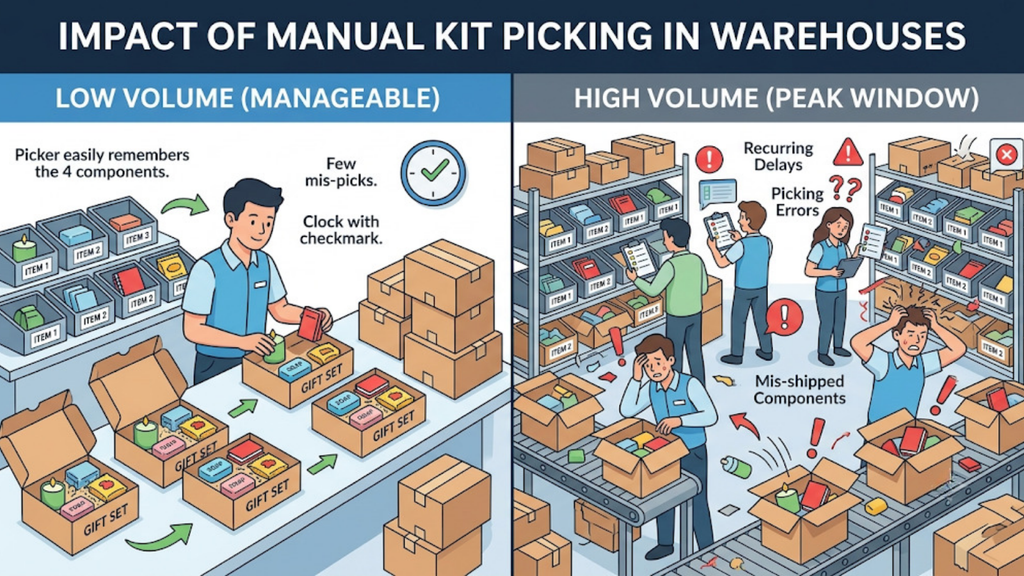
A gifting set with four component SKUs needed a picker to remember, or look up, exactly which items belonged in each kit. At low volume, this was manageable. At high volume during a festive promotional window, it became a recurring source of picking delay and mis-shipped components.
3. Batch and expiry tracking was maintained separately from the pick process.
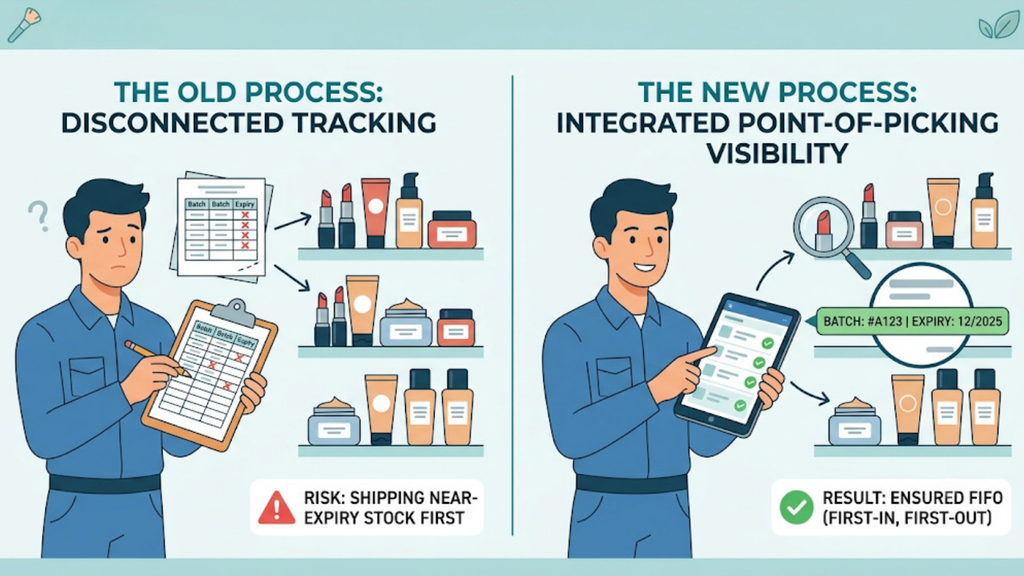
Beauty products carry genuine expiry sensitivity, and the brand’s existing process tracked batch numbers in a separate spreadsheet rather than surfacing them directly at the point of picking, creating a real risk of shipping near-expiry stock ahead of fresher inventory.
4. Headcount was the brand’s default answer to rising order volume.
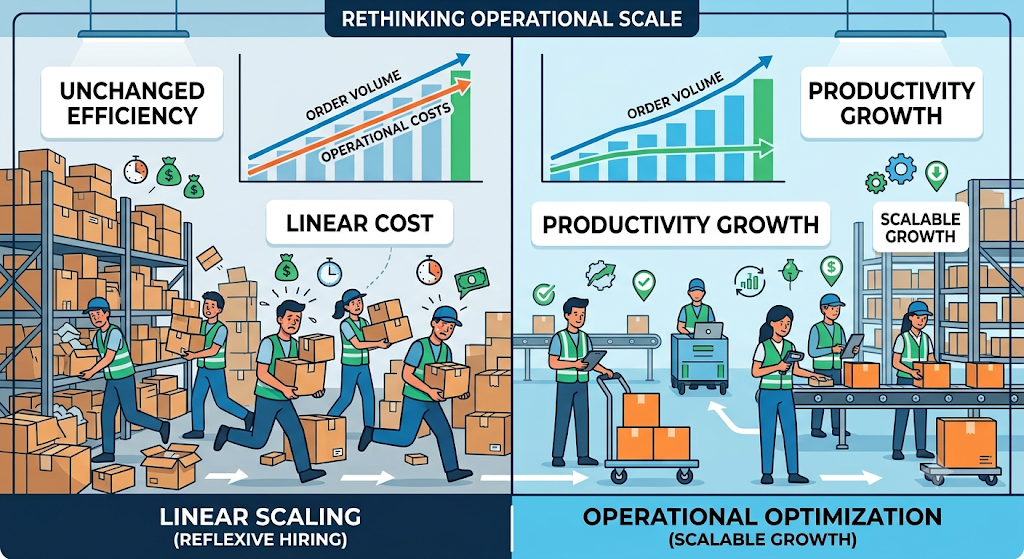
Every time order volume climbed, the operational instinct was to hire another picker or packer. This works up to a point, but it scales cost linearly with volume rather than allowing productivity per worker to improve, and it does nothing to fix the underlying process inefficiencies driving the strain in the first place.
5. Peak-day order spikes during flash sales repeatedly overwhelmed the existing setup.
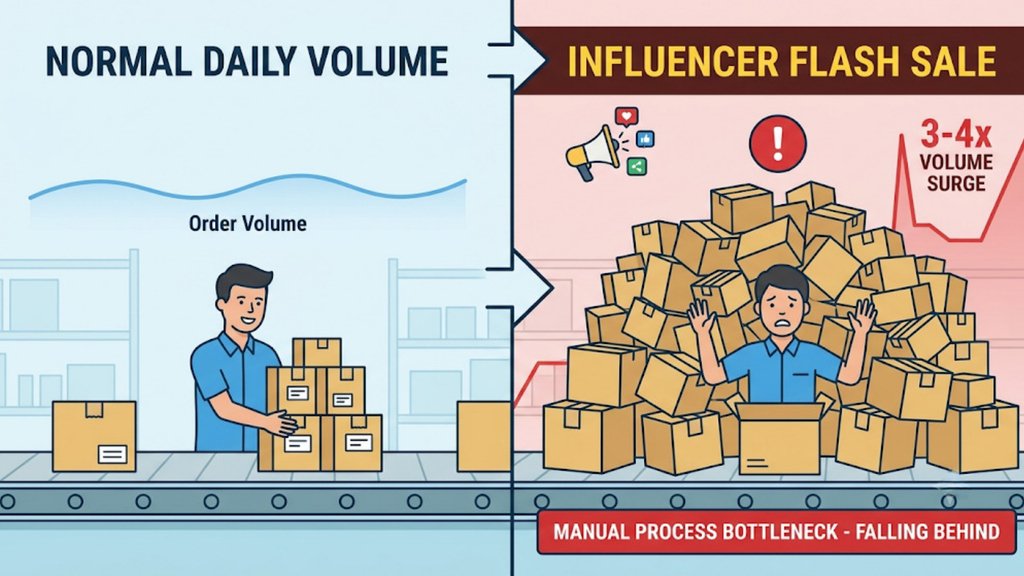
A single influencer-driven flash sale could push daily order volume to 3-4x the recent average within hours, and the manual process had no mechanism to absorb that spike without falling badly behind on dispatch.
Why This Brand Chose to Scale Ecommerce Orders With Base.com
The brand’s leadership team evaluated two paths as order volume climbed past 15,000 a month: keep adding warehouse headcount proportionally to volume, or restructure the underlying process and choose a platform built to scale ecommerce orders with Base.com without a linear headcount increase.
The headcount-scaling path was rejected once the brand modelled its cost trajectory. Continuing to add pickers and packers at the same ratio would have meant warehouse labour cost roughly sextupling alongside the sixfold order growth the brand was targeting, eroding margin at exactly the volume where margin should have been improving through scale efficiency.
Base.com was chosen specifically because its warehouse and order management layers addressed the brand’s core bottlenecks directly: bin-sequenced picking to cut walk time per order, native kit and bundle decomposition so pickers see individual components rather than opaque bundle entries, batch and expiry-aware stock logic surfaced at the point of picking, and a unified multi-channel order queue that eliminated the need to check five separate seller portals every morning.
For a brand specifically trying to scale ecommerce orders with Base.com rather than through headcount, the deciding factor was that these capabilities worked together as one system rather than requiring five separate point solutions bolted together over time.
The Implementation: What Changed as Volume Grew from 8,000 to 50,000 Orders
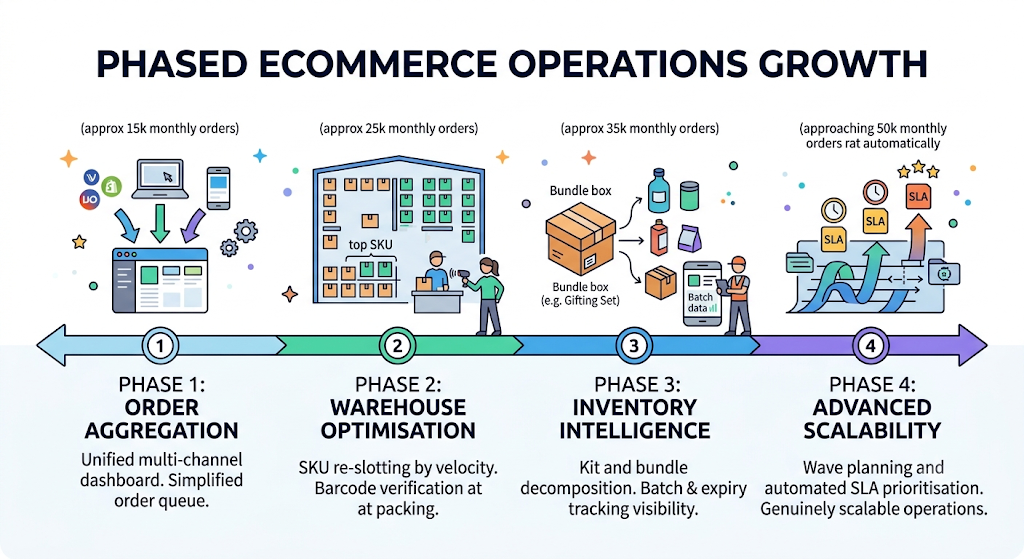
The brand’s implementation was phased across its growth trajectory rather than completed in one step, since order volume itself was climbing throughout the rollout period.
- Phase one, at roughly 15,000 monthly orders, focused on multi-channel order aggregation.
All five channels were connected into a single order queue, removing the daily manual portal-checking overhead entirely and giving the operations team one dashboard instead of five.
- Phase two, at roughly 25,000 monthly orders, focused on warehouse floor restructuring.
The brand’s top SKUs by order frequency were re-slotted closer to the packing station based on actual sales velocity, and barcode scan enforcement was activated at packing, directly targeting the mis-shipped component problem that bundles had been creating.
- Phase three, at roughly 35,000 monthly orders, activated kit and bundle decomposition and batch-aware picking.
Gifting sets and bundles were mapped to their component SKUs at the inventory level, so a picker working a kit order saw every individual item required, with batch and expiry data surfaced directly on the pick screen rather than in a separate spreadsheet.
- Phase four, as the brand approached 50,000 monthly orders, activated wave planning and SLA-based prioritisation.
Orders were released to the pick floor in structured batches rather than all at once, and high-priority or SLA-sensitive orders automatically surfaced to the top of the queue, removing the need for a supervisor to manually reprioritise during flash sale spikes. This final phase is often the one that determines whether a brand can genuinely scale ecommerce orders with Base.com through peak demand, not just steady average-day volume.
Each phase was implemented without pausing operations, and the brand’s warehouse headcount stayed effectively flat across all four phases, even as monthly order volume grew more than sixfold.
What Makes Beauty a Distinct Case for Scaling Order Volume
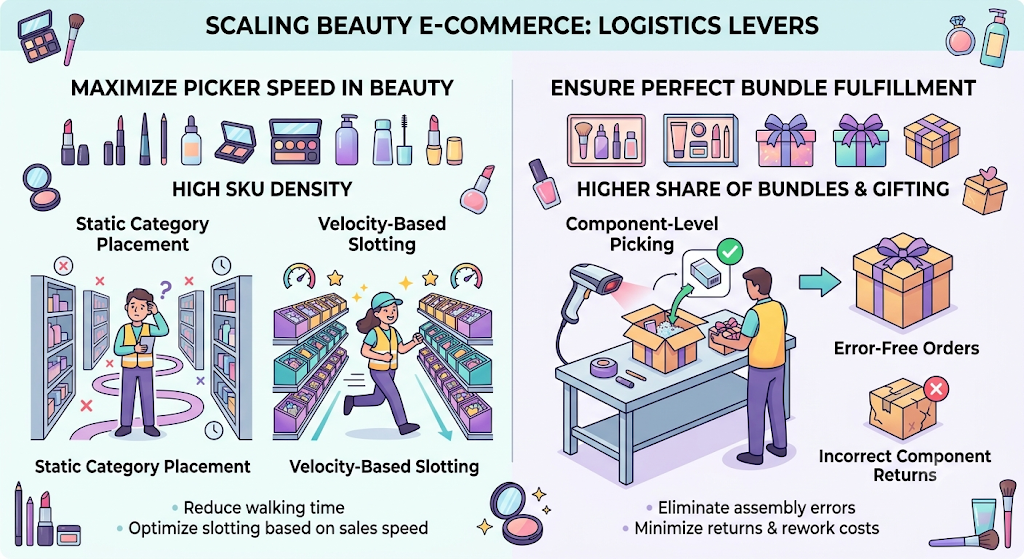
Not every category responds identically to the same scaling fixes, and it is worth being specific about why beauty rewards this particular set of changes so strongly.
SKU density is unusually high relative to order volume in beauty, since a single brand can carry dozens of shade or variant SKUs across a handful of core products. This makes bin-level slotting based on actual velocity, rather than static category-based placement, disproportionately valuable, since the wrong SKUs sitting near the packing station waste meaningful picker time at any real scale.
Bundling and gifting sets are a larger share of order volume in beauty than in many other categories, particularly around festive and wedding seasons. This is exactly why component-level bundle picking is such a high-leverage lever for any brand trying to scale ecommerce orders with Base.com in this specific category, since a mis-shipped bundle component generates a return, a customer complaint, and a rework cost that a simple single-SKU order never creates.
Batch and expiry sensitivity adds a compliance and quality dimension that pure fashion or electronics categories do not carry. Surfacing batch data directly at the pick screen, rather than in a disconnected spreadsheet, protects against the specific risk of shipping near-expiry stock ahead of fresher inventory, a risk that grows rather than shrinks as order volume scales.
Any beauty or personal care brand planning to scale ecommerce orders with Base.com should expect these three category-specific factors, SKU density, bundle share, and batch sensitivity, to determine how much of the productivity gain shows up in which phase of implementation.
The Results: 50,000 Monthly Orders, Same Warehouse Headcount
The table below summarises the transformation across the metrics that matter most to any brand trying to scale ecommerce orders with Base.com.
| Metric | At ~8,000 Monthly Orders | At ~50,000 Monthly Orders |
| Warehouse headcount | Baseline | Effectively unchanged |
| Orders processed per warehouse worker | Baseline | Roughly 6x baseline |
| Channels requiring manual portal checks | 2, then growing to 5 | 0, unified order queue |
| Bundle/kit mis-ship rate | Elevated during promotional periods | Reduced substantially via component-level picking |
| Peak flash-sale day dispatch performance | Frequently fell behind same-day SLA | Same-day dispatch maintained through 3-4x spikes |
The core result is straightforward to state: this brand was able to scale ecommerce orders with Base.com from 8,000 to 50,000 a month, a more than sixfold increase, while keeping its warehouse team size effectively flat. Orders processed per warehouse worker rose by a corresponding multiple, reflecting genuine productivity gain rather than simply working the same team longer hours.
Where the Capacity Came From
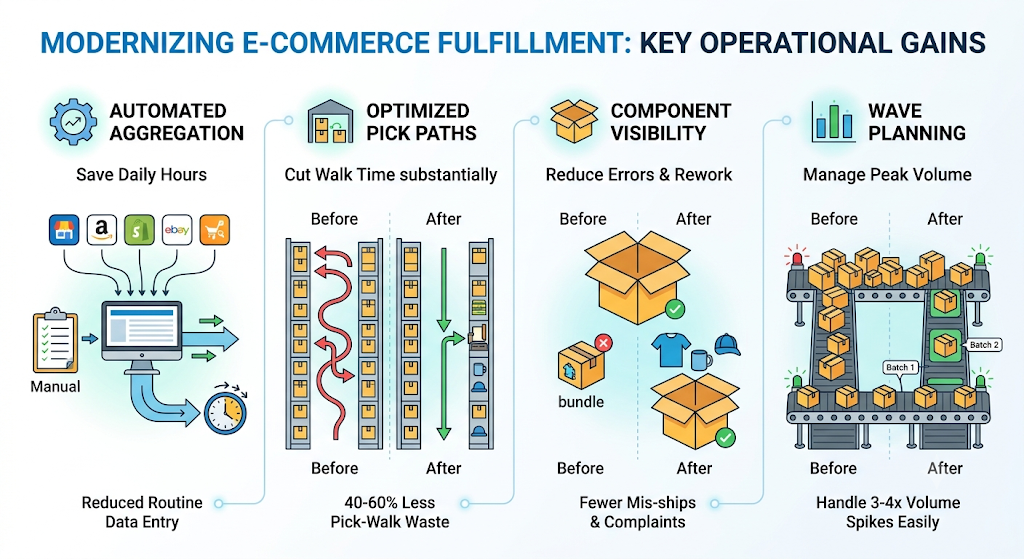
Breaking down how a brand can scale ecommerce orders with Base.com without proportional headcount growth shows which specific changes carried the most weight.
- Eliminating manual order aggregation freed meaningful daily time. Removing the need to check five separate seller portals every morning gave the operations team hours back daily, time that shifted toward exception handling and process improvement rather than routine data entry.
- Bin-sequenced picking cut walk time per order substantially. Velocity-based slotting reduces pick-walk waste by 40-60% in warehouses previously organised without route optimisation, and this gain compounds directly with rising order volume, since every additional order benefits from the same shorter pick path.
- Component-level bundle picking removed a recurring source of rework. When a picker sees every individual item in a kit order rather than one opaque bundle entry, mis-ships drop and the rework time spent on customer complaints and reshipments drops with them.
- Wave planning and SLA prioritisation prevented flash-sale chaos. Releasing orders in structured batches rather than all at once avoided the bin congestion and picker collisions that were previously causing peak-day slowdowns, letting the same team handle a 3-4x volume spike without falling behind.
- A unified queue removed the coordination tax that grows with every added channel. Each new marketplace a brand adds multiplies coordination overhead under a manual process. Under a system built to scale ecommerce orders with Base.com, adding a sixth or seventh channel carries close to zero additional manual overhead, since new orders simply flow into the same existing queue.
The Productivity Timeline: How Capacity Built Up Across Four Phases
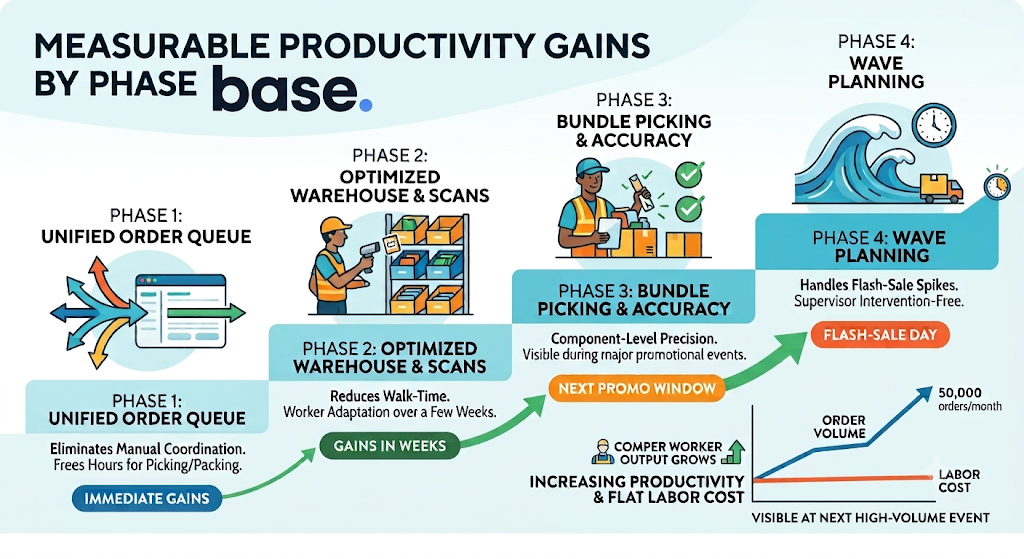
Brands evaluating whether to scale ecommerce orders with Base.com naturally want to know how quickly productivity gains actually materialise, rather than just what the eventual multiple looks like at the finish line.
In this case, each of the four implementation phases contributed a distinct, measurable jump in orders processed per warehouse worker. Phase one, unifying the order queue, freed up hours of manual coordination time daily almost immediately, time that was redirected toward picking and packing rather than portal-checking. Phase two, warehouse re-slotting and scan enforcement, took a few weeks for pickers to fully adapt to the new bin layout before the full walk-time reduction showed up in daily throughput numbers.
Phase three, component-level bundle picking, showed its biggest impact during the brand’s next major promotional window, when bundle order share spiked, and the previous mis-ship rate would have created a substantial rework backlog under the old process. Phase four, wave planning, proved its value on the first flash-sale day after activation, when order volume spiked 3-4x, and the warehouse maintained same-day dispatch without any manual supervisor intervention.
This staged pattern matters for any brand planning to scale ecommerce orders with Base.com across its own growth curve. The order-aggregation and warehouse-restructuring gains tend to arrive within weeks, while the full benefit of bundle decomposition and wave planning often only becomes fully visible at the next high-volume event that tests them directly.
For this brand specifically, the combination of steadily compounding productivity gains across four phases meant that by the time monthly order volume reached 50,000, warehouse output per worker had grown by a corresponding multiple without a single new hire, turning what would have been a linearly rising labour cost curve into a flat one.
Lessons for Other Beauty and D2C Brands Scaling Order Volume
A few takeaways from this case generalise well beyond one brand’s specific trajectory.
- Headcount is rarely the right lever for scaling order volume. Adding pickers and packers against an unoptimised process scales the underlying inefficiency proportionally, rather than fixing it. Brands aiming to scale ecommerce orders with Base.com or any comparable system should expect labour cost per order to fall as volume rises, not stay flat or climb.
- Bundle-heavy categories need component-level picking logic from early on. Beauty, gifting, and any category with meaningful bundle or kit order share should not wait until bundles represent a large share of volume before implementing decomposed pick instructions.
- Channel expansion should not multiply manual coordination overhead. Every new marketplace a brand adds should ideally cost close to zero additional manual effort if the underlying order management system is built correctly, since the alternative is coordination cost compounding with every channel added, the exact trap this brand escaped once it committed to scale ecommerce orders with Base.com rather than add another portal-checking routine per channel.
- Phased implementation works better than a single big-bang rollout for a fast-growing brand. This brand’s four-phase approach, implemented across its actual growth curve rather than all at once, meant each new capability arrived exactly when order volume justified it, without disrupting operations mid-scale.
- Peak-day resilience has to be designed before the peak arrives, not during it. Wave planning and SLA prioritisation were activated before the brand’s volume regularly hit flash-sale-driven spikes, meaning the system was already proven by the time it needed to absorb 3-4x demand surges.
Why This Matters Beyond One Brand
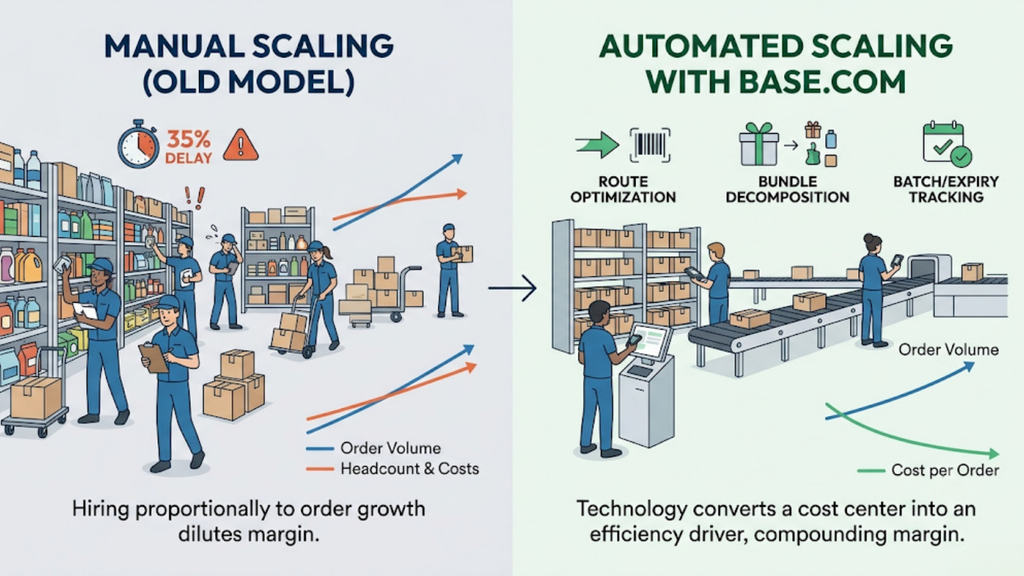
India’s D2C sector is scaling fast enough that the old model, hiring proportionally to order growth, is no longer financially sustainable for brands wanting to protect margin through hypergrowth. Manual, unoptimised warehouse processes can slow order processing by up to 35% compared to automated, route-optimised alternatives, and this inefficiency compounds precisely at the volumes where a brand most needs its operations to scale smoothly.
For beauty and personal care specifically, a category defined by high SKU density, frequent bundling, and batch-expiry sensitivity, the case for restructuring the process before adding headcount is especially strong. Brands in this category looking to scale ecommerce orders with Base.com should expect the bundle-decomposition and batch-tracking gains to matter proportionally more than they would for a simpler, single-SKU product line.
The broader pattern this case illustrates applies well beyond beauty: any D2C brand that chooses to scale ecommerce orders with Base.com rather than through linear headcount growth converts a cost centre that grows with volume into a cost centre that shrinks per order as volume grows, which is the difference between growth that dilutes margin and growth that compounds it.