

A mid-size, India-based home décor and furnishings D2C brand selling hand-finished lamps, wall art, and soft furnishings across its own website, Amazon, Flipkart, and Myntra cut its warehouse operating costs by roughly 30% after moving from a manual, spreadsheet-driven process to Base.com. This case study breaks down exactly where those costs were hiding, what changed on the warehouse floor, and how the brand did it, with the intent to show any home decor brand looking to reduce warehouse operating costs with Base.com what a realistic before-and-after actually looks like.
Home decor is a category with a specific cost structure most generic ecommerce advice ignores: high dimensional weight relative to product value, fragile-handling requirements, and a sales calendar dominated by Diwali and wedding-season demand spikes. This case study is built around that reality, and around the practical question every operations lead in this category eventually asks: how do you actually reduce warehouse operating costs with Base.com, step by step, rather than in the abstract?
The Brand: Scaling Home Decor Across a Punishing Sale Calendar
Home decor as a category grows unevenly across the year. A meaningful share of annual revenue for most Indian home decor D2C brands lands in a six-to-eight week window around Diwali, with a second, smaller spike around the wedding season from October through February.
The brand in this case study was processing roughly 300 orders a day on average month, spiking to 1,200-1,500 orders a day during its Diwali sale window. Each order carried an average of 1.8 items, many of them fragile, oddly shaped, or dimensionally heavy relative to their actual weight, lamps, framed art, and ceramic pieces among them.
India’s ecommerce market has crossed $226 billion, and D2C brands are growing at a 40% CAGR; this brand was riding successfully on the revenue side while its warehouse operations quietly fell behind. By the time the brand began evaluating how to reduce warehouse operating costs with Base.com, its existing process was already showing strain at normal volume, and Diwali sale weeks had become genuinely stressful rather than simply busy.
The Problem: Where Warehouse Costs Were Actually Leaking
Before switching, the brand’s warehouse ran on a category-based shelving layout, a paper pick list system, and manual packaging decisions made by individual packers. On paper, this looked like a normal small-to-mid-size operation. In practice, it was leaking cost in five specific, measurable places that any brand hoping to reduce warehouse operating costs with Base.com needs to identify in its own operation first.
1. Category-based layout inflated pick time.
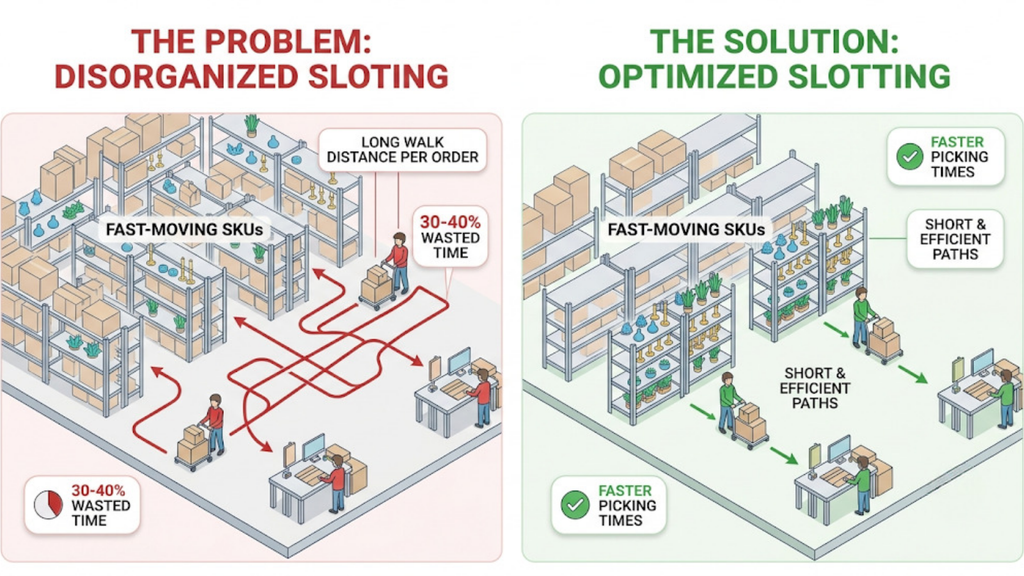
Fast-moving SKUs, mostly small decor accents and candle holders, sat wherever they fit in the warehouse rather than closest to the packing station.
Pickers were covering far more floor distance per order than necessary, and 30-40% of total pick walk time in most warehouses running this kind of layout is attributable to poorly slotted SKUs.
2. No scan validation created a recurring packing error cost.
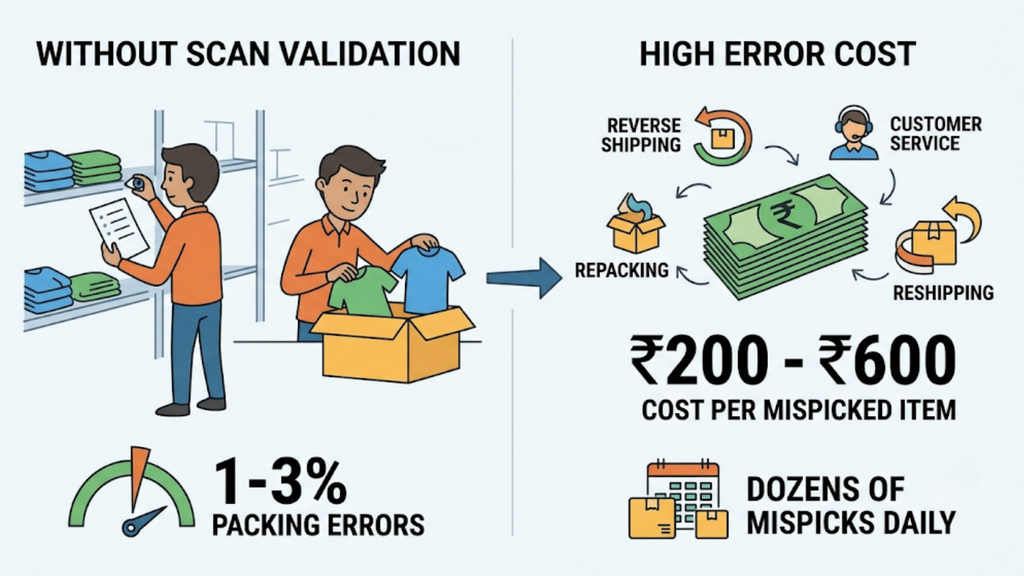
Packers matched paper pick lists to physical items by eye. Industry data suggests warehouses without scan validation run packing error rates of 1-3%, and this brand’s own pre-migration numbers sat close to that range.
A mispicked item costs an Indian ecommerce seller between Rs. 200 and Rs. 600 once reverse shipping, customer service, repacking, and reshipping are accounted for, a cost the brand was absorbing on dozens of orders daily without a system to track it in aggregate.
3. Oversized, inconsistent packaging inflated freight costs on every shipment.
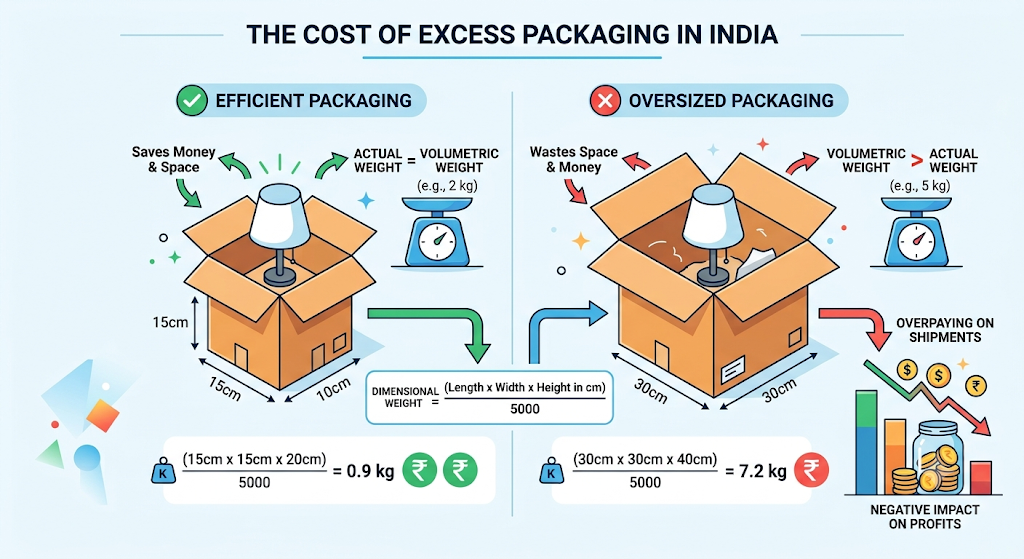
With no defined packaging configuration per SKU, packers defaulted to whichever box was on hand, frequently oversized for smaller decor items. Indian couriers charge on the higher of actual weight or dimensional weight, calculated as Length × Breadth × Height in centimetres divided by 5000.
A lamp shipped in a box sized for a larger item pays a meaningfully higher freight charge on every single unit, an overcharge that compounds across thousands of monthly shipments.
4. Returns processing was mixed with forward dispatch, creating daily disruption.
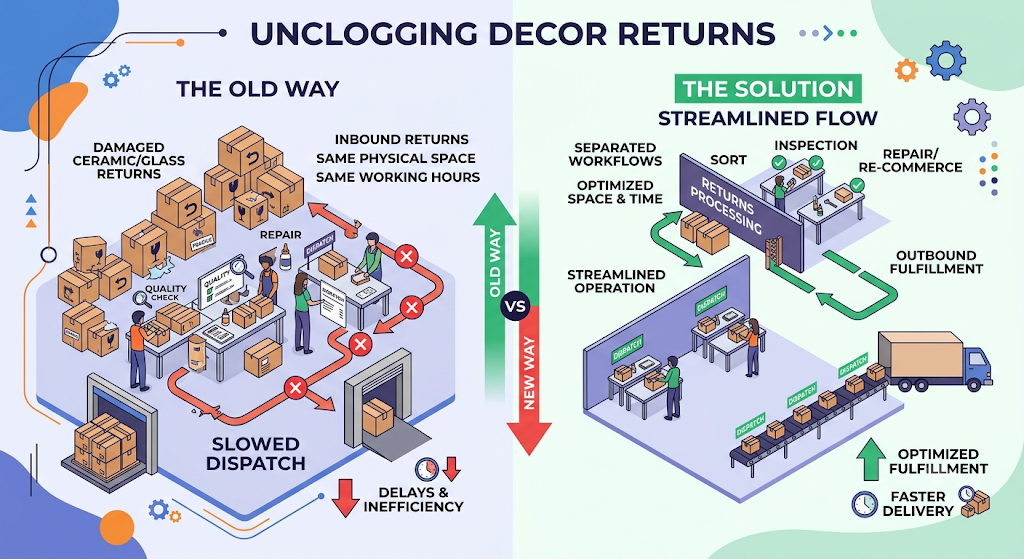
Home decor carries a naturally higher return rate than many categories; damage in transit is a genuine risk for ceramic and glass items, and returns were being sorted and quality-checked in the same physical space and same working hours as outbound fulfilment.
This created daily interference exactly when the warehouse needed full focus on dispatch.
5. No real-time visibility meant problems surfaced only after they had already cost money.
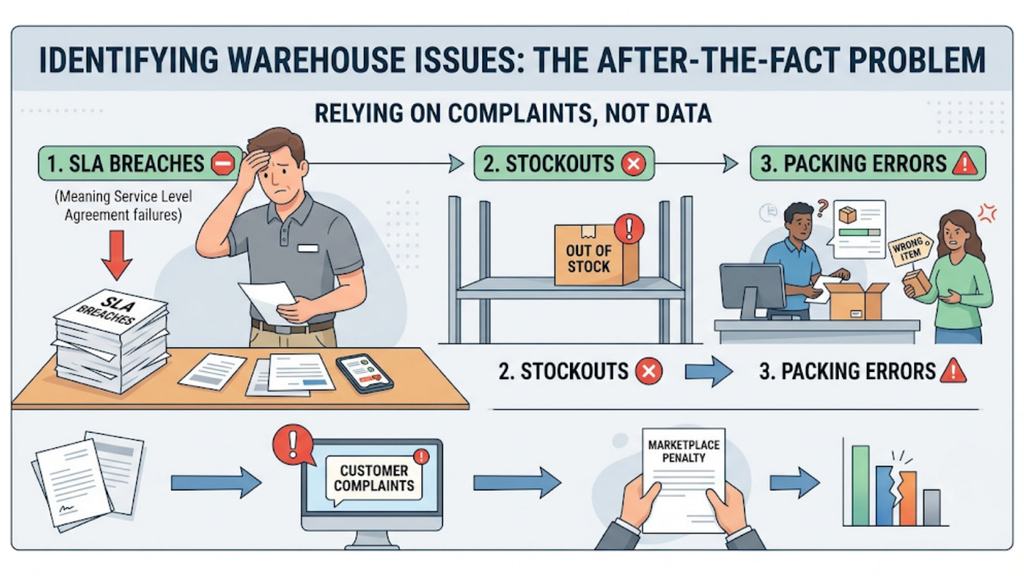
The warehouse manager discovered SLA breaches, stockouts, and packing errors after the fact, through customer complaints or marketplace penalty notices, rather than through any live operational dashboard.
Why the Brand Chose Base.com
The brand evaluated three options before deciding how to reduce warehouse operating costs with Base.com specifically: continuing to scale its manual process with added headcount, adopting a generic global warehouse management tool, and adopting Base.com.
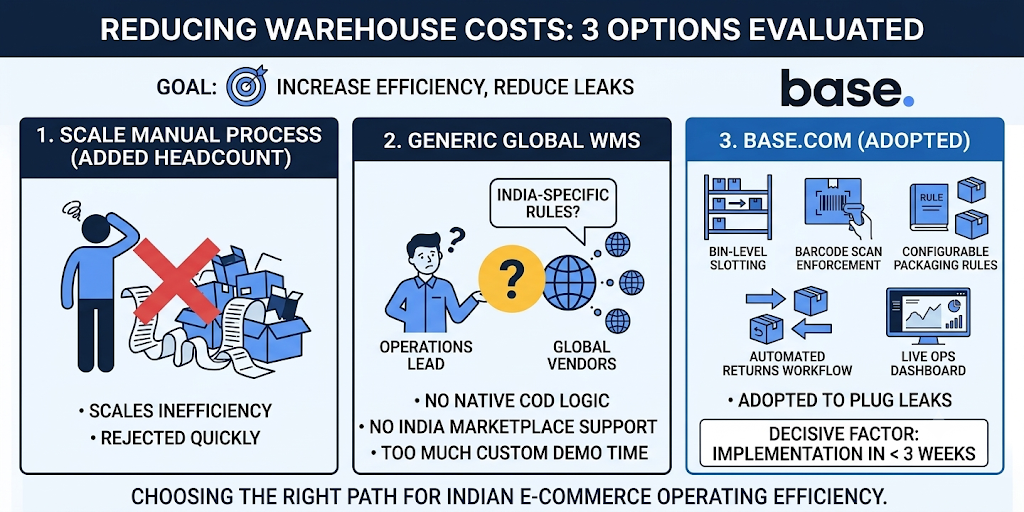
Adding headcount was rejected quickly. Additional pickers on an unoptimised layout and pick-list process would have scaled the underlying inefficiency rather than solved it, a pattern common across Indian warehouses that hire their way through a process problem instead of fixing the process itself.
A generic global WMS was evaluated and set aside because it had no native COD-risk logic and no purpose-built handling for India’s marketplace-specific dispatch rules across Amazon, Flipkart, and Myntra. The brand’s operations lead noted that most of the demo time with global vendors was spent explaining Indian-specific requirements the platform had not been built to handle natively.
Base.com was chosen specifically because its warehouse module addressed all five leak points identified above without requiring custom development: bin-level slotting based on actual sales velocity, barcode scan enforcement at packing, configurable packaging rules per SKU, an automated returns workflow physically and procedurally separated from forward dispatch, and a live operations dashboard.
For a brand trying to reduce warehouse operating costs with Base.com within a single sale season, the fact that implementation could be completed in under three weeks was a decisive factor, and it remains the clearest reason other home decor brands cite when asked why they chose the same path.
The Implementation: What Changed on the Warehouse Floor
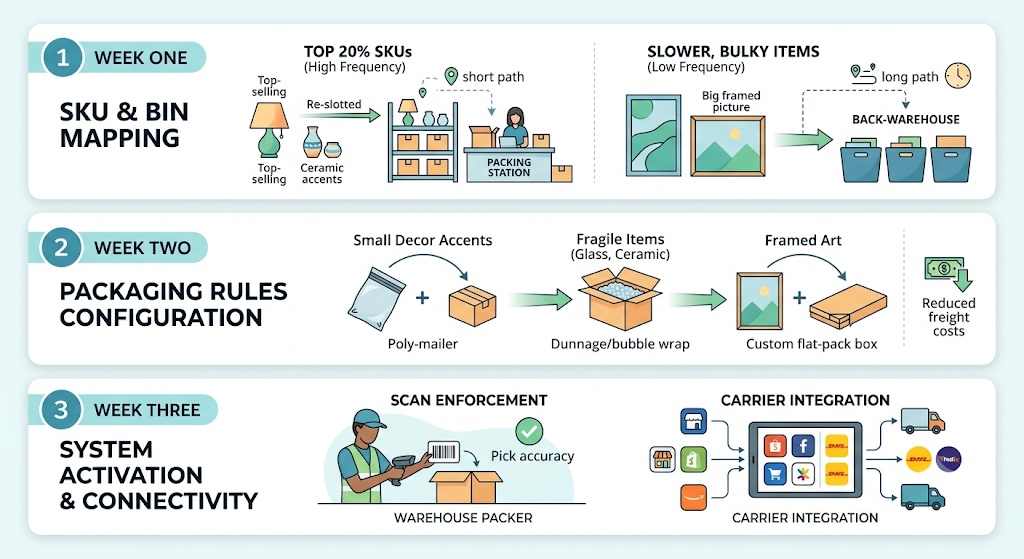
Implementation ran across three weeks, timed to complete roughly six weeks before the brand’s Diwali sale window, following a sequence any brand aiming to reduce warehouse operating costs with Base.com can broadly replicate.
- Week one focused on SKU and bin mapping. The brand’s top 20% of SKUs by order frequency, mostly small decor accents, candle holders, and best-selling lamp models, were identified and re-slotted to bins closest to the packing station. Slower-moving, bulkier items like large wall art moved further back, where longer pick-travel time was an acceptable tradeoff given lower order frequency.
- Week two configured packaging rules per SKU category. Small decor accents were mapped to appropriately sized poly-mailers and small boxes, fragile ceramic and glass items were mapped to rigid boxes with defined filler material, and framed art was mapped to a custom flat-pack configuration. This single step directly targeted the freight overcharge the brand had been absorbing silently on every oversized shipment.
- Week three activated barcode scan enforcement at the packing station and connected the platform to the brand’s existing courier accounts across the marketplaces it sold on. A parallel run against the old manual process confirmed pick accuracy before full cutover.
Return processing was physically relocated to a separate staging area on implementation, with a defined internal SLA for return-to-restock processing, and a returns workflow that triggers automatic quality checks before flagging an item as saleable or write-off.
The Results: A 30% Reduction in Warehouse Operating Costs
The table below summarises what changed across the metrics that matter most to any brand trying to reduce warehouse operating costs with Base.com.
| Metric | Before Base.com | After Base.com |
| Average pick time per order | Baseline | Reduced meaningfully via bin-sequenced picking |
| Packing error rate | 1-3% range | Below 0.5%, in line with scan-validated benchmarks |
| Freight cost per shipment | Baseline, inflated by oversized packaging | Reduced via SKU-specific packaging rules |
| Order-to-dispatch time during Diwali peak | Multi-hour backlog on peak days | Same-day dispatch maintained through peak volume |
| Returns processing time to restock | Multiple days, mixed with forward ops | Same-day to next-day, physically separated workflow |
The combined effect of tighter pick paths, scan-enforced packing accuracy, right-sized packaging, and a dedicated returns workflow is what the brand attributes to its roughly 30% reduction in total warehouse operating costs, measured across labour hours per order, freight cost per shipment, and error-correction cost, over the following full sale cycle.
This is the kind of result other home decor brands can realistically expect when they set out to reduce warehouse operating costs with Base.com, provided the underlying process changes, slotting, scan enforcement, packaging configuration, and returns separation, are actually implemented rather than the software being layered on top of an unchanged process.
Where the Savings Actually Came From
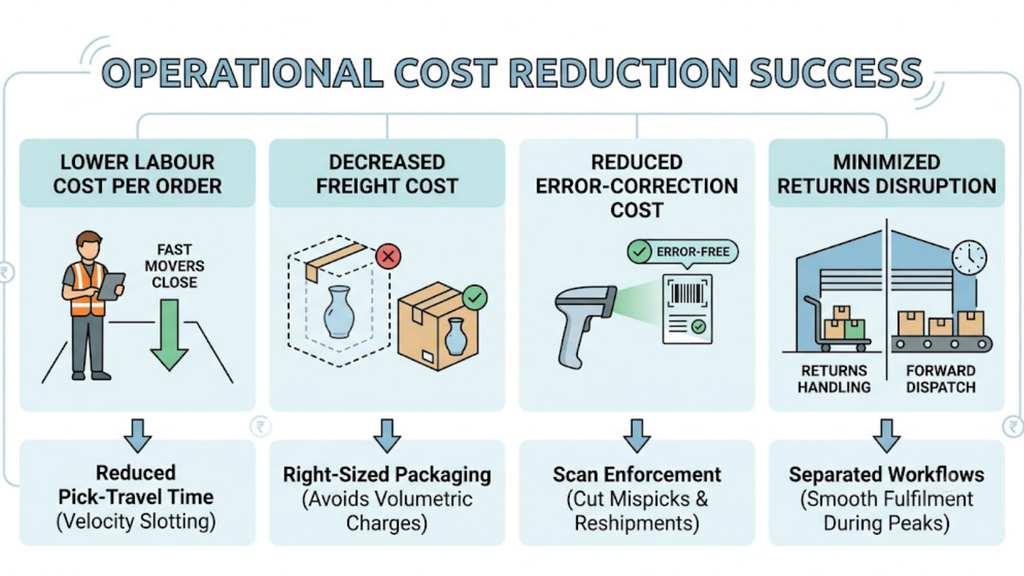
Breaking the 30% figure into its parts shows which changes carried the most weight, and gives other brands a clearer roadmap for where to reduce warehouse operating costs with Base.com first.
- Labour cost per order dropped from reduced pick-travel time. Velocity-based slotting cut the distance pickers walked per order meaningfully, since fast-movers were no longer scattered throughout the warehouse. Good slotting typically cuts pick-walk waste by 40-60% in warehouses that were previously organised by category rather than velocity, directly reducing labour hours per dispatched order.
- Freight cost per shipment dropped from right-sized packaging. Because Indian couriers bill on whichever is higher, actual or dimensional weight, eliminating oversized boxes for small decor items removed a freight overcharge that had been silently applied to a large share of daily shipments.
- Error-correction cost dropped from scan enforcement. Reducing the packing error rate from the 1-3% range down toward industry best-practice levels below 0.5% removed a recurring cost of roughly Rs. 200 to Rs. 600 per mispicked order that the brand had previously absorbed without visibility into its true scale.
- Returns-related disruption cost dropped from workflow separation. Physically and procedurally separating returns from forward dispatch removed the daily interference that had been slowing outbound fulfilment during active dispatch windows, particularly valuable during the brand’s highest-volume Diwali weeks.
Any home decor brand evaluating how to reduce warehouse operating costs with Base.com should expect the actual savings breakdown to vary by category mix, but this four-part structure- labour, freight, error correction, and returns disruption- is a reliable framework for estimating where the biggest gains will come from.
The ROI Timeline: When the Investment Paid for Itself
Brands evaluating whether to reduce warehouse operating costs with Base.com naturally want to know how quickly an implementation like this pays for itself, not just what the eventual savings look like.
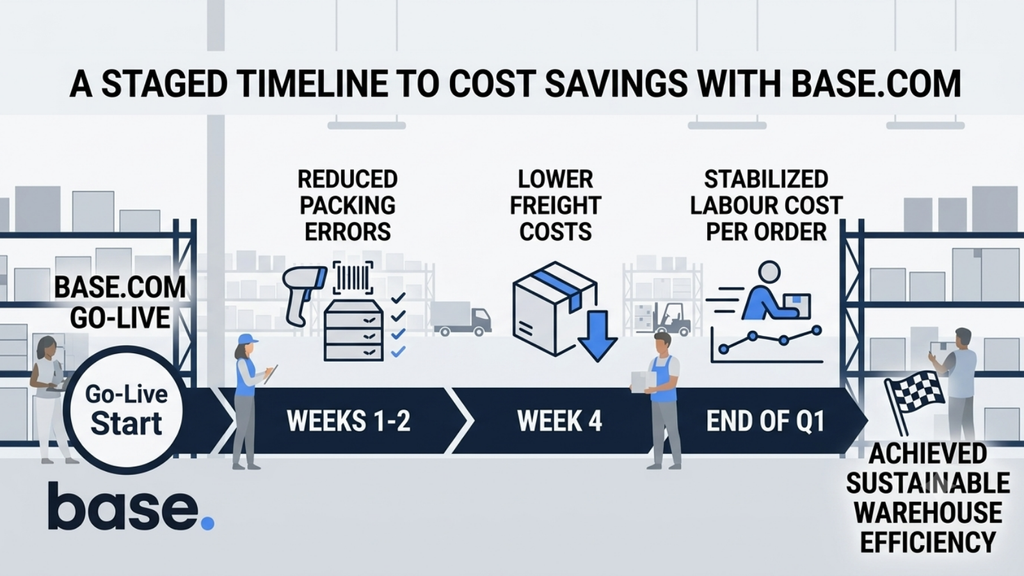
In this case, the brand tracked three milestones. Within the first two weeks of go-live, packing error rates had already dropped meaningfully, since scan enforcement removes most manual matching mistakes almost immediately once packers adjust to the new station workflow. By week four, freight cost per shipment had dropped visibly once the new packaging rules had been applied across a full month of dispatch volume. By the end of the first full quarter, labour cost per order had stabilised at its new, lower baseline, once pickers had fully adapted to the re-slotted warehouse layout.
This staged timeline matters for any brand budgeting the decision to reduce warehouse operating costs with Base.com. The packaging and scan-enforcement gains arrive fastest, within weeks, while the full labour-efficiency gains from re-slotting typically take a full sale cycle to show their complete effect, since picker familiarity with a new layout builds gradually rather than overnight.
For this brand specifically, the combination of fast-arriving packaging savings and slower-building labour savings meant the platform’s cost had effectively paid for itself well before the first Diwali sale window closed, with the majority of ongoing savings continuing to accrue every month afterward, reinforcing the case for brands weighing whether to reduce warehouse operating costs with Base.com sooner rather than later in their growth curve.
What Makes Home Decor a Distinct Case for Warehouse Cost Reduction

Not every category gets the same magnitude of benefit from the same set of fixes, and it is worth being specific about why home decor responds so strongly to the changes described in this case study.
Dimensional weight matters disproportionately in this category. A lightweight ceramic vase or a large but airy lampshade can occupy significant box volume while weighing very little, which means courier billing on dimensional weight hits home decor harder than it hits denser categories like supplements or packaged food. This is precisely why packaging configuration is such a high-leverage lever for any brand trying to reduce warehouse operating costs with Base.com in this specific category.
Fragility drives a naturally higher damage-in-transit return rate than most other ecommerce categories carry. This makes the returns workflow separation described earlier disproportionately valuable, since a higher volume of returns needs quality-checking without disrupting forward dispatch, and a slow returns process ties up more working capital in this category than in one with lower average order values.
The sale calendar concentration around Diwali and the wedding season also means this brand’s warehouse had to absorb a sharper demand spike than a category with more evenly distributed year-round demand. Any home decor brand planning to reduce warehouse operating costs with Base.com should specifically budget implementation time to land well before its own peak season, mirroring the six-week buffer this brand built into its own rollout.
Lessons for Other Home Decor and D2C Brands
A few takeaways from this case generalise well beyond one brand’s specific numbers, and apply broadly to any brand trying to reduce warehouse operating costs with Base.com in a similar category.
1. Category-based warehouse layout is a structural cost, not a minor inefficiency.
Any home decor brand still organising inventory by product type rather than sales velocity is very likely leaving meaningful labour cost on the table, regardless of order volume.
2. Packaging configuration is one of the highest-leverage, lowest-effort fixes available.
Mapping SKUs to correctly sized packaging requires no new hardware and can be configured in days, yet it directly attacks freight cost on every single shipment going forward.
3. Returns need their own physical and procedural space.
Categories with naturally higher damage-in-transit risk, home decor prominently among them, cannot afford to let returns processing compete with forward dispatch for the same floor space and staff attention.
4. Sale-event readiness has to be built in weeks before the event, not during it.
This brand’s implementation timeline, completed roughly six weeks before its Diwali peak, meant the new process was already stable and proven by the time volume spiked 4-5x above normal.
Why Reducing Warehouse Operating Costs Matters Beyond One Brand
India’s D2C sector is scaling fast enough that warehouse cost discipline is no longer optional for brands wanting to protect margin through that growth.
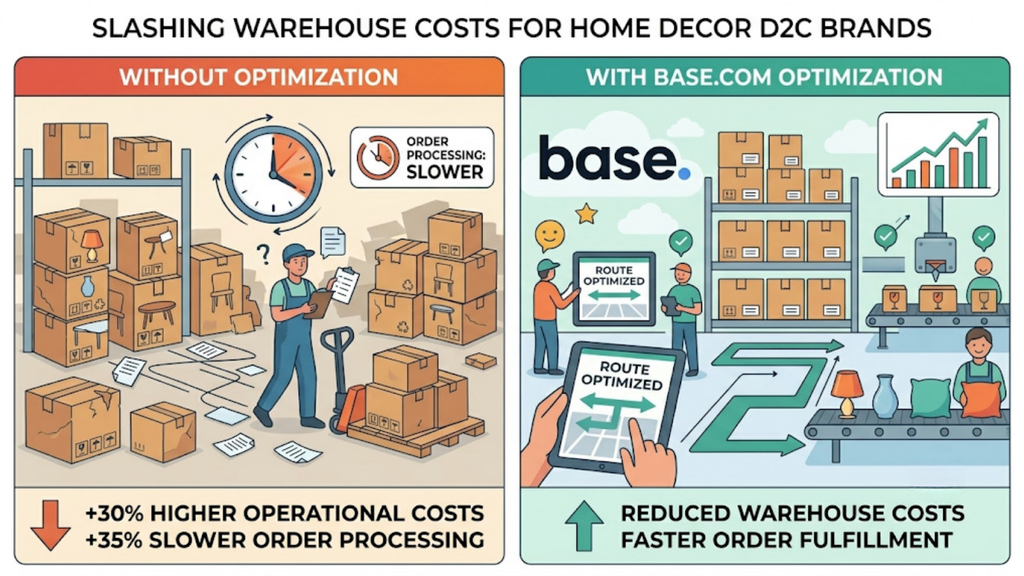
Manual, unoptimised warehouse processes can slow order processing by up to 35% compared to automated, route-optimised alternatives, and businesses relying on manual coordination incur roughly 30% higher operational costs than those running an integrated system, a gap this case study’s results sit squarely inside.
For any brand asking how to reduce warehouse operating costs with Base.com in practical terms, this gap is the starting benchmark to measure against.
For home decor specifically, a category defined by fragile handling, high dimensional weight relative to value, and a sales calendar concentrated into a few high-stakes weeks each year, the case for disciplined warehouse operations is even stronger than for lower-complexity categories.
Brands looking to reduce warehouse operating costs with Base.com in this category should expect the packaging and returns-workflow gains to matter proportionally more than they would for a simpler, low-fragility product line.