A barcode pick and pack system for a D2C warehouse in India eliminates the two most expensive problems in ecommerce fulfillment: wrong items shipped and slow order processing. Indian D2C brands dispatching 200-2,000 orders daily can build a fully functional barcode-driven fulfillment operation for under Rs 25,000 in hardware, and reduce packing errors to near zero within the first week of deployment.
This guide covers exactly how to do it: hardware selection at Indian market prices, warehouse layout, WMS integration via Base.com, and the standard operating procedures that hold it all together.
Why Indian D2C Warehouses Cannot Afford Manual Picking Anymore
Manual picking is the default for most Indian ecommerce sellers under 1,000 daily orders. It is also the source of avoidable losses that compound silently every month.
A mispicked item costs between Rs 200 and Rs 600 per order when you account for reverse logistics, repackaging, customer service, and reshipping. For a seller dispatching 300 orders a day, even a 2% error rate means 6 wrong shipments daily, Rs 1,200 to Rs 3,600 in direct losses, before counting marketplace penalties.
India’s D2C market crossed Rs 2.5 lakh crore in GMV in 2025. The national average RTO rate for D2C brands sits between 20-30%, and a meaningful share of those returns trace back to fulfillment mistakes, wrong size, wrong colour, wrong quantity. Marketplaces like Amazon, Flipkart, and Meesho track order defect rates closely. A sustained error rate above their threshold can cost you Buy Box eligibility and payment delays, regardless of how competitive your pricing is.
A barcode pick and pack system for a D2C warehouse in India directly addresses this. Scan-to-verify at the pick and pack stage catches errors before they leave the facility. The investment is small. The impact on the error rate is immediate.
What a Barcode Pick and Pack System Actually Consists Of
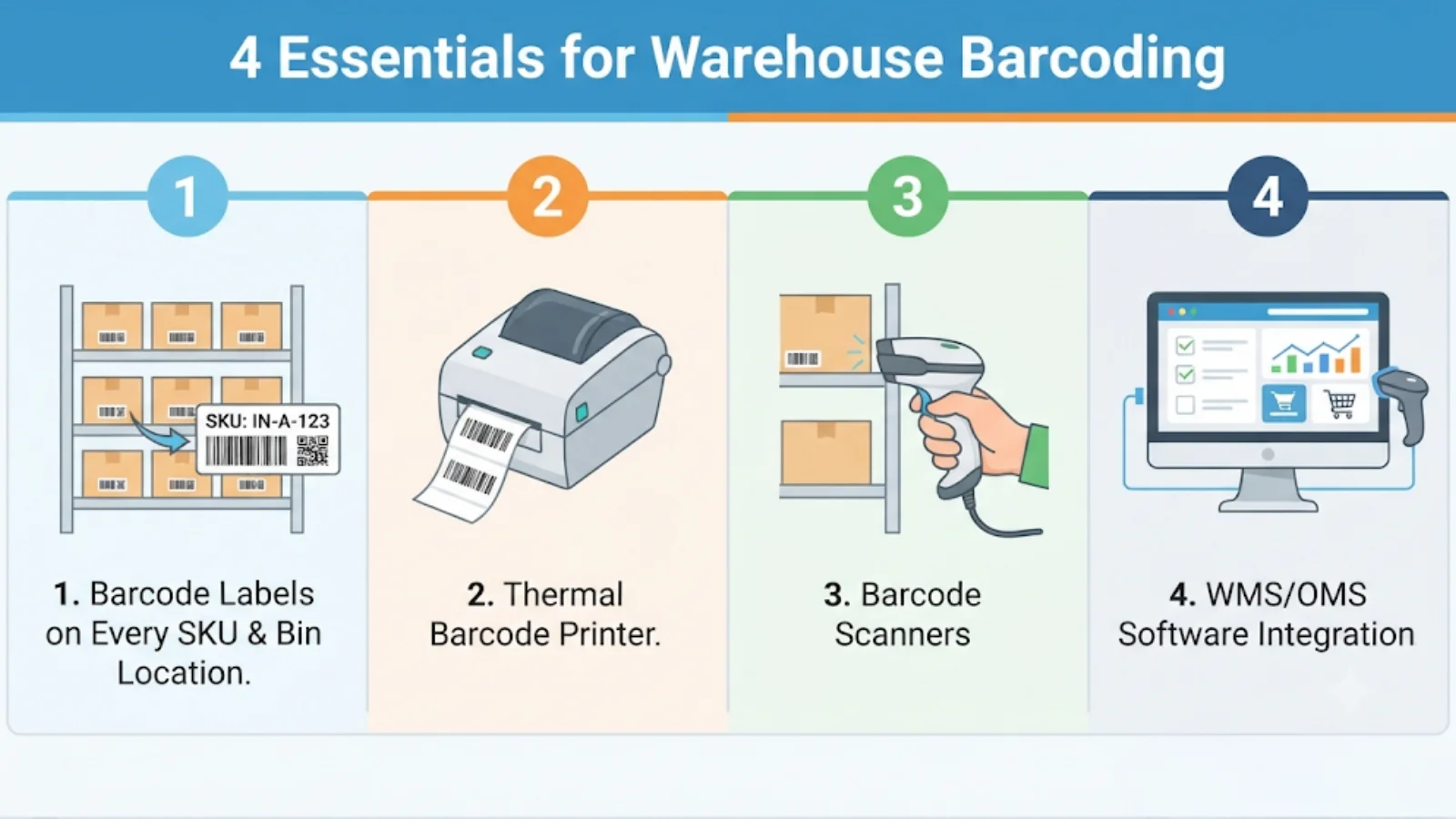
Before spending anything, understand what the system is made of. There are four components.
1. Barcode labels on every SKU and bin location
Every product and every storage bin in your warehouse needs a scannable barcode label. For most Indian sellers, EAN-13 barcodes assigned by GS1 India or internal SKU barcodes generated through your WMS are sufficient. Labels cost Rs 0.50-2 per piece in bulk rolls from vendors on IndiaMART or Amazon Business.
2. A thermal barcode printer
This prints your shipping labels, product barcodes, and bin location labels. Entry-level thermal printers from TSC, Argox, or Godex, suitable for D2C warehouse use, are available between Rs 6,000 to Rs 9,000. Zebra’s ZD series starts around Rs 9,500-12,000 on Moglix with GST and is the most durable choice for multi-shift operations.
3. Barcode scanners
Wired 2D scanners (which read both QR codes and standard barcodes) are the workhorse of a D2C pick and pack operation. A Zebra DS2208 with a 5-year warranty retails for Rs 4,500-5,500. The Honeywell 1472G wireless scanner with cradle runs Rs 10,350-12,650. For a small warehouse with 2-3 pack stations, budget Rs 9,000-15,000 total for scanners, depending on whether you choose wired or wireless.
4. A WMS or OMS with barcode scan integration
The scanner is useless without software that validates the scan against the open order. This is where Base.com’s WMS module connects the hardware to the fulfillment workflow.
Hardware Budget Breakdown: Under Rs 25,000
Here is a realistic hardware configuration for a D2C warehouse processing 300-1,500 daily orders with 2 pack stations.
| Item | Recommended Option | Approx. Cost (INR, incl. GST) |
|---|---|---|
| Thermal label printer | TSC DA220 or Godex DT4X (203 DPI) | Rs 7,000-9,000 |
| Wired 2D barcode scanner × 2 | Zebra DS2208 or Honeywell Xenon 1950 | Rs 9,000-11,000 |
| Barcode label rolls (10,000 labels) | 100mm × 150mm direct thermal, IndiaMART | Rs 1,500-2,500 |
| Bin location labels (printed set) | Pre-printed adhesive shelf labels | Rs 500-1,000 |
| Wi-Fi router (if not existing) | TP-Link or D-Link dual-band | Rs 2,000-3,000 |
| Total | Rs 20,000-26,500 |
A lean setup with one thermal printer and two wired scanners comes in well under Rs 22,000. The wireless scanner upgrade (recommended for large floor areas) adds roughly Rs 3,000-4,000 per unit but eliminates cable drag on high-velocity pack stations.
Warehouse Layout for Barcode-Based Fulfillment
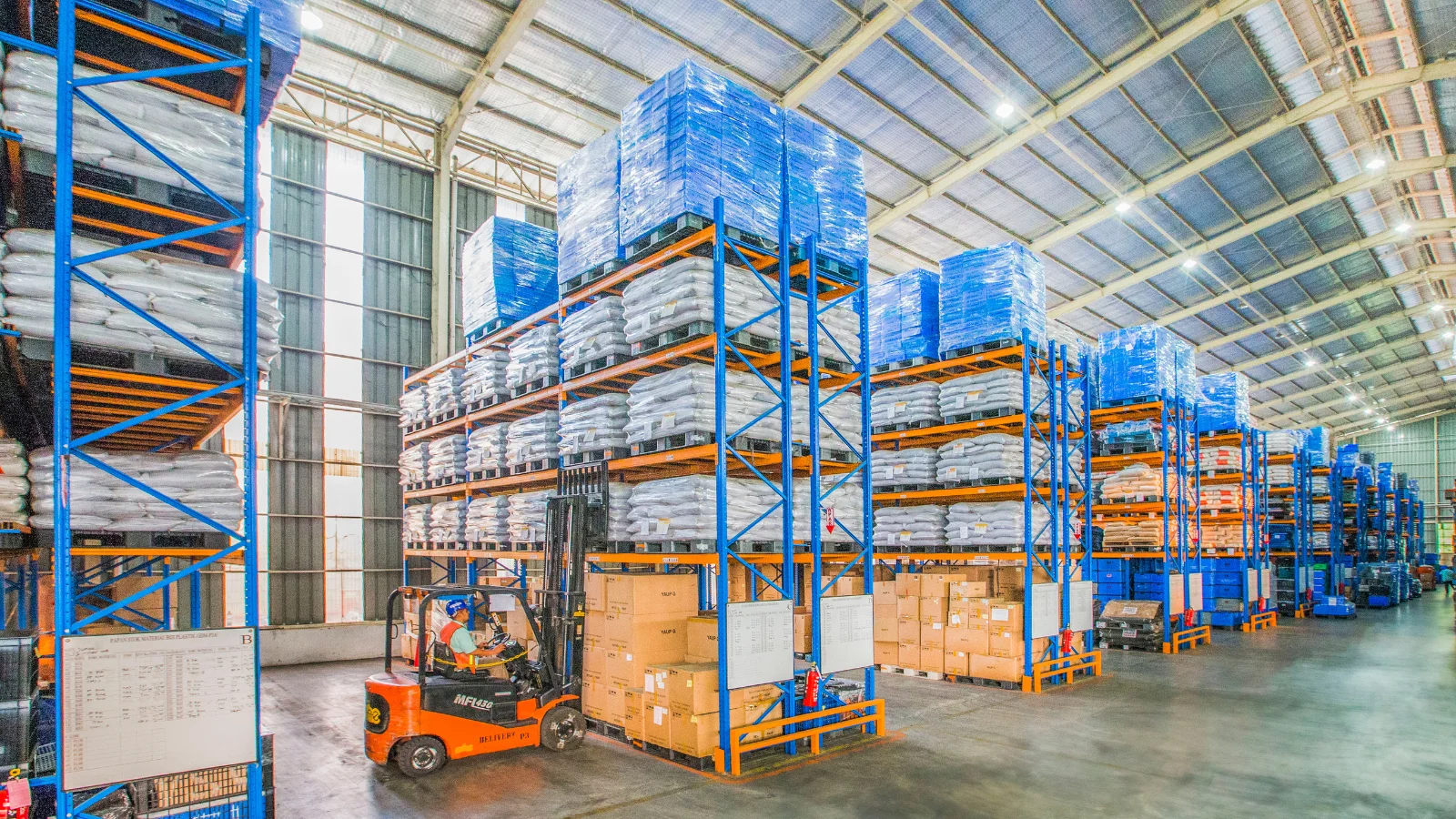
Hardware alone does not produce accuracy. The physical layout of your warehouse determines whether barcode scanning speeds up fulfillment or creates bottlenecks.
Zone Your Warehouse Into Three Distinct Areas
- Inbound / Receiving zone: All incoming stock enters here. Every SKU is scanned and matched against a purchase order before being placed in storage. Base.com’s WMS records receipt quantity, batch, and storage bin at this stage. No unscanned stock moves to the shelf.
- Pick zone: Organised by velocity. Your fastest-moving SKUs (typically 20% of the catalogue driving 80% of daily orders) should be closest to the pack station. Bin locations use a simple alphanumeric format: A1-01, A1-02 (row-aisle-shelf). Every bin has a barcode label. Every SKU bin location is mapped in Base.com.
- Pack and dispatch zone: Pack stations are fixed with a scanner, a monitor or tablet showing the open picklist, and a thermal printer. The packer scans each item before placing it in the shipping bag. Base.com validates the scan in real time against the order line. If the item does not match, the system flags it immediately.
This three-zone separation is the difference between a warehouse where scanners are used and a warehouse that actually runs on scanning. Without zone discipline, pickers carry stock across the floor and mix inbound with outbound, barcode scanning becomes an audit exercise rather than a live control.
Setting Up Barcode Pick and Pack in Base.com
Base.com’s WMS module is built for multi-channel Indian D2C brands operating across Shopify, Amazon, Flipkart, Meesho, and direct channels simultaneously. Here is how the barcode pick and pack system for a D2C warehouse in India maps to Base.com’s workflow.
Step 1: SKU and Bin Location Setup
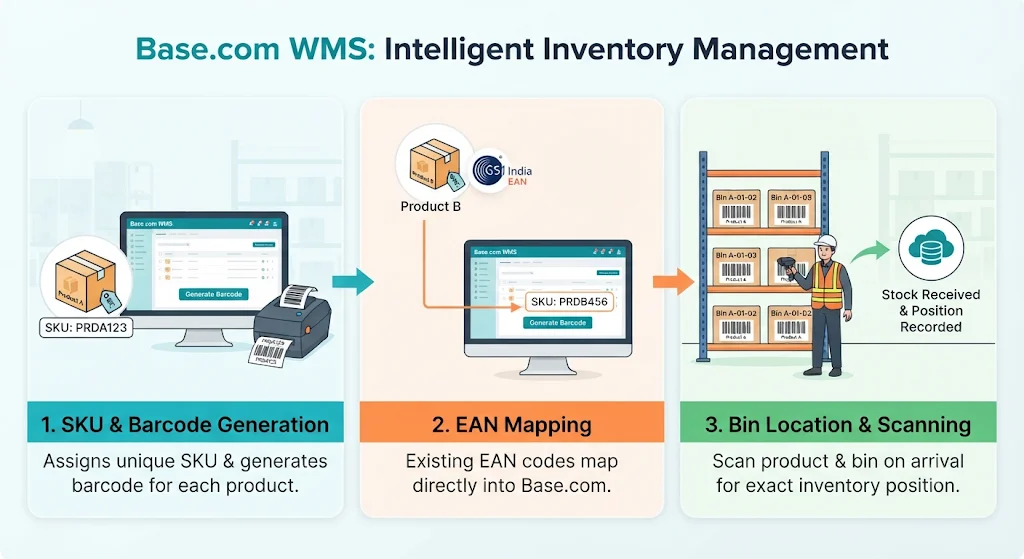
In Base.com, every product gets a unique internal SKU code. The WMS generates a barcode for each SKU that can be printed directly from the platform onto your thermal printer. If your products already have EAN codes from GS1 India, those map directly into Base.com.
Bin locations are created in Base.com as warehouse locations. Each location is assigned a barcode. When stock arrives, the receiving team scans the product barcode and the bin barcode. Base.com records the exact bin-level inventory position. This is the foundation for accurate pick instructions.
Step 2: Order Routing and Picklist Generation
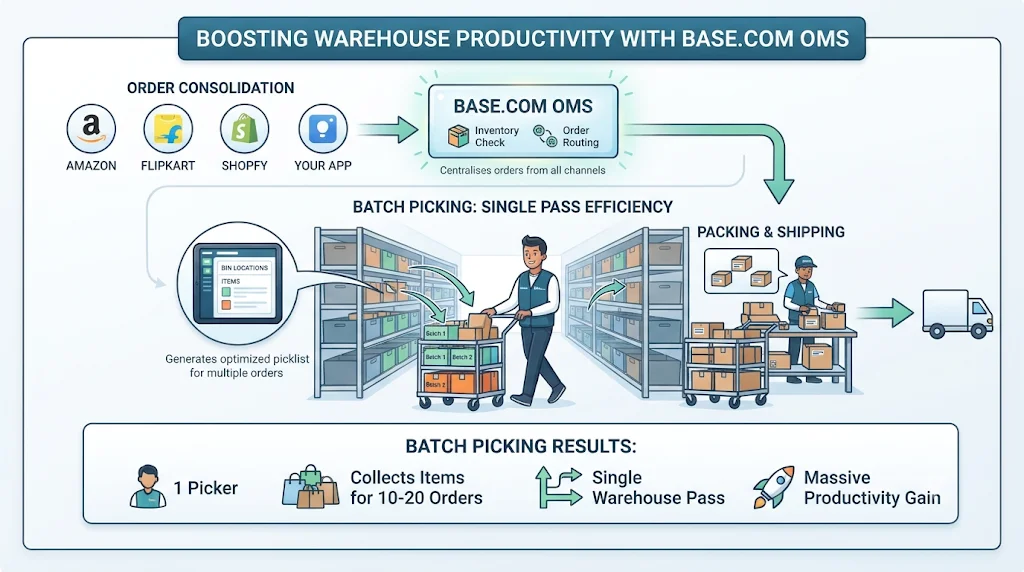
When an order comes in from any channel, Amazon, Flipkart, Shopify, or your own app, Base.com’s OMS captures it, checks inventory across all active storage locations, and routes it to the relevant warehouse.
Base.com generates a picklist that specifies the exact bin location for every item in every order. For D2C warehouses processing multiple orders simultaneously, Base.com supports batch picking: a single picker walks the warehouse once and collects items for 10-20 orders in a single pass. This is the single biggest productivity improvement most Indian warehouses can make without adding headcount.
Step 3: Scan-to-Pick Verification
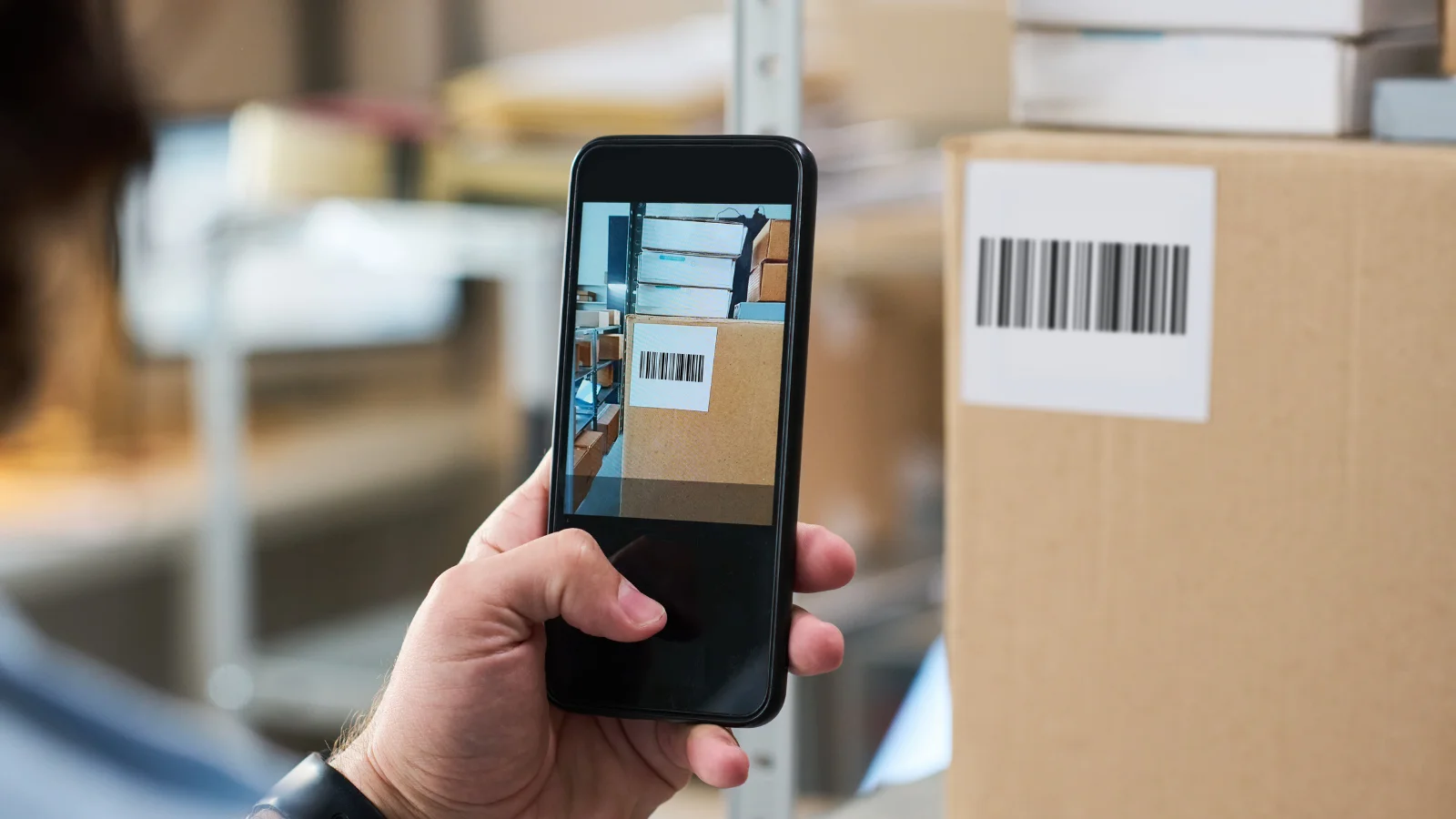
The picker carries a barcode scanner and the printed or screen-displayed picklist. At each bin, they scan the bin location barcode first (confirming they are at the right location), then scan the product barcode (confirming the right item). Base.com validates both scans. If either is wrong, the picker gets an immediate alert.
This two-scan verification is what drives packing error rates toward zero. Most Indian D2C operations, before implementing a barcode pick and pack system for a D2C warehouse in India, have error rates of 2-4%. After scan-to-pick, error rates drop below 0.5% within the first 30 days.
Step 4: Pack Station Verification
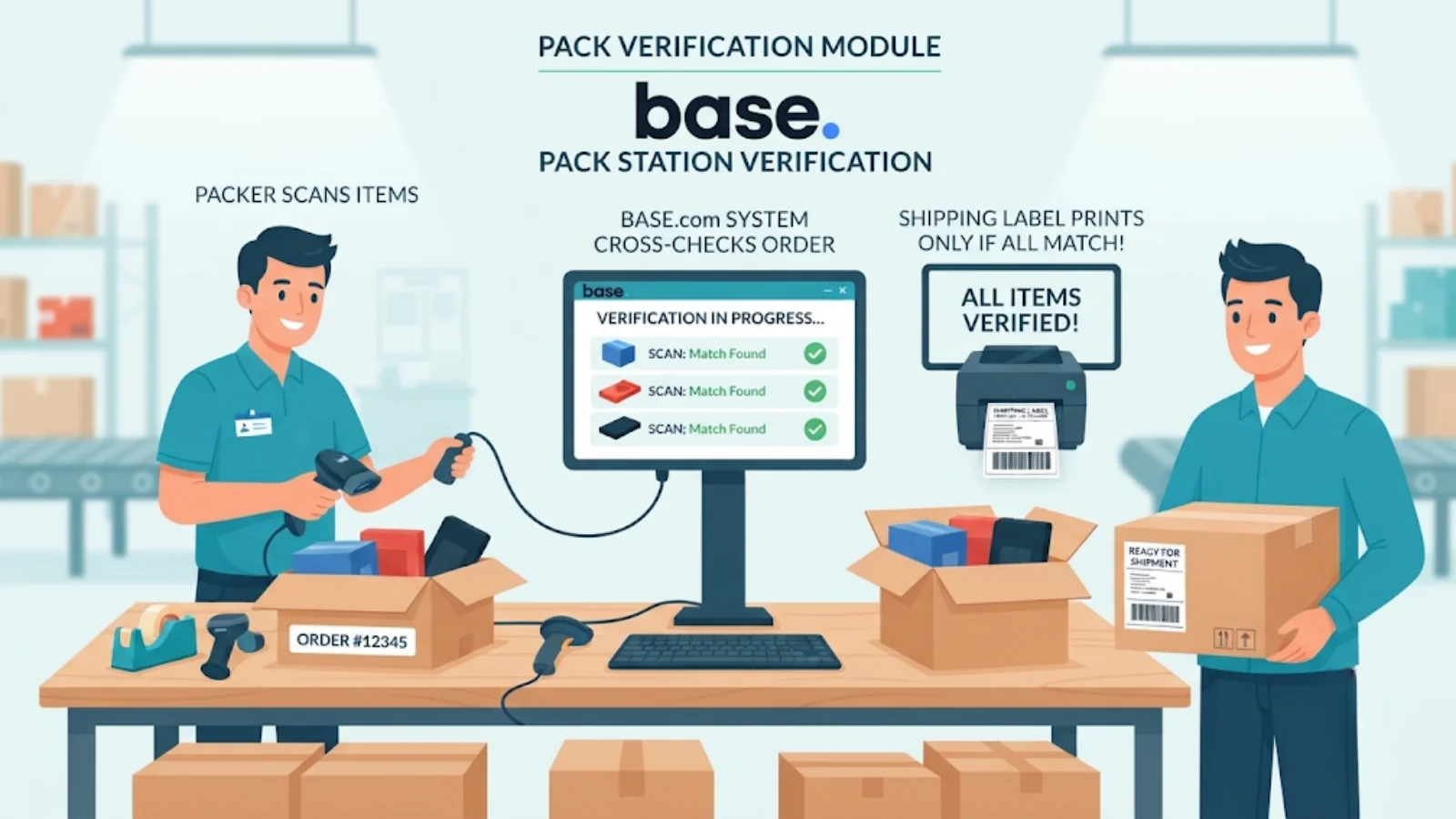
At the pack station, the packer scans each item a second time before sealing the shipment. Base.com cross-checks the scanned items against the original order. Only when all items in an order are verified does the system allow the shipping label to print.
This is Base.com’s pack verification module. It prevents partially packed orders from being dispatched and catches any picks that were mixed up during the walk from the shelf to the pack station.
Step 5: Shipping Label Generation and AWB Assignment
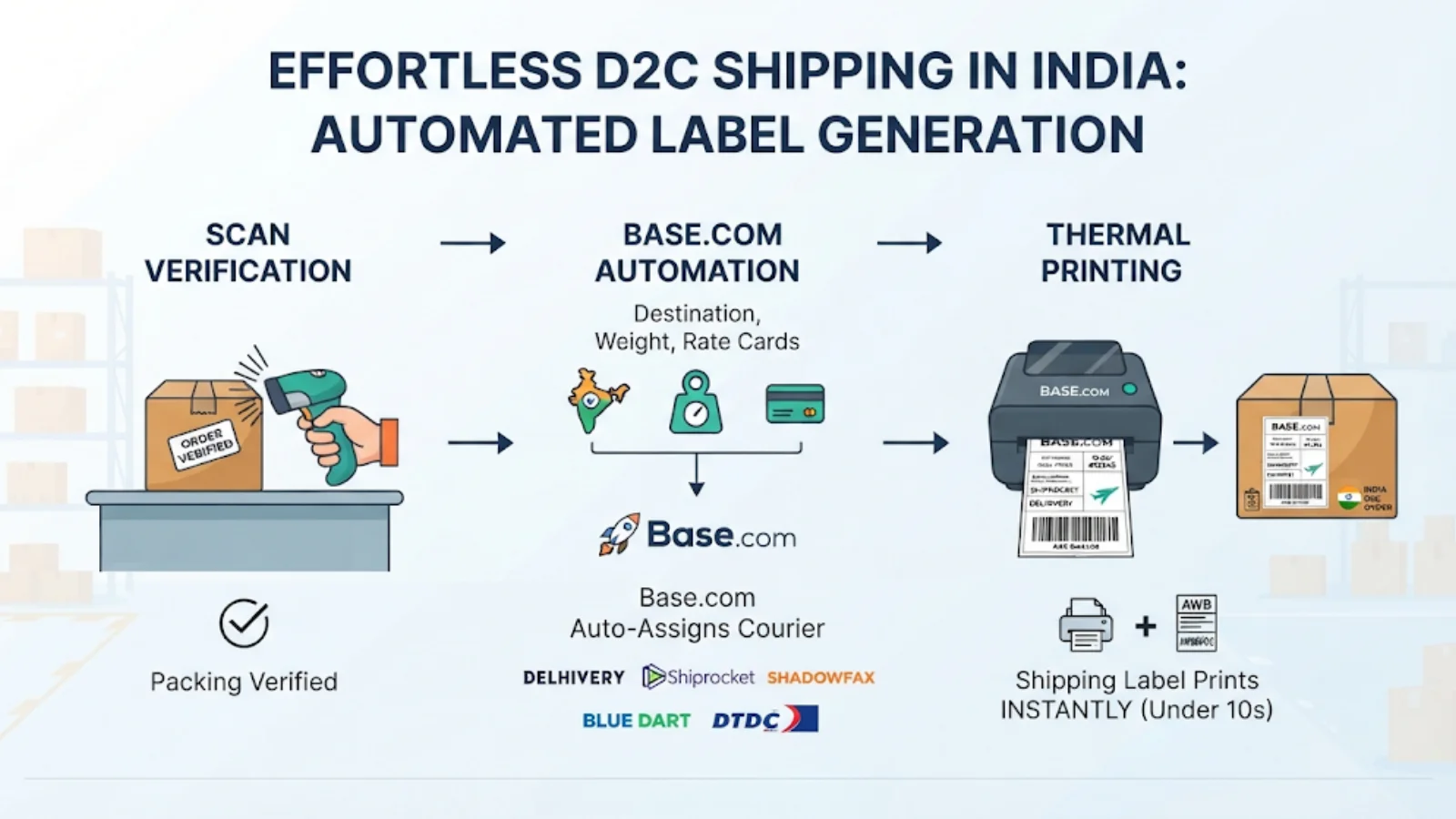
Once packing is verified, Base.com triggers the shipping label print directly from the thermal printer at the pack station. The AWB (airway bill) is auto-assigned from the appropriate courier based on the order’s destination, weight, and your configured rate cards, Delhivery, Shiprocket, Shadowfax, Blue Dart, DTDC, or others.
No manual data entry. No copy-paste between tabs. No courier selection errors. The barcode pick and pack system for a D2C warehouse in India generates the correct label in under 10 seconds from scan completion.
Standard Operating Procedure: Daily Warehouse Run
A barcode pick and pack system for a D2C warehouse in India is only as good as the SOP your team follows. Here is the daily operating rhythm for a 300-800 order operation.
1. Morning (8:00-9:00 AM), Inbound and picklist prep
All overnight and early-morning orders from Base.com are batched into picklists. The warehouse manager reviews stock availability, and Base.com flags any orders with stockouts or partial inventory before picking begins.
2. Peak picking window (9:00 AM-1:00 PM)
Pickers work from Base.com picklists in batch mode. Two-scan verification at every bin. No item moves to the pack station without a confirmed scan. Bins with low stock trigger a reorder alert in Base.com automatically.
3. Pack and dispatch (11:00 AM-5:00 PM, overlapping with pick)
Pack station operators work from verified pick totes. Every item is scanned at the pack. Shipping labels printed, pouches sealed, manifests generated. Courier pickups are scheduled through Base.com’s logistics module.
4. EOD cycle count (5:00-6:00 PM)
Pickers scan 20-30 bin locations daily on a rotating basis. Base.com’s WMS compares scan counts against system inventory. Discrepancies are flagged for physical recount. A full warehouse physical count takes 2-3 days instead of a week when bin-level data is maintained accurately.
Common Mistakes Indian D2C Warehouses Make With Barcode Systems

Many sellers buy the hardware and fail on execution. These are the four most common failure points.
- Not labelling bin locations. Scanning products without scanning bin locations eliminates half the accuracy benefit. Every storage bin must have a barcode, and the bin must be mapped in Base.com before the system can generate accurate pick instructions.
- Using mobile phones as barcode scanners. Phones work in a demo. They fail under eight hours of continuous warehouse use, battery drain, overheating, and slow scan speeds on aged handsets create bottlenecks. A dedicated 2D wired scanner at Rs 4,500-5,500 is the correct choice. It pays back within two weeks of reduced error costs.
- Not enforcing the two-scan rule. Pickers under time pressure skip the bin scan and only scan the product. This defeats the location-verification half of the system. Base.com can be configured to require both scans before proceeding. Use this setting from day one.
- Skipping cycle counts. A barcode system improves accuracy but does not self-correct if items are placed in the wrong bins. Weekly cycle counts using Base.com’s WMS maintain inventory integrity. Sellers who skip cycle counts see accuracy drift back within 60-90 days of go-live.
Scaling the System: From 300 to 3,000 Daily Orders
The hardware setup described above handles up to 1,500 daily orders comfortably with 2-3 pack stations. Scaling to 3,000+ orders requires two adjustments, neither of which requires replacing Base.com.
- Add pack stations, not headcount. Each additional pack station requires one wired scanner (Rs 4,500-5,500) and a monitor or tablet. The incremental hardware cost per station is under Rs 8,000. Base.com’s WMS supports unlimited concurrent pack stations without additional module licensing.
- Move to wireless scanners for large floor areas. Warehouses over 5,000 sq ft benefit from wireless scanners, so pickers are not tethered. The Honeywell 1472G or Zebra Li4278 at Rs 10,000-13,000 per unit connects over Wi-Fi and maintains full scan validation through Base.com’s WMS. The floor coverage upgrade pays back in picker walk time reduction alone.
The barcode pick and pack system for a D2C warehouse in India that starts at Rs 20,000 in hardware scales to 5,000+ orders daily with the same Base.com WMS platform, only the hardware footprint changes.
Why Base.com Is the Right WMS for Indian D2C Barcode Operations
Most generic WMS platforms available in India were built for large enterprises or 3PL operations. They require 3-6 month implementations, dedicated IT resources, and annual contracts in the tens of lakhs. They are not built for a 300-order-per-day D2C brand in Bengaluru or Surat trying to reduce packing errors this month.
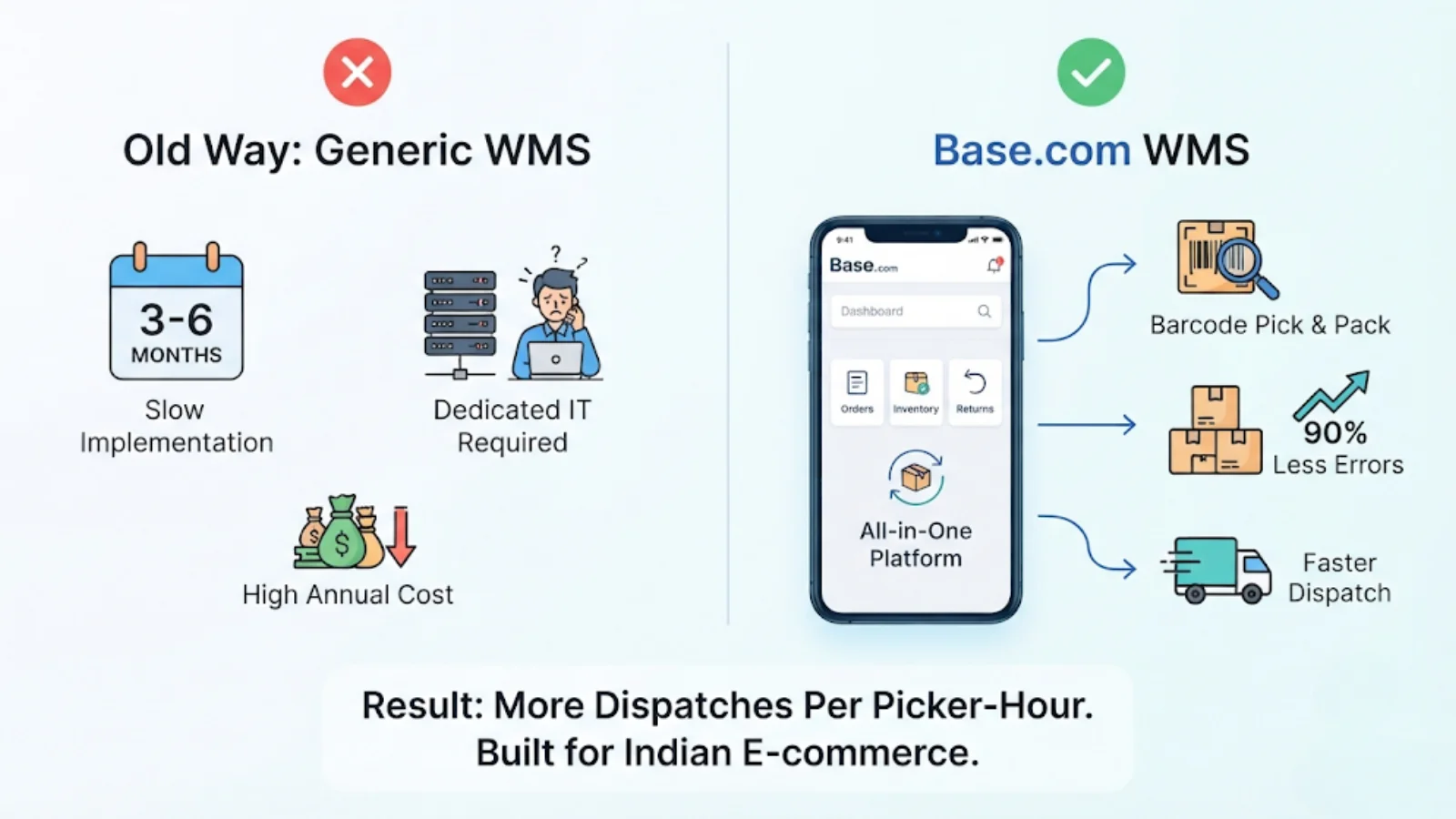
Base.com is purpose-built for Indian ecommerce sellers. It integrates natively with Amazon, Flipkart, Meesho, Myntra, Shopify, WooCommerce, and 40+ other Indian channels and courier partners. The WMS module activates on the same platform where your order management, inventory, and returns already live, with no separate software stack to manage.
For the barcode pick and pack system for a D2C warehouse in India, the relevant Base.com capabilities are:
- Bin-level inventory tracking across unlimited locations
- Barcode-driven pick and pack verification with real-time validation
- Batch picking for multi-order fulfillment
- Direct thermal label printing from pack stations without courier portal logins
- Automated courier assignment based on destination and rate card
- Cycle count workflows with discrepancy flagging
- Returns management with barcode-verified QC at inbound
Indian D2C brands using Base.com’s barcode-enabled WMS consistently reduce pick and pack errors by 80-90% within the first month. Order processing throughput increases because pickers spend less time rechecking, and packers spend less time correcting. The result is more dispatches per picker-hour without adding headcount.
Total Cost Summary
| Category | Cost Range (INR) |
|---|---|
| Hardware (printer + 2 scanners + labels) | Rs 18,000-22,000 |
| Bin location labels and setup | Rs 500-1,000 |
| Wi-Fi infrastructure (if needed) | Rs 2,000-3,000 |
| Base.com WMS setup and onboarding | Platform subscription (no additional hardware cost) |
| Total hardware investment | Rs 20,500-26,000 |
This is a one-time hardware cost. The Rs 200-600 per error savings begin immediately. For a brand shipping 500 orders a day at a 2% error rate, the hardware investment pays back in under two weeks.