

The warehouse management best practices to follow in 2026 start with one fact: inefficient warehousing drives up logistics costs by 15-25%, while a properly implemented system cuts operational costs by up to 30% and improves order accuracy by 20-30%. India’s warehousing footprint is projected to reach 516 million square feet by 2026, up from 344 million square feet in 2023, a 50% increase in three years.
Grade A warehouses, built to modern operational standards, now account for nearly 40% of new supply. Against that backdrop, the warehouse management best practices to follow below separate warehouses that scale smoothly from ones that buckle under their own growth.
Most warehouses do not fail because of a single missing tool. They fail because they adopt one or two warehouse management best practices to follow in isolation while ignoring the other eighteen, which limits how much operational improvement actually shows up in fill rate, cost, or delivery speed.
1. Implement a Warehouse Management System

A WMS is the foundation among warehouse management best practices to follow, since manual tracking cannot keep pace with multi-channel order volume. It centralizes inventory, order, and workforce data into one system instead of spreadsheets.
Roughly 85% of businesses still run inventory primarily on spreadsheets, and that gap is exactly where a properly implemented WMS delivers the fastest visible improvement.
| Do | Don’t |
| Run a needs assessment before choosing a WMS | Buy based on brand name alone |
| Involve warehouse staff in the rollout plan | Roll out to all shifts without training first |
| Set clear KPIs before go-live | Skip a pilot phase on a smaller SKU set |
2. Optimize Warehouse Layout and Slotting
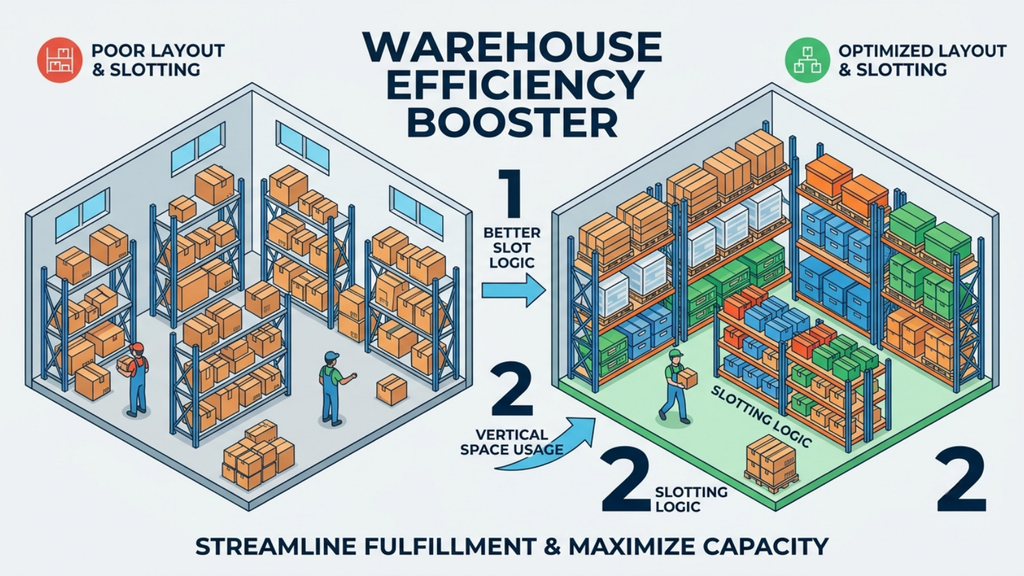
Poor layout is one of the most common reasons warehouses struggle to hit fulfillment targets. Vertical space and slotting logic are core warehouse management best practices to follow, especially as SKU count grows.
| Do | Don’t |
| Place fast-moving SKUs near dispatch zones | Slot new SKUs randomly without a plan |
| Use vertical racking to maximize floor space | Leave aisles too narrow for equipment |
| Re-slot quarterly based on velocity data | Assume the original layout stays optimal forever |
3. Use ABC Analysis for Inventory Prioritization
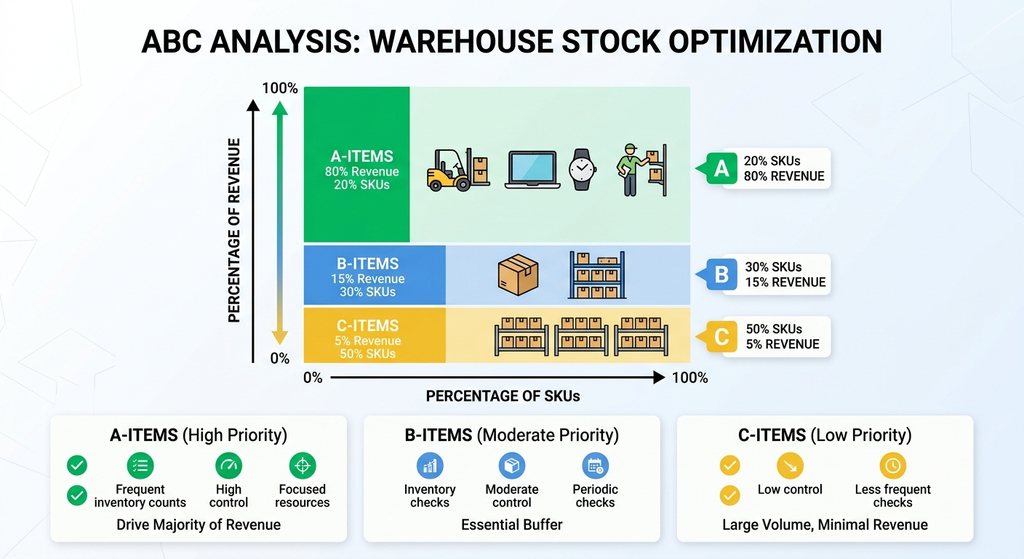
ABC analysis is one of the warehouse management best practices to follow that directly controls where staff attention and stock investment go. A-items typically drive the majority of revenue from a small share of SKUs.
| Do | Don’t |
| Rank SKUs by revenue contribution | Treat every SKU with equal monitoring |
| Set tighter reorder checks for A-items | Apply the same reorder rule catalog-wide |
| Re-run classification every 6 months | Classify once and never revisit |
4. Set Dynamic Reorder Points
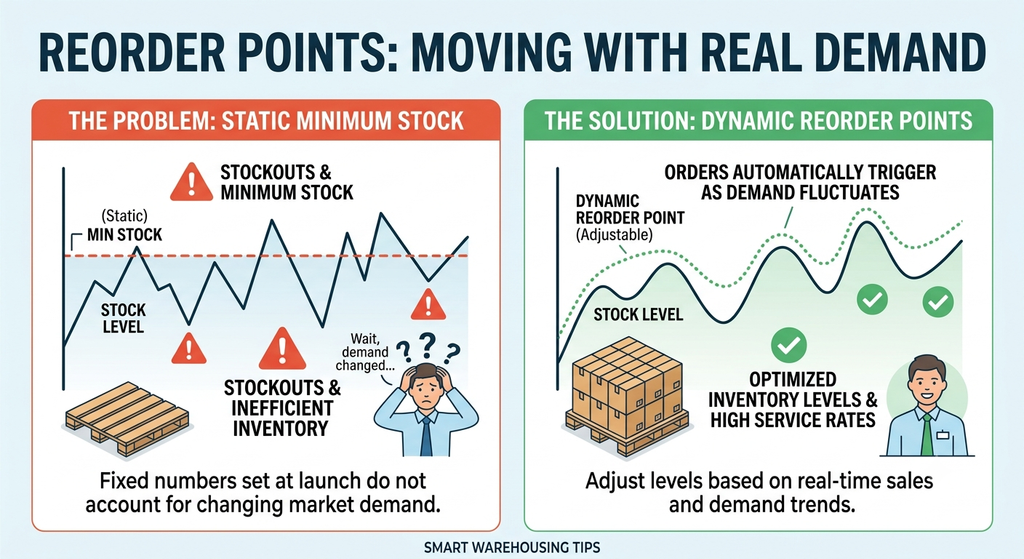
Static minimum stock levels are one of the fastest ways to undermine otherwise sound warehouse management best practices to follow. Reorder points should move with real demand, not a number set at launch.
| Do | Don’t |
| Calculate reorder points from live demand and lead time | Copy last year’s reorder numbers unchanged |
| Adjust for seasonal and festive demand shifts | Ignore supplier lead time variability |
| Automate reorder alerts | Rely on manual stock checks |
5. Adopt Barcode and RFID Scanning

Barcode and RFID scanning remove manual data entry errors at receiving, picking, and shipping. This is one of the warehouse management best practices to follow that pays for itself quickly through fewer mis-picks.
| Do | Don’t |
| Scan at every transaction point, not just receiving | Allow manual SKU entry as a routine fallback |
| Validate location during picking with scans | Skip scanning during high-volume rush periods |
| Keep barcode labels legible and durable | Use handwritten labels for high-turnover bins |
6. Conduct Regular Cycle Counting
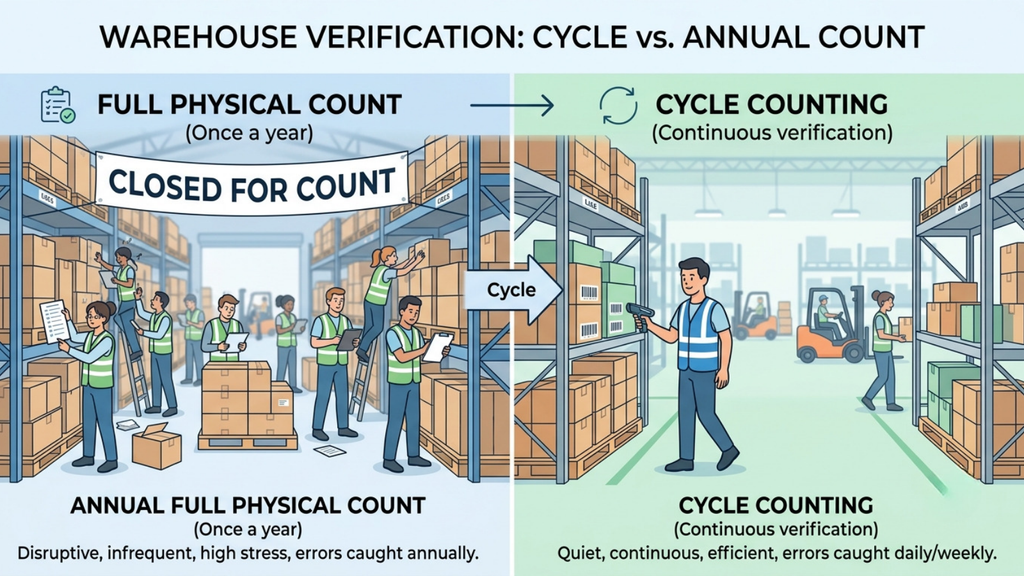
Annual full physical counts are disruptive and only catch errors once a year. Cycle counting is one of the quieter warehouse management best practices to follow, spreading verification across the year instead.
| Do | Don’t |
| Prioritize A-class items for frequent counts | Wait for an annual count to catch discrepancies |
| Set variance thresholds that trigger a recheck | Ignore small recurring variances |
| Rotate counting responsibility across shifts | Assign counts to the same person indefinitely |
7. Standardize Operating Procedures
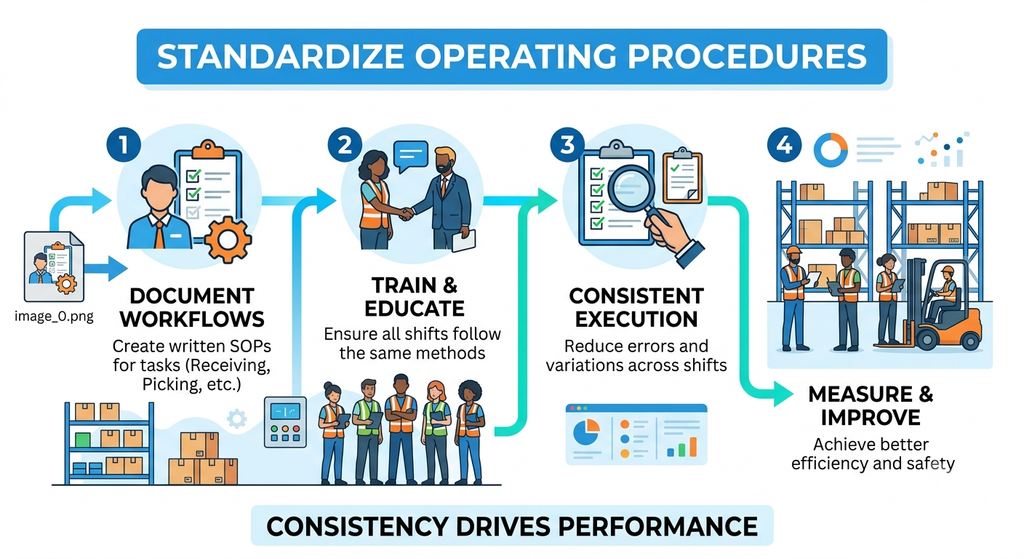
Written SOPs are a foundational warehouse management best practice to follow, since they ensure consistent execution regardless of which shift or staff member is on the floor.
| Do | Don’t |
| Document every process step by step | Rely on tribal knowledge passed verbally |
| Update SOPs when a process changes | Let SOPs go stale after the first version |
| Make SOPs accessible on the warehouse floor | Store SOPs only in a manager’s office drawer |
8. Train and Cross-Train Warehouse Staff
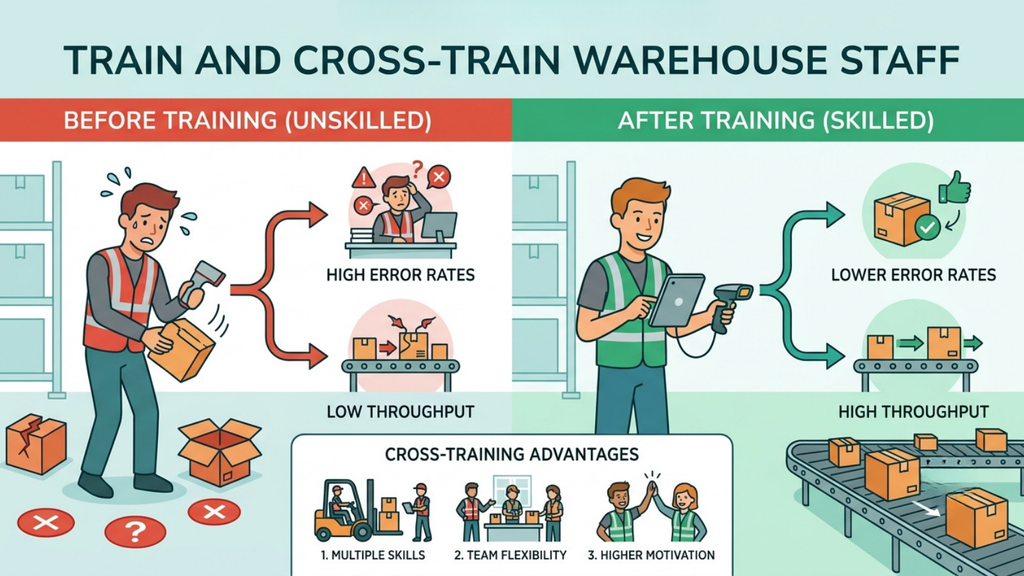
Among warehouse management best practices to follow, staff training is one of the most underfunded, despite directly affecting error rates and throughput.
| Do | Don’t |
| Cross-train staff across receiving, picking, and packing | Depend on one specialist per critical task |
| Retrain after every major process or system change | Assume one-time onboarding is sufficient |
| Track error rates per trained role | Treat training as a one-off event |
9. Optimize Picking Routes and Methods

Inefficient picking paths quietly eat into throughput every single shift. Route and method optimization is one of the warehouse management best practices to follow that scales in impact as order volume grows.
| Do | Don’t |
| Use batch or zone picking for high SKU density | Send pickers on the same inefficient route daily |
| Reassess picking method as order profile changes | Assume one picking method fits every SKU type |
| Use directed picking through a WMS where possible | Rely on paper pick lists at high volume |
10. Automate Receiving and Putaway
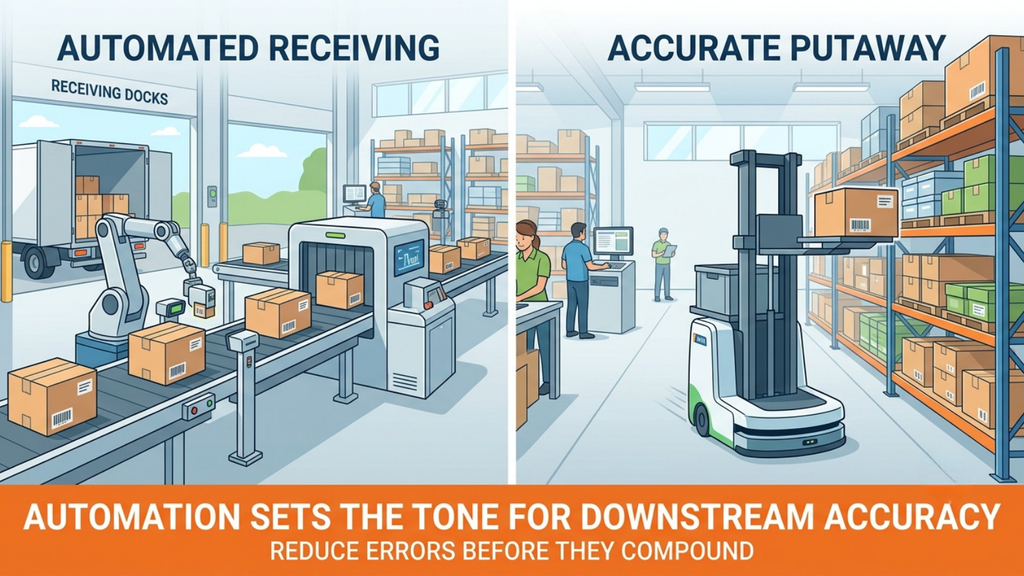
Receiving and putaway set the accuracy tone for everything downstream. Automating this step is one of the warehouse management best practices to follow that reduces errors before they can compound.
| Do | Don’t |
| Validate incoming stock against purchase orders automatically | Manually reconcile receiving records after the fact |
| Direct putaway to optimal locations via system logic | Let staff choose storage locations ad hoc |
| Flag discrepancies at receiving, not later | Discover receiving errors during a stockout |
11. Use FIFO and FEFO for Perishable and Batch Stock
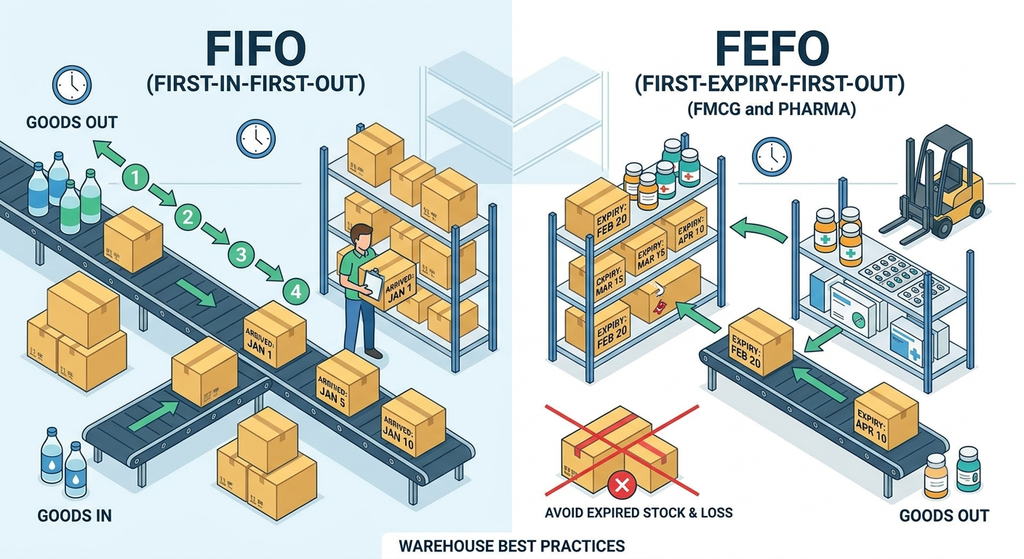
For FMCG and pharma warehouses, First-In-First-Out and First-Expiry-First-Out are non-negotiable warehouse management best practices to follow, since expired stock effectively disappears from usable inventory.
| Do | Don’t |
| Apply FEFO strictly to any batch-tracked SKU | Rely on staff memory for expiry sequencing |
| Tag batch and expiry data at receiving | Add expiry data only when a batch is picked |
| Flag stock nearing expiry automatically | Discover expired stock during a physical count |
12. Maintain Safety and Compliance Standards

Safety incidents cause downtime, and downtime undermines every other warehouse management best practice to follow. Compliance is not separate from efficiency, it is a precondition for it.
A single serious safety incident can shut down a warehouse floor for days, erasing weeks of throughput gains from every other practice on this list combined.
| Do | Don’t |
| Conduct regular safety audits and drills | Treat safety training as a one-time checkbox |
| Keep aisles and emergency exits clear at all times | Store overflow stock in walkways |
| Maintain equipment on a scheduled service cycle | Wait for equipment failure to trigger maintenance |
13. Track and Monitor Key Warehouse KPIs
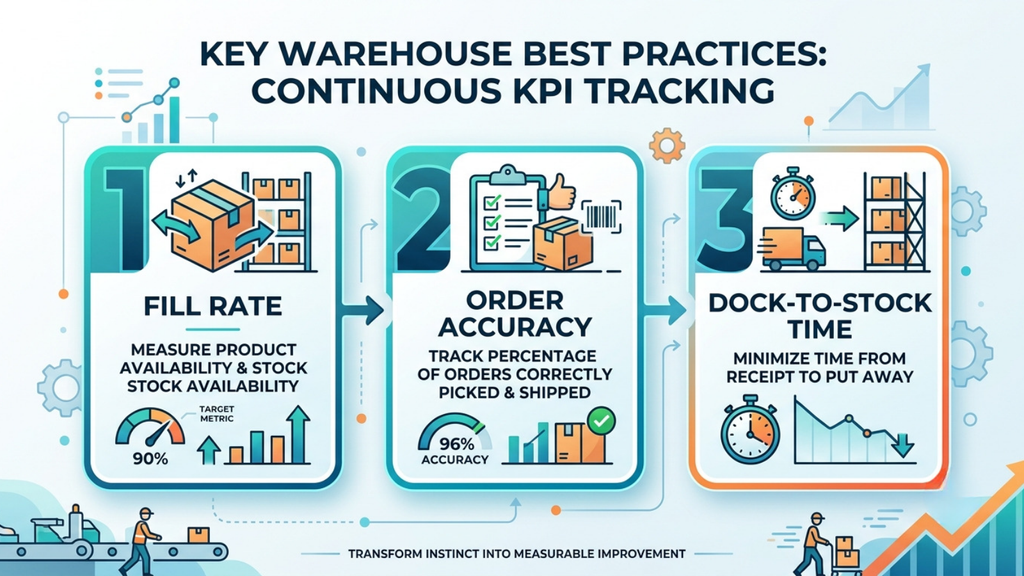
Among the warehouse management best practices to follow, KPI tracking is what turns operational instinct into measurable improvement. Fill rate, order accuracy, and dock-to-stock time are core metrics worth tracking continuously.
| Do | Don’t |
| Track fill rate, accuracy, and cycle time weekly | Rely on gut feel instead of data |
| Compare KPIs against a documented baseline | Track metrics without acting on the trends |
| Share KPI dashboards with floor teams | Keep performance data visible only to management |
14. Integrate WMS with SAP, ERP, and OMS
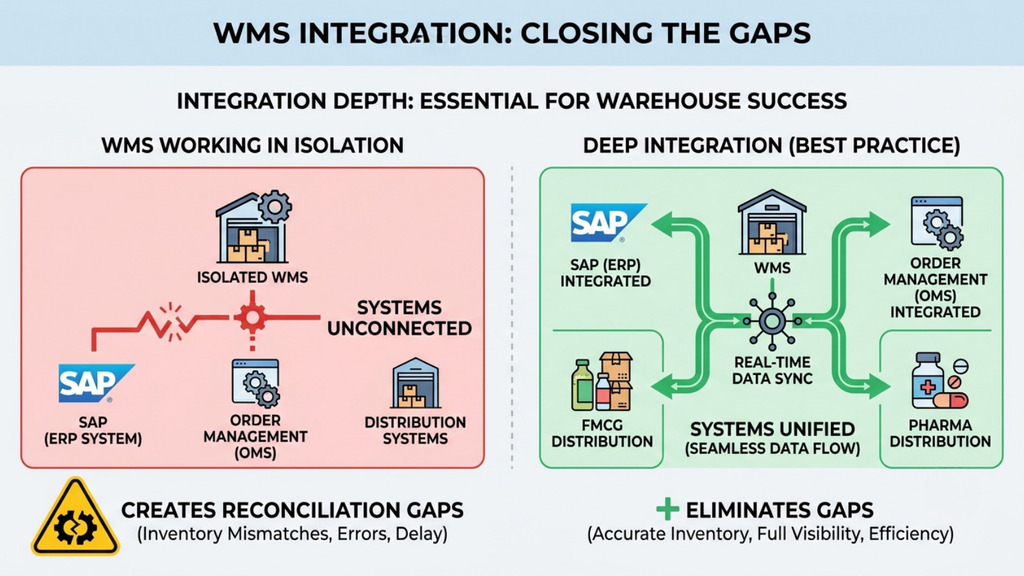
A WMS working in isolation from SAP, ERP, and order management systems creates reconciliation gaps. Integration depth is one of the warehouse management best practices to follow that matters most for FMCG and pharma distribution.
| Do | Don’t |
| Connect WMS, ERP, and OMS in real time | Rely on manual data exports between systems |
| Choose integrations without custom middleware where possible | Accept a connector that needs constant maintenance |
| Test integration under peak order volume | Assume integration works the same at scale |
15. Plan for Seasonal and Festive Demand Spikes
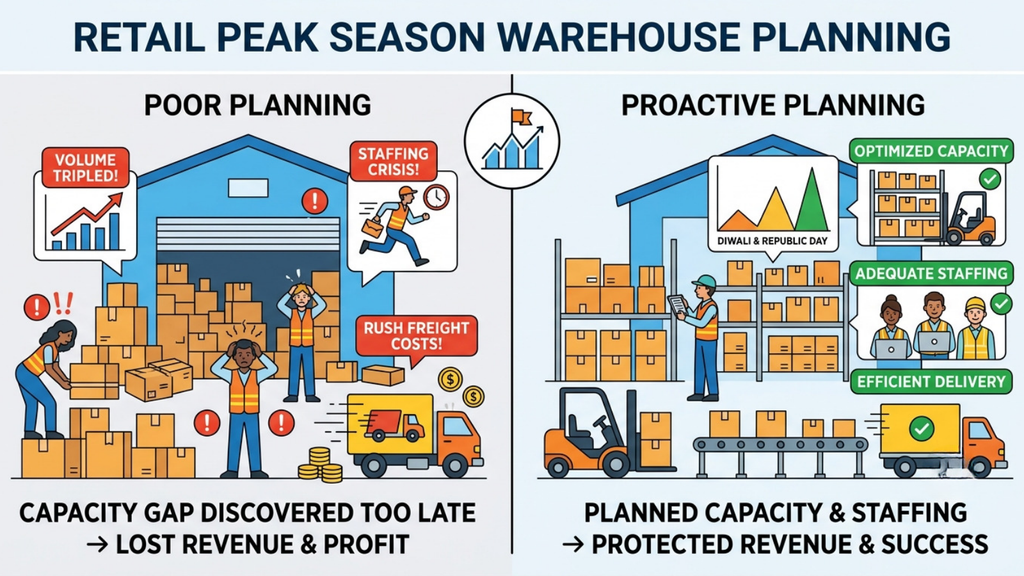
Diwali and Republic Day sale windows push order volumes up sharply within days. Planning ahead is one of the warehouse management best practices to follow that protects revenue during the highest-value days of the year.
Warehouses that treat festive-season planning as a last-minute exercise typically discover their capacity gap only after order volume has already tripled, at which point emergency staffing and rush freight costs erase much of the seasonal revenue upside.
| Do | Don’t |
| Model capacity needs for festive-period volume in advance | Wait until the spike hits to plan staffing |
| Pre-stage high-velocity SKUs closer to dispatch | Leave seasonal SKUs in standard slotting |
| Test system load before the peak window | Assume last year’s plan still fits this year’s volume |
16. Improve Vertical Space Utilization
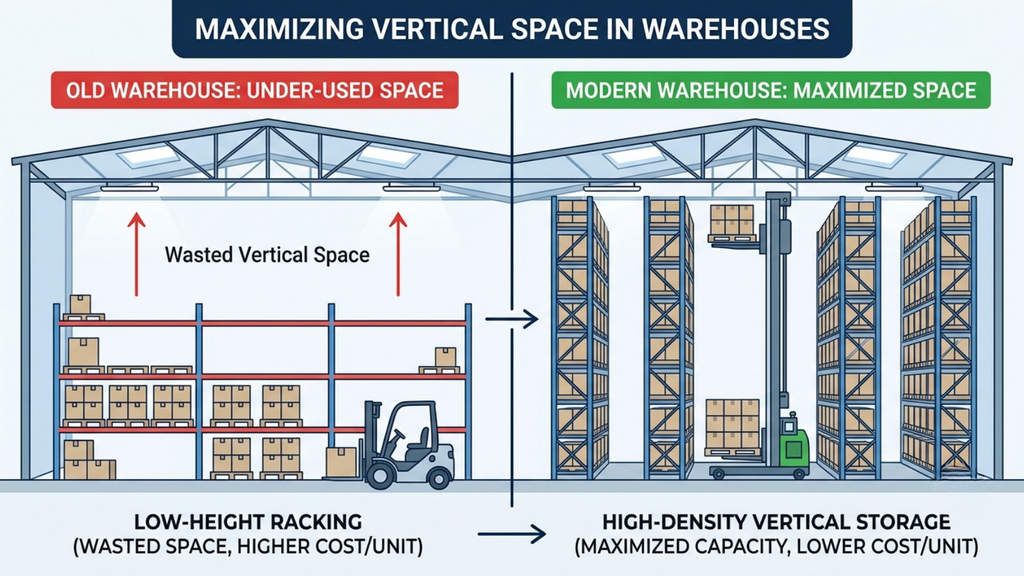
Most warehouses under-use vertical space, relying on traditional racking that leaves ceiling height unused. This is one of the warehouse management best practices to follow with a direct, measurable cost impact.
| Do | Don’t |
| Use vertical racking suited to your ceiling height | Design storage around floor space alone |
| Match racking type to SKU size and turnover | Use one racking style for all inventory types |
| Reassess vertical utilization as volume grows | Leave racking design static for years |
17. Manage Returns and Reverse Logistics Efficiently
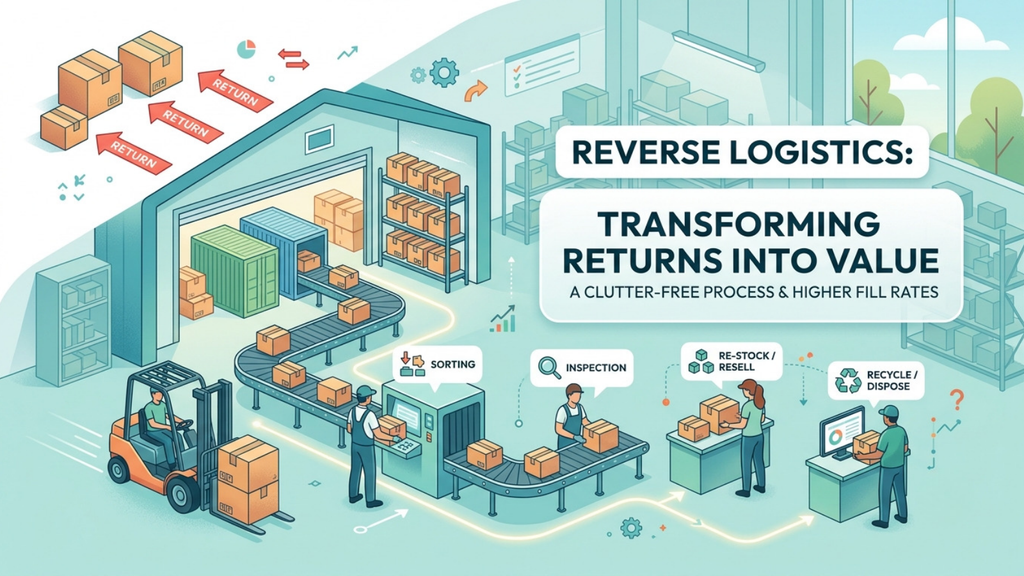
Returns are inevitable, and how they are processed determines whether they become a cost center. Reverse logistics discipline is one of the warehouse management best practices to follow that directly affects fill rate.
| Do | Don’t |
| Automate return authorization and restocking | Let returns sit unprocessed in a holding area |
| Inspect and grade returned stock quickly | Assume all returned stock is automatically resellable |
| Feed return data back into demand forecasting | Treat returns data as separate from planning |
18. Adopt Automation and Robotics Where Feasible

Automated guided vehicles, robotic picking arms, and drone-based cycle counts are becoming practical, not experimental. Selective automation is one of the warehouse management best practices to follow for high-volume operations.
| Do | Don’t |
| Pilot automation on a single high-volume process first | Automate every process simultaneously without testing |
| Measure ROI before scaling automation further | Adopt automation purely because competitors have it |
| Train staff to work alongside automated systems | Assume automation removes the need for skilled staff |
19. Ensure Real-Time Multi-Warehouse Visibility

For businesses running more than one warehouse, real-time visibility across locations is one of the warehouse management best practices to follow that prevents both stockouts and overselling.
| Do | Don’t |
| Sync stock data across warehouses in real time | Rely on nightly batch jobs for stock updates |
| Set warehouse-specific reorder points | Use one blanket reorder number across locations |
| Rebalance stock based on real regional demand | Leave stock allocation fixed regardless of demand shifts |
20. Continuously Review and Improve Processes

The final and most overlooked of the warehouse management best practices to follow is treating the warehouse as an evolving system rather than a fixed setup. Processes that worked at last year’s volume may not hold at this year’s.
| Do | Don’t |
| Review KPIs and processes on a scheduled cadence | Treat any process as permanently finished |
| Solicit floor staff feedback on bottlenecks | Assume management sees every operational gap |
| Benchmark against industry standards periodically | Compare performance only against your own history |
Quick Recap: Warehouse Management Best Practices to Follow
This table groups the 20 warehouse management best practices to follow into five categories, since most warehouses improve fastest by strengthening one category at a time rather than all twenty at once.
| Category | Practices |
| Systems and technology | WMS implementation, barcode/RFID, automation, integration |
| Inventory discipline | ABC analysis, reorder points, cycle counting, FIFO/FEFO |
| People and process | SOPs, training, picking optimization, continuous review |
| Operational resilience | Safety compliance, seasonal planning, returns management |
| Visibility | KPI tracking, multi-warehouse sync, layout optimization |
A warehouse struggling with fulfillment speed usually gets the fastest win from the systems and technology category. A warehouse struggling with stockouts or overselling usually needs to focus on inventory discipline first. Treating all five categories as equally urgent from day one tends to spread resources too thin to see meaningful improvement in any single area within the first few months.
Where Base.com Fits Across These Practices
Base.com connects directly into the systems and technology layer of these warehouse management best practices to follow, syncing WMS, ERP, and order execution data in real time so inventory discipline and visibility practices actually run on current information rather than a stale export. For FMCG and pharma clients, this integration depth is what makes FEFO compliance, multi-warehouse sync, and festive-season planning work reliably at scale, without custom middleware that needs constant upkeep.
Rather than replacing an existing WMS, Base.com typically sits on top of it, feeding real-time order and dispatch data into the same reorder point, cycle counting, and KPI tracking practices already covered above. This means a warehouse does not need to overhaul its entire technology stack to start seeing the benefit of these warehouse management best practices to follow more consistently.