Multi-warehouse fulfillment in India is the operational model where a brand stores inventory across more than one physical location and routes each order to the node that can fulfill it fastest, cheapest, or most reliably. For Indian D2C brands scaling beyond a single city, it is not an advanced capability; it is a baseline requirement.
India’s ecommerce geography makes this unavoidable. Over 62% of ecommerce shipments now go to Tier 2 and Tier 3 cities. A brand fulfilling all orders from a single Mumbai warehouse ships to Patna, Coimbatore, Indore, and Guwahati from the same node. Transit times stretch to 5-7 days. Shipping costs climb. RTO rates rise because customers who wait longer are more likely to reject COD deliveries. Marketplace SLA scores fall.
The brands that have solved this are running multi-warehouse fulfillment in India with two, three, or four nodes positioned to cover the major demand zones, typically Mumbai or Pune for West, Delhi NCR for North, Bengaluru or Chennai for South, and sometimes Hyderabad or Kolkata for Central and East.
The problem is not setting up the warehouses. The problem is connecting them. And the connection layer is the OMS.
What Multi-Warehouse Fulfillment in India Actually Requires
Multi-warehouse fulfillment in India is not just about storing stock in multiple cities. It requires a set of operational capabilities that most brands underestimate before they run it for the first time.
- A unified inventory view across all nodes. Before an order can be routed to the right warehouse, the system needs to know what is available at each one, in real time. If Warehouse A shows 30 units and Warehouse B shows 20 units of the same SKU, the routing decision depends on both numbers being accurate and current.
- Routing logic. The OMS needs rules for which warehouse gets which order. The simplest rule is stock availability, the route to the warehouse that has the item. More sophisticated rules layer in proximity to the delivery pincode, courier serviceability, node-level SLA performance, and cost per shipment.
- Cross-location order allocation. When an order contains two items and no single warehouse has both, the OMS must decide whether to split the shipment across nodes or hold the order at the node that can fulfill it partially while waiting for a transfer. This is one of the most complex decisions in multi-warehouse fulfillment in India and cannot be made manually at scale.
- Node-level pick, pack, and dispatch. Each warehouse needs its own operational workflow, picklists, packing station, label generation, manifest, and run in the same system but with its own location-level data.
- Return routing. An RTO from a Kolkata customer should return to the nearest warehouse node, not automatically to the brand’s head warehouse in Mumbai. Without return routing rules in the OMS, multi-warehouse fulfillment in India creates a return consolidation problem that compounds the working capital problem returns already caused.
Why the OMS Is the Central Dependency
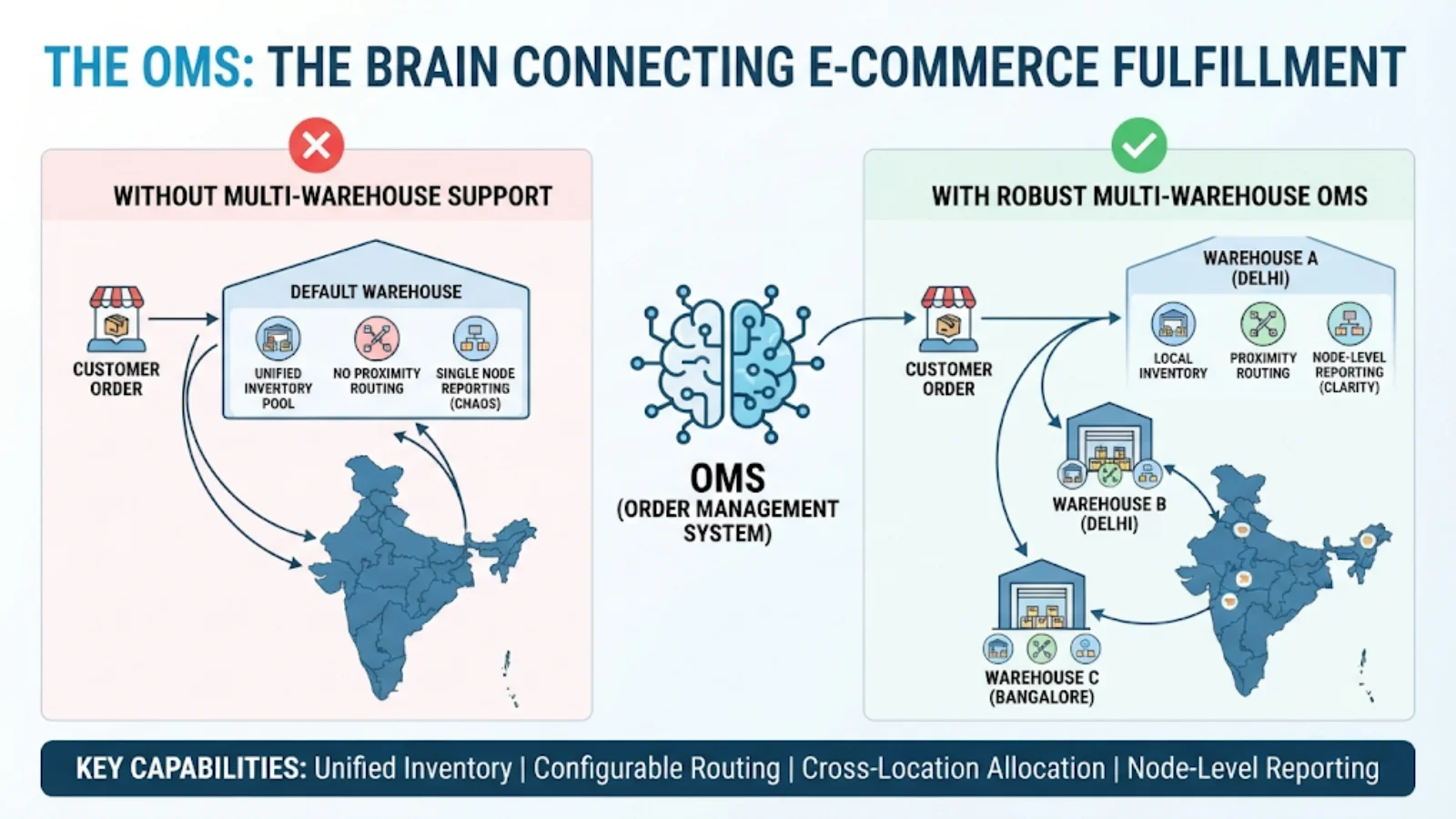
The warehouse nodes are physical infrastructure. The courier integrations are logistics contracts. The OMS is the brain that connects them.
An OMS without multi-warehouse support treats all inventory as a single undifferentiated pool. It has no concept of location. It routes every order to one default warehouse. It cannot split orders across nodes. It cannot make proximity-based routing decisions. It cannot report node-level performance separately.
Multi-warehouse fulfillment in India runs on a single-node OMS, which creates operational chaos the moment the second warehouse goes live. Finance cannot attribute costs by node. Operations cannot identify which warehouse is the bottleneck. Returns cannot be routed intelligently. The brand ends up with two warehouses running on two separate systems, manually reconciling inventory counts, and losing the efficiency gains that justified building the second node.
The OMS capability that makes multi-warehouse fulfillment in India work is not complicated in concept. It is: unified inventory, configurable routing rules, cross-location allocation, and node-level reporting. Every major platform either has this or does not. The differences are in depth and how well the WMS layer integrates with the OMS layer.
How Base.com Handles Multi-Warehouse Fulfillment in India
Base.com is built as a unified OMS and WMS with 1,700+ global integrations. Its multi-warehouse architecture gives each node its own physical configuration, bins, racks, locations, and zones, while maintaining a single inventory pool visible across all nodes from one dashboard.
1. Node-Level Warehouse Configuration
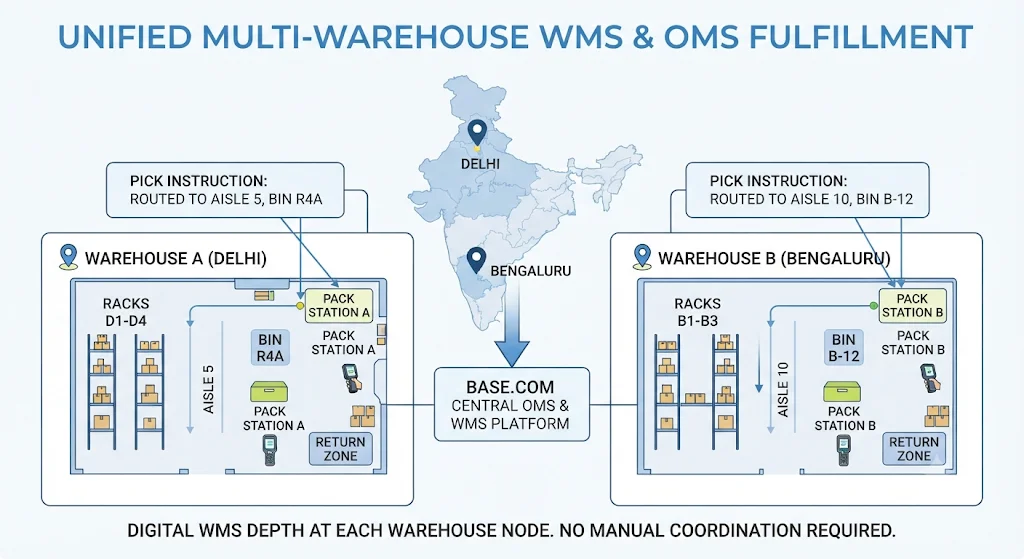
Each warehouse in Base.com has a digital view with custom locations, bins, racks, and return handling zones. This is not just an inventory count at the node level; it is full WMS depth at each location. Product barcodes and MRP tags are created within the system, applicable at each node independently.
A pick instruction generated at Warehouse B in Bengaluru routes the picker to the correct bin at that location. A pick instruction at Warehouse A in Delhi routes to a completely different bin layout. Both are running in the same system with no manual coordination required between nodes.
This is the specific gap in most OMS tools that claim multi-warehouse fulfillment in India support: they track inventory at the warehouse level but cannot manage physical operations within each warehouse. Base.com handles both.
2. Automated Order Fulfillment Routing
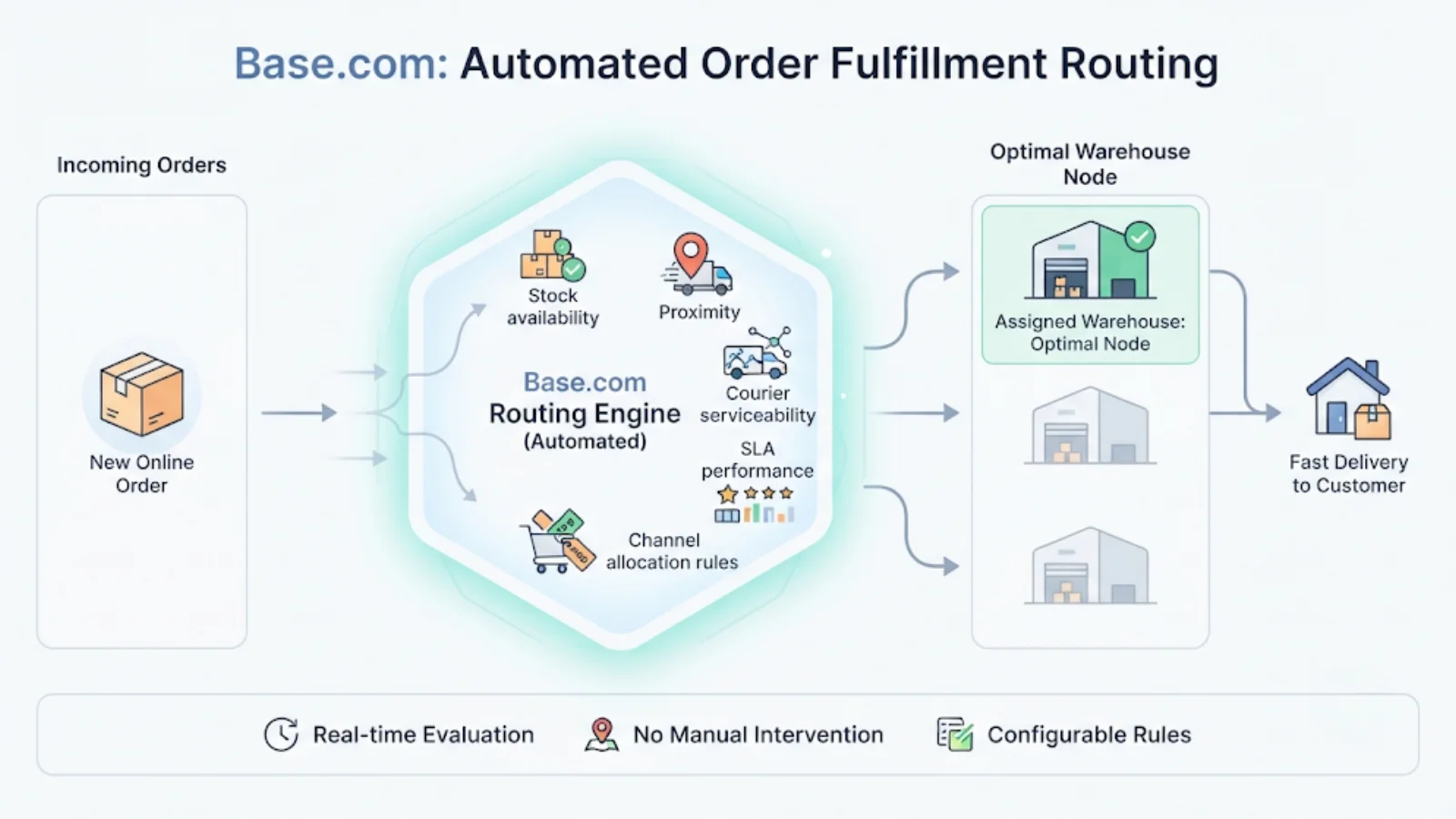
Base.com’s routing engine applies configurable rules to assign each incoming order to the optimal warehouse node. The routing logic can be configured based on:
- Stock availability at each node
- Proximity of the node to the delivery pincode
- Courier serviceability from each node to the destination
- Node-level SLA performance (warehouses consistently breaching SLAs can be deprioritized)
- Channel-level allocation rules (certain SKUs reserved for specific channels at specific nodes)
This is automated order fulfillment routing in the truest sense, no manual intervention required once the rules are set. The system evaluates every incoming order against the rule set and assigns it to a node in real time.
3. Cross-Location Order Allocation
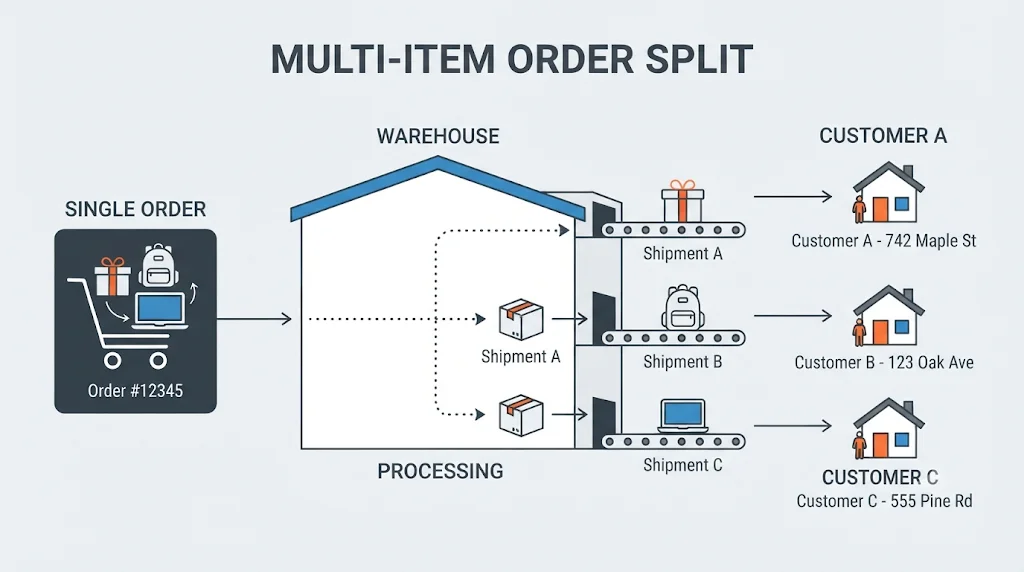
When a single order requires items available at different nodes, Base.com can split the shipment across warehouses. Each node receives its own pick instruction, generates its own label and invoice, and ships its portion directly to the customer.
This prevents the scenario where a multi-item order is held at one node waiting for a stock transfer from another, delaying the entire order beyond the SLA window. For multi-warehouse fulfillment in India serving marketplace channels with tight CPT requirements, split-shipment capability is a hard operational requirement.
4. Real-Time Stock Visibility Across All Nodes
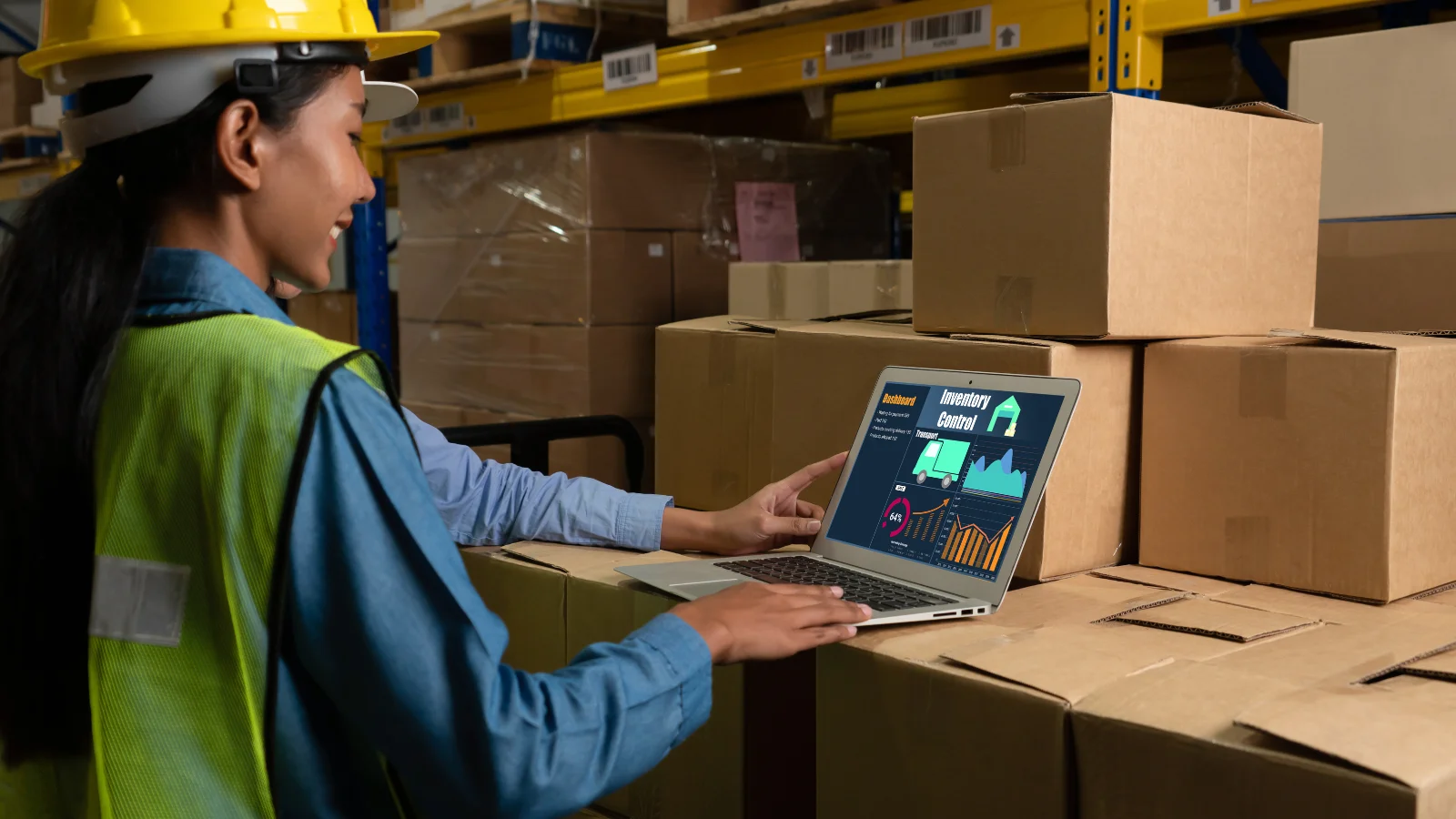
Every sale, return, transfer, and adjustment at any node updates the central inventory count in real time. The channel-facing inventory, what Amazon and Flipkart see as available, reflects the aggregate of all nodes minus their respective channel allocations.
A sale on Flipkart routed to Warehouse C in Hyderabad decrements Hyderabad’s count immediately. That decrement propagates to the marketplace-visible inventory within seconds. Overselling caused by sync lag between nodes is eliminated.
The Competitive Landscape: Which Indian OMS Platforms Support Multi-Warehouse Fulfillment in India
The feature data across all eight major platforms in the Indian market is clear on which ones have genuine multi-warehouse capability and which are missing it entirely.
| Feature | Base.com | Unicommerce | Increff | EasyEcom | Vinculum | Browntape | OMS Guru | FYND |
|---|---|---|---|---|---|---|---|---|
| Multi-warehouse management | Yes | Yes | Yes (limited) | Yes | No | No | No | No |
| WMS at each node | Yes | Yes | Yes | No | No | No | No | No |
| Cross-location order allocation | Yes | Yes | Yes | No | No | No | No | No |
| Automated fulfillment routing | Yes | Yes | No | No | No | No | No | No |
| Hyperlocal order allocation | Yes | Yes | Yes | No | No | No | No | No |
| SLA-based order prioritization | Yes | Yes | Yes | Yes | Yes | Yes | Yes | No |
| Rack/shelf allocation per node | Yes | Yes | Yes | No | No | No | No | No |
| Real-time stock visibility | Yes | Yes | Yes | Yes | Yes | Yes | Yes | Yes |
| Omnichannel WMS | Yes | Yes | No | No | No | No | No | Yes |
| Store-wise inventory visibility | Yes | Yes | Yes | No | No | No | No | No |
Browntape, OMS Guru, Vinculum, and FYND have no multi-warehouse management at all. They are effectively disqualified for any brand running multi-warehouse fulfillment in India on more than one node.
EasyEcom supports multi-warehouse inventory sync but has no dedicated WMS, no rack/shelf allocation, no barcode scanning, and no cross-location order allocation. It tracks counts per node but cannot manage physical operations within each node or intelligently split orders.
Unicommerce and Increff are the closest peers to Base.com on multi-warehouse support. The comparison is worth examining in detail.
Base.com vs. Unicommerce on Multi-Warehouse Fulfillment in India
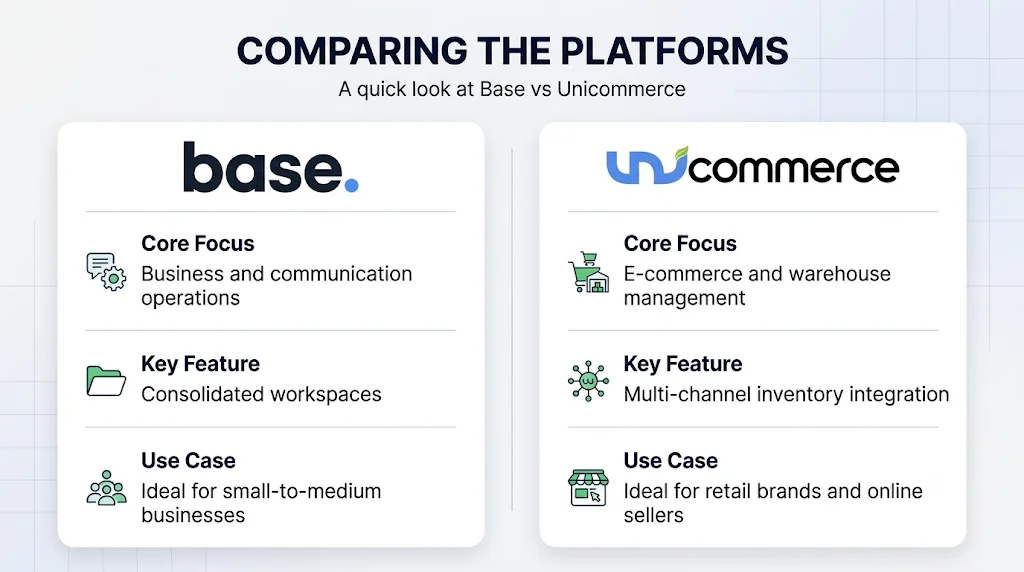
Unicommerce supports multi-warehouse management with real-time inventory tracking across locations, batch management with FIFO/FEFO, hyperlocal fulfillment, and integration with POS and ERP systems. Its WMS includes inventory tracking, handheld device support, and customizable print templates.
Base.com adds the digital warehouse view, a spatial map of each node that Unicommerce does not offer. Base.com creates product barcodes and MRP tags within the system; Unicommerce requires external barcode generation. Base.com supports cart-level barcode scanning in addition to location scanning; Unicommerce supports location scanning only.
On the OMS routing side, Unicommerce supports automated order fulfillment routing and cross-location order allocation. Base.com supports all of this, plus 1-click order processing (a single action that packs, prints, updates status, and triggers customer notification), a workflow Unicommerce does not have. Custom order statuses in Base.com allow brands to define their own fulfillment stages at each node; Unicommerce uses fixed statuses.
The Total Business P&L Dashboard in Base.com is absent from Unicommerce. For brands running multi-warehouse fulfillment in India, this matters because node-level cost attribution, shipping cost per node, fulfillment cost per order per node, and return rate per node are the data that determine whether the multi-warehouse model is delivering the expected margin improvement.
Base.com vs. Increff on Multi-Warehouse Fulfillment in India
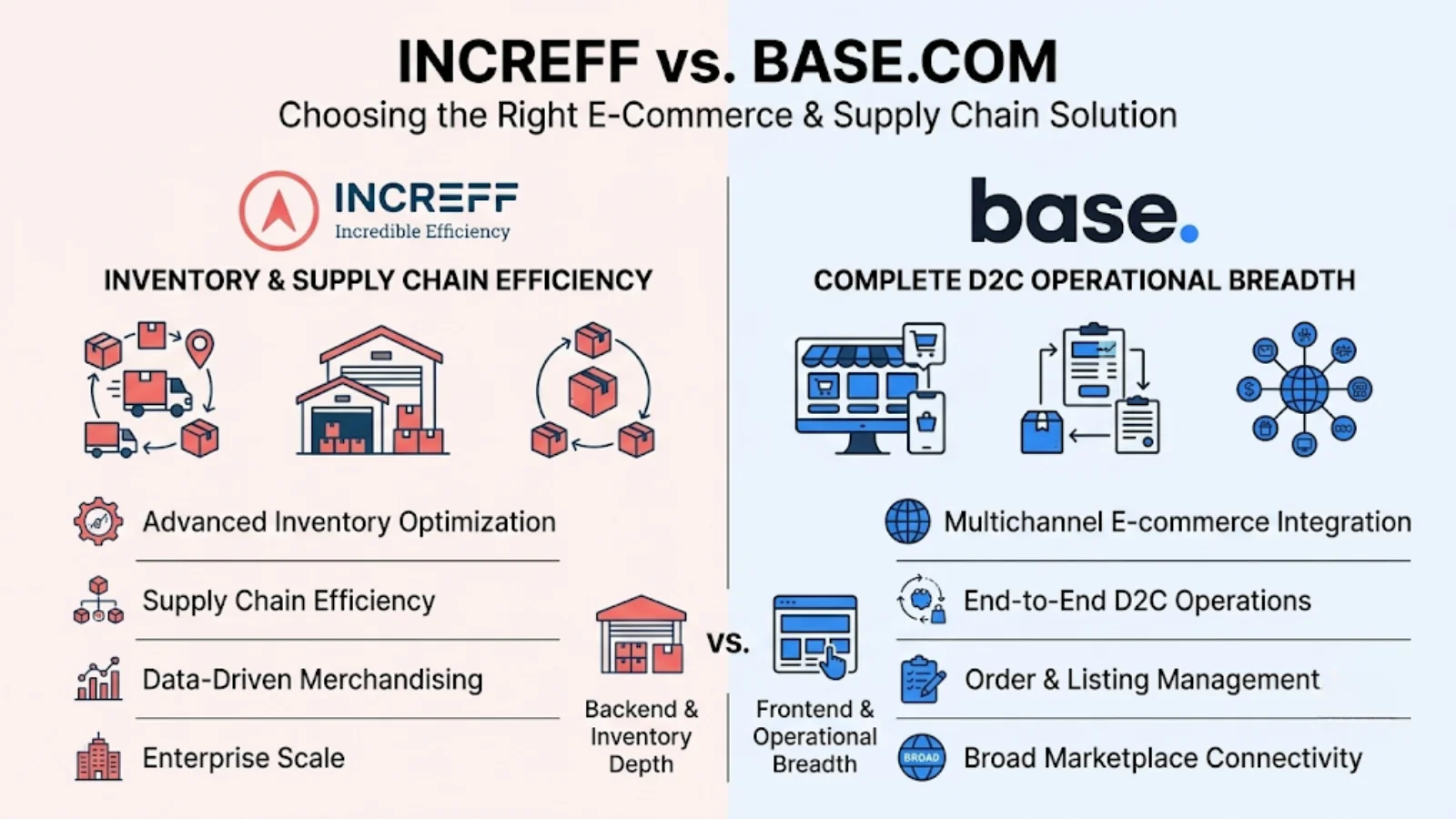
Increff is specifically positioned around inventory optimization and supply chain efficiency. Its WMS includes efficient inventory allocation, automated replenishment, and accurate bin-level tracking. Its OMS handles order prioritization, auto-reassignment of inventory across nodes, and high-speed order processing.
Increff’s strength is inventory intelligence, inventory health tracking, sales velocity reports, category and SKU-wise insights, and dynamic allocation across channels based on demand patterns. For brands with very large SKU counts where multi-warehouse fulfillment in India requires continuous rebalancing of stock between nodes based on velocity, Increff’s analytics layer is strong.
Base.com’s differentiation versus Increff is in the breadth of the platform: automated order invoicing, order status updates, 1,700 global integrations covering cross-border channels, the unified PIM with AI-assisted listings, the accounting sync with Tally and Zoho Books, and the customer service module. Increff is optimized for supply chain efficiency; Base.com is optimized for the complete operational lifecycle of a D2C brand running multi-warehouse fulfillment in India across both domestic and international channels.
The Routing Decision: How Orders Get Assigned to the Right Node
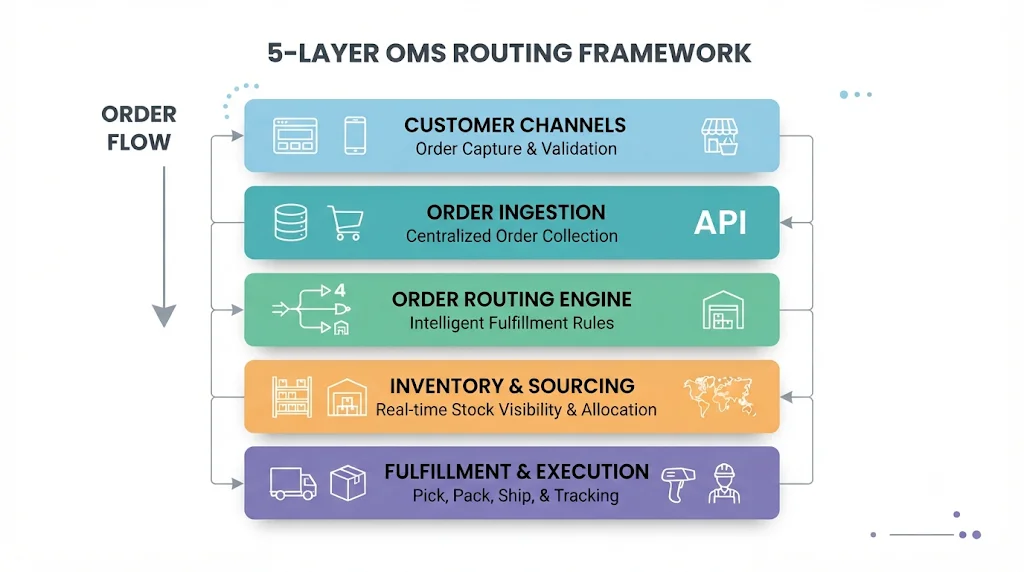
The routing logic inside an OMS for multi-warehouse fulfillment in India operates in layers. Understanding the sequence helps brands configure rules that match their actual operational priorities.
Layer 1: Stock Availability Check
Before any routing rule applies, the OMS checks which nodes have the required items in sufficient quantity. A node with zero stock of the required SKU is immediately excluded, regardless of other factors. If only one node qualifies, the order goes there.
Layer 2: Channel Allocation Rules
If the brand has reserved specific inventory for specific channels at specific nodes, the routing respects those reservations. A Flipkart order will only be routed to a node that has Flipkart-allocated stock of the required items. This prevents multi-warehouse fulfillment in India from inadvertently depleting D2C-reserved stock to fulfill marketplace orders.
Layer 3: Proximity and Serviceability
Among qualifying nodes, the OMS evaluates which is closest to the delivery pincode and whether the required courier services are available from each node. Zone-1 shipping (local, within the same city) is cheaper than Zone-3 or Zone-4. Routing to the closest qualified node reduces shipping cost on every order. At scale, this is a material margin improvement.
Layer 4: SLA and CPT Compliance
If an order has a tight CPT (Carrier Pickup Time) window, the OMS deprioritizes nodes that are likely to miss it based on current queue depth or historical performance. A node with 800 orders already in queue may not be able to pick and pack a new order before 2 PM CPT, even if it has the stock and proximity advantage.
Layer 5: Fallback and Override
If no node satisfies all layers, the OMS applies a fallback rule, typically routing to the node with the best stock coverage, even if proximity is suboptimal. Manual overrides allow operations managers to temporarily redirect orders away from a node experiencing system downtime, a courier serviceability issue, or a physical warehouse problem.
This layered routing is what transforms multi-warehouse fulfillment in India from a logistics model into a cost and SLA optimization engine.
Inventory Transfers Between Nodes: When and How
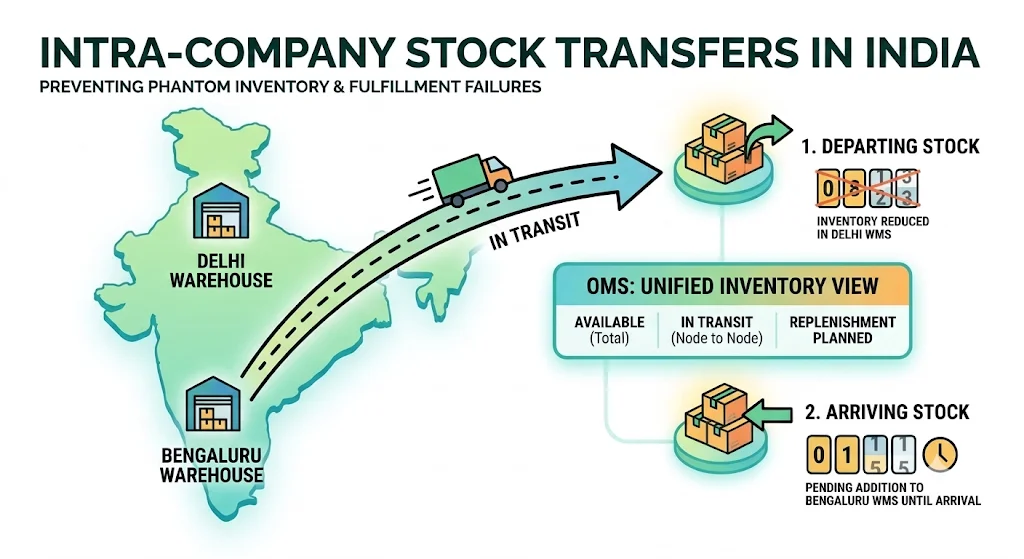
Running multi-warehouse fulfillment in India creates situations where inventory needs to move between nodes. A SKU sells faster than expected in Bengaluru but has excess stock in Delhi. The next purchase order should ideally be replenished from the nearest supplier to Bengaluru, but until it arrives, some stock needs to be transferred from Delhi.
An OMS that supports multi-warehouse fulfillment in India needs to handle intra-company stock transfers without creating phantom inventory. The moment a transfer is initiated at Node A (Delhi), those units must be removed from Node A’s available count. They are neither available at Node A nor at Node B until they physically arrive and are scanned into Node B’s WMS.
If this transfer is not tracked in the OMS, the brand ends up overselling at Node A (because the departed stock is still showing as available) or failing to route orders to Node B (because the arriving stock is not yet showing as available). Both create the same fulfillment failures that multi-warehouse fulfillment in India was supposed to solve.
Base.com handles intra-company stock transfers with a dedicated transfer workflow that moves units from one node’s count to an in-transit state until they are scanned into the receiving node’s WMS. This is the correct mechanical approach and a specific gap in tools that only track inventory counts without managing the physical transfer process.
Returns in a Multi-Warehouse Model: Routing and Restocking
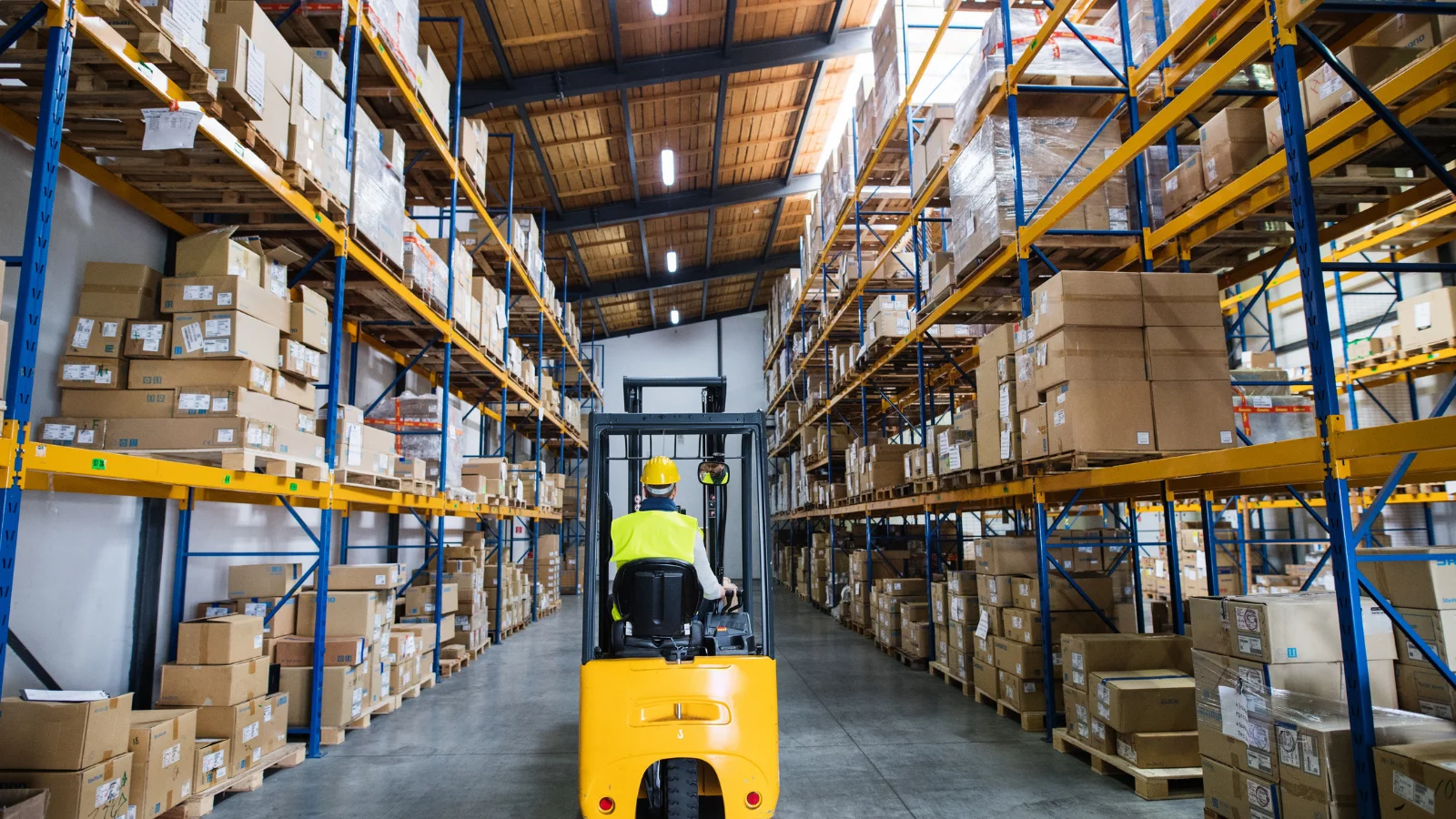
Returns in multi-warehouse fulfillment in India require routing logic just like outbound orders. A return that originated from Node C in Hyderabad should ideally come back to Node C, where the stock is needed and where the courier’s return network is configured. Sending it to Node A in Mumbai creates a transfer cost and inventory imbalance.
The OMS must configure return routing rules per node and per the courier’s return serviceability. When a return label is generated, the return address should be the node best positioned to receive it, not always the head office.
Once the return arrives at a node, it enters the node’s WMS for inspection. The sellable/damaged classification happens at the node level. Sellable units are restocked into the node’s bin, and the node-level inventory count updates immediately. Damaged units are quarantined at that node and logged for claims.
This closes the full multi-warehouse fulfillment in India loop: outbound routing, cross-location allocation, node-level operations, and return routing, all managed from one OMS, all reflecting the same inventory data.
When to Move to Multi-Warehouse Fulfillment in India
Not every D2C brand needs two warehouses immediately. The indicators that the model makes financial sense:
- Average delivery time exceeding 4 days to your top 5 demand states
- Shipping cost per order rising above 12-15% of product value
- RTO rates above 20% in specific geographies (often a transit time problem in disguise)
- Marketplace SLA scores consistently below 95% due to courier transit, not warehouse processing time
- More than 40% of orders are going to Tier 2 and Tier 3 cities from a single metro warehouse
When these indicators align, multi-warehouse fulfillment in India is not an aspiration; it is a margin recovery exercise. The investment in a second node and the OMS capability to run it will typically be recovered within 3-6 months through reduced shipping costs, lower RTO rates, and improved marketplace ranking from better SLA scores.
The OMS capability must be in place before the second warehouse goes live. Retrofitting routing logic and cross-location inventory management after the fact, while running two live nodes, is significantly more disruptive than configuring the OMS before the second node activates.
OMS Evaluation Checklist for Multi-Warehouse Fulfillment in India
Before committing to an OMS for multi-warehouse operations, verify each of these capabilities:
| Capability | What to Ask |
|---|---|
| Unified inventory | Does it show real-time stock across all nodes in one view? |
| Node-level WMS | Can it manage bins, racks, and pick routes at each warehouse separately? |
| Automated routing | Does it route orders based on stock, proximity, and SLA without manual intervention? |
| Cross-location allocation | Can it split an order across two nodes and generate separate labels and invoices? |
| Stock transfers | Does it track in-transit inventory during inter-node transfers? |
| Return routing | Can it route returns to the correct node, not just the head warehouse? |
| Node-level reporting | Does it show fulfillment performance, return rates, and shipping costs per node? |
| SLA alerts | Does it flag CPT-at-risk orders at the node level in real time? |
| Channel allocation | Can you reserve inventory for specific channels at specific nodes? |
| Scalability | Can it add a third or fourth node without architectural changes? |
Base.com satisfies all ten criteria from the same platform, OMS routing, WMS at each node, and the financial reporting layer that connects multi-warehouse fulfillment in India to actual margin outcomes.