
Cycle counting in warehouse operations checks portions of stock regularly, while perpetual inventory records track movements. Receiving errors, missed transfers, picking mistakes and uninspected returns can all cause records to drift. A year-end count may reveal the gap without showing when it began.
Cycle counting reduces reliance on one annual count as the main accuracy control, but does not remove every need for full physical verification. Financial reporting, audit or internal control may still call for it. The US Government Accountability Office inventory guide notes that count approaches depend on objectives and circumstances. The shift is from discovering accumulated errors once a year to checking and investigating throughout the year.
What is cycle counting in a warehouse?
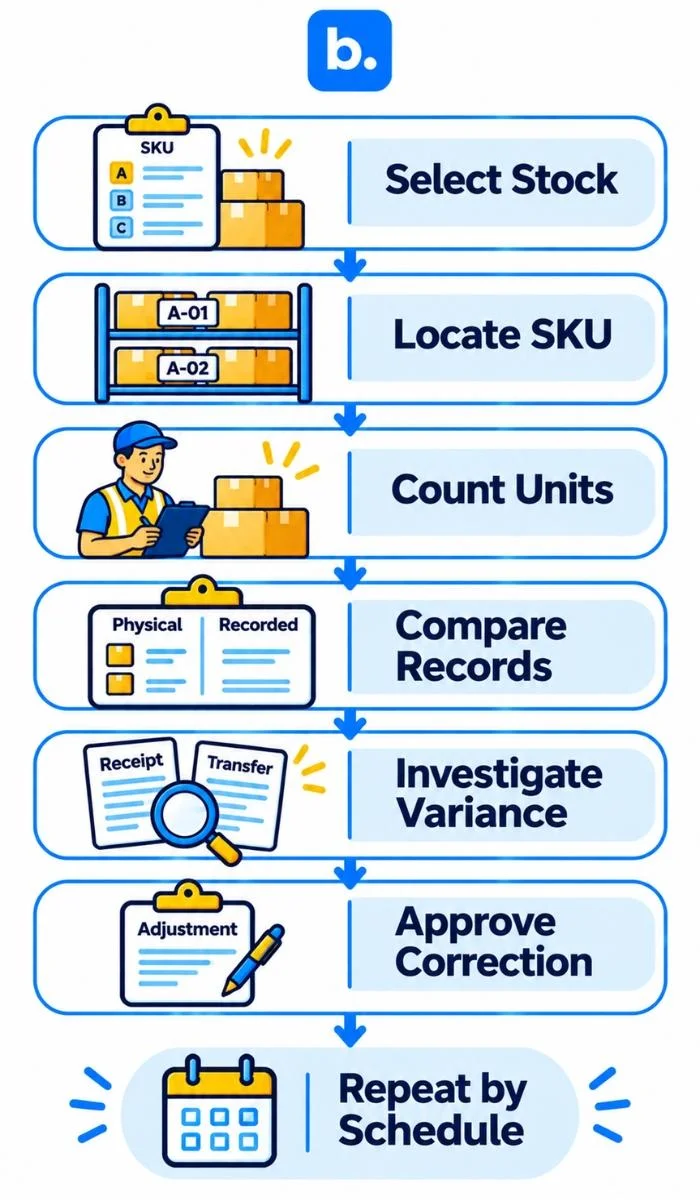
Cycle counting is a planned physical count of selected stock, compared with the recorded quantity. A business can count SKUs, bins, locations or categories, assigning frequencies according to risk and capacity, then investigate differences and correct records through an authorised process.
The aim is not just to make the system number match the shelf, but to find why they differ. Oracle’s cycle-counting documentation describes comparing perpetual and physical quantities, correcting errors and using patterns to improve processes.
Imagine a warehouse with 5,000 SKUs. Rather than count every item in one large exercise, the team can schedule selected groups over the month. A high-value or frequently picked product may receive more attention than a low-risk item that rarely moves. The right schedule depends on stock value, movement, error history, operational risk, available people and the time needed to count. There is no frequency that fits every warehouse.
What is perpetual inventory and how does it work?
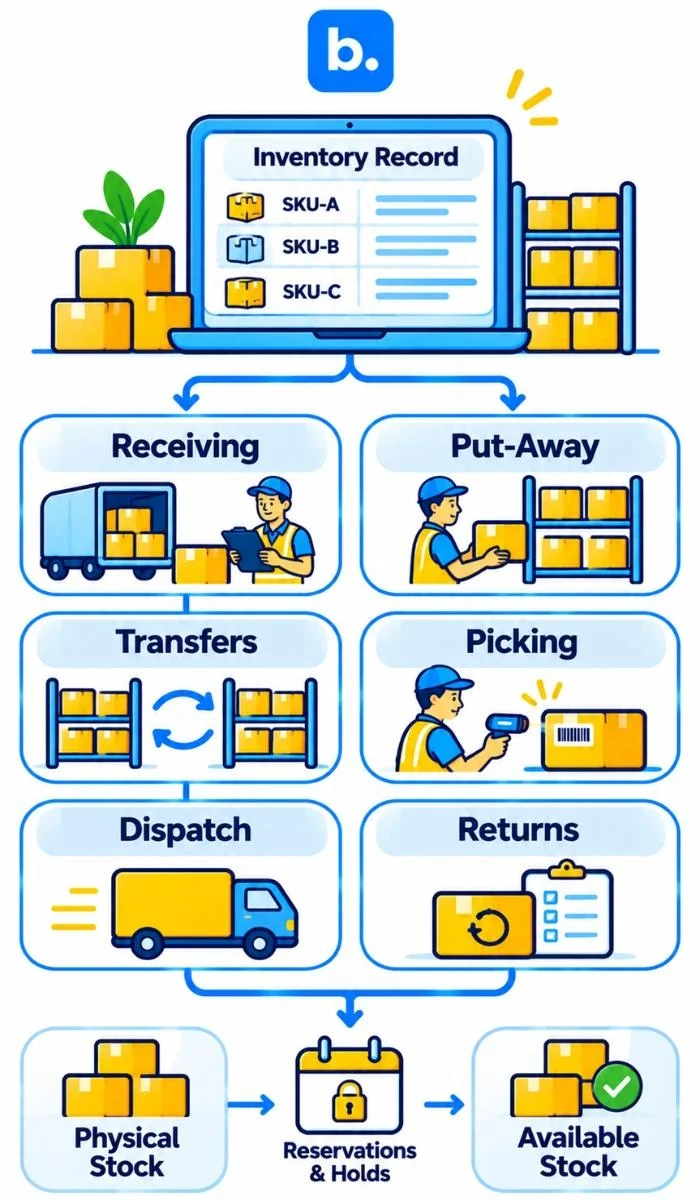
Perpetual inventory updates stock records as movements are recorded: receipts, put-away, transfers, orders and reservations, picking, dispatch, returns, damage, write-offs and approved adjustments. The aim is an ongoing balance rather than one refreshed only during periodic counts.
For example, a business starts with 100 units, receives 50, reserves 20 and dispatches 15. The available balance changes as transactions are processed. An unrecorded bin transfer stays invisible to the system. A return added to saleable stock before inspection may also overstate what is available.
This is the key distinction: perpetual inventory records what the system believes is in stock; cycle counting checks whether selected recorded quantities match physical stock. One does not guarantee the other. Reliable records need both timely transaction capture and physical verification. Also be precise about the balance being counted: physical units on hand are not always the same as units available to promise, because reservations and stock holds affect availability without changing what is on the shelf.
Cycle counting vs perpetual inventory vs annual stock-take
| Comparison | Cycle counting | Perpetual inventory | Annual physical stock-take |
|---|---|---|---|
| What it is | Recurring physical verification of selected stock | Ongoing record updated through transactions | Planned count of all or a large portion of inventory |
| Main purpose | Check accuracy and investigate differences | Maintain current recorded balances | Verify physical inventory at a point in time |
| Frequency | Recurring schedule | Updated as transactions are recorded | Often annual, though practices vary |
| Physical counting | Yes, for selected stock | Not required for each transaction | Yes |
| Operational disruption | Usually more limited when planned well | Depends on the transaction process | Can be significant at scale |
| Relationship | Tests the recorded inventory | Provides the record being checked | Provides broader verification |
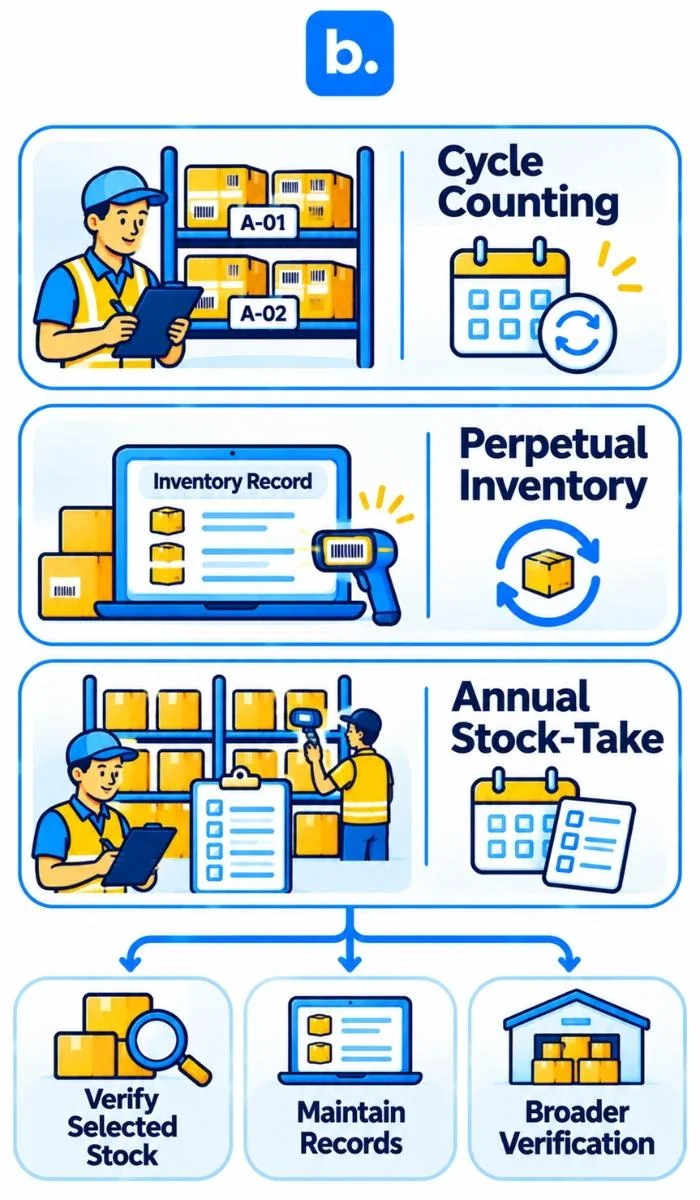
The three can work together. Perpetual inventory maintains the record, cycle counting tests selected stock during the year, and a full physical count provides broader verification when appropriate. A business should decide whether it needs a full count based on its own accounting, audit, internal-control and other applicable requirements, rather than treating cycle counting as a blanket substitute.
Why warehouse inventory discrepancies happen
Discrepancies often start with small gaps. At receiving, quantities may be entered incorrectly or supplier packing differences go unchecked. Stock moved between bins without a transfer record, wrong picks and dispatches with incomplete movements add more variance.
Returns need control too. A product awaiting inspection, damaged or unsuitable for resale may remain in available stock unless segregated and labelled. Manual entry creates typing errors, duplicates and delays; separate spreadsheets or disconnected systems can make it unclear which balance is authoritative.
A count identifies a mismatch, not its cause. Adjusting repeatedly without checking receipts, transfers, picks, returns and locations can hide the same failure. Link each variance to a cause and corrective action.
How to build a cycle counting programme for your warehouse
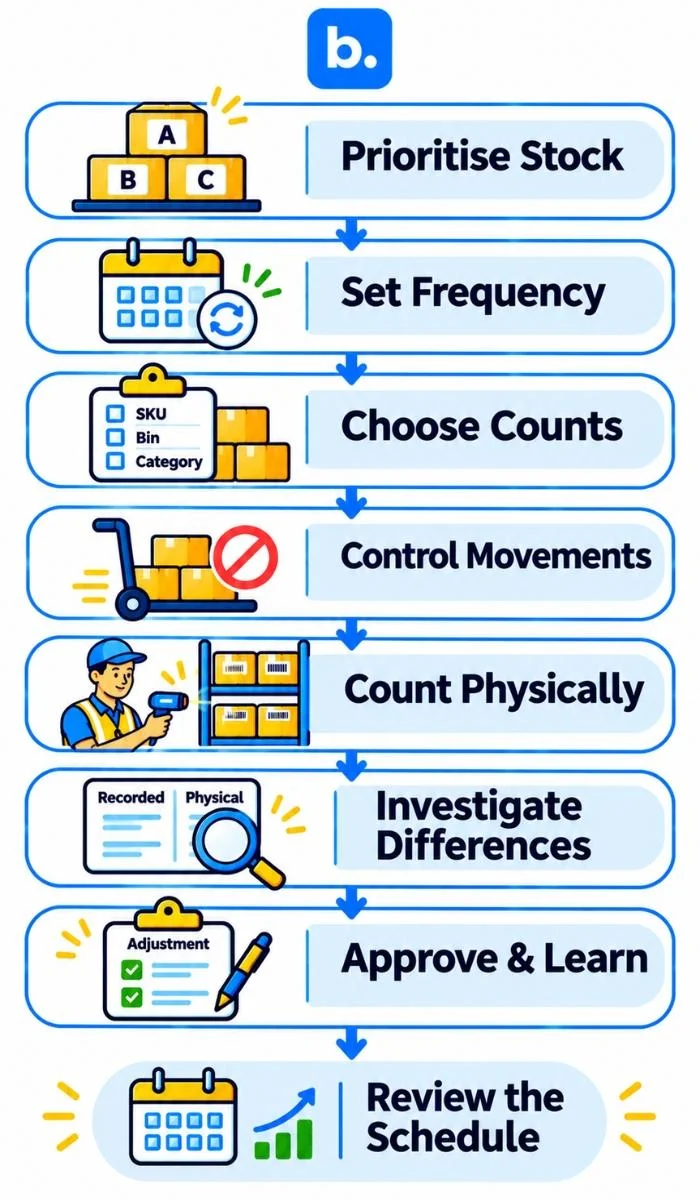
For cycle counting in warehouse operations, use a written process defining what to count, how to handle movements, who investigates and who approves corrections.
1. Prioritise stock using risk. ABC analysis groups A items as high-value or critical, B as medium priority, and C as lower priority. Classify by value, movement, error history, shortage impact or a combination. No percentage split is universal. A low-cost component that blocks a key product may deserve priority.
2. Set review frequencies. Fast-moving, valuable, frequently mispicked or inaccurate stock may need more checks. Stable, lower-risk items may need fewer if controls work. Use variance history and capacity; review the schedule when products, volumes, locations or errors change.
3. Choose what to count. SKU counts suit targeted product checks; location counts can reveal misplaced stock; ABC counts follow priority; random samples test outside high-risk groups. Event-based counts follow a failed pick, negative balance or suspected misplacement. Combine methods as useful. Lists should identify warehouse, location, SKU and unit.
4. Control movements during the count. Decide whether to pause movements, record them as they happen or reconcile them around a cut-off. Otherwise, a correct count may look wrong if stock is received, picked or transferred mid-count. Separate saleable stock from damaged, held or uninspected returns.
5. Count and record physical stock. Assign a counter, confirm product, location and unit, and record the quantity. Where practical, hide the expected balance until recording it. Blind counts reduce the temptation to match the system, but do not prevent misidentification or missed units. Recount material variances, preferably with another person.
6. Investigate before adjusting. Check receipts, transfers, open picks, dispatches, reservations, returns, damage and nearby locations. Confirm SKU, unit, bin and movement cut-off. Recount or escalate unexplained differences. An adjustment changes the record; it does not explain what happened.
7. Approve, document and learn. After confirming the cause and quantity, an authorised person makes the correction. Record reason, date, responsible person and reference where supported. Review recurring causes: receiving variance may call for an extra check; repeated bin errors may point to labelling or put-away practices.
Different cycle counting methods businesses can use
| Method | How it works | When it may be useful |
|---|---|---|
| ABC cycle counting | Counts by assigned priority category | Broad catalogues with different values or risks |
| Random cycle counting | Selects items or locations randomly | Finding discrepancies outside frequently counted stock |
| Location-based counting | Counts inventory in specific locations | Warehouses with multiple bins, racks or zones |
| Event-based counting | Triggers a count after an issue or movement | Negative stock, failed picks or suspected misplacement |
| Control-group counting | Repeatedly counts a selected group | Testing whether a process change improves accuracy |
Methods can be combined. For instance, an ecommerce warehouse could count priority products according to its risk plan, sample other locations randomly, and investigate a failed pick with an immediate location check. The blend should reflect the warehouse’s own error patterns, not a claim that one method is best for all.
How to measure whether cycle counting is improving inventory accuracy
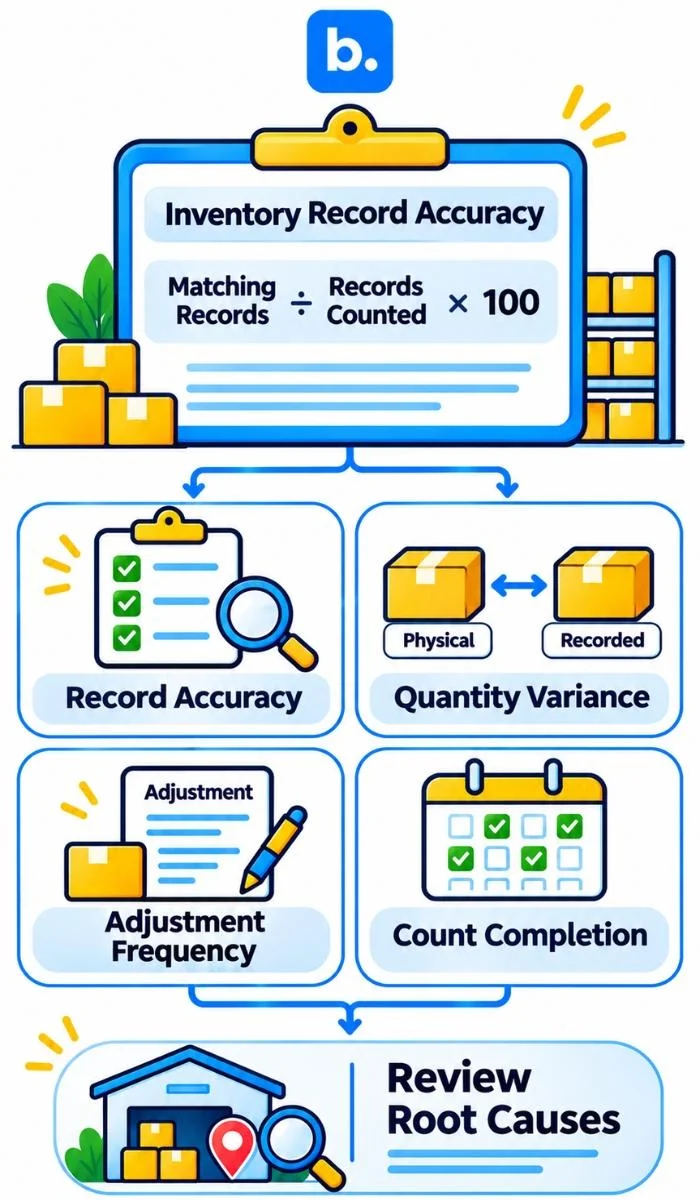
Choose a small set of measures and define them before comparing results. Inventory record accuracy is the proportion of counted records that match physical stock under the business’s stated tolerance:
Inventory record accuracy = (Records matching physical stock / Total records counted) x 100
For example, if 92 of 100 counted records meet the defined match rule, the measured accuracy for that sample is 92%. This is an illustration, not an industry benchmark. Define whether a match means an exact quantity or falls within a documented tolerance, then use the same rule each period. Also be clear whether a “record” means a SKU, SKU-location combination or another unit, as changing the denominator changes the result.
Track inventory variance as the difference between system and physical quantities, including both shortages and overages. Consider the value of discrepancies as well as unit differences: a one-unit variance can matter differently across products. Adjustment frequency shows how often records are corrected; a rising or recurring rate can point to an unresolved process issue. Count completion rate is the share of scheduled counts completed in the planned period. Completion is a workload measure, not proof of accuracy, so review variance, causes and corrective actions alongside it. Segment results by product group or location where useful; an improving overall figure can hide a persistent problem in one zone. Avoid comparisons with unsupported industry-wide benchmarks.
How warehouse inventory management software supports cycle counting
Warehouse inventory management software may provide current stock quantities, SKU and location visibility, count lists, barcode-assisted counts, physical-to-system comparison, adjustment records and transaction history. For businesses managing inventory across multiple warehouses, location-level records help teams see where a difference occurred instead of treating total network stock as one balance.
An inventory tool may maintain stock records, while a warehouse management system also supports warehouse activity such as receiving, storage, picking and dispatch. Product scope varies, so evaluate the specific workflow rather than assuming every inventory software for the warehouse offers the same features.
| Capability | Why it matters |
|---|---|
| Full and partial stocktakes | Allows teams to count all or selected inventory |
| Barcode-assisted counting | Helps identify products during a count |
| Location-level stock visibility | Helps narrow down where a discrepancy occurred |
| System versus physical comparison | Makes quantity differences easier to identify |
| Stock adjustment records | Supports traceability after corrections |
| Transaction history | Helps investigate possible causes |
| Multi-warehouse visibility | Helps compare records across facilities |
During evaluation, ask how the system handles stock moving during a count, whether users can record a physical quantity without seeing the expected balance, how recounts and approvals work, and what audit trail is retained. Confirm whether a feature is included, configurable or dependent on a separate process. Test a normal count and a variance scenario before rollout: can staff identify the location, record a recount, document the reason and trace the resulting adjustment? Barcode scanning can help identify an item, but it does not by itself guarantee that the correct quantity was counted or that every movement was recorded.
How our WMS supports physical stocktakes and inventory accuracy
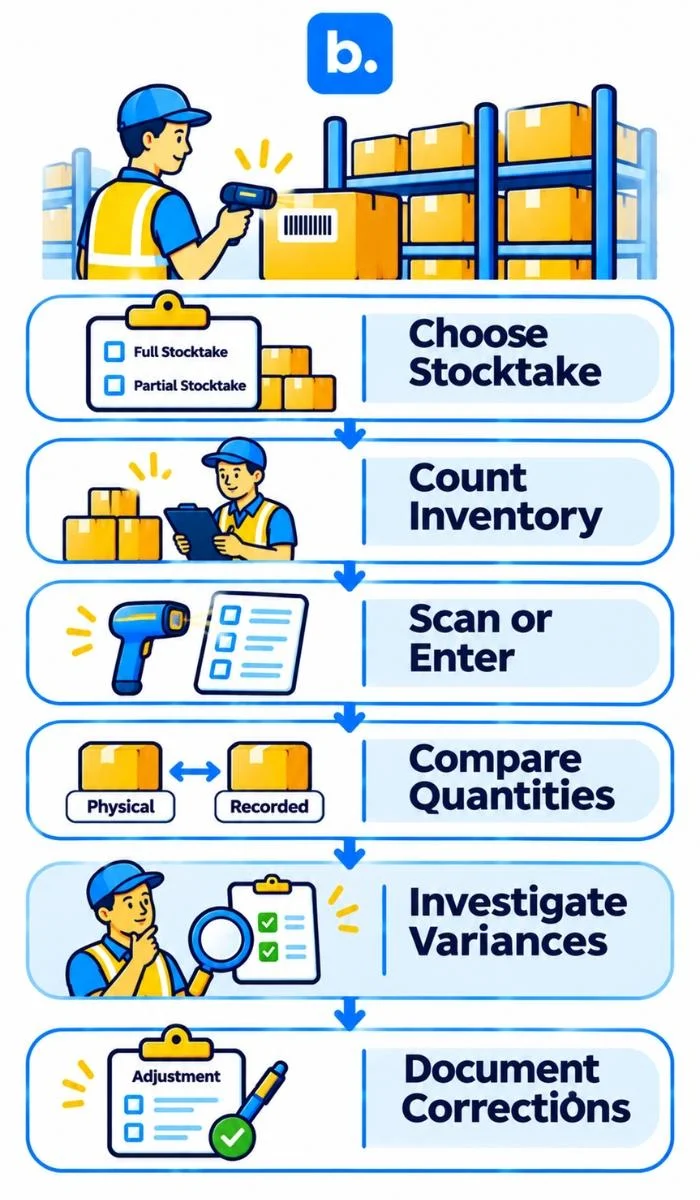
When stock is spread across products and warehouse locations, spreadsheets and memory make verification harder to coordinate. Our WMS supports full and partial stocktakes, allowing teams to check selected inventory or carry out a broader count. Teams can count manually or with a barcode scanner, compare physical quantities with system records, and make real-time adjustments during the count. Stock corrections are processed through formal documentation, as described in our stock take guide and on our WMS page.
These functions support verification; they do not automatically generate an optimised counting schedule, assign frequencies through ABC analysis, investigate every discrepancy or remove the need for full physical stocktakes. The team still needs to plan counts, understand variances and apply its adjustment controls. For broader context on warehouse management systems in India, see our related article.
How to maintain inventory accuracy beyond the count
Record receipts, transfers, picks, dispatches and returns promptly; keep SKU and bin labels consistent; and set permissions for documented adjustments. Review repeat variances by SKU, location, shift or transaction, and revise the schedule as risk changes. Where stock is distributed across facilities, count and investigate at the relevant warehouse and location rather than relying only on a combined total. Keep wider verification in the control plan where appropriate. Software supports coordination, but people and processes maintain the records.
Conclusion
Perpetual inventory updates the recorded stock position; cycle counting in warehouse operations checks it against physical stock. Together, they provide ongoing accuracy checks rather than relying only on a large annual count. The essential practice is to investigate variances, correct their causes and retain wider physical verification where the business’s circumstances call for it. Our WMS supports full and partial stocktakes, barcode-assisted counting and documented corrections.
Frequently asked questions
What is cycle counting in a warehouse?
Cycle counting is a planned process of physically counting selected inventory at intervals and comparing the result with the recorded stock quantity. Teams investigate differences and correct the record through an authorised process. Unlike a single broad stock-take, it checks selected stock repeatedly during the year.
What is the difference between cycle counting and perpetual inventory?
Perpetual inventory maintains an ongoing stock record as transactions are processed. Cycle counting physically checks selected inventory to see whether that record matches what is present. One maintains the recorded position; the other tests it against physical stock.
Is cycle counting better than an annual stock-take?
Cycle counting can reveal discrepancies more regularly and reduce the disruption of depending on one large count. It is not automatically a replacement for full physical verification. A business should decide what wider counts it needs based on its reporting, audit, internal-control and other applicable requirements.
How often should a warehouse perform cycle counts?
Frequency depends on stock value, movement, error history, operational risk and available resources. High-priority or frequently inaccurate items may need more checks than stable, lower-risk stock. Review the schedule when products, volumes, locations or discrepancy trends change.
What is ABC cycle counting?
ABC cycle counting groups stock into priority categories, commonly using value, movement, risk or business importance. The categories help allocate counting effort, often giving higher-priority items more attention. The classification criteria and count frequency should suit the warehouse rather than follow a universal percentage split.
What causes inventory discrepancies in a warehouse?
Common causes include receiving errors, unrecorded transfers, wrong picks, incomplete dispatch records, returns not inspected, damaged goods left available, manual-entry mistakes and location mismatches. Often, several small process failures accumulate before a count exposes the difference.
Can warehouse management software automate cycle counting?
Some systems support count lists, stocktake workflows, barcode scanning and comparison of records with physical stock. The level of automation varies. Check the product’s documented capabilities and confirm which steps still require people to select counts, investigate variances and approve adjustments.
Can cycle counting replace a full physical inventory?
It may reduce reliance on a full count as the main operational accuracy check, but does not automatically remove the need for wider verification. Consider applicable accounting, audit, internal-control and regulatory requirements, as well as the business’s own risk and reporting needs.