Cloud vs on-premise inventory management is not a close contest for Indian D2C and enterprise sellers anymore. Cloud wins on cost, speed, and multi-channel visibility for 9 out of 10 growing businesses. On-premise still holds ground only where regulatory data residency or offline manufacturing floors demand it. This guide breaks down the cloud vs on-premise inventory management decision using India-specific numbers, not generic global benchmarks.
What Is the Difference Between Cloud and On-Premise Inventory Management
Cloud-based inventory management runs on a vendor’s servers. Your team logs in through a browser, from a warehouse in Bhiwandi or a laptop in Bengaluru. The vendor hosts and maintains the infrastructure, so your IT team never touches a server rack. For the warehouse side of this decision, see our guide to cloud vs on-premise WMS.
On-premise inventory management runs on hardware your company owns and operates. Your servers sit in your office or your own data center. Every update, patch, and backup is your team’s responsibility, not the vendor’s.
The cloud vs on-premise inventory management debate in India has shifted hard toward cloud since 2022. India’s ecommerce market is approximately $226 billion, and most of that volume routes through systems that were not designed for single-location, single-server architecture.
Which Costs More: Cloud or On-Premise Inventory Management in India
Most Indian sellers evaluate cloud vs on-premise inventory management purely on subscription cost. That is the wrong lens. The correct lens is total cost of ownership across three years, including hardware refresh cycles, IT staffing, and downtime risk.
An on-premise setup means buying servers, licences and networking up front, then paying for IT staff to keep it running. A cloud system such as Base.com runs on a subscription, with no hardware to buy.
| Cost Factor | On-Premise | Cloud |
|---|---|---|
| Upfront hardware cost | Servers, licences and networking | None |
| Implementation | Hardware setup plus software installation | Account setup and integrations |
| IT staffing requirement | Dedicated IT support | Handled by the vendor |
| Scaling to a new warehouse | New hardware purchase | Add the warehouse in the system |
| Festive season scaling | Manual capacity planning | Vendor infrastructure handles the load |
| Software updates | Manual, scheduled downtime | Updated by the vendor |
This table settles most of the cloud vs on-premise inventory management argument for sellers under ₹500 crore in annual revenue. The math rarely favors on-premise once IT staffing is counted honestly.
Why Does On-Premise Inventory Management Struggle With India’s Order Volumes
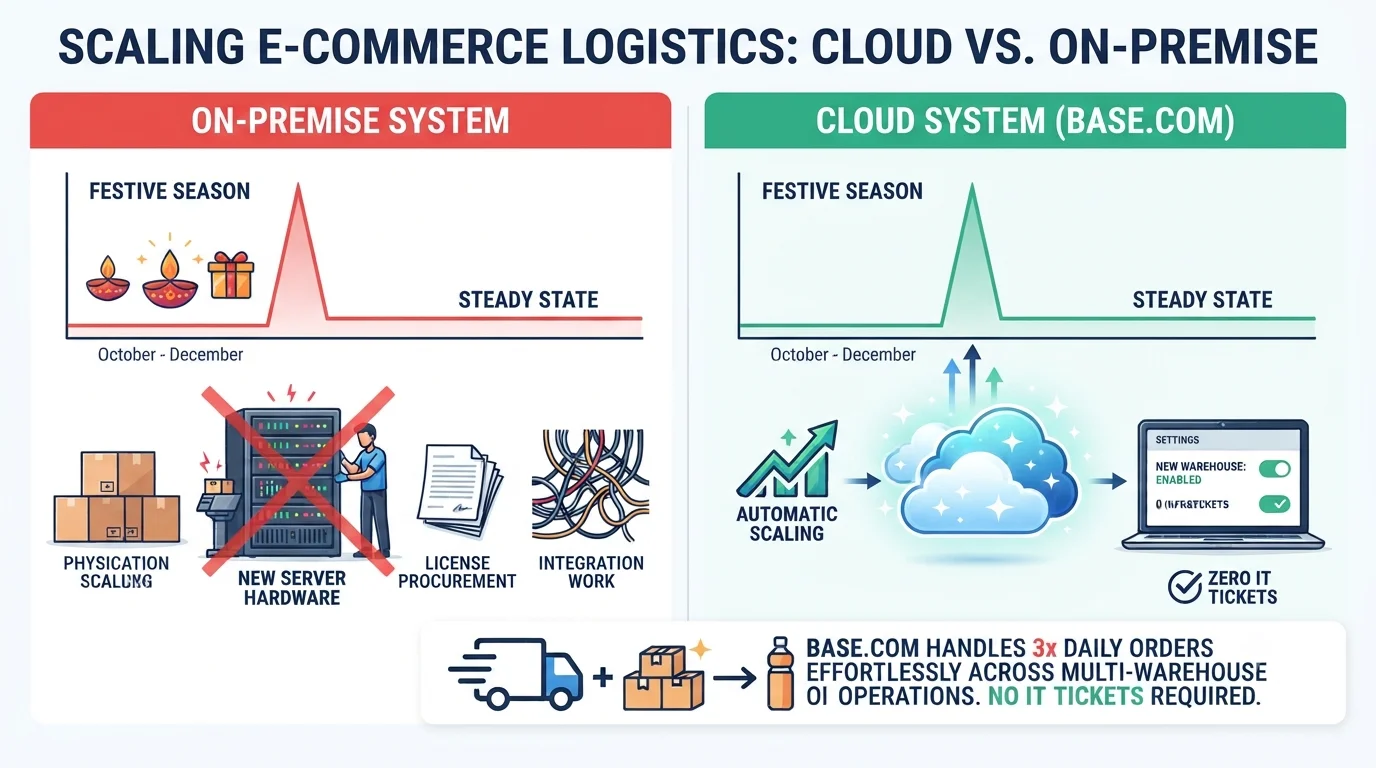
India’s D2C sector is growing at roughly 40% CAGR, and that growth is not linear. It spikes hard around festive months, then flattens. On-premise inventory management was built for steady, predictable load, not for a business that does 3x its average daily orders during a 10-day festive window.
Cloud vs on-premise inventory management becomes a scaling question the moment a brand crosses two or three warehouses. On-premise systems require a new server, new licensing, and new integration work for every new location. Cloud systems add a warehouse as a configuration change, not a procurement cycle.
How Does Cloud vs On-Premise Inventory Management Affect India’s RTO Problem
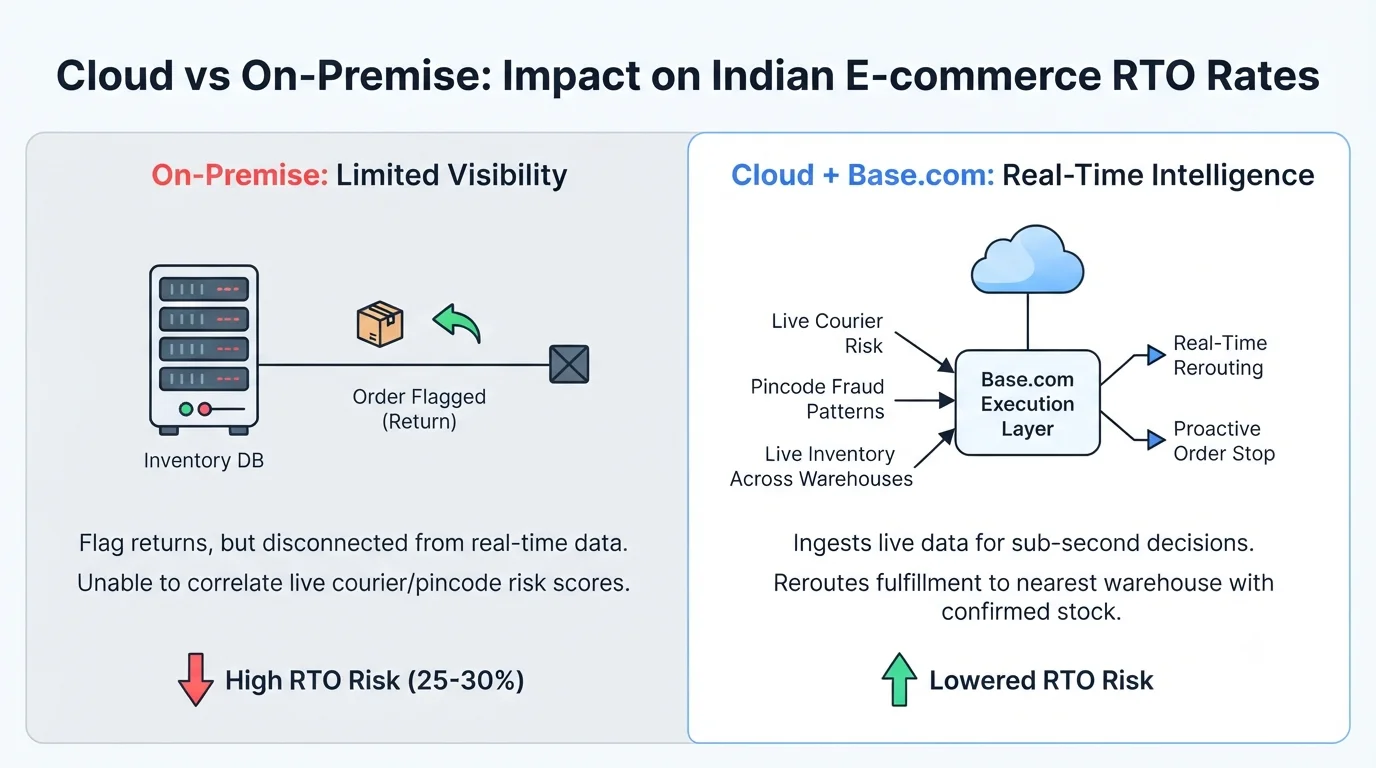
Return-to-origin rates in Indian ecommerce run between 25% and 30% for COD orders, among the highest RTO rates globally. This is where the cloud vs on-premise inventory management decision has a direct P&L impact, not just an IT impact.
An on-premise system can flag a return. It cannot, on its own, connect that return signal in real time to a courier risk score, a pincode-level fraud pattern, and a live reorder decision across warehouses. That kind of connected, real-time correlation needs a cloud architecture built for constant data flow.
A cloud system can also bring order, courier and stock data into one place. In Base.com, automation rules can hold or route orders based on conditions you set, such as payment type, PIN code or weight, before they are dispatched.
Security: Is On-Premise Inventory Management More Secure Than Cloud?

Many Indian IT heads still default to on-premise inventory management because of a security assumption. Physical control feels safer than a hosted server. This assumption does not hold up against actual breach data.
Cloud vs on-premise inventory management security is now largely a question of vendor maturity, not deployment model. Enterprise cloud vendors run continuous security patching, encrypted data layers, and 24/7 monitoring that most in-house IT teams cannot replicate at the same cost. A single IT administrator managing an on-premises server is a bigger single point of failure than a dedicated cloud security team.
Ask any cloud vendor about encryption, user permissions and action history, and check where your data is stored. A good cloud system lets you give each team member access to only what they need.
Can Cloud Inventory Management Handle Festive Season Spikes Better Than On-Premise
Diwali, the Republic Day sale window, and end-of-season clearance events push Indian ecommerce order volumes up sharply within days. This is the single clearest real-world test of cloud vs on-premise inventory management.
On-premise infrastructure is sized for average load. When Diwali order volume hits, a business either over-provisions expensive hardware that sits idle 350 days a year, or it under-provisions and risks system slowdowns exactly when order value is highest.
Cloud inventory management scales with demand. The vendor manages the infrastructure, so festive season spikes do not require you to buy and set up extra servers, and fulfilment speed holds up on the highest revenue days of the year.
Which Integrates Better With Amazon, Flipkart, and Shopify: Cloud or On-Premise
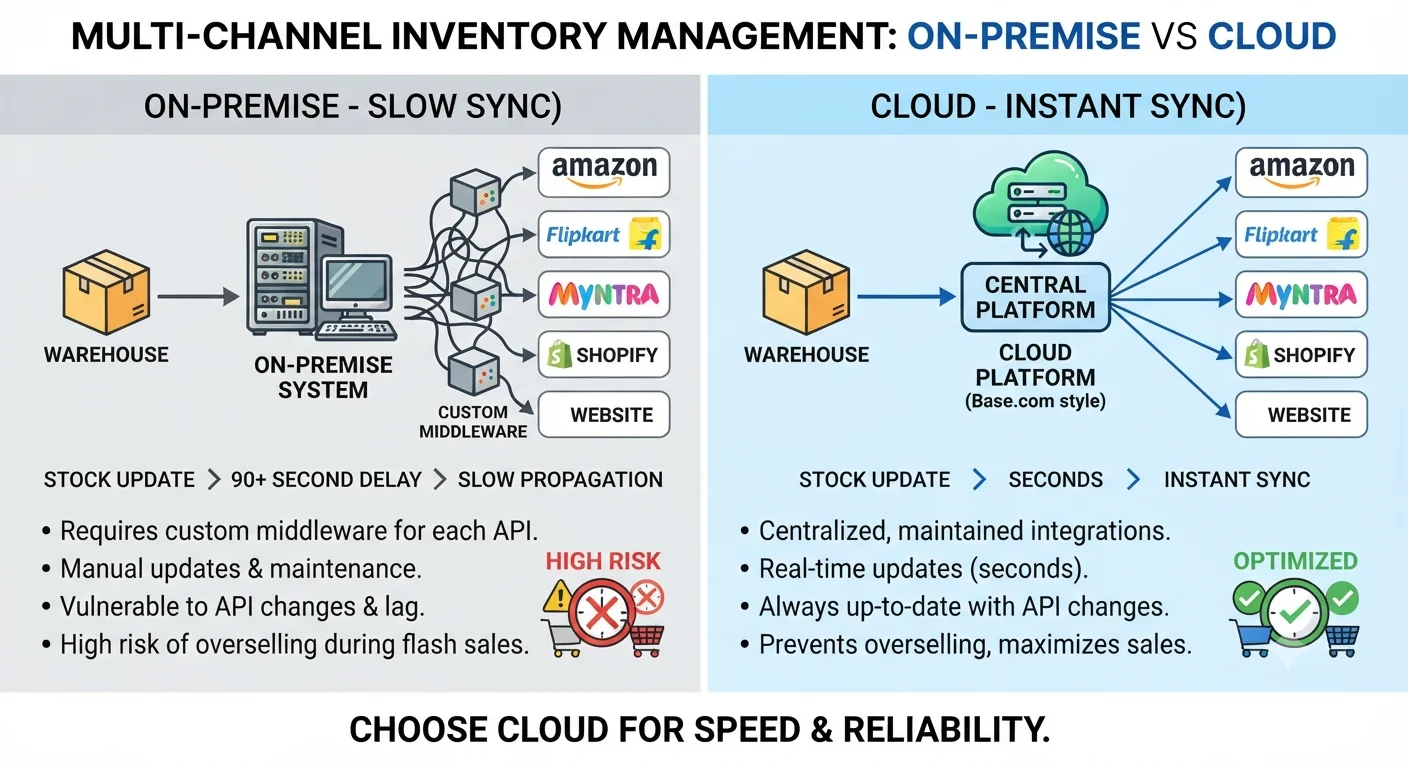
Most Indian sellers run inventory across Amazon, Flipkart, Myntra, Shopify, and their own website simultaneously. Cloud vs on-premise inventory management matters here because integration depth determines how fast stock updates propagate across channels.
On-premise systems typically need custom middleware to talk to each marketplace API, and that middleware needs maintenance every time a marketplace changes its API. Cloud platforms like Base.com maintain these integrations centrally. Base.com connects with 2,000+ marketplaces, stores and couriers, and how often stock syncs depends on your plan.
This is not a minor detail. A 90-second sync delay across channels during a flash sale can cause oversells on two marketplaces at once. Cloud architecture removes that lag structurally, while on-premise setups depend on how well the middleware was built and how often it is patched.
How Does Base.com Approach Cloud vs On-Premise Inventory Management
Base.com is a cloud platform, so there are no servers to install or maintain. The Order Manager brings orders from connected marketplaces and stores into one list. The Marketplace Manager syncs stock and prices across channels. The WMS handles locations, picking, packing, returns and stocktakes across multiple warehouses. Workflow Automation runs routine order steps based on rules you set. Team members log in from a browser, wherever they are.
Which Should You Choose: Cloud or On-Premise Inventory Management
| Your Situation | Better Fit |
|---|---|
| Selling across 2+ marketplaces and your own site | Cloud |
| Operating 3+ warehouses across India | Cloud |
| COD-heavy category with high RTO exposure | Cloud |
| Single warehouse, single sales channel, stable volume | On-premise may work |
| Strict data residency mandate with no cloud allowance | On-premise |
| Planning to scale beyond ₹50 crore in the next 18 months | Cloud |
This framework reflects how the cloud vs on-premise inventory management decision actually plays out for Indian sellers, not a one-size-fits-all recommendation.
Hidden Downtime Costs Indian Sellers Rarely Calculate

Every cloud vs on-premise inventory management comparison eventually has to address downtime, because downtime cost is where on-premise setups quietly lose the argument. A server failure at a single-location on-premise setup can take an entire order pipeline offline until hardware is repaired or replaced.
Cloud systems usually run on infrastructure with built-in redundancy, so a single server failure does not stop your operations. Ask your vendor what uptime it commits to, because Indian sellers cannot afford a four-hour outage during a flash sale or a festive dispatch window.
Indian sellers evaluating cloud vs on-premise inventory management should price downtime risk the same way they price hardware and staffing. A single lost day of order processing during Diwali week often costs more than a full year of cloud subscription fees.
How Do You Migrate From On-Premise to Cloud Inventory Management
Sellers currently running on-premise inventory management often delay a move to the cloud because they expect a painful, months-long migration. That fear is usually based on outdated assumptions about cloud implementation timelines.
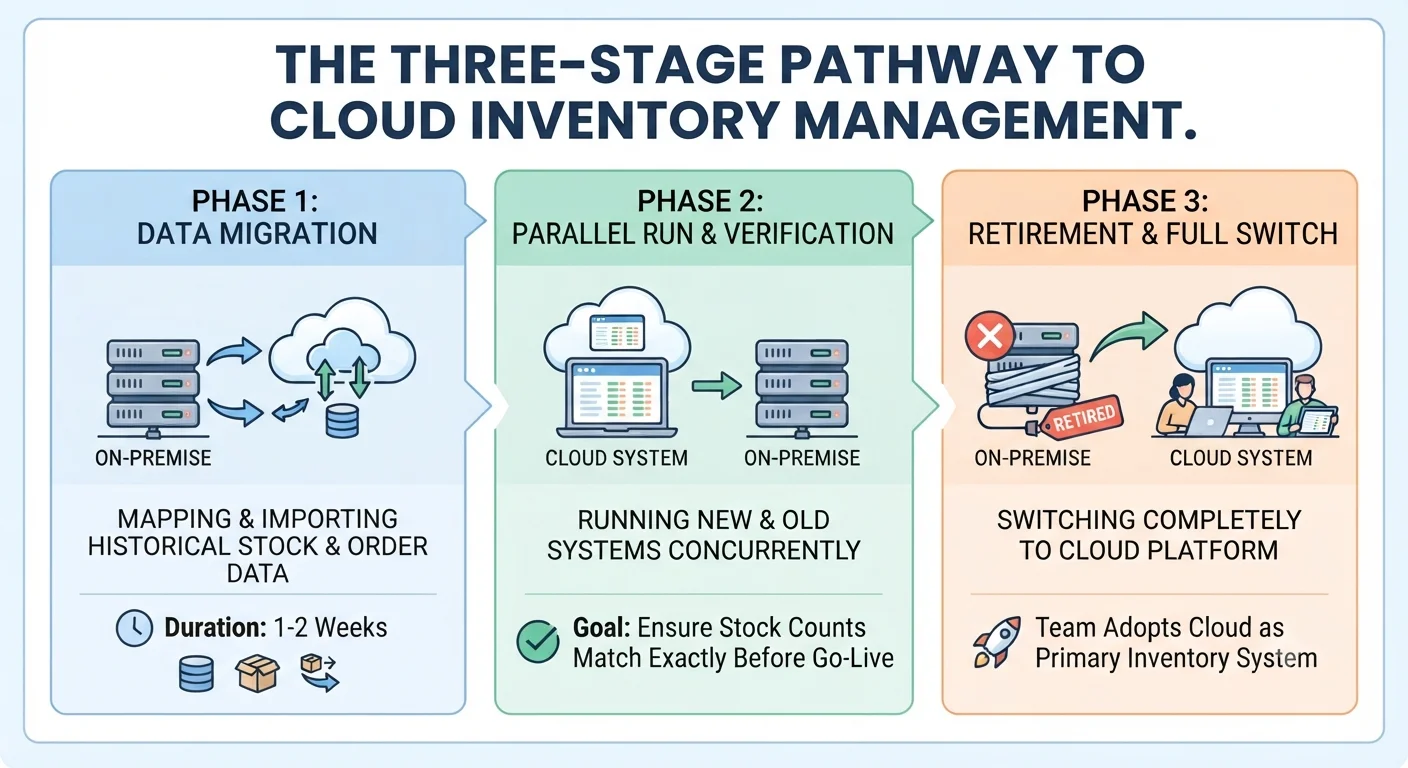
A well-planned migration from on-premises to cloud inventory management typically runs in three phases. First, historical stock and order data are mapped and imported, usually over 1-2 weeks depending on data quality. Second, the new system runs in parallel with the old on-premise setup for a short verification window, so nothing goes live until stock counts match exactly. Third, the on-premise system is retired, and the team fully switches to the cloud platform.
Plan the move so daily order processing keeps running. Connect your channels and warehouses, run both systems side by side for a short period, then switch over once orders and stock match.
The most common mistake Indian sellers make during this transition is under-preparing their SKU and warehouse master data before migration. Clean master data before the switch cuts implementation time significantly, regardless of which cloud vs on-premise inventory management platform is involved.
Sellers should also plan for a short training window for warehouse staff. Cloud interfaces are generally simpler than legacy on-premise software, but any change in daily workflow benefits from a structured two- to three-day onboarding period rather than an unannounced switch.
Team Access and Remote Operations
India’s warehouse and operations teams are rarely all in one city. A brand might run its warehouse in Bhiwandi, its customer service team in Bengaluru, and its founders reviewing dashboards from anywhere in between. Cloud vs on-premise inventory management has a direct answer for this reality.
On-premise inventory management ties access to a physical location or a VPN connection that most operations staff never configure correctly. Cloud inventory management gives every authorized team member secure, role-based access from a browser, regardless of city.
In Base.com, team members log in from a browser wherever they are, so a team spread across cities works from the same order and stock data.
What Are the Common Objections to Cloud Inventory Management

Modern inventory management decisions should be based on practical business requirements rather than long-standing assumptions. While concerns around cloud adoption are understandable, many of them stem from outdated perceptions rather than the capabilities of today’s enterprise platforms.
Evaluating these concerns objectively helps businesses choose a solution that supports long-term growth instead of limiting future scalability.
- Internet Dependency: Modern cloud platforms include redundancy and offline-friendly capabilities to reduce the impact of temporary connectivity issues.
- Data Ownership: Your business retains ownership of its data through clearly defined contractual agreements.
- Vendor Lock-in: Open APIs, standard integrations, and data export options make switching vendors significantly easier.
- Security & Compliance: Leading cloud providers typically offer enterprise-grade security, regular updates, and compliance certifications that many on-premises deployments struggle to match.
- Total Cost of Ownership: Consider ongoing maintenance, infrastructure, upgrades, and IT staffing, not just the initial implementation cost.
The Final Verdict for Indian D2C and Enterprise Sellers
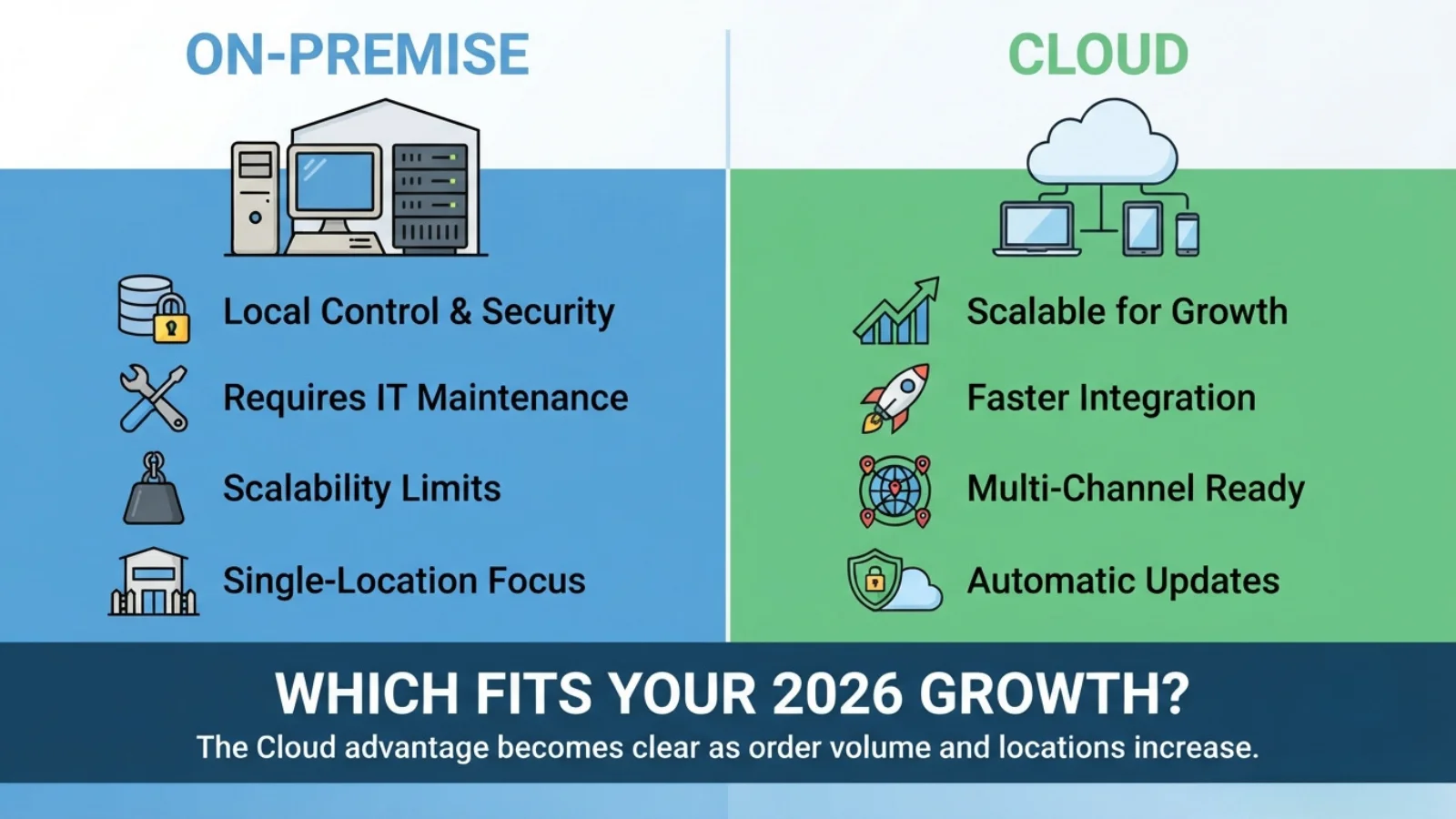
Cloud vs on-premise inventory management is no longer a genuinely close debate for most Indian sellers scaling past a single warehouse. Cloud wins on cost predictability, integration speed, RTO reduction, and festive-season scalability. On-premise inventory management still has a narrow, legitimate place for businesses with strict regulatory data residency needs or extremely stable, single-location operations.
For sellers weighing cloud vs on-premise inventory management in 2026, the practical question is not which model is theoretically better. It is the model that matches your channel mix, your warehouse count, and your growth trajectory over the next 18 to 24 months. Base.com is a cloud platform built for sellers running multiple channels and warehouses.
Sellers who delay this decision are not avoiding risk. They are carrying it forward at a higher cost every quarter their order volume grows. A brand doing 500 orders a day can survive on-premise limitations that a brand doing 5,000 orders a day cannot. Growth is precisely when the cloud vs on-premise inventory management gap becomes visible in daily operations, not just in a cost spreadsheet.
The sellers who move early tend to move on their own timeline, with a planned migration and clean data. The sellers who wait tend to move under pressure, usually right after a festive-season failure exposes exactly where the on-premise setup could not keep up. Choosing cloud inventory management before that failure happens is simply the lower-risk path.