Knowing how to convert COD orders to prepaid in Indian D2C is the single highest-leverage move available to a profitable ecommerce operation right now. Done right, a brand converting even 12-15% of its COD base to prepaid eliminates that share of RTO risk, without losing the order, without alienating the buyer.
This post covers the psychology, the mechanics, and the operational systems behind doing this at scale.
The Real Cost of COD in 2026
COD still accounts for 60-65% of Indian D2C orders. That number has held despite UPI processing 85% of all digital payments in India and over 491 million registered UPI users. The persistence of COD is not a payment infrastructure problem. It is a trust problem.
But trust or not, COD is expensive. Each COD delivery attempt costs Rs 45-73 in logistics and handling. A prepaid shipment costs Rs 8-15. The RTO rate on COD orders across Indian D2C brands averages 25-35%. For prepaid orders, the same figure is below 4-8%. Every returned COD order costs Rs 180-240 in forward shipping, reverse logistics, and overhead, generating zero revenue.
A brand processing 10,000 COD orders per month with a 28% RTO rate is losing Rs 5-7 lakh monthly on avoidable returns. Knowing how to convert COD orders to prepaid in Indian D2C directly attacks that number. Not by removing COD, which causes 28-38% customer loss, but by systematically shifting buyer behaviour through intent, timing, and incentive design.
Why Indian Buyers Choose COD: The Psychology Behind the Preference
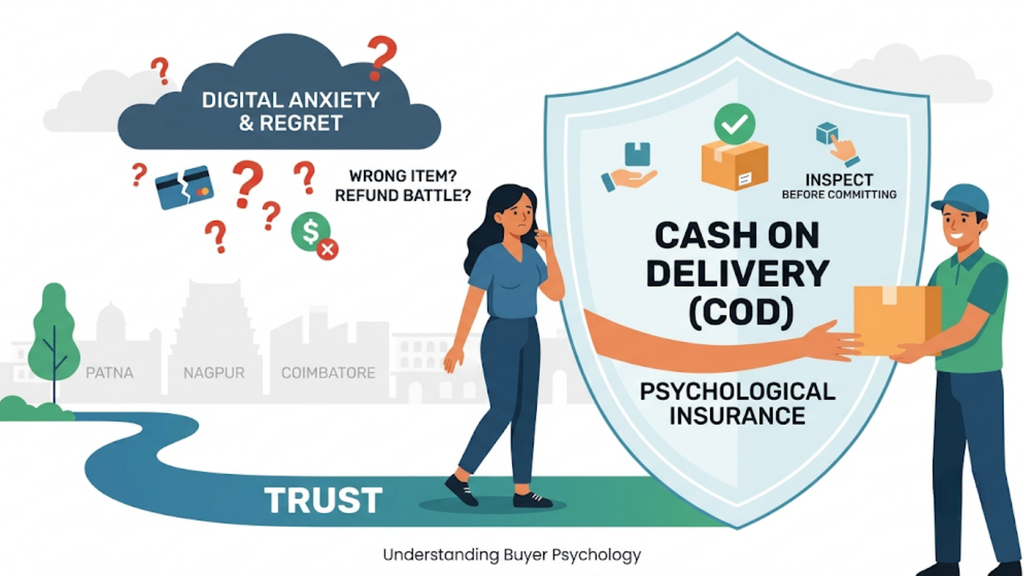
Most prepaid conversion strategies fail because they treat COD as a payment inconvenience. It is not. It is psychological insurance.
When a buyer from Patna, Nagpur, or Coimbatore selects COD on a D2C brand they have never purchased from before, they are not price-optimising. They are protecting themselves. They have seen poor product photos, received the wrong item, or had trouble getting a refund. COD lets them inspect before committing. It is rational behaviour in a market where trust is earned slowly.
Three psychological barriers drive COD preference:
- Anticipated regret. The buyer imagines receiving the wrong product and facing a refund battle. COD removes that risk entirely. No payment means no exposure.
- Digital payment anxiety. This is particularly pronounced in Tier 2 and Tier 3 markets. Losing Rs 800 to a payment that “didn’t go through” but got deducted is a real fear for buyers with limited margins.
- Habit. First-time buyers become COD-default buyers. The habit transfers across brands and categories.
Understanding how to convert COD orders to prepaid in Indian D2C means you are addressing these barriers, not just offering a discount.
What Does Not Work (And Why Brands Keep Doing It)
Before covering the playbook that works, the common mistakes are worth naming. These are the approaches Indian D2C brands apply most frequently, and that consistently underperform.
- Blanket prepaid discounts at checkout. A flat 5% discount for prepaid visible to every buyer at the payment screen is the most popular conversion tactic. It is also the least efficient. Buyers who already prefer prepaid take the discount. Committed COD buyers ignore it. The discount erodes margin without moving the cohort that matters.
- Removing COD entirely. Some brands interpret high RTO as a COD problem and eliminate the option. This drops conversion rates by 28-38% immediately. In Tier 2 and Tier 3 markets, it is catastrophic. The goal is not to remove COD; it is to reduce unnecessary COD.
- Identical communication for all COD buyers. A first-time buyer from a new pincode has a different risk profile and different psychology than a repeat buyer who has successfully received four prepaid orders. Treating them identically is how to convert COD orders to prepaid in Indian D2C badly, generic nudges annoy low-risk buyers, and fail to address the real barriers for high-risk ones.
The Four-Stage COD Conversion Framework
Effective COD-to-prepaid conversion in Indian D2C is a sequence, not a single touchpoint. Each stage builds on the previous one.
Stage 1: Check Friction Design
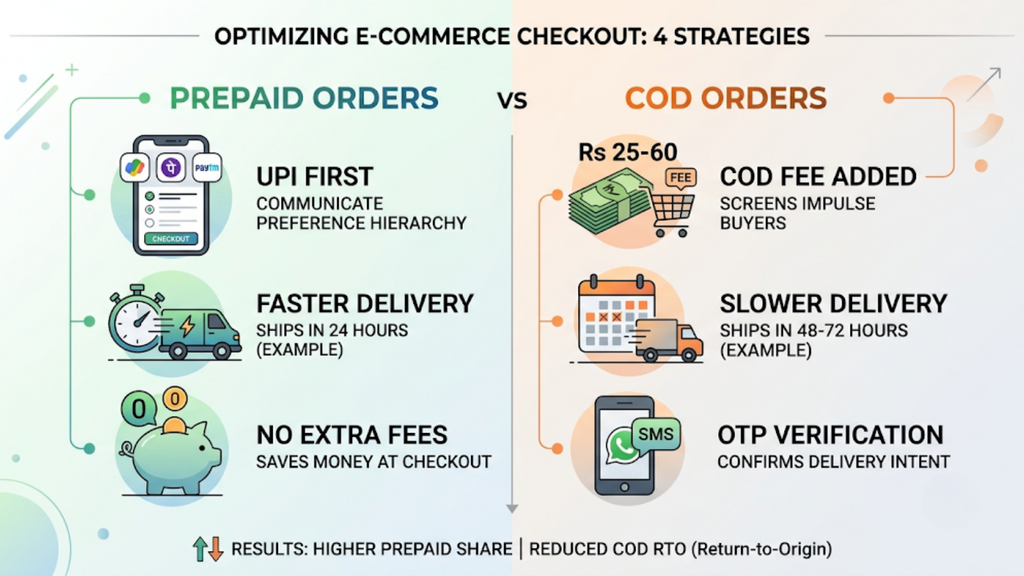
The conversion opportunity begins before the order is placed. Checkout design influences payment method selection more than most brands realise.
- Payment method ordering. Placing UPI first, followed by cards and wallets, and COD last, communicates a preference hierarchy without blocking any option. Brands that implement this see measurable shifts in prepaid share within the first two weeks, with no customer messaging required.
- COD handling fee. Adding a nominal Rs 25-60 COD handling fee at checkout serves two functions simultaneously. It screens out impulse buyers who were never going to receive the package. And it creates a visible cost differential that makes prepaid feel like the smarter financial choice. Brands that implement this see COD share drop by 10-15%, and the orders that remain on COD are higher-intent buyers, which reduces RTO on the remaining COD base.
- Delivery time differential. Showing “Prepaid: Ships in 24 hours. COD: Ships in 48-72 hours” creates a genuine value proposition for prepaid without manufacturing false urgency. This works especially well on fashion and beauty orders where delivery speed matters to the buyer.
- OTP verification friction. Requiring a WhatsApp or SMS OTP for COD order confirmation screens to screen fake and impulsive orders before they enter the fulfillment pipeline. It also communicates that the brand is serious about delivery intent, which subtly increases perceived legitimacy and buyer commitment.
Stage 2: Post-Order WhatsApp Nudge
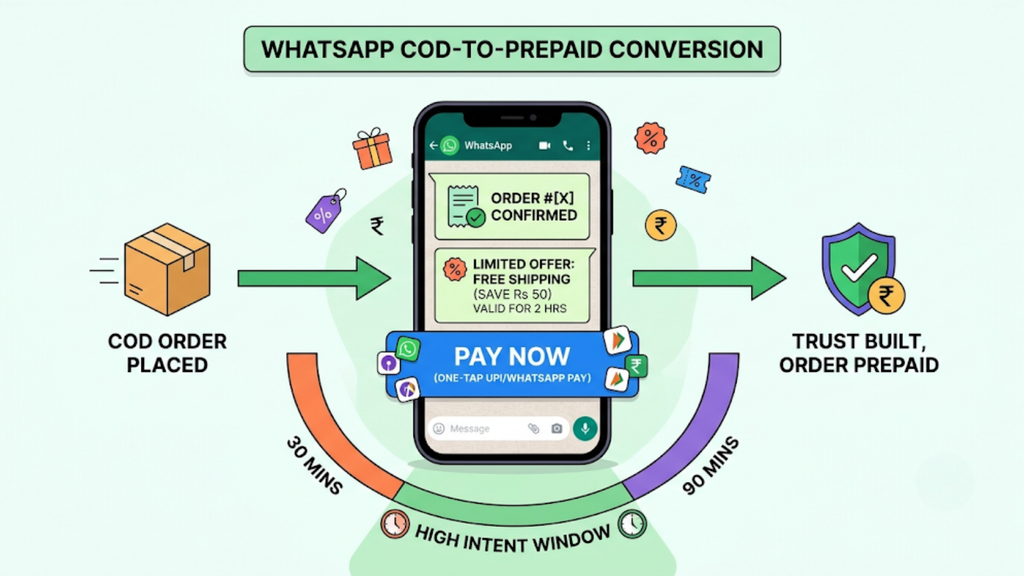
The most effective COD-to-prepaid conversion window is the 30-90 minutes after an order is placed. The buyer’s purchase intent is highest, their attention is on the order, and they have not mentally “closed” the transaction.
Understanding how to convert COD orders to prepaid in Indian D2C at this stage means getting the message right.
The WhatsApp message must do three things: confirm the order (builds trust), offer a specific, time-bound incentive (creates urgency), and provide a one-tap payment link. An example that performs:
“Your order #[X] is confirmed. Pay now via UPI and get free shipping (save Rs 50). Offer valid for 2 hours: [payment link].”
This structure converts 8-12% of COD orders to prepaid when sent within 30 minutes of placement. The conversion rate drops significantly after 2 hours. Brands that delay the nudge to the next business day lose most of the window entirely.
The payment link must be one tap. WhatsApp Pay, Razorpay payment links, and PayU smart links all work. Asking the buyer to navigate to a website and re-enter payment details at this stage is how to convert COD orders to prepaid in Indian D2C incorrectly; it adds friction at exactly the moment you are asking for trust.
Stage 3: Pre-Dispatch Reminder
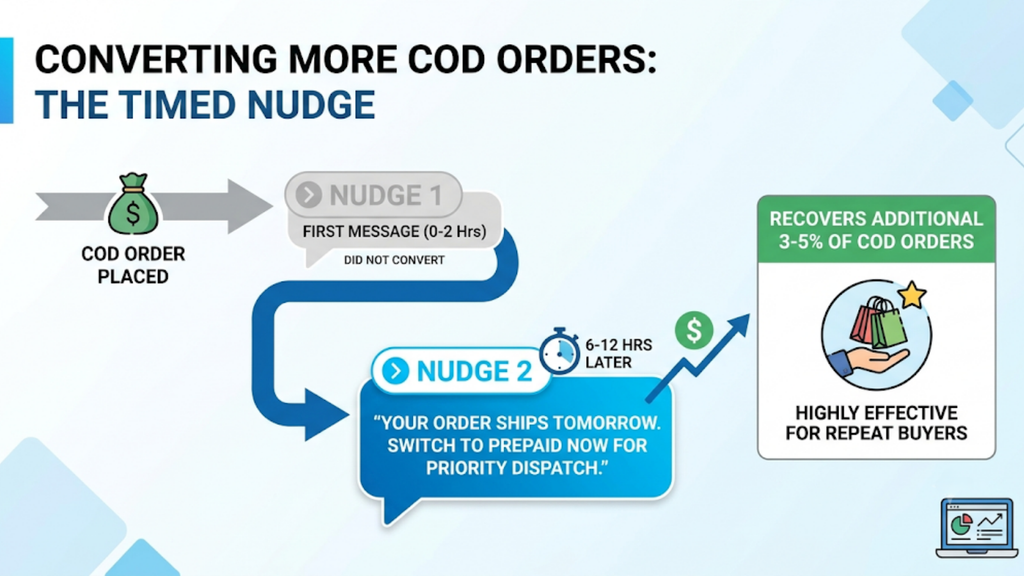
If the post-order nudge did not convert, a second message timed 6-12 hours later, before the order is dispatched, recovers an additional 3-5% of COD orders.
The messaging approach at this stage shifts from incentive to urgency: “Your order ships tomorrow. Switch to prepaid now for priority dispatch.” The framing works because it connects the payment method to a tangible operational outcome the buyer cares about, when their package leaves the warehouse.
This nudge is particularly effective for repeat buyers. They already have a relationship with the brand. The risk perception is lower. A small incentive combined with dispatch timing often tips the decision.
Stage 4: NDR Recovery and Last-Mile Conversion
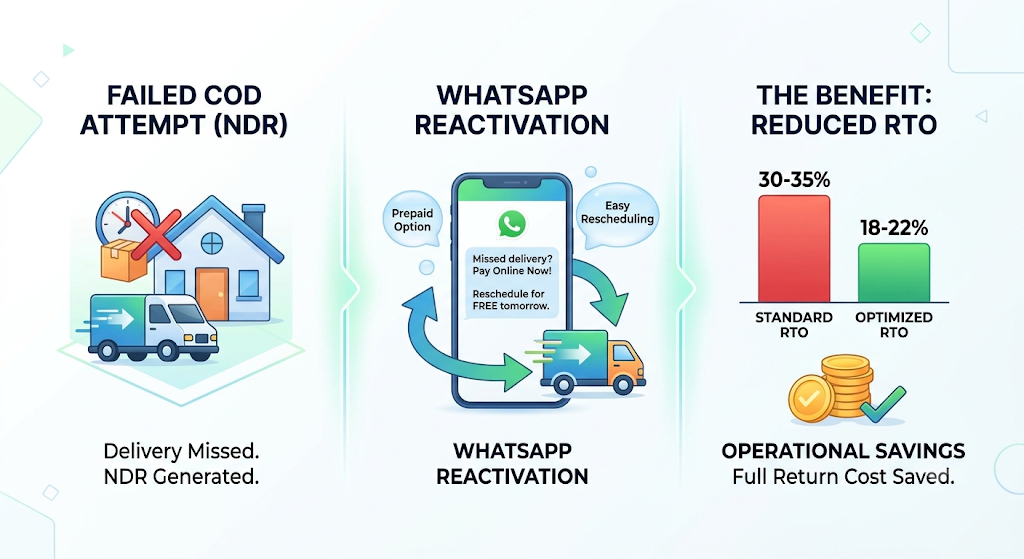
When a COD delivery attempt fails and generates an NDR (non-delivery report), a new conversion window opens. The buyer is aware that the delivery was attempted. Their intent to receive the package is still present but requires reactivation.
At NDR stage, a WhatsApp message offering to reschedule alongside a prepaid conversion option performs well: “We attempted delivery today. Pay online now, and we’ll reschedule for tomorrow at no extra charge.”
Brands that address NDRs within 2 hours see RTO rates drop from 30-35% to 18-22%. The NDR window is where converting COD orders to prepaid in Indian D2C becomes a direct operational saving; every conversion at this stage saves the full cost of a return shipment.
Segmenting COD Buyers: Not All COD Orders Are the Same
Generic nudges sent to every COD buyer are a waste of margin. The conversion rate and the right approach differ significantly by buyer segment.
| Buyer Segment | Recommended Approach | Expected Conversion |
| First-time buyer, known pincode | WhatsApp nudge + Rs 50 UPI incentive within 30 min | 8-12% |
| Repeat buyer, 2+ previous orders | Loyalty framing + cashback on next order | 15-20% |
| High-RTO pincode, first-time buyer | OTP verification first, prepaid discount second | 5-8% |
| High-value order (AOV > Rs 1,500) | Faster delivery promise + one-click payment link | 12-18% |
| Previously returned COD order | Address confirmation + partial upfront payment | 3-6% |
Brands implementing segmented nudge flows through Base.com’s OMS achieve conversion rate improvements of 34-52% over unsegmented approaches.
The platform’s order intelligence layer identifies repeat buyers, flags high-RTO pincodes, and triggers the appropriate WhatsApp or SMS flow automatically.
Pincode Risk Scoring: The Foundation of Scalable Conversion
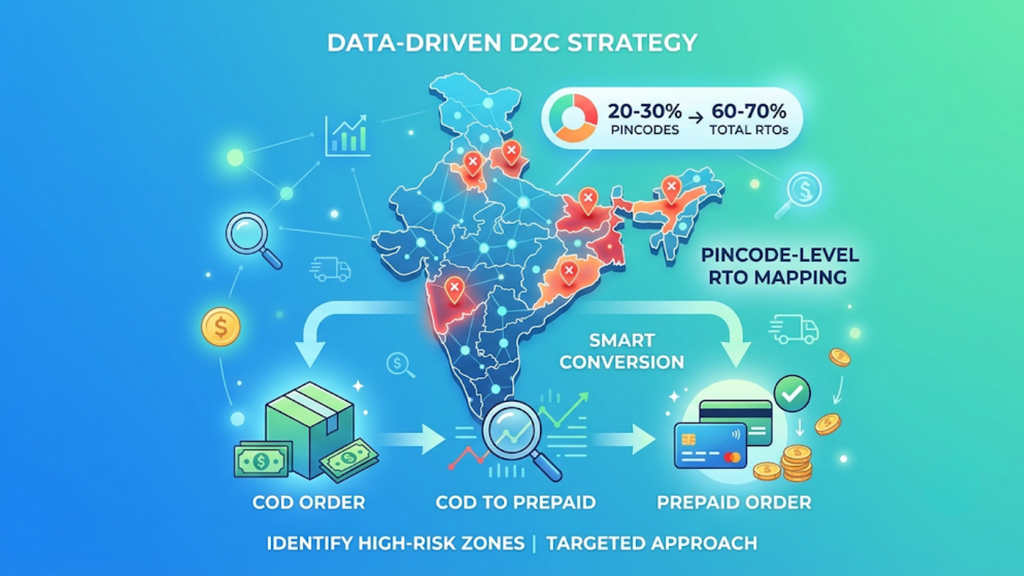
Knowing how to convert COD orders to prepaid in Indian D2C at scale requires more than good messaging. It requires data. Specifically, it requires a pincode-level view of RTO rates, delivery success rates, and COD refusal patterns.
Indian D2C brands that map their RTO data by pincode consistently discover that 20-30% of their pincodes account for 60-70% of their total returns. These are not random. They cluster by geography, by courier serviceability, and by category.
Base.com’s analytics module surfaces this data directly from order history. For every pincode in your delivery network, you can see COD order volume, successful delivery rate, RTO rate, and the average number of delivery attempts before return. This creates a three-tier risk classification:
- Low-risk pincodes (RTO below 15%): Allow COD freely. No surcharge. Offer a light prepaid incentive at checkout. No aggressive nudging required.
- Moderate-risk pincodes (RTO 15-30%): Add a Rs 30-50 COD handling fee. Send the post-order WhatsApp nudge within 30 minutes. Offer free shipping for prepaid orders.
- High-risk pincodes (RTO above 30%): Block COD for first-time buyers. For repeat buyers with a successful delivery history, allow COD with OTP verification. Offer 10% prepaid discount to offset the COD restriction. Show a transparent message: “Due to high delivery costs in your area, we’re offering 10% off prepaid orders.”
This tiered approach is how to convert COD orders to prepaid in Indian D2C without blunt policy enforcement that damages trust. Buyers in high-risk postcodes who genuinely intend to receive the package are offered a clear value exchange. Impulsive or fraudulent orders are filtered out before dispatch.
How Base.com Operationalises COD Conversion
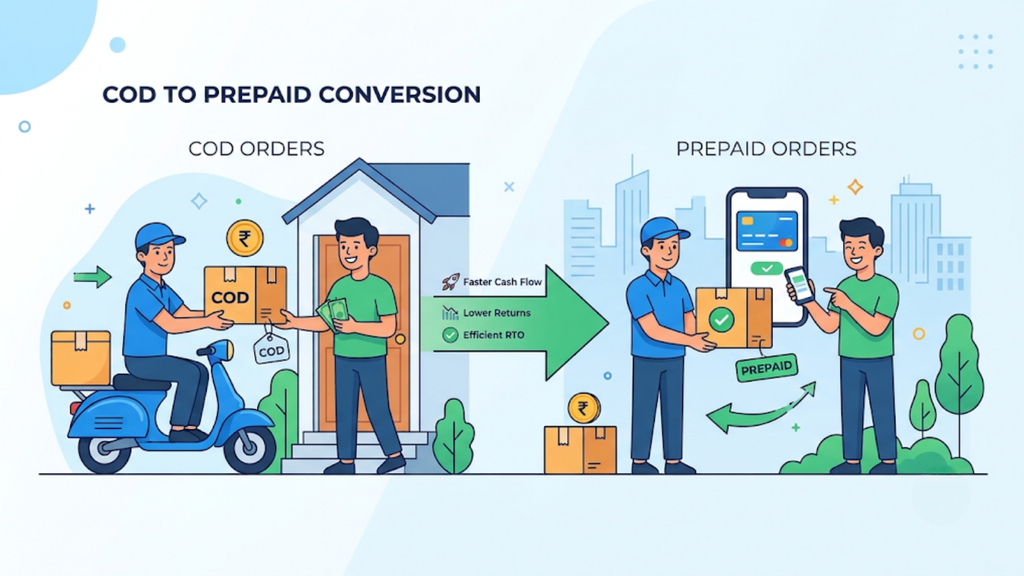
Understanding how to convert COD orders to prepaid in Indian D2C is conceptually straightforward. The operational challenge is running it simultaneously across Amazon, Flipkart, Meesho, Shopify, and your direct D2C channel, where order volumes differ, buyer data is fragmented, and each channel has different communication rules.
Base.com’s OMS captures every COD order across all active channels into a single order queue. The platform flags each order by buyer segment, pincode risk score, order value, and repeat purchase history. This intelligence layer powers the conversion flow without manual intervention.
The WhatsApp and SMS nudge sequences trigger automatically from Base.com via integrated BSP (Business Solution Provider) connections, Interakt, WATI, AiSensy, or a brand’s own WhatsApp Business API setup. The payment link is generated inside Base.com and expires after the configured window.
When a COD order converts to prepaid through the nudge flow, Base.com updates the order status, tags the conversion, and re-routes it through the prepaid fulfillment queue, which in most warehouses runs on a faster dispatch SLA than COD. The buyer gets their order faster. The brand saves the RTO exposure. The metric that matters, contribution margin per order, improves on both sides of the transaction.
Base.com’s reporting module tracks COD-to-prepaid conversion rate by channel, by SKU category, by pincode cluster, and by nudge timing. This data closes the loop: brands can see exactly which nudge sequence, which incentive value, and which buyer segment drives the highest conversion rate, and optimise accordingly.
The Incentive Stack: How Much to Offer and When
The right incentive is the smallest amount that moves the specific buyer at the specific moment. Over-incentivising COD conversion is a margin problem brands rarely calculate correctly.
| Nudge Stage | Effective Incentive | Incremental Margin Impact |
| Post-order WhatsApp (within 30 min) | Rs 30-50 cashback or free shipping | Saves full RTO cost (Rs 180-240) |
| Pre-dispatch reminder | Priority dispatch + Rs 25 off | Saves partial RTO exposure |
| NDR recovery | Reschedule + Rs 50 coupon on next order | Saves reverse logistics + processing |
| Repeat buyer loyalty nudge | Cashback on next purchase (Rs 75-100) | Builds prepaid habit across orders |
Research shows Rs 50-100 absolute discounts convert 31-38% of COD-preferring customers to prepaid. Percentage discounts (5-10% off) achieve only 18-23% conversion for the same cost level. Absolute rupee amounts are more legible and feel more tangible to Indian buyers, particularly in Tier 2 and Tier 3 markets where a Rs 50 saving is meaningful, not marginal.
Common Failure Points in COD Conversion Programmes
Even brands that understand how to convert COD orders to prepaid in the Indian D2C conceptually fail in execution. These are the patterns that appear most often.
- Nudging high-RTO buyers instead of verifying them first. A buyer with three previous RTOs from the same pincode does not need a Rs 50 cashback offer. They need address confirmation and order intent verification. Sending a prepaid conversion nudge to this segment wastes the incentive and signals that the brand has no visibility into buyer history.
- Using the same message for all channels. Meesho buyers and Shopify buyers have different price sensitivity, different brand relationships, and different WhatsApp engagement behaviour. A conversion message optimised for one channel often underperforms significantly on another.
- Not tracking conversion by nudge timing. The 30-minute window after order placement is roughly 3x more effective than the same message sent 6 hours later. Brands that send a single daily batch nudge are losing most of their conversion potential to timing.
- Ignoring the incentive cost per converted order. If the prepaid incentive costs Rs 75 and the conversion saves Rs 200 in expected RTO cost, the programme has positive unit economics. If the brand is offering Rs 100 incentives to buyers who have a 5% RTO probability, the programme is losing margin. Pincode and buyer segment risk scoring is what makes the economics work.
Building the Habit: Long-Term Prepaid Conversion
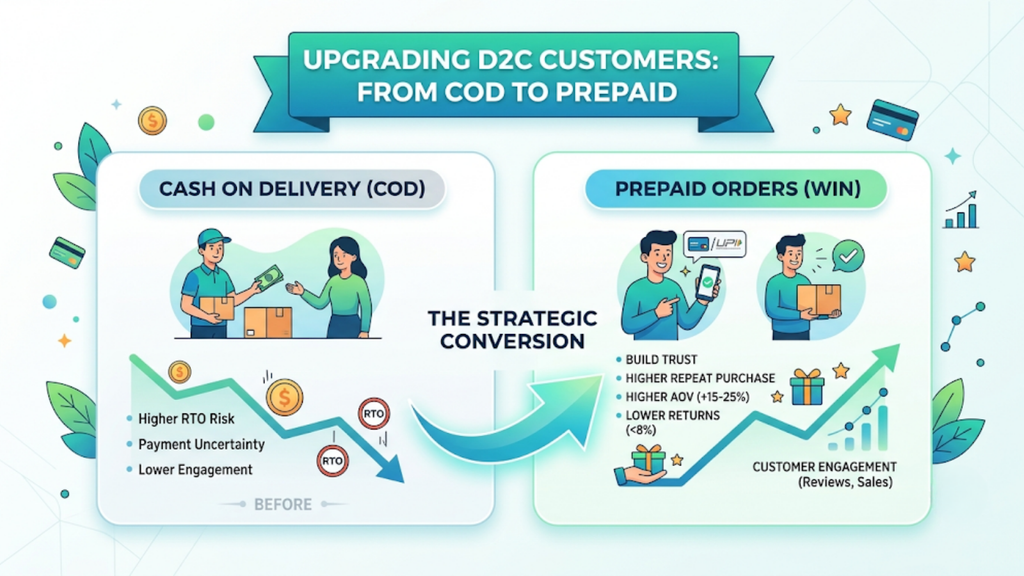
A single converted COD order is a unit economics win. A buyer who switches permanently to prepaid is a retention win. Understanding how to convert COD orders to prepaid in Indian D2C means thinking about both.
Buyers who complete their first prepaid transaction with a brand have a materially different repeat purchase behaviour. They have demonstrated trust. Their average order value on subsequent purchases is typically 15-25% higher than that of COD-only buyers. Their return rate drops below 8%.
Brands that track prepaid cohort LTV consistently discover that the prepaid conversion investment is not just an RTO reduction measure; it is a customer quality upgrade. Prepaid buyers are more likely to leave reviews, respond to restock alerts, and purchase in festive sale windows.
Base.com’s CRM segmentation separates prepaid and COD buyer cohorts across all channels. Brands can run targeted retention campaigns to convert prepaid buyers, offer loyalty offers, early access, and faster SLAs, which reinforce the habit and increase LTV without additional acquisition spend.