

The single most effective thing you can do to reduce RTO for D2C brands in India is to stop treating it as a logistics problem and start treating it as an operations problem. Brands that bring RTO down sustainably do not do it by switching couriers or renegotiating rates. They do it by fixing the decision-making layer that sits between an order being placed and that order reaching the customer’s hands.
Effilo learned this through direct experience. With RTO rates as high as 60%, the brand was losing more than half of every dispatched order to returns before delivery. The cost was not just financial; it was operational, relational, and reputational. Every returned order meant a wasted dispatch, a courier dispute, a restocking effort, and a customer who never received what they ordered.
What Effilo built with Base.com was not a workaround. It was a structural fix. This is the complete account of how they did it, and what every Indian D2C brand dealing with high RTO can take from that journey.
Understanding Why Effilo’s RTO Problem Was Structural, Not Incidental
Before evaluating any solution, it is worth being precise about what Effilo was dealing with. An RTO rate of 60% means that for every 10 orders dispatched, six came back. In the context of Indian ecommerce, where the market-wide COD return rate already sits between 25-30%, a 60% rate is not just above average. It is operationally unsustainable.
To genuinely reduce RTO for D2C brands in India, you must first understand what is driving it. Not all RTOs have the same cause, and treating it as a single problem with a single solution is why many brands implement changes and see only partial improvement.
What Was Driving High RTO at Effilo
Effilo’s RTO problem had multiple contributing causes, each compounding the others:
- Fake delivery attempts. Courier partners were logging failed delivery attempts without genuinely attempting delivery. Orders were being marked undeliverable, scanned as returned, and sent back without the customer ever being contacted. Without visibility into delivery-attempt authenticity, Effilo had no systematic way to separate genuine failures from manufactured ones.
- No structured customer confirmation layer. Orders were being dispatched without any pre-delivery validation step. Customers who had ordered impulsively, entered incorrect addresses, or were simply unreachable at the time of delivery became automatic RTOs. A structured confirmation step, before dispatch or before a second attempt, could have intercepted a significant share of these before they became returns.
- Carrier allocation driven by habit, not data. Shipping partners were assigned to orders based on existing relationships and manual judgment, not actual delivery performance. Some carriers were consistently underperforming on turnaround time and delivery success in specific geographies. Without data-driven allocation, those carriers kept receiving orders they were structurally likely to fail.
- Manual, reactive post-order operations. When delivery problems arose, the team dealt with them individually, calling customers, following up with couriers, and resolving disputes case by case. This reactive model consumed enormous team bandwidth while doing nothing to prevent the same problems from appearing in the next dispatch cycle.
- Carrier disputes without data backing. When Effilo raised disputes with shipping partners over failed or fake deliveries, those disputes were difficult to prosecute without clear performance records. The absence of structured historical data gave carriers room to defend poor outcomes with minimal accountability.
Each problem fed the others. High RTO created more disputes. Disputes created more manual work. Manual work left less bandwidth to address root causes. To genuinely reduce RTO for D2C brands in India, Effilo needed a system that would break this cycle entirely, not manage it more efficiently.
Why Most Attempted Fixes Fail to Reduce RTO for D2C Brands in India
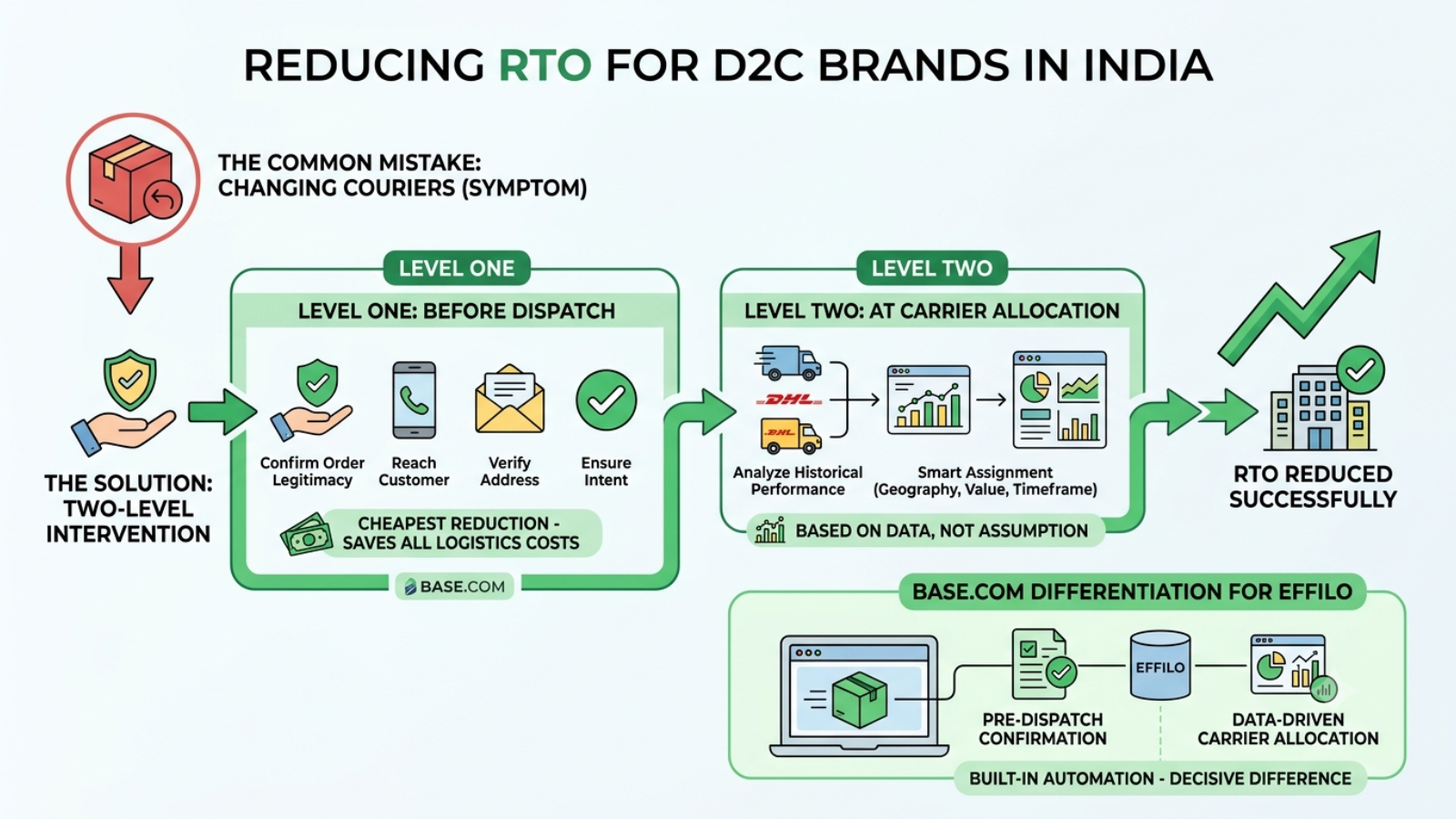 This is the mistake the majority of Indian D2C brands make when RTO climbs: they change the courier. Switch logistics partners. Try a different aggregator. Negotiate new rates with a different carrier. These changes address a symptom, not the cause.
To meaningfully reduce RTO for D2C brands in India, intervention is required at two levels simultaneously:
Level one, before dispatch. Confirming that the order is legitimate, the customer is reachable, the address is accurate, and the intent to receive is genuine. This is the pre-dispatch layer, and it is where the cheapest RTO reduction happens. An order intercepted before dispatch saves the entire outward and return logistics cost.
Level two, at the point of carrier allocation. Assigning each order to the courier most likely to deliver it successfully, in that geography, at that order value, within the required timeframe, based on actual historical performance rather than assumption or habit.
Most standard OMS platforms in India handle neither layer with any depth. They route orders to shipping partners based on basic rate or speed rules and leave both confirmation and performance monitoring as manual tasks for the operations team.
Base.com was built differently. And for Effilo, that difference was decisive.
How Base.com Built the Solution to Reduce RTO for D2C Brands in India
Base.com addressed rising RTO challenges for Indian D2C brands by bringing structure, visibility, and control to fragmented, high-COD fulfilment operations.
1. The Two-Sided Architecture: Confirmation Plus Allocation
 Base.com approached Effilo’s problem from both sides simultaneously. This integrated architecture is what separated it from single-lever solutions that had failed to reduce RTO for D2C brands in India at the scale Effilo needed.
- Side one: Automated customer confirmation calls. Before high-risk orders were dispatched or before second delivery attempts were made on pending orders, Base.com’s automated call system reached customers to confirm intent, verify address accuracy, and create a recorded confirmation layer. This step intercepted orders that would have been near-certain RTOs before they ever entered the dispatch queue.
- Side two: TAT-based intelligent carrier allocation. Base.com used historical shipping partner performance data to allocate orders to couriers based on actual turnaround time and delivery success rates, not fixed relationships or manual preference. Each order was matched to the carrier most likely to deliver it successfully, based on data from prior deliveries in the same geography and order profile.
Together, these two interventions addressed both the demand-side failure, customer not prepared or reachable for delivery, and the supply-side failure, wrong carrier assigned to the wrong order. That dual coverage is the reason Effilo’s results were as significant as they were.
2. Automated Customer Confirmation Calls in Detail
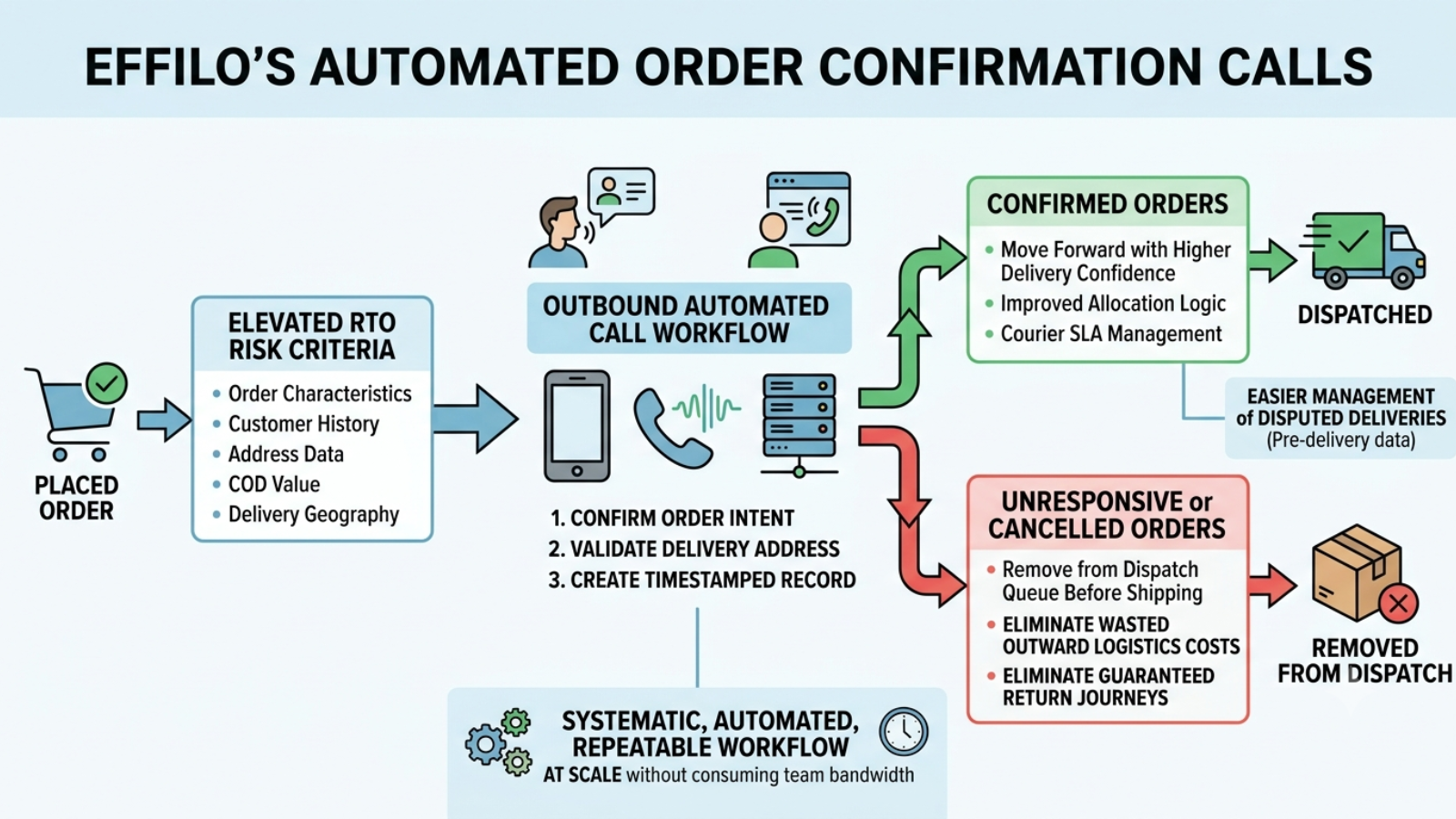 The automated call workflow operated as a proactive verification layer embedded directly into Effilo’s fulfilment process.
When an order met criteria indicating elevated RTO risk, based on order characteristics, customer history, address data, COD value, or delivery geography, the system triggered an outbound automated call to the customer. The call confirmed order intent, validated delivery address details, and created a timestamped record of customer responsiveness.
The downstream benefits of this confirmation layer were significant:
- Orders from customers who did not respond or who confirmed cancellation were removed from the dispatch queue before shipping, eliminating wasted outward logistics costs and guaranteed return journeys entirely
- Confirmed orders moved forward with a higher baseline delivery confidence, improving allocation logic and courier SLA management.
- Disputed deliveries became easier to manage because the pre-delivery confirmation record provided a verifiable data point that standard courier tracking does not offer
- The automated nature of the calls meant this validation ran at scale without consuming team bandwidth on individual manual outreach.
For Effilo, this was the confirmation structure the business had lacked entirely. Not a manual process dependent on someone making calls one by one, but a systematic, automated, repeatable workflow that runs on every qualifying order, consistently, without team input.
This is one of the highest-ROI interventions available to reduce RTO for D2C brands in India. The cost per automated confirmation call is small. The cost of a returned order, in outward logistics, return logistics, restocking, team dispute-resolution time, and lost revenue, is multiples higher.
3. TAT-Based Intelligent Shipping Allocation in Detail
 The second side of the solution addressed the carrier allocation problem at its root.
Base.com brought carrier performance data directly into Effilo’s order allocation workflow. Instead of assigning shipping partners based on existing relationships or static rate rules, orders were routed to couriers based on:
- Actual turnaround time performance in the specific delivery geography
- Historical delivery success rates broken down by carrier and region
- Carrier-specific performance trends identifying improving or deteriorating reliability over time
- Order-level matching between the delivery profile and the carrier capability
This data-driven allocation model fundamentally changed the logic of carrier selection. The question shifted from “which courier do we use?” to “which courier is most likely to successfully deliver this specific order, to this specific address, within the required window?”
For Indian D2C brands operating across diverse geographies, metros, tier-2 cities, and tier-3 towns, each with dramatically different carrier performance profiles, this kind of allocation intelligence is not optional. It is the structural difference between a delivery outcome that is predictable and one that is left to chance. It is also one of the most direct ways to reduce RTO for D2C brands in India at volume.
4. Addressing Fake Deliveries Through System Logic
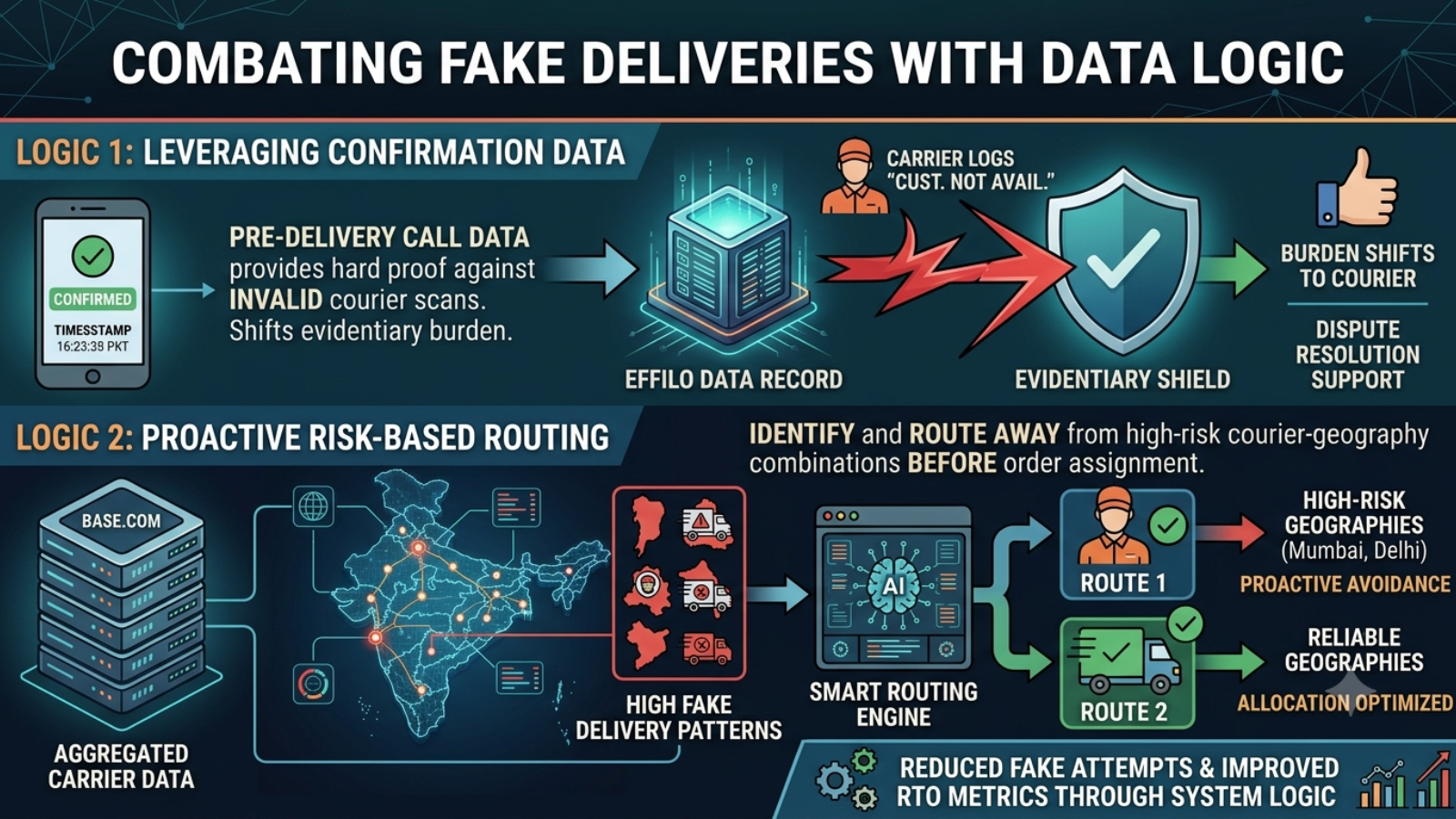 Fake delivery attempts, where couriers log a failed delivery without making a genuine attempt, are one of the most persistent and underreported problems in Indian ecommerce fulfilment. They are difficult to prove, time-consuming to dispute, and damaging to RTO metrics in ways that are hard to isolate from genuine delivery failures.
Base.com helped Effilo reduce this problem through two mechanisms working in combination.
First, when a customer has confirmed their order through an automated pre-delivery call, a subsequent “customer not available” scan from the courier becomes significantly harder to accept without scrutiny. The confirmation record creates a counter-data point that shifts the evidentiary burden in courier disputes. Effilo could now say: the customer confirmed delivery intent at this time; explain why delivery failed two hours later.
Second, carriers with high fake-delivery patterns in specific geographies were identifiable through the performance data Base.com aggregated. This allowed Effilo to route away from high-risk carrier-geography combinations proactively, before orders were assigned, rather than discovering the problem after returns arrived.
Both mechanisms together reduced Effilo’s exposure to fake delivery events significantly. This is a dimension of the ability to reduce RTO for D2C brands in India that most standard platforms do not address at all.
The Results: From 60% RTO to 20%, with a Clear Path to 10%
The operational impact at Effilo was measurable across every dimension the team had previously struggled to control.
Core Performance Metrics
| Metric | Before Base.com | After Base.com | Target |
|---|---|---|---|
| RTO rate | ~60% | ~20% | 10% |
| Carrier dispute frequency | High, frequent, hard to resolve | Significantly reduced | Minimised |
| Manual post-order intervention | High, reactive, case-by-case | Low, system-driven | Fully automated |
| Customer confirmation coverage | None, no structured layer | Automated on all qualifying orders | Complete coverage |
| Carrier allocation method | Habit-based, manual preference | Data-driven, TAT-optimised | Continuous optimisation |
| Fake delivery exposure | High, no counter-data | Reduced, confirmation records present | Minimal |
A reduction from 60% to 20% RTO is not an incremental improvement. It represents a structural change in how the business performs at the point of delivery. The financial implications at scale are significant: fewer wasted dispatch costs, lower return logistics spend, reduced restocking overhead, less team time on dispute management, and more revenue reaching completion rather than returning as a cost.
Effilo’s team described this outcome as solving one of the biggest problems the business had faced, not as a performance optimisation, but as a resolution of a persistent, growth-limiting challenge that had been dragging on the brand’s ability to operate confidently at scale.
Reduced Carrier Disputes
With Base.com’s carrier performance data informing allocation decisions and automated customer confirmation providing pre-delivery records, Effilo’s position in carrier disputes strengthened substantially.
Disputes that previously required extensive manual escalation and relied on contested delivery scan records became more structured and resolvable. The confirmation data and performance history created an evidentiary baseline that Effilo had never had before.
Carrier disputes are an underappreciated cost component for Indian D2C brands trying to reduce RTO for D2C brands in India. Each dispute requires team time to log, document, escalate, and follow up. At a 60% RTO volume, this overhead becomes a serious operational drain. Reducing dispute frequency and resolution effort simultaneously produced compounding efficiency gains.
Post-Order Operations Shifted From Reactive to Managed
Before Base.com, Effilo’s post-order operations were defined by reactive intervention. Problems were identified after they occurred: a failed delivery scan, a fake return, a disputed outcome, and the team responded individually to each.
After Base.com, post-order operations became a managed workflow. The system handled pre-delivery confirmation, allocation logic, and performance tracking automatically. The team’s role shifted from daily firefighting to managing the exceptions the system surfaced.
This shift, from reactive to managed, is one of the most important qualitative outcomes when brands successfully reduce RTO for D2C brands in India through a properly configured operations platform. The metric improvement is visible and measurable. The change in team operating environment is what sustains it.
What Makes Base.com a Differentiator for RTO Reduction
 Base.com stands out by aligning automation, real-time visibility, and intelligent workflows to directly tackle the root causes of high RTO in D2C operations.
1. Execution Layer, Not Just Reporting Layer
The most important distinction in Base.com’s approach is that it functions as an execution layer, not a visibility layer. Many OMS and logistics platforms offer dashboards showing RTO rates, carrier scorecards, and delivery success breakdowns. That information is genuinely useful, but it does not, by itself, change any outcome.
A dashboard showing 60% RTO does not reduce RTO for D2C brands in India. The actions that follow the data are what reduce it. Base.com’s architecture connects data directly to action: carrier performance data flows into allocation decisions; customer risk signals flow into confirmation triggers. The platform does not just surface the problem, it operationalises the response.
2. Integrating Two Levers Most Platforms Treat Separately
Most Indian OMS and logistics platforms address either the confirmation problem or the carrier allocation problem, rarely both, and almost never in a coordinated, integrated workflow.
Confirmation tools exist as standalone products. Carrier aggregators exist as separate platforms. Bringing both together so that confirmation outcomes inform dispatch decisions and carrier performance data informs allocation logic, that architectural integration is what made Base.com effective for Effilo, where other approaches had not been.
For D2C brands where RTO has multiple contributing causes, as it almost always does, solving one side while ignoring the other produces partial results. Effilo’s ability to reduce RTO for D2C brands in India from 60% to 20% came directly from addressing both sides simultaneously through a single, coordinated platform.
3. Configurability to Effilo’s Specific Operational Context
Base.com did not apply a generic RTO-reduction template to Effilo’s operations. The platform was configured to Effilo’s specific problem profile, the fake delivery patterns, the carrier dispute history, and the absence of any confirmation layer, and built the solution around those specifics.
This configurability is essential for Indian D2C brands trying to reduce RTO for D2C brands in India in a sustainable way. Generic solutions produce generic results. A platform that adapts to the brand’s actual operational context produces results that hold at scale.
The Operational Framework for Indian D2C Brands to Reduce RTO
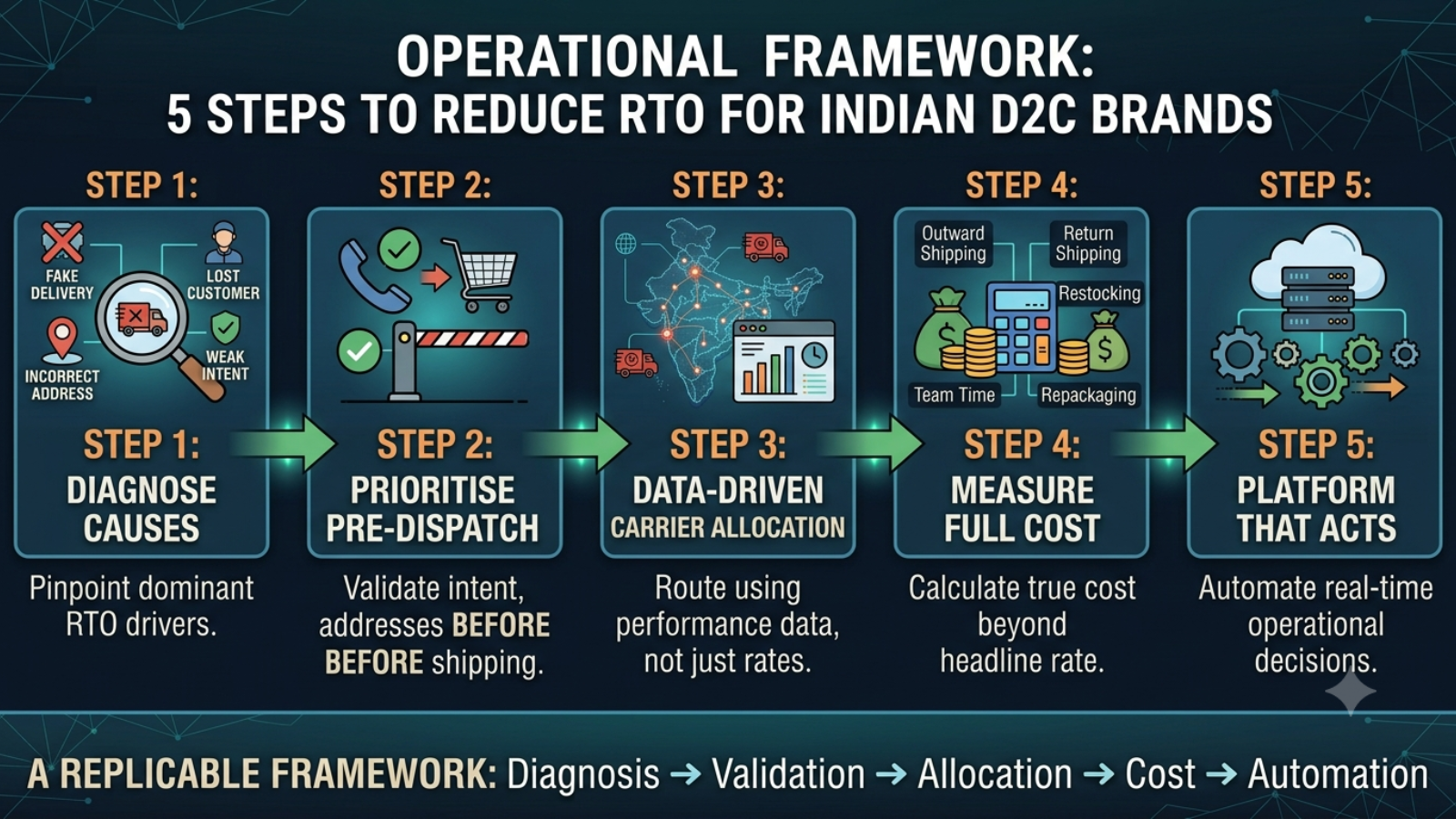 Effilo’s journey offers a replicable framework for any Indian D2C brand dealing with high RTO.
Step 1: Diagnose Before Investing in Solutions
Not all RTO has the same drivers. Fake deliveries, unreachable customers, incorrect addresses, weak purchase intent, and carrier underperformance each require different interventions. Brands that invest in solutions before diagnosing which causes dominate their specific RTO profile often solve the wrong problem and see minimal improvement.
Effilo’s diagnosis was precise. That precision made the solution selection accurate and the implementation fast.
Step 2: Prioritise the Pre-Dispatch Layer
The most cost-effective way to reduce RTO for D2C brands in India is to intercept likely-return orders before they ship. An order that does not dispatch cannot return. Automated confirmation calls, address validation, and risk-based hold logic are the highest-ROI interventions available; the cost is small relative to the full economics of a returned COD order.
Step 3: Replace Habit-Based Carrier Allocation With Performance Data
Carrier relationships and negotiated rates matter. But allocation without performance data leaves significant delivery risk on the table. In Indian ecommerce, carrier performance varies substantially by geography, order type, and time of year. TAT-based allocation that routes orders based on real delivery outcome data consistently outperforms static rules.
Step 4: Measure the Full Cost of RTO, Not Just the Rate
The RTO headline metric is the starting point. The full cost includes outward shipping, return shipping, restocking and repackaging, team time on dispute management, customer re-engagement costs, and the brand trust cost of a failed delivery experience. When Indian D2C brands calculate the complete cost of a 60% RTO rate, the business case for investing in a proper platform to reduce RTO for D2C brands in India becomes straightforward.
Step 5: Choose a Platform That Acts, Not Just Reports
The right platform for RTO reduction connects data to operational decisions in real time, not just surfaces data for the team to act on manually. If the platform tells you which carrier is underperforming but does not change the allocation logic automatically, you are still dependent on human intervention at every step. That dependency is the bottleneck.
Key Takeaway
Reducing RTO is not about quick fixes; it is about building a system that prevents failures before they happen. Effilo’s journey shows that when brands shift from reactive firefighting to structured, data-driven operations, RTO stops being an uncontrollable cost and becomes a manageable metric.
For Indian D2C brands, the real takeaway is simple: fix the decision layer, not just the logistics layer. Validate orders before dispatch, assign carriers based on performance, and automate what should never depend on manual effort.
The brands that win are not the ones negotiating better courier rates. They are the ones building smarter systems.
Ready to reduce RTO and build a more dependable delivery operation? [Talk to the Base.com team →]

[…] sits a structural operations crisis that most brands only partially understand. The national average RTO rate for D2C brands in India sits between 20-30%. For COD-heavy categories like fashion, footwear, and […]
[…] RTO and CRET processing, quality inspection at return receipt, damaged vs. sellable segregation, re-shelving with bin […]