India’s consumer market is changing fast, and that is exactly why founders who want to grow a D2C brand in India need a clear scaling playbook, not just good products. What worked at 1 crore in revenue will not work at 50 crores.
Customer acquisition costs on Meta have increased 25 to 40 percent in the last three years across most consumer categories. At the same time, return rates on marketplaces like Amazon and Flipkart can go as high as 18 to 25 percent in fashion, directly impacting margins.
If you want to grow a D2C brand in India, you need sharp positioning, tight operations, strong retention, and disciplined capital allocation. Marketplaces typically charge 18 to 28 percent, including commission, shipping, and ads. Add GST, payment gateway fees of 2 percent, and RTO losses, and your gross margin can shrink fast.
Smart founders track contribution margin per SKU, not just revenue. They negotiate courier rates below 35 rupees per 500 grams, push prepaid orders to reduce RTO, and aim for at least 30 percent repeat purchase within 90 days. That is how sustainable scale actually happens. The D2C Scaling Playbook focuses on increasing revenue without increasing operational chaos. Hence, most founders find this helpful.
What It Really Takes to Grow a D2C Brand in India
Before we talk about brands, let us get one thing clear. To grow D2C brand in India, you need to build for three layers at the same time:
- Demand creation
- Conversion efficiency
- Backend strength
If even one layer is weak, scaling becomes expensive and unstable.
Here is a simple structure most successful brands follow:
| Stage | Revenue Range | Core Focus | Key Metric |
|---|---|---|---|
| Early | 0–5 Cr | Product-market fit | Repeat purchase rate |
| Growth | 5–50 Cr | Channel scale | CAC:LTV ratio |
| Scale | 50 Cr+ | Brand + retention | Contribution margin |
Now, let us break this down with real numbers that matter for Indian sellers.
In the 0 to 5 crore stage, your repeat purchase rate should cross 25 percent within 60 to 90 days in consumables. If it is below 15 percent, you do not have a strong product-market fit. Many founders try to grow a D2C brand in India by increasing ad spends instead of fixing repeat behavior. That only increases burn.
In the 5 to 50 crore stage, the CAC to LTV ratio must stay above 1:3. If you are spending 800 rupees to acquire a customer, your lifetime gross profit from that customer should be at least 2,400 rupees.
On marketplaces like Amazon, ad cost of sales can go up to 12 to 18 percent in competitive categories. If you are not tracking blended CAC across the website and the marketplace, your scale is misleading.
Once you cross 50 crores, contribution margin becomes critical. After marketplace commissions of 20 to 28 percent, payment gateway charges, GST, warehousing, and returns, many brands operate at less than 10 percent contribution. Founders who successfully grow D2C brands in India track SKU-level profitability weekly and reduce RTO below 10 percent by pushing prepaid incentives.
Scaling in India is not about revenue headlines. It is about controlled margins, strong retention, and operational discipline.
5 Indian D2C Brands and What They Did Right
Instead of giving you theory, let us break down real brands like Mokobara, Blue Tea, The Whole Truth, Minimalist, and Snitch. These are not legacy giants with decades of distribution muscle. They are focused brands that scaled with clear unit economics and sharp execution. If you want to grow a D2C brand in India, study how they built margins before chasing scale.
1. Mokobara – Premium Positioning with Strong Unit Economics
Mokobara entered a luggage market dominated by Safari and VIP, where price competition is intense and offline distribution is heavy. Instead of entering at 3,000 to 5,000 rupees, they positioned themselves between 8,000 and 20,000 rupees.
Every successful ecommerce brand eventually needs a structured D2C Scaling Playbook to sustain growth.
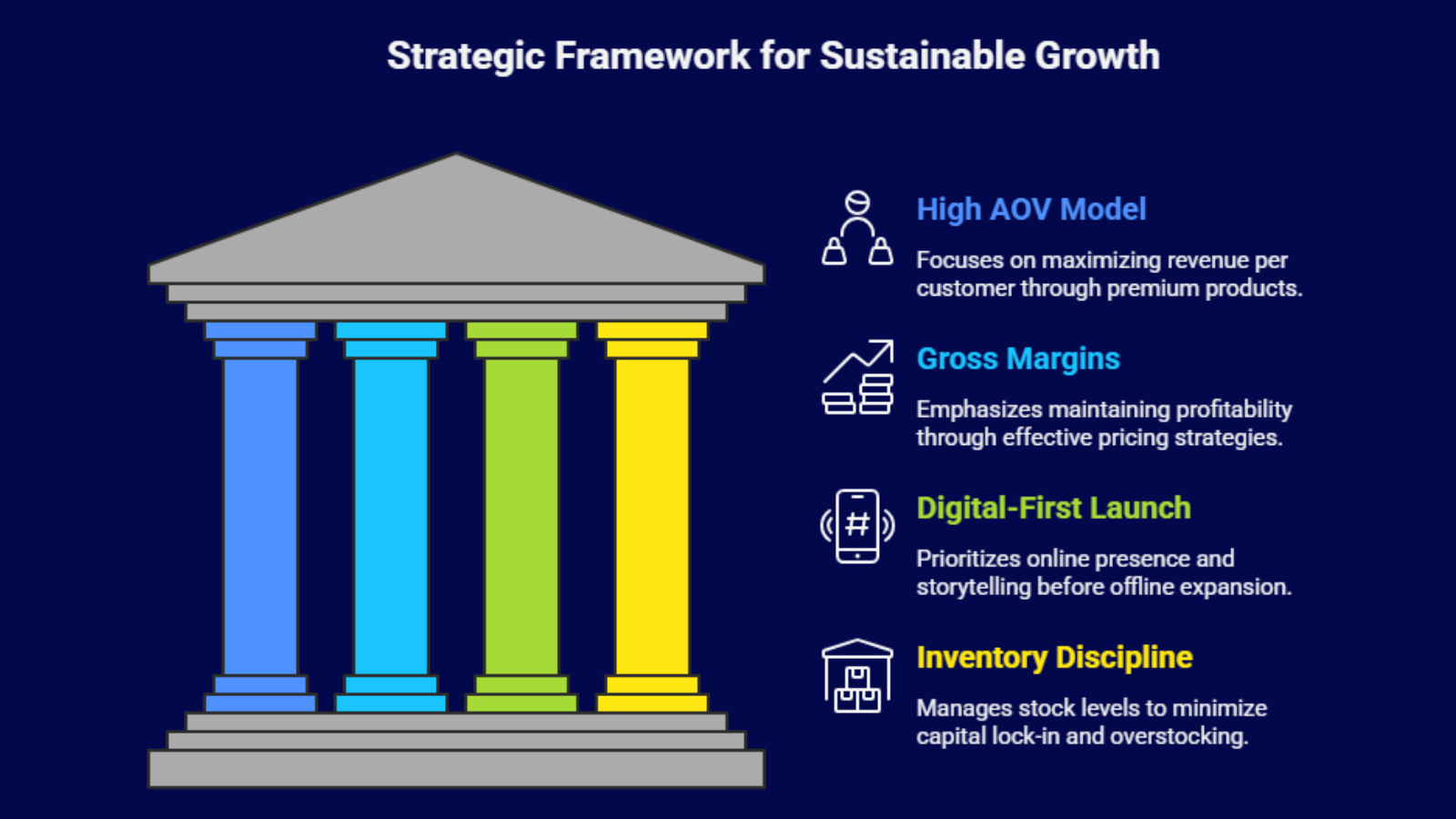 What helped them scale:
- High AOV model: At an average order value of 12,000 rupees, even a 1,200 to 1,800 rupee CAC is sustainable. In comparison, a 2,000 rupee product cannot absorb that CAC without high repeat rates.
- Gross margins above 60 percent: Premium pricing allowed them to maintain a healthy contribution even after shipping bulky items.
- Digital-first launch: They built strong Instagram and website storytelling before investing in offline stores. Many founders underestimate offline capex. A single mall store can require 30 to 50 lakh upfront, including deposits and interiors.
- Inventory discipline: Limited SKUs reduced working capital lock-in. Luggage has slower repeat cycles, so overstocking is dangerous.
Marketplace nuance: Large products have higher forward shipping and RTO costs. Brands like Mokobara push prepaid orders and reduce COD dependency. In bulky categories, RTO can cost 250 to 400 rupees per order.
Lesson: If you want to grow a D2C brand in India in high-ticket categories, focus on AOV and margin cushion before scaling ads.
2. Blue Tea – Category Creation Through Education
Blue Tea built a market for butterfly pea flower tea and herbal infusions when most consumers were not searching for them.
What they did differently:
- SEO-led acquisition: Instead of relying only on Meta ads, they built content around benefits like skin health and detox. Informational keywords often have a lower CPC compared to transactional beauty keywords.
- Amazon plus its own website balance: On Amazon, tea categories can have 15 to 25 percent commission plus ad spend. Blue Tea used Amazon for discovery but built retention on their own website, where payment gateway costs are only around 2 percent.
- Strong repeat purchase systems: Consumables need 30 to 40 percent repeat purchase within 60 days. Without that, scaling becomes ad-dependent.
- Educational packaging and inserts: Offline buyers often convert online later when the education is clear.
Marketplace nuance: In food and consumables, expiry management is critical. Slow-moving SKUs on marketplaces lead to write-offs. Smart brands monitor sell-through weekly and avoid long-tail SKUs.
A strong D2C Scaling Playbook combines retention, acquisition, and automation into one growth system.
If you want to grow a D2C brand in India in a new category, invest early in education and organic traffic. Paid ads alone will not build category trust.
3. The Whole Truth – Radical Transparency as a Moat
 Protein bars and health snacks are crowded. The Whole Truth focused on ingredient transparency and clean labels.
Key scale levers:
- Clear ingredient storytelling: Instead of vague health claims, they listed every ingredient clearly. This built trust in a category where consumers doubt labels.
- Email and community retention: Email marketing can generate 15 to 25 percent of total revenue in strong brands. Many Indian founders underinvest in this channel.
- Subscription model: Subscriptions reduce CAC payback time. If a customer subscribes for three months, the lifetime value increases immediately.
- Higher repeat purchase rate: In early growth stages, repeat reportedly crossed 35 percent. That reduces dependency on paid acquisition.
Marketplace nuance: Health categories on Amazon often require aggressive ad bidding. The cost of sales can hit 12 to 20 percent. If gross margins are below 55 percent, contribution gets squeezed.
If you want to grow a D2C brand in India in health foods, retention is your primary lever. Without subscription or repeat systems, scale becomes expensive. Most brands fail to scale because they grow sales before building a proper D2C Scaling Playbook.
4. Minimalist – Trust Through Science
Minimalist entered skincare with ingredient-focused positioning. Instead of emotional storytelling, they used actives like niacinamide and salicylic acid as hooks.
Their growth drivers:
- SEO and ingredient landing pages: Search terms like “niacinamide serum benefits” convert strongly. Educational SEO reduces long-term CAC.
- Marketplace dominance: Skincare on Amazon sees heavy competition. Minimalist balanced marketplace visibility with strong own website retention.
- High SKU expansion speed: They launched multiple variants quickly but within a tight science-based narrative.
- Influencer reviews with data-backed claims: Instead of generic beauty influencers, they used dermatology-backed content.
Marketplace nuance: Beauty categories often face 18 to 28 percent total marketplace cost, including commission and ads. Return rates can be 8 to 12 percent. Packaging quality directly impacts damage returns.
If your brand simplifies complex information, you can grow a D2C brand in India faster in trust-driven categories.
5. Snitch – Fast Fashion with Fast Feedback Loops
 Fashion has one of the highest return rates in India, often 20 to 35 percent due to sizing issues. Snitch scales by controlling inventory risk.
What they executed well:
- Small batch production: Instead of large inventory bets, they launched limited quantities. This reduces dead stock.
- Weekly drops: Frequent launches keep engagement high and improve repeat site visits.
- Data-driven inventory planning: Sell-through rates determine reorders. Fast-moving SKUs get replenished quickly.
- Strong Instagram and performance ads: A visual-first strategy suits fashion.
Marketplace nuance: In fashion, RTO and returns can destroy margins. Many brands now incentivise prepaid orders with discounts. Reducing the COD share from 70 percent to 40 percent significantly improves cash flow.
If you want to grow a D2C brand in India in fashion, focus more on inventory velocity than just revenue. The best D2C Scaling Playbook always prioritizes customer lifetime value over short-term revenue spikes.
The Real Scaling Playbook to Grow D2C Brand India
Across Mokobara, Blue Tea, Minimalist, The Whole Truth, and Snitch, one thing is clear. Revenue growth alone does not build strong brands. Gross margins above 55 percent, sharp differentiation, repeat purchase focus, and weekly contribution tracking are non-negotiable. To grow a D2C brand in India, founders must move from chasing topline to protecting unit economics.
First, nail product-market fit before increasing ad budgets. Your repeat purchase rate should cross 25 percent in consumables and at least 15 percent in non-consumables. Maintain a minimum 60 percent gross margin to absorb marketplace commissions of 18 to 28 percent. Collect at least 200 genuine reviews to improve conversion rates. Identify the top 20 percent SKUs that drive 80 percent of revenue and scale only those.
Second, improve AOV instead of obsessing over CAC. If your AOV increases from 1,200 to 1,800 rupees through bundles, free shipping thresholds, and cross-sell, your ad efficiency improves instantly. Higher AOV gives breathing room against rising Meta CPMs.
Third, build retention before offline expansion. Email, WhatsApp flows, loyalty programs, and subscriptions can drive 30 to 40 percent repeat revenue. Offline stores lock capital. Retention improves cash flow.
Fourth, build content assets. SEO blogs, comparison pages, ingredient explainers, and UGC reduce long-term CAC. Organic traffic lowers dependence on paid ads.
Finally, track contribution margin weekly. Monitor ad spend, shipping cost per order, return rates, and working capital cycles. Many fail to grow a D2C brand in India because they scale revenue but ignore profitability discipline. Add these pointers into you D2C Scaling playbook.
Common Mistakes That Block Growth and Why Systems Matter More Than Campaigns
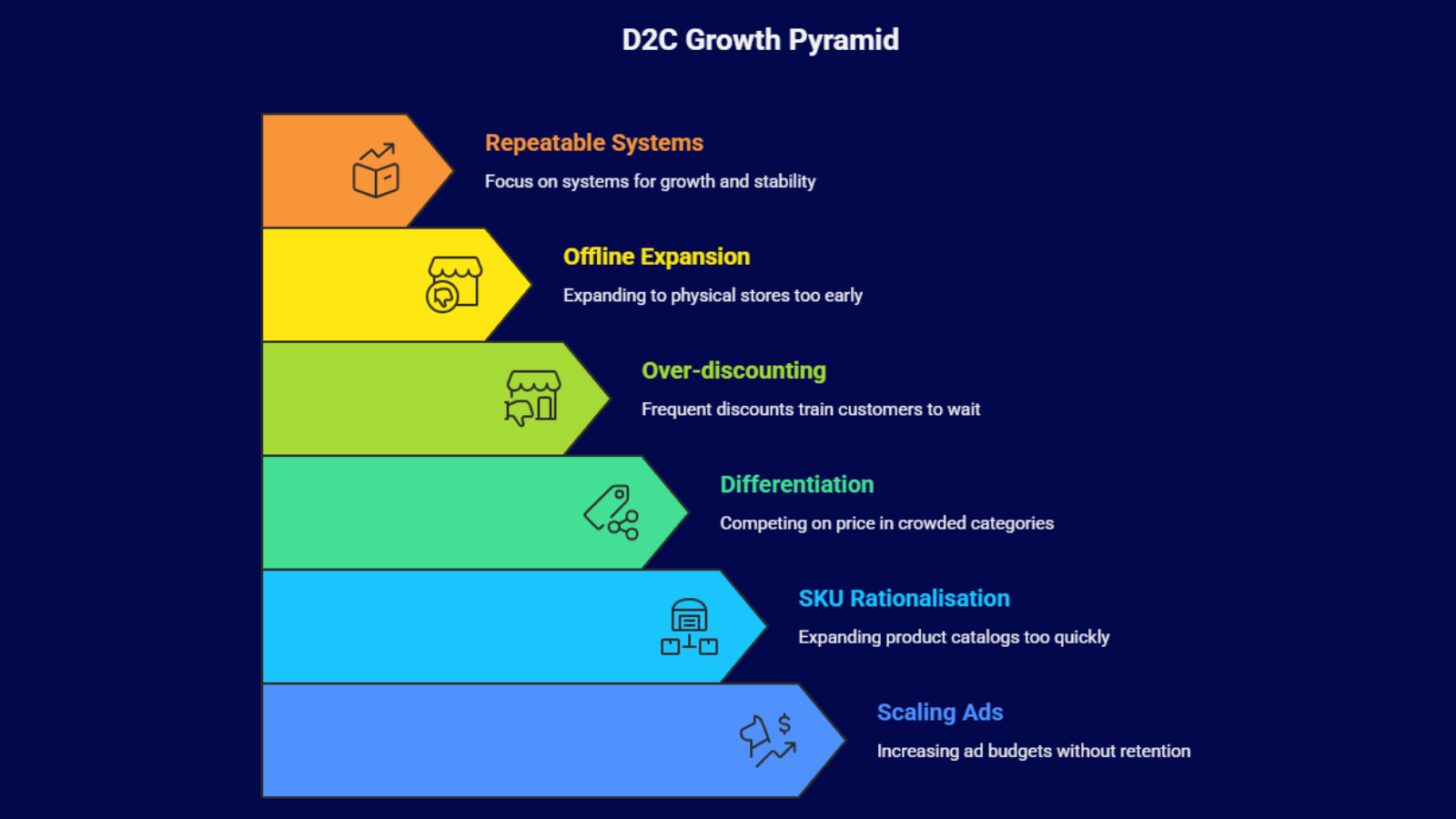 Even strong products fail when execution lacks discipline. If you want to grow a D2C brand in India, avoiding these mistakes is as important as running good ads.
1. Scaling ads without retention
Many brands increase Meta budgets before fixing repeat purchase. If 70 to 80 percent of revenue depends on new customers every month, CAC pressure will kill margins. Without email, WhatsApp flows, or subscriptions, payback periods stretch beyond 90 days.
2. Ignoring SKU rationalisation
Founders often expand catalogs too fast. In reality, 20 to 30 percent SKUs usually generate 70 to 80 percent revenue. Slow-moving SKUs block working capital and increase warehousing costs, especially on marketplaces with storage penalties.
3. No clear differentiation
Competing on price in crowded categories leads to margin erosion. If your product looks similar to 50 others on Amazon, ad bids will keep rising, and conversion rates will drop.
4. Over-discounting
Frequent 30 to 40 percent discounts train customers to wait for sales. This directly reduces contribution margin and brand perception.
5. Expanding offline too early
Offline stores demand high deposits, inventory, and fixed overheads. Without strong repeat revenue, cash flow tightens quickly.
Campaigns create short-term spikes. Systems create predictable revenue. Mokobara built brand storytelling systems. Blue Tea invested in education systems. The Whole Truth built trust systems.
If you truly want to grow a D2C brand in India, focus on repeatable systems across acquisition, retention, inventory planning, and contribution tracking. Discipline scales. Hype does not.
A complete D2C Scaling Playbook should include fulfilment, marketing, retention, and customer support strategies.
Build Strong Foundations Before You Scale
 India’s D2C market is expected to cross 100 billion dollars in the next few years, but growth alone will not guarantee survival. Competition is increasing across marketplaces, ad costs are rising, and consumers are comparing brands more than ever.
To grow a D2C brand in India, you must protect margins at every stage. That means maintaining healthy gross margins above 55 percent, controlling return rates, and avoiding unnecessary discounting.
You also need to build trust through transparent communication, strong reviews, and consistent product quality. Retention should be a core focus. Brands that generate 30 to 40 percent revenue from repeat customers are far more stable than those dependent only on new acquisitions.
Tracking contribution margin weekly, not just revenue, helps prevent cash flow shocks. Expand offline or into new channels only when your backend and retention systems are stable. Scaling is not about moving fast. It is about moving correctly. Hence, it’s better to have clear objectives rather than stand in the middle of nowhere, figuring out things. The ultimate goal of a D2C Scaling Playbook is building predictable and scalable ecommerce growth.
Base.com helps founders bring structure to growth. From streamlining operations to managing inventory, orders, and performance data in one place, it reduces chaos as you scale. If you want to grow a D2C brand in India without burning cash blindly, Base.com gives you the operational backbone required for sustainable expansion.
Frequently Asked Questions
1. What is the biggest challenge to grow a D2C brand in India?
The biggest challenge is managing CAC while improving retention. Many founders overspend on ads but ignore repeat purchase systems, which leads to unstable cash flow and poor contribution margins.
2. How important is retention in D2C scaling?
Retention is critical. If 30 percent or more revenue comes from repeat customers, scaling becomes cheaper and more predictable. Without retention, ad dependency increases and profitability drops.
3. When should a D2C brand expand offline?
Offline expansion should happen only after stable online revenue, strong brand recall, and positive contribution margins. Expanding too early increases fixed costs and operational pressure.
4. How can small brands compete with bigger players?
Small brands win through niche positioning, faster feedback loops, sharper storytelling, and better customer experience. Clear differentiation is more powerful than large ad budgets.
5. What metrics should founders track weekly?
Track CAC, AOV, repeat purchase rate, gross margin, return rate, and contribution margin. Weekly tracking prevents surprises and helps in making faster strategic decisions.