Quick commerce is reshaping how Indian consumers buy everyday products. Platforms like Blinkit, Zepto, and Instamart promise delivery within 10 to 20 minutes, and customers are responding quickly.
According to Redseer, quick commerce already accounts for nearly 65 percent of all online grocery orders in major Indian cities, and the category is expected to grow at over 40 percent CAGR in the next few years. For D2C brands, this creates a powerful but complex distribution opportunity.
This is where the debate around the Blinkit for D2C brands becomes critical. Listing on a quick commerce aggregator like Blinkit can immediately place a product in front of millions of users.
For example, many packaged snack and beverage brands see 15 to 25 percent of their online revenue coming from quick commerce platforms once they gain visibility inside dark stores. However, these platforms usually charge 18 to 28 percent commissions, along with additional listing and promotional fees.
On the other hand, operating an owned dark store works best for brands with high order density in metro clusters such as Bengaluru, Mumbai, and Gurgaon, where delivery radii remain under 3 km. In these cases, brands can improve contribution margins by 10 to 15 percent while also controlling inventory movement and customer data.
Understanding these operational realities helps Indian founders make smarter decisions
The Rise of Quick Commerce and Why It Matters
Quick commerce is built around one idea: delivering everyday products within 10 to 30 minutes using hyperlocal dark stores. These micro-warehouses typically cover a 2 to 3 km delivery radius and stock only fast-moving SKUs.
This model works because urban India has high order density. In cities like Bengaluru, Mumbai, and Delhi NCR, a single dark store can process 1,200 to 1,800 orders per day during peak demand.
Platforms like Blinkit, Zepto, and Instamart are expanding rapidly to capture this demand. Blinkit alone operates 1,500+ dark stores and plans to keep increasing coverage in high-density neighborhoods. For Indian D2C sellers, this infrastructure creates a ready distribution network through a quick commerce aggregator.
However, brands must understand the economics. Only 50 to 80 SKUs typically get placement per dark store, and high rotation categories like snacks, beverages, personal care, and impulse products perform best. This is why the discussion around Blinkit vs own dark stores becomes important when planning quick commerce expansion.
Understanding the Blinkit Marketplace Model
 Blinkit operates as a quick commerce aggregator, which means it brings together brands, inventory, and customers on a single platform while handling the logistics layer.
For most Indian D2C brands entering quick commerce for the first time, this model becomes the fastest way to access demand without building their own operational network.
In this setup, brands supply inventory to Blinkit’s network of dark stores. Once products are stocked, Blinkit manages order picking, packing, and last-mile delivery through its rider fleet. Orders are generated directly through the Blinkit app, which already has a large base of active users in urban markets.
For Indian sellers, the biggest advantage is distribution speed. Many brands report that once their SKUs are approved and placed in 50 to 100 dark stores, they start seeing daily order velocity almost immediately. In categories like beverages, packaged snacks, instant foods, and personal care, a single SKU can move 30 to 80 units per day per dark store, depending on location.
How the Blinkit Marketplace Works
| Element | How It Works |
|---|---|
| Inventory | Stored in Blinkit dark stores |
| Logistics | Managed by Blinkit riders |
| Demand | Generated through the Blinkit app |
| Customer data | Mostly owned by the platform |
| Margins | Commission based |
Blinkit has also been moving towards an inventory-led supply model. In this structure, the platform purchases inventory from brands and distributes it across dark stores based on predicted demand. This improves stock availability and helps Blinkit maintain high service levels in dense urban clusters.
For brands, this also means faster sell-through. In cities like Bengaluru and Gurgaon, dark stores often process 1,500 to 2,000 orders per day, which creates strong demand for fast-moving SKUs.
Advantages of the Marketplace Model
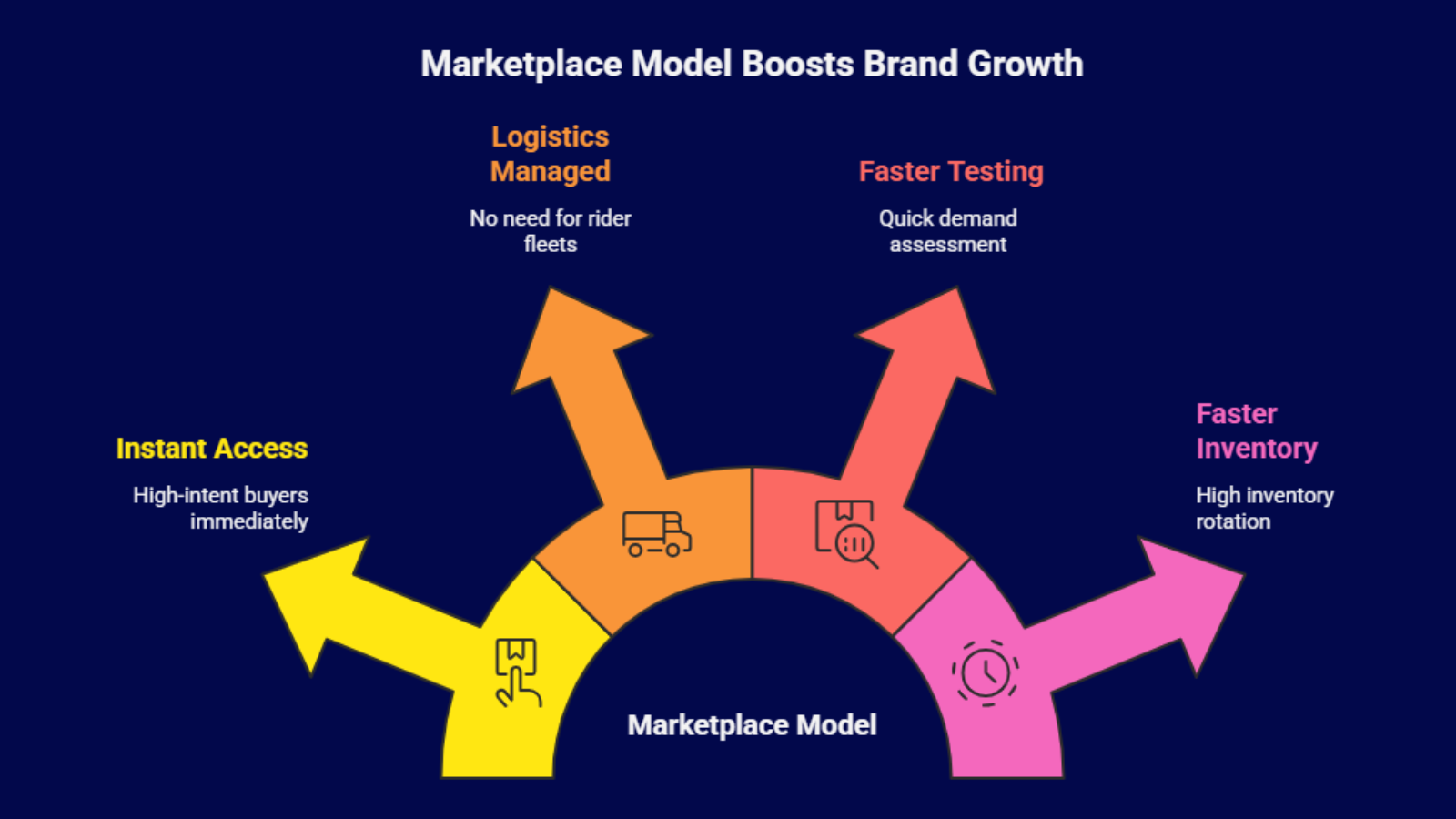 The biggest reason brands start with a quick commerce aggregator is operational simplicity.
1. Instant Market Access
Blinkit already has millions of active users across major metros. For a new brand, listing on the platform immediately places products in front of high-intent buyers.
For example, snack and beverage brands often see 20 to 35 percent of their online orders coming from quick commerce platforms once they scale listings across multiple dark stores.
2. Logistics Managed by the Platform
Blinkit handles warehousing, picking, packing, and delivery operations. This eliminates the need for brands to manage rider fleets or local fulfillment teams.
This is especially useful for brands that do not have logistics expertise.
3. Faster Product Testing
Quick commerce allows brands to test demand quickly. If a product moves well in 20 to 30 dark stores, brands can expand distribution across more clusters within weeks.
Many beverage brands in India use Blinkit specifically to test new pack sizes and impulse purchase SKUs before launching them in modern trade.
4. Faster Inventory Movement
Dark stores operate on high inventory rotation. Unlike traditional retail stores that may hold stock for weeks, quick commerce inventory often rotates within 3 to 5 days for high-demand categories.
This improves working capital cycles for brands selling consumables.
Challenges in the Marketplace Model
Despite its advantages, the marketplace model has limitations that Indian founders should understand early.
Platform commissions generally range between 18 and 28 percent, and promotional campaigns often require additional marketing spend.
Shelf space is also limited. A typical dark store stocks 1,500 to 2,500 SKUs, but only a small percentage are allocated to emerging brands.
Another critical issue is data ownership. Customer insights, repeat purchase patterns, and location-level demand data largely remain with the platform.
This lack of visibility often pushes brands to evaluate the quick commerce marketplace vs directly owned by Blinkit for D2C brands’ strategies once they start generating meaningful sales.
Understanding the Owned Dark Store Model
 The alternative approach is operating an independent quick commerce infrastructure through brand-owned dark stores.
Instead of relying on a quick commerce aggregator, brands build their own micro fulfillment centers and connect them to their website or mobile app.
These dark stores are designed specifically for fast order fulfillment and usually serve a 2 to 4 km delivery radius.
How the Owned Dark Store Model Works
| Element | How It Works |
|---|---|
| Inventory | Owned and managed by the brand |
| Logistics | Managed by brand or delivery partners |
| Demand | Comes from the brand website or mobile app |
| Customer data | Fully owned by the brand |
| Margins | Higher compared to the marketplace |
In this setup, orders are placed directly through the brand’s digital channels and fulfilled from nearby dark stores.
This model requires operational investment but provides significantly more control compared to the dark store vs marketplace structure.
Advantages of Owning Dark Stores
1. Better Profit Margins
Since brands are not paying marketplace commissions, contribution margins can improve significantly.
For example, brands that shift repeat customers to owned channels often see 10 to 15 percent margin improvement per order.
2. Ownership of Customer Data
Brands gain access to detailed insights, including customer location clusters, reorder frequency, and basket composition.
This data helps optimize inventory planning and personalized marketing campaigns.
3. Strong Inventory Control
Dark stores allow brands to stock specific SKUs based on hyperlocal demand.
For example, beverage brands often stock smaller pack sizes in high-density office districts while keeping larger bundles in residential areas.
4. Full Brand Experience
Delivery experience becomes part of the brand journey. Packaging inserts, loyalty programs, and personalized offers can be integrated directly into the fulfillment process.
Because of these advantages, many brands start exploring the quick commerce marketplace vs owned Blinkit for D2C brands once they achieve stable demand through aggregator platforms.
Dark Store vs Marketplace: Key Differences
Understanding the operational differences between dark store and marketplace models is essential before scaling quick commerce operations.
| Factor | Marketplace (Blinkit) | Owned Dark Store |
|---|---|---|
| Setup time | Very fast | Medium to high |
| Investment | Low | Higher |
| Logistics | Managed by the platform | Managed by brand |
| Margins | Lower | Higher |
| Customer data | Platform owned | Brand owned |
| Scalability | Faster through the aggregator | Controlled expansion |
For most Indian D2C brands, the marketplace model works well during the early growth stage because it provides instant distribution.
However, once brands start generating consistent demand in high-density clusters, the economics of the dark store vs marketplace model begin to shift.
At that point, many brands adopt a hybrid approach where marketplace platforms drive customer acquisition while owned dark stores handle repeat purchases and higher margin orders.
When Brands Should Choose Each Model
There is no universal answer to the Blinkit vs own dark store decision. The right approach depends on a brand’s order volume, product category, and the density of customers in specific cities. For Indian D2C sellers, the economics change significantly depending on where demand comes from and how frequently customers reorder.
Choose Blinkit If
 The marketplace model works best for brands that want to enter quick commerce without building their own logistics infrastructure. Many early-stage brands use Blinkit to validate demand before committing capital to dark stores.
For example, snack brands, ready-to-drink beverages, and impulse purchase products often see traction quickly because customers on quick commerce apps buy frequently and in small quantities.
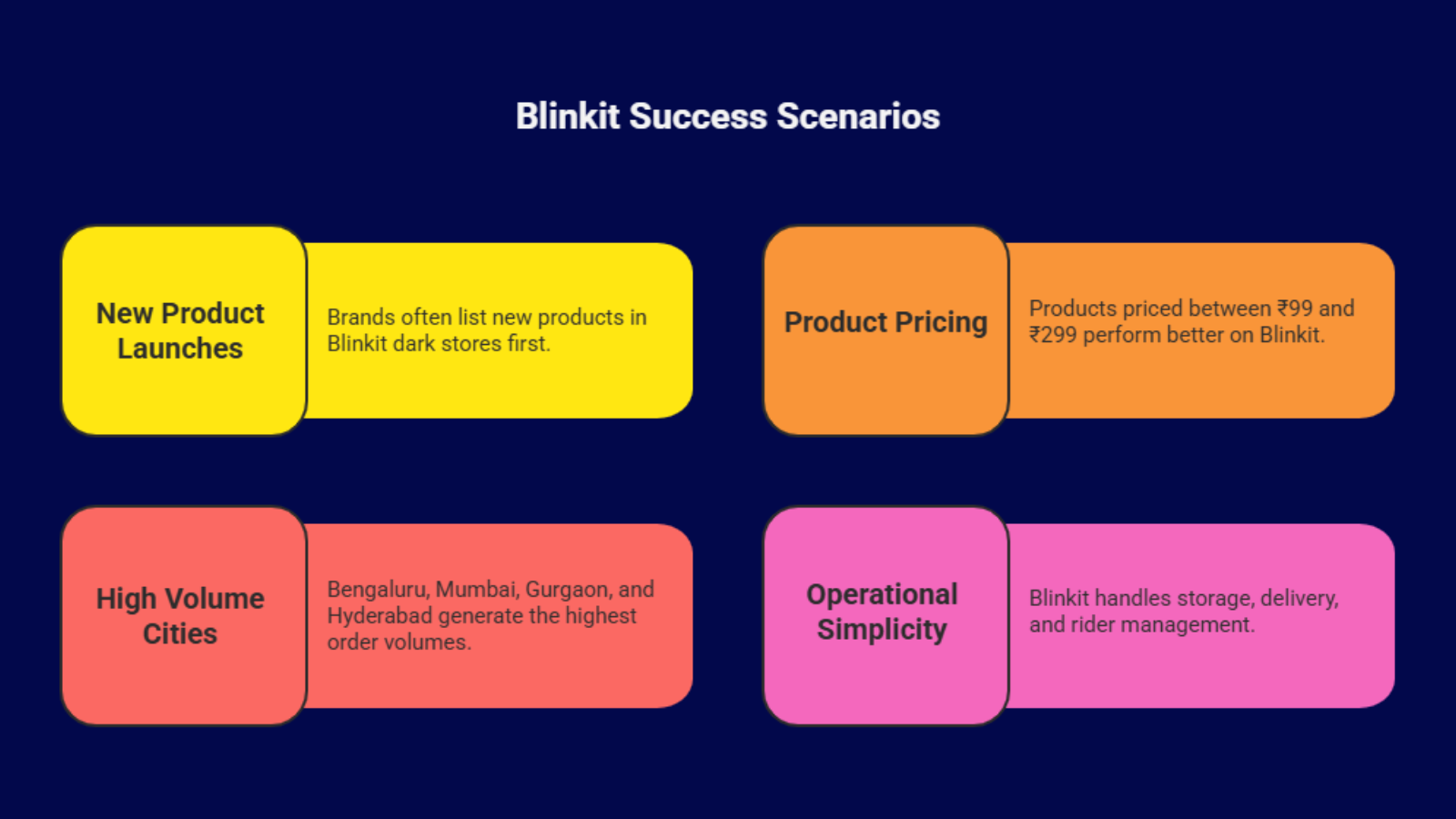
Specific scenarios where Blinkit works well include:
- Brands launching new products often list them in 20 to 30 Blinkit dark stores first. If the SKU sells more than 20 units per store per day, it usually indicates strong quick commerce demand.
- Products priced between ₹99 and ₹299 perform better on Blinkit because quick commerce orders typically have smaller baskets.
- Bengaluru, Mumbai, Gurgaon, and Hyderabad generate the highest quick commerce order volumes. In these markets, brands can scale quickly through Blinkit without investing in infrastructure.
- Blinkit handles storage, delivery, and rider management, which removes operational complexity for founders.
However, Indian sellers should also consider the cost structure. Marketplace commissions often range between 18 and 28 percent, and paid placements inside the app may add 5 to 10 percent marketing spend. This is why the Blinkit vs own dark store decision becomes important once order volumes increase.
Choose Own Dark Store If
An owned dark store model becomes viable when a brand has consistent demand within a small geographic cluster. Quick commerce only works efficiently when delivery radii remain small, usually within 3 to 4 kilometers.
Brands typically start exploring the Blinkit vs own dark store strategy when they see predictable repeat orders from the same neighborhoods.
Some practical use cases include:
- Brands selling milk alternatives, healthy snacks, protein drinks, or fresh products often see repeat purchases every 7 to 10 days. In such cases, serving customers through owned dark stores improves margins.
- If a brand receives 300 to 500 orders per day within a single 5 km area, running a local dark store becomes economically viable.
- Removing marketplace commissions can improve margins by 10 to 15 percent per order, especially for products with strong repeat demand.
- Dark stores operated by aggregators typically limit SKU placement. Brands running their own dark stores can stock 100 to 300 SKUs, depending on demand.
These operational advantages often push founders to revisit the Blinkit vs own dark store decision once their quick commerce sales stabilize.
The Hybrid Model Many Brands Are Adopting
 Most successful Indian D2C brands eventually combine both approaches instead of choosing only one.
In this hybrid setup, Blinkit acts as a customer acquisition channel while owned dark stores handle repeat demand. This allows brands to capture the benefits of both models.
A common operational strategy looks like this:
- Blinkit drives discovery for new customers
- High-demand SKUs are stocked across aggregator dark stores
- Repeat buyers are gradually shifted to the brand’s own delivery network
For example, several beverage and packaged snack brands use Blinkit to build awareness in metro cities. Once demand becomes predictable in specific neighborhoods, they open small dark stores in those clusters and redirect repeat customers to their own platform.
This hybrid strategy helps brands balance reach and profitability. Marketplace channels bring scale quickly, while owned dark stores create stronger margins and deeper customer insights.
For Indian founders evaluating Blinkit vs own dark store, the most practical strategy is often not choosing one model over the other but designing systems where both can work together as the brand grows.
Final Thoughts: Building a Scalable Quick Commerce Stack
Quick commerce is no longer experimental for Indian brands. In major cities like Bengaluru, Delhi NCR, and Mumbai, many consumer categories already see 20 to 35 percent of their online orders coming from quick commerce channels. Because of this shift, the Blinkit vs own dark store decision is becoming a strategic operational choice rather than just a distribution decision.
Platforms like Blinkit provide immediate reach and discovery. But as brands grow, managing inventory across multiple marketplaces, dark stores, and warehouses becomes complex. This is where infrastructure becomes critical.
Base helps Indian D2C sellers manage this complexity by acting as the operational layer between quick commerce platforms and brand-owned fulfillment networks.
For example, a brand selling across 100 Blinkit dark stores and 2 owned micro warehouses must track stock availability in real time to avoid cancellations and stockouts. Base centralizes inventory visibility across these locations and automatically syncs stock levels.
Base also helps brands manage SKU-level allocation, ensuring fast-moving products are prioritized in high-demand clusters. This becomes critical when brands scale across multiple cities.
For founders navigating the Blinkit vs own dark store strategy, Base provides the operational system needed to run both models efficiently while maintaining accurate inventory, faster fulfillment, and scalable quick commerce growth.
FAQs
What is quick commerce?
Quick commerce refers to ultra-fast delivery where products are delivered within 10 to 30 minutes using hyperlocal dark stores and rider networks that operate within small delivery radii.
What is a dark store?
A dark store is a small warehouse designed exclusively for online order fulfillment. Customers cannot visit these stores physically because they operate purely for delivery operations.
What is a quick commerce aggregator?
A quick commerce aggregator is a platform, such as Blinkit or Zepto, that connects brands with customers while managing storage, logistics, and last-mile delivery.
Is owning a dark store profitable?
Owning a dark store can improve profitability because brands avoid marketplace commissions and gain access to valuable customer data. However, it requires significant operational investment.
Should brands choose a marketplace or owned dark stores?
Most brands start with marketplace platforms to acquire customers quickly and later build their own dark store network to improve margins and strengthen customer relationships.