Fast delivery has changed how people shop online. A customer opens Zepto, Blinkit, Swiggy Instamart, Flipkart Minutes, or Amazon Fresh, adds a few items, and the order arrives in about ten minutes. For a D2C brand, this speed directly affects product discovery and repeat purchases.
But this speed is powered by a dense network of dark stores placed within 2–3 km of customers. Platforms like Blinkit and Zepto now operate 400–500+ dark stores each across major Indian cities, and each location typically handles 1,000 to 2,500 orders per day. This setup allows quick commerce apps to maintain average delivery times of 8–12 minutes.
For Indian D2C sellers, the opportunity lies in how these dark stores prioritize inventory. Most locations stock 1,800 to 3,000 SKUs, but only fast-moving products stay on shelves. If a D2C brand sells snacks, beverages, personal care, or daily essentials with high weekly velocity, the product is more likely to be stocked across multiple dark stores.
Another nuance many sellers miss is local demand clustering. For example, protein snacks may move faster in Bengaluru tech corridors, while ready-to-drink beverages sell heavily in Mumbai. This is where the dark store model in India becomes critical, because brands that supply inventory city-wise and maintain 3–5 day replenishment cycles get deeper placement across quick commerce networks.
What Is a Dark Store and Why Does It Matter for Quick Commerce?
A dark store is a small fulfillment facility designed only for online orders. Customers cannot enter these locations. Instead, the space is organized purely for inventory storage, fast picking, and dispatching orders to delivery riders. In India, most dark stores operate within 2 to 3 km delivery zones and carry 1,800 to 3,000 fast-moving SKUs, focusing mainly on groceries, snacks, beverages, personal care, and daily essentials.
Platforms such as Zepto, Blinkit, Swiggy Instamart, Flipkart Minutes, Amazon Fresh, and BigBasket BB Now rely on these facilities to meet delivery promises of 10 to 20 minutes. Each dark store typically processes 1,000 to 2,000 orders per day, and high-performing locations in dense cities like Bengaluru, Delhi NCR, and Mumbai can cross 2,500 daily orders.
For D2C brands, the real value lies in hyperlocal inventory placement. A single SKU stocked across 50 dark stores in one city can reach more than 1 million urban consumers within a few hours of restocking. However, platforms usually track weekly sales velocity and stock rotation, so products that do not sell within 5 to 7 days often lose shelf space.
| Platform | Estimated Dark Stores | Delivery Promise |
|---|---|---|
| Zepto | 400+ | 10 minutes |
| Blinkit | 500+ | 10–15 minutes |
| Swiggy Instamart | 500+ | 15 minutes |
| BigBasket BB Now | 300+ | 10–20 minutes |
| Amazon Fresh | expanding | same-day or quick delivery |
| Flipkart Minutes | rapidly expanding | 10–15 minutes |
This structure is why the dark store model in India has become the operational backbone of quick commerce in India. For D2C sellers, success depends on maintaining high sell-through rates, frequent replenishment cycles, and city-level demand planning rather than relying on traditional warehouse distribution.
Dark Store vs Warehouse: Why the Difference Matters for D2C Brands
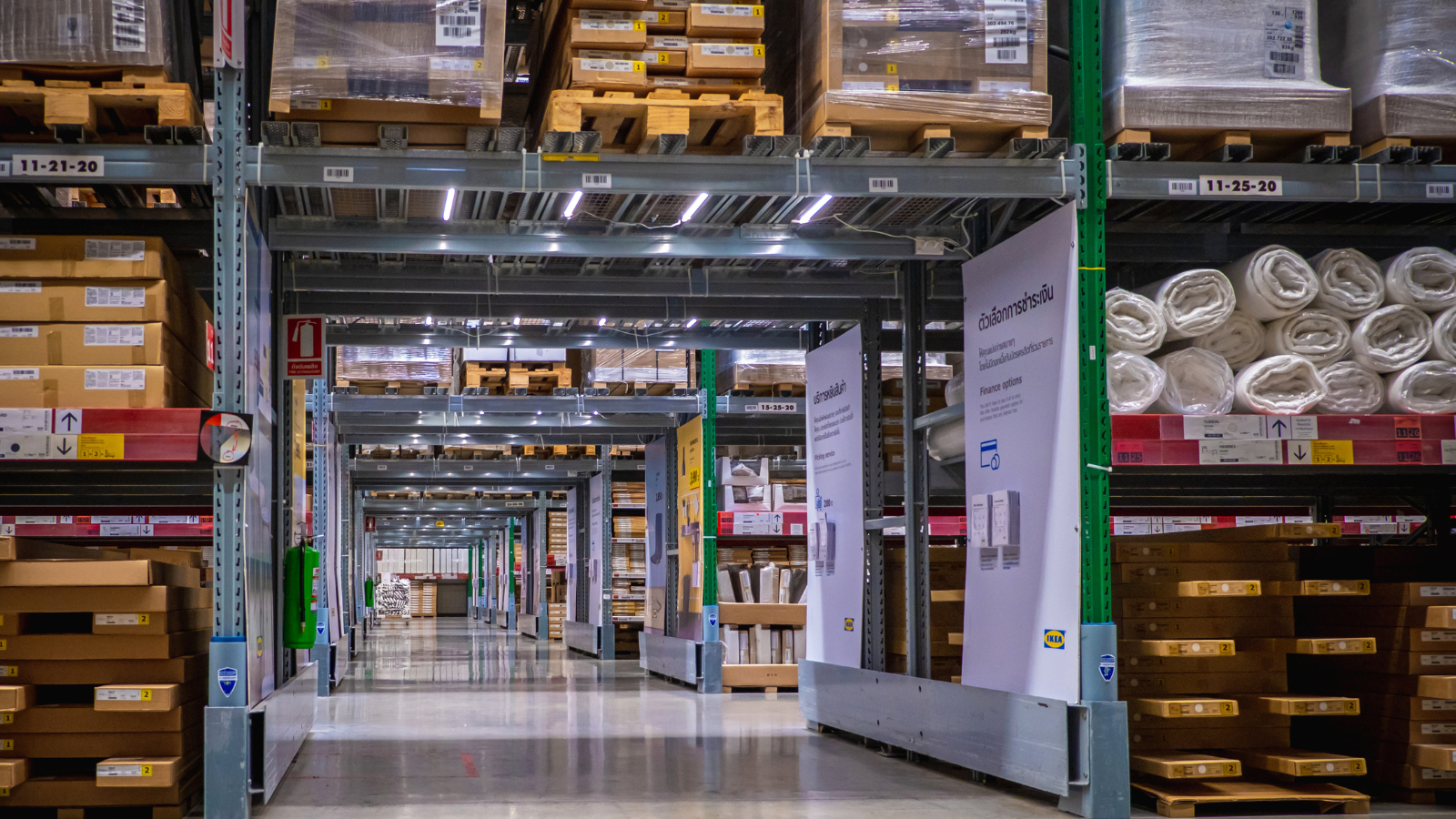 Many D2C brands entering quick commerce assume the same supply chain used for marketplaces like Amazon or Flipkart will work for Zepto or Blinkit. In reality, dark stores operate very differently from traditional warehouses. Warehouses prioritize storage and nationwide distribution, while dark stores prioritize speed and inventory rotation. A typical warehouse may hold 20,000 to 50,000 SKUs, but a dark store usually stocks only 2,000 to 3,000 high-demand products.
For D2C brands, this difference directly affects how inventory must be planned.
Inventory selection strategy
Dark stores only stock products with high weekly sales velocity. If a SKU does not sell at least 15 to 20 units per week per store, platforms may replace it with faster-moving products.
Replenishment cycles
Unlike warehouses that restock every few weeks, dark stores often require inventory refills every 3 to 5 days to avoid stockouts.
SKU prioritization
Smaller pack sizes and impulse purchase products perform better. For example, single-serve beverages, protein bars, ready snacks, and travel-size personal care move faster than bulk packs.
City-level distribution planning
Instead of sending inventory to one central warehouse, brands must distribute stock across multiple city-level dark stores, sometimes 30 to 100 stores per metro.
| Factor | Dark Store | Traditional Warehouse |
|---|---|---|
| Location | Inside city | Outside city |
| Size | Small (2k–5k sq ft) | Large (50k+ sq ft) |
| Purpose | Fast delivery | Bulk storage |
| Inventory | Fast-moving SKUs | Full product catalog |
| Delivery Radius | 2–5 km | Nationwide shipping |
Because of this structure, the dark store model in India system forces D2C brands to rethink supply chains. Success depends less on storage capacity and more on maintaining fast SKU turnover inside city clusters.
How Micro Fulfillment Centers Enable 10-Minute Delivery and Why D2C Brands Should Care
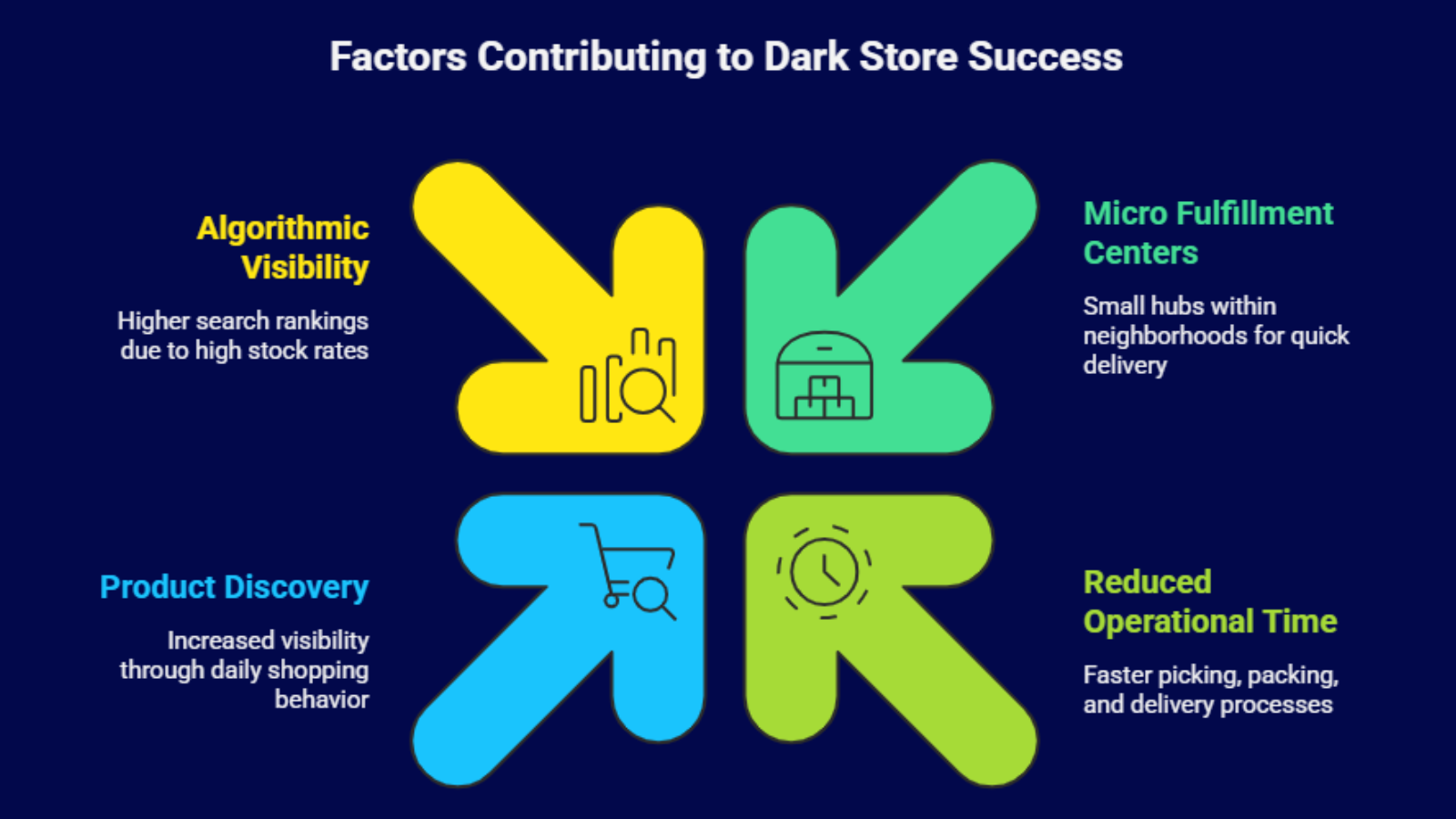 Dark stores function as micro fulfillment centers that shorten the distance between inventory and the customer. Instead of shipping products from a warehouse located 20 to 40 km outside a city, quick commerce platforms distribute inventory across dozens of small hubs within residential neighborhoods.
This approach reduces operational time across three stages. Orders are picked within 60 to 90 seconds, packed in under 2 minutes, and handed to riders who typically travel 2 to 3 km. Because of this structure, the average delivery window drops to 8 to 15 minutes.
For D2C brands, the biggest advantage is product discovery through daily-use shopping behavior. Research from quick commerce platforms shows that nearly 60 to 70 percent of orders are impulse-driven, especially in categories like snacks, beverages, and personal care. This means a product placed across 100 dark stores in a city can generate thousands of daily impressions inside the app.
Another nuance many Indian sellers miss is algorithmic visibility. Platforms often boost products that maintain high in-stock rates above 95 percent and strong sell-through ratios. Brands that fail to replenish inventory frequently lose ranking in search results.
This is why the dark store model in India ecosystem is becoming a critical growth channel. For many emerging D2C brands, quick commerce now drives 15 to 25 percent of urban sales, especially in metros where instant delivery has become part of everyday shopping.
Challenges D2C Brands Must Understand and How to Solve Them
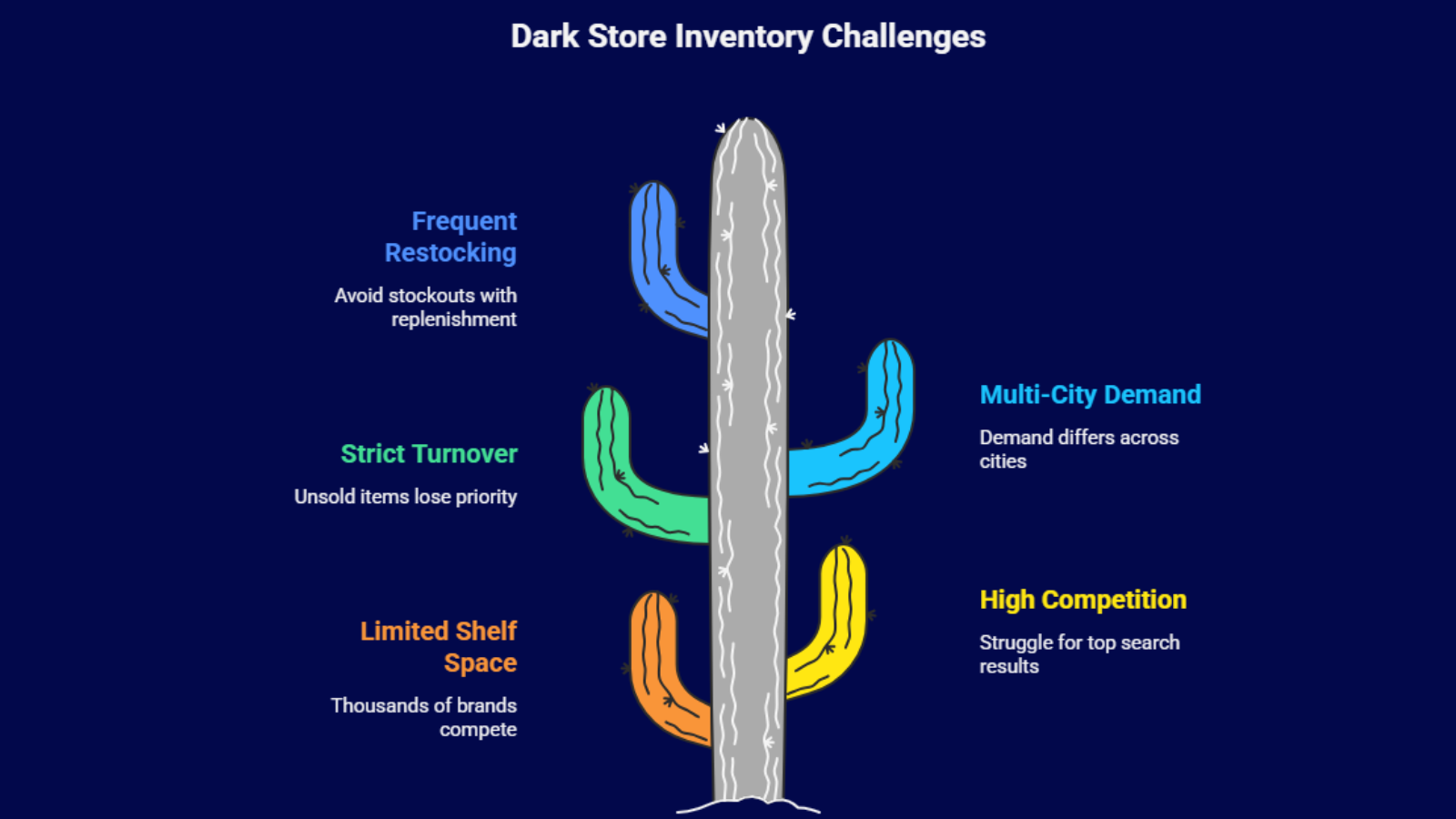 Quick commerce creates strong growth opportunities, but it also introduces operational pressure that many D2C brands underestimate. Since dark stores operate with limited space and high SKU turnover, brands must manage inventory, visibility, and supply cycles carefully within the dark store model in India ecosystem.
1. Limited Shelf Space in Dark Stores
Dark stores usually stock only 2,000 to 3,000 SKUs, while thousands of brands compete for placement. If a product does not sell quickly, it may be removed from the store.
Solution: Launch with 1 or 2 high-performing SKUs first instead of listing the full catalog. Focus on products with proven demand in marketplaces or D2C websites.
2. High Competition for Search Visibility
Platforms like Blinkit and Zepto rank products based on sales velocity, ratings, and availability. New brands often struggle to appear in top results.
Solution: Maintain consistent stock availability above 95 percent and run targeted promotions during the first few weeks to boost ranking.
3. Strict Inventory Turnover Expectations
Dark stores expect fast-moving products. Items that remain unsold for 5 to 7 days may lose shelf priority.
Solution: Track weekly sell-through rates per store cluster and adjust supply quickly.
4. Multi-City Demand Differences
Demand patterns differ across cities. A product that sells well in Bengaluru may move more slowly in Delhi.
Solution: Use city-level inventory allocation instead of sending equal stock everywhere.
5. Frequent Restocking Requirements
Unlike traditional warehouses, dark stores require 3 to 5-day replenishment cycles to avoid stockouts.
Solution: Plan micro-fulfillment distribution with smaller, more frequent shipments.
D2C brands that solve these operational challenges perform significantly better within the dark store model in India ecosystem and scale faster across quick commerce platforms.
The Future of Dark Stores in India
Quick commerce is still evolving. Platforms continue to expand their dark store networks across major cities.
Zepto alone has invested heavily in building a dense network of micro fulfillment centers to reduce delivery times further.
As more consumers rely on instant delivery, the India micro fulfillment center framework will become even more important.
For D2C brands, understanding this system early provides a competitive advantage.
How Base Helps D2C Brands Scale in Quick Commerce
 Managing quick commerce operations is very different from managing marketplaces or D2C websites. Inventory needs to move faster, stock must be distributed across multiple dark stores, and replenishment cycles are much shorter. For growing brands selling on Zepto, Blinkit, Swiggy Instamart, Amazon Fresh, and Flipkart Minutes, handling this manually quickly becomes complex.
Base helps D2C brands manage this entire process in a structured way, so inventory flows smoothly into the dark store model in India ecosystem.
With Base, brands can manage operations at a more granular level.
1. Smart Warehouse Allocation: Brands can ship inventory from two or more central warehouses and automatically distribute stock across different city clusters. For example, inventory can move from a Delhi NCR warehouse to 60 Blinkit dark stores while another warehouse in Bengaluru supplies Zepto and Instamart locations in South India.
2. City-Level Inventory Distribution: Instead of sending bulk stock to one location, Base helps brands split inventory across multiple dark store clusters so products stay available within quick commerce delivery zones.
3. Real-Time SKU Performance Tracking: Brands can track SKU sales by platform, city, and store cluster, helping identify which products perform best in Bengaluru, Mumbai, or Delhi.
4. Faster Replenishment Planning: Since dark stores often require restocking every 3 to 5 days, Base helps plan shipments from warehouses before stock runs out.
5. Unified Operations Across Quick Commerce Platforms: Instead of managing each platform separately, Base centralizes inventory, orders, and fulfillment data across Zepto, Blinkit, Swiggy Instamart, and other quick commerce channels.
For D2C brands expanding into quick commerce, Base helps ensure the right products reach the right dark stores at the right time, making it easier to scale inside the dark store model in India.