
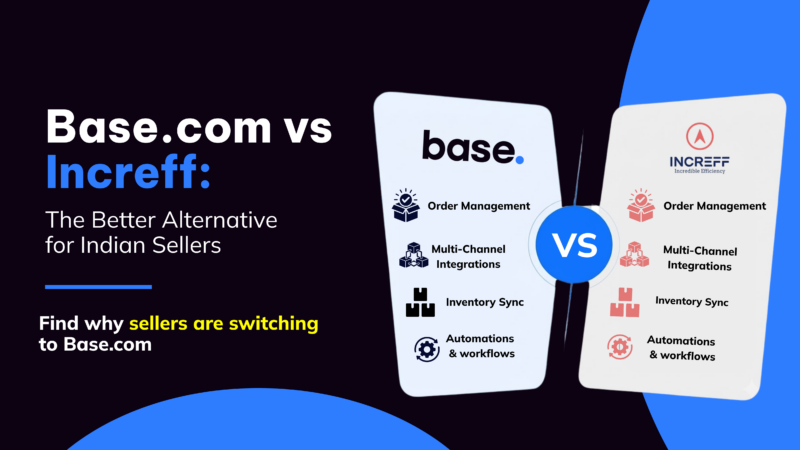
Base.com is the best alternative to Increff for Indian multichannel sellers, supporting 71 of 80 audited commerce capabilities, compared to Increff’s 43. Base.com covers orders, warehouse, catalog, accounting, customer service, and repricing on one platform, connects to 405 marketplaces against Increff’s 30-plus, and syncs with Tally and Zoho, which Increff does not support at all.
| Base.com | Increff |
|---|---|
| 71 of 80 capabilities | 43 of 80 |
| 405 marketplaces | 30+ |
| Tally + Zoho sync | None |
| Payment reconciliation | None |
| 30 days free, no card | No public trial |
| First order same day | Post-contract implementation |
Base.com vs Increff: Which Platform Fits Your Business?
Choosing the right inventory and order management platform depends on your business model, operational complexity, and future growth plans. While both Base.com and Increff help businesses manage inventory across multiple sales channels, they are designed with different priorities in mind. Understanding these differences early can help you invest in a solution that aligns with both your current requirements and long-term expansion plans.
At a high level, Base.com focuses on centralized order management, marketplace integrations, warehouse automation, and workflow customization for businesses selling across multiple channels. Increff, on the other hand, places a stronger emphasis on inventory visibility, merchandising, and retail inventory optimization, particularly for brands managing large product catalogs and omnichannel retail operations. Comparing their core capabilities side by side makes it easier to identify which platform best fits your operational goals.
| S No. | Dimension | Base.com | Increff |
|---|---|---|---|
| 1 | Scope | OMS + WMS + PIM + accounting + CS + repricing | Fulfilment and merchandising only |
| 2 | Capabilities supported (of 80) | 71 | 43 |
| 3 | Marketplace integrations | 405 | 30+ |
| 4 | Total integrations | 2,000+ | 1,300+ |
| 5 | Shipping integrations | 377 | Not published |
| 6 | Accounting / ERP integrations | 140 | ERP only, no accounting |
| 7 | Tally / Zoho sync | Yes | No |
| 8 | Payment reconciliation | Yes | No |
| 9 | Full PIM | Yes | No |
| 10 | AI listing agents | Yes | No |
| 11 | Automated repricing | Yes | No |
| 12 | Native customer service | Yes | No |
| 13 | Pricing | Flat subscription, no user limit | Quote-only, no public price |
| 14 | Free trial (India) | 30 days, no card | None public |
| 15 | Time to first order processed | Same day | Post-contract implementation |
Two numbers settle the Base.com vs Increff question. Increff connects to 30-plus marketplaces. Base.com connects to 405. Indian sellers add channels every quarter, and a fulfilment tool built for 30 of them becomes the ceiling on growth.
Why are Indian sellers leaving Increff?
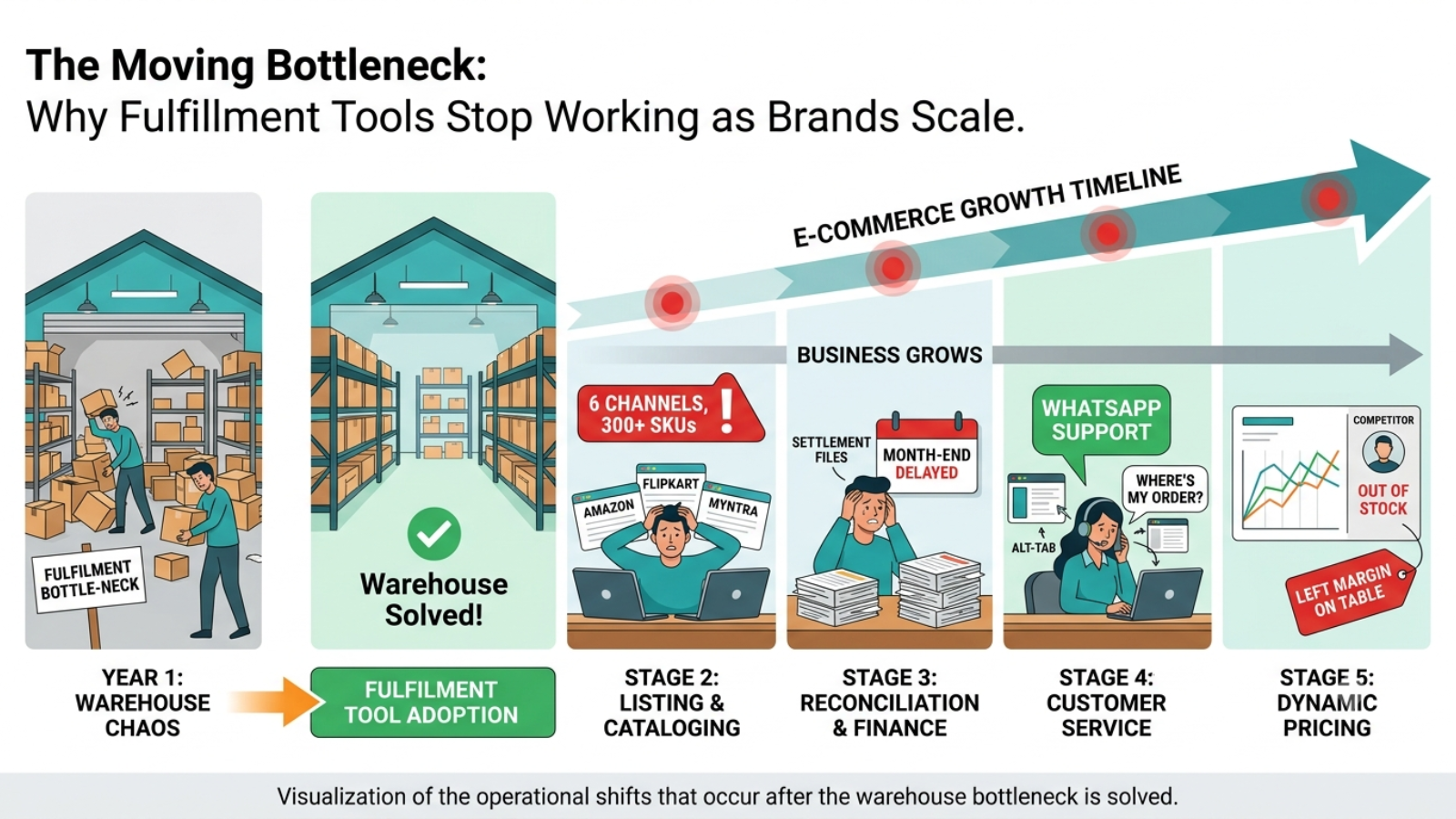 Because the bottleneck moves. A fulfilment tool solves year-one warehouse chaos, then the constraint shifts to listing, reconciliation, pricing and customer service, none of which a fulfilment-only platform can see or fix.
The pattern is remarkably consistent.
A brand signs a fulfilment tool because the warehouse is the loudest problem in year one. Picking is chaotic, dispatch is late, inventory is a guess. The tool fixes that, and for a while everything feels solved.
Then the business grows, and the bottleneck relocates. It moves to listing, because there are now six channels and 300 new SKUs a quarter and a merchandising team drowning in portal tabs. It moves to finance, because marketplace payouts arrive as settlement files nobody has time to check and month-end close slips two weeks. It moves to service, because WhatsApp became the primary support channel and agents alt-tab between three systems to answer “where is my order.” It moves to pricing, because competitors go out of stock and nobody notices the margin left on the table.
None of those problems live in the warehouse. That is the whole issue. A fulfilment-only system can’t see them, report on them or fix them, not because it’s badly built, but because it was never scoped for them. Each function has to be bought separately, licensed separately, integrated separately and stitched together by your team.
Base.com was built as a commerce platform from day one. Sellers looking for the best alternative to Increff are usually not looking for a better warehouse. They’re looking for everything the warehouse system never touched.
Top 7 Comparisons to Help You Choose the Right OMS
Choosing an Order Management System (OMS) is a long-term business decision that affects every stage of your operations, from inventory visibility and order processing to shipping, returns, and customer experience. While many platforms solve similar problems, the way they approach integrations, automation, scalability, and operational workflows can vary significantly. A feature that works well for one business may become a limitation as order volumes, sales channels, and warehouse operations grow.
Rather than focusing on marketing claims alone, it is more useful to compare platforms across the capabilities that influence day-to-day operations. Marketplace coverage, inventory synchronization, warehouse management, automation, shipping integrations, implementation effort, reporting, and pricing all play an important role in determining which solution aligns better with your business requirements. Looking at these areas side by side provides a clearer understanding of the strengths and trade-offs of each platform.
The following comparison breaks down seven key areas that businesses should evaluate before selecting an OMS. Whether you are managing a growing D2C brand, operating across multiple marketplaces, or planning to scale internationally, these comparisons will help you identify which platform offers the flexibility, automation, and operational support that best fits your current needs and future growth plans.
1. Comparing Marketplace Integrations
 Increff connects to 30-plus marketplaces. Base.com connects to 405 in India. Base.com also carries 377 shipping integrations and 140 accounting and ERP connectors, for 2,000-plus integrations total, all included in one subscription.
That comparison exposes something easy to miss. Increff publishes roughly 1,300 total integrations, but only thirty-odd marketplaces. Total integration count includes ERPs, carriers, and internal plumbing. Marketplace count is the only number that determines where you can actually earn revenue.
Base.com’s 2,000-plus integrations break down into what matters operationally:
- 405 marketplaces, India, Middle East, US, Europe, LatAm, Southeast Asia
- 377 shipping providers, including DHL Blue Dart India, Shiprocket, Ecom Express
- 140 accounting and ERP systems, including Tally and Zoho, which Increff does not offer
No connector fees. No per-integration surcharge. No user cap.
Here’s why reach decides the evaluation for growing brands. Indian commerce doesn’t add channels gradually; it adds them in bursts. Quick commerce went from novelty to material revenue line inside eighteen months. A brand that was Amazon-plus-Flipkart in 2022 now runs six or seven surfaces, and the list extends every quarter.
When a new channel opens, the question is never whether you want to be there; your competitors are already listing. The only question is whether your platform can talk to it today. With 405 connectors, the answer is almost always yes, and you’re live inside a day. With thirty, you’re filing a feature request and watching someone else take the category page. Growth in India is a channel game, which is the simplest reason Base.com is the best alternative to Increff for anyone still expanding.
2. Product Information Management (PIM) Comparison
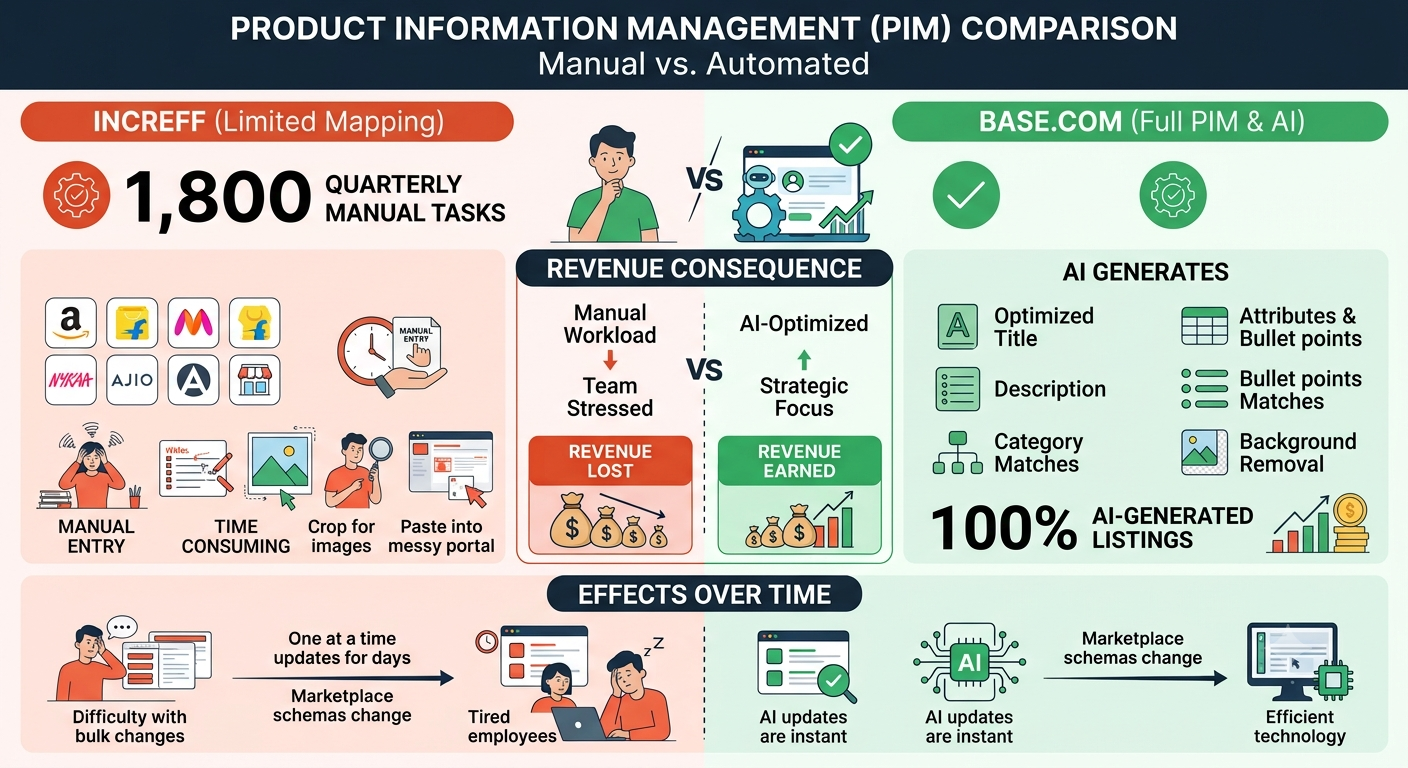 Increff maintains an article master for SKU mapping but scored No on full PIM and No on AI-assisted listing creation.
Base.com ships a complete PIM plus AI listing agents that generate titles, descriptions, attributes, Amazon bullets, category matches, background removal, and translations automatically.
Increff has no content store, no images, no long-form copy, no per-marketplace attribute overrides, no dated fields, no file assets. Listing work returns to your team, all of it, every time.
Base.com generates in a single pass:
- Product titles optimised per marketplace
- Long-form descriptions
- Structured parameters and attributes
- Amazon bullet points
- Category matches
- Background removal on product imagery
- Translations for export markets
- Upload-ready files for marketplaces without an API
Now the arithmetic that convinces merchandising directors. Three hundred new SKUs a quarter across Amazon, Flipkart, Myntra, Nykaa, Ajio and your own storefront. Six listing jobs per SKU.
That is 1,800 manual listing tasks every quarter.
Each one is a title rewrite, an attribute map, an image crop, a category hunt, and a paste into a portal that formats differently from the last. On Increff, all 1,800 land on your team. On Base.com, the platform authors and your team reviews.
The compounding effect is what shows up in revenue. When listing is expensive, teams ration it without deciding to; SKUs go live on two channels instead of five because nobody has the hours. That isn’t a cost line; it’s revenue you never earned, the easiest loss in the business to miss. Bulk AI editing extends the same advantage: revise several hundred listings in one pass when a marketplace changes its category schema, instead of one at a time for a week.
3. Accounting Integrations and Marketplace Reconciliation
 Increff’s published integration list covers operational ERPs, SAP, Dynamics, Odoo, Infor, Ginesys, Logic ERP, with Tally and Zoho absent. Increff performs order and returns reconciliation, not payment reconciliation. Base.com does both natively.
This is the clearest gap on the board, and for finance teams it ends the conversation.
Order reconciliation and payment reconciliation answer completely different questions. One asks whether the goods moved. The other asks whether the money arrived. Only the second one protects your margin.
Tally runs the books at the overwhelming majority of Indian SMB and mid-market sellers. A platform that can’t speak to Tally can’t close your month; it can only produce an export somebody re-keys by hand, which is precisely where reconciliation errors are born.
Base.com handles the full finance flow:
- Syncs orders, line items, and credit notes to Tally and Zoho automatically
- Reconciles marketplace payouts against underlying orders
- Issues four document types natively: standard invoice, receipt, correction invoice, pro forma invoice
- Automatic tax on domestic and export invoices, with FOB and CIF terms
- Prints GST invoices, receipts and labels via Base Printer (India), one-click or fully automatic
Now the money at stake. Reverse logistics carries an 8-12% cost premium on affected orders. Indian fashion returns run 25-40% by category, per RedSeer estimates. Stack those and a serious share of your volume travels backwards, each unit costing more to unwind than it did to ship.
Without payout-versus-order reconciliation inside the platform, that leakage is structurally invisible. A marketplace deducts a return fee that shouldn’t have applied. A settlement short-pays against the wrong commission tier. A credit note never lands against its original invoice. None of it appears on a fulfilment dashboard, because a fulfilment dashboard doesn’t look at money. It appears at quarter close as a variance somebody has to explain, by which point the reclaim window has shut.
Every month without payout reconciliation is a month of payouts you never checked. For finance-led evaluations, this row alone makes Base.com the best alternative to Increff.
4. Automated Repricing and Oversell Protection
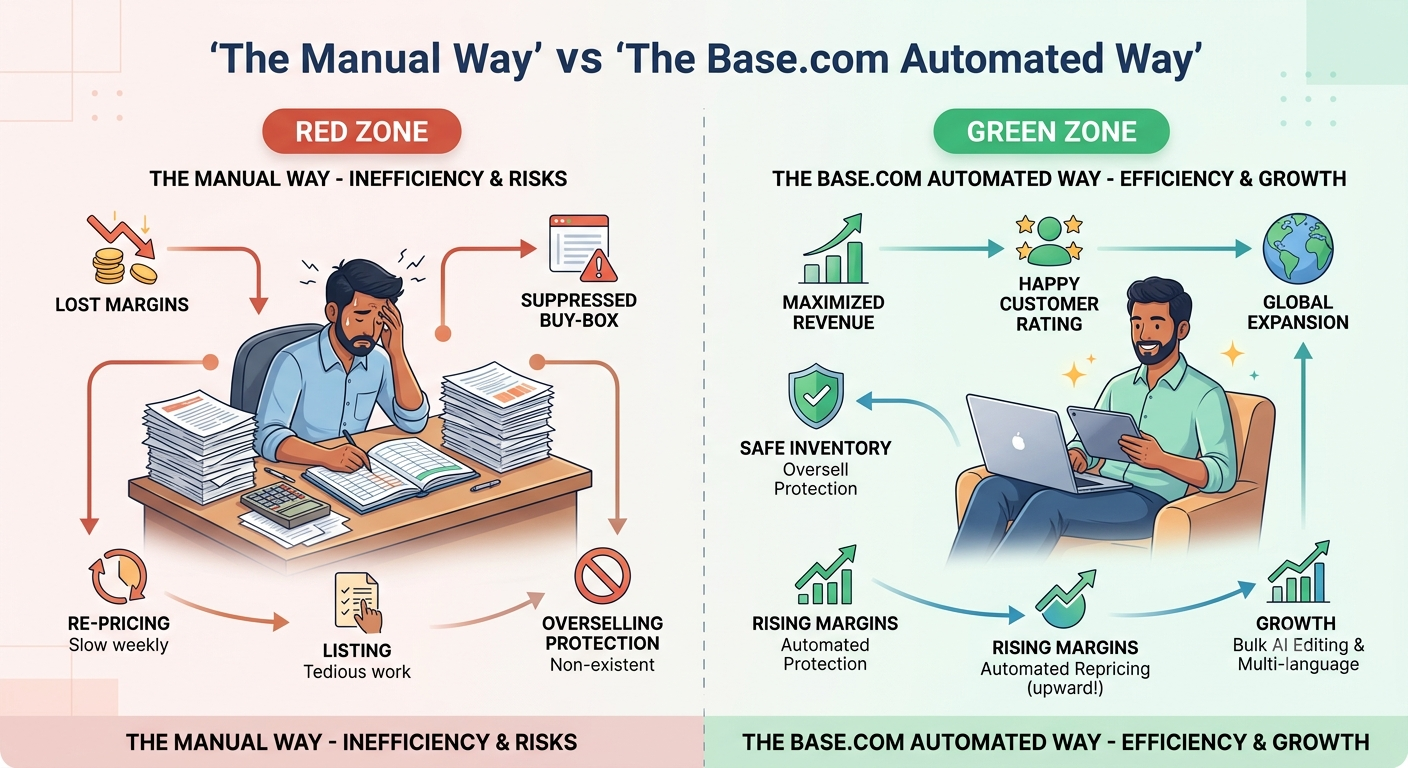 Increff has no listing or pricing automation layer. Base.com runs automated repricing, oversell protection, bulk AI editing, and multi-language generation- mechanisms that pay for the subscription on their own in Indian marketplace conditions.
Without a pricing layer, the function doesn’t disappear. It moves to a person, a spreadsheet, and a weekly rhythm that can’t keep pace with a marketplace repricing hourly.
- Oversell protection. Offers close automatically the moment stock hits zero, and relist on restock. This is a seller-rating defence as much as an inventory feature, and marketplace penalties compound viciously: cancellation fees first, then buy-box suppression, then search demotion, then a rating that takes two quarters to repair. Base.com stops the sequence before it starts.
- Automated repricing. When competing offers go out of stock or move up in price, Base.com raises your prices to capture the margin that just became available. Most sellers only ever reprice downward, reactively, in a race they lose. The upward move is the one that makes money, and it only works automated, because the window is hours, not days.
- Bulk AI editing. Change several hundred listings in one operation instead of sequentially.
- Multi-language generation. Produce descriptions for new export markets without a translation vendor per market, turning “should we test the UAE” from a project into a decision.
- Price erosion and marketplace penalties are where Indian sellers lose margin quietly, in single-digit percentages that never trigger an alarm. A fulfilment-only system can’t see either, because neither is a fulfilment event.
5. Customer Communication and Support Features
 Increff has no CRM, no customer segmentation, no social inbox, no chatbot, and no AI service agents. Base.com includes Responso natively, one panel for Instagram, Facebook and WhatsApp, plus AI service agents, sentiment analysis and a website chatbot.
Because service isn’t part of Increff’s product, it becomes another vendor, another licence and another integration your team maintains.
Base.com includes, natively:
- One panel for Instagram, Facebook and WhatsApp
- AI customer-service agents handling routine volume
- Sentiment analysis across conversations
- Website chatbot
- Customer segmentation built on real order data
Of the eight platforms audited, Base.com is the only one with a full native social inbox.
WhatsApp is the default support channel for Indian D2C, not a supplement. The cost of not having it inside your order system is specific and measurable. Answering “where is my order” means an agent holds three windows open: messaging app, order system, courier portal. Then they manually correlate a phone number to an order ID to an AWB. Thirty to ninety seconds of context assembly per ticket, across hundreds of tickets daily, plus the error rate that comes free when humans copy numbers between screens.
On Base.com, the conversation sits next to the order, customer, order, shipment, and history in one view. Context assembly disappears, response times drop, and because service and order data share a system, “which SKUs generate the most complaints” becomes a query instead of a quarterly project. For D2C brands, that integration is why Base.com reads as the best alternative to Increff rather than merely a competitor to it.
6. Self-Service Configuration and Customization
 Increff is API-led but closed at the surface: no custom JavaScript or CSS, no add-on store, no supplier discovery network. Of eight platforms audited, Base.com is the only one you can extend yourself.
| Sno. | Extensibility capability | Base.com | Increff | Other 6 audited |
|---|---|---|---|---|
| 1 | Custom JavaScript / CSS in panel | Yes | No | All No |
| 2 | Addon store, publish your own app | Yes | No | All No |
| 3 | Supplier/distributor discovery network | Yes | No | All No |
| 4 | Open REST API | Yes (~180 methods) | Partial | Mixed |
| 5 | No-code automation engine | Yes (40+ actions, if/else) | Yes | Mixed |
| 6 | User-defined custom order fields | Yes | Unverified | Mostly Partial |
| 7 | Code-editable invoice/export templates | Yes | Unverified | Mostly Partial |
| 8 | Modules switched on as needed | Yes | Partial | Mostly Partial |
This determines long-term satisfaction more reliably than any feature list.
No platform fits your process on day one. It fits in month seven, once you’ve found the six things your operation does that no vendor anticipated. What happens at that moment is what you’re really buying.
On a closed platform, you file a support ticket. It joins a queue, competes with every other customer’s request, and ships in a future release or never. Meanwhile your team invents a manual workaround, and eighteen months later that workaround is load-bearing, undocumented, and owned by one person who’s thinking about leaving.
On Base.com, you write an automation rule yourself in an afternoon, 40-plus actions with if/else logic, no developer required. Across a three-year contract, that’s dozens of change requests you never filed and dozens of workarounds that never calcified. Operators who’ve been trapped by a closed system once weigh this above everything else.
What is Base Connect and does Increff have an equivalent?
Base Connect moves orders, shipments, and courier labels between Base accounts regardless of which party created the shipment, and shares catalog data across them, running store-to-3PL, store-to-dropshipper, and wholesaler-to-reseller flows with no build. Increff scored Partial on dropshipping and marketplace backend, and No on supplier discovery.
Of all eight audited platforms, only Base.com offers a supplier and distributor discovery network.
In practice: adding a 3PL or dropship vendor mid-year stops being an integration project with a scoping call and a six-week timeline, and becomes a configuration task. Anyone who has tried to onboard a fulfilment partner in October to survive a Diwali peak knows what that’s worth.
7. Localization and Compliance for Indian Businesses
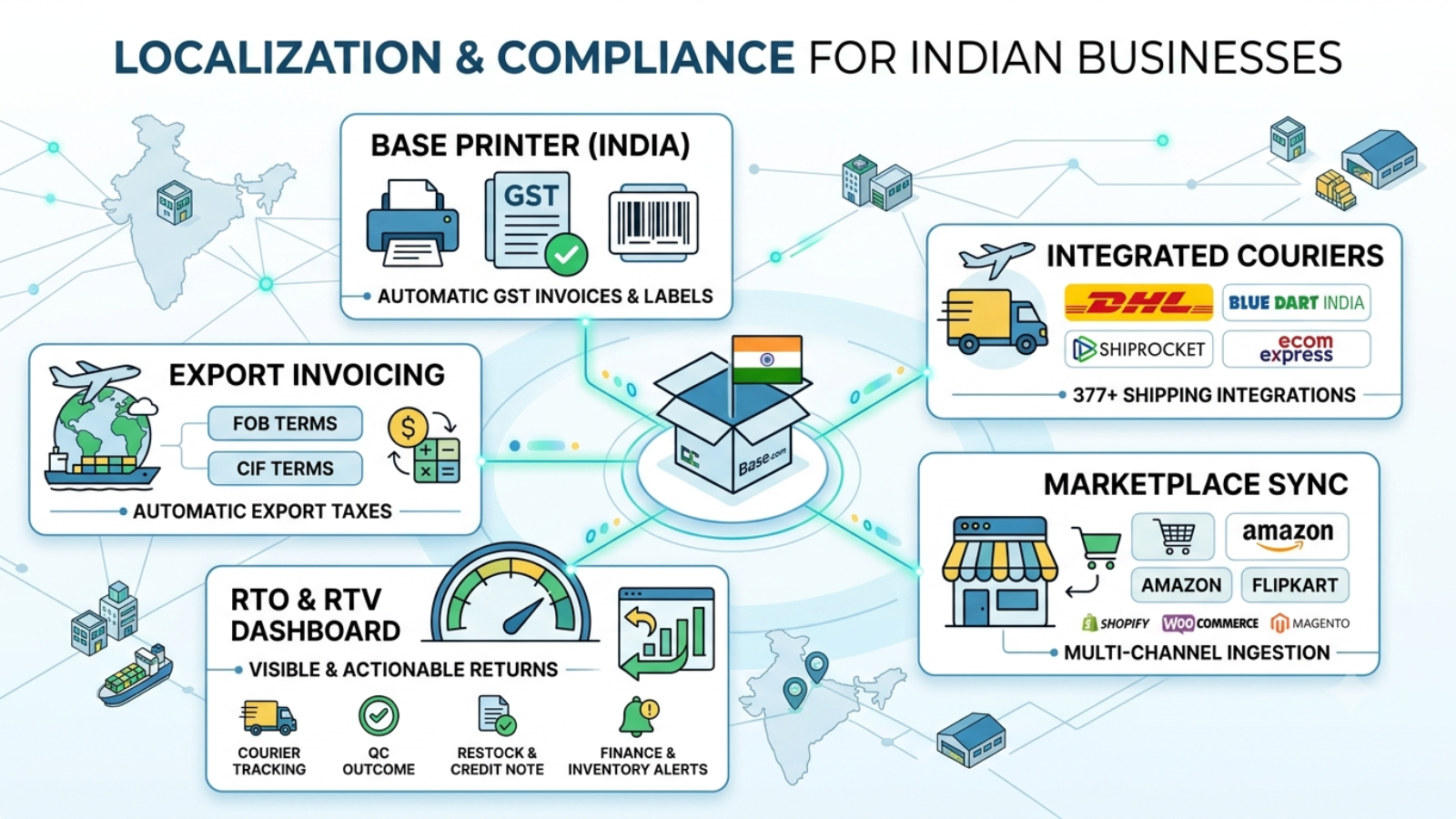 Base Printer (India) handles GST invoices, labels, and receipts one-click or automatically; couriers include DHL, Blue Dart India, Shiprocket, and Ecom Express; export invoicing supports FOB and CIF terms.
Global platforms fail Indian sellers in the same two places every time: paperwork and couriers. Base.com handles both natively.
- Base Printer (India), one-click and automatic printing for labels, GST invoices, receipts
- Couriers, DHL Blue Dart India inside 377 shipping integrations, plus Shiprocket and Ecom Express
- Marketplaces, Amazon and Flipkart ingestion alongside Shopify, WooCommerce, Magento
- RTO and RTV, reverse pickup confirmation, courier updates, QC outcome, finance and inventory alerts in dedicated dashboard views
- Exports, automatic tax on domestic and export invoices, FOB and CIF terms
- India leadership, dedicated India country CEO with local deployment support
The RTO and RTV dashboard deserves a second look, because reverse flow is where Indian sellers bleed. Base.com tracks a return from pickup confirmation through courier movement, QC outcome, restock and credit note, raising finance and inventory alerts along the way, every stage visible while it’s still actionable, rather than reconstructed afterwards from three separate systems.
What Does the Full Base.com vs Increff Scorecard Show?
Twenty-seven capabilities where Base.com leads, plus parity on core order management fundamentals.
| SNo. | Capability | Base.com | Increff |
|---|---|---|---|
| 1 | Custom additional order fields | Yes | Unverified |
| 2 | 1-click pack, print, status, email, tracking | Yes | Unverified |
| 3 | Open REST API | Yes (~180 methods) | Partial |
| 4 | Custom JavaScript / CSS in panel | Yes | No |
| 5 | Addon store, build your own app | Yes | No |
| 6 | Full PIM | Yes | No |
| 7 | AI-assisted listing creation | Yes | No |
| 8 | AI listing agents | Yes | No |
| 9 | Auto-close and relist on stock change | Yes | No |
| 10 | Automated repricing rules | Yes | No |
| 11 | Tally sync | Yes | No |
| 12 | Zoho / accounting sync | Yes | No |
| 13 | Payment reconciliation | Yes | No |
| 14 | Custom invoice templates | Yes | Unverified |
| 15 | Return label generation | Yes | Unverified |
| 16 | Refund management | Yes | Partial |
| 17 | Customer segmentation | Yes | No |
| 18 | Unified social inbox (IG, FB, WhatsApp) | Yes | No |
| 19 | AI customer-service agents | Yes | No |
| 20 | Website chatbot | Yes | No |
| 21 | Supplier/distributor discovery | Yes | No |
| 22 | Dropshipping backend | Yes | Partial |
| 23 | Run-your-own-marketplace backend | Yes | Partial |
| 24 | Multi-currency | Yes | Partial |
| 25 | Marketplace integrations | 405 | 30+ |
| 26 | Accounting / ERP integrations | 140 | ERP only |
| 27 | Shipping integrations | 377 | Not published |
Parity on the fundamentals, multi-channel order sync, unlimited custom order statuses, workflow automation, where Base.com ships 40-plus actions with conditional logic.
What Does Staying on Increff Cost You?
 What an OMS does not automate often costs more than the features it includes. Those costs rarely appear on a dashboard, yet they affect finance teams, operations, customer service, and marketplace performance every single month. Manual reconciliation, disconnected systems, missing automation, and additional third-party tools gradually increase operational costs as order volumes grow, making the true cost of ownership much higher than it initially appears.
Many of these expenses remain hidden because they are spread across different teams instead of appearing as a single software bill. Finance teams spend hours reconciling marketplace payouts and manually updating accounting systems when there is no native Tally or Zoho integration. Product teams manage listings separately across multiple sales channels without a built-in PIM or AI-assisted listing solution. Meanwhile, the absence of automated repricing and oversell protection can lead to lost margins, cancelled orders, and lower marketplace seller ratings.
Customer operations can become equally fragmented. Without a native customer service layer, businesses often rely on separate WhatsApp, social messaging, and support platforms, increasing both software licensing costs and operational complexity. A closed platform also means even simple workflow changes may require raising support tickets, slowing down process improvements and creating dependencies on the vendor for routine operational updates.
Pricing transparency is another important consideration. When software pricing is available only through custom quotations, it becomes difficult to benchmark costs or negotiate renewals effectively. In contrast, a platform with transparent subscription pricing, broad integration coverage, and a free trial enables businesses to evaluate the total cost of ownership before committing. Looking beyond feature lists and considering these recurring operational costs provides a clearer picture of which OMS delivers better long-term value.
How Do You Migrate from Increff to Base.com?
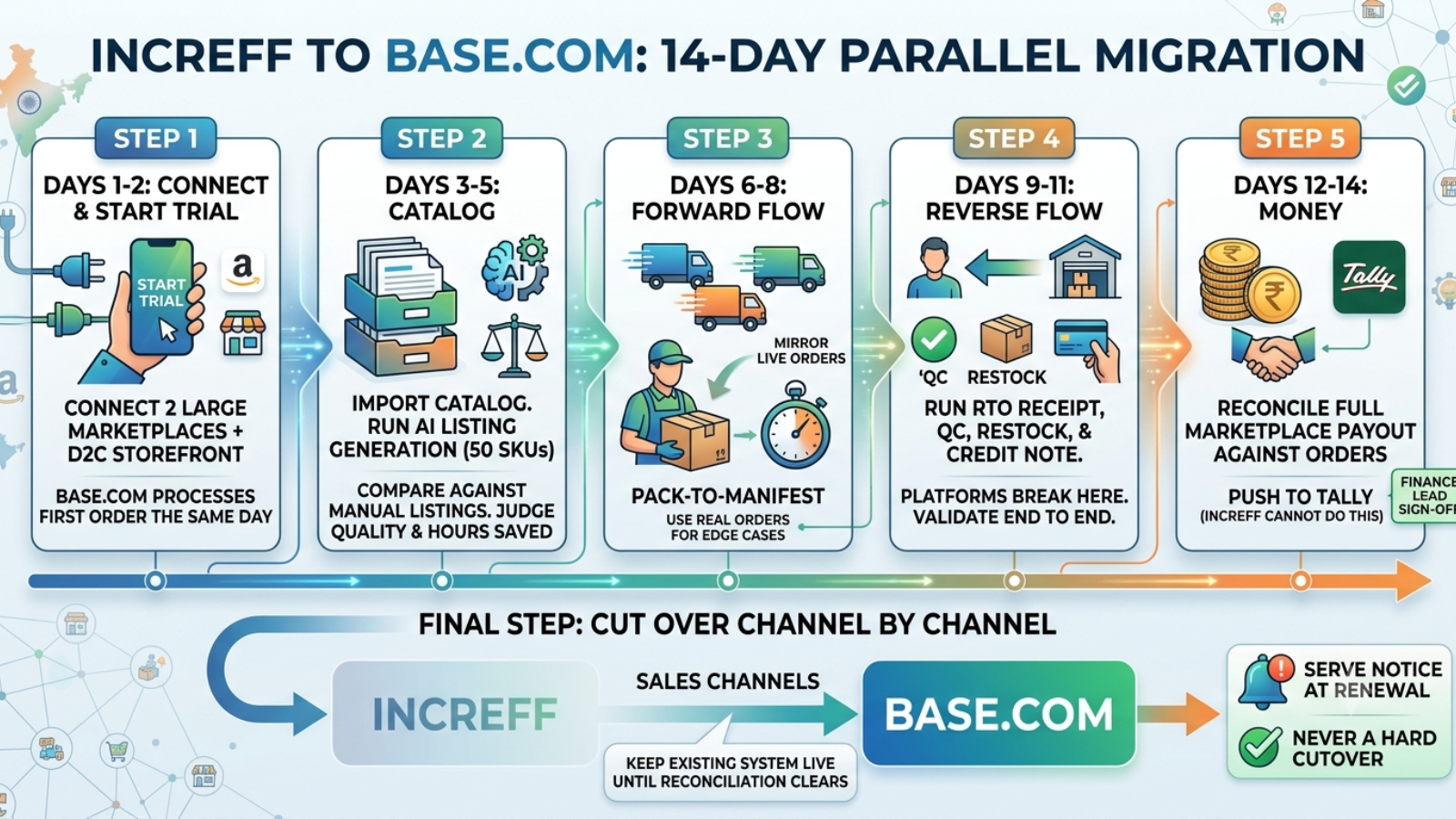 In 14 days, running in parallel. Base.com gives Indian sellers 30 days free with no card, so you validate on your own orders alongside your live Increff instance and cut over channel by channel only when the numbers hold.
- Days 1-2: Connect. Start the trial. Connect your two largest marketplaces plus your D2C storefront. Base.com processes your first order the same day.
- Days 3-5: Catalog. Import your catalog. Run AI listing generation on fifty SKUs and compare against listings your team wrote manually. Judge quality and hours saved.
- Days 6-8: Forward flow. Mirror live orders. Time pack-to-manifest against your current baseline. Use real orders; real orders carry the edge cases.
- Days 9-11: Reverse flow. Run RTO receipt, QC, restock, and credit note end to end. This is where platforms break and where most evaluations skip ahead.
- Days 12-14: Money. Reconcile a full marketplace payout against orders and push it to Tally. Increff cannot perform this step at all. Have your finance lead sign off personally.
Cut over channel by channel, not all at once. Keep your existing system live until reconciliation clears, then serve notice at renewal. Migrating to the best alternative to Increff never requires a hard cutover.
What Results Do Sellers Report After Switching?
A growing ecommerce business often reaches a point where operational complexity begins to outweigh the capabilities of its existing order management system. As sales channels, warehouses, and order volumes expand, businesses need greater automation to reduce manual work, improve inventory accuracy, and speed up fulfilment. The benefits of switching are usually reflected in measurable operational improvements rather than just additional features.
Businesses that have migrated to Base.com have reported significant efficiency gains. In one reported case study, order processing time was reduced from around three hours to just 30 minutes, while packing errors fell from 3-4% to virtually zero. Improvements like these help reduce operational costs, increase fulfilment accuracy, and create a more scalable workflow as order volumes grow.
These results are particularly valuable for businesses selling across multiple marketplaces, operating their own online stores, or managing both domestic and international orders. As operations become more complex, centralizing inventory, orders, fulfilment, and automation within a single platform can eliminate many of the manual processes that slow down growth and increase the risk of errors.
Reported business outcomes:
- Order processing time: Reduced from 3 hours to 30 minutes.
- Packing accuracy: Improved from 3-4% errors to virtually zero.
- Operational impact: Faster fulfilment, fewer manual errors, and improved scalability across multiple sales channels.
Bottom Line
Increff is a fulfilment system. Base.com is a commerce platform. The score says it plainly: 71 capabilities to 43.
The direction of travel says the same. India’s e-commerce market is projected to grow from US$125 billion in 2024 to US$345 billion by 2030, an 18.4% CAGR, per IBEF. Channel count will rise faster than warehouse count, and the platform you pick today sets the ceiling on how many channels you can carry when it does.
Base.com is the best alternative to Increff: 405 marketplaces, Tally and Zoho sync, full PIM, AI listing agents, automated repricing, payment reconciliation and native WhatsApp support, one flat subscription, no user limit, first order processed the day you connect.
Start the 30-day free trial. No card. Run your own numbers.
Frequently Asked Questions
1. Is Base.com better than Increff for Indian D2C brands?
Yes. Base.com scored 71 of 80 audited capabilities against Increff’s 43, adding Tally and Zoho sync, full PIM, AI listing agents, automated repricing, payment reconciliation, and native WhatsApp support that Increff does not offer. It also connects 405 marketplaces against Increff’s 30-plus, which is decisive for any brand still adding channels.
2. What is the best alternative to Increff in India?
Base.com. It is the only platform among the eight audited that combines OMS, WMS, PIM, accounting, customer service, and repricing in one system, connects 405 marketplaces, syncs to Tally and Zoho, and offers Indian sellers 30 days free with no card.
3. Should I switch from Increff to Base.com?
If you sell across multiple marketplaces, keep books in Tally or Zoho, list new SKUs regularly, or want WhatsApp support inside your order system, yes. The 30-day free India trial lets you prove it on your own order data before committing a rupee.
4. Does Increff integrate with Tally?
No. Increff’s published list covers operational ERPs including SAP, Dynamics, Odoo, Infor, Ginesys and Logic ERP. Tally and Zoho are both absent, and Increff performs order and returns reconciliation rather than payment reconciliation. Base.com syncs orders, items and credit notes to both automatically.
5. How much does Increff cost compared to Base.com?
Increff publishes no price on any channel, including Capterra, GetApp and G2, and offers no self-serve trial. Reviewers describe it as premium-priced and note it runs high for non-fashion brands. Base.com prices as a flat subscription with no user limit and all 2,000-plus integrations included, plus 30 days free for Indian sellers.
6. How long does switching from Increff take?
Most sellers validate in 14 days on the free trial and cut over channel by channel. Base.com processes its first order the same day you connect a marketplace, against a post-contract implementation on Increff. Keep both live until payout reconciliation clears, then serve notice at renewal.
7. Can Base.com handle Indian GST and courier requirements?
Yes. Base Printer (India) handles one-click and automatic printing of GST invoices, labels, and receipts. Couriers include DHL, Blue Dart India, Shiprocket, and Ecom Express within 377 shipping integrations. Export invoicing supports automatic tax with FOB and CIF terms, and India deployment is backed by a dedicated India country CEO.