

Unicommerce alternative in India is one of the most searched queries among Indian D2C operations teams in 2026, and for good reason. Unicommerce has been the default choice for Indian ecommerce operations for years. It has built strong marketplace integrations, a recognizable brand, and a loyal user base across SMBs and mid-market brands.
But as Indian D2C brands scale past ₹5-10 crore monthly GMV, a set of specific gaps starts surfacing. Order statuses cannot be customized. The warehouse has no digital view. Catalog management requires a separate tool. Payment reconciliation needs a manual export. The accounting sync to Tally does not happen automatically. And on the WMS side, cart-level barcode scanning and in-system barcode creation do not exist.
None of these is catastrophic in isolation. In aggregate, they slow down operations, increase manual effort, and limit how efficiently a brand can run at scale. This post explains where Unicommerce falls short, what a genuine Unicommerce alternative in India needs to deliver, and why Base.com is the platform Indian D2C brands are switching to.
Why Brands Look for an Unicommerce Alternative in India
As Indian eCommerce brands grow across marketplaces, warehouses, and sales channels, their operational needs become more complex. Many businesses begin looking for an Unicommerce alternative when they require greater flexibility, deeper automation, better reporting, and broader operational capabilities.
The right Order Management System should not only manage orders efficiently but also simplify inventory, procurement, shipping, returns, and financial reconciliation from a single platform.
1. The Customization Gap
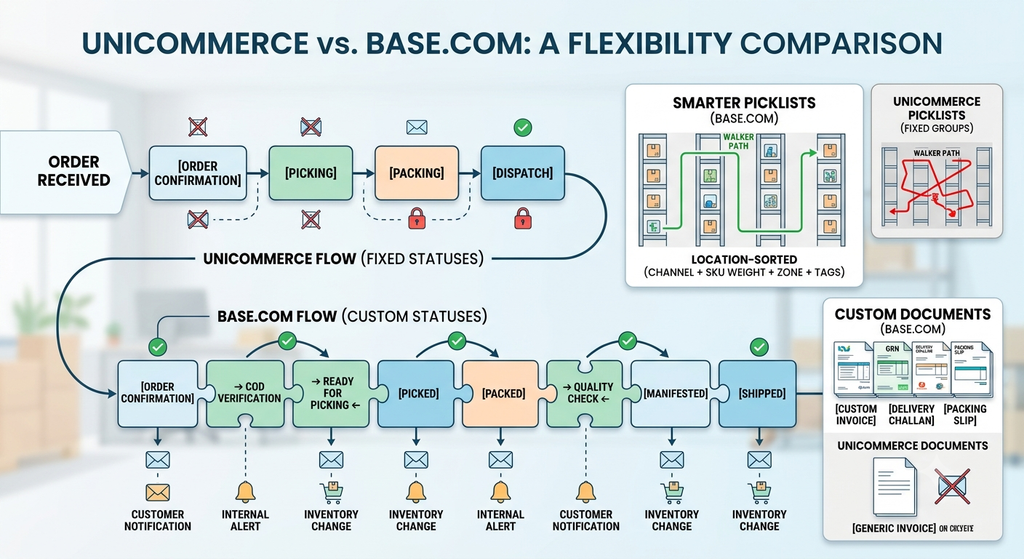
The most common reason operations teams start evaluating a Unicommerce alternative in India is customization. Unicommerce uses fixed order statuses. For a brand that needs a COD verification step between order confirmation and picking, or a quality check status between packing and dispatch, fixed statuses are a hard constraint.
Base.com supports fully customized order statuses, New, COD Pending Verification, Verified COD, Ready for Picking, Picked, Packed, Manifested, Shipped, Delivered, configured to the brand’s actual operational flow. Each status can trigger an action: a customer notification, an internal alert, or an inventory reservation change.
Custom picklists in Base.com go beyond what Unicommerce offers. Unicommerce groups orders on fixed parameters. Base.com allows grouping on any combination of channel, product category, SKU weight, fulfillment zone, CPT window, or custom tags. For a warehouse team processing 500+ orders per day, location-sorted picklists that reduce walker backtracking are a meaningful efficiency gain.
Custom invoices and custom documents, GRNs, and delivery challans are native to Base.com. Unicommerce does not support custom invoices or custom document generation. For Indian brands with specific invoice formats required by marketplace partners or B2B clients, this is a recurring manual workaround in Unicommerce that disappears in Base.com.
2. The WMS Depth Gap
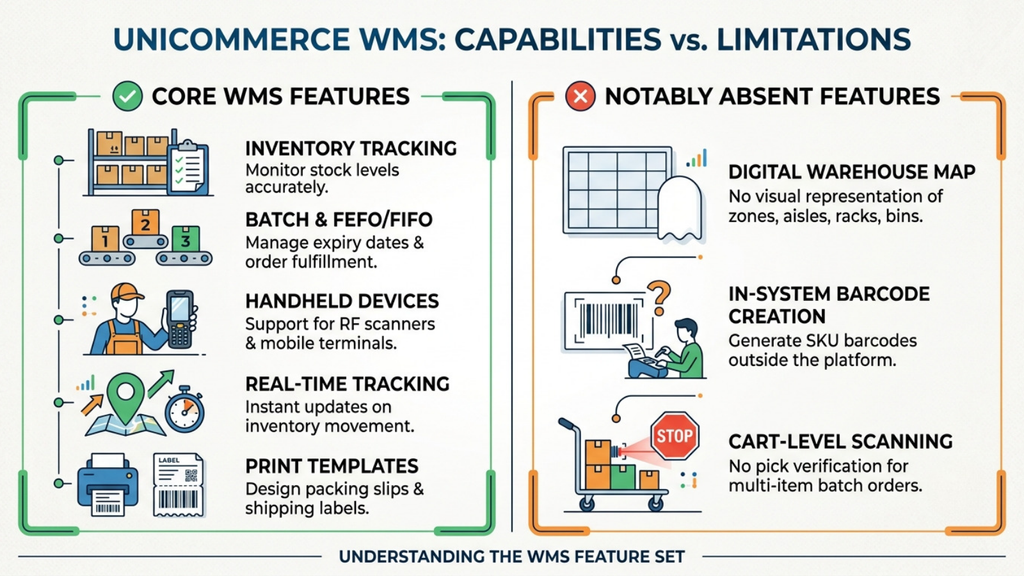
Unicommerce has a WMS module. It covers inventory tracking, batch management with FIFO/FEFO, handheld device support, real-time tracking, and customizable print templates. These are solid capabilities for the feature set the product was designed around.
What Unicommerce does not have: a digital warehouse view. No spatial map of the warehouse, zones, aisles, racks, bins, that the system represents and operates against. No in-system barcode creation. If a brand’s supplier does not provide SKU-level barcodes, warehouse teams print them externally and apply them manually. Unicommerce has no mechanism for generating and managing those barcodes within the platform. No cart-level barcode scanning, Unicommerce supports location scanning but not cart scanning, which is the more accurate pick verification method for multi-item batch picking workflows.
Base.com’s WMS provides all three. The digital warehouse view gives the operations team a live spatial map of their warehouse. Custom locations, bins, racks, and return handling zones are defined in the system, and each carries a scannable identifier. Product barcodes and MRP tags are created within Base.com and printed directly from the platform, no external tool required. Cart scanning adds a second barcode verification checkpoint beyond location scanning, further reducing pick errors that originate in wrong-bin picks.
This is why brands looking for an Unicommerce alternative in India with stronger WMS depth consistently land on Base.com.
3. The Accounting Integration Gap

Unicommerce does not offer automatic sync of orders to Tally or Zoho Books. Orders can be exported and manually imported into accounting software. For a brand doing 2,000 orders per day, manual export and import is a daily finance team task that consumes hours and introduces mapping errors.
Base.com automatically syncs every order as a ledger entry to Tally and Zoho Books. Returns sync as credit notes. Invoice corrections, sales registers, and receipts are managed within the platform. The accounts team works from a Tally ledger that is always in sync with the OMS without a manual transfer step.
This specific gap, automatic vs. manual accounting sync, is one of the most cited reasons operations and finance leads evaluate a Unicommerce alternative in India. The operational load of manual reconciliation at scale is a monthly drag on the finance team that Base.com eliminates by design.
4. The PIM Gap
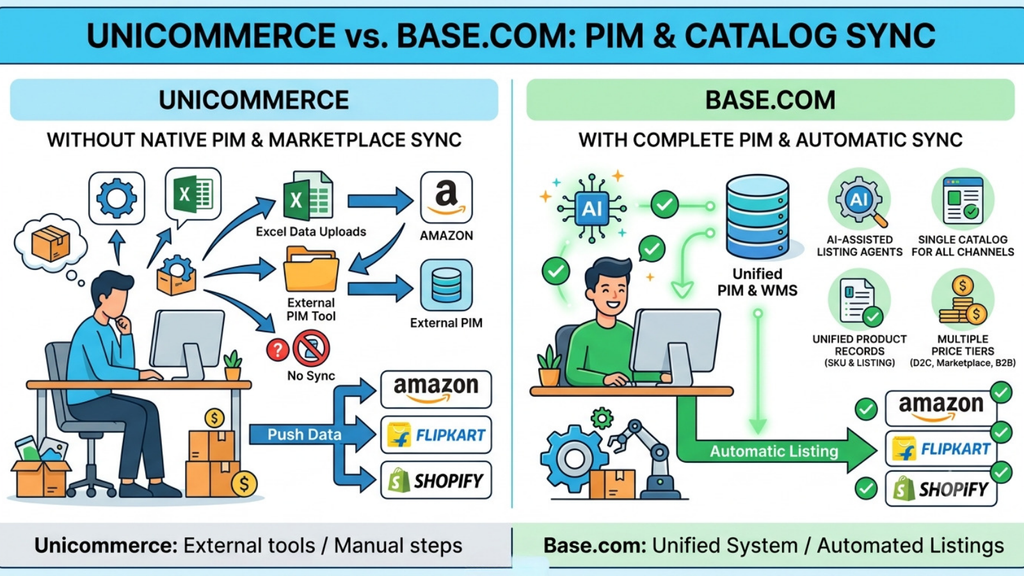
Unicommerce does not offer a Product Information Management module with catalog sync to marketplaces. Pushing catalog content, product images, descriptions, attributes, and variant data to Amazon, Flipkart, or a Shopify store requires an external tool or manual template uploads.
Base.com includes a complete PIM: a single place to maintain catalog content across all channels, with AI-assisted listing agents that push new products to connected marketplaces automatically. AI listing agents can automatically list products you create in the system, with no manual channel-by-channel listing workflow. Supplier costs and multiple price tiers (D2C price, marketplace price, B2B price) are supported per product. The catalog and WMS are unified; the same product record that carries SKU data for picking also carries the channel listing data for all marketplaces.
Brands evaluating a Unicommerce alternative in India who currently use a separate tool for catalog management find that Base.com consolidates that into the same platform, reducing both tool cost and data synchronization overhead.
5. The P&L Reporting Gap

Unicommerce provides advanced dashboards, sales reports, returns reports, inventory reports, and channel-specific alerts. The reporting stack is solid.
What it does not have: a Total Business P&L Dashboard. There is no native view in Unicommerce that connects operational data, orders, returns, fulfillment costs, and shipping costs to financial outcomes at the business level.
Base.com’s Total Business P&L Dashboard does this. It shows realized revenue net of all fees, returns, and fulfillment costs, connected to the operational data that produced it. For a founder or CFO evaluating contribution margin per channel or per SKU, this dashboard provides the number that matters, not gross GMV, but actual margin after operational costs.
This reporting gap is not operationally blocking. Brands on Unicommerce build their P&L in Excel using exported reports. But it is a weekly manual exercise that Base.com eliminates, and it is a consistent differentiator cited by operations and finance leads evaluating a Unicommerce alternative in India.
Feature-by-Feature: Base.com vs Unicommerce
The comparison below is drawn directly from the competitive mapping data across all sheets.
- OMS Capabilities
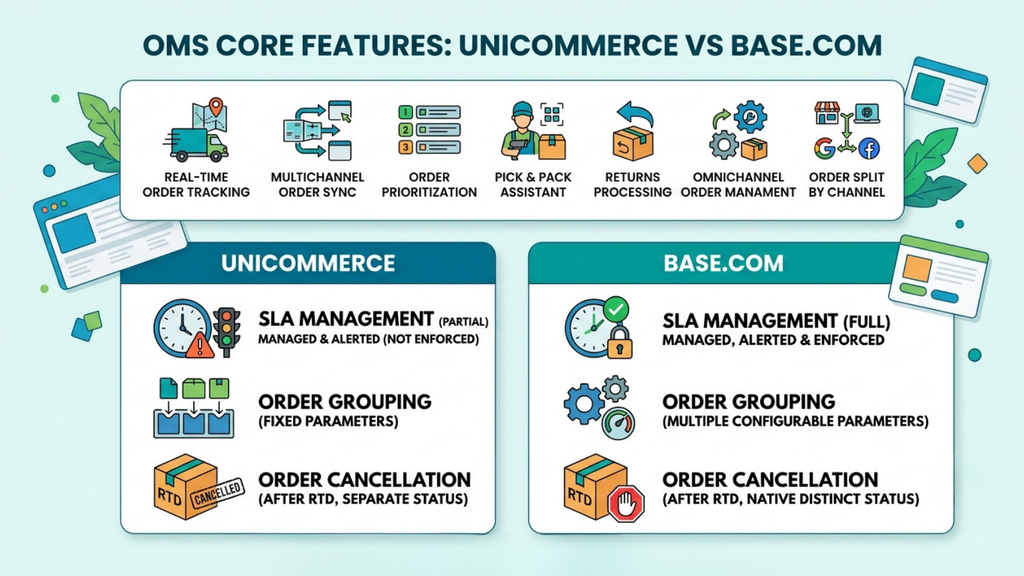
Both Unicommerce and Base.com cover the OMS core: real-time order tracking, multichannel order sync, order prioritization, pick and pack assistant, returns processing, workflow automation for pick and pack, omnichannel order management, and order split by channel.
Where they diverge:
Unicommerce SLA management is partial; it manages and alerts on SLA but does not fully enforce it. Base.com SLA management is fully managed and alerted. Order grouping in Unicommerce works on fixed parameters. Base.com groups on multiple configurable parameters. Order cancellation management after RTD (Ready to Dispatch) in Unicommerce adds it as a separate status; it is not handled as a distinct status natively. Base.com handles it as a distinct status natively.
The 1-click order processing workflow, a single action that packs, prints an invoice and label, updates order status, sends customer notification, and updates tracking, exists in Base.com and does not exist in Unicommerce. For high-volume operations, this is a direct throughput difference.
- WMS Capabilities
| WMS Feature | Base.com | Unicommerce |
| Full WMS module | Yes | Yes |
| Stock sync | Yes | Yes |
| Rack/shelf allocation | Yes | Yes |
| Inventory allocation per channel | Yes | Yes |
| Barcode scanning on location | Yes | Yes |
| Barcode scanning on the cart | Yes | No |
| Multi-warehouse management | Yes | Yes |
| Real-time stock visibility | Yes | Yes |
| Digital warehouse view | Yes | No |
| Custom locations, bins, racks | Yes | Yes |
| In-system barcode/MRP tag creation | Yes | No |
| Order picking and packing | Yes | Yes |
| Batch management (FIFO/FEFO) | Yes | Yes |
| Handheld device support | Not listed | Yes |
The three differentiators that make Base.com a stronger Unicommerce alternative in India for WMS-heavy operations: digital warehouse view, in-system barcode creation, and cart-level scanning. Each addresses a specific physical warehouse accuracy problem that Unicommerce’s WMS does not solve.
- Inventory Management

Both platforms cover stock alerts, batch tracking, multi-warehouse management, inventory allocation per channel, real-time stock visibility, and inventory control/stock reservation.
Unicommerce adds bundles and kits management and inventory forecasting as specific, named capabilities, both of which are relevant for brands with complex catalogue structures or seasonal demand patterns.
Base.com’s inventory health data flows through the P&L Dashboard, connecting inventory position to financial exposure directly. Aging inventory by bin, working capital locked per SKU, and channel-wise turn rates are visible in one place.
- ERP and Accounting

Both platforms cover invoice creation, payment reconciliation, multi-currency support, and tax calculation.
The fundamental difference: Unicommerce requires manual export and import to accounting software. Base.com automatically syncs to Tally and Zoho Books. This is not a feature gap; it is an architectural difference. Any brand doing more than 500 orders per day will feel this difference as a daily operational cost if they are on Unicommerce.
- Catalog and PIM
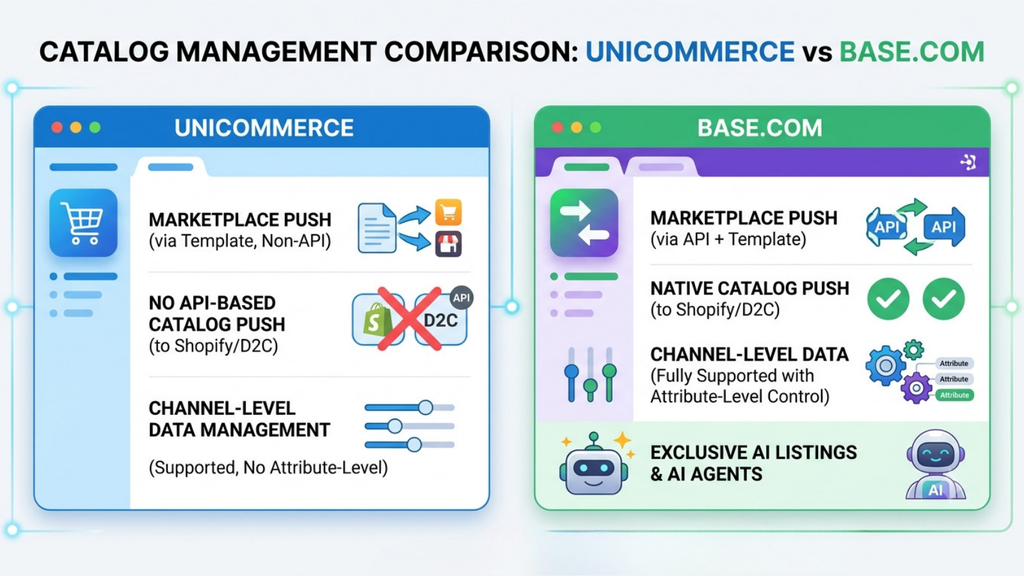
Unicommerce pushes the catalog to marketplaces via a template for non-API marketplaces. It does not offer API-based catalog push to Shopify or a D2C website. Channel-level data management is supported, but not at the attribute level.
Base.com pushes catalog to marketplaces via API, to Shopify and D2C websites natively, and via a template for non-API marketplaces. Channel-level data is fully supported with attribute-level control. AI-assisted listings and AI listing agents are exclusive to Base.com; Unicommerce has no equivalent.
For any brand managing a large, frequently updated catalogue across six or more channels, the PIM gap is a significant driver toward evaluating a Unicommerce alternative in India.
- Returns Management
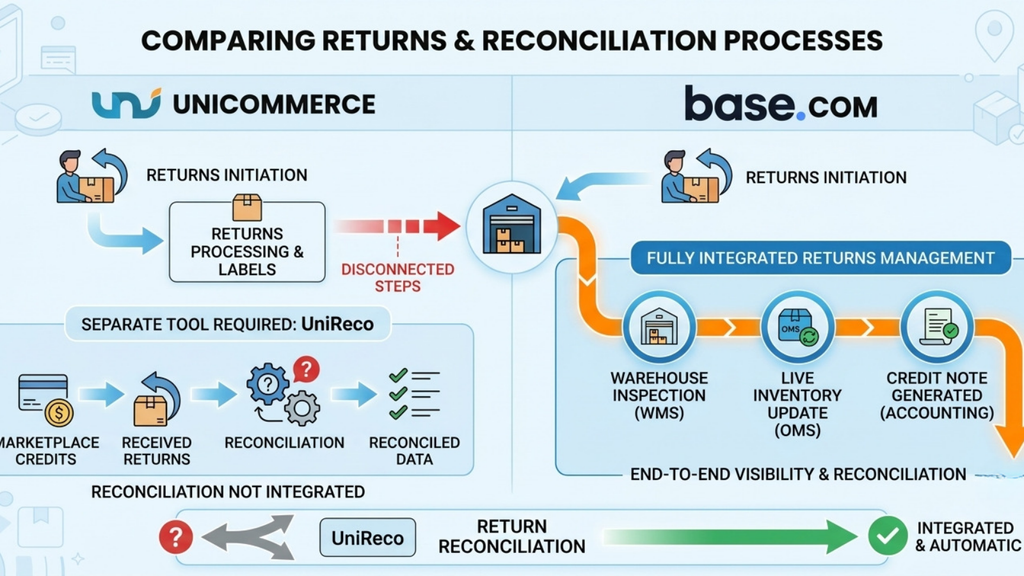
Both platforms handle returns management. The data shows a specific gap: Unicommerce does not support return reconciliation. Base.com’s returns and RTO management is integrated with the OMS, WMS, and accounting modules; a returned unit inspected at the warehouse immediately updates live inventory and generates a credit note in the accounting ledger.
Unicommerce processes returns and generates return labels, but the reconciliation layer, matching marketplace return credits against the returns received, at the order level, requires the separate UniReco tool. Base.com handles this within the platform.
- Customer Service
Base.com includes a customer service module (Responso) with a single panel for all social conversations, Instagram, Facebook, WhatsApp, AI-assisted customer service agents and workflows, and a website chatbot integration. Unicommerce has no equivalent customer service capability.
For brands where customer service load is driven by order queries and return requests, which is most Indian D2C brands, having customer service integrated with the OMS (so the support agent can see the order status, tracking, and return history in the same interface as the conversation) reduces resolution time significantly. This is a differentiator that has no parallel in Unicommerce.
- Global Integrations
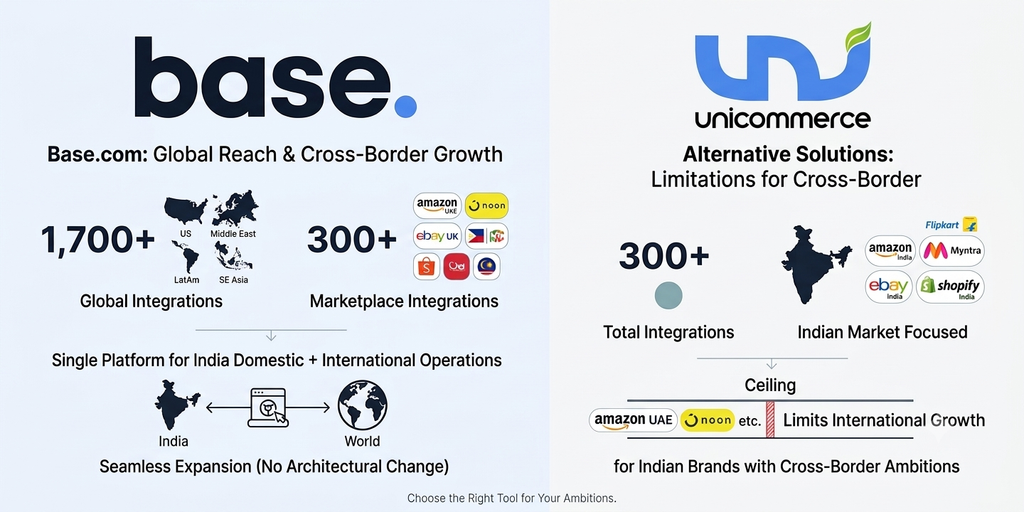
Base.com has 1,700+ global integrations covering India, the US, Europe, the Middle East, LatAm, and Southeast Asia, including 300+ marketplace integrations. Unicommerce has 300+ total integrations, focused primarily on the Indian market with Amazon, Flipkart, Myntra, eBay, and Shopify as the key channels.
For any Indian brand with cross-border ambitions, selling on Amazon UAE, Noon, eBay UK, or expanding to Southeast Asia, Unicommerce’s integration coverage is a ceiling. Base.com, as a Unicommerce alternative in India for brands with international channels, provides the same platform for Indian domestic and cross-border operations, with no architectural change required when new geographies are added.
Base.com also includes bespoke integrations, digital scales for weight management, Base Caller, Slack, Discord, and Google Drive, which Unicommerce does not offer. These operational tool integrations matter for brands that have built workflows around these platforms.
Who Should Evaluate a Unicommerce Alternative in India
Not every brand on Unicommerce has a reason to switch. Unicommerce is a capable platform that serves the OMS and WMS needs of a large segment of the Indian ecommerce market competently. For brands in the early growth stage with a single warehouse, limited SKU count, and primarily Indian marketplace channels, Unicommerce does the job.
The evaluation of a Unicommerce alternative in India makes sense when specific gaps start producing operational costs:
- When order customization is needed. If the brand’s fulfillment workflow requires status steps that do not fit Unicommerce’s fixed status model, the workaround adds manual coordination overhead per order. At 1,000 orders per day, that overhead is material.
- When WMS accuracy is a priority. If the brand is experiencing pick errors that generate wrong-item returns, and the warehouse does not have barcode-verified picking at the cart level, Base.com’s WMS closes that gap.
- When the finance team is spending hours on manual accounting reconciliation. If the accounts team is exporting from Unicommerce and importing to Tally weekly, that is a recoverable cost with Base.com’s automatic sync.
- When catalog management requires a separate tool. If the brand is maintaining catalog content across channels in a separate PIM tool, Base.com consolidates it into the operational platform.
- When cross-border channels are being added. If the brand is expanding to the UAE, UK, or Southeast Asian marketplaces, Unicommerce’s integration coverage is not sufficient. Base.com handles the expanded geography from the same account.
- When the finance team needs a channel-level P&L. If the founder or CFO is building the P&L from exported reports in Excel monthly, Base.com’s Total Business P&L Dashboard provides it natively.
The Migration Question: What Switching Looks Like
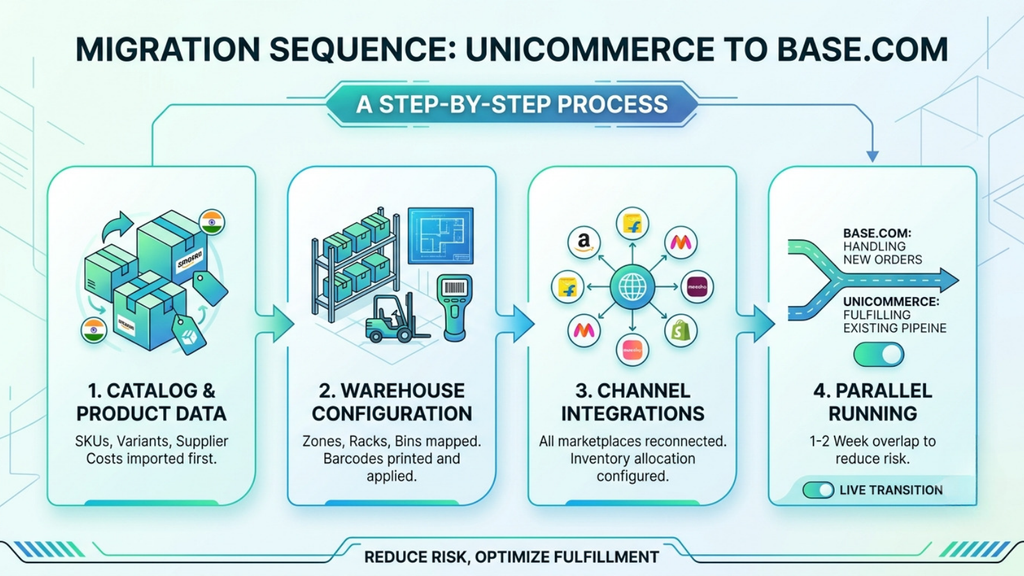
The most common concern when evaluating a Unicommerce alternative in India is migration complexity. Switching OMS platforms while running a live ecommerce operation is a real operational risk.
The practical migration sequence for brands moving from Unicommerce to Base.com:
The catalog and product data migrate first, and product records, SKU data, variant configurations, and supplier costs are imported into Base.com’s unified catalog before any order operations switch over.
Warehouse configuration comes next. Zones, racks, bins, and bin-to-SKU assignments are set up in Base.com’s digital warehouse view. Location barcodes are printed and applied. Product barcodes are generated in-system where needed.
Channel integrations are connected. Amazon, Flipkart, Myntra, Meesho, Shopify, and other channels are reconnected to Base.com. Inventory allocations per channel are configured.
Parallel running for one to two weeks, both platforms run simultaneously, with Base.com handling new orders while Unicommerce fulfills orders already in the pipeline. This reduces switchover risk.
Accounting sync activation: Tally or Zoho Books is connected to Base.com’s automatic sync. The manual export-import process from Unicommerce has been retired.
The migration is not trivial. But it is a one-time investment against a permanent operational improvement. Brands that have completed this migration typically report the accounting sync alone recovering the migration cost within two months.