

The best warehouse management software in India for mid-size businesses combines bin-level pick optimisation, scan-enforced packing accuracy, and marketplace-aware dispatch rules, not just basic stock tracking. For a mid-size Indian business running one or more warehouses and shipping through Amazon, Flipkart, Meesho, or Myntra, the right WMS needs to handle COD risk, GST-compliant multi-warehouse transfers, and peak-season order spikes without breaking down.
This guide ranks the top 10 platforms mid-size Indian businesses are actually evaluating in 2026, with a definition, ideal use case, a Dos and Don’ts table, features, advantages, disadvantages, and a direct G2 link for each one.
How Sellers Should Evaluate Warehouse Management Software in India
Choosing warehouse management software in India requires looking past generic feature lists and into how each platform actually performs on the warehouse floor. We evaluated each entry against five criteria specific to mid-size Indian operations.
- Bin-level slotting and pick-path optimisation
- Scan-enforced packing accuracy
- COD and RTO risk handling at the dispatch step
- Marketplace-specific manifest and SLA compliance
- Verified user sentiment from G2 reviews
This is the filter that separates genuinely useful warehouse management software in India from a platform that simply lists India as a supported region without solving for its operational specifics.
India’s ecommerce market has crossed $226 billion, and D2C brands are scaling at a 40% CAGR. That pace of growth is exactly why warehouse management software in India needs to handle sudden 5-10x order spikes during sale events without collapsing, a scenario most generic global WMS platforms were never built to absorb.
Top 10 Best Warehouse Management Software in India for Mid-Size Businesses
As order volumes grow and warehouse operations become more complex, mid-size businesses need more than basic inventory tracking to stay efficient. The right warehouse management software helps streamline receiving, storage, picking, packing, and shipping while improving inventory accuracy, reducing fulfillment errors, and supporting faster business growth.
Rank | Platform | Best For | G2 Rating |
|---|---|---|---|
1 | Base.com | D2C and marketplace sellers needing COD-aware, scan-enforced warehouse operations | 4.4/5 |
2 | Unicommerce | Large-catalogue multi-marketplace sellers wanting broad warehouse and channel coverage | 4.5/5 |
3 | Increff WMS | Fashion and lifestyle brands needing high-accuracy picking at scale | 4.7/5 |
4 | Vinculum (Vin eRetail) | Omnichannel retailers running offline stores plus online warehouses | 4.6/5 |
5 | WareIQ | Brands wanting fulfilment infrastructure bundled with warehouse software | No Reviews |
6 | SAP Business One | Mid-size manufacturers and distributors needing ERP-integrated warehousing | 4.3/5 |
7 | Browntape | Sellers on the Ginesys ERP and POS ecosystem | 4.2/5 |
8 | EasyEcom | Growing D2C brands wanting an affordable warehouse and order management entry point | 4.5/5 |
9 | Odoo Inventory | Businesses wanting an open, modular warehouse system inside a wider ERP | 4.6/5 |
10 | Fishbowl Inventory | Manufacturers and distributors needing warehouse management tied to QuickBooks | 4.1/5 |
1. Base.com
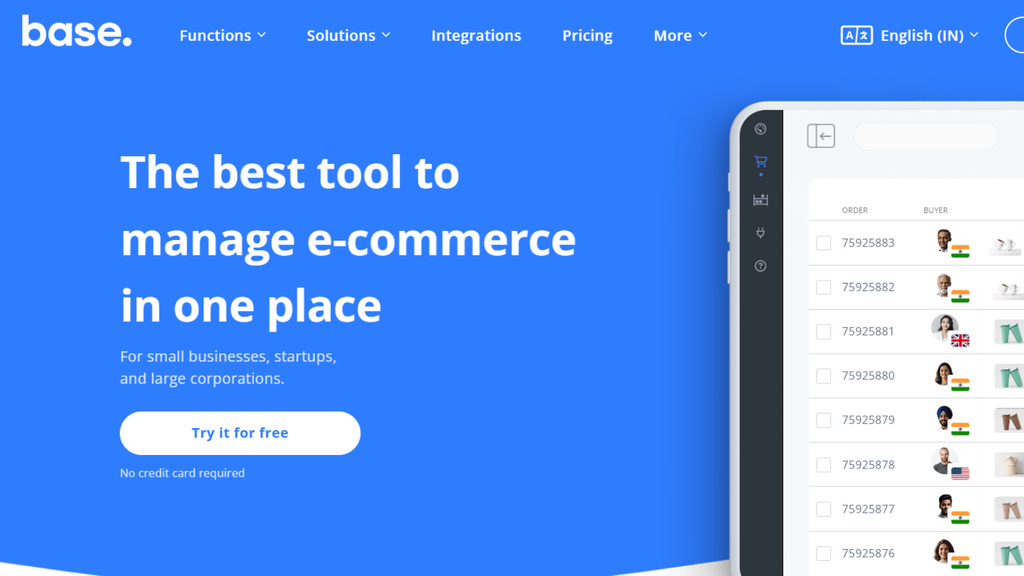
Base.com is an order and warehouse management platform built specifically for Indian D2C, marketplace, and B2B sellers, directing bin-level picking, scan-enforced packing, and channel-specific dispatch from one system.
Best for: Mid-size Indian D2C and marketplace brands running one or more warehouses who need COD risk flagged before dispatch and SAP connectivity as they scale.
Among the strongest options for warehouse management software in India built specifically around COD, marketplace SLA rules, and Indian dispatch complexity.
Do | Don’t |
|---|---|
Use it if you need bin-sequenced pick lists and scan-enforced packing out of the box | Don’t expect a generic global template experience; it is built around Indian dispatch patterns specifically |
Use it if COD orders and RTO risk are a meaningful share of your dispatch volume | Don’t onboard without mapping your warehouse bin coordinates first; this speeds up go-live significantly |
Use it if you run SAP alongside your warehouse operations | Don’t skip the parallel-run period before full cutover |
Features: Bin-location sequenced pick lists, barcode scan enforcement at packing, kit and bundle component-level picking, pincode-level COD/RTO flagging before label generation, native SAP connector, real-time dispatch dashboard.
Advantages: Built for India’s COD and multi-marketplace dispatch reality from day one; fast implementation timeline; strong SAP and depot-level connectivity for growing enterprises.
Disadvantages: As a newer entrant relative to some competitors on this list, third-party review volume is still building.
G2 link: https://www.g2.com/products/base/reviews
2. Unicommerce
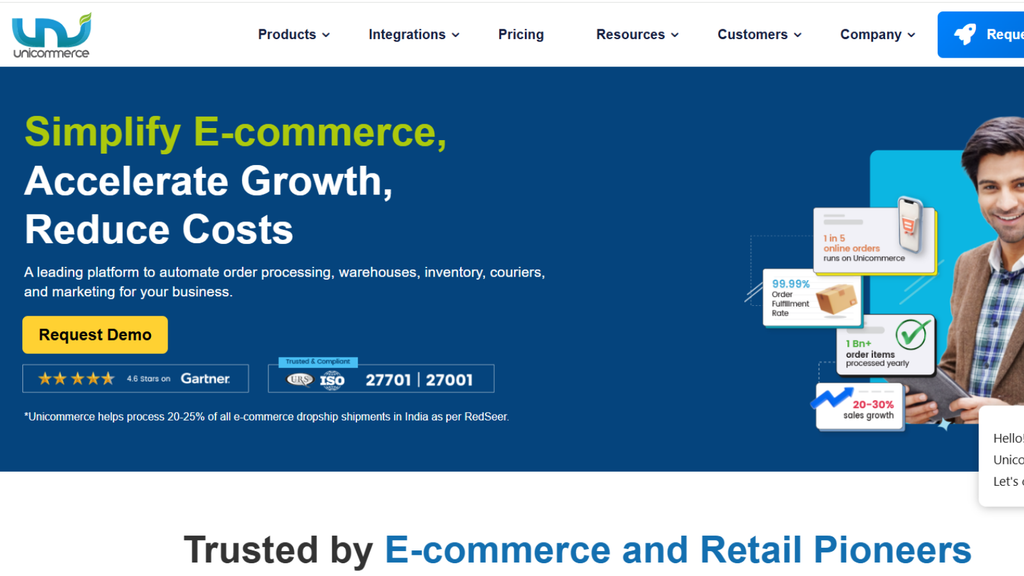
Unicommerce is an established order, inventory, and warehouse management system supporting multi-channel ecommerce and offline retail operations, widely deployed across Indian D2C and enterprise warehouses.
Best for: Larger catalogues and sellers who need broad, pre-built integration coverage across a wide range of marketplaces, couriers, and warehouse configurations.
One of the most recognised names in warehouse management software in India, particularly for sellers prioritising integration breadth over a lighter learning curve.
Do | Don’t |
|---|---|
Use it if you need warehouse integrations across a very large number of channels and couriers | Don’t expect the simplest learning curve; new users report the interface can feel dense initially |
Use it if you value an established, high-review-volume platform | Don’t assume every warehouse module is included at the entry pricing tier |
Use it if multi-warehouse and 3PL routing is a core requirement | Don’t skip proper onboarding support given the platform’s depth |
Features: Centralised warehouse inventory database, multi-warehouse routing, 3PL warehouse management, pick and pack workflows, marketplace connections, order management.
Advantages: Wide integration ecosystem, strong brand recognition in Indian ecommerce, high real-user review volume on G2.
Disadvantages: Some G2 reviewers note the interface can feel overwhelming for new users during initial onboarding.
G2 link: https://www.g2.com/products/unicommerce/reviews
3. Increff WMS
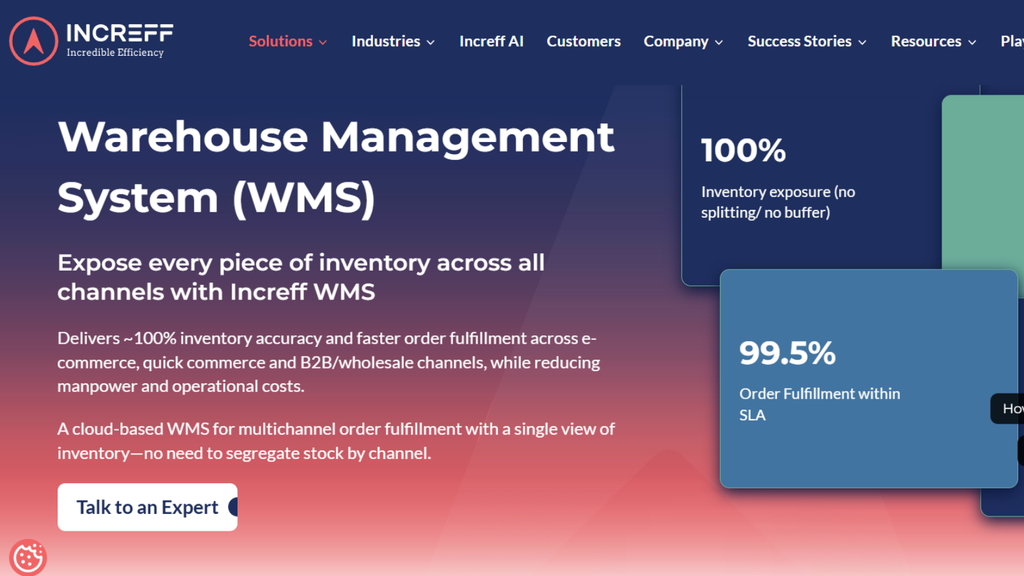
Increff WMS is a cloud-hosted warehouse management system giving fashion and lifestyle brands a single, real-time view of inventory and pick accuracy across online and offline warehouses.
Best for: Fashion, footwear, and lifestyle brands needing high picking accuracy and near real-time inventory-order sync at the warehouse floor level.
Consistently rated among the top warehouse management software in India for picking accuracy specifically.
Do | Don’t |
|---|---|
Use it if picking accuracy and unique-piece barcoding matter for your category | Don’t expect the deepest reporting customisation; some reviewers note this as a limitation |
Use it if you are a fashion, footwear, or lifestyle brand specifically | Don’t assume it is the best fit outside fashion-adjacent categories without evaluating your own workflow |
Use it if near real-time order-warehouse sync is a hard requirement | Don’t overlook checking mid-market vs enterprise pricing tiers before committing |
Features: Unique piece barcoding for serialisation, near real-time inventory and order syncing, cross-dock GRN support, high SLA fulfilment accuracy, single view of inventory across online and offline warehouses.
Advantages: Very high G2 rating among platforms on this list, strong reputation specifically for picking accuracy and warehouse execution.
Disadvantages: Some reviewers note report customisation options are more limited than they would like.
G2 link: https://www.g2.com/products/increff-wms/reviews
4. Vinculum (Vin eRetail)
Vin eRetail, from Vinculum, is an omnichannel order, inventory, and warehouse management suite connecting online marketplaces, webstores, and physical retail stores under one warehouse view.
Best for: Retailers and brands operating both offline stores and online warehouses who need a single, real-time dispatch view across both.
A strong pick among warehouse management software in India for businesses with a genuine offline-plus-online fulfilment footprint.
Do | Don’t |
|---|---|
Use it if you run physical retail stores alongside online warehouses | Don’t expect it to be the cheapest option for a pure online-only D2C brand |
Use it if GST and e-way bill compliance features matter to your warehouse workflow | Don’t skip evaluating which specific Vinculum product (Vin OMS, Vin WMS, Vin PIM) fits your need; they are modular |
Use it if catalogue and content management across warehouses and channels is a priority | Don’t assume every module ships as a single bundled product |
Features: Omnichannel order aggregation, real-time warehouse inventory sync across stores and marketplaces, GST and e-way bill compliance support, warehouse and dispatch tools, pick and pack workflows.
Advantages: Strong fit for hybrid offline-online retailers, high G2 rating, established presence in the Indian market since 2007.
Disadvantages: The modular product structure means buyers need to evaluate which specific Vinculum product matches their exact warehouse requirement.
G2 link: https://www.g2.com/products/vin-eretail-oms/reviews
5. WareIQ
WareIQ combines physical fulfilment infrastructure, including warehousing and courier network access, with warehouse and order management software for Indian ecommerce sellers.
Best for: Brands that want warehouse management software bundled together with actual fulfilment centre and courier access, rather than software alone.
A distinct entry among warehouse management software in India because it pairs software with a physical fulfilment network.
Do | Don’t |
|---|---|
Use it if you want fulfilment infrastructure and warehouse software from one vendor | Don’t expect a large volume of independent G2 reviews yet to benchmark sentiment |
Use it if smart inventory placement across fulfilment centres is a priority | Don’t skip requesting references directly given the platform’s more limited public review history |
Use it if fast-delivery positioning is central to your growth strategy | Don’t assume this model fits brands that already have their own dedicated warehouse network |
Features: Smart inventory placement across fulfilment centres, warehouse order management, courier integration, fulfilment network access alongside the software layer.
Advantages: Useful for brands wanting fulfilment infrastructure and warehouse software bundled rather than sourced separately.
Disadvantages: Limited independent review volume on G2 at the time of writing makes it harder to benchmark against more established platforms.
G2 link: https://www.g2.com/products/wareiq/reviews
6. SAP Business One
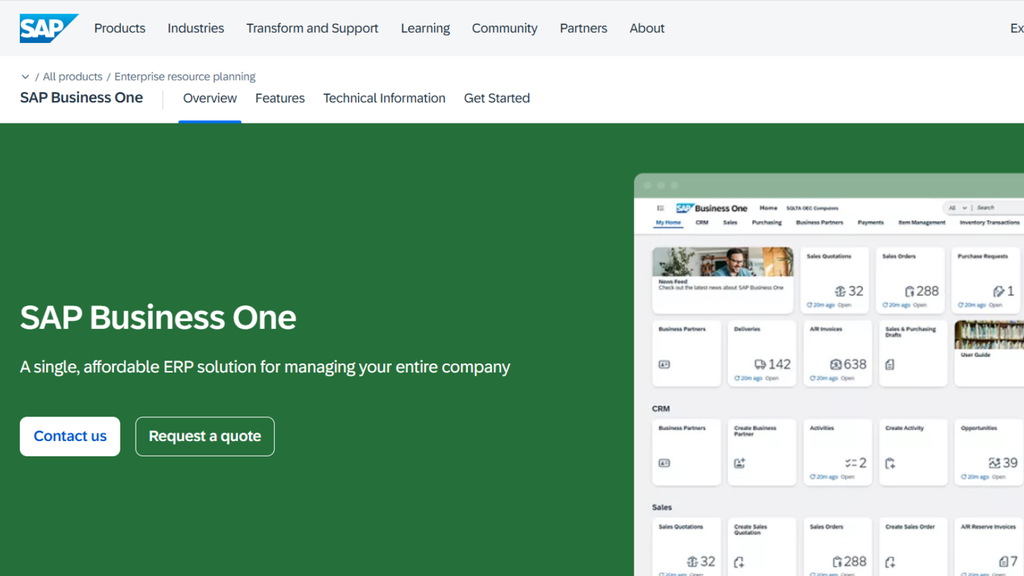
SAP Business One is a full ERP system covering finance, inventory, warehouse operations, purchasing, and CRM in a single platform, widely used by mid-size manufacturers and distributors.
Best for: Mid-size manufacturers, distributors, and B2B sellers who need warehouse management deeply integrated with finance, procurement, and production planning.
The most enterprise-grade option in this list of warehouse management software in India, suited to businesses beyond pure D2C ecommerce.
Do | Don’t |
|---|---|
Use it if you need warehouse operations unified with finance, procurement, and production | Don’t expect the fastest go-live timeline compared to lighter cloud-native WMS platforms |
Use it if multi-currency, multi-legislation operations are relevant to your business | Don’t underestimate implementation and configuration effort; this is a full ERP, not a lightweight tool |
Use it if you are scaling beyond a single warehouse function into full ERP needs | Don’t choose it purely for D2C marketplace-specific warehouse needs without evaluating lighter alternatives first |
Features: Unified finance, inventory, warehouse, purchasing, and CRM; multi-currency and multi-legislation support; real-time shared data across departments; automated approvals and alerts.
Advantages: Deep ERP-level integration across business functions, strong fit for manufacturers and distributors, established global support network.
Disadvantages: Reviewers note a steeper configuration and onboarding process compared to lighter, ecommerce-specific warehouse tools.
G2 link: https://www.g2.com/products/sap-business-one/reviews
7. Browntape
Browntape, part of the Ginesys One ecosystem, is an order, inventory, and warehouse management system built to integrate ecommerce operations tightly with the Ginesys retail ERP suite.
Best for: Retail and fashion brands already using, or planning to use, the Ginesys ERP, POS, and warehouse ecosystem alongside their ecommerce operations.
A relevant option among warehouse management software in India for brands wanting ERP and warehouse operations unified under one vendor.
Do | Don’t |
|---|---|
Use it if you are already on, or evaluating, the Ginesys ERP suite | Don’t expect the largest standalone marketplace-integration ecosystem compared to dedicated WMS platforms |
Use it if payment reconciliation across warehouses and channels is a pain point | Don’t rely on limited third-party review volume alone; request a live walkthrough |
Use it if automatic order routing across multiple warehouse locations matters | Don’t assume feature parity with Ginesys ERP if evaluated as a pure standalone tool |
Features: Multichannel order and warehouse sync, payment reconciliation module, automatic order routing across locations, integration with Ginesys ERP and POS, warehouse management through Ginesys integration.
Advantages: Tight integration with a full retail ERP suite, useful for brands wanting warehouse, POS, and ecommerce unified under one ecosystem.
Disadvantages: Review volume on independent platforms is comparatively limited, making it harder to benchmark sentiment at scale.
G2 link: https://www.g2.com/products/browntape/reviews
8. EasyEcom
EasyEcom is an omnichannel order, inventory, and warehouse management solution aimed at small and growing online sellers, covering bin allocation, pick and pack workflows, and vendor management.
Best for: Growing D2C brands that want a straightforward, cost-effective warehouse and order management starting point before scaling into more complex operational needs.
Frequently shortlisted among warehouse management software in India for brands prioritising affordability during early scaling.
Do | Don’t |
|---|---|
Use it if you are a smaller brand wanting a cost-effective entry point for warehouse operations | Don’t expect the most advanced feature depth compared to more established enterprise platforms |
Use it if bin allocation and vendor management are your core warehouse needs | Don’t underestimate the initial setup time; some users note certain workflows take time to learn |
Use it if real-time inventory sync to avoid overselling is a priority | Don’t skip requesting a demo of bin allocation features if warehouse complexity is high |
Features: Centralised warehouse inventory tracking, bin allocation, vendor management, real-time inventory sync, order management dashboard.
Advantages: Cost-effective for growing brands, scalable as order volume increases, positive G2 sentiment around ease of use for mid-volume sellers.
Disadvantages: Some G2 reviewers note that certain workflows and features feel complex during initial setup and onboarding.
G2 link: https://www.g2.com/products/easyecom/reviews
9. Odoo Inventory
Odoo Inventory is an open, modular warehouse management application within the broader Odoo ERP suite, supporting real-time stock tracking, barcode scanning, and multi-warehouse organisation.
Best for: Businesses wanting a modular, open-source-based warehouse system that connects natively to sales, purchase, accounting, and manufacturing modules.
A flexible entry among warehouse management software in India for businesses wanting warehouse operations tied directly to a wider open ERP suite.
Do | Don’t |
|---|---|
Use it if you already run, or plan to run, other Odoo modules like Sales or Manufacturing | Don’t expect India-specific marketplace and COD dispatch logic out of the box |
Use it if barcode scanning and defined storage locations are core requirements | Don’t expect the deepest fashion or D2C-specific warehouse features compared to purpose-built platforms |
Use it if automated replenishment across multiple warehouses is a priority | Don’t skip evaluating implementation partners, since configuration depth benefits from experienced setup |
Features: Real-time inventory tracking, defined storage locations and racks, barcode scanning, automated replenishment, multi-warehouse management.
Advantages: Strong integration with the wider Odoo ERP ecosystem, flexible and modular, generally well-rated for ease of use.
Disadvantages: Requires more configuration effort to match India-specific marketplace and COD dispatch requirements compared to purpose-built ecommerce WMS platforms.
G2 link: https://www.g2.com/products/odoo-inventory/features
10. Fishbowl Inventory
Fishbowl Inventory is a warehouse and inventory management solution built primarily for QuickBooks users, covering manufacturing, warehouse tracking, and order fulfilment.
Best for: Manufacturers and distributors already using QuickBooks who need warehouse management tied directly to their existing accounting system.
A relevant option among warehouse management software in India for QuickBooks-based manufacturers and distributors specifically.
Do | Don’t |
|---|---|
Use it if you already run QuickBooks for accounting and want warehouse data tied to it | Don’t expect native Indian marketplace integrations for Amazon, Flipkart, or Meesho |
Use it if manufacturing and warehouse tracking need to sit in one system | Don’t expect the same India-specific COD and GST depth as ecommerce-native platforms on this list |
Use it if a one-time licence model fits your business better than a subscription | Don’t overlook evaluating implementation cost; some reviewers note the platform is not the least expensive option |
Features: Warehouse and manufacturing inventory tracking, QuickBooks integration, barcode scanning, order fulfilment tracking, multi-location warehouse support.
Advantages: Deep QuickBooks integration, established base of manufacturing and distribution users, flexible licensing options.
Disadvantages: Lacks native Indian marketplace integrations and India-specific COD or GST logic compared to other warehouse management software in India built for ecommerce specifically.
G2 link: https://www.g2.com/products/fishbowl-inventory/reviews
Quick Comparison: Ecommerce-Native vs. ERP-Native Warehouse Platforms
As warehouse operations become more complex, businesses must choose a platform that matches the way they sell and fulfill orders. Ecommerce-native warehouse platforms are built for high-volume online fulfillment and marketplace operations, while ERP-native platforms prioritize broader business processes such as finance, procurement, and accounting, often with warehouse management as one component.
Category | Ecommerce-Native (Base.com, Unicommerce, Increff, Vinculum, WareIQ, Browntape, EasyEcom) | ERP-Native (SAP Business One, Odoo Inventory, Fishbowl Inventory) |
|---|---|---|
Marketplace dispatch rules | Built-in, native | Requires middleware or manual work |
COD and RTO logic | Present in leading platforms | Not a core focus |
Bin-level pick optimisation | Core feature | Varies, often requires configuration |
Best fit | D2C and marketplace-first sellers | Manufacturers, distributors, B2B-heavy operations |
Implementation speed | Days to a few weeks | Weeks to months, depending on scope |
Most mid-size Indian businesses evaluating warehouse management software in India end up choosing based on which category matches their actual fulfilment model, ecommerce-first or ERP-first, rather than comparing all ten platforms head-to-head on identical criteria.
What Mid-Size Businesses Should Prioritise When Choosing
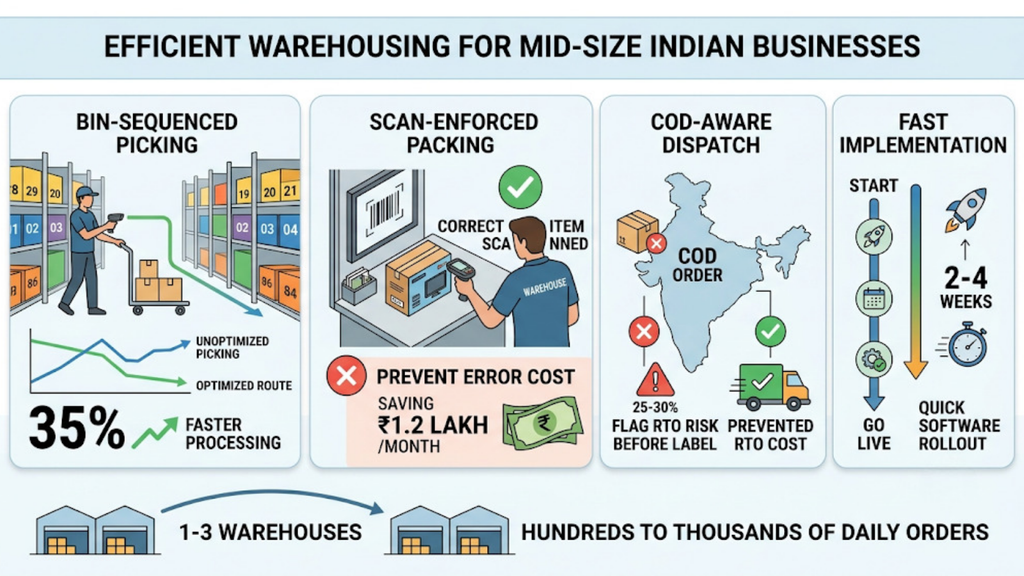
A mid-size Indian business, generally running one to three warehouses and processing a few hundred to a few thousand orders a day, has different needs from either a small single-warehouse operation or a large enterprise network.
- Bin-sequenced picking over order-receipt sequencing. Unoptimised pick lists can slow processing by up to 35% compared to route-optimised picking.
- Scan enforcement at packing. A 2% packing error rate at 500 daily orders creates roughly Rs. 1.2 lakh a month in pure correction cost.
- COD-aware dispatch logic, not just stock counting. With COD return rates at 25-30% nationally, software that flags RTO risk before label generation prevents costs that cannot be recovered after a failed delivery.
- Fast implementation. Mid-size businesses cannot afford a multi-month rollout; the best warehouse management software in India for this segment typically goes live within two to four weeks.