

Treat a combo as a manufacturing output, not a catalogue entry. Its availability depends on the weakest component, its assembly consumes floor time, and its demand lands inside a three-week window. Once you accept that framing, how to manage combo and bundle inventory in ecommerce becomes a planning problem rather than a listing problem.
India’s ecommerce market is set to reach roughly ₹19.7 trillion, close to $226 billion, this year at around 12.4% growth. Gifting brands capture that growth in compressed bursts around Diwali, Raksha Bandhan, and wedding season. Annual averages tell you almost nothing about how your operation behaves during those weeks.
Most gifting operations are built for the eleven quiet months and then asked to perform in the twelfth. That mismatch explains why the same brand can run smoothly in June and cancel hundreds of orders in October without anything fundamental having changed. The system did not break under load; it was never designed to compute availability continuously in the first place.
This manual works backwards from your peak week through a 90-day countdown, then sets the controls each stage demands.
Diagnose Which Bundle Maturity Tier Your Brand Operates At Today
Gifting brands sit at one of three operating tiers, and the tier determines which problems you can safely ignore. Fixing advanced problems while stuck at tier one wastes an entire season.
Read the three tiers below and identify yours honestly before planning anything else.
1. Tier One: Combos Sold as Standalone SKUs With No Component Link
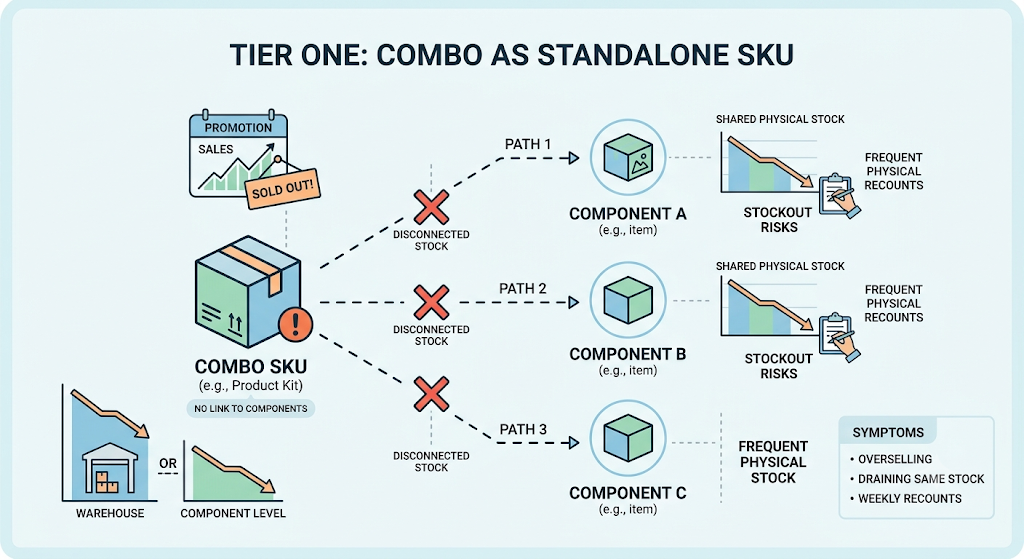
At this tier, each combo carries a manually maintained stock number. Nobody knows which components that number depends on until something runs out.
The symptoms are unmistakable. Combos oversell during promotions, standalone component listings drain the same physical stock, and someone recounts the shelf every Friday evening.
2. Tier Two: Components Tracked but Availability Calculated by Hand
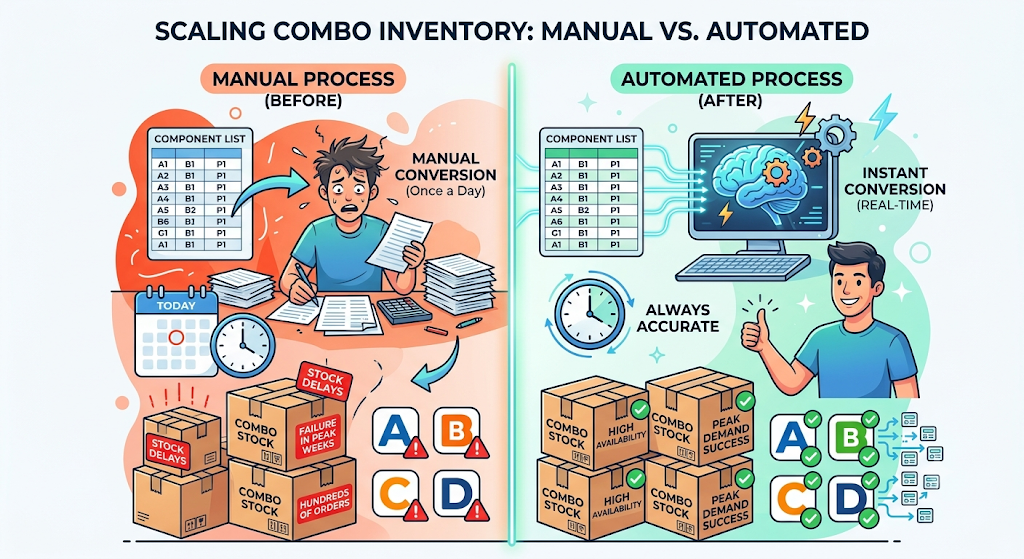
Here the component list exists, usually in a shared spreadsheet. Someone converts component stock into combo availability manually, typically once a day.
This tier survives ordinary weeks and fails in peak ones. Manual recalculation cannot keep pace when a single evening produces several hundred orders across four marketplaces.
3. Tier Three: Component Stock Drives Bundle Availability Automatically
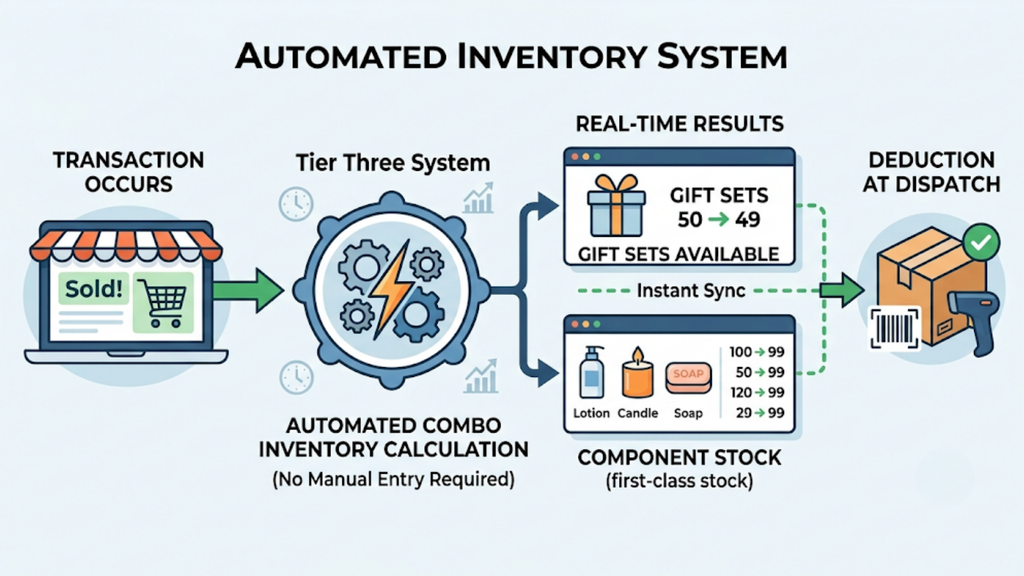
At tier three, the system computes sellable combo quantities after every transaction. Nobody types an availability figure anywhere.
Base.com operates at this tier by treating bundles, gift sets, and virtual inventory as first-class stock rather than manual adjustments. Component deduction happens at dispatch, so the set and its parts never drift apart.
4. Why Your Tier Matters More Than Your Order Volume
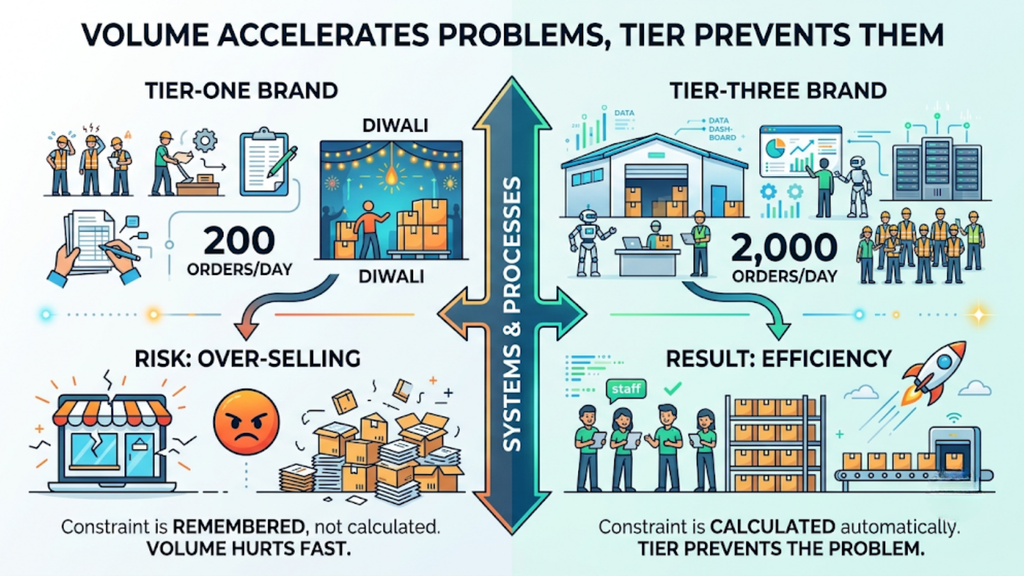
Volume determines how fast a problem hurts you. Tier determines whether the problem exists at all.
A tier-one brand doing 200 orders a day will oversell during Diwali. A tier-three brand doing 2,000 will not, because the constraint is calculated rather than remembered.
5. What Moving Up a Tier Actually Requires
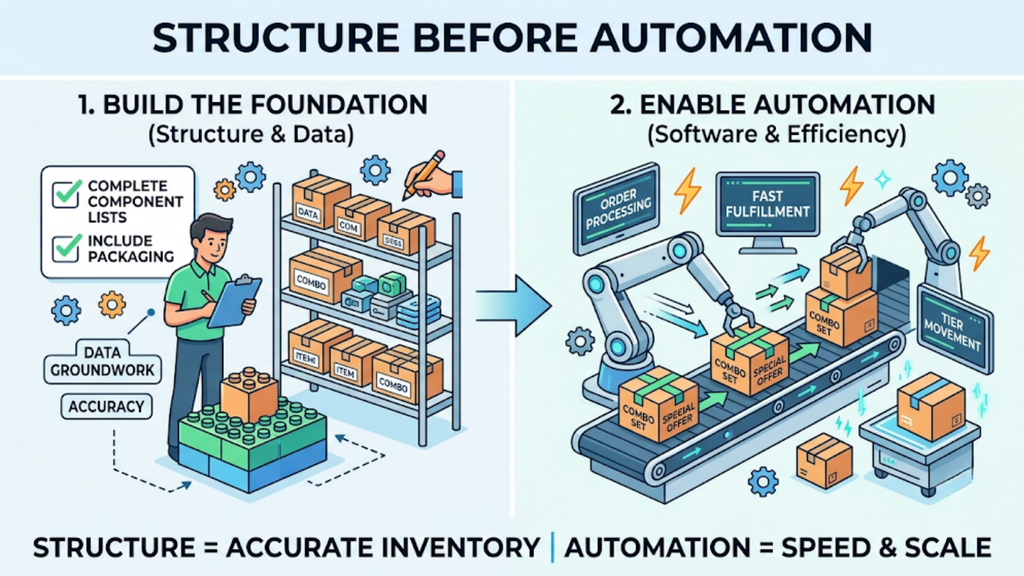
Tier movement is a data exercise before it becomes a software exercise. Component lists must exist, be complete, and include packaging.
Brands attempting to manage combo and bundle inventory in ecommerce without that groundwork end up with a faster version of the old problem. Structure comes first, automation second.
Most brands underestimate how much of this work is clerical rather than technical. Writing down what goes into each set, confirming quantities with the packing team, and agreeing a naming convention takes days of unglamorous effort. That effort, however, determines whether every later stage produces accurate numbers or merely faster wrong ones.
Work Backwards From Peak Week Using a 90-Day Countdown.
Gifting operations fail on timing more often than on capability. Planning forwards from today produces preparation that finishes too late.
The countdown below anchors every decision to your peak week, so build your own calendar outward from that date.
1. T-90 Days: Lock Combo Architecture and Component Lists
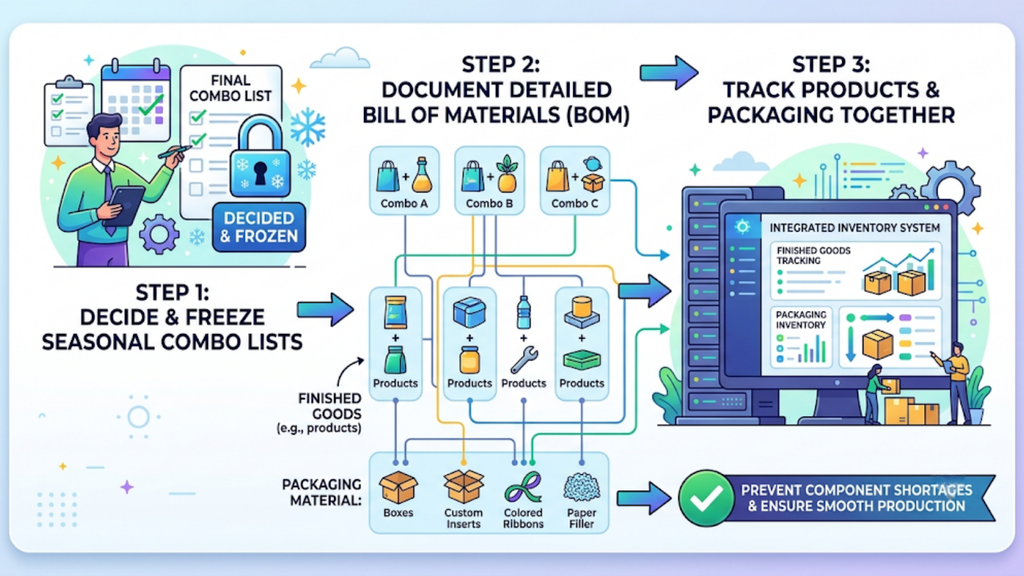
Decide which combos you will actually sell this season, then freeze that list. Late additions cause most component shortages.
Document each combo as a bill of components including boxes, inserts, ribbons, and filler. Base.com tracks packing material inventory alongside finished goods, so packaging enters the same plan as product.
2. T-75 Days: Convert Combo Forecasts Into Component Requirements
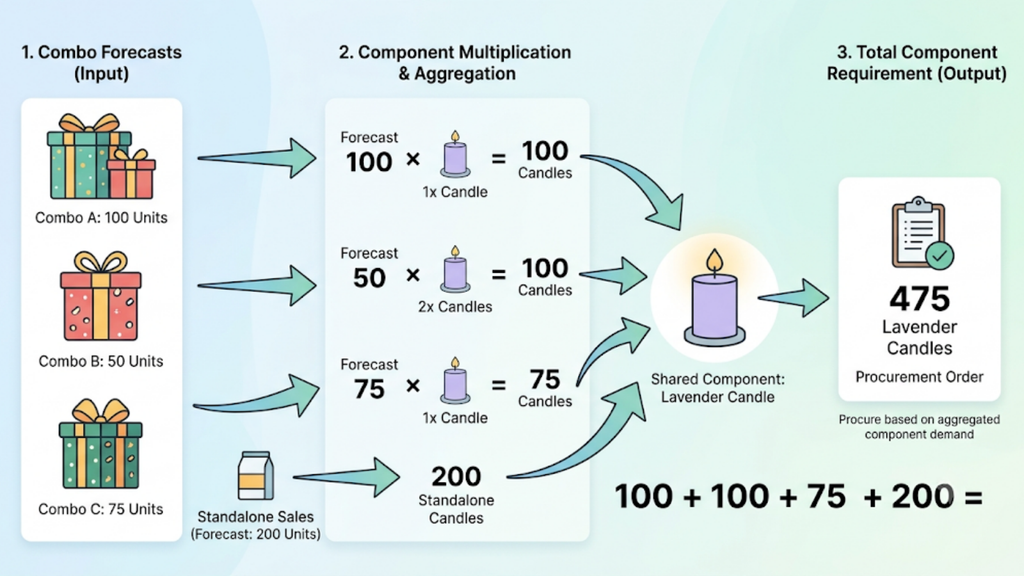
A combo forecast stays unusable until translated into component quantities. Multiply forecast units by the component list, then aggregate across every combo sharing that component.
Shared components deserve particular attention, since one candle may appear in five sets plus a standalone listing. Base.com supports forecasting and purchase order management, so procurement follows the aggregated requirement rather than a per-combo guess.
3. T-60 Days: Procure With Buffer Weighted Toward Shared Components
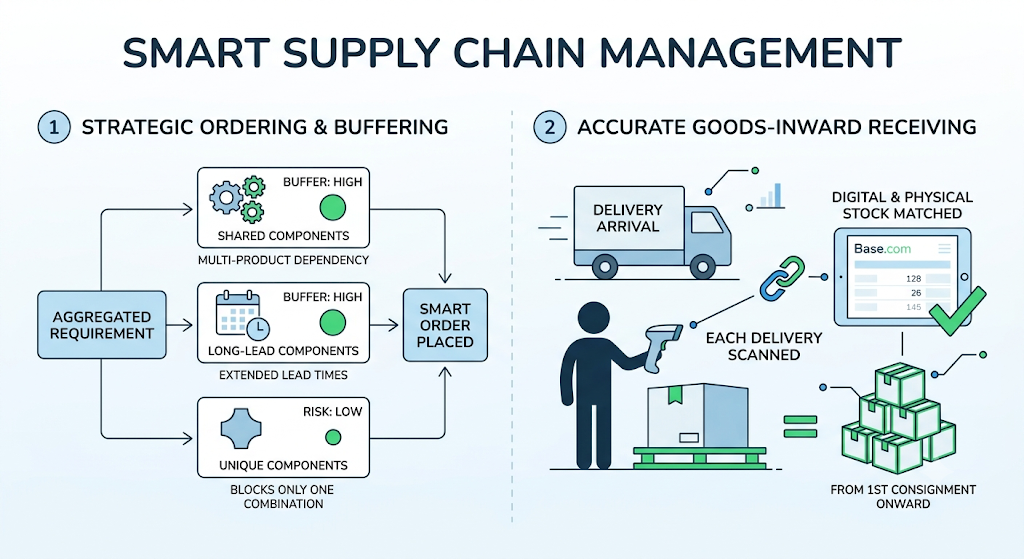
Order against the aggregated requirement, adding buffers specifically on shared and long-lead components. Unique components carry less risk because one shortage blocks only one combo.
Native goods-inward receiving in Base.com captures each delivery as a scanned event. Recorded stock then matches physical stock from the first consignment onward.
4. T-45 Days: Restructure Storage and Separate Sets From Components
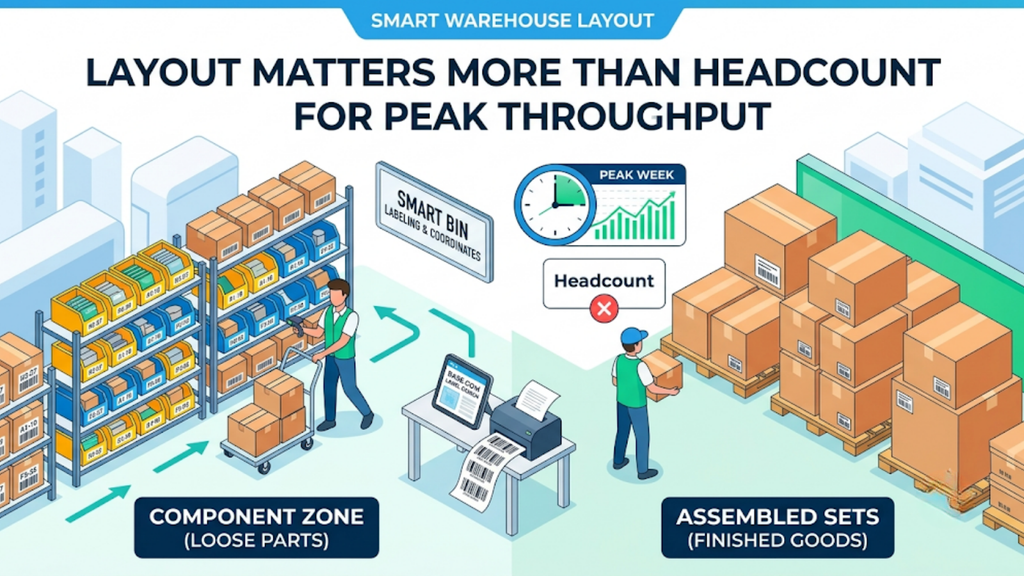
Physical layout decides peak-week throughput more than headcount does. Assembled sets and loose components need distinct, labelled locations.
Base.com assigns bin coordinates such as H2-37 and supports bulk barcode printing plus location label design. Pickers then collect components without disturbing pre-assembled stock.
5. T-30 Days: Switch On Automatic Component Deduction and Channel Sync
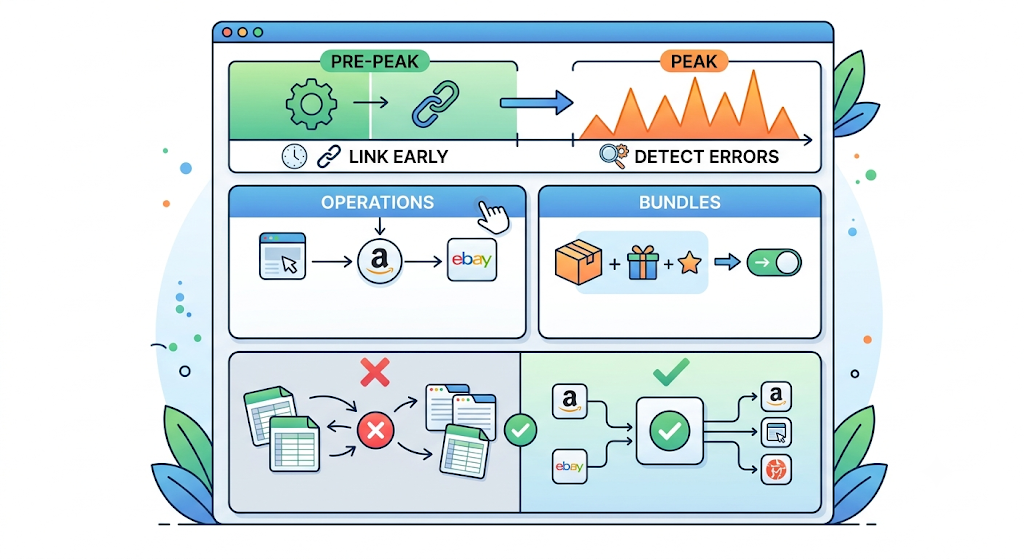
Go live with linked inventory a full month before peak, never during it. That month is your error-detection window.
Base.com consolidates website and marketplace orders into one operations view and syncs bundle availability to every listing. Manual per-channel uploads stop here.
6. T-14 Days: Pre-Assemble Core Combos and Dry-Run the Packing Line
Pre-assemble your top-selling sets while the floor still has spare capacity. Assembly during peak week is the single biggest throughput constraint.
Run a timed dry run through picking, assembly, packing, and label generation. Fix whatever breaks now, because peak week offers no room for diagnosis.
The value of this countdown lies in its ordering rather than its individual tasks. Procurement without a component conversion produces the wrong quantities, and storage restructuring after go-live forces a second stock count nobody has time for. Each stage exists to make the next one cheap, which is why skipping one rarely saves the time it appears to.
How Do You Keep Bundle Availability Accurate During Peak Week?
Peak week rewards preparation and punishes improvisation. These controls hold accuracy when order volume multiplies several times over.
Apply all six from the first day of your sale period.
1. Let the System Calculate Availability, Never a Person
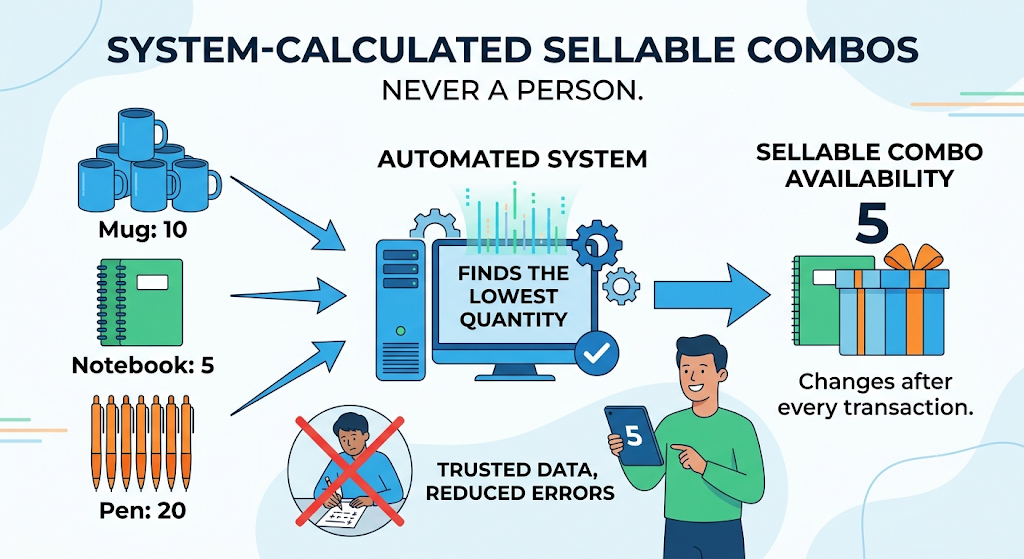
Sellable combo quantity equals the lowest available quantity across all components. That figure changes after every transaction.
Base.com recalculates continuously and pushes the result to every channel. Nobody should be typing stock numbers during a sale window.
2. Protect Shared Components From Silent Drain
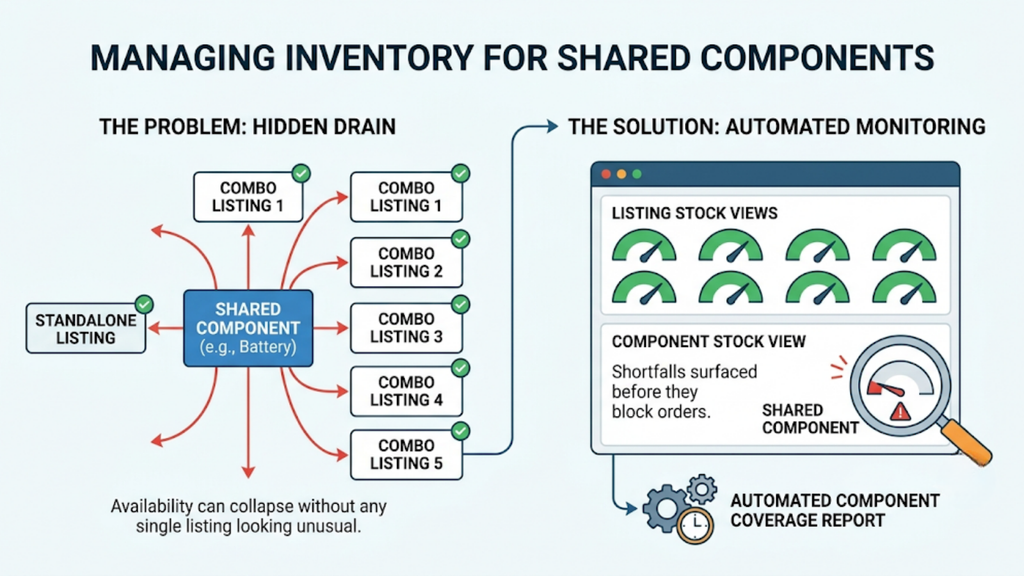
One component sitting inside five combos plus a standalone listing drains from several directions simultaneously. Availability can collapse without any single listing looking unusual.
Monitor shared components separately from unique ones. Base.com’s cron-based reports deliver component coverage lists automatically, so shortfalls surface before they block orders.
3. Treat Assembly as a Tracked Stage With Its Own Location
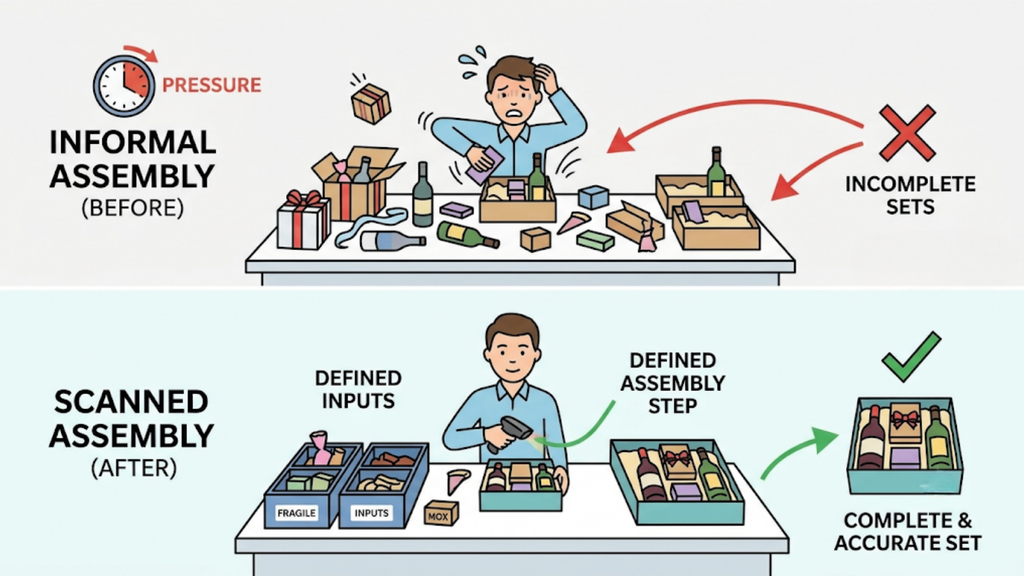
Informal assembly at the packing table produces incomplete sets under pressure. Scanning each component into the set removes that risk.
Base.com applies careful pick-and-pack rules for gift sets and fragile handcrafted items. Assembly becomes a defined step with defined inputs.
4. Route Fragile Consignments Through Suitable Carriers
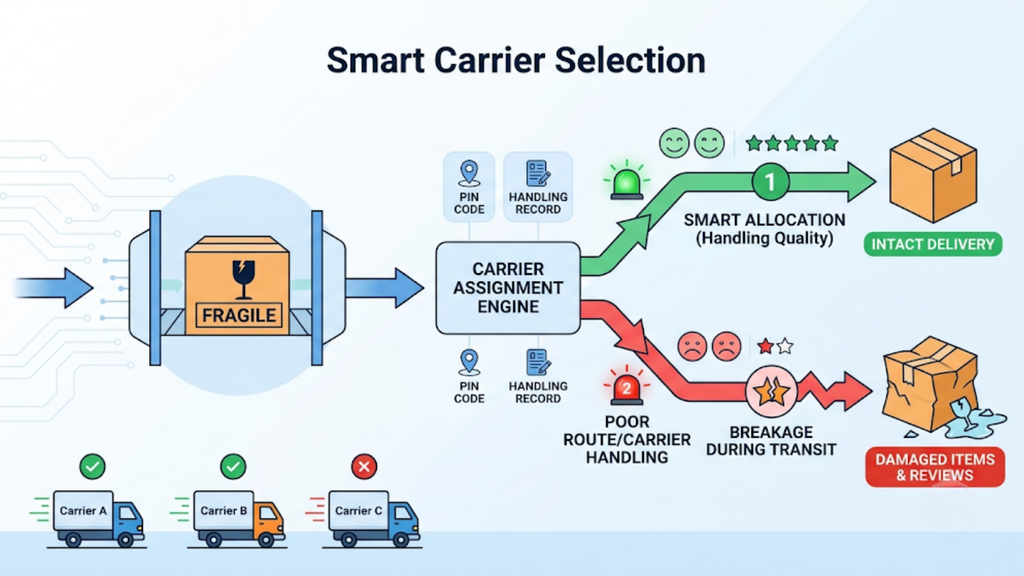
Handcrafted and glass components break in transit, and breakage during the festive season damages reviews at the worst possible moment. Carrier choice matters as much as packing material.
Base.com assigns couriers by destination PIN code and weight slab, with automatic failover when a partner cannot service an address. Breakables route through carriers with better handling records in that area.
5. Capture Returns at Component Level, Not Set Level
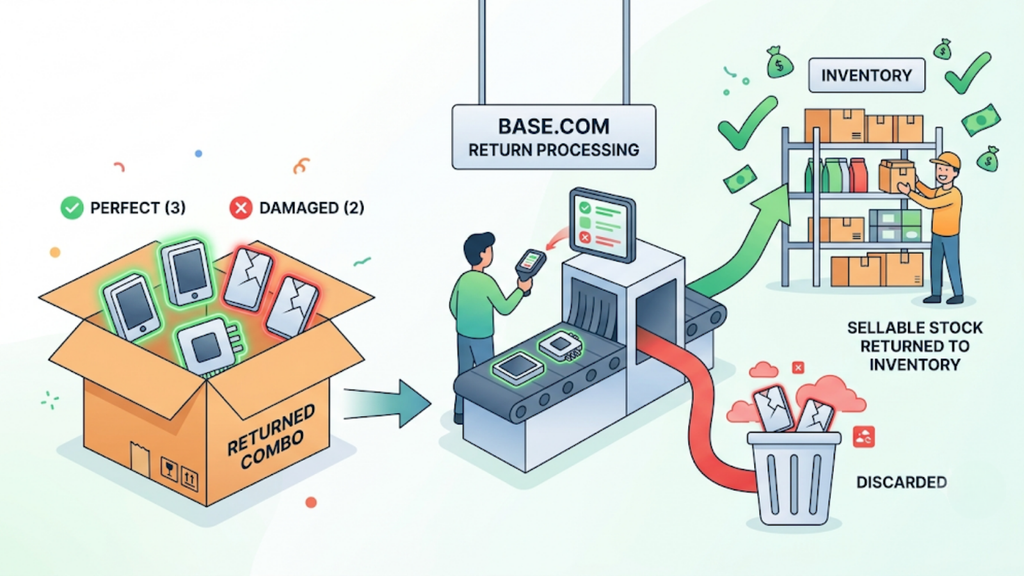
A returned combo often contains two damaged pieces and three perfect ones. Writing off the whole set discards sellable stock.
Base.com scans returns into condition-level statuses such as damaged, recoverable, and return-to-store. Usable components return to inventory rather than a rejection pile.
6. Review Coverage Daily Rather Than Weekly
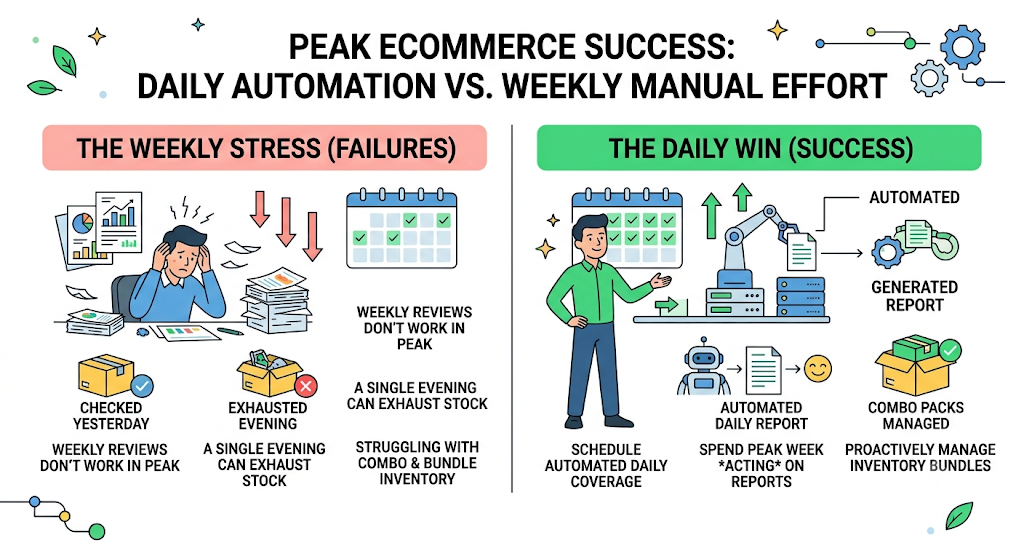
Weekly reviews work outside peak season and fail inside it. A single evening can exhaust a component you checked yesterday.
Schedule automated daily coverage reports for the full sale window. Brands executing how to manage combo and bundle inventory in ecommerce properly spend peak week acting on reports, not building them.
Notice that none of these controls ask anyone to work faster. They remove judgement calls from moments when judgement is least reliable, which is the only durable way to hold accuracy through a sale period. Speed during peak week comes from decisions already made, not from effort applied on the day.
Compare Manual Bundle Tracking Against Linked Component Inventory
The difference looks administrative in July and commercial in October. Mapping each failure to its cause makes the case concrete.
Score your current process against the table below, then count how many rows already cost you orders.
| Operational area | Manual bundle tracking | Linked component inventory | Cost of the gap |
| Bundle availability | Estimated and updated by hand | Calculated from weakest component live | Combos oversold, orders cancelled |
| Component deduction | Adjusted after dispatch | Automatic at dispatch | Same unit sold twice |
| Shared components | Drained invisibly across listings | Reconciled through one stock pool | Standalone listings oversell |
| Channel sync | Uploaded per marketplace | Pushed automatically to every listing | Account health penalties |
| Storage | Sets and components mixed | Separate mapped locations | Miscounts during peak weeks |
| Assembly | Informal at the packing table | Tracked stage with scanned components | Incomplete sets dispatched |
| Packaging materials | Rarely tracked as stock | Held as inventory alongside components | Dispatch stops for missing boxes |
| Festive planning | Reactive reordering | Component forecasting from combo demand | Shortages mid-season |
| Fragile dispatch | One default carrier | PIN-code and weight-based routing | Breakages and replacement costs |
| Returns | Whole set written off | Component-level condition capture | Sellable pieces discarded |
| Reporting | Rebuilt each week manually | Scheduled automated coverage reports | Shortfalls found too late |
Rows sitting in the left column form your requirement list. Take that list into every vendor demo you run.
Match Base.com Capabilities to Gifting and Bundle Operations
Most platforms treat bundles as an afterthought bolted onto single-product tracking. Gifting brands need them handled as core inventory instead.
Use this checklist to test each shortlisted platform against real Indian gifting operations.
- Bundles and gift sets as first-class stock: Base.com deducts component stock when a set sells, keeping combos and individual SKUs aligned.
- Virtual inventory management: Base.com models stock that exists across combinations rather than only as discrete units.
- Packing and raw material inventory: Base.com tracks boxes, inserts, and packaging alongside finished goods, so dispatch never stops for missing materials.
- Unified website and marketplace orders: Base.com brings D2C and marketplace demand into one queue with synced availability.
- Careful pick and pack for fragile items: Base.com applies handling rules built for handcrafted, breakable, and multi-item shipments.
- Bin-level storage mapping: Base.com assigns shelf coordinates to components and assembled sets separately, with bulk barcode printing support.
- PIN-code courier allocation with failover: Base.com switches partners automatically when a courier cannot service a destination.
- Condition-level returns intake: Base.com restocks recoverable components instead of writing off entire returned sets.
- Forecasting and purchase orders: Base.com converts demand planning into procurement, backed by native goods-inward receiving.
- Marketplace support and ticket management: Base.com offers a ticketing add-on, so platform-side queries run beside catalogue and fulfilment work during peak season.
Read that list as a set of connected capabilities rather than ten separate features. Component deduction only helps if storage separates sets from parts, and forecasting only helps if procurement records land as scanned inward events.
Brands solving how to manage combo and bundle inventory in ecommerce usually find that a single platform holding all of these beats three specialised tools that each solve one link in the chain.
What Should a Gifting Brand Budget for Bundle-Level Control?
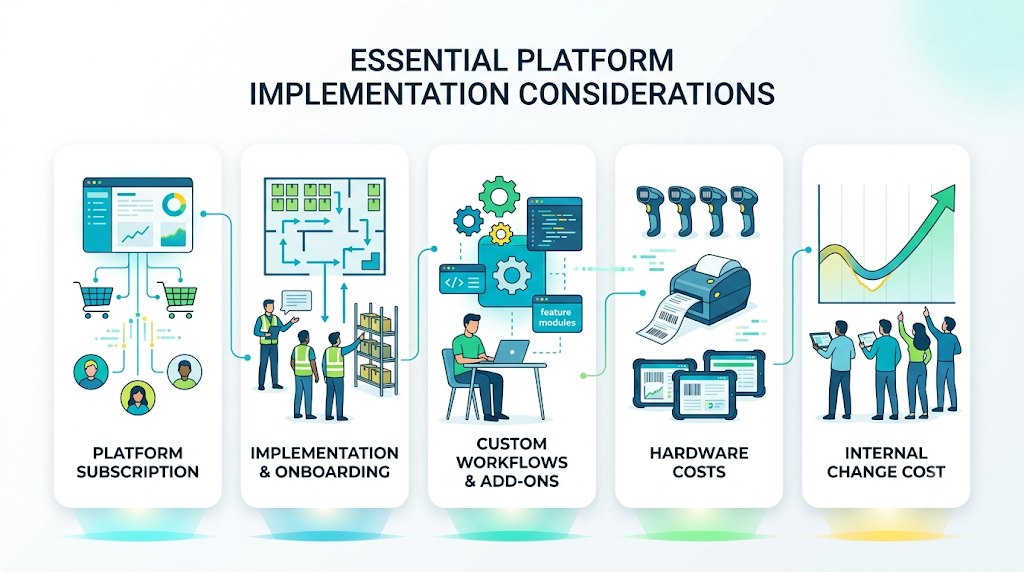
Costs shift with catalogue breadth, combo count, warehouse footprint and add-on scope, so published pricing rarely applies directly. Gifting brands should expect breadth to influence tiering more than order volume does.
Build your budget across these five heads rather than the subscription line alone.
- Platform subscription, tiered by order volume, active channels, and seller accounts.
- Implementation and onboarding, including on-site warehouse mapping and training for seasonal staff.
- Custom workflow or add-on development, quoted separately by most vendors, including Base.com for client-specific builds.
- Hardware, covering barcode scanners, thermal label printers and mobile devices for component picking.
- Internal change cost, meaning two to four weeks of reduced throughput while teams adapt.
Compare platforms on total first-year cost, not monthly licence. Brands planning how to manage combo and bundle inventory in ecommerce should also price festive cancellations and written-off components, since reverse logistics consumes 25–30% of order value on low-ticket Indian shipments.
Seasonal staffing deserves a line of its own in this calculation. Temporary hires learn the system during your busiest fortnight, so platforms requiring long training cycles cost more than their licence fee suggests. A scan-driven process that a new packer can follow on day two is worth considerably more than a feature nobody has time to learn.
Fix Bundle Control Before the Next Festive Window Opens
Gifting brands rarely regret restructuring early. They regret discovering component shortfalls during the three weeks that carry the year’s revenue.
The work itself is unremarkable: write down what goes into each set, separate your storage, link your stock, and let the system do the arithmetic. What makes it difficult is the calendar, because every month you delay compressing the same preparation into less time.
Identify your maturity tier, build the 90-day countdown backwards from peak week, and go live a full month before demand arrives. If you want a clear plan for how to manage combo and bundle inventory in ecommerce across your exact combo count, component breadth, and channel mix, book a Base.com operations review and get the countdown mapped to your own numbers.