Your brand is on Shopify, Amazon, Flipkart, Meesho, Myntra, and one more, maybe Jiomart, Blinkit, or your own app. Revenue is growing. The ops team is not.
What is actually happening inside that team every day is a series of context switches that compound into hours of wasted time. Someone opens Amazon Seller Central. Then, Flipkart Seller Hub. Then Meesho’s portal. Then Shopify. Then, a logistics aggregator dashboard. Then a spreadsheet to reconcile what all five just told them. By the time one complete cycle finishes, orders from 45 minutes ago are still unprocessed, and the inventory numbers in three of those portals are already wrong.
This is the hidden cost of multi-channel selling in India, not the platform commissions or the courier rates, but the operational friction of running six parallel workflows with six separate data sources and no single view of truth.
A single dashboard for Shopify, Amazon, Flipkart, Meesho, and Myntra in India is not a feature request. It is the operational infrastructure that makes selling across all these channels sustainable for a team that is not growing as fast as the order volume.
Why the Indian Multi-Channel Problem Is Uniquely Complex
India’s ecommerce landscape is unlike any other market in the world. Five platforms that are dominant, operationally distinct, structurally different, and each serving a materially different buyer.
Amazon India serves premium and brand-conscious buyers. Its seller performance metrics, Late Dispatch Rate, Order Defect Rate, and Buy Box eligibility, are strict and have real consequences. Flipkart dominates mobile-first and value buyers, and through Ekart, has the widest pincode coverage of any domestic courier.
Meesho, now India’s largest ecommerce platform by shipment volume at 29-31% of all ecommerce shipments in FY25, serves 213 million annual transacting users, with 87% coming from outside India’s top eight cities. Its average order value is Rs 274. It runs on 77% COD.
Myntra is category-specific to fashion with distinct content, imagery, and compliance requirements. And Shopify is the D2C channel where the brand controls pricing, margins, and customer data.
Each of these channels has a different:
- Seller portal and login
- Order data format and API structure
- SLA for dispatch acknowledgement
- Commission and fee structure
- Inventory management mechanism
- Returns and claims process
- Payment and COD remittance cycle
Running all five from separate portals does not just create inefficiency. It creates compounding inaccuracy. When inventory updates in one place but not the others, overselling follows. When NDRs pile up in one portal, and your ops team is in another, RTO follows. When payment remittances arrive in five formats, reconciliation delays follow.
A single dashboard for Shopify, Amazon, Flipkart, Meesho, and Myntra in India solves this structurally, not by simplifying the complexity, but by unifying it under one operational layer.
What “One Dashboard” Actually Means Operationally
The phrase is used loosely. Most sellers have experienced “dashboards” that aggregate data for reporting, but do not actually let operations teams act from them. A read-only summary of your five channels is not a single dashboard in the meaningful sense.
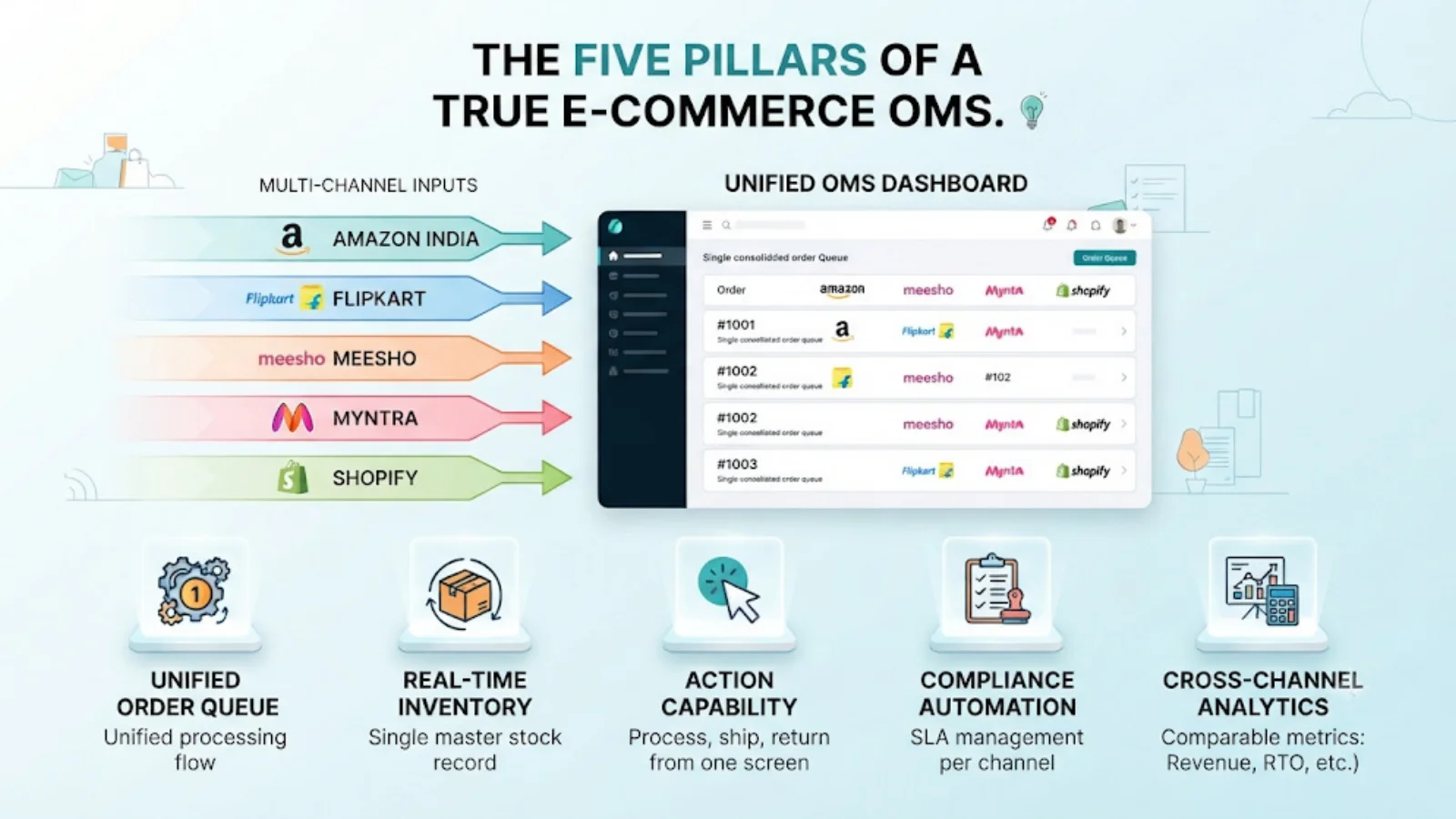
A true unified operations dashboard for Indian multi-channel D2C brands does five things, not just one.
1. Unified order queue across all channels
Every order from every channel, Amazon, Flipkart, Meesho, Myntra, Shopify, and any additional channel, flows into a single processing queue. The ops team works from one screen, one set of statuses, one workflow. Not five. The order has a source tag showing its origin channel, but the processing workflow is identical regardless of where the order came from.
2. Real-time inventory with a single master record
One inventory number per SKU, updated in real time as orders come in from any channel. Not Shopify’s count, Amazon’s count, and Flipkart’s count exist as three separate numbers that drift apart throughout the day. One number. When a unit sells on Meesho, it is immediately deducted from the inventory visible to all other channels. When a return is received and passes QC, it is added back. The master record lives in the OMS, not in any individual channel.
3. Action capability, not just visibility
The dashboard must allow the ops team to process, route, print labels, initiate reverse pickups, update inventory, and close returns, all from within the unified interface. A dashboard that shows you a problem without letting you fix it on the same screen is a reporting tool, not an operational control.
4. Channel-specific compliance automation
Each channel has different SLA requirements, invoice formats, and dispatch acknowledgement protocols. The unified dashboard handles these differences automatically in the background, generating the right invoice format for the right channel, pushing dispatch acknowledgements to each marketplace API, and flagging SLA breaches before they cross the threshold that triggers marketplace penalties.
5. Cross-channel analytics with a shared denominator
Revenue per channel, RTO rate per channel, order processing time per channel, and contribution margin per channel, all calculated on the same data model, are comparable against each other. Not pulled separately from five dashboards and manually assembled in a spreadsheet.
This is what a single dashboard for Shopify, Amazon, Flipkart, Meesho, and Myntra in India looks like when it is built to actually run operations, not just report them.
The 7 Operational Problems It Solves
As Indian ecommerce brands scale across Shopify, Amazon, Flipkart, Meesho, and Myntra, operational complexity grows exponentially. Inventory sync issues, SLA breaches, reconciliation delays, fragmented returns, and poor visibility can quickly erode efficiency and profitability.
A modern OMS for ecommerce brands in India solves these challenges by centralising operations, automating workflows, and creating a single source of truth across every sales channel.
Problem 1: Inventory Overselling Across Channels
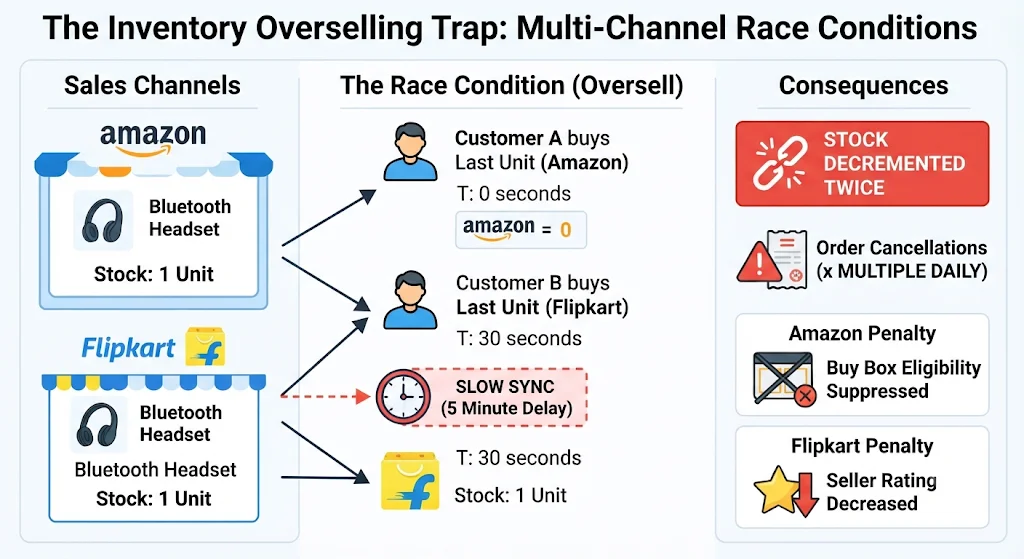
Every minute of the day, an ops team without a unified inventory layer is managing a race condition. An Amazon sale and a Flipkart sale that happen 30 seconds apart can both decrement the same unit of stock, but if the sync between systems takes 5 minutes, the second sale goes through on stock that no longer exists.
At low volume, this is occasional. At 500 orders per day across channels, this happens multiple times daily. Each oversell triggers a marketplace cancellation, which damages seller performance metrics. On Amazon, even a small number of cancellations can suppress Buy Box eligibility. On Flipkart, it affects the seller rating directly.
A unified inventory layer in Base.com maintains a single master stock count. Stock is reduced as soon as the order comes into Base.com, and the updated quantity is sent to every other connected channel at the next sync. On Business plans this sync runs in real time; on the free plan it runs every hour. This sharply reduces the risk of selling the same last unit twice.
Problem 2: Missed SLA Breaches on Marketplace Orders
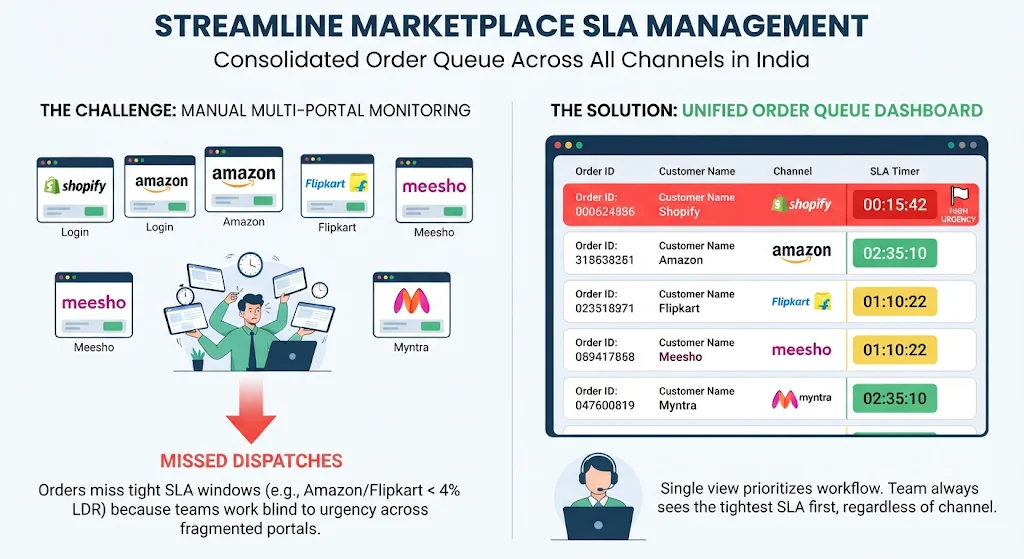
Amazon’s Late Dispatch Rate threshold is 4%. Flipkart’s equivalent is similarly strict. When an ops team is working across five separate portals, orders that need dispatch acknowledgement within a tight window can miss that window simply because the team was working in a different portal when the clock ran out.
A unified order queue with SLA timers visible for every order, regardless of channel, means the team never works blind to urgency. The oldest unprocessed order at the top of the queue. The one with the tightest SLA is flagged in red. The operations manager can see, at a glance, whether the team is ahead of or behind the SLA on every channel simultaneously. A single dashboard for Shopify, Amazon, Flipkart, Meesho, and Myntra in India converts SLA management from a manual monitoring task into a visible, prioritised workflow.
Problem 3: COD Reconciliation Consuming Finance Team Bandwidth
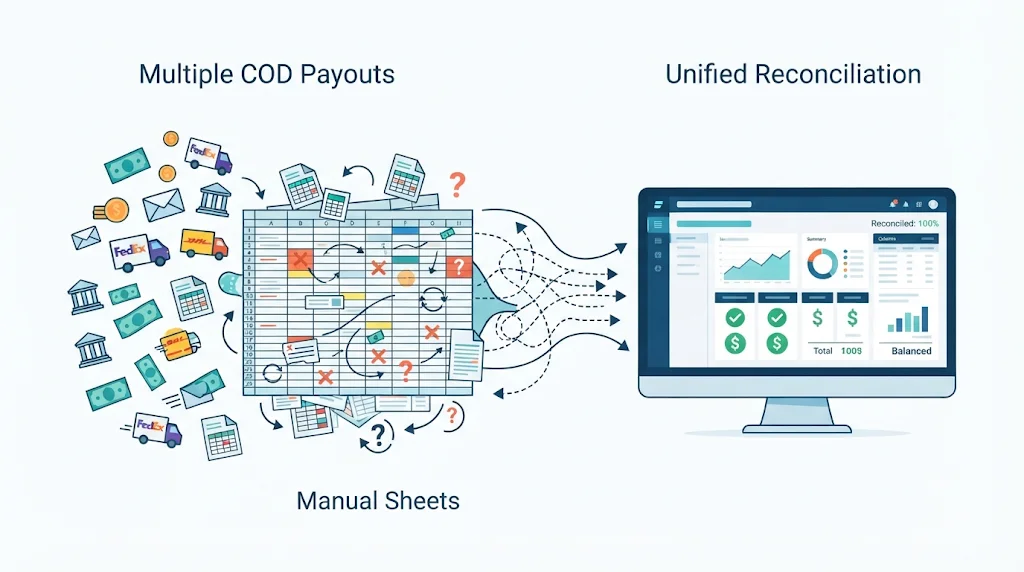
Meesho runs 77% COD. Flipkart has significant COD volume in Tier 2 and Tier 3 markets. Across five channels with three or more courier partners, a brand processing 1,000 daily orders generates COD remittance data in 5-8 different formats, on different cycles, from different partners.
The finance team’s job is to match every remittance against every order, identify discrepancies, and close the books weekly. Without a unified system, this involves downloading multiple files, building a reconciliation sheet, and manually identifying mismatches, a process that takes 1-2 days per week at scale.
With every order, shipment and COD amount held in one Base.com order record, the finance team can match courier remittances against orders from one place instead of pulling data from each courier portal. That makes the weekly reconciliation far quicker to complete.
Problem 4: Returns Processed in Isolation Per Channel
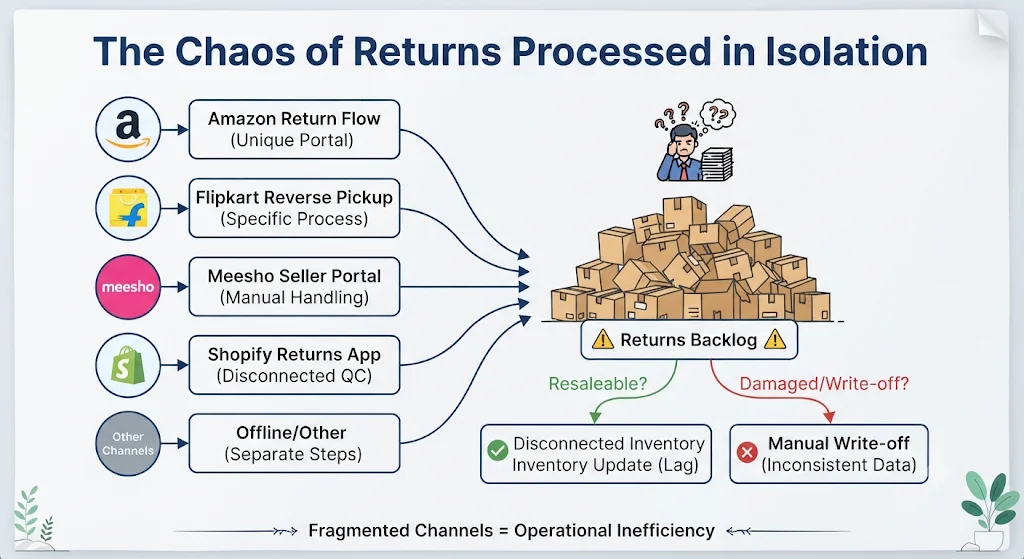
Each channel handles returns differently. Amazon has its own return initiation flow. Flipkart has its own reverse pickup mechanism. Meesho manages returns through its own seller portal. A Shopify return is managed through Shopify or a connected returns app.
When a brand processes 200 returns per day across these five channels, each one entering through a different system and requiring a separate manual step, the returns backlog grows faster than the team can clear it. Quality check results, whether an item is resaleable or must be written off, are not linked back to inventory in any consistent way.
A unified returns workflow in Base.com receives all return requests from all channels through a single interface. QC is logged at the warehouse against the original SKU. Inventory updates automatically based on QC outcome. Refund or replacement is triggered from the same screen. The channel of origin is recorded, but does not change the workflow.
Problem 5: Pricing Inconsistency Across Channels
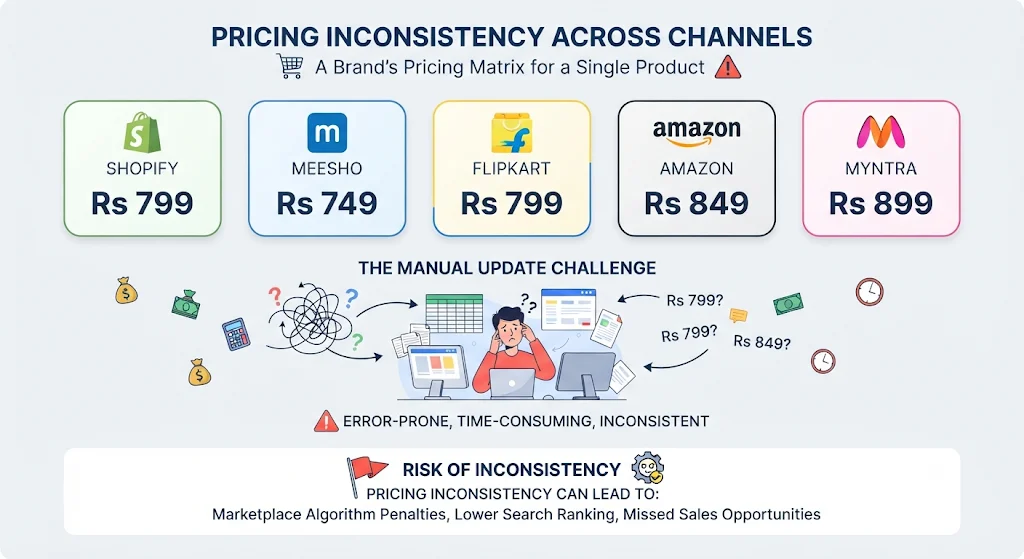
Managing pricing manually across five channels is an error-prone, time-consuming process. A brand that prices a product at Rs 799 on Shopify, Rs 749 on Meesho (to compete on that channel’s value positioning), Rs 799 on Flipkart, and Rs 849 on Amazon needs that matrix to be maintained accurately. Manual updates mean changes made on one portal are not reflected on others until someone gets around to it, creating pricing inconsistency that marketplace algorithms can flag.
A unified product catalogue in Base.com maintains a pricing matrix per SKU per channel. Price changes flow from the master catalogue to each marketplace’s listing automatically. The ops team makes one change. All channels are updated.
Problem 6: Catalogue Maintenance Across Different Content Requirements
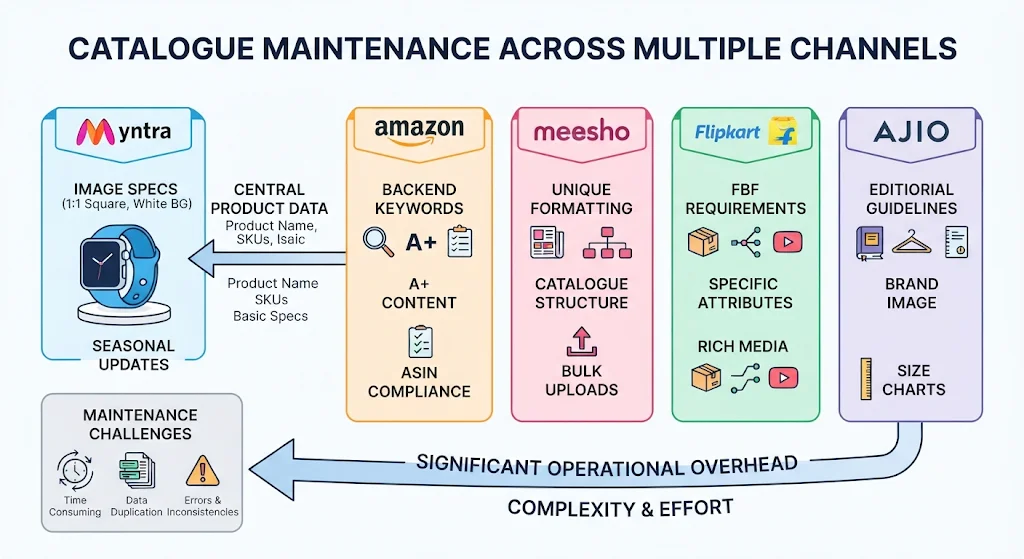
Myntra has specific image dimensions, background requirements, and attribute formats. Amazon requires backend keywords, A+ content, and ASIN-level compliance. Meesho’s catalogue formatting differs from both. A product listed on all five channels requires five different content configurations, and keeping them maintained as products change, seasonal images are updated, or compliance requirements evolve is a significant operational overhead.
A unified catalogue management layer in Base.com stores the master product record and maps it to channel-specific templates. When a product image is updated or a description is revised, the change propagates to all connected channels in the correct format for each. New SKU onboarding across all five channels happens from one interface, not from five separate listing flows.
Problem 7: No Cross-Channel Performance Visibility
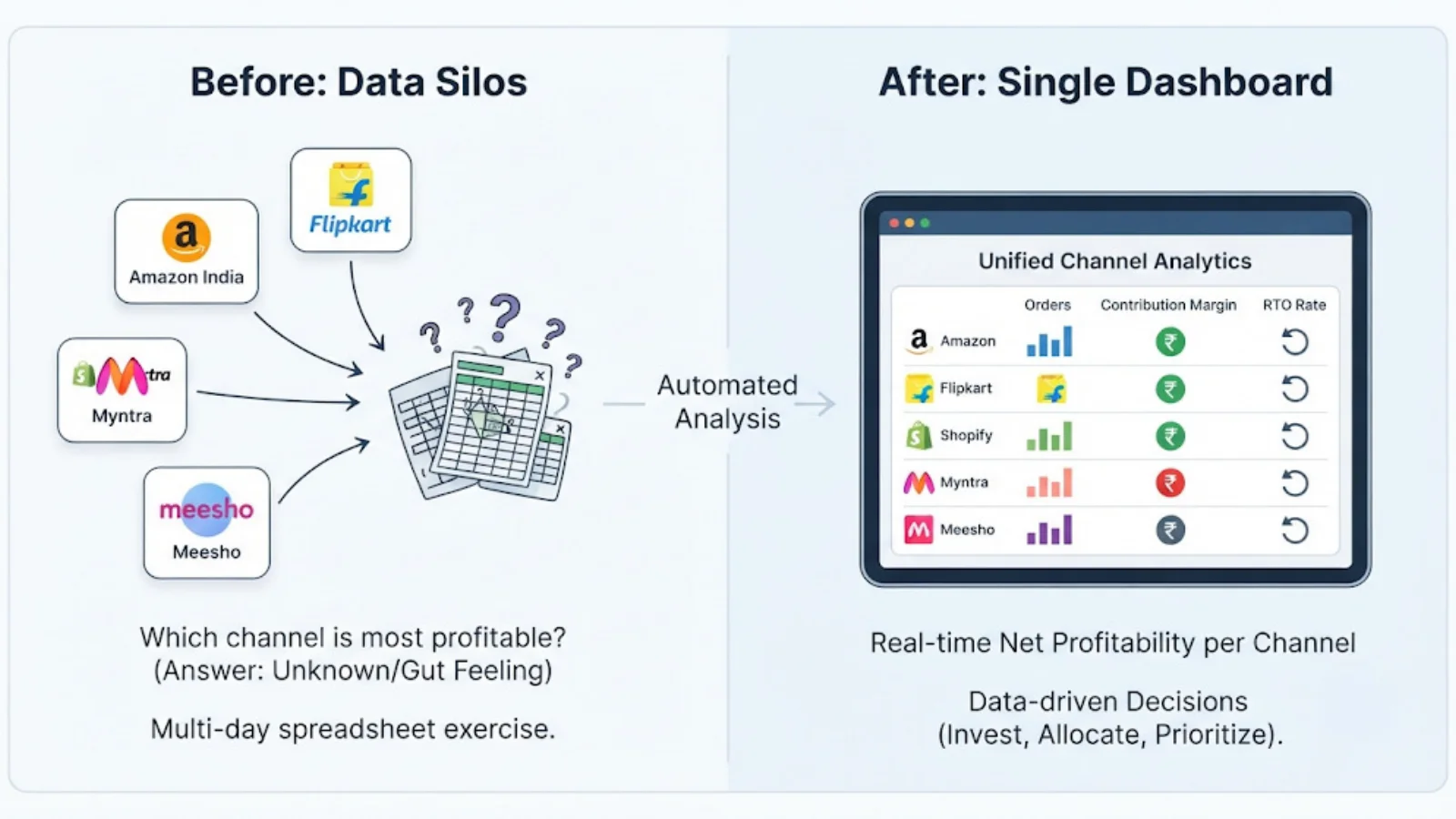
“Which channel is actually most profitable for us?” is a question most Indian D2C brands cannot answer accurately because their data lives in five separate places. They know their Amazon revenue. They know their Flipkart revenue. But net contribution margin per channel, after platform commissions, courier costs, COD handling, and returns, is rarely visible without a multi-day spreadsheet exercise.
A single dashboard for Shopify, Amazon, Flipkart, Meesho, and Myntra in India that is built on a shared data model produces this analysis automatically. The ops manager can see, for any time period, which channel is generating the highest orders, the lowest RTO rate, the best contribution per order, and the worst performance metrics. Channel strategy decisions, where to invest in advertising, where to tighten inventory allocation, which channel to prioritise during a sale event, become data-driven rather than intuition-driven.
How Base.com Delivers the Unified Dashboard
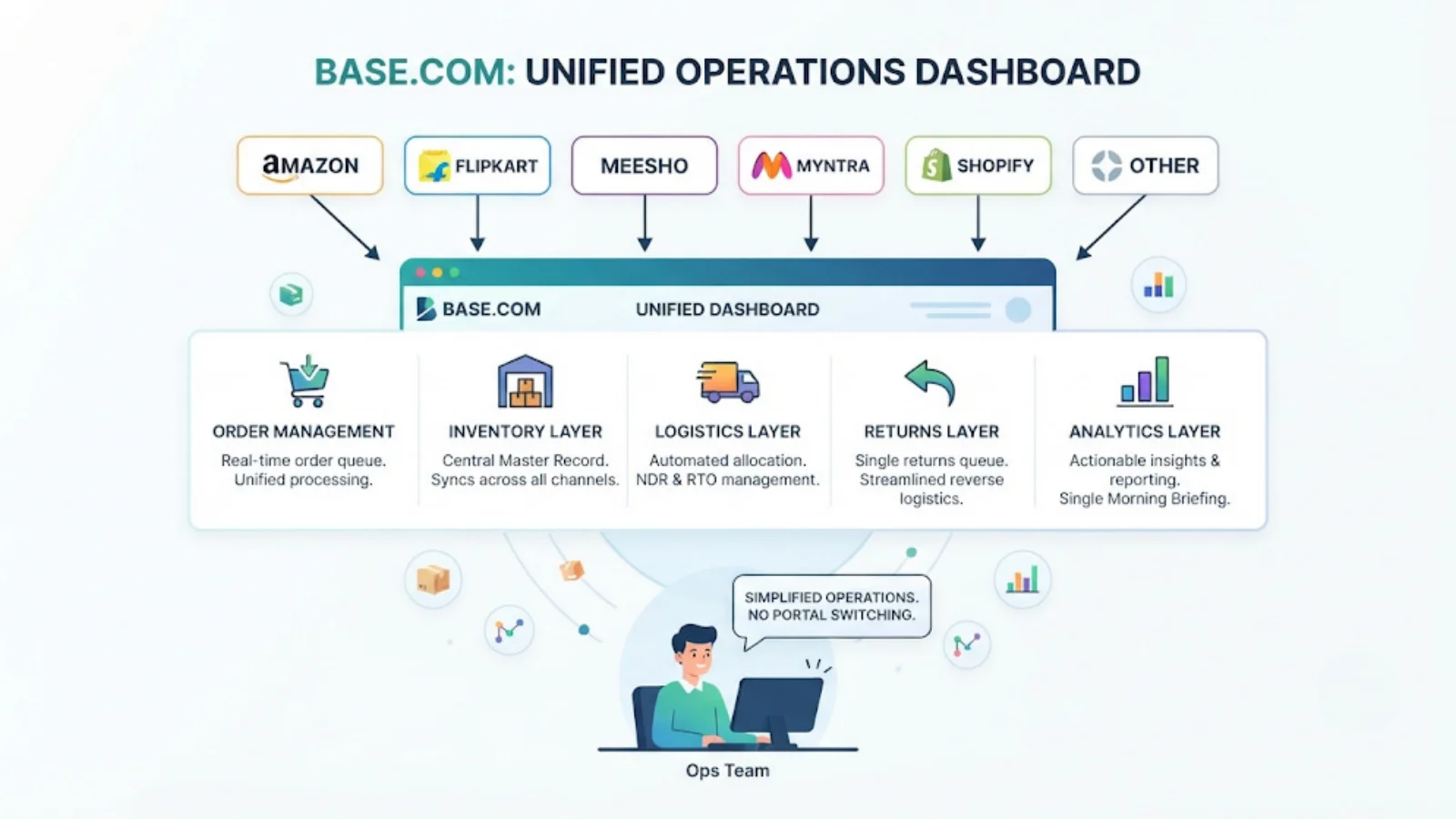
Base.com is an OMS and WMS platform built specifically for the Indian multi-channel ecommerce environment. It integrates with Shopify, Amazon India, Flipkart, Meesho, Myntra and over 2,000 other marketplaces, online stores and courier partners, all managed from one panel.
The unified dashboard in Base.com gives an ops team one operational environment for the full order lifecycle across every channel.
- Order Management Layer
Every order from every connected channel flows into the Base.com order queue in real time. The queue is filterable by channel, by order status, by SLA urgency, by warehouse assignment, and by courier. The ops team processes, routes, and dispatches from this single interface. Marketplace-specific SLA clocks are visible per order. Dispatch acknowledgements are pushed back to each marketplace API automatically.
A brand running 1,000 daily orders across six channels processes them in Base.com as if they were all from a single channel, with the ops workflow unified, the channel-specific compliance automated, and the team never needing to log into individual seller portals for order processing.
- Inventory Layer
Base.com holds the master inventory record. Every sale, every return, every restock, and every warehouse transfer updates this master record. The updated count is then synced to every connected channel: in real time on Business plans and every hour on the free plan. Amazon, Flipkart, Meesho, Myntra, and Shopify all see the same inventory number, the correct one.
For brands with multiple warehouse locations, Base.com’s inventory layer maintains bin-level stock visibility across all locations simultaneously. Allocation rules determine which warehouse fulfils which channel’s orders, with zone-based courier cost optimization applied automatically.
- Logistics Layer
Base.com integrates with Delhivery, XpressBees, Ecom Express, Shadowfax, Ekart, Blue Dart, DTDC, Smartr, and the major shipping aggregators. Courier allocation rules are configured once and run automatically; every order is assigned to the optimal carrier based on pincode, order value, payment type, and channel-specific requirements. Fallback rules activate when a carrier degrades without any manual reconfiguration.
NDR management runs automatically. Failed delivery attempts trigger customer WhatsApp notifications within minutes. Reattempt scheduling is handled without the ops team’s intervention. RTO rates are tracked by channel, by courier, and by pincode, giving the team the data to continuously optimise carrier allocation.
- Returns Layer
All return requests from all channels flow into a single returns queue in Base.com. Return intake, QC logging, inventory updates and customer communication are all managed from the same interface. Channel of origin does not change the workflow, which means the returns team processes a Meesho return and a Shopify return using the same steps, with no portal switching.
- Analytics Layer
Base.com’s reporting module calculates channel-level performance on a shared data model. Orders, revenue, RTO rate, return rate, courier performance, SLA compliance, and contribution margin are all available per channel, per time period, and per SKU, without manual spreadsheet assembly. The ops manager’s morning briefing is visible in a single screen rather than assembled from five separate portal reports.
The Before and After: A Day in Your Ops Team
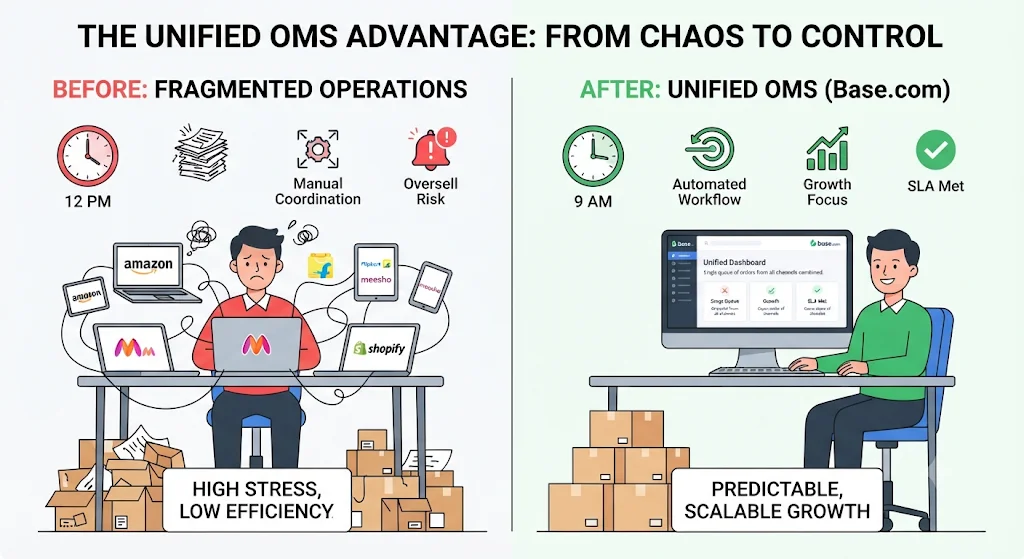
The difference between fragmented operations and a unified OMS becomes most visible in the daily experience of the team. Before implementation, hours were consumed by manual coordination, spreadsheet work, and switching between multiple platforms.
After implementation, workflows became automated, prioritised, and predictable, allowing the team to process more orders, meet SLAs consistently, and focus on growth-driving activities instead of operational firefighting.
Without a unified dashboard:
8 AM: Log into Amazon Seller Central. Process and acknowledge 80 overnight orders. Check account health metrics. Log in to Flipkart Seller Hub. Process 60 Flipkart orders. Log in to the Meesho portal. Process 200 Meesho orders, the largest volume, lowest AOV, and highest COD percentage. Log in to the Myntra seller portal. Process 30 Myntra orders with Myntra-specific compliance checks. Log in to Shopify. Process 40 Shopify orders. Start printing labels from three separate aggregator interfaces. The warehouse team receives five different picklists from five different sources.
10 AM: First oversell notification from Amazon. The same SKU was available on both Amazon and Flipkart, and it sold on both. One order must be cancelled. Marketplace cancellation metric worsens. Someone manually updates inventory across all portals.
12 PM: Finance team asks for yesterday’s COD remittance reconciliation. Begins downloading files from three couriers. Will finish tomorrow.
4 PM: Returns from yesterday are still unprocessed because the team spent the morning catching up on order processing. Three Meesho return windows are at risk of closing.
With Base.com’s unified dashboard:
8 AM: Ops manager opens one screen. 410 orders from overnight, all channels combined, sit in a unified queue with SLA timers showing urgency. Batch picking instructions are already generated for the warehouse based on channel priority and courier cut-off times.
9 AM: All 410 orders processed, labelled, and dispatched. No portal switching. Marketplace SLA acknowledgements have already been pushed automatically.
10 AM: An SLA warning appears; 12 Flipkart orders are approaching their dispatch window. Manager reviews and clears them. No breach.
11 AM: Finance team’s COD reconciliation dashboard shows yesterday’s remittances auto-matched. Two discrepancies flagged. Resolved in 20 minutes.
12 PM: Yesterday’s 47 returns processed in the unified returns queue. QC results logged. Inventory updated. Three Meesho returns cleared before the window closed.
The ops team in scenario two is not larger. It is just not fragmented.
What to Assess Before Implementing a Unified Dashboard
Not every brand at every stage needs a full OMS implementation. Use this checklist to determine readiness.
| Signal | Implication |
|---|---|
| Selling on 3+ channels simultaneously | Unified inventory is non-negotiable at this point |
| Processing 200+ orders/day total | Manual channel-by-channel processing is consuming significant hours |
| COD volume above 40% across channels | Remittance reconciliation is a recurring finance bottleneck |
| Returns above 100/day | A unified returns workflow saves hours daily |
| One or more marketplace performance warnings in the last 90 days | SLA and metric management from a unified queue is urgent |
| More than 3 people in ops are doing data entry between portals | The labour cost of fragmented operations exceeds the OMS cost |
If three or more rows apply, the operational cost of fragmented portals exceeds the cost of a unified system, and the time to implement is now, before scale makes the fragmentation worse.