
As D2C brands, Crossing ₹10Cr in annual revenue feels like proof. The product works. Paid ads convert. Revenue is predictable. Investors return your calls. But ₹10Cr is validation, not scale. What got you here will not get you to ₹100Cr.
In India, many D2C brands reach ₹5–10Cr. Far fewer cross ₹30Cr. Fewer still build profitable ₹50Cr businesses. And only a small fraction become durable ₹100Cr brands. The drop-off happens because growth complexity compounds faster than revenue.
Scaling from ₹10Cr to ₹100Cr demands a shift in thinking. Unit economics must tighten. CAC and LTV must be measured honestly. Inventory discipline becomes survival. Distribution expands beyond one channel. Pricing must protect contribution, not just drive volume.
This stage is less about hacks and more about systems. The brands that win treat scale as operational design, capital allocation, and brand building, working together. That’s the real journey from ₹10Cr to ₹100Cr.
Why Most D2C Brands Get Stuck at ₹30Cr — And What Changes After ₹10Cr ARR
The ₹20–30Cr stage is where momentum hides structural weakness. At ₹10Cr, performance marketing, one hero SKU, and aggressive discounts can drive growth. By ₹30Cr, those same levers start breaking.
Take a typical Indian D2C brand doing ₹2–3Cr a month. CAC has quietly risen 25–40% over 18 months due to higher CPMs. The hero SKU now contributes 60% of revenue, increasing dependency risk. Repeat rate looks decent on dashboards, but when cohort data is cleaned, only 28–35% reorder within 90 days. The rest were discount-driven buyers.
Founders often underestimate how unit economics shift at scale. ROAS on Meta may still look healthy at 3x, but blended CAC across Meta, Google, influencers, affiliates, and marketplace ads is far higher. Meanwhile, returns and RTO in India, especially with COD-heavy orders, silently erode contribution. A 20% RTO rate can wipe out 4–6% of net margin.
Another blind spot is working capital. As revenue doubles, inventory requirements often triple because SKUs expand, safety stock increases, and marketplace commitments lock inventory. Many ₹50Cr brands are technically profitable on a P&L basis but face cash stress because money is stuck in slow-moving stock and 45-day marketplace payout cycles.
The real shift after ₹10Cr ARR is this: growth must be measured by contribution margin and payback period, not just revenue. Healthy Indian D2C brands at scale aim for sub-6-month payback and category-appropriate LTV/CAC ratios, but based on real retention cohorts, not projections.
The Real Journey from ₹10Cr to ₹100Cr in D2C
Most founders think scaling is about increasing ad budgets, launching new SKUs, or entering more channels. That works for a while. Then growth slows, margins shrink, and cash gets tight.
The journey from ₹10Cr to ₹100Cr is not a straight line. Each revenue stage brings a new constraint. marketing efficiency weakens around ₹20Cr, operational cracks appear near ₹30Cr, cash flow becomes fragile by ₹50Cr, and leadership gaps begin hurting execution between ₹70-80Cr.
What separates brands that cross ₹100Cr from those stuck at ₹30–50Cr is not luck or funding. It is discipline. Discipline in contribution margin. In pricing, inventory and channel expansion.
Below is a step-by-step scale journey in 10 stages. Each stage outlines the real issues Indian D2C founders face and the practical solutions that actually work in this market.
If you treat scale as a systems problem, not just a marketing problem, ₹100Cr becomes achievable.
The brands that cross ₹100Cr build financial discipline early. The ones stuck at ₹30Cr keep chasing top-line growth while unit economics quietly weaken.
1. ₹10Cr → ₹20Cr: Stop scaling ROAS, start scaling contribution
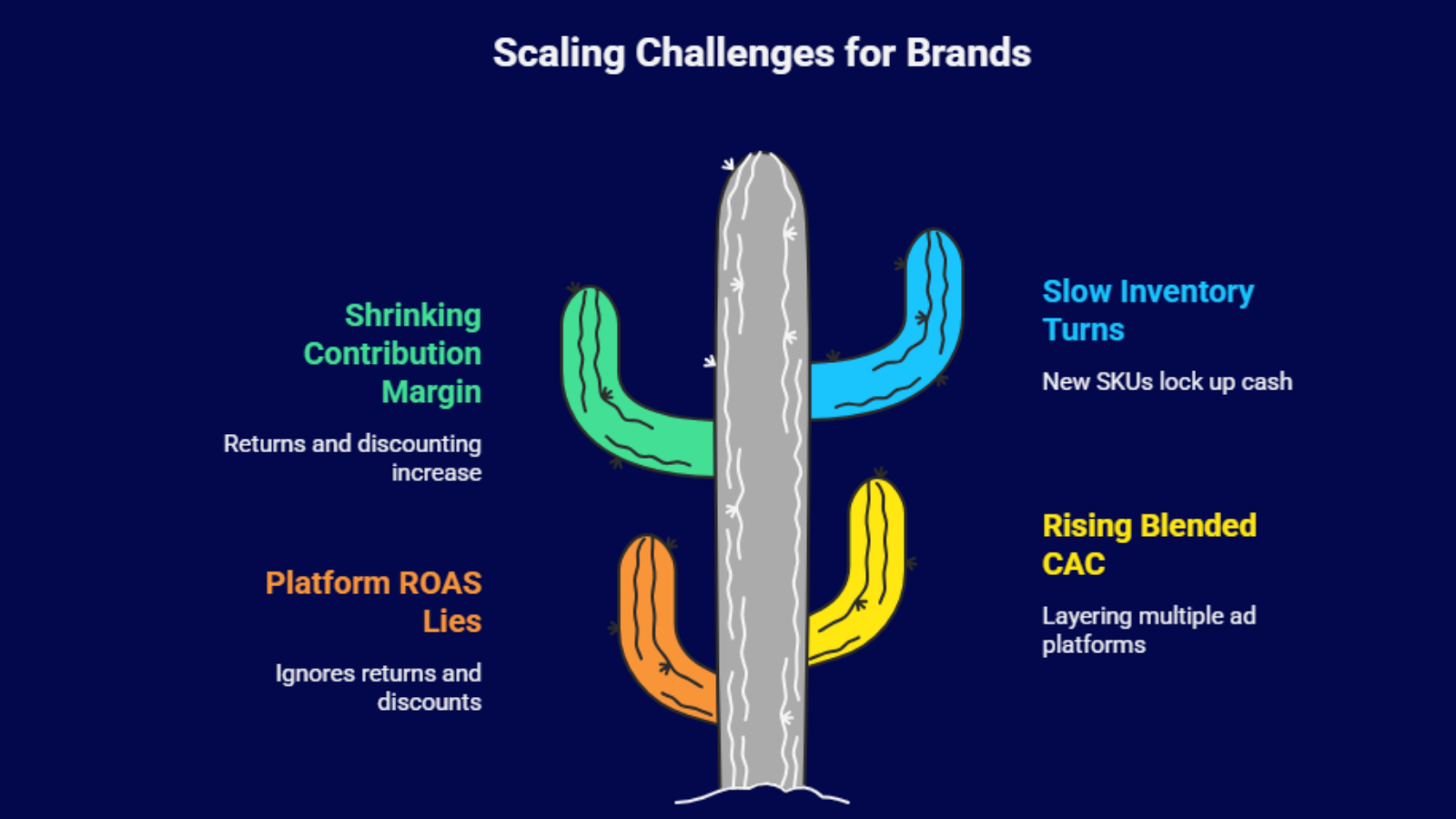 At ₹10Cr, most brands run on a simple loop: launch offers → run Meta/Google → watch ROAS → reorder stock. That loop breaks as soon as you try to double-spend. The first issue is that platform ROAS lies by omission: it ignores returns, RTO, COD leakage, and the “hidden” cost of freebies/discounts. Solution: switch your weekly dashboard from ROAS to contribution margin per order and payback period.
Issues you’ll hit
- CAC looks stable on Meta, but blended CAC is rising because you’re layering Google, influencers, affiliates, WhatsApp, and sometimes marketplace ads.
- Contribution quietly shrinks because returns/RTO and discounting increase as you chase volume.
- Founders keep adding SKUs, hoping to grow AOV, but new SKUs slow inventory turns and lock cash.
What to do now
- Define “scale-ready unit economics”: Contribution margin after shipping + payment gateway + packaging + returns/RTO + marketing.
- Set payback targets: 4–6 months max at this stage. If payback is longer, you’re buying growth with working capital.
- Fix COD leakage early: reduce COD % over time, add address verification, OTP confirmation, and courier performance scorecards by zone.
- Build real cohorts (not averages): 30/60/90-day repurchase, by acquisition source and by SKU. If 60–70% don’t reorder, you don’t have LTV yet.
Outcome
If you can hold a contribution while growing, you earn the right to scale spend. If you can’t, the next stage (₹20–30Cr) will punish you with rising CAC and cash stress.
2. ₹20Cr → ₹30Cr: Why growth marketing fails and how to restructure the engine
This is where many brands get stuck because they assume “more spend = more revenue.” At ₹20Cr, CPMs rise, audiences saturate, and creative fatigue accelerates. CAC creeps up 20–40%, and the brand keeps spending because the top-line still grows. That’s how you end up with impressive revenue and weak contributions.
Issues you’ll hit
- Performance marketing starts cannibalising your own demand (retargeting-heavy accounts look profitable but don’t grow incremental customers).
- You run the same “% off” playbook more often. Discounts stop being a lever and become a habit.
- You hire “growth marketers” who are great at campaigns but not at building retention loops.
Solutions that actually work
- Rebalance the mix: as you approach ₹30Cr, aim for 60–70% performance, 20–30% brand, 10% experimentation. Not because it’s fashionable, but because the brand lowers future CAC.
- Build a creative factory: weekly creative testing pipeline (UGC, demos, founder-led, problem/solution, comparison). Treat creatives as operations function, not an occasional shoot.
- Shift growth from acquisition to retention: lifecycle messaging (WhatsApp/email), replenishment reminders, post-purchase education, referral loops, subscription, where applicable.
- Stop measuring “ROAS”; start measuring incrementality (holdout tests, geo tests, and clean attribution).
Outcome
Your objective is not “cheaper CAC.” It’s a stable blended CAC + improving repeat cohorts. That’s how you avoid the ₹30Cr ceiling.
3. Discount detox: Why discounts stop working after scale and what replaces them
 Discounts are rocketing early. At scale, they become an anchor. Customers learn your calendar, wait for sales, and your contribution margin collapses. The brand then needs even more volume to make the same profit, which pushes even heavier discounting. That’s the trap.
Issues you’ll hit
- Sales days pull demand forward, then you see a dip post-sale. Your marketing team panics and schedules another sale.
- Your “best customers” become deal hunters, not loyalists.
- Marketplaces and quick commerce intensify discount expectations.
Solutions that protect growth and margin
- Replace flat discounts with bundles: bundle design should protect margin while increasing perceived value (starter kits, routine packs, family packs).
- Use tiered offers tied to AOV: “Buy 2 save 10%, buy 3 save 15%” works better than “flat 20% off” because it lifts AOV and reduces shipping cost as a % of revenue.
- Introduce non-price incentives: samples, early access, limited drops, loyalty points (redeemable but margin-controlled).
- Discount rules: cap discount depth by channel; do not allow marketplace pricing to undercut your D2C by more than a planned threshold, or you’ll kill your own website repeat.
Seller-level insight founders miss
Discounting is not just a margin loss. It changes inventory behaviour. You overbuy expecting sale velocity, then you’re stuck clearing slow stock, which destroys cash flow. Cleaning discount dependency early keeps your inventory healthy later.
4. Pricing for ₹100Cr: Build pricing backward from contribution, not competition
At ₹5Cr, pricing is often “what competitors charge.” At ₹50Cr, pricing must fund distribution, returns/RTO, commissions, offline margins, quick commerce cuts, and rising marketing costs. If you don’t price for scale, every new channel makes you weaker.
Issues you’ll hit
- Gross margin looks fine on D2C, but collapses when you add marketplaces/offline/quick commerce.
- Logistics inflation and packaging upgrades quietly eat 3–5% of margin over time.
- Founders underestimate the cost of returns and replacements.
Solutions
- Price from contribution targets: decide your minimum contribution margin by category and design AOV, COGS, and discount ceilings around it.
- Build buffers: keep a 3–5% margin buffer for cost inflation and courier volatility.
- If you’re in beauty/supplements and gross margin is under ~60%, scaling across channels becomes hard unless your repeat is extremely strong.
- Create a channel pricing architecture: MRP, D2C everyday price, marketplace price (with controlled discounts), offline MRP strategy (so trade margins don’t force deep discounting).
Seller-level insight
If you plan to go offline, your pricing must absorb 35–50% channel cost (distributor + retailer + schemes). If you can’t, you’ll either (a) lose shelf space or (b) keep shelves but bleed margin. Fix pricing before you sign the distribution.
5. Marketplaces: When to enter, and how to decide using contribution (not ego)
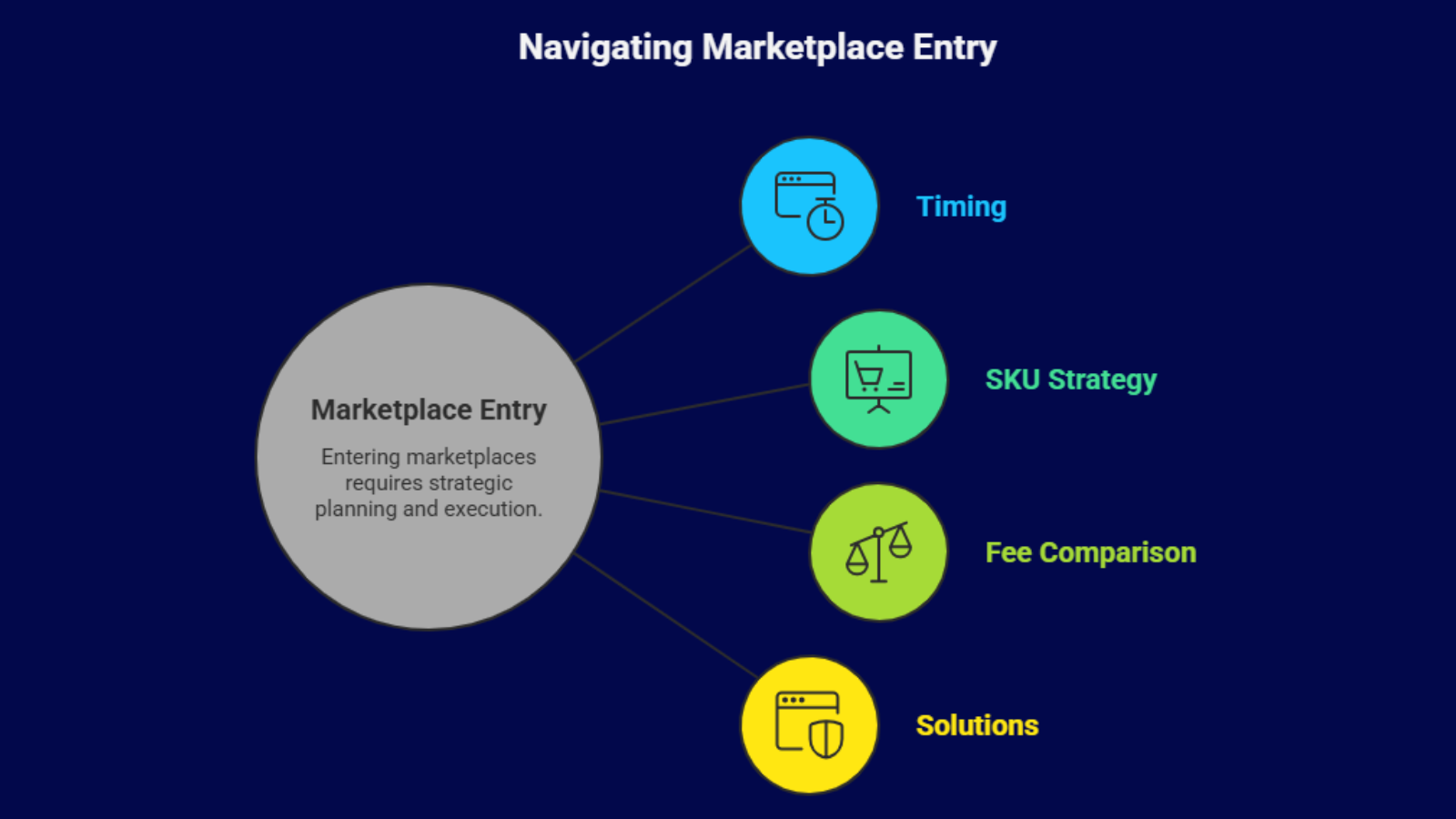 Founders delay marketplaces because they want customer data and margins. But marketplaces offer scale, discovery, and sometimes better acquisition economics than paid ads. The key is entering at the right time with the right SKU strategy.
When to enter marketplaces
- Product-market fit is proven (low refund complaints, stable ratings likely).
- Repeat cohorts are stable enough that you can afford some margin compression for scale.
- Operations can handle surges, SLAs, and catalog discipline.
Marketplace fees vs D2C margins
On D2C, you pay: payment gateway + shipping + marketing.
On marketplaces, you pay: commission (often 15–25%) + logistics + on-platform ads.
The mistake is comparing gross margin. The right comparison is: contribution after acquisition. Sometimes, marketplace CAC (via search + discovery) is lower than Meta CAC, making marketplaces profitable even with commissions.
Solutions to avoid getting crushed
- Choose “marketplace SKUs” intentionally: hero SKUs, bundles, and sizes that reduce returns.
- Control discounting: don’t let marketplace pricing permanently undercut your D2C.
- Track net realization: commission + shipping + ads + returns. Many sellers only track sales, not realization.
Outcome
Marketplaces should become a distribution pillar, not a margin leak. Enter with discipline and contribution to math.
6. Omnichannel and offline: When to expand, and what offline economics really demand
Offline is not “just more sales.” It’s a different business model: credit cycles, returns policies, slower data, and margin sharing. It can reduce blended CAC and improve trust, but it adds complexity and can destroy profitability if you enter too early.
When D2C brands should go omnichannel
- Typically ₹30–50Cr revenue.
- Brand recall exists (customers ask for you in stores).
- Repeat purchase is proven (so offline customers don’t need heavy discounting to convert).
Offline retail economics
- Distributor margin: 8–12%
- Retailer margin: 20–35%
- Trade schemes + promotions on top
Your gross margin must absorb ~35–50% channel cost.
Solutions
- Start with controlled offline: modern trade pilots, premium retail, or your own kiosks/pop-ups where you control pricing.
- Build a trade playbook: margins, schemes calendar, store visibility, promoter strategy.
- Design offline-friendly packaging and SKUs (barcode, shelf life, tamper-proofing).
- Prepare for longer cash cycles: 30–60-day credit is common. Your working capital planning must reflect that.
Outcome
Offline can become your moat if you enter with the right economics and operational readiness.
7. Quick commerce: High growth, high tax on margins — use it like a scalpel
 Quick commerce promises speed and discovery, but it’s margin-expensive. It can drop margins by 10–20% due to commissions, inventory blocking, and discount pressure. It’s not a default lever; it’s a category and geography lever.
When D2C brands should use quick commerce
Best for:
- Impulse categories
- High-repeat FMCG products
- Urban-focused brands where convenience drives conversion
Not great for:
- High-AOV niche products
- Slow-moving inventory (you’ll get penalized with low visibility and dead stock)
Key issues
- Platforms expect availability and fast replenishment.
- You may lose pricing control.
- Inventory can get blocked at dark stores, affecting your own D2C fulfilment.
Solutions
- Treat quick commerce as “trial + replenishment”: send your fastest-moving SKUs and bundle sizes that encourage repeat.
- Protect contribution with channel-specific pack sizes (don’t replicate your best D2C combo exactly).
- Set replenishment discipline: daily/alternate-day tracking, minimum stock thresholds, expiry management.
- Monitor net realization weekly: commission + ads + shrinkage + returns.
Outcome:
Quick commerce works when it’s engineered for contribution and velocity. Otherwise, it becomes a shiny growth channel that quietly drains margin.
8. Inventory: The #1 cash flow killer from ₹30Cr to ₹100Cr
At ₹10Cr, inventory mistakes are painful. At ₹50Cr, they can kill the company. Over-forecasting locks cash. Under-forecasting breaks momentum and increases CAC because you lose your best converting SKUs.
How inventory kills D2C cash flow at scale
- Capital stuck in slow SKUs
- Heavy discounting to clear stock
- Higher warehouse costs and write-offs
- More variants = lower accuracy = lower turns
Ideal inventory turns (guidance)
- Beauty: 4–6 turns/year
- Fashion: 6–8 turns/year
- Supplements: 5–7 turns/year
If you’re at 2–3 turns, you’re financing inventory, not growing profit.
Solutions
- SKU rationalization: cut the bottom 20% SKUs that block cash.
- Forecasting by SKU velocity + seasonality + channel (marketplace/offline requires separate planning).
- Build safety stock rules by lead time, not gut feel.
- Tie marketing calendar to inventory reality: don’t run heavy campaigns on low cover; don’t buy stock assuming campaigns will fix demand.
Outcome
Brands that hit ₹100Cr are not the ones with the most SKUs. They are the ones with the best inventory discipline.
9. Returns, RTO, OMS, and tech stack: Operations decides whether growth is profitable
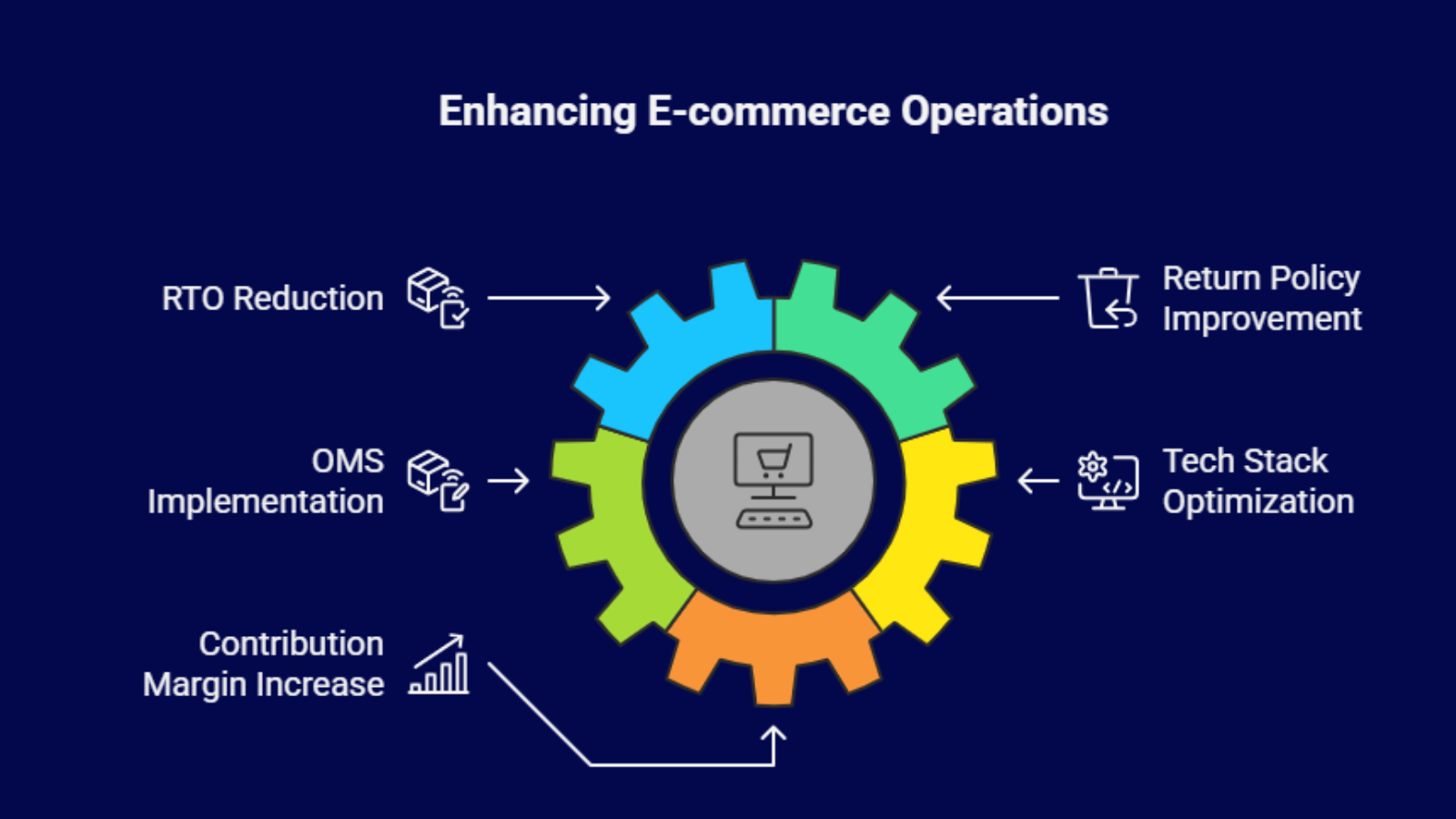 In India, RTO can hit 20–30% in COD-heavy models. Returns and RTO don’t just hurt profit; they distort inventory, slow turns, and increase logistics costs twice. As soon as you add marketplaces and offline, order complexity multiplies, and manual ops break.
Issues
- Double shipping cost on RTO
- Damaged goods and unsellable returns
- Overselling when inventory isn’t synced across channels
- Data fragmentation: you can’t trust numbers, so decisions get delayed
Solutions
- Reduce COD over time and improve verification: OTP confirmation, address intelligence, and courier selection by pin code.
- Tighten return policies where category allows; improve product pages to reduce wrong expectations.
- Implement a strong OMS: sync inventory across D2C, marketplaces, offline, quick commerce; prevent oversell; improve fulfilment speed; reduce cancellations.
- Fix tech stack: clean data pipelines, CRM automation (WhatsApp/email), inventory intelligence, integrated analytics. Fragmented tools create manual reconciliation and slow decision-making.
Outcome
At scale, “marketing problems” are often ops problems. Better OMS + better data + lower RTO directly raise contribution margin without spending an extra rupee on ads.
10. From ₹50Cr to ₹100Cr: Investor-grade execution and the real scaling playbook
Many ₹50Cr brands are unprofitable because they optimized for revenue, GMV, and valuation stories instead of contribution margin, cash flow, and sustainable retention. Investors at ₹50Cr+ don’t get impressed by top-line alone. They look for proof that you can scale without breaking unit economics.
What investors look for
- Strong repeat cohorts and honest LTV (cohort-based, not blended averages)
- Improving blended CAC (not just one channel)
- Controlled inventory and healthy turns
- Clear path to profitability and payback discipline
- Channel diversification (D2C + marketplace + offline where viable)
- Strong second-line leadership (operators who run supply chain, finance, growth systems)
Founder vs operator gap
Founders win early with vision and hustle. Scale requires supply chain discipline, financial control, channel strategy, and process rigor. The jump from ₹30–40Cr often needs senior operators.
The step-by-step playbook
- Get the contribution margin healthy before aggressive growth.
- Track real LTV and payback periods.
- Reduce discount dependency; shift to bundles and value.
- Add marketplaces strategically and measure contribution, not ego.
- Expand offline only when margins support it.
- Use quick commerce selectively for velocity categories.
- Control inventory tightly; protect turns.
- Invest in OMS + tech stack early.
- Strengthen operations leadership.
- Manage cash flow weekly, not quarterly.
Outcome
₹100Cr brands don’t grow the fastest. They grow the smartest by treating scale as a systems problem across marketing, pricing, operations, and finance.
Building the Right Tech Backbone: How Base.com Powers D2C Scale
 As D2C brands move from ₹30Cr to ₹100Cr, operational complexity increases much faster than revenue. You’re no longer managing just a Shopify store and a single warehouse. Orders flow in from your website, Amazon, Flipkart, Myntra, quick commerce platforms, and even offline B2B partners. Inventory sits across multiple depots and 3PLs. Returns and RTO need reconciliation. Manual coordination starts breaking. This is where a unified system like Base.com becomes critical because it combines OMS, WMS, PIM, and automation into one operational backbone.
At the center is the OMS, which acts as a control tower for multi-channel order management. All orders sync into one dashboard, and inventory updates in real time across platforms. You can create intelligent routing rules so orders are auto-assigned to the nearest warehouse based on pin code, SLA, inventory availability, or shipping cost logic. For example, a Delhi order can automatically route to your NCR depot while a South India order ships from Bangalore. This multi-depot shipment logic reduces freight costs and delivery timelines without manual intervention.
Base.com also enables automated shipment selection. Instead of your ops team choosing courier partners manually, the system can auto-select carriers based on cost, performance by pin code, COD success rates, or delivery speed. This directly reduces RTO risk and improves fulfillment efficiency.
Label generation is another operational bottleneck at scale. With Base label printing, shipping labels and invoices are generated automatically in bulk as soon as orders are confirmed or packed. Barcode-based workflows ensure pick-pack-ship accuracy, reducing mis-shipments and cancellations. For high-volume brands, this alone saves hours of manual processing daily.
On the warehouse side, the WMS handles multi-depot and multi-storage complexity. You get bin-level tracking, batch management, expiry tracking for categories like beauty or supplements, and structured pick-pack workflows. Returned inventory can be quality-checked and automatically restocked into the correct storage location. This improves inventory accuracy and protects inventory turns, which directly impacts cash flow.
The PIM layer centralizes SKU data across channels. Product descriptions, images, pricing rules, bundles, and compliance details are managed once and pushed everywhere. If you launch a new combo or update pricing, it reflects across marketplaces and your D2C store without manual duplication.
Beyond structure, Base.com supports automatic actions. You can trigger workflows such as auto-confirming prepaid orders, tagging high-risk COD orders for verification, splitting orders by warehouse, or prioritizing express shipments. As complexity grows, these automations prevent operational chaos.
At scale, technology is not about convenience. It protects contribution margin, reduces cancellations, improves shipment success, and keeps data clean. A unified system like Base.com allows D2C brands to expand channels, manage multiple depots, automate labels and shipments, and scale without losing control over operations.
Frequently Asked Questions
1. How do I manage inventory across multiple warehouses without overselling?
Use a unified OMS + WMS with real-time inventory sync. Multi-depot routing automatically assigns orders based on stock availability, location, or ageing inventory. This prevents overselling, reduces shipping costs, and improves delivery speed without manual coordination.
2. How can I reduce RTO and improve courier performance?
Auto-select couriers based on pin code success rates and COD performance. Add COD verification for high-risk orders. This reduces failed deliveries, double shipping costs, and improves contribution margin.
3. How do I handle D2C, marketplaces, and quick commerce together?
Centralize orders in one OMS. Use automation to split shipments, prioritize express orders, and bulk-generate labels. This prevents operational chaos during high-volume periods.
4. How do I manage batch tracking and expiry?
Use WMS with batch-level tracking and FIFO dispatch. Monitor expiry by depot and restock returns after QC. This protects compliance and reduces dead stock.
5. How do I update product listings across channels efficiently?
Use a centralized PIM to manage SKU data, pricing, and images. Update once and sync across marketplaces and D2C to avoid errors and inconsistencies.