
Quick commerce has changed how people buy everyday products in India. Instead of planning weekly grocery trips, customers now open apps like Blinkit, Zepto, or Instamart and expect delivery in 10 to 20 minutes. This behavior shift is already visible in order patterns. Industry data shows that over 70% of quick commerce orders are top-up purchases, meaning customers buy only a few items they need immediately rather than full baskets.
For Indian D2C brands, this creates a very different selling environment. Dark stores used by quick commerce platforms typically carry 2,000 to 3,000 SKUs, compared to 20,000+ SKUs in supermarkets. That means only products with high repeat demand and fast inventory turnover get listed.
This is where a strong quick commerce product strategy becomes critical. Platforms prioritize products that sell multiple times per day per store. For example, snack packs priced between ₹20 and ₹99, instant noodles, dairy items, and ready-to-drink beverages dominate sales. On Blinkit, small snack packs and beverages alone contribute over 30% of daily order volume.
Indian sellers often miss one key nuance. Quick commerce favors small pack sizes and single-use formats, not family packs. A ₹30 snack SKU can outperform a ₹150 pack by 4–5x in order frequency.
In this guide, we break down the best categories for quick commerce, the role of high velocity SKUs, and how brands can build an effective Q-commerce assortment planning model.
Why Product Selection Matters in Quick Commerce
Quick commerce works very differently from traditional eCommerce. Instead of large warehouses that store thousands of products, platforms like Blinkit, Zepto, and Instamart rely on dark stores located within 2–3 km of residential clusters. These stores typically carry 2,000 to 3,000 SKUs, which means product selection is extremely strict.
For Indian D2C sellers, this creates a major challenge. If a product does not sell consistently, it can lose shelf space quickly. Platforms prioritize items that sell multiple times per day per dark store, because faster inventory turnover improves operational efficiency.
 India’s quick commerce market crossed $7.4 billion in 2025 and is expected to reach $30 billion by 2030. Most orders are small top-up purchases, with the average order containing 3–5 items and an average order value of ₹350–₹500.
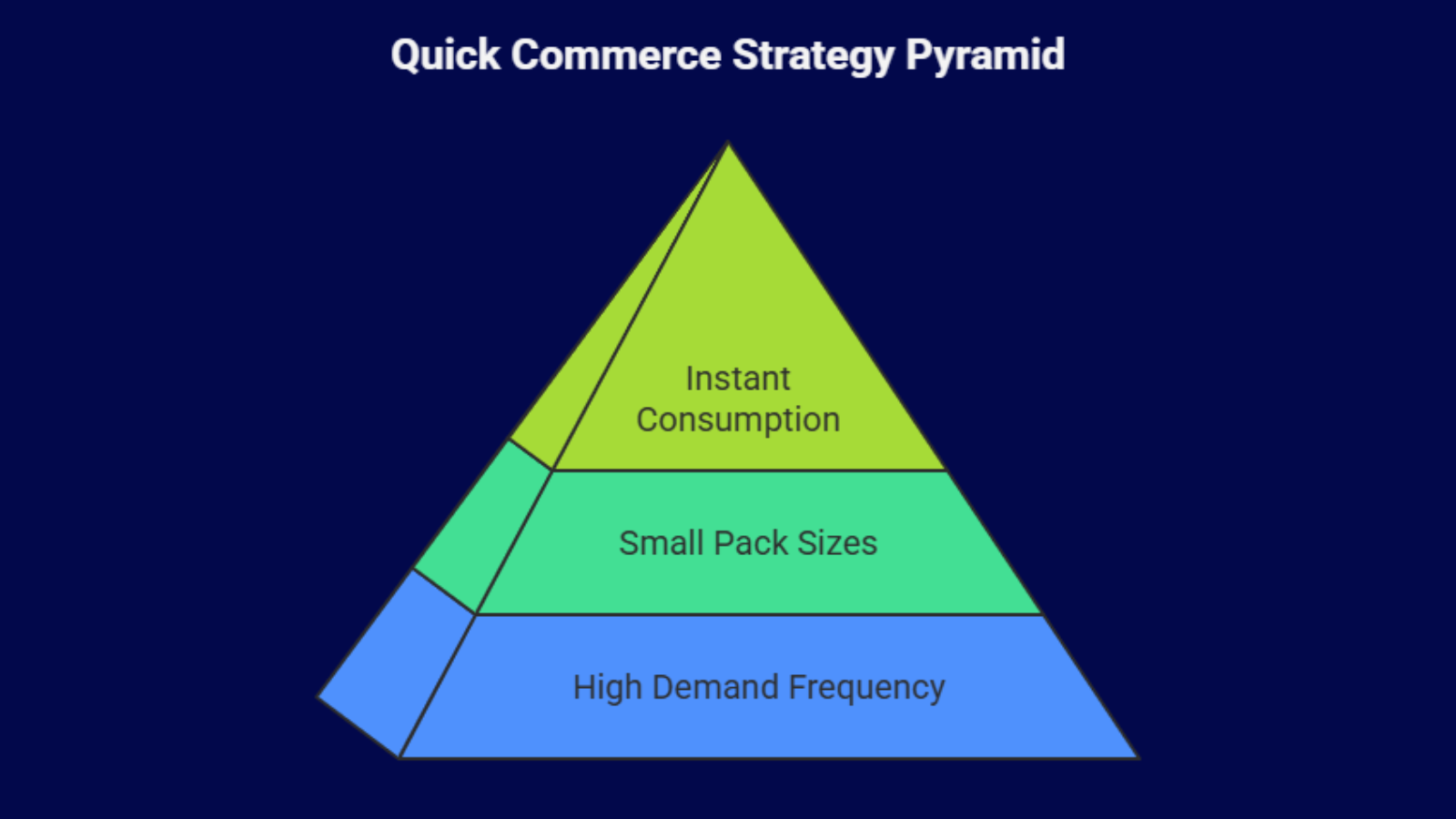
A strong quick commerce product strategy focuses on three factors:
- High demand frequency
- Milk, bread, and eggs can sell 30–40 units daily per store
- Snacks and beverages dominate evening orders
- Small pack sizes
- SKUs priced between ₹20 and ₹99 convert faster
- Mini packs drive higher repeat purchases
- Instant consumption behavior
- Ice creams, chocolates, and drinks work well as impulse products quick delivery
These factors shape Q-commerce assortment planning and help brands identify high velocity SKUs that perform consistently across quick commerce platforms.
Best Categories for Quick Commerce
Quick commerce demand in India is highly concentrated in a few product categories that match instant consumption behavior. Customers typically open apps like Blinkit or Zepto when they suddenly run out of something or want something immediately. Because of this, most orders come from products that are consumed daily or bought impulsively.
Market data shows that groceries contribute around 63.6% of all quick commerce purchases, making them the largest category. However, within groceries, certain product segments dominate because they generate higher repeat orders and faster turnover.
For Indian D2C sellers, entering the right category significantly improves the chances of getting listed and scaling across cities.
Below are the best categories for quick commerce and why they perform well.
| Category | Why It Works | Example Products |
|---|---|---|
| Snacks & beverages | Strong impulse purchases and evening demand | Chips, cold drinks, chocolate bars |
| Dairy & breakfast | Daily consumption products | Milk, bread, butter |
| Fresh produce | Frequent replenishment | Fruits, vegetables |
| Personal care | Emergency purchase behavior | Shampoo sachets, razors |
| Household essentials | Top-up purchases | Detergent, tissues |
| Ready-to-eat foods | Instant consumption | Instant noodles, frozen snacks |
Snacks and beverages alone contribute around 32% of quick commerce category share, mainly because they are purchased without planning. For example, small snack packs priced between ₹20 and ₹60 often sell 20–30 units per day per dark store during peak evening hours.
Another nuance many Indian sellers overlook is pack size strategy. A ₹30 snack SKU or 250ml beverage can generate 3–4x higher order frequency than larger family packs. This is why many platforms encourage brands to launch quick commerce exclusive SKUs.
For D2C brands, building a strong quick commerce product strategy means focusing on categories that combine daily consumption, impulse behavior, and smaller pack formats.
Understanding High Velocity SKUs in Quick Commerce
 One of the most critical parts of Q-commerce assortment planning is identifying high velocity SKUs. These are products that sell repeatedly within a short time window and generate consistent demand across multiple dark stores.
In quick commerce, shelf space is limited. Each dark store stocks around 2,000–3,000 SKUs, which means only products with strong sales velocity survive in the assortment.
High velocity SKUs typically sell 20–50 units per day per dark store. Platforms track this closely because faster turnover reduces storage costs and improves delivery efficiency.
Common examples of high velocity SKUs include:
- Milk
- Bread
- Eggs
- Instant noodles
- Soft drinks
- Packaged snacks
These products perform well because they fall into categories that customers buy frequently.
For example:
- A 500ml milk pack can sell 40+ units daily per store in metro areas.
- ₹20 instant noodles often see repeat purchases during late evening hours.
- 250ml soft drinks drive impulse purchases during weekends.
For Indian D2C brands, one of the most effective ways to create high velocity SKUs is by designing products specifically for quick commerce.
Key strategies include:
- Launching small entry packs priced under ₹100
- Reducing SKU complexity by focusing on top-performing variants
- Optimizing pack formats for faster storage and picking in dark stores
For instance, many snack brands have introduced ₹30–₹50 mini packs exclusively for quick commerce platforms.
A well-designed quick commerce product strategy prioritizes these high velocity SKUs because they increase inventory turnover, improve platform profitability, and drive repeat purchases across cities.
The Role of Impulse Products in Quick Delivery
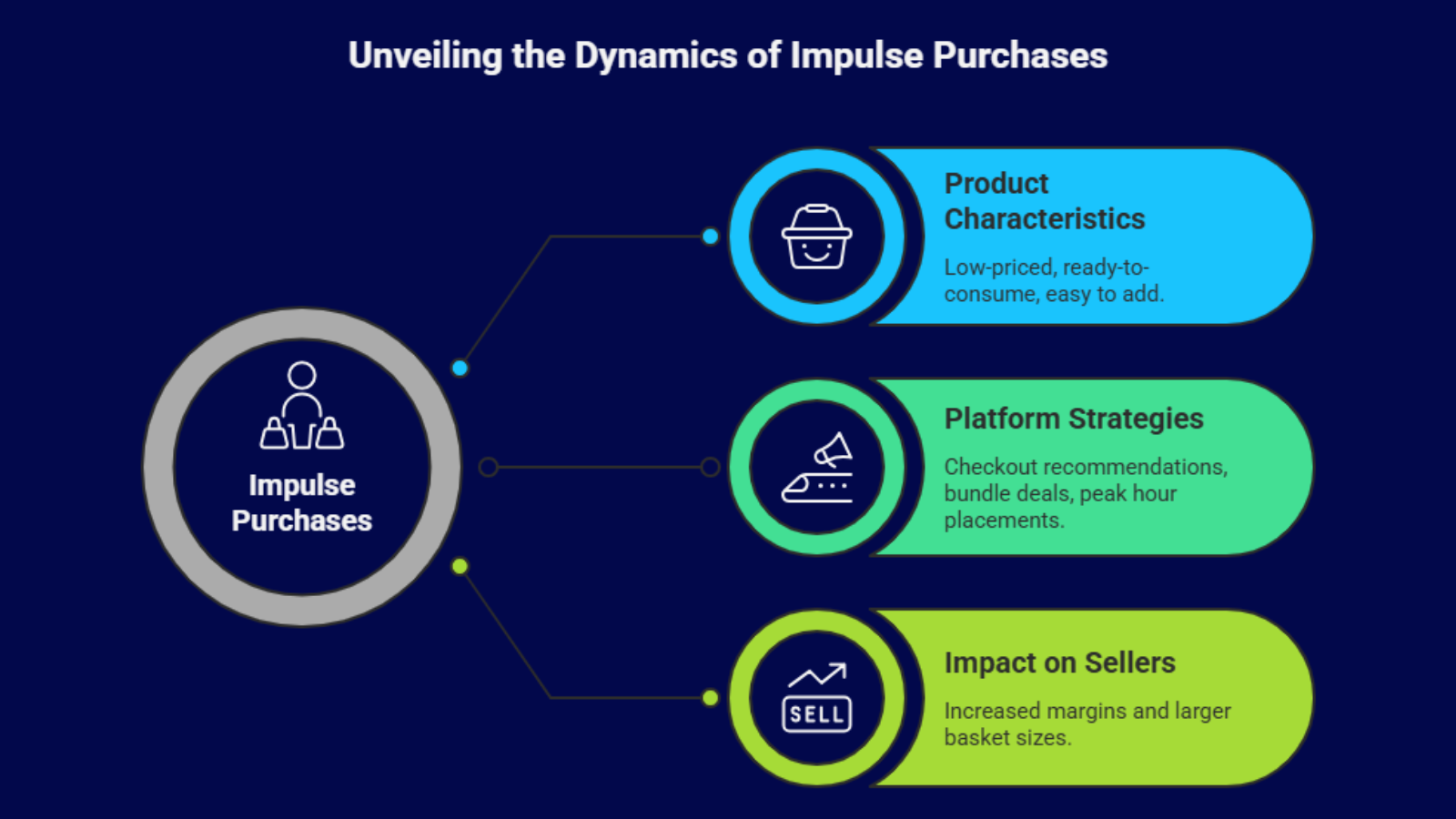 Impulse purchases are one of the biggest drivers of quick commerce order value in India. Most customers open an app to buy one urgent item, but they often add more products before checkout. Industry estimates show that 30–40% of items in a quick commerce basket are impulse additions, which significantly increases the final order value.
For Indian D2C sellers, this behavior creates a strong opportunity. Platforms actively promote impulse products and quick delivery items because they improve margins and increase basket size. These products are usually low-priced, ready to consume, and easy to add to cart.
Common impulse products quick delivery items include:
- Chocolate bars priced between ₹20 and ₹60
- Ice cream cups and sticks
- Energy drinks and small beverage cans
- Instant snack packs like noodles or chips
- Cookies and biscuit mini packs
- Flavored milk and ready-to-drink beverages
Platforms push these products aggressively through:
- Checkout recommendations that suggest add-on products
- Bundle deals like snack and beverage combos
- Homepage placements during evening peak hours
For D2C brands, including multiple impulse products quick delivery SKUs is an important part of building a strong quick commerce product strategy.
How to Build a Winning Q-commerce Assortment Planning Strategy
For D2C brands, quick commerce requires a completely different assortment approach compared to marketplaces or traditional eCommerce. On marketplaces, brands can list dozens of SKUs and let search demand decide what sells. In quick commerce, that flexibility does not exist. Dark stores operate with limited shelf space of roughly 2,000–3,000 SKUs, and each SKU must justify its presence through fast sales.
This means brands cannot treat quick commerce as just another sales channel. Instead, they need a structured Q-commerce assortment planning strategy built around demand velocity, pack formats, and price points.
In India, the average quick commerce order value ranges between ₹350 and ₹500, with 3–5 items per basket. This small basket size forces brands to focus on SKUs that customers can easily add without much thought.
Below is a practical framework Indian D2C brands can follow to build a strong quick commerce product strategy.
Step 1: Identify High Velocity SKUs
 The first step in Q-commerce assortment planning is identifying high velocity SKUs. These are products that sell multiple times per day per dark store and generate consistent demand across different locations.
Quick commerce platforms measure SKU performance using sales velocity per store per day. If a product sells fewer than 8–10 units per day, it risks losing shelf space.
Focus on the following types of products:
- Daily consumption items
- Milk, bread, curd, eggs
- These products can sell 30–50 units per day per store
- Low price impulse products
- Chips, chocolates, small beverage cans
- SKUs priced between ₹20 and ₹99 convert faster
- Quick replenishment products
- Cooking oil pouches, tea packets, instant noodles
- These products are often bought when customers run out
For example, many snack brands in India see ₹30 snack packs selling 3–5 times more frequently than ₹150 family packs in quick commerce.
These SKUs become the foundation of your quick commerce product strategy.
Challenges brands face in this step
- Difficulty identifying demand patterns without platform data
- Launching too many SKUs instead of focusing on 3–5 winners
- Selecting products designed for supermarket shelves rather than quick commerce
Step 2: Focus on the Best Categories for Quick Commerce
Choosing the right category significantly improves the chances of success. Not all product categories perform equally in quick commerce.
Data from major platforms shows that the best categories for quick commerce include:
- Snacks and beverages
- Dairy and breakfast
- Ready-to-eat foods
- Personal care
- Household essentials
These categories perform well because they combine frequent consumption with instant need behavior.
For example:
- Snacks and beverages contribute over 30% of quick commerce orders.
- Dairy products are among the highest repeat purchase items, often bought multiple times per week.
Indian D2C brands entering these categories often scale faster because platforms already see strong demand.
Challenges brands face in this step
- Entering low-frequency categories that do not generate repeat orders
- Launching premium-only SKUs without affordable entry packs
- Ignoring regional consumption patterns that affect category demand
Step 3: Create Impulse-Friendly Packs
 Pack size plays a major role in quick commerce performance. Customers rarely buy large packs because most purchases are driven by immediate consumption or short-term needs.
Smaller packs increase the likelihood of impulse purchases.
For example:
| Standard SKU | Quick Commerce SKU |
|---|---|
| 1L beverage | 250ml beverage |
| 200g snack pack | 60g snack pack |
| Family chocolate box | Single chocolate bar |
These smaller formats perform well because they align with impulse products quick delivery behavior.
Typical price sweet spots for impulse purchases in India are:
- ₹20 to ₹60 for snacks
- ₹30 to ₹80 for beverages
- ₹40 to ₹100 for ready-to-eat products
Many successful brands launch quick commerce exclusive SKUs designed specifically for this format.
These products become high-performing impulse products quick delivery items that drive incremental basket value.
Challenges brands face in this step
- Repurposing supermarket SKUs instead of designing new pack formats
- Incorrect pricing that pushes products above impulse thresholds
- Packaging that is not optimized for dark store picking and stacking
Step 4: Optimize Assortment Depth
Quick commerce stores cannot stock large product catalogs. Instead of offering 20 variants, platforms prefer a focused assortment of high-performing SKUs.
A typical assortment structure includes:
- 3 to 5 best-performing SKUs
- One premium SKU for higher margins
- One value SKU to capture price-sensitive customers
For example, a beverage brand might offer:
- 250ml value pack
- 300ml standard pack
- 500ml premium variant
This limited assortment helps platforms manage inventory efficiently while ensuring faster product rotation.
From a Q-commerce assortment planning perspective, fewer SKUs often lead to higher sales concentration and better visibility on the platform.
Challenges brands face in this step
- Launching too many variants that split demand
- Ignoring demand data when deciding SKU assortment
- Failing to update assortment based on city-level performance
How Quick Commerce Is Expanding Product Categories and What It Means for Brands
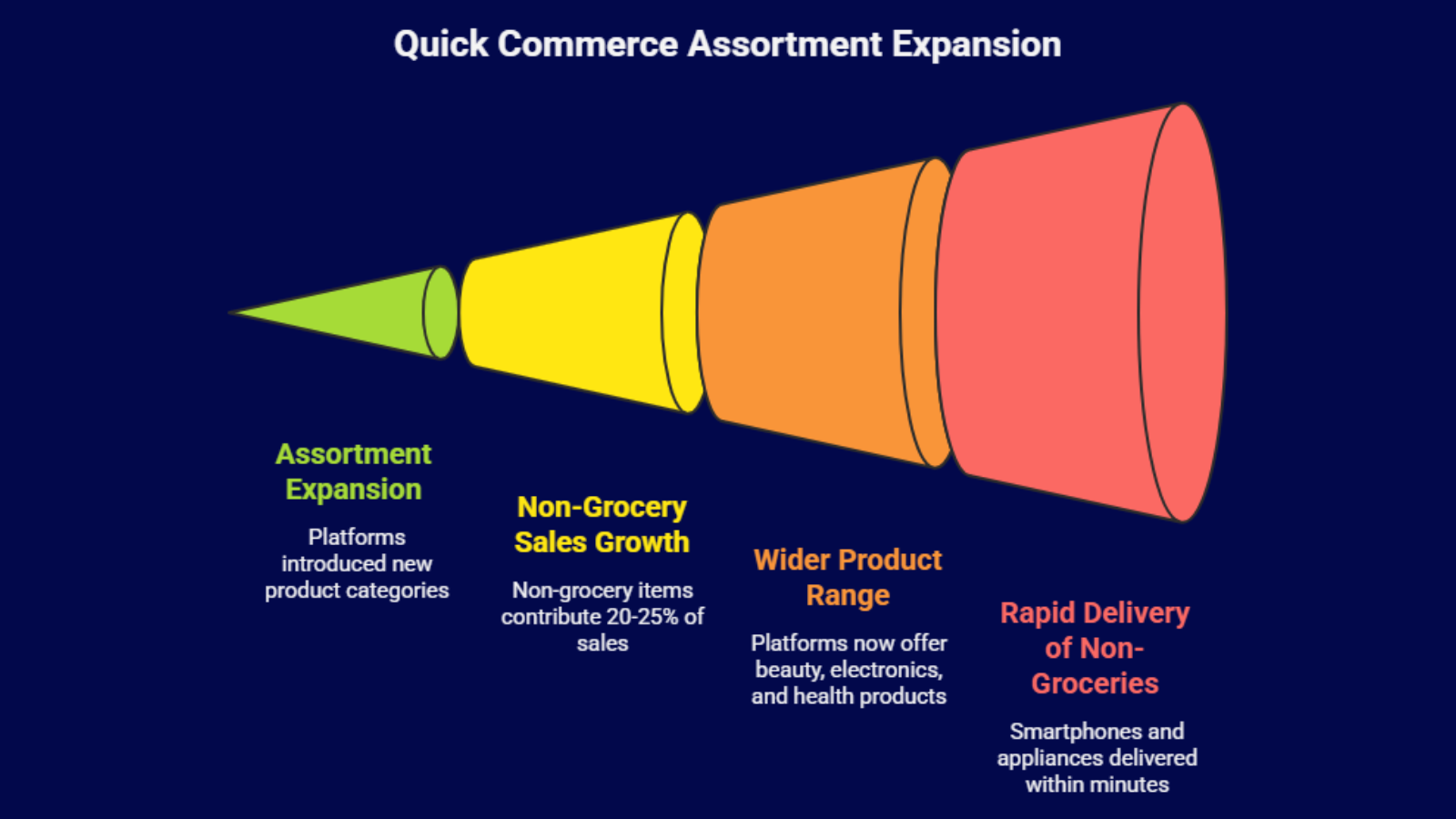 Quick commerce in India initially focused on groceries and daily essentials, but the assortment is expanding rapidly as platforms mature. While groceries still dominate the majority of orders, platforms are increasingly introducing higher-margin categories to increase basket value and improve profitability. Today, non-grocery categories contribute roughly 20 to 25 percent of sales on some quick commerce platforms, showing how customer behavior is evolving beyond emergency grocery purchases.
Platforms like Blinkit, Zepto, and Instamart now stock a wider range of products including beauty and personal care items, electronics accessories, gifting products, and health and wellness products. For example, customers can order face washes, grooming kits, protein bars, phone chargers, and earbuds for delivery within minutes. In several metro cities, some platforms have also started delivering smartphones, small appliances, and gadgets within 15 to 20 minutes, expanding the role of quick commerce beyond groceries.
Industry forecasts suggest that India’s quick commerce market could reach $35 billion by 2030, driven by faster logistics networks and higher consumer adoption. As the industry grows, platforms are also moving toward hyperlocal assortment strategies, where product selection changes based on neighborhood demand. Regional product preferences and discretionary categories will increasingly shape inventory decisions. For D2C brands, adapting their quick commerce product strategy to these evolving categories will become essential to stay competitive.
How Base Helps D2C Brands Win on Quick Commerce
Managing quick commerce operations becomes complex very quickly for growing D2C brands. Most brands are not selling on just one platform. They are often listed on Blinkit, Zepto, Instamart, and other marketplaces at the same time. Each platform has different catalog requirements, inventory rules, and demand patterns. Without the right system in place, it becomes difficult to track which SKUs are performing well and which ones need adjustments.
This is where Base helps simplify operations. Base provides a centralized platform that helps brands manage their quick commerce presence efficiently while improving decision making.
With Base, brands can manage product listings across multiple marketplaces from a single dashboard, ensuring that catalog updates, pricing, and product information stay consistent across platforms. This is especially useful when brands launch new quick commerce specific SKUs.
Base also helps teams track the performance of high velocity SKUs across different cities and platforms. Instead of manually compiling reports, brands can quickly see which products are driving the most orders and which ones are slowing down.
In addition, Base enables better Q-commerce assortment planning by providing insights into SKU demand, sales velocity, and category performance. Brands can monitor how their products perform within the best categories for quick commerce and adjust their assortment accordingly.
If your team wants to build a stronger quick commerce product strategy, Base gives you the visibility and operational control needed to scale faster across modern commerce platforms.
Frequently Asked Questions
1. What is a quick commerce product strategy?
A quick commerce product strategy focuses on selecting fast-moving products that sell frequently within short delivery cycles. It prioritizes high demand items, smaller pack sizes, and products suited for impulse buying.
2. Which are the best categories for quick commerce?
The best categories for quick commerce include snacks, beverages, dairy, fresh produce, personal care, and household essentials. These products have frequent purchase cycles and strong demand for instant delivery.
3. What are high velocity SKUs in quick commerce?
High velocity SKUs are products that sell quickly and repeatedly within short time periods. Examples include milk, bread, snacks, beverages, and instant foods. These SKUs generate consistent daily demand.
4. Why are impulse products important in quick commerce?
Impulse products drive additional revenue because customers often add them during checkout. Items like chocolate, ice cream, and beverages are common impulse purchases in quick commerce.
5. How should D2C brands approach Q-commerce assortment planning?
D2C brands should focus on limited SKUs, prioritize high velocity SKUs, create smaller pack sizes, and track demand trends. This approach improves product visibility and increases repeat purchases on quick commerce platforms.