

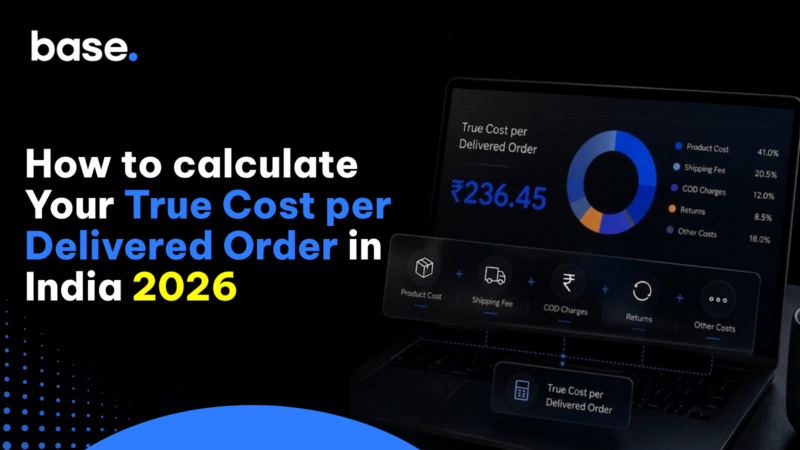
Most Indian ecommerce brands are losing margins they cannot see. The gap usually lives in their ecommerce backend India stack, in costs that are real but never calculated. Your cost per delivered order is not your shipping rate.
It includes forward freight, COD handling fees, RTO losses, warehouse labour, packaging, payment gateway charges, and the hidden cost of every manual process in your fulfillment stack.
This guide gives you the exact formula to calculate your true cost per delivered order, and shows you where Base.com eliminates the costs that eat margin silently.
Why Most Indian Brands Miscalculate Their Delivery Costs
Indian ecommerce operations track shipping cost as a line item. That is the wrong metric. Your true cost per delivered order is the total operational spend required to get one order successfully into a customer’s hands, including the cost of orders that never arrive.
COD returns in India run at 25-30% across most categories, a number every ecommerce backend India platform should be surfacing to operations teams daily. That means for every 100 orders you dispatch, 25-30 come back. You have paid forward shipping on all 100. And pay return shipping on 25-30. You pay warehouse labour to process the return, re-inspect the product, and restock it. None of this appears in your shipping rate card.
For D2C operations, India brands running at scale, this miscalculation compounds fast. A brand dispatching 10,000 orders per month at a 28% RTO rate is running nearly 2,800 reverse shipments every month, often without a clear per-order cost attached to any of them.
The True Cost Per Delivered Order Formula
Here is the framework broken into six cost components. Every number in this calculation should be extractable from your ecommerce backend India platform; if it isn’t, your platform is hiding cost from you. Calculate each per order dispatched, then divide by your successful delivery rate to get your true cost per delivered order.
Component 1: Forward Freight Cost
 This is the most visible cost. Take your total monthly courier spend across all carriers, Delhivery, Bluedart, Ecom Express, Shiprocket, DTDC, and divide by total orders dispatched.
Formula:
Forward Freight Per Order = Total Monthly Courier Spend ÷ Total Orders Dispatched
For most Indian D2C operations, India brands, this ranges from ₹45 to ₹120 per order, depending on weight, zone, and carrier mix. Quick-commerce brands running hyperlocal fulfillment through Blinkit or Zepto operate on different economics, typically ₹20-₹40 per order, but with strict SLA penalties.
Component 2: RTO Cost Per Dispatched Order
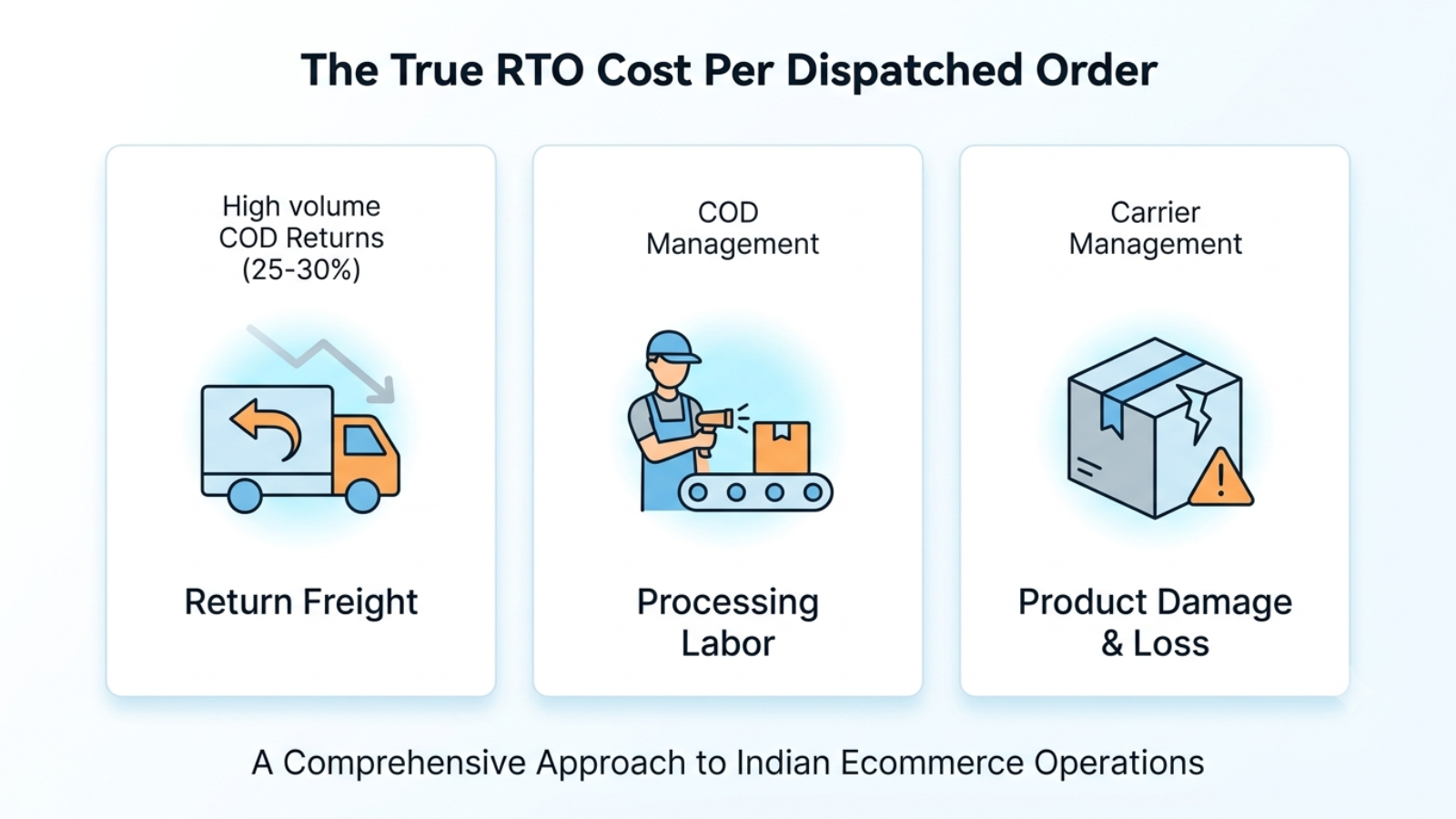 This is the most underestimated cost in Indian ecommerce. RTO cost has three sub-components: return freight, return processing labour, and product damage or loss during return transit.
Formula:
RTO Cost Per Dispatched Order = (RTO Rate × Return Freight Cost) + (RTO Rate × Return Processing Cost Per Unit) + (RTO Rate × Average Damage/Loss Value)
If your RTO rate is 28%, your return freight is ₹60 per shipment, your return processing cost is ₹15 per unit, and your average damage/loss per returned unit is ₹25:
RTO Cost = (0.28 × ₹60) + (0.28 × ₹15) + (0.28 × ₹25)
RTO Cost = ₹16.80 + ₹4.20 + ₹7.00 = ₹28 per dispatched order
That ₹28 per order is money spent with zero revenue return. For a brand doing 10,000 orders per month, that is ₹2.8 lakh in pure loss every month, before you account for the inventory value tied up in transit returns.
Reducing RTO is the highest-leverage lever in D2C operations in India for cost reduction. To reduce RTO in India, brands must act before dispatch, not after. Base.com’s pre-dispatch RTO scoring is the most direct way to reduce RTO India at scale.
It flags high-risk COD orders before dispatch, enabling brands to convert them to prepaid or hold them for address verification. Brands using Base.com have documented meaningful RTO reductions that directly lower this cost component.
Component 3: Warehouse and Fulfillment Labour Cost
 This covers pick, pack, and dispatch labour per order. Many Indian brands do not calculate this accurately because warehouse staff handle multiple activities. The right approach is to measure productive labor hours attributed to order fulfillment only.
Formula:
Warehouse Labour Per Order = (Total Monthly Fulfillment Labour Cost) ÷ (Total Orders Fulfilled)
For brands running their own warehouse, fulfillment labour typically runs ₹12-₹35 per order, depending on SKU complexity, pack configuration, and how automated the warehouse floor is.
For D2C operations in India, brands on Base.com, barcode-driven pick-pack-ship workflows eliminate manual checking steps. Packing errors drop from 3-4% to effectively zero, which means zero cost of re-picking, re-packing, and re-dispatching a wrong-item order. Each wrong dispatch costs you forward freight, return freight, and customer service time. Eliminating packing errors at the source directly reduces your true cost per delivered order.
India’s ecommerce market is growing fast, with the D2C segment alone at a 40% CAGR. At that growth rate, warehouse labour cost per order must come down even as volume grows.
Automation through your ecommerce backend India platform is the only way to make that happen without proportionally scaling headcount.
Component 4: Packaging Cost
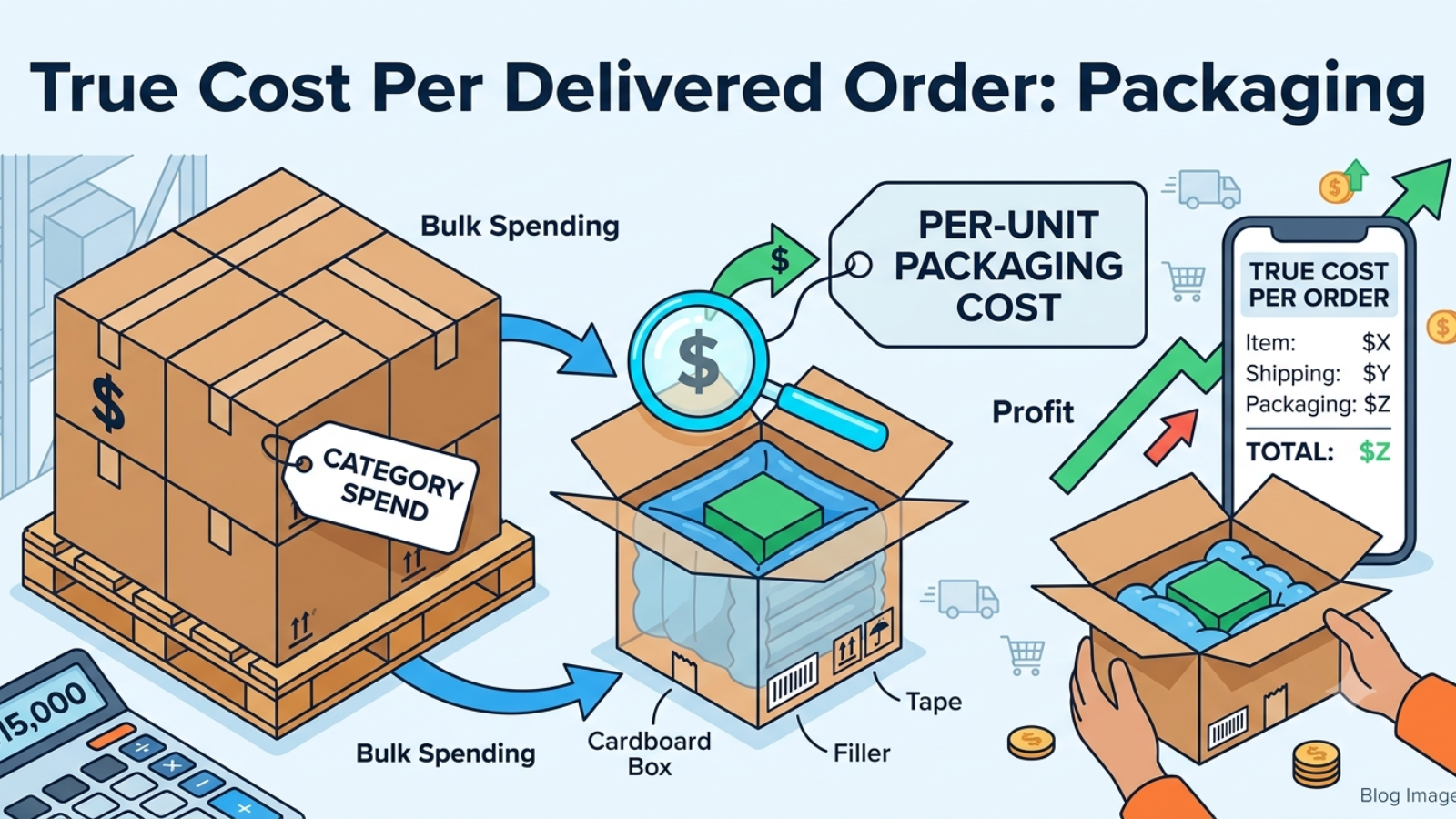 Packaging is often tracked as a category spend, not a per-order cost. For your true cost per delivered order calculation, you need the per-unit packaging cost.
Formula:
Packaging Cost Per Order = Total Monthly Packaging Spend ÷ Total Orders Dispatched
This includes primary packaging (bags, boxes), secondary packaging (void fill, tape, labels), and any branded inserts. For D2C brands, packaging cost typically runs ₹8-₹45 per order, depending on category and brand investment in unboxing experience.
Pack configuration complexity also matters here. Brands managing L1 to L5 pack hierarchies, inner packs, outers, master cartons, need their OMS and WMS to handle UOM alignment correctly.
A mismatch between how a product is ordered and how it is packed creates dispatch errors that add cost. Base.com handles multi-level pack configurations natively, with UOM alignment validation built into the order flow.
Component 5: Payment and Transaction Cost
 Every order carries a payment processing cost. For prepaid orders, this is your payment gateway fee, typically 1.5-2.5% of order value for Indian gateways (Razorpay, PayU, CCAvenue). For COD orders, this is your COD handling fee charged by the courier.
Formula:
Payment Cost Per Order = (Prepaid Order % × Avg Payment Gateway Fee) + (COD Order % × Avg COD Handling Fee)
For a brand with 60% prepaid and 40% COD, average order value ₹800, gateway fee 2%, COD fee ₹30:
Payment Cost = (0.60 × ₹16) + (0.40 × ₹30) = ₹9.60 + ₹12 = ₹21.60 per order
Shifting your prepaid-to-COD ratio is one of the fastest ways to reduce this component, and a lever every D2C operations India brand should be actively managing.
Every 10% shift from COD to prepaid at ₹800 AOV saves approximately ₹1.44 per order across your total volume. At 10,000 monthly orders, that is ₹14,400 per month, from one ratio shift.
Your ecommerce backend India platform must give you visibility into prepaid vs COD split by channel, product, and pin code so you can target conversion intelligently. Base.com’s operations dashboard surfaces this data at the SKU and channel level.
Component 6: Technology and Platform Cost
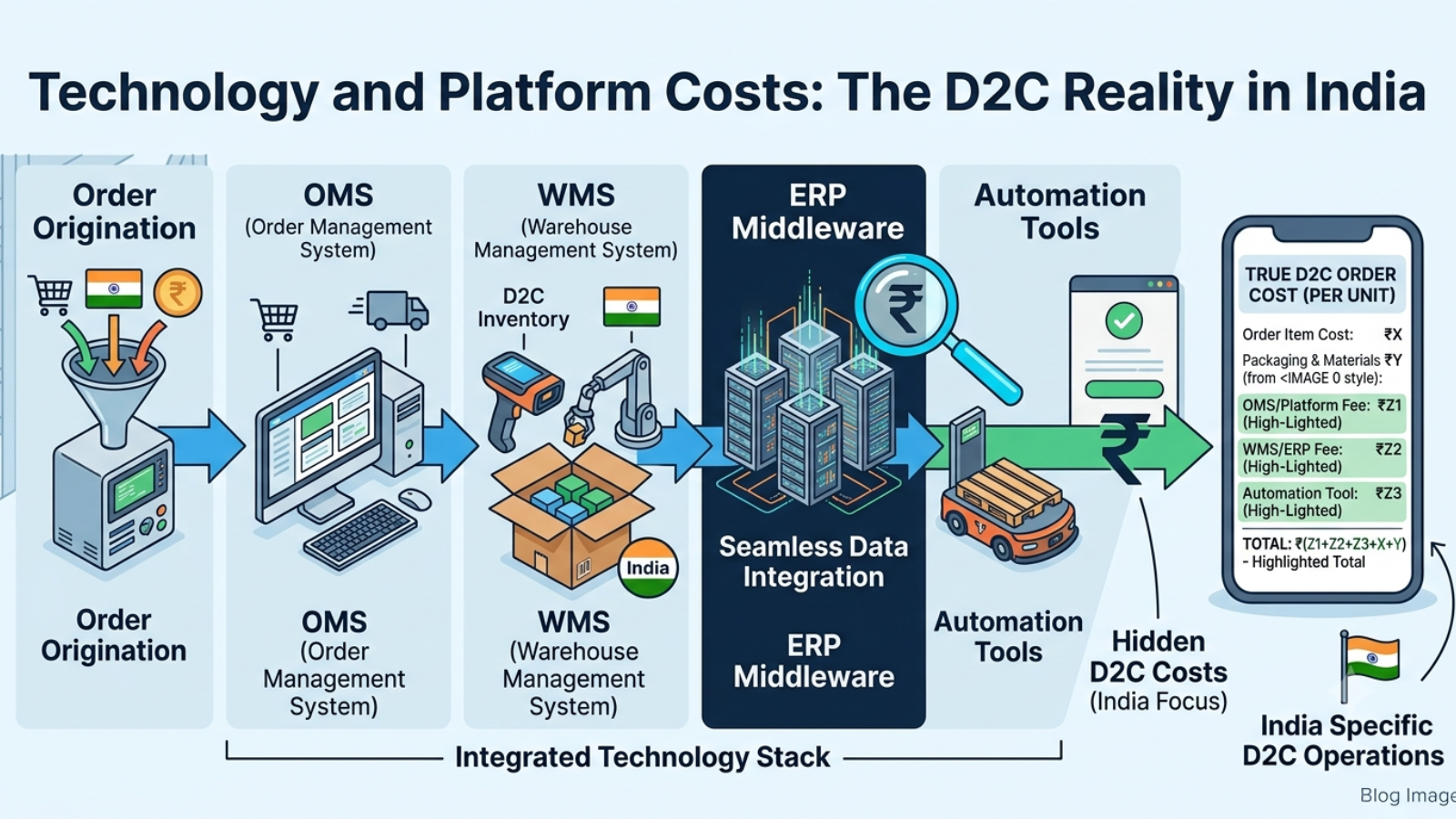 Your OMS, WMS, ERP middleware, and any automation tools carry a per-order cost, and for D2C operations in India, these costs add up faster than most teams realise. That is seldom calculated.
Formula:
Technology Cost Per Order = Total Monthly Platform Spend ÷ Total Orders Processed
For a brand paying ₹1.5 lakh per month in platform fees and processing 15,000 orders, the technology cost is ₹10 per order. This is a real cost that belongs in your true cost per delivered order.
The key question here is whether your platform spend is generating a return through automation, error reduction, and speed, or whether you are paying for features that are not reducing cost elsewhere.
A modular ecommerce backend India platform like Base.com allows brands to activate only what they need, keeping per-order technology cost in line with the operational value delivered, a key principle for selecting any ecommerce backend India platform.
Complete True Cost Per Delivered Order Formula
Add all six components, then adjust for your delivery success rate.
Step 1: Sum of cost components per dispatched order:
Total Cost Per Dispatched Order = Forward Freight + RTO Cost + Warehouse Labour + Packaging + Payment Cost + Technology Cost
Step 2: Adjust for delivery success rate:
True Cost Per Delivered Order = Total Cost Per Dispatched Order ÷ Delivery Success Rate
If your delivery success rate is 72% (28% RTO):
True Cost Per Delivered Order = Total Cost ÷ 0.72
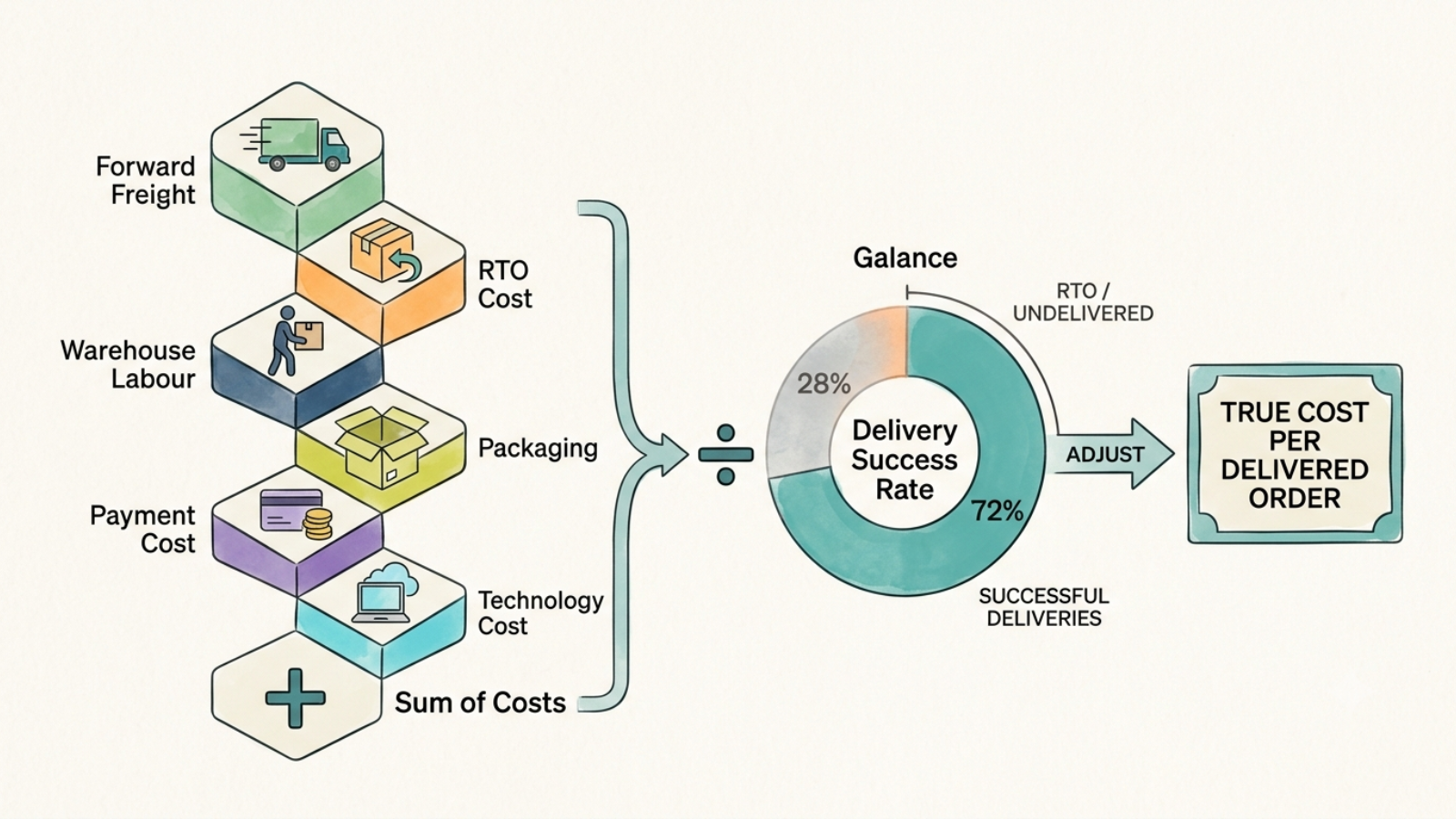 This adjustment is critical. Every cost you incur on RTO orders must be absorbed by your successful deliveries. A brand that does not make this adjustment is systematically underestimating its true cost per delivered order by 20-35%. This is the most common miscalculation in D2C operations, India finance reviews.
Sample Calculation: Mid-Market D2C Brand India
Here is a worked example for a fashion D2C brand doing 8,000 orders per month, ₹1,200 AOV, 30% RTO rate.
| Cost Component | Per Dispatched Order |
|---|---|
| Forward freight (Delhivery mix) | ₹72 |
| RTO cost (30% rate, ₹65 return freight, ₹20 processing, ₹30 damage) | ₹34.50 |
| Warehouse labour | ₹22 |
| Packaging (branded D2C) | ₹35 |
| Payment cost (55% prepaid, 45% COD) | ₹24 |
| Technology platform | ₹10 |
| Total per dispatched order | ₹197.50 |
Delivery success rate: 70% (30% RTO)
True cost per delivered order = ₹197.50 ÷ 0.70 = ₹282
At ₹1,200 AOV and 40% gross margin (₹480 gross profit), this brand’s true cost per delivered order of ₹282 leaves ₹198 of contribution margin per successful delivery, before customer acquisition cost.
If CAC runs ₹350-₹500 for a fashion D2C brand, this business is contribution-negative on first orders.
This is why calculating your true cost per delivered order matters, and why the ability to reduce RTO India is the fastest way to improve the number.
Every D2C operations India CFO should see this calculation monthly. It is not a theoretical exercise. It is the calculation that tells you whether your unit economics are viable.
Where Indian Brands Lose the Most, and How Base.com Addresses Each Leak
Every line in this table represents a real cost that does not appear in your shipping rate card but appears in your true cost per delivered order. Base.com’s AI layer is specifically designed to catch these before they become costly events, not after.
| Cost Leak | Typical Impact | Base.com Solution |
|---|---|---|
| High RTO rate | ₹25-₹45 per dispatched order | Pre-dispatch RTO scoring flags high-risk COD orders before shipment |
| Packing errors are causing re-dispatch | ₹120-₹200 per error (full forward + return cycle) | Barcode-driven pick-pack-ship with pre-shipment QC |
| Manual order processing labour | ₹15-₹30 per order overhead | Automated SO creation, OBD generation, and invoice posting, no manual steps |
| ERP sync failures are causing duplicate SOs | Variable, often discovered late | Real-time SAP/NetSuite integration with proactive duplicate detection |
| COD reconciliation errors | ₹2-₹8 per order in unreconciled amounts | Automated remittance-level COD matching |
| UOM mismatch dispatch errors | Full re-dispatch cost + customer impact | UOM alignment validation at order receipt, errors flagged before warehouse action |
How to Benchmark Your Cost Per Delivered Order
Once you have calculated your number, here is how Indian D2C operations compare:
| Category | Typical True Cost Per Delivered Order | Key Driver |
|---|---|---|
| Fashion / Apparel | ₹220-₹320 | High RTO rate (25-35%), branded packaging |
| Beauty / Personal Care | ₹180-₹260 | Fragile packaging, moderate RTO |
| Electronics / Gadgets | ₹160-₹240 | High AOV offsets cost, but damage risk is significant |
| FMCG / Grocery | ₹90-₹160 | Lower AOV, but high volume and quick-commerce ops |
| Home and Furnishings | ₹280-₹450 | Heavy freight, high damage rate on returns |
If your cost per delivered order is above the top of your category range, you have specific cost leaks to investigate. Start with your RTO rate, which is the highest-leverage intervention in D2C operations in India’s cost management. Brands that actively reduce RTO in India cut this cost component faster than any other lever.
Five Operational Actions to Reduce Your True Cost Per Delivered Order
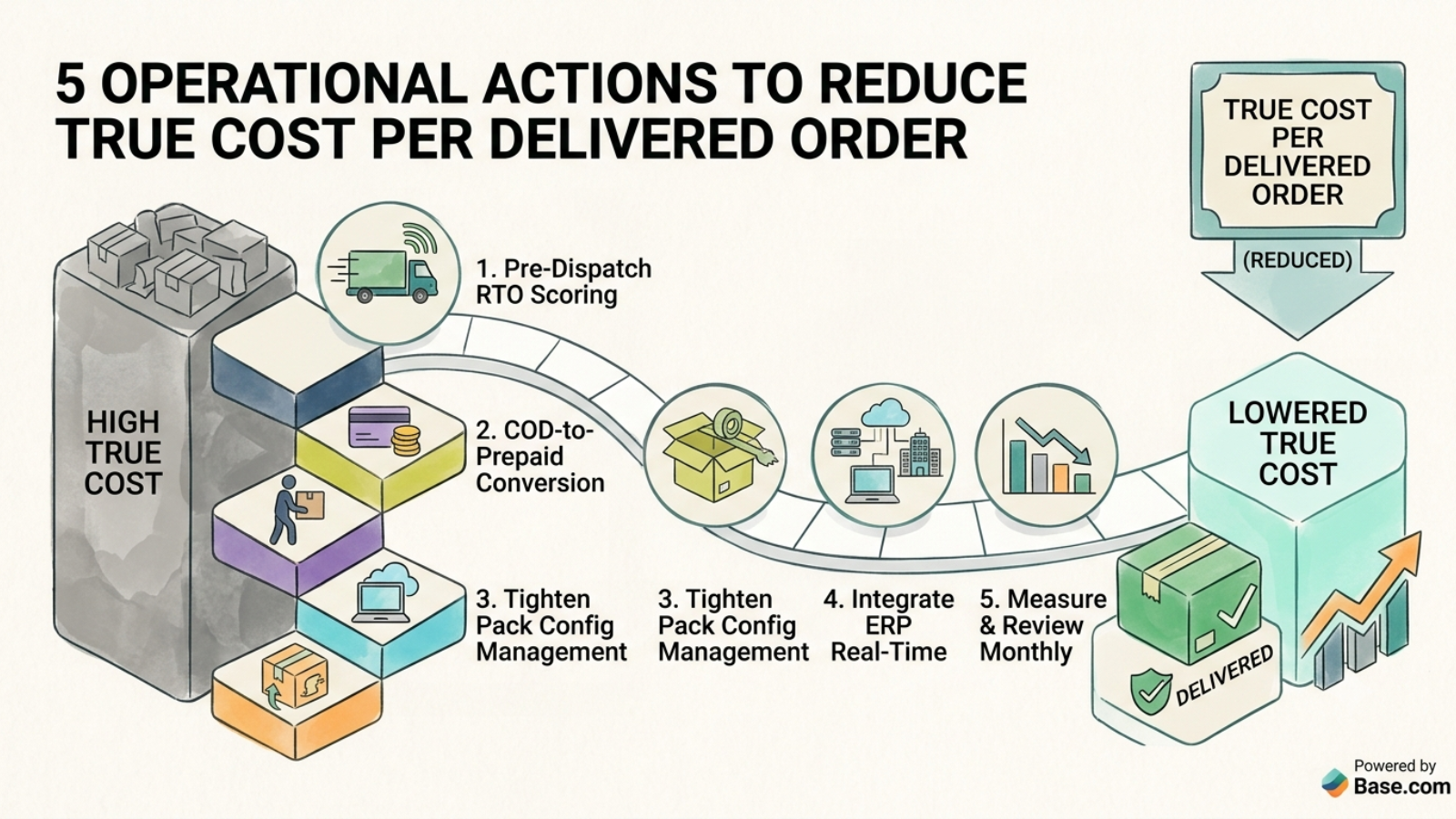 In D2C and omnichannel businesses, the real cost of an order is rarely just the product and shipping. It includes failed deliveries, returns (RTO), reverse logistics, payment gateway losses, inventory blocking, and operational inefficiencies. Many brands assume they are profitable on paper, but once these hidden costs are accounted for, margins shrink significantly.
The goal is not just to increase sales, but to reduce the true cost per delivered order, because that is what ultimately drives sustainable profitability. The brands that scale efficiently are the ones that treat operations as a growth lever, not just a backend function. Below are five practical, high-impact operational actions that directly improve margins without increasing ad spend.
1. Implement Pre-Dispatch RTO Scoring
The single highest-ROI action for any Indian brand with more than 15% COD RTO. If you want to reduce RTO India quickly, this is where to start. Risk-scoring orders before dispatch, using address completeness, customer history, and channel signals, allows you to intervene before forward freight is spent.
Base.com does this automatically as part of its standard order flow, making it the most operationally efficient way to reduce RTO India without adding manual intervention.
2. Automate COD-to-Prepaid Conversion Nudges
Every COD order converted to prepaid saves you the COD handling fee, eliminates RTO risk for that order, and removes return freight cost from your equation.
Automated nudges triggered by your ecommerce backend India platform can shift your prepaid ratio by 8-15% over 3-6 months, and meaningfully reduce RTO India in the process.
3. Tighten Pack Configuration Management
Wrong-pack dispatches are expensive and invisible. A brand dispatching an outer carton when a single unit was ordered, or vice versa, creates a full returns cycle cost. Ensuring your ecommerce backend India OMS enforces pack configuration rules at order entry, not at dispatch, eliminates this cost category.
This is a standard D2C operations India failure point that costs more than it looks. Base.com’s L1-L5 pack hierarchy management with UOM validation does this at the platform level.
4. Integrate Your ERP in Real Time
Batch-sync ERP integration in your ecommerce backend India stack creates gaps where stock is allocated in your OMS but not updated in SAP or NetSuite, leading to stockouts, duplicate SOs, and cancellations.
Each cancellation is a lost sale plus a customer service cost. Real-time ERP integration through Base.com eliminates this gap, making it the most reliable ecommerce backend approach for SAP and NetSuite brands for brands on SAP ECC, SAP S/4HANA, or NetSuite.
5. Measure and Review Monthly
Your true cost per delivered order changes as your channel mix, carrier rates, and RTO rate shift. Build a monthly review cadence where you calculate all six components and compare against the prior month. D2C operations in India, brands that do this quarterly are always 2-3 months behind their cost reality.
The brands that reduce RTO India most consistently are the ones that treat it as a tracked metric, not an assumed cost. To reduce RTO India, you must measure it weekly, not monthly.
How Base.com Helps Reduce Your True Cost Per Delivered Order
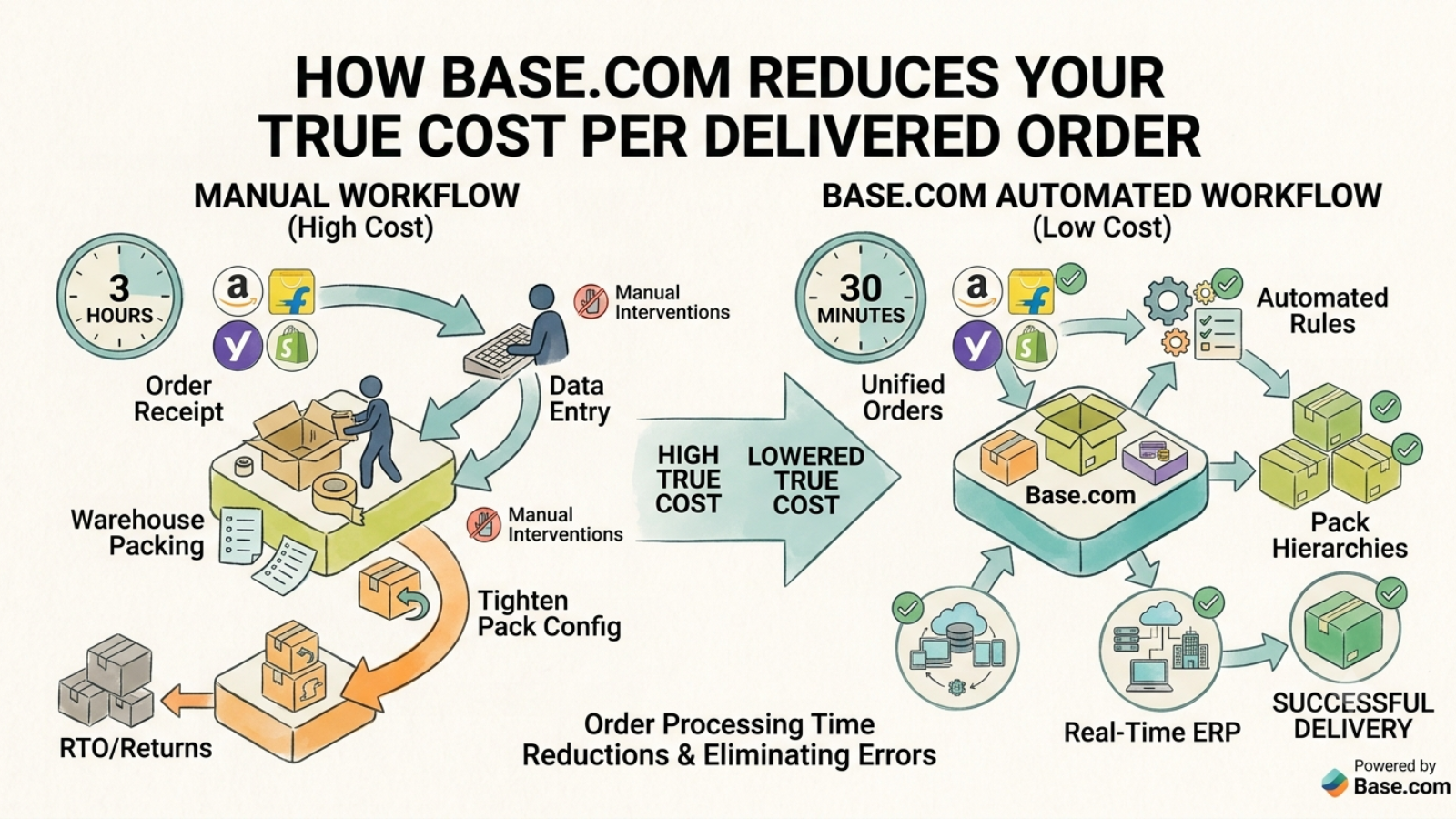 Base.com is built as an ecommerce backend India platform for the specific operational complexity that drives cost in Indian ecommerce. Its platform covers the full order lifecycle that D2C operations India teams manage every day, from order receipt across all channels to ERP posting to warehouse dispatch to customer delivery, with automation at every step.
The result is measurable. Order processing time drops from 3 hours to 30 minutes. Packing errors drop to effectively zero. Automated workflows replace manual interventions that add costs, cause delays, and increase the risk of errors in Indian D2C operations.
For brands running ecommerce backend India operations on SAP or NetSuite, Base.com eliminates the middleware layer that creates cost through sync failures that creates cost through sync failures and manual corrections.
For D2C operations, India brands at the ₹25-₹500 crore GMV range, Base.com is the operational platform that makes true cost per delivered order a metric you can actually reduce, and the most practical way to reduce RTO India systematically, quarter over quarter.
India’s ecommerce market, at $226 billion, is large enough to support profitable unit economics if you manage the cost stack correctly. The brands that win across D2C operations in India are the ones that know exactly what it costs to deliver one order, and systematically drive that number down.
Reducing true cost per delivered order requires consistent operational control, not one-time fixes. Brands that win focus on minimizing RTO, automating workflows, and improving inventory and fulfillment efficiency. Platforms like Base.com enable this by centralizing operations and eliminating manual inefficiencies.
In India’s competitive ecommerce market, profitability depends on how well you manage your cost stack. The brands that track, optimize, and improve this metric continuously are the ones that scale sustainably while maintaining strong margins.



[…] prices in your catalogue. Every downstream calculation depends on this figure, and a plan built on last season’s costs is confidently […]
[…] allocation logic checks live stock at every warehouse, delivery pincode proximity, and courier cut-off times simultaneously. It then assigns the order automatically to the location best positioned to […]
[…] loaded basis, ₹350-700 in logistics and operational cost plus ₹1,200 in unrealised revenue, the true cost of a single COD RTO on a ₹1,200 order is ₹1,550-₹1,900. Most brands account for the logistics cost in their […]