

Buy the OMS first if you sell across multiple channels from one warehouse. Buy the WMS first if you carry thousands of SKUs or hold stock in more than one location. That rule settles the decision for most sellers searching “need OMS or WMS for my ecommerce business” in 2026.
India’s ecommerce market is set to reach roughly ₹19.7 trillion, about $226 billion, in 2026, growing near 12.4% year on year. That growth reaches your operations before it reaches your margin. Sellers who delay the decision usually make it mid-festive-season, which is the worst possible window for a system migration.
This guide gives you the signals, the sequence, the cost heads, and a 90-day rollout plan. Read it as an operations checklist rather than a software brochure.
What Is the Difference Between an OMS and a WMS for Indian Sellers?
Both categories advertise “inventory management,” and that shared phrase causes most buying mistakes. The real difference lies in what each system means by inventory.
Work through these six distinctions before you shortlist any vendor, because the question “do I need OMS or WMS for my ecommerce business” only becomes answerable once the categories are clear.
1. An OMS Governs Available-to-Sell Quantity Across Channels
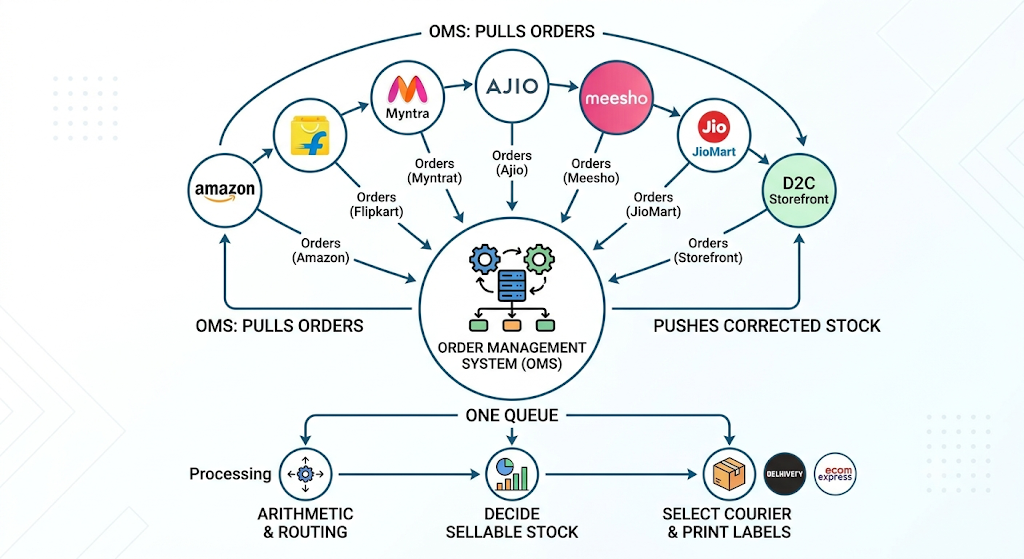
An OMS sits above your sales channels. It pulls orders from Amazon, Flipkart, Myntra, Ajio, Meesho, JioMart, and your D2C storefront into one queue, then pushes corrected stock counts back to every listing.
Its job is arithmetic and routing. It decides what is sellable, which courier ships it, and which label prints.
2. A WMS Governs Where That Stock Physically Sits
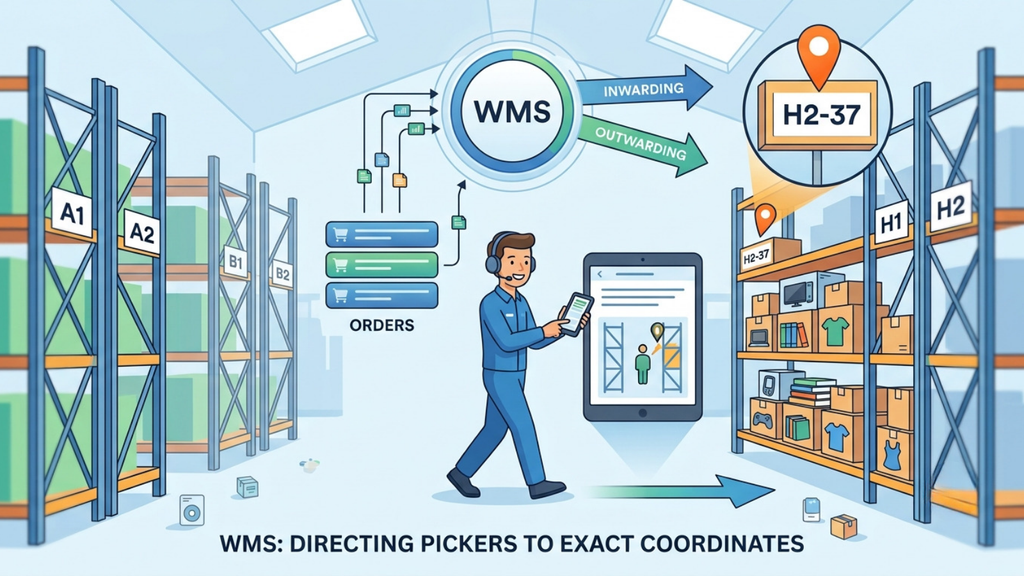
A WMS sits below your orders. It maps bins, structures inwarding and outwarding, and directs a picker to an exact shelf coordinate.
Base.com assigns bin locations such as H2-37 to each product, so staff walk to a coordinate instead of scanning an entire rack. That capability starts paying back once catalogues cross a few thousand SKUs.
3. Channel Count Drives OMS Urgency
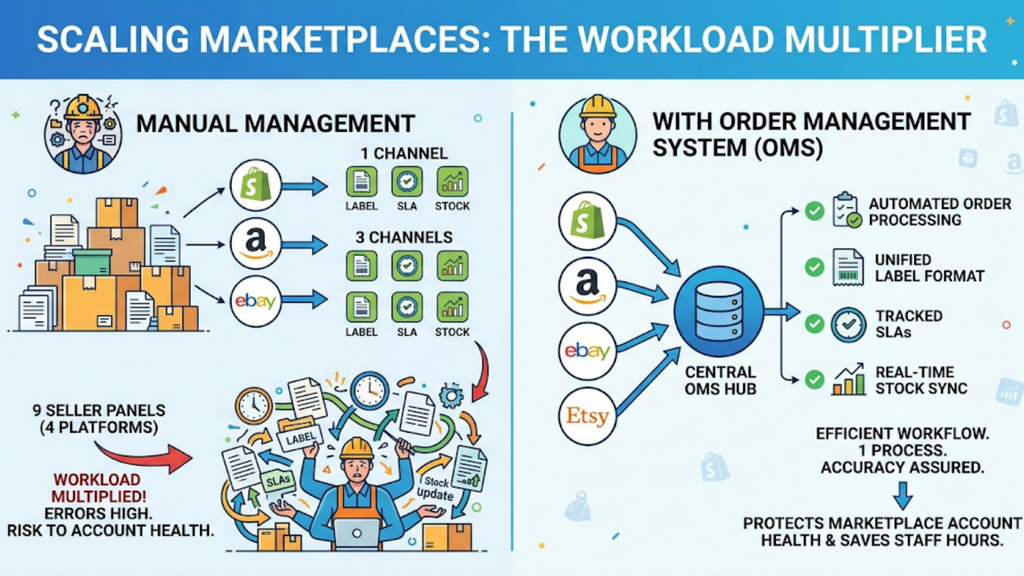
Each additional marketplace multiplies your manual workload rather than adding to it. Three channels mean three label formats, three dispatch SLAs, and three stock updates per sale.
Sellers running nine seller panels across four platforms cannot maintain accuracy manually. At that stage, an OMS protects marketplace account health, not just staff hours.
4. SKU Depth and Location Count Drive WMS Urgency
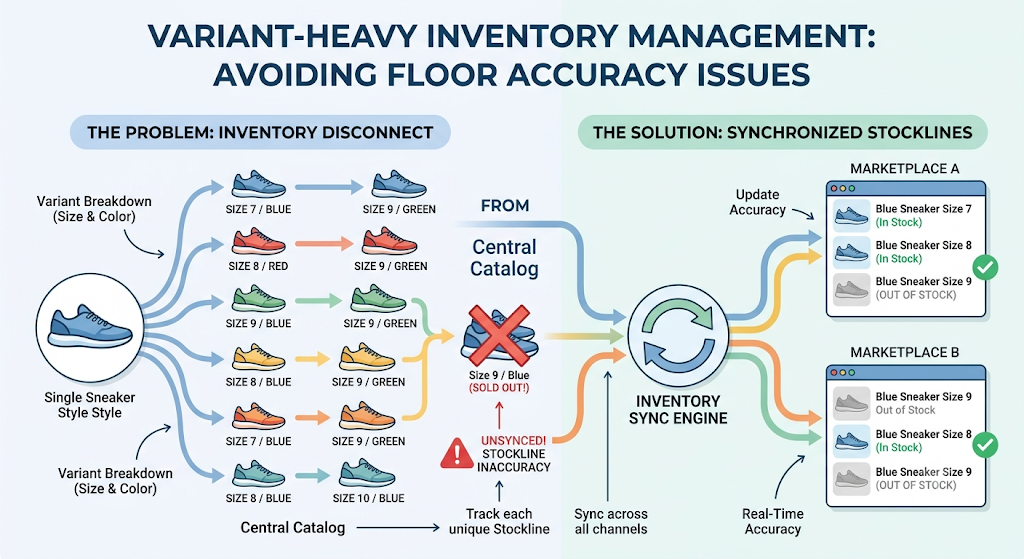
Variant-heavy catalogues break floor accuracy long before they break order flow. One apparel style forks into a dozen sizes and several colours, and each combination sells at a different pace.
Footwear sellers hit this first. Base.com tracks each size-and-colour combination as its own stock line and syncs it everywhere the style is listed, which prevents a sold-out size from staying live on a second marketplace.
5. Returns Exposure Pushes the Timeline Forward for Both
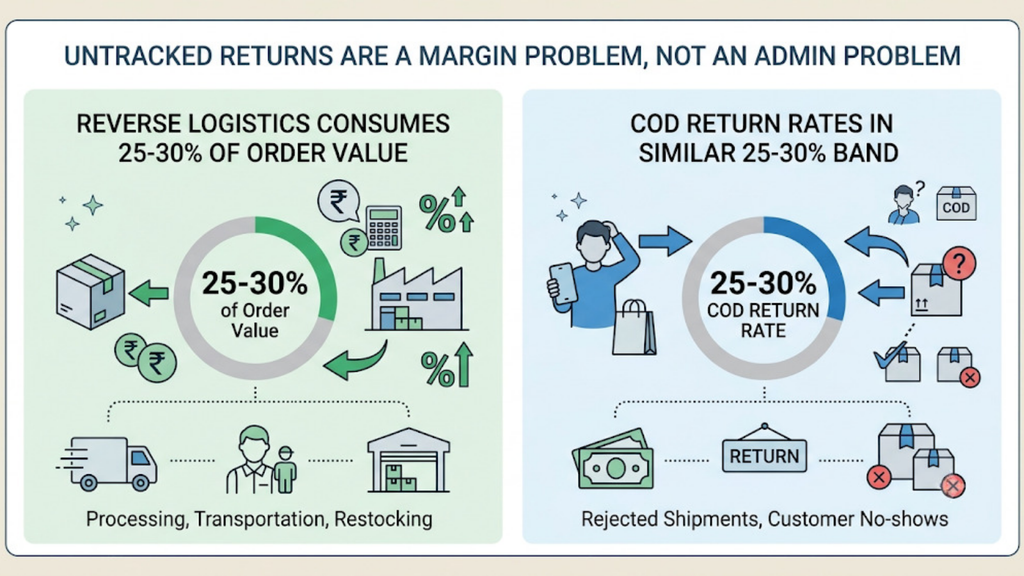
Reverse logistics consumes 25-30% of order value on low-ticket Indian shipments, and COD return rates in several categories sit in a similar band. Untracked returns are therefore a margin problem, not an admin problem.
Base.com handles RTO and customer returns through scan-based intake with custom statuses such as damaged, recoverable, and return-to-store. Sellers restock resalable units instead of writing them off.
6. Compliance Requirements Often Decide the Order for You

FMCG, beauty, wellness and pet food sellers carry batch and expiry obligations that spreadsheets cannot satisfy. FEFO picking, batch-wise inventory and goods-inward receiving are native Base.com capabilities rather than paid add-ons.
If a regulator or a marketplace can penalise you for a near-expiry dispatch, the warehouse layer stops being optional. Compliance overrides convenience every time.
Read the Symptom Table Before You Read Any Feature List
Feature comparisons rarely settle this decision, because both categories list forty features each. Mapping your daily symptoms to the system that actually fixes them settles it in minutes.
Score your own operation against the table below, then count where your ticks cluster.
| Operational symptom you face daily | Fixed mainly by OMS | Fixed mainly by WMS | Typical trigger point |
| Orders missed across multiple seller panels | Yes | No | 3+ live channels |
| Overselling a SKU listed on four marketplaces | Yes | Partially | Shared stock, 2+ channels |
| Labels printing out of sequence, manual cropping | Yes | No | 100+ orders per day |
| Pickers cannot locate a SKU on the shelf | No | Yes | 1,000+ SKUs |
| Wrong size, colour or variant dispatched | Partially | Yes | Apparel and footwear catalogues |
| Near-expiry or wrong batch shipped | No | Yes | FMCG, beauty, pet food |
| Stock shows available but sits in another city | Partially | Yes | 2+ warehouses |
| RTO returns untracked and never restocked | Yes | Yes | 20%+ COD share |
| Courier selected manually, order by order | Yes | No | PIN-code-dependent SLAs |
| Festive spikes collapse the whole process | Yes | Yes | October-November peak |
| Payouts unreconciled across seller accounts | Yes | No | Multi-account sellers |
| Gift sets or bundles drift out of stock sync | Yes | Yes | Bundle-led catalogues |
If most ticks land in the OMS column, resolve the question “need OMS or WMS for my ecommerce business” in favour of the OMS and revisit the warehouse layer two quarters later. If ticks cluster on the right, invert that order.
Which Should You Buy First Based on Your Seller Profile?
Sequence matters more than vendor selection. Buying the correct system in the wrong order wastes the first six months of any contract.
These six profiles cover almost every Indian seller we encounter, so match yourself to the closest one.
1. Single Warehouse, Multiple Channels: Start With the OMS

Start with the OMS without exception. One warehouse keeps your physical process containable by a floor supervisor, so your real losses sit in channel sync and dispatch delays.
Base.com consolidates every channel into one login, syncs stock automatically, and generates labels and invoices in bulk. Sellers recover the cost through avoided stockouts and late-dispatch penalties rather than through headcount.
2. Single Channel, High SKU Depth: Start With the WMS
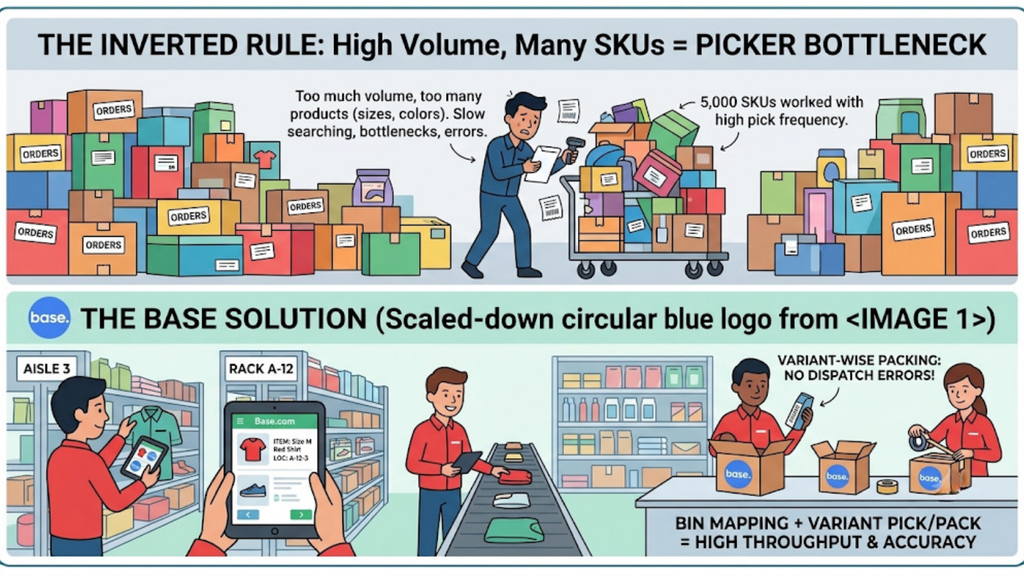
Invert the rule here. If 90% of volume comes from one marketplace but you carry 5,000 SKUs across sizes and colours, your pickers are the constraint.
Base.com supports size-wise, variant-wise, and style-wise pick and pack, so dispatch errors stop at the packing table. Bin mapping removes the search time that quietly caps daily throughput.
3. Two or More Warehouses: Buy Both, Sequenced Two Weeks Apart
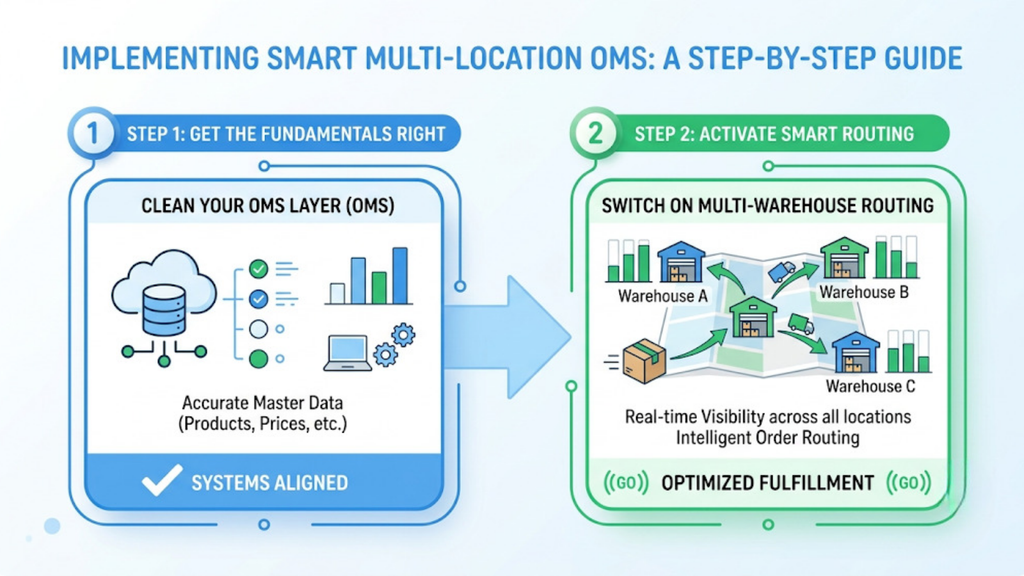
Multi-location sellers cannot separate routing from visibility. Stock in Gurgaon is worthless against a Bengaluru order if the system cannot see the difference.
Base.com shows stock warehouse by warehouse, tracks inter-location transfers inside the same system, and routes each order to a location that genuinely holds the inventory. Implement the OMS layer first, then switch on multi-warehouse routing once location masters are clean.
4. Manufacturers Selling Online: Start With Raw Material Visibility
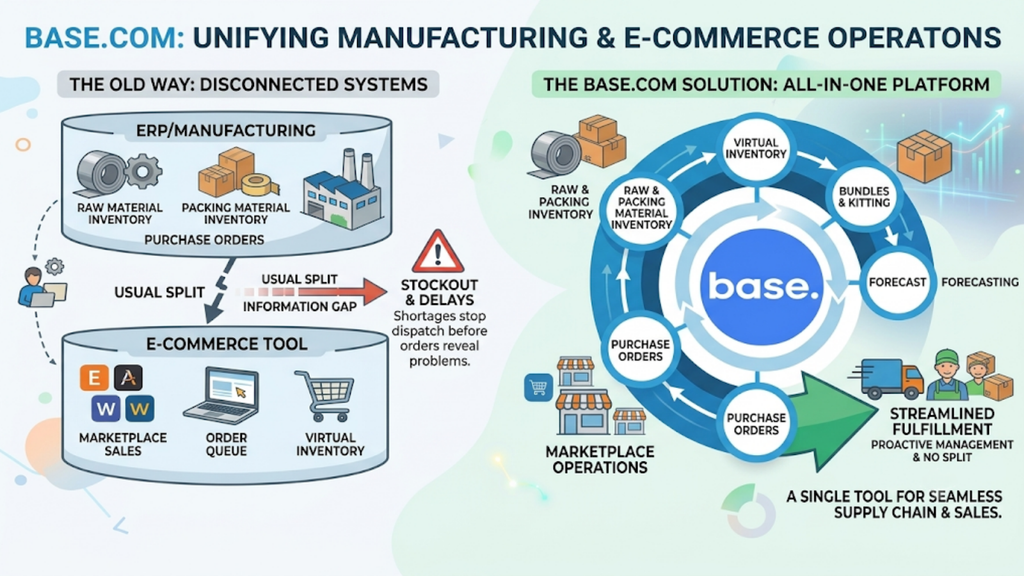
Manufacturing sellers run two inventories, not one. Raw material and packing material shortages stop finished-goods dispatch days before the order queue reveals a problem.
Base.com covers raw material and packing material inventory, virtual inventory, bundles, forecasting, and purchase orders alongside marketplace operations. That combination removes the usual split between an ERP and an ecommerce tool.
5. Agencies and Multi-Client Operators: Prioritise Workflow Configurability
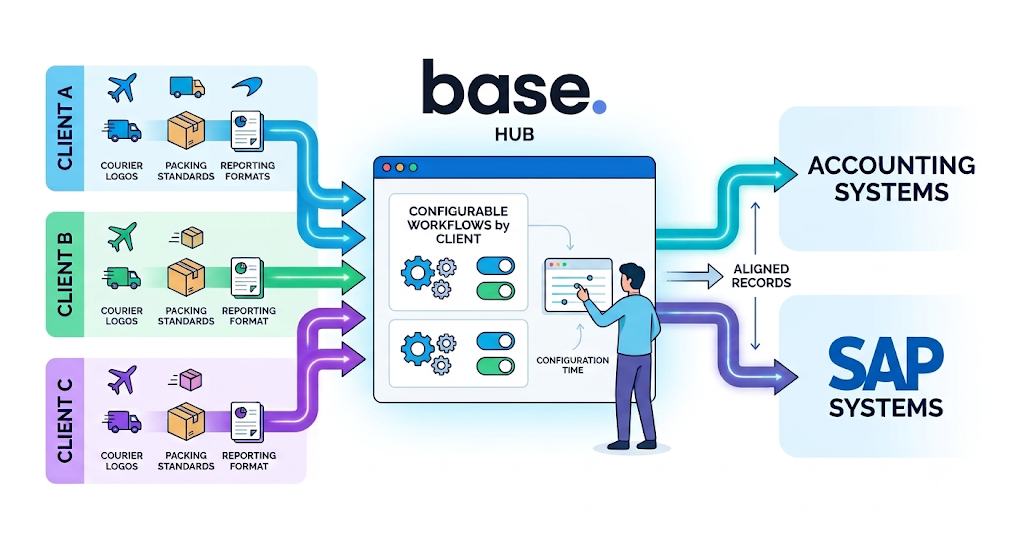
Agencies do not run one operation; they run several at once. Each client brings its own couriers, packing standards and reporting formats.
Base.com lets you configure genuinely different workflows by product, category, or client, and it connects to accounting and SAP systems so back-office records stay aligned with fulfilment. Onboarding a new client then costs configuration time instead of proportional headcount.
6. Quick Commerce and Modern Trade Sellers: Buy for Batch Discipline First
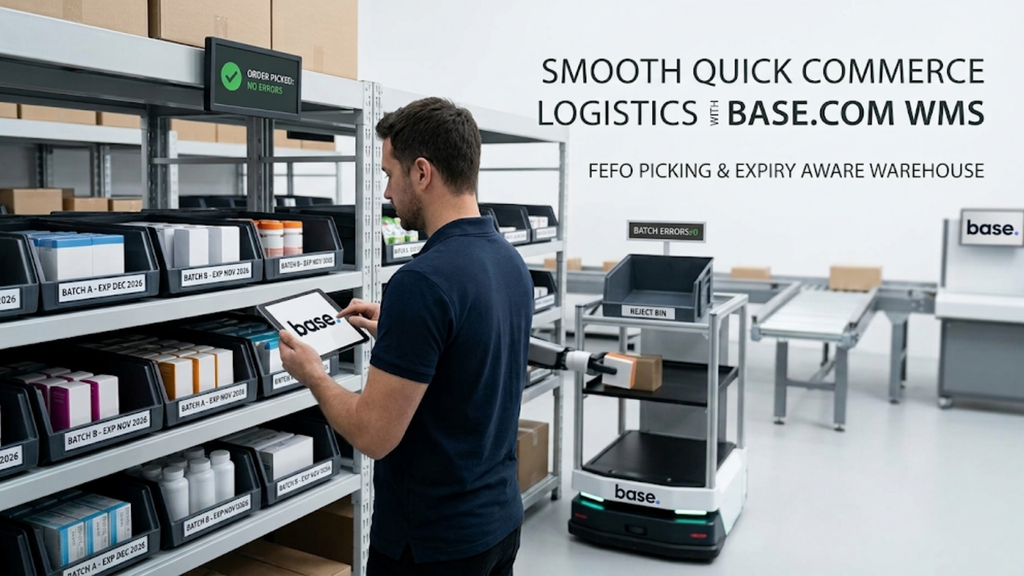
Quick commerce now contributes 16-17% of Indian ecommerce GMV, and appointment-based replenishment leaves no room for batch errors. Rejections at the dark store or DC hit fill rate immediately.
Base.com supports batch-wise inventory, FEFO picking, and expiry-aware warehouse management natively, plus add-ons such as Product Dates for WMS expiry and discount auto-scan. Sellers in this lane should treat the warehouse layer as the first purchase.
Match Base.com Capabilities to the Gaps You Actually Have
Most platforms cover the obvious basics well. The decision usually turns on the operational edge cases that appear at 300 orders a day, which is exactly where sellers re-ask whether they need OMS or WMS for my ecommerce business after their first tool disappoints them.
Use the list below to check your shortlist against real Indian requirements rather than generic feature grids.
- PIN-code-based courier routing: Base.com assigns couriers by destination PIN code, calculates weight-based pricing per package, and fails over automatically to the next partner when a courier cannot service an address.
- Weight-slab and category-specific packing rules: Base.com applies different pick-and-pack logic to bulky kitchenware, fragile handcrafted items, glass-bottled skincare and multi-size garments instead of forcing one packing standard.
- Bundle and gift-set inventory: Base.com deducts component stock when a bundle sells, so festive gift sets and their individual SKUs never drift apart.
- Batch, expiry and FEFO compliance: Base.com treats batch-wise inventory and first-expiry-first-out picking as native functionality, with batch details carried into invoices for traceability.
- Multi-warehouse routing and transfers: Base.com routes each order to a location holding stock and records transfers as structured events rather than manual adjustments.
- GST and financial workflows: Base.com covers e-invoicing, e-way bills, and payment reconciliation alongside order operations, which removes a second system from the stack.
- SAP and accounting integration: Base.com connects ecommerce operations to internal ERP systems, a requirement for larger multi-category operators.
- Add-on depth: Base.com ships bulk barcode printing, scheduled cron-based reports, offline-order POS, pre-order inventory separation, and marketplace ticket management as configurable add-ons.
That breadth matters because it changes the answer to “need OMS or WMS for my ecommerce business” from a two-product purchase into one implementation with two phases.
How Much Does an OMS or WMS Cost an Indian Seller in 2026?

Pricing shifts with order volume, channel count, and add-on scope, so a single sticker price rarely applies. Budget across the full cost structure instead of the licence line alone.
These five heads make up your true first-year spend.
- Platform subscription, tiered by monthly order volume and active channels.
- Implementation and onboarding, which should include on-site warehouse mapping for WMS scope.
- Custom workflow or add-on development, charged separately by most vendors, including Base.com, for client-specific builds.
- Hardware, covering barcode scanners, label printers, and mobile devices for bin-based picking.
- Internal change cost, meaning the two to four weeks of reduced throughput while staff learn new processes.
Compare vendors on total first-year cost, not monthly licence. A cheaper subscription with weak courier logic costs more through failed deliveries, because reverse logistics eats 25-30% of order value on low-ticket shipments.
Avoid the Five Mistakes That Waste the First Six Months

Implementation failures rarely come from software limitations. They come from sequencing errors and unclean data, both of which are preventable.
Check your plan against these five failure patterns before you sign anything.
- Buying a WMS to fix a channel-sync problem. Bin mapping will not stop overselling across four marketplaces, and sellers who confuse the two lose a quarter. Decide whether you need OMS or WMS for my ecommerce business using symptoms, not vendor positioning.
- Migrating during the festive season. Indian ecommerce concentrates heavily into the October-November window, when daily volumes multiply several times over. Go live in a trough month instead.
- Importing a dirty SKU master. Duplicate SKUs, inconsistent variant naming, and missing barcodes break inventory sync on day one. Clean the master before migration, not after.
- Skipping courier-rule configuration. Sellers often launch with default routing and keep assigning couriers manually, which erases the main throughput gain. Configure PIN-code and weight rules during onboarding.
- Training only the supervisor. Pickers, packers, and returns staff each touch the system daily. On-site training for the full floor team delivers adoption; a dashboard handoff does not.
How Long Does Implementation Take and What Should Each Phase Deliver?
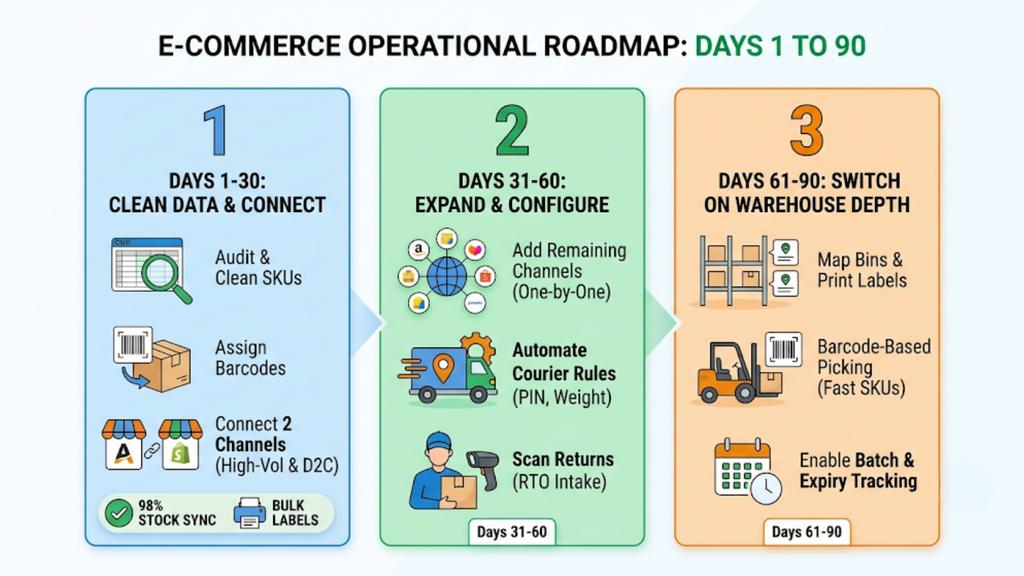
A phased rollout protects revenue while you change systems. Split the quarter into three blocks with defined exit criteria for each.
Follow this schedule, and treat every checkpoint as a gate rather than a suggestion.
1. Days 1 to 30: Clean Data and Connect Channels
Audit your SKU master first, then deduplicate, standardise variant naming, and assign barcodes. Connect two channels only, starting with your highest-volume marketplace and your D2C store.
Exit criteria: stock sync accuracy above 98% on connected channels, and label generation running in bulk for at least one week.
2. Days 31 to 60: Add Channels and Configure Fulfilment Rules
Bring remaining marketplaces online one at a time, never simultaneously. Configure courier allocation by PIN code, weight slab, and COD status, then set up return statuses.
Exit criteria: every channel live, manual courier selection eliminated, and RTO intake scanned rather than logged manually.
3. Days 61 to 90: Switch On Warehouse Depth
Map bins, print location labels, and run barcode-based picking on your fastest-moving 200 SKUs before extending coverage. Add batch and expiry tracking now if your category requires it.
Exit criteria: bin-based picking across A-class SKUs, scheduled reports running automatically, and dispatch-error rate measured weekly. By this point, sellers who asked whether they need OMS or WMS for my ecommerce business have both layers running without a second migration.
Make the Decision Before Your Next Peak Season
Sellers rarely regret buying early; they regret buying during a spike. With over 800 Indian D2C brands now crossing ₹100 crore in annual revenue, operational tooling has become a growth prerequisite rather than a scale reward.
Score your symptoms against the table, match your profile to the right sequence, then commit to a 90-day rollout in a low-volume month. If you still need OMS or WMS for my ecommerce business clarified against your exact channel mix, SKU depth, and warehouse count, book a Base.com operations review and get the sequence mapped to your own numbers.