

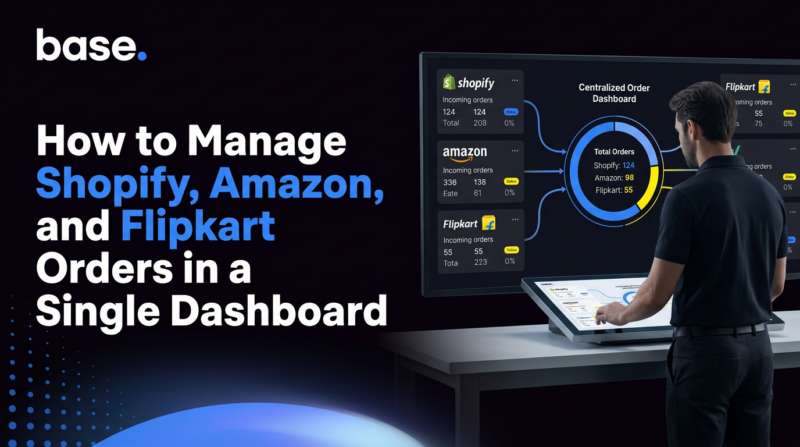
Indian D2C brands selling on Shopify, Amazon, and Flipkart simultaneously lose 2-3 hours daily switching between portals, manually syncing inventory, and reconciling order statuses across tabs. The fix is straightforward: manage Shopify, Amazon, and Flipkart orders in a single dashboard in India, one screen, all channels, real-time sync.
This guide covers exactly how to manage Shopify, Amazon, and Flipkart orders in a single dashboard in India, the architecture behind it, what breaks without it, and how Indian sellers implement it without disrupting live operations.
The Real Cost of Managing Three Channels Separately
India’s ecommerce market is projected to reach $226 billion by 2026. Most of that growth is multi-channel. A brand selling on only one platform is leaving revenue on the table. But selling on three platforms without unified order management creates operational debt that compounds daily.
When you do not manage Shopify, Amazon, and Flipkart orders in a single dashboard in India, three specific failures become routine.
- Overselling. Stock updates on Amazon happen every few minutes via API. Flipkart’s inventory sync has its own cadence. Your Shopify store updates when someone remembers to log in. A product sells out on Amazon at 11 AM. The other two channels keep selling it until someone manually pulls the listing. By the time you catch it, you have 12 unfulfillable orders and three negative reviews.
- Delayed fulfilment. Flipkart’s SLA for seller-fulfilled orders is tight; miss it, and your seller score drops. When orders live in three separate portals, your warehouse team checks each one independently. Orders fall through the gap between portal checks. Indian sellers operating this way typically see 6-8% of orders processed outside SLA during peak periods.
- Reconciliation failure. At the end of the month, your Shopify revenue, Amazon settlement, and Flipkart payment advice are three separate documents. Matching them against actual dispatch records requires hours of manual work, and errors that slip through directly affect your GST filing accuracy.
The decision to manage Shopify, Amazon, and Flipkart orders on a single dashboard in India solves all three problems at the architecture level.
What It Actually Means to Manage Shopify, Amazon, and Flipkart Orders in a Single Dashboard in India
A unified dashboard is not a reporting tool that aggregates data after the fact. It is an operational layer that sits between your sales channels and your warehouse, pulling orders in real time and pushing inventory updates back out simultaneously.
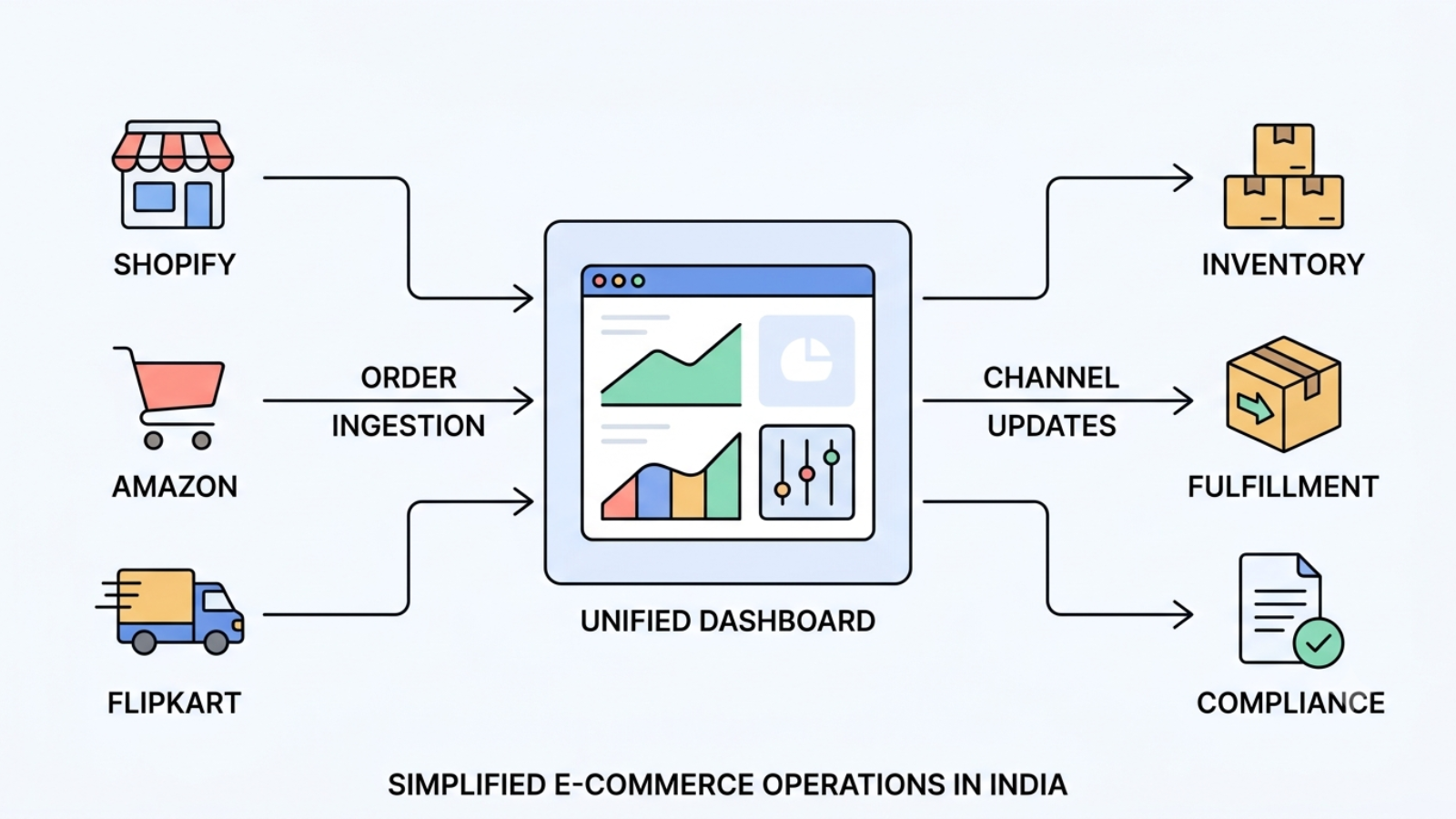 When you manage Shopify, Amazon, and Flipkart orders in a single dashboard in India, four core functions operate in parallel:
- Order ingestion. Every order placed on Shopify, Amazon, or Flipkart appears in one queue within seconds of placement. No manual export, no CSV upload, no portal switching.
- Centralised inventory. One master inventory number per SKU. When an order is confirmed on any channel, available inventory is decremented across all three simultaneously. Overselling becomes structurally impossible.
- Unified fulfilment workflow. Pick, pack, and ship instructions are generated from one system regardless of which channel the order came from. Your warehouse team works one queue, not three.
- Channel-specific compliance. Amazon requires specific label formats. Flipkart has its own manifest structure. Shopify orders going through third-party logistics need AWB generation. A proper system built to manage Shopify, Amazon, and Flipkart orders on a single dashboard in India handles all channel-specific output requirements automatically.
Base.com connects Shopify, Amazon, and Flipkart into a single order management layer with real-time bidirectional sync. Brands using Base.com to manage Shopify, Amazon, and Flipkart orders in a single dashboard in India report inventory sync latency under 60 seconds across all three channels, and a sale on Amazon updates Flipkart and Shopify available stock in under a minute.
Why Indian Sellers Specifically Need This
Global OMS platforms exist. Most are built for Western markets, US fulfilment networks, FedEx and UPS integrations, and single-currency accounting. When Indian sellers deploy them, they hit walls immediately.
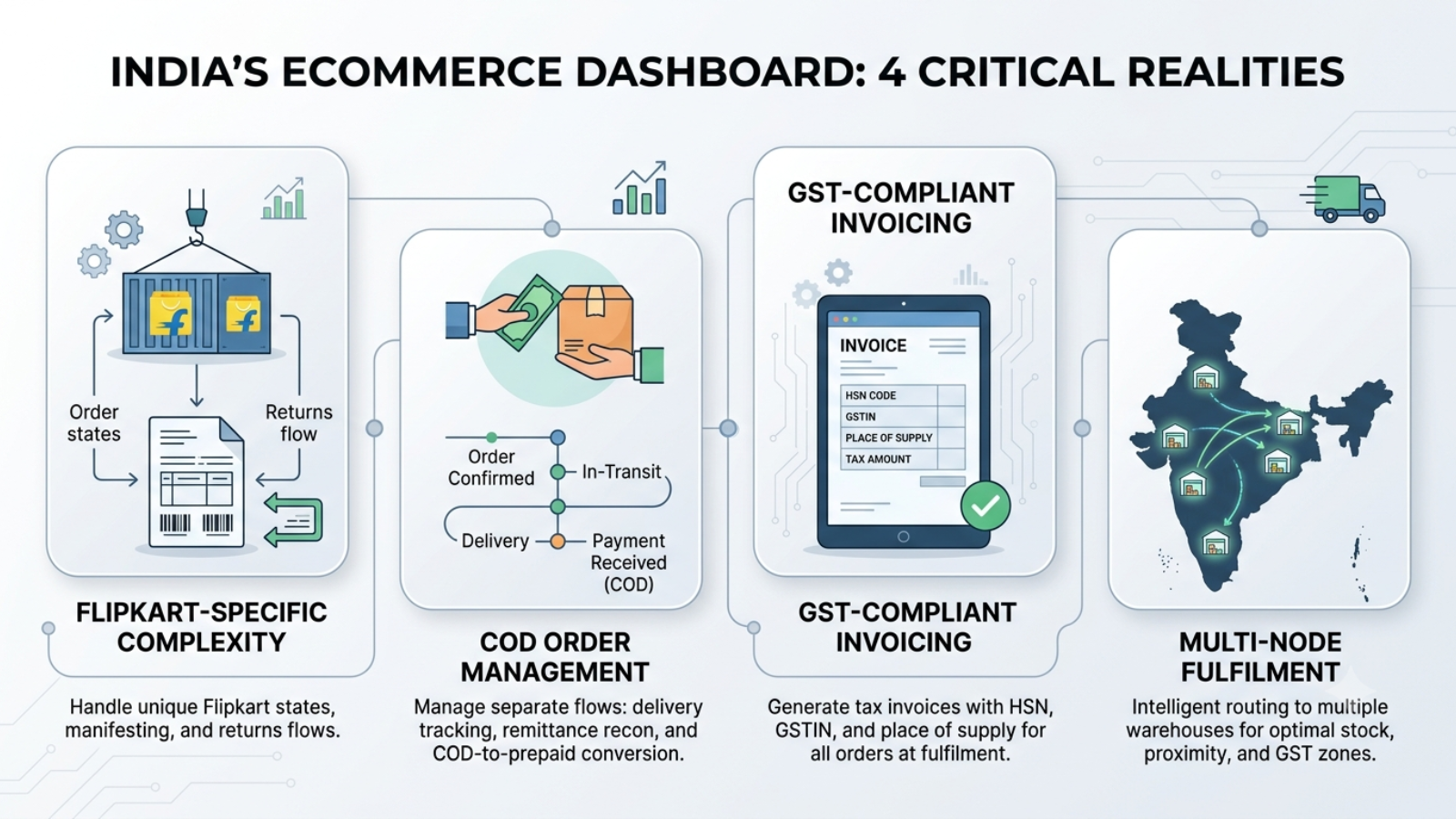 India’s ecommerce operations have requirements that generic platforms do not handle. To properly manage Shopify, Amazon, and Flipkart orders in a single dashboard in India, the platform must address four India-specific realities.
- Flipkart-specific complexity. Flipkart’s seller portal has its own order states, its own manifest format, and its own returns flow. A system that handles Amazon well but treats Flipkart as an afterthought will create manual exceptions for your second-largest revenue channel.
- COD order management. India’s COD rate remains at 25-30% across categories. COD orders have a different confirmation flow; they are not financially confirmed until delivery. Any platform used to manage Shopify, Amazon, and Flipkart orders on a single dashboard in India must handle COD status tracking, remittance reconciliation, and COD-to-prepaid conversion tracking distinctly from prepaid orders.
- GST-compliant invoicing. Every order, regardless of channel, requires a GST-compliant tax invoice with the correct HSN code, GSTIN, and place of supply. A dashboard built for Indian sellers generates this automatically at fulfilment. Platforms not built for India require manual invoice generation outside the system.
- Multi-node Indian fulfilment. Brands with revenue of ₹ 10 crore+ typically operate from multiple warehouse locations, often for GST zone optimisation. A system to manage Shopify, Amazon, and Flipkart orders in a single dashboard in India must support intelligent order routing: assign each order to the optimal warehouse based on proximity, stock availability, and courier serviceability.
Base.com is built from the ground up for Indian ecommerce. It handles Flipkart-specific flows, COD reconciliation, GST invoicing, and multi-node fulfilment natively, not as bolt-on modules.
How the Integration Architecture Works
 To manage Shopify, Amazon, and Flipkart orders in a single dashboard in India, the integration must be bidirectional and real-time on three data streams simultaneously.
1. Order flow, inbound:
| Channel | Flow |
|---|---|
| Shopify | Shopify webhook → Base.com OMS → Unified order queue |
| Amazon | Amazon SP-API event → Base.com OMS → Unified order queue |
| Flipkart | Flipkart Seller API push → Base.com OMS → Unified order queue |
2. Inventory flow, outbound:
| Action | Result |
|---|---|
| Order confirmed on any channel | Base.com decrements the master inventory |
| Master inventory updated | Pushes available stock to Shopify, Amazon, and Flipkart simultaneously |
| Return received, and QC passed | Base.com increments available stock, pushes update to all channels |
3. Fulfilment flow:
Unified order queue → Pick list generated → Warehouse execution → AWB/manifest pushed back to channel → Order status updated on channel portal
Base.com uses direct API integrations with Shopify (REST Admin API), Amazon (SP-API), and Flipkart (Seller API). No CSV intermediaries. No scheduled batch syncs with a 4-hour lag. This matters for Indian sellers because Flipkart and Amazon SLA clocks start at order placement. A 4-hour sync lag on a Flipkart order with a 24-hour dispatch SLA means you have already burned 17% of your fulfilment window before the order appears in your system.
Step-by-Step Setup: How to Manage Shopify, Amazon, and Flipkart Orders in a Single Dashboard in India
Managing orders across Shopify, Amazon, and Flipkart separately creates delays, errors, and operational complexity as order volumes grow. A unified dashboard brings all channels into one system, enabling real-time visibility, faster processing, and seamless fulfilment control across platforms.
Step 1: Map Your SKUs Across All Three Channels
 Every product listed on Shopify, Amazon, and Flipkart has a different identifier. Shopify uses its own product ID. Amazon uses ASIN and seller SKU. Flipkart uses FSN. Before you can manage Shopify, Amazon, and Flipkart orders in a single dashboard in India, these identifiers must be mapped to a single internal SKU master.
This is not optional. Incomplete mapping means orders for unmapped SKUs either fail to ingest or create phantom inventory records. Map every active SKU before go-live, including size and colour variants, which are the most common mapping gaps in Indian multi-channel setups.
Step 2: Set Channel-Wise Inventory Allocation
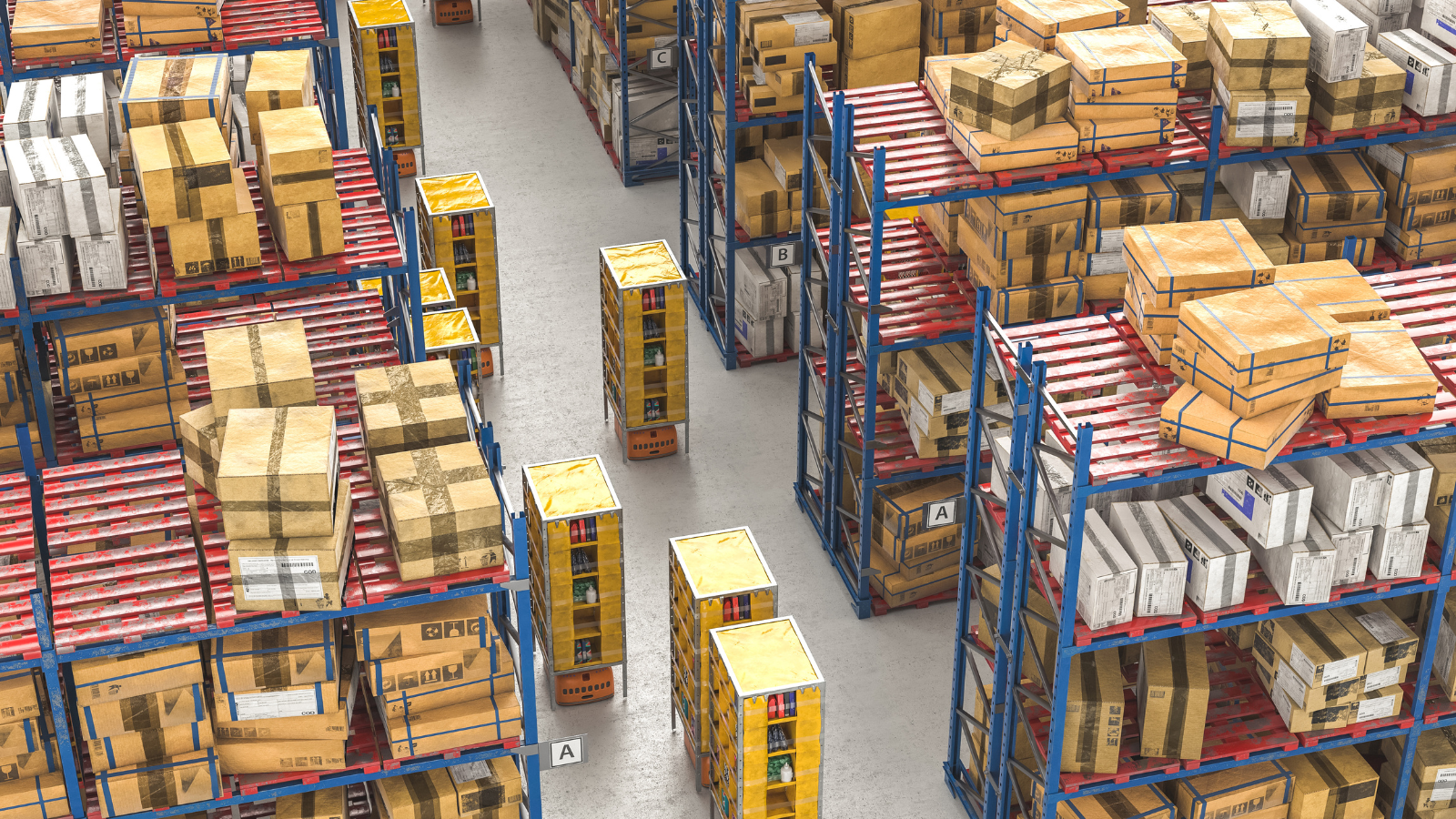 Not all inventory should be available on all channels simultaneously. Many Indian sellers reserve a portion of stock for their Shopify D2C store to protect margin, while listing the remainder on Amazon and Flipkart.
A proper system to manage Shopify, Amazon, and Flipkart orders in a single dashboard in India should support channel-wise allocation. For example: 60% of stock available on Amazon, 30% on Flipkart, 10% reserved for Shopify. When total stock drops below a threshold, the allocation logic rebalances automatically rather than draining one channel entirely.
Base.com supports buffer stock configuration per channel. VMSK Retail uses this to protect their Shopify D2C inventory during Flipkart Big Billion Day events, preventing a sale spike from zeroing out their own-channel stock.
Step 3: Configure Fulfillment Rules
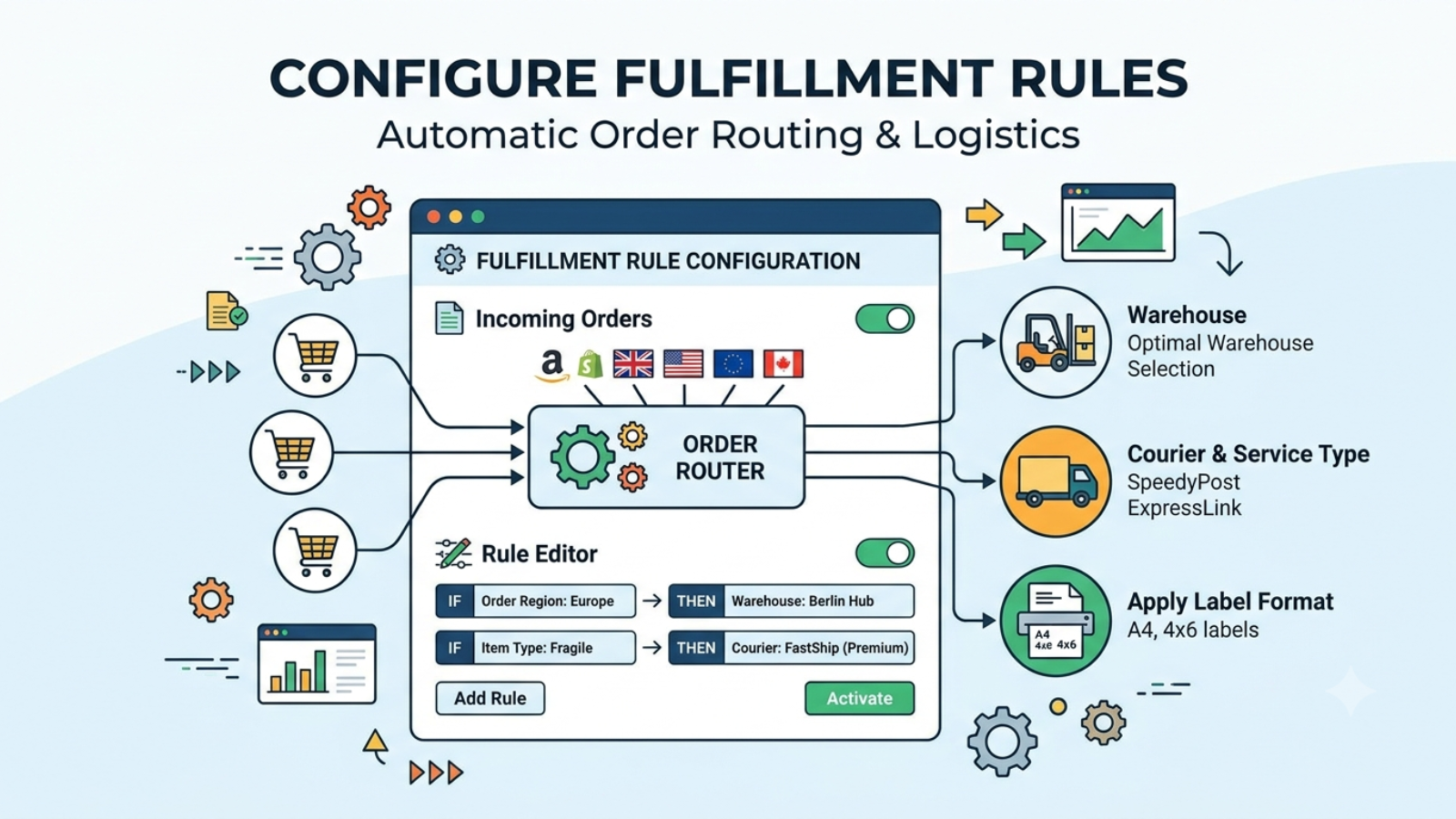 Multi-channel order management creates a routing decision for every order: which warehouse fulfils it, which courier ships it, and which label format applies. Configuring these rules once means every subsequent order routes automatically.
| Rule Type | Example Logic |
|---|---|
| Geography | Orders to South India → Bangalore warehouse; North → Delhi warehouse |
| Channel | Flipkart orders → use Flipkart-empanelled courier only |
| Order value | Orders above ₹2,000 → premium courier with faster SLA |
| SKU weight | Orders above 5kg → surface freight options |
| Stock availability | Primary warehouse OOS → auto-route to secondary warehouse |
Step 4: Automate Channel-Specific Compliance
 Amazon, Flipkart, and Shopify each require different outputs at dispatch. A system built to manage Shopify, Amazon, and Flipkart orders in a single dashboard in India must handle all three without manual intervention:
| Channel | Required Output |
|---|---|
| Amazon | Amazon-specific shipping label, packing slip, and box content labels for FBA |
| Flipkart | Flipkart manifest, Flipkart label format, trip sheet for bulk handover |
| Shopify (D2C) | GST invoice, AWB from 3PL partner, customer-facing packing slip |
Base.com generates all of these from the same order record in the correct format for each channel. The warehouse team scans a barcode and gets the right label. Channel compliance happens at the system level, not the human level.
Step 5: Centralise Returns Across All Three Channels
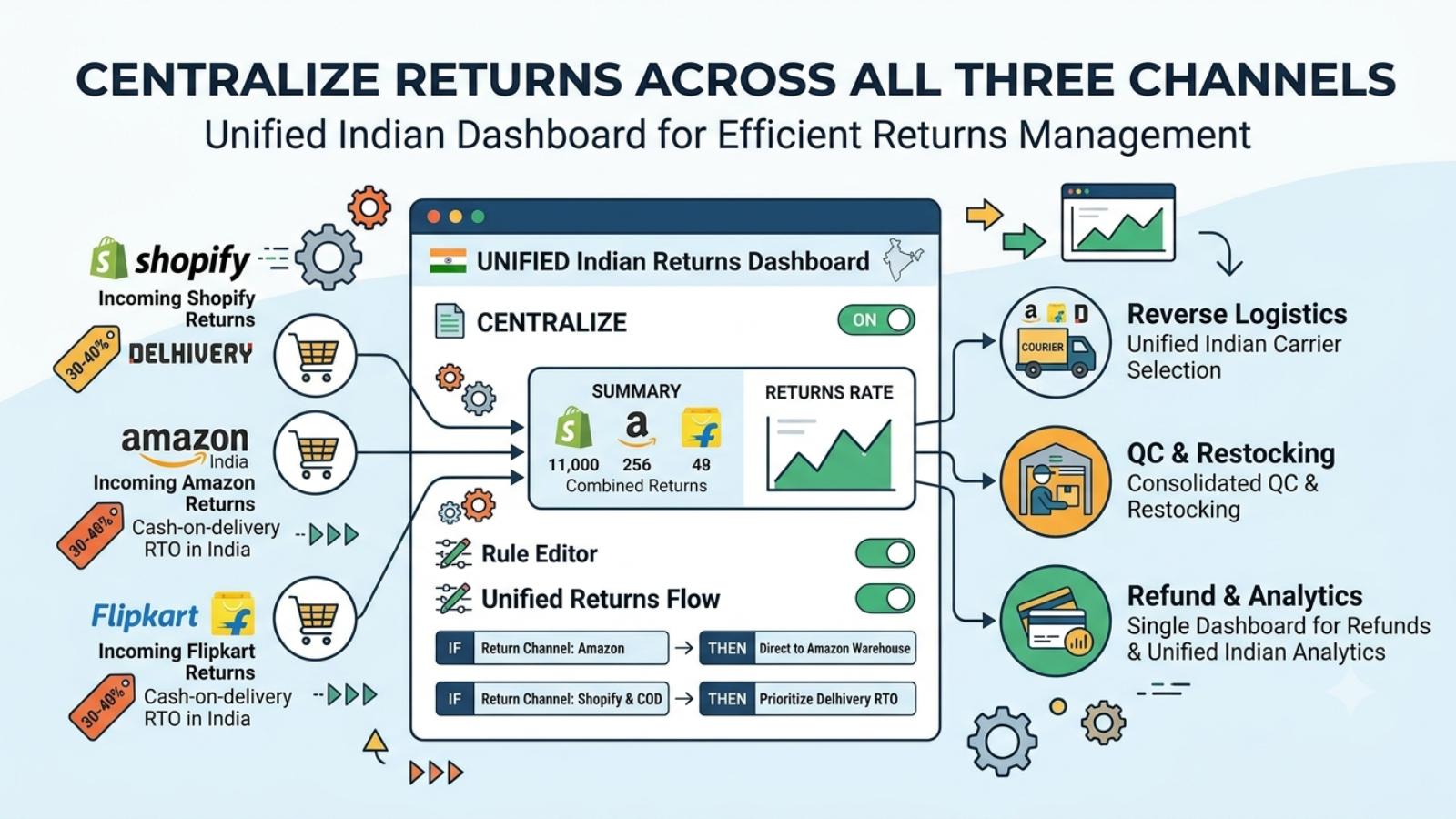 Returns in India are high, and fashion sees 30-40% return rates on COD. Each channel has its own return flow. A unified system to manage Shopify, Amazon, and Flipkart orders in a single dashboard in India should centralise all three.
When a return arrives, regardless of origin channel, the system should: update inventory if the item is resalable, flag it for QC if the condition is uncertain, trigger credit note or refund initiation, and update the original order record. Without centralised returns, reverse logistics becomes a separate manual operation layered on top of the fragmentation you were trying to fix.
What Breaks Without a Unified Dashboard
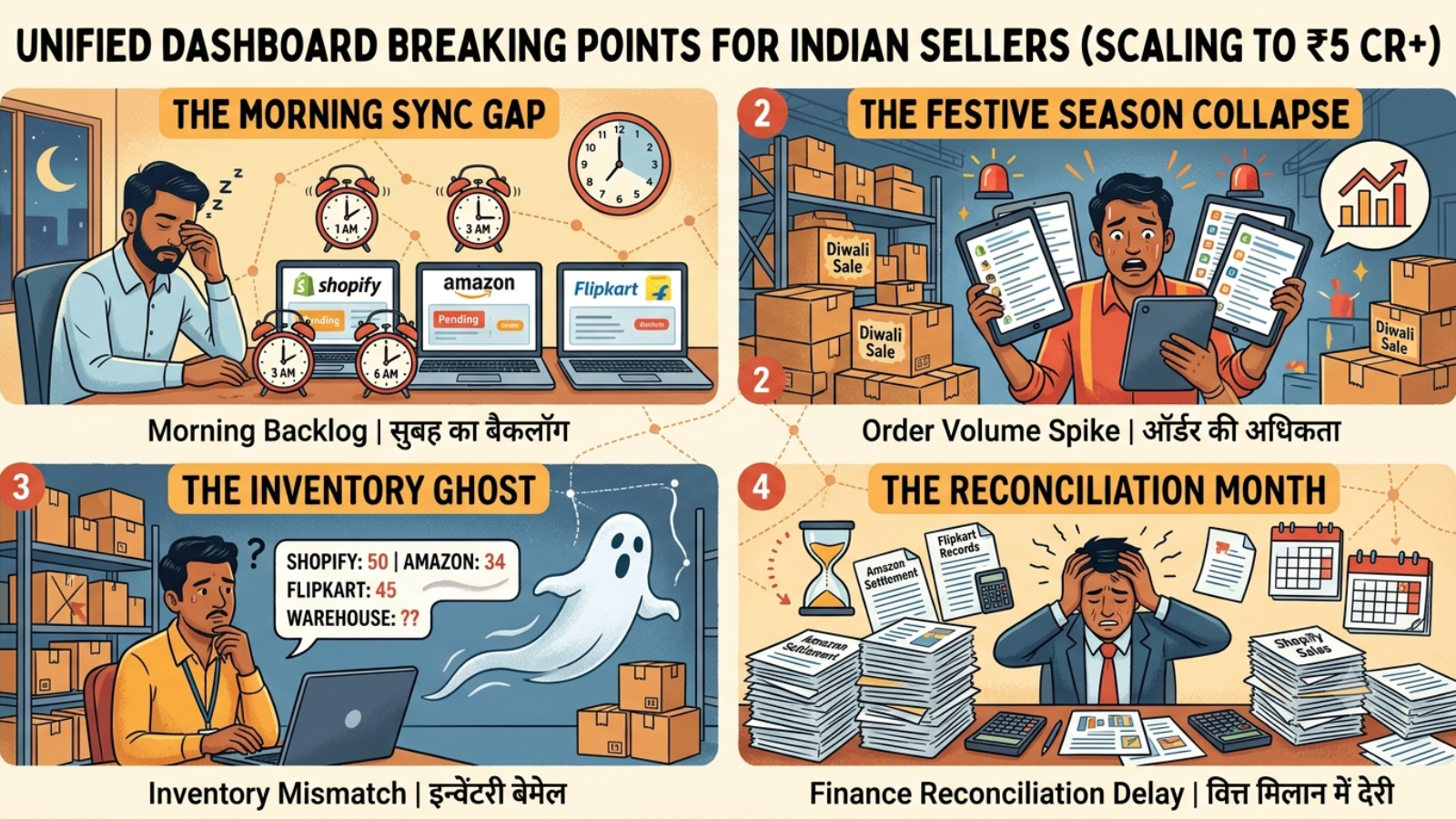 Indian sellers who scale to ₹5 crore+ revenue on three channels without a unified system to manage Shopify, Amazon, and Flipkart orders in a single dashboard in India hit the same four breaking points without exception.
Breaking point 1: The morning sync gap. Orders placed between midnight and 8 AM are not visible until someone logs into each portal. For brands with early-morning warehouse operations, this creates a daily backlog before the shift has even started.
Breaking point 2: The festive season collapse. During Diwali sales, order volume spikes 10x in 48 hours. Manual multi-portal management that works at normal volume breaks completely under spike conditions. Sellers miss SLAs, get penalised, and lose Buy Box ranking on Amazon at the worst possible moment.
Breaking point 3: The inventory ghost. After weeks of manual inventory updates across three portals, the numbers diverge. The system says 50 units. The warehouse has 34. Nobody knows which portal is accurate. Brands that cannot manage Shopify, Amazon, and Flipkart orders in a single dashboard in India make procurement and listing decisions on numbers that stopped being accurate weeks ago.
Breaking point 4: The reconciliation month. Finance spends 3-4 days every month matching three platform settlements against dispatch records. That is 36-48 days per year on a single operational task, time that compounds into a structural cost.
Metrics That Change When You Go Unified
Once you manage Shopify, Amazon, and Flipkart orders in a single dashboard in India, these are the numbers that move:
| Metric | What It Measures | Target for Indian D2C |
|---|---|---|
| Order-to-dispatch time | Placement to AWB generated | Under 12 hours for seller-fulfilled |
| Inventory sync latency | Sale to cross-channel stock update | Under 60 seconds |
| Oversell rate | Orders accepted with no available stock | 0% |
| SLA adherence rate | Orders dispatched within channel SLA | Above 98% |
| Return processing time | Return receipt to inventory update | Under 24 hours |
| Reconciliation time | Monthly settlement matching | Under 2 hours with automation |
These metrics are only measurable once all three channels feed into one system. Fragmented portals make measurement impossible because the data lives in three places with no common record key.
How to Choose the Right Platform to Manage Shopify, Amazon, and Flipkart Orders in a Single Dashboard in India
Not every OMS handles Indian ecommerce correctly. Before selecting a platform to manage Shopify, Amazon, and Flipkart orders in a single dashboard in India, evaluate against this checklist:
| Requirement | Why It Matters |
|---|---|
| Native Flipkart API integration | Generic platforms deprioritise Flipkart; Indian sellers cannot afford that |
| COD order tracking | 25-30% of Indian orders are COD, which requires a dedicated flow |
| GST-compliant invoice generation | Mandatory for every order; must be automatic |
| Multi-warehouse routing | Essential for brands operating across GST zones |
| Real-time inventory sync under 2 minutes | Anything slower creates oversell windows at peak volume |
| Indian courier integrations | Delhivery, Bluedart, Xpressbees, Shadowfax, all need native support |
| SAP/Tally ERP integration | Most Indian brands at scale run one of these |
Base.com meets every requirement on this list. It is purpose-built to manage Shopify, Amazon, and Flipkart orders in a single dashboard in India, not adapted from a Western platform with Indian channels bolted on afterward.
Base.com is an order and warehouse management platform built for Indian D2C and B2B brands. It connects Shopify, Amazon, Flipkart, and 50+ Indian logistics partners into one unified operations layer, real-time inventory sync, GST invoicing, COD management, and multi-warehouse fulfilment from a single dashboard.



[…] Marketplace Manager connects all your sales channels into one system. When a product sells on Amazon, the stock […]