The best OMS platforms for D2C brands in India are Base.com, Unicommerce, Vinculum, EasyEcom, Increff, and Omniful, with the right pick depending on your channel mix, COD share, and daily order volume. Brands running Shopify plus marketplaces plus quick commerce need multi-channel order orchestration. Single-channel brands rarely do.
What does an order management system actually do for an Indian D2C brand?
An order management system sits between your sales channels and your warehouse. It pulls orders from Shopify, Amazon, Flipkart, Myntra, Nykaa, Blinkit, and your own app into one queue, allocates inventory, generates the pick list, prints the label, and pushes tracking back to the customer.
That sounds simple until you add Indian conditions. India’s ecommerce market runs at roughly $226 billion, and cash on delivery still drives a large share of D2C orders. COD return rates sit between 25% and 30% across categories, which means one in four shipments comes back before it earns revenue.
A Western OMS treats returns as an exception. In India, returns are a core workflow. The platforms that handle this well separate RTO return to origin, refused at the door, from customer-initiated returns, and they reconcile both against courier claims.
What three problems must an OMS solve for sellers operating in India?
Indian ecommerce creates operational pressure that platforms built for other markets rarely anticipate. Three problems come up in almost every evaluation, and each one shapes which platform suits your brand.
1. Channel fragmentation. A growing D2C brand typically sells across five to eight channels, each with its own SLA, seller panel, and penalty structure. Every channel wants a different dispatch window.
2. COD economics. Every COD order carries a meaningful probability of never converting to revenue. Your OMS must flag risky orders before dispatch, not report on them after the loss.
3. Compliance. GST-compliant invoicing, e-way bills above the state threshold, and place-of-supply logic are not optional add-ons. They are day-one requirements, and platforms built outside India usually bolt them on badly.
D2C in India grows at roughly 40% CAGR. Manual operations break long before most founders expect, and the break shows up as oversells and missed dispatch SLAs rather than a visible system failure.
How did we evaluate the best OMS platforms for D2C brands in India?
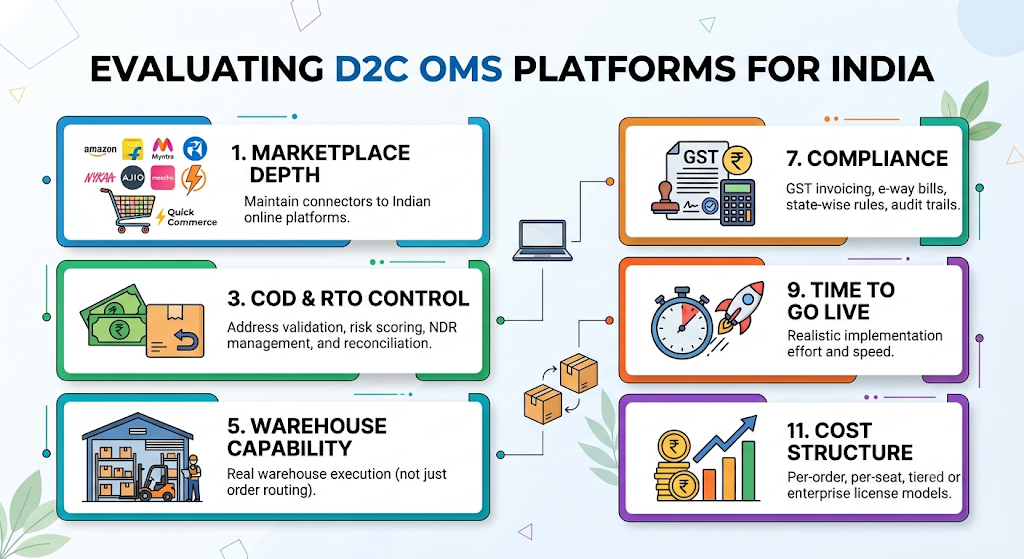
We scored each platform on six criteria that matter specifically to Indian sellers. Global feature lists tell you very little here, because the difference shows up in how a platform handles COD, returns, and marketplace SLAs.
- Marketplace depth, maintained connectors to Amazon, Flipkart, Myntra, Nykaa, Ajio, Meesho, and quick commerce
- COD and RTO control, address validation, risk scoring, NDR management, RTO reconciliation
- Warehouse capability, whether the platform includes real warehouse execution or stops at order routing
- Compliance, GST invoicing, e-way bills, state-wise logic, audit trails
- Time to go live, realistic implementation effort, not the sales-deck number
- Cost structure, per-order, per-seat, tiered or enterprise licence
We did not score on brand recognition. The largest vendor is not automatically the right one, and the newest is not automatically the most capable.
Which of the best OMS platforms for D2C brands in India should you shortlist?
The table below maps each platform to the brand profile it serves best. Use it to cut fifteen options down to a shortlist of three before you book a single demo.
| # | Platform | Best fit | Warehouse module | Pricing model |
| 1 | Base.com | Multi-channel D2C at scale | Yes | Tiered SaaS |
| 2 | Unicommerce | Large established sellers | Yes | Tiered SaaS |
| 3 | Vinculum | Omnichannel retail plus online | Yes | Enterprise licence |
| 4 | EasyEcom | Mid-market D2C and distributors | Yes | Tiered SaaS |
| 5 | Increff | Fashion and high-SKU brands | Yes | Enterprise |
| 6 | Omniful | Fast-scaling D2C, India and Gulf | Yes | Tiered SaaS |
| 7 | Ginesys | Retail chains with POS | Yes | Modular licence |
| 8 | Anchanto | Cross-border sellers and 3PLs | Yes | Enterprise |
| 9 | Fynd Commerce | Storefront plus backend in one | Partial | Tiered SaaS |
| 10 | Browntape | Small to mid marketplace sellers | Partial | Tiered SaaS |
| 11 | Eshopbox | Brands outsourcing fulfilment | Fulfilment-led | Per-order |
| 12 | WareIQ | Speed-focused fulfilment | Fulfilment-led | Per-order |
| 13 | Shiprocket | Early-stage D2C | Partial | Per-shipment |
| 14 | Zoho Inventory | Very small sellers on Zoho | No | Per-seat |
| 15 | Primaseller | Small multi-channel sellers | Partial | Tiered SaaS |
15 best OMS platforms for D2C brands in India
For a D2C brand in India, managing orders across Shopify, Amazon, Flipkart, Meesho, and other sales channels can quickly become difficult without a centralized order management system.
The right OMS can bring orders, inventory, fulfillment, returns, and shipping into one workflow, reducing manual work and helping brands scale without losing control of operations. Here are 15 OMS platforms worth considering for Indian D2C brands, along with their key features, pricing, integrations, and ideal use cases.
1. Base.com: Which Indian D2C brands should shortlist this platform first?
Base.com targets D2C brands that outgrew spreadsheets but do not want an eighteen-month enterprise rollout. The platform brings order orchestration, warehouse execution, and returns handling into one stack, so brands stop stitching three vendors together and reconciling between them.
Its design assumption is Indian operating reality. COD risk, NDR follow-up, and RTO reconciliation sit inside the core order workflow rather than in a reporting module you check weekly. That matters because RTO decisions have a short window; once a courier marks a shipment undelivered, your options narrow sharply.
The platform suits brands where operations, not marketing, has become the constraint on growth. Order volume climbs, the warehouse team grows, and error rates climb with it. Base.com addresses that by enforcing a scan-verified pick and pack sequence and by routing orders to the right facility automatically.
Strengths
- Order orchestration and warehouse execution in a single system
- Returns and RTO treated as core workflows, not add-ons
- Built around Indian channel mix, COD behaviour and GST requirements
- Channel-level visibility into what each order actually costs to deliver
Trade-offs
- A single integrated stack means less freedom to swap one layer later
- Brands under a hundred orders a day will not use most of the capability
Best fit: multi-channel D2C brands past the manual-operations ceiling, especially where COD makes up a large share of orders.
2. Unicommerce: is India’s most deployed OMS the right fit for you?
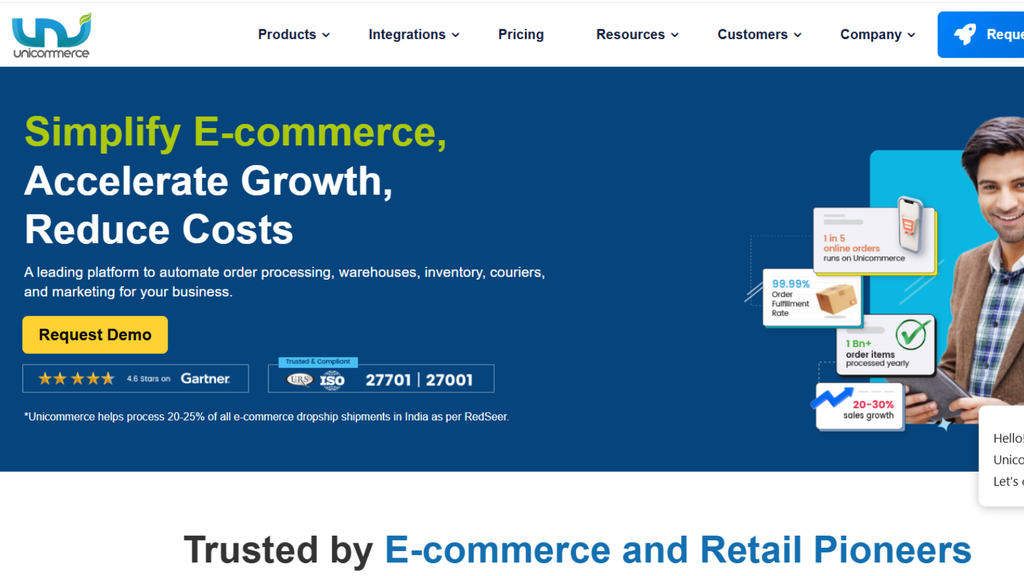
Unicommerce is India’s most widely deployed order management platform and the default shortlist entry for large sellers. It was listed publicly in 2024, which gives buyers unusual visibility into its financials and customer base, useful during vendor due diligence.
Its strongest asset is connector breadth. Unicommerce has maintained marketplace integrations for well over a decade, so edge cases on Amazon, Flipkart, and Myntra tend to be handled rather than discovered. For a brand selling across many channels, that maturity has real value.
The platform is configurable, which cuts both ways. Large teams shape it to their processes. Smaller teams sometimes find the configuration surface larger than their operations need, and onboarding takes longer as a result.
Strengths
- Deepest marketplace connector library in the Indian market
- Proven at high daily order volumes and through peak sale events
- Large partner and implementation ecosystem
Trade-offs
- Configuration depth adds onboarding effort for small teams
- Enterprise-oriented commercial structure
Best fit: established brands and distributors running high volume across many marketplaces.
3. Vinculum: should brands with retail stores choose this omnichannel platform?
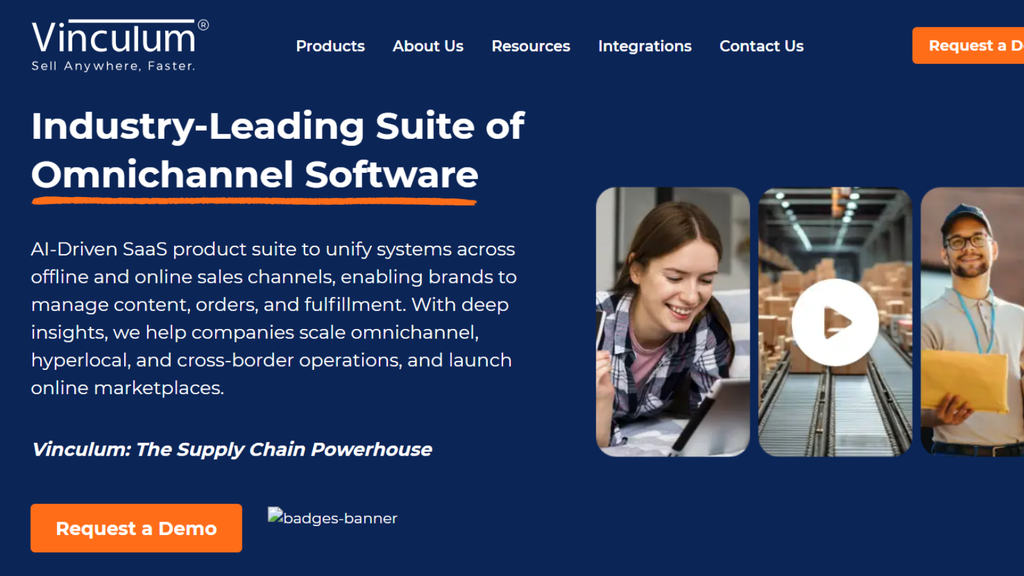
Vinculum built its reputation in omnichannel retail. Its inventory engine handles store-as-warehouse scenarios properly, which means a brand can fulfil an online order from retail stock in a nearby store rather than shipping from a central warehouse.
That capability is genuinely hard to build and matters enormously to brands with physical doors. It shortens delivery distance, reduces freight cost, and clears slow-moving store inventory.
For pure-play D2C brands with no retail footprint, the same strength becomes surplus. You pay for an omnichannel engine and use the ecommerce slice of it.
Strengths
- Strong store-as-warehouse and ship-from-store capability
- Mature inventory allocation across distributed locations
- Handles complex multi-entity and multi-country structures
Trade-offs
- Enterprise implementation timelines
- Capability overlap for brands without retail stores
Best fit: brands running retail doors alongside ecommerce, or planning to open them.
4. EasyEcom: does your brand need payment reconciliation built into the OMS?
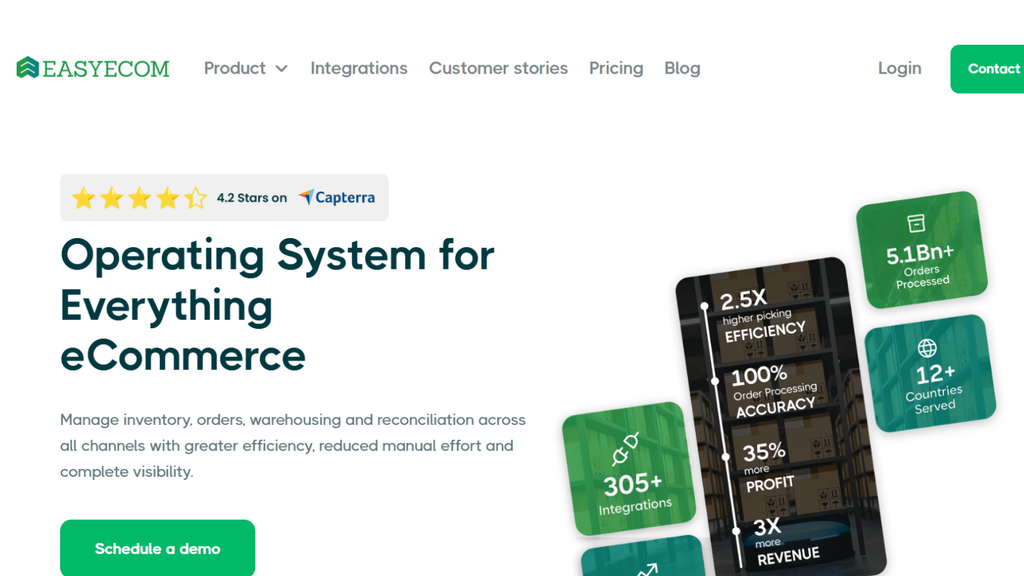
EasyEcom sits in the mid-market and covers order management, warehouse operations, and financial reconciliation. The reconciliation piece is its differentiator; it compares what marketplaces owe you against what they actually settled.
That matters more than most founders realise. Marketplace settlements carry commission errors, incorrect return deductions, and missing claims. Brands that do not reconcile systematically lose money quietly every month.
EasyEcom also serves B2B distributors, so it handles wholesale order flows alongside D2C. Brands selling through both channels avoid running two systems.
Strengths
- Marketplace payment reconciliation built in
- Handles both D2C and B2B distribution flows
- Reasonable implementation effort for mid-market teams
Trade-offs
- Less depth than enterprise platforms at very high volume
- Interface carries the complexity of covering many use cases
Best fit: mid-market D2C brands, and brands mixing online retail with wholesale distribution.
5. Increff: is this the right OMS for high-SKU fashion brands in India?
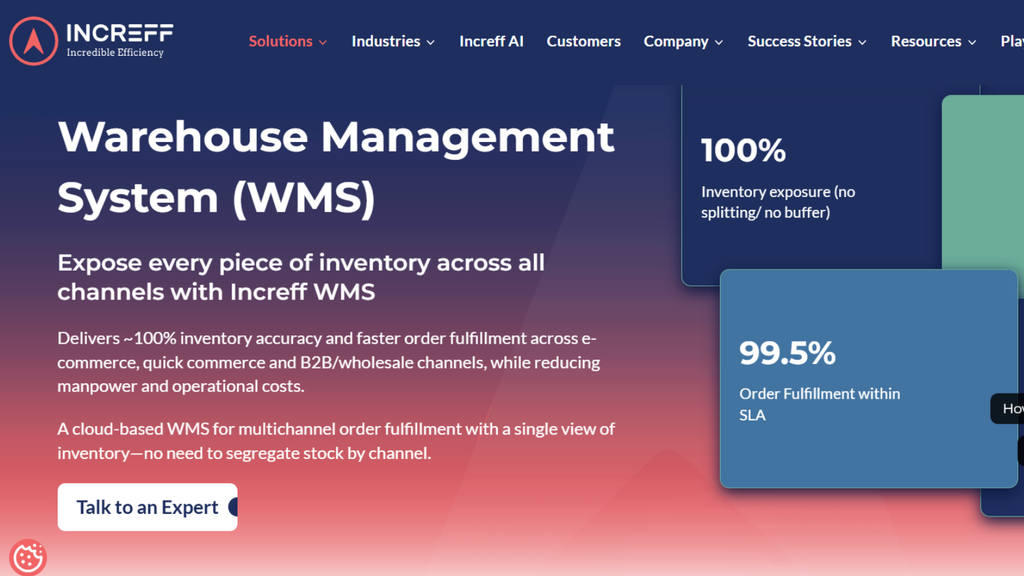
Increff pairs warehouse management with algorithmic inventory planning. Its founding team came out of fashion ecommerce, and the product reflects that; it is built for brands managing size and colour matrices across thousands of SKUs.
The planning layer recommends what to stock where, based on demand patterns rather than flat reorder rules. For apparel and footwear brands, where the wrong size distribution strands inventory, this is the core value.
Brands with narrow catalogues get less from it. If you sell forty SKUs, algorithmic assortment planning solves a problem you do not have.
Strengths
- Best-in-class handling of high-SKU fashion catalogues
- Inventory planning and allocation intelligence, not just execution
- Strong serialised inventory and piece-level tracking
Trade-offs
- Overbuilt for low-SKU brands
- Enterprise commercial and implementation model
Best fit: apparel, footwear and accessories brands with deep size-colour catalogues.
6. Omniful: should fast-scaling quick commerce brands consider this newer platform?
Omniful is one of the newer entrants, building for fast-scaling D2C operations across India and the Gulf. Its architecture is more recent than the incumbents’, which shows in API design and in how it handles quick commerce order flows.
Quick commerce deserves specific attention. Blinkit, Zepto and Instamart operate on dispatch windows measured in minutes, not hours, and they push inventory expectations that legacy OMS designs were never built for. Platforms designed after quick commerce existed handle it more naturally.
Newer platforms also carry integration risk. The connector library is younger, and edge cases surface in production rather than in testing.
Strengths
- Modern architecture and API-first design
- Native quick commerce order handling
- Multi-country structure for brands expanding to the Gulf
Trade-offs
- Shorter track record at very high Indian volumes
- Smaller implementation partner ecosystem
Best fit: brands scaling fast with meaningful quick commerce exposure.
7. Ginesys: what does a retail-first platform offer an ecommerce operations team?
Ginesys grew out of retail ERP and point of sale, so accounting, GST, and store operations are native rather than adapted. Its ecommerce layer came through the Browntape acquisition, which connected marketplace order management to the retail backend.
For a retail chain adding online channels, that combination removes an integration project. Store sales, warehouse stock, and marketplace orders all resolve into one ledger.
Pure D2C brands start from the other direction and find the retail weight unnecessary.
Strengths
- Retail ERP, POS and ecommerce under one vendor
- Strong native GST and accounting handling
- Established presence among Indian retail chains
Trade-offs
- Retail-first design rather than D2C-first
- Modular licensing means costs accumulate across modules
Best fit: retail chains extending into ecommerce.
8. Anchanto: is this built for cross-border sellers rather than domestic brands?
Anchanto operates across Asia-Pacific and focuses on cross-border sellers and third-party logistics providers. Its multi-country, multi-entity structure suits brands shipping into Southeast Asia and the Middle East.
The 3PL orientation is important. Anchanto is built so a logistics provider can run many client brands on one instance, with separate inventory pools and billing. If you are a brand rather than a 3PL, you inherit that complexity.
Strengths
- Genuine multi-country and multi-currency capability
- Designed for 3PL operators managing multiple brands
- Strong cross-border marketplace coverage
Trade-offs
- More complexity than a domestic-only brand needs
- India-specific depth is lighter than local-first platforms
Best fit: exporters, cross-border sellers and logistics providers.
9. Fynd Commerce: should you buy storefront and order management from one vendor?
Fynd bundles a storefront platform with order management, backed by Reliance Retail’s investment. Brands rebuilding their website and their backend at the same time get one vendor and one contract.
That bundle is the whole argument. Fewer vendors means fewer integration points, fewer finger-pointing conversations during an outage, and a single roadmap.
It also concentrates risk. Switching either layer later means switching both, and storefront and operations rarely need replacing on the same schedule.
Strengths
- Storefront and order management from one vendor
- Backing and retail network of a large parent group
- Reasonable fit for brands starting fresh
Trade-offs
- Higher switching cost from the bundle
- Operations depth trails specialist OMS vendors
Best fit: brands replacing storefront and backend together.
10. Browntape: how far can a lightweight marketplace aggregator take your brand?
Browntape handles marketplace order aggregation for small and mid-sized sellers and now sits inside the Ginesys group. It does the core job: pull orders from multiple marketplaces, sync inventory, and prevent oversells, without enterprise weight.
Sellers choose it for straightforward setup. A marketplace-first business with a modest catalogue gets running quickly and cheaply.
The ceiling arrives as complexity grows. Multi-warehouse allocation, serialised inventory and advanced returns handling sit beyond its design.
Strengths
- Quick setup for marketplace sellers
- Cost-effective at small and mid volumes
- Backed by a larger group, reducing vendor risk
Trade-offs
- Limited warehouse execution depth
- Outgrown as multi-warehouse operations begin
Best fit: marketplace-first sellers with simple fulfilment.
11. Eshopbox: does outsourcing fulfilment alongside software make sense for your brand?
Eshopbox combines software with its own fulfilment network, so brands hand over storage, picking, and dispatch alongside the order management layer. The brand keeps merchandising and marketing; Eshopbox runs operations.
This model removes an entire operational discipline from your business. For a small team without warehouse expertise, that is genuinely valuable.
Per-order economics change as you scale. Outsourced fulfilment costs rise in line with volume, while in-house fulfilment costs flatten. Model where those lines cross before you commit.
Strengths
- Software plus fulfilment from one provider
- Removes warehouse hiring and management
- Predictable per-order cost at low volumes
Trade-offs
- Less control over process and packaging experience
- Cost advantage erodes as volume grows
Best fit: brands that choose not to run their own warehouse.
12. WareIQ: will a distributed warehouse network improve your delivery promise?
WareIQ follows a similar fulfilment-as-a-service model with a distributed warehouse network positioned for faster metro delivery. Stock sits closer to demand, so delivery promises shorten.
Distributed inventory is the strategic argument. Splitting stock across regional nodes cuts transit time and reduces the RTO risk that comes with long delivery windows.
It also fragments your inventory. Brands with limited stock depth find that splitting across nodes creates stockouts in one region while another sits overstocked.
Strengths
- Distributed network supporting faster delivery promises
- Software and fulfilment bundled
- Suits brands competing on delivery speed
Trade-offs
- Distributed stock needs sufficient inventory depth to work
- Less direct control over operations
Best fit: brands where delivery speed drives conversion.
13. Shiprocket: is shipping-first order management enough for an early-stage D2C brand?
Shiprocket built its base in shipping aggregation, comparing courier rates, booking pickups, tracking shipments, and extended upward into order management. Its reach among small Indian sellers is unmatched.
Setup takes hours rather than weeks, which is exactly right for a brand still finding product-market fit. Founders get multi-courier access and basic order handling without an implementation project.
Depth is the limitation. Once a brand runs real warehouse operations across multiple locations, the order management layer stops keeping up.
Strengths
- Fastest setup of any option here
- Strong multi-courier rate comparison and NDR tooling
- Low commitment and low entry cost
Trade-offs
- Shipping-first rather than operations-first design
- Limited warehouse execution capability
Best fit: early-stage brands prioritising speed of setup.
14. Zoho Inventory: when is an inventory tool enough and when is it not?
Zoho Inventory manages stock, purchase orders, and basic order flow, and connects cleanly to the rest of the Zoho suite. Brands already running Zoho Books or Zoho CRM get a coherent stack.
It is an inventory tool with order features, not an order management system. That distinction matters once marketplace SLAs, multi-warehouse allocation, and returns workflows enter the picture.
Strengths
- Tight integration with the wider Zoho suite
- Low cost and quick to start
- Solid core inventory and purchase management
Trade-offs
- Not a true multi-channel OMS
- Limited Indian marketplace and returns depth
Best fit: very small sellers already committed to Zoho.
15. Primaseller: can a simple sync tool handle retail, wholesale and online?
Primaseller syncs inventory across online channels and physical retail, and handles B2B wholesale orders alongside D2C. Small brands balancing three sales modes get one place to see stock.
Its scope is deliberately modest. Primaseller solves the oversell problem and basic order routing well, and does not attempt warehouse execution at scale.
Strengths
- Clean multi-channel inventory sync
- Handles retail, wholesale, and online together
- Simple enough for small teams to run unaided
Trade-offs
- Limited automation and warehouse depth
- Outgrown quickly by fast-scaling brands
Best fit: small brands with mixed retail, wholesale and online channels.
How do the best OMS platforms for D2C brands in India compare on features?
This table covers the six platforms that most Indian D2C brands shortlist. Capability bands describe depth rather than presence, because almost every vendor claims every feature on a sales call.
| Capability | Base.com | Unicommerce | Vinculum | EasyEcom | Increff | Omniful |
| Multi-channel order sync | Core | Core | Core | Core | Core | Core |
| Warehouse execution | Core | Core | Core | Core | Core | Core |
| Store-as-warehouse | Supported | Supported | Leading | Supported | Limited | Supported |
| High-SKU assortment planning | Supported | Supported | Supported | Limited | Leading | Supported |
| Payment reconciliation | Supported | Supported | Supported | Leading | Limited | Supported |
| Quick commerce readiness | Supported | Developing | Developing | Developing | Limited | Leading |
| Cross-border | Limited | Supported | Leading | Supported | Limited | Leading |
| Implementation effort | Moderate | High | High | Moderate | High | Moderate |
What pricing models will you encounter when buying an OMS in India?
Indian OMS vendors price four ways, and the model shapes your cost curve far more than the headline number. A platform that looks cheap at your current volume can become your largest operating line item within two years.
| Model | How it works | Works well when | Breaks when |
| Per-order | You pay per order processed | Volume is low or seasonal | Volume scales, cost rises linearly |
| Per-seat | You pay per user | The team stays small | Warehouse headcount grows |
| Tiered SaaS | Bands by order volume | Growth is predictable | You jump a band mid-month |
| Enterprise licence | Annual contract plus implementation | You need heavy customisation | Requirements change within the term |
Ask every vendor on your shortlist of the best OMS platforms for D2C brands in India for a three-year total cost at your projected volume. Implementation, custom connector work, and premium support tiers sit outside the licence fee and often surprise buyers in year two.
How should you choose from the best OMS platforms for D2C brands in India?
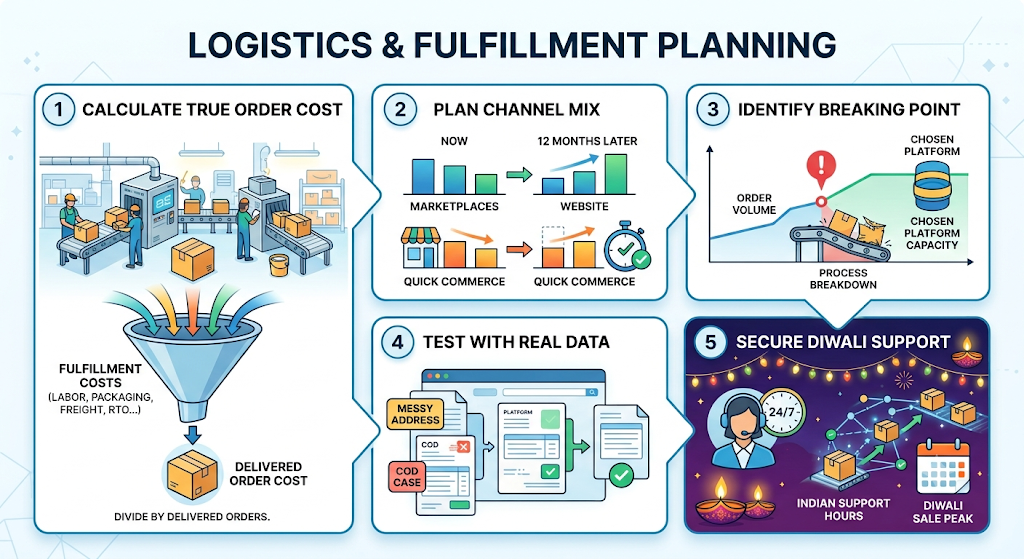
Run this sequence rather than starting with vendor demos.
Step 1: How do you calculate your true cost per delivered order?
Add fulfilment labour, packaging, forward freight, RTO freight, RTO restocking and unsellable returns. Divide by delivered orders, not total orders. With COD returns running between 25% and 30%, this number usually lands well above what founders assume.
Step 2: What will your channel mix look like twelve months from now?
List every channel, its current order share, and its projected share in twelve months. If quick commerce sits above a tenth of that projection, filter your shortlist to platforms handling it today rather than on a roadmap.
Step 3: At what daily order volume does your current process break down?
Identify the daily order number where your current process breaks. Shortlist platforms that comfortably serve one band above it. Buying exactly at today’s volume forces a migration within a year.
Step 4: How should you test each platform using your own order data?
Send each vendor several hundred real orders, including messy addresses and COD cases. Watch how the system handles them. Demos use clean data; your customers do not.
Step 5: What support model do you need during a Diwali sale peak?
Confirm response times, escalation path, and whether support operates on Indian hours. A platform that works almost all the time still costs you money when nobody answers during a Diwali peak.
How do you know your brand has outgrown its current order management setup?
Most founders evaluate the best OMS platforms for D2C brands in India about six months later than they should. Watch for these signals instead of waiting for a breakdown.
1. Your team edits inventory in two places. The moment someone updates stock in a spreadsheet and again in a channel panel, oversells become inevitable.
2. Packing errors reach customers. Manual picking holds accuracy until SKU count climbs. After that, error rates rise regardless of how careful the team is.
3. Nobody knows your real RTO cost. If finance calculates returns quarterly rather than daily, you are pricing products against the wrong margin.
4. Peak days require overtime. A sale day that needs double shifts to clear signals a process ceiling, not a staffing gap.
5. Marketplace penalties appear monthly. Late dispatch penalties usually trace back to order routing rather than warehouse effort.
What mistakes do Indian sellers make when shortlisting an OMS vendor?
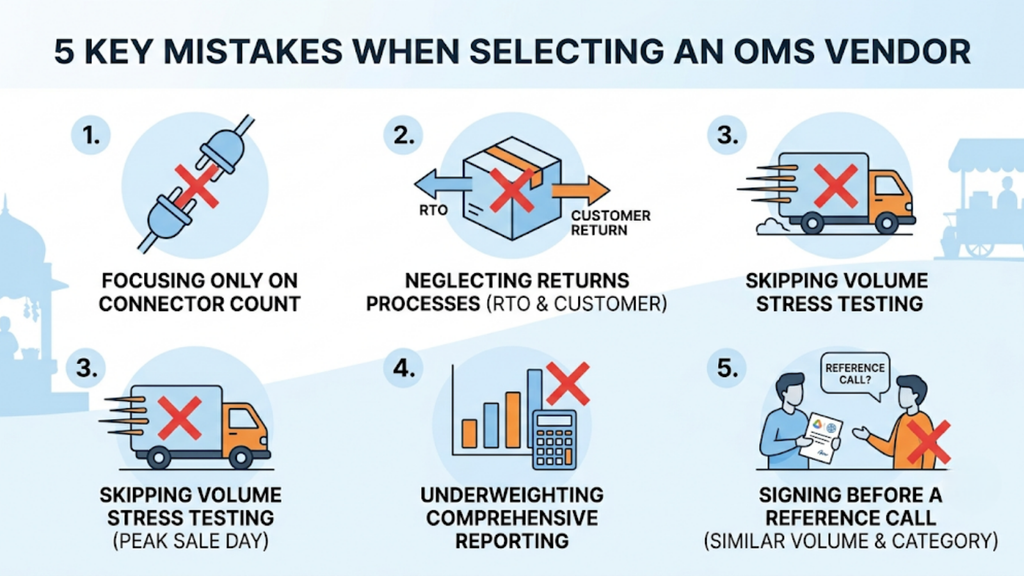
Most bad OMS decisions trace back to the evaluation stage rather than the platform itself. These five mistakes come up repeatedly, and each one costs money after the contract is signed.
1. Buying on connector count. Forty connectors help nobody if the six you use break during peak. Ask which connectors the vendor maintains directly and which come through partners.
2. Ignoring returns. Ask specifically how the platform separates RTO from customer returns, and how it reconciles courier claims against your ledger.
3. Skipping the volume stress test. Ask what happens ten times your current daily orders on a sale day, and ask for a customer reference who has been through it.
4. Underweighting reporting. If you cannot see the cost per delivered order by channel, you cannot manage it.
5. Signing before a reference call. Speak to a customer at your volume in your category, not the vendor’s largest logo.
Where does Base.com fit among the best OMS platforms for D2C brands in India?
Base.com occupies a specific position in this market. Enterprise platforms bring longer track records and deeper connector libraries, but they require enterprise implementation timelines. Fulfilment-led providers remove warehouse operations entirely, but they take control and margin with them.
Base.com sits between those poles. Brands keep ownership of their operations and gain automation across order routing, warehouse execution, and returns without committing to a year-long rollout.
The decision usually comes down to one question: is operations your constraint on growth? If marketing still limits you, a lighter tool serves you fine. If your warehouse determines how fast you can scale, a full order management platform earns its cost quickly.