
Return to Origin is the most expensive operational problem in Indian ecommerce. It is not a delivery problem. It is an order quality problem, and it starts well before a package reaches the customer’s door.
India’s average COD RTO rate sits between 25% and 40%, depending on category. In fashion, some brands report COD RTO above 50% in Tier 3 markets. Every returned order costs the brand the forward shipping fee (₹50-120), the reverse logistics fee (₹80-150), and in many cases, the product itself if it cannot be restocked.
SMS changes the economics of this problem. With over 530 million active users in India and open rates above 90%, SMS is the most reliable customer communication channel available to Indian D2C brands. Using it to confirm COD orders before dispatch is the single highest-ROI operational intervention to reduce RTO in India, which brands can execute without changing their logistics infrastructure.
This article explains exactly how to build that system, the message flows, the timing, the decision logic, and how platforms like Base.com integrate this into a complete order management software India workflow that drives measurable improvement in ecommerce returns management India outcomes.
Why COD Is Still Dominant in India, and Why It Creates RTO
Indian D2C brands can reduce RTO in India by 20-35% by using SMS to confirm COD orders before dispatch. The workflow is simple: send an automated SMS message after a COD order is placed, ask the customer to confirm delivery intent, and hold or cancel orders without confirmation. This single intervention filters out fraudulent, impulsive, and address-error orders before they leave the warehouse, and is the most accessible lever available to D2C operations India teams today.
The COD Reality in India 2026
Despite the rapid growth of UPI and digital payments, COD still accounts for 55-65% of all ecommerce orders in Tier 2 and Tier 3 India. In categories like fashion, home décor, and general merchandise, COD share can exceed 70% in markets outside the top eight cities.
This is not going away quickly. A large portion of Indian ecommerce customers, particularly first-time buyers and those in smaller cities, distrust prepaid transactions. COD is a trust mechanism, not just a payment preference.
The operational consequence is that D2C operations India teams must master COD fulfilment. They cannot avoid it without abandoning a majority of their addressable market.
Why COD Orders Generate Higher RTO
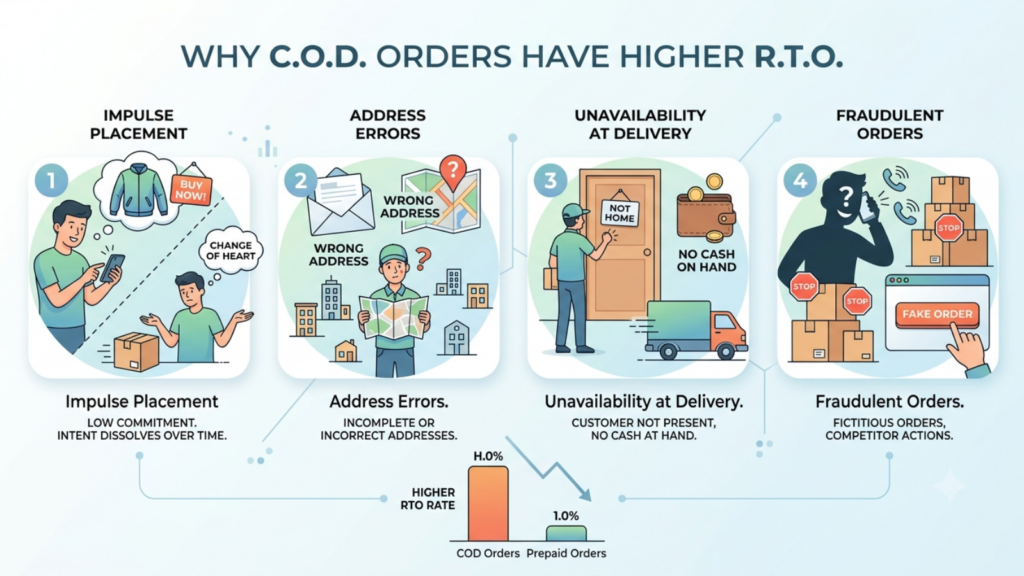
COD orders fail delivery for several reasons specific to the Indian market:
- Impulse placement. Customers place COD orders with low commitment. No money has been left in their account. Cancellation feels costless. By the time the package arrives, the purchase intent may have dissolved.
- Address errors. COD customers are less likely to have verified their address during checkout because they are not entering payment details that require precision. Incorrect addresses, missing landmarks, and wrong pin codes are significantly more common on COD orders than on prepaid.
- Unavailability at delivery. COD requires the customer to be present and have cash at hand at the time of delivery. A single failed attempt in many markets results in a return because re-attempt rates are low.
- Fraudulent orders. A small but meaningful percentage of COD orders in India are placed with no intention of acceptance, sometimes by competitors, sometimes by individuals testing platforms, sometimes through organised return fraud rings operating in specific pin codes.
Each of these failure types is addressable before dispatch. SMS confirmation intercepts all four, making it the most direct mechanism to reduce COD returns India brands absorb every month.
The SMS COD Confirmation Workflow
Cash on Delivery (COD) orders often face high return-to-origin rates due to low purchase intent or failed deliveries. A SMS COD confirmation workflow helps verify customer intent before dispatch by sending automated messages for confirmation.
This simple step reduces fake orders, improves delivery success rates, and lowers operational costs significantly for D2C brands.
How the Basic Confirmation Flow Works
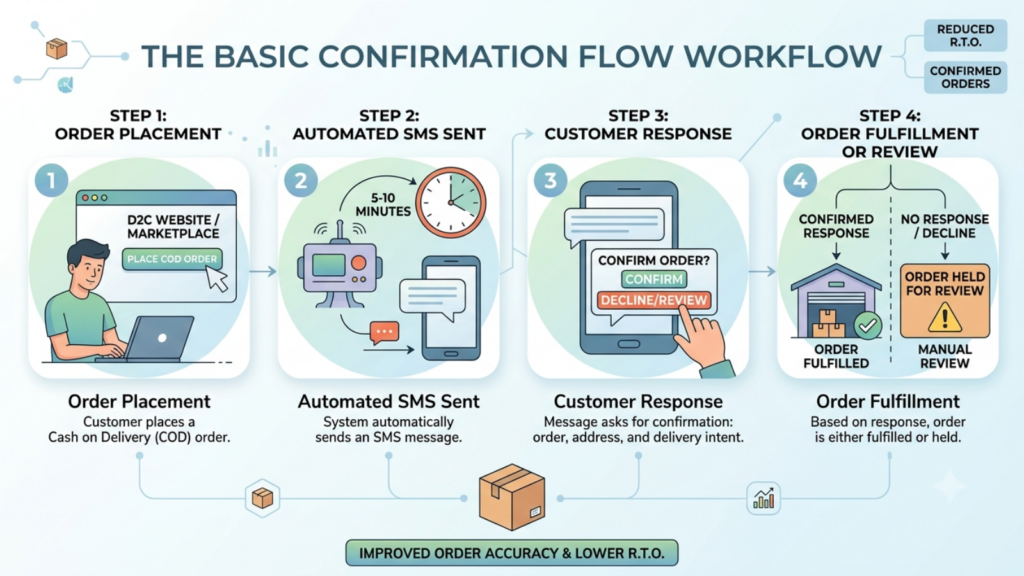
The core workflow has four steps:
- Customer places a COD order on your D2C website or marketplace.
- An automated SMS message is sent within 5-10 minutes of order placement.
- The message asks the customer to confirm their order, address, and delivery intent, typically through a one-tap button reply.
- Based on the response, the order is either confirmed for fulfilment or held for review.
This is not a novel concept; the best D2C operations India teams have been doing manual versions of this for years. What has changed is automation. Through SMS Business API integrations, this entire flow can run without human intervention on every COD order placed.
Message Design That Gets Responses

The confirmation message needs to be short, specific, and require minimal effort from the customer. Long messages get ignored. Vague messages create confusion.
High-performing confirmation message structure:
“Hi [Name], your order for [Product Name], ₹[Amount], has been placed with cash on delivery. Confirm your order to proceed: Yes, confirm my order. Cancel this order. Your address: [Address]. Reply 1 to confirm or 2 to cancel.”
This message does three things: it creates a moment of real purchase commitment, it surfaces address errors (customers often correct their address when they see it printed back to them), and it eliminates impulse orders where the customer was on the fence. It is the foundational touchpoint for any ecommerce returns management India workflow built on SMS.
Timing the Message Correctly

Send the confirmation message within 5-10 minutes of order placement. This is when purchase intent is highest, and the customer is still engaged with the transaction.
Messages sent 30+ minutes after placement have significantly lower response rates. Messages sent the next day, which is common in manual operations, perform poorly and frustrate customers who have already forgotten the order.
Base.com triggers the SMS confirmation immediately on COD order creation, without manual intervention. The integration connects the OMS for D2C brands order state directly to the SMS Business API, so no order slips through without a confirmation attempt.
Building the Decision Logic: What to Do With Non-Confirmations
The confirmation message is only useful if you act on the response, or the absence of one.
Response Scenarios and Recommended Actions
|
Customer Response |
Recommended Action |
|---|---|
|
Confirms within 2 hours |
Release order to the warehouse for fulfilment |
|
Cancels via reply |
Cancel order, send cancellation confirmation |
|
No response within 4-6 hours |
Hold order, send follow-up reminder |
|
No response after the second message (8-12 hours) |
Auto-cancel or route to the manual review queue |
|
Confirms, but the address is incorrect |
Hold for address correction before dispatch |
The decision logic matters as much as the message itself. Brands that send the confirmation message but release all orders regardless of response get minimal RTO benefit. The hold-and-cancel logic is where the actual reduction of RTO in India comes from. Any order management software India platform worth using should be able to execute this logic automatically.
The Follow-Up Message
For orders where no response is received within 4-6 hours, send a single follow-up:
“Hi [Name], we haven’t received confirmation for your order yet. Your order for [Product], ₹[Amount], is ready to ship. Please confirm by [Time], or it will be cancelled: Confirm | Cancel.”
Do not send more than two messages. Over-messaging triggers spam reports and SMS Business account restrictions. Two messages, initial confirmation and one follow-up, is the correct cadence.
RTO Prevention Beyond Confirmation: The Full SMS Workflow
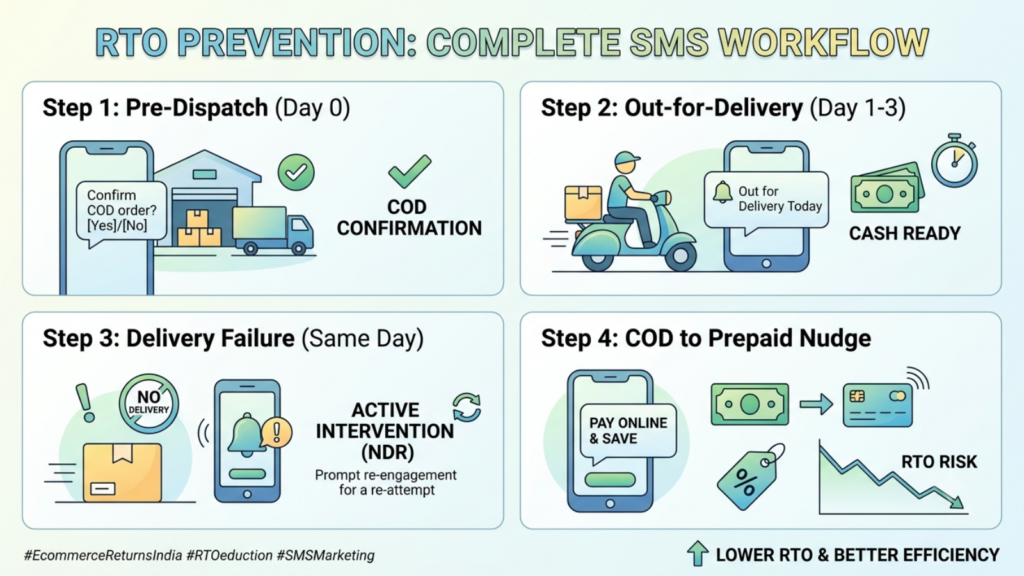
COD confirmation is the most impactful use of SMS for ecommerce returns management in India, but it is not the only one. A complete RTO prevention workflow uses SMS at four points in the order lifecycle.
Step 1: Pre-Dispatch COD Confirmation (Day 0)
As described above. Filters fraudulent, impulsive, and address-error orders before they leave the warehouse. Estimated RTO reduction: 15-25 percentage points for COD orders. This is the fastest way to reduce RTO in India at the top of the fulfilment funnel.
Step 2: Out-for-Delivery Notification (Day 1-3)
Send an SMS message when the order is out for delivery:
“Hi [Name], your order is out for delivery today. Estimated arrival: [Time Window]. Please keep ₹[Amount] ready for cash payment. Delivery agent: [Name], [Number].”
This reduces failed delivery attempts by ensuring the customer is expecting the delivery, has cash ready, and knows who to contact. Brands that implement this notification report a 12-18% reduction in first-attempt delivery failures.
Base.com’s dispatch tracking integration triggers this message automatically when the courier partner marks the order as out for delivery, no manual monitoring required. This is a core component of D2C operations in India teams that run fulfilment at scale.
Step 3: Delivery Failure Re-Engagement (Same Day as Failure)
When a delivery attempt fails, most brands do nothing for 24-48 hours. The courier makes re-attempt decisions internally. This is the window where RTO gets locked in.
Instead, send an SMS message within 2 hours of delivery failure:
“Hi [Name], our delivery agent attempted to deliver your order today but couldn’t reach you. We’ll try again tomorrow. To schedule a specific time or update your address, reply here.”
This message does three things: it captures the customer at the moment they are most likely to take action, it offers a re-attempt scheduling option that improves second-attempt success rates, and it reduces the chance of a forced RTO on the second attempt.
Brands using active NDR (Non-Delivery Report) intervention on SMS report 25-40% improvement in order recovery from first-attempt failures, meaning orders that would have returned instead get delivered. This is a critical pillar of any serious ecommerce returns management India strategy.
Step 4: COD-to-Prepaid Conversion Nudge
This is the highest-leverage SMS intervention for reducing COD returns in India at the structural level.
After a customer confirms their COD order, send an optional conversion message:
“Hi [Name], your order is confirmed! Pay online now and get ₹[X] off + priority dispatch: [Pay Now Link] Or we’ll collect cash at delivery, your choice.”
This nudge converts 8-15% of confirmed COD customers to prepaid, depending on category and discount offered. Prepaid orders have 3-5x lower RTO rates than COD. Every COD-to-prepaid conversion removes a high-risk order from your fulfilment queue.
The economics are clear: a ₹20-30 conversion discount on a ₹400 order that prevents a ₹230 RTO cost is strongly positive. This is one of the highest-ROI interventions available to D2C operations in India teams without touching logistics infrastructure, and it simultaneously works to reduce RTO in India and reduce COD returns in India in a single message.
How Base.com Integrates SMS Into OMS Workflows

Sending SMS messages manually is not a scalable solution. At 500+ daily COD orders, manual SMS confirmation is as operationally broken as the spreadsheet it replaces.
Base.com connects the SMS Business API directly to order state management. This means:
- COD order placed → confirmation message auto-triggered within 5 minutes
- Customer confirms → order automatically moves to “ready for pick” in the warehouse queue
- Customer cancels → order auto-cancelled, inventory released, cancellation confirmation sent
- No response in configured window → order auto-held, follow-up triggered, or routed to exception queue
This is not a bolt-on feature. It is built into the order management software workflow as a native order state trigger. The ops team does not manage individual messages; they configure the rules once and monitor the outcomes via the Base.com dashboard.
The dashboard shows COD confirmation rates by day, by product category, and by source channel. If confirmation rates drop on a specific SKU or channel, it is immediately visible, allowing ops managers to investigate whether it is a product issue, a channel issue, or a message delivery problem.
Base.com also captures SMS data as an RTO predictor. Orders where the customer does not respond to the confirmation message have a 3-4x higher RTO rate, even when they eventually ship. This signal feeds into the platform’s risk scoring model, which can automatically downgrade these orders’ priority or flag them for additional review, making it one of the most data-informed OMS for D2C brands available in the Indian market.
Measuring the Impact: What Good Numbers Look Like
Tracking the impact of your SMS COD confirmation workflow is essential to understanding its effectiveness. Key metrics like confirmation rate, RTO reduction, and delivery success rate indicate performance. Strong numbers typically show higher verified orders, fewer cancellations, and improved overall profitability, helping D2C brands scale operations with better control and efficiency.
COD Confirmation Rate Benchmarks
|
Brand Stage |
Average Confirmation Rate |
High-Performance Target |
|---|---|---|
|
First 30 days of implementation |
55-65% |
— |
|
60-90 days (optimised messaging) |
68-75% |
— |
|
Mature implementation |
75-85% |
85%+ |
A confirmation rate below 55% typically indicates a messaging problem, either the message is unclear, delayed, or being blocked. A rate above 85% is achievable with well-optimised message copy and fast trigger timing.
RTO Reduction After SMS COD Confirmation
|
Category |
RTO Before |
RTO After Confirmation Flow |
Reduction |
|---|---|---|---|
|
Fashion D2C |
32-38% |
18-24% |
12-15 pts |
|
Beauty and personal care |
22-28% |
12-16% |
8-12 pts |
|
Home and lifestyle |
24-30% |
14-20% |
10-12 pts |
|
General merchandise |
30-40% |
18-26% |
12-15 pts |
These reductions are achievable within 60 days of implementation with proper decision logic in place, not just message sending, but the hold-and-cancel logic that acts on non-confirmations. Every category above confirms that SMS is the most practical tool to reduce RTO in India that brands can deploy without a logistics overhaul.
The Financial Impact
At ₹50 lakh monthly GMV with 60% COD share and 30% pre-intervention RTO:
- COD GMV: ₹30 lakh
- Monthly RTO orders at 30%: approximately 600 orders (at ₹500 avg order value)
- Cost per RTO (forward + reverse logistics + product): ₹300-350
- Monthly RTO cost: ₹1.8-2.1 lakh
After SMS confirmation intervention, reducing RTO to 18%:
- RTO orders fall to approximately 360
- Monthly RTO cost: ₹1.08-1.26 lakh
- Monthly saving: ₹72,000-₹84,000
This is recurring monthly savings, not a one-time improvement. The SMS Business API cost at this order volume runs ₹8,000-15,000 per month. The ROI is 5-8x within the first month. For any brand serious about reducing COD returns in India, this is the clearest return-on-infrastructure available in D2C operations India today.
Common Mistakes Indian D2C Brands Make With SMS COD Confirmation
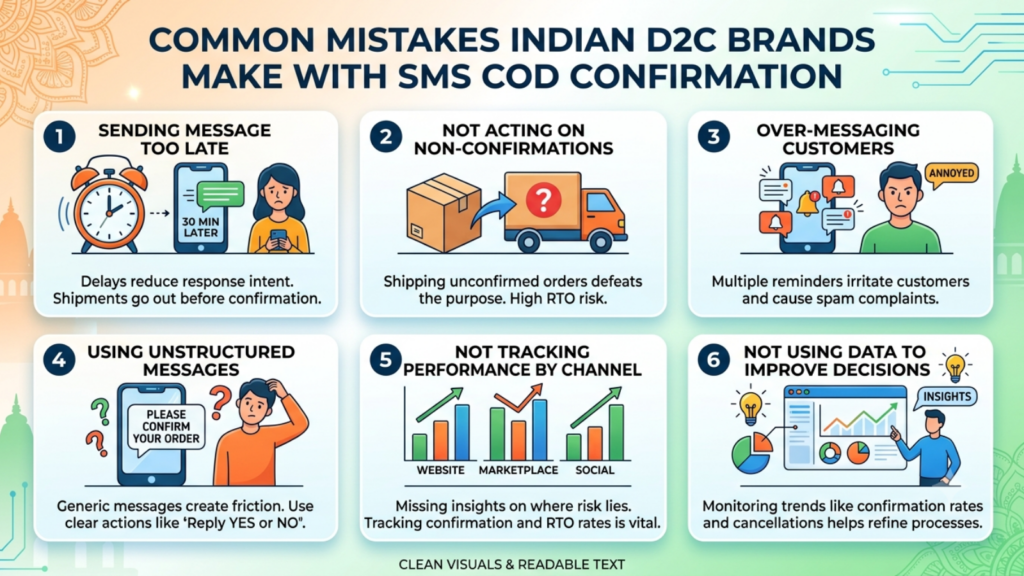
Many Indian D2C brands implement COD confirmation, but execution gaps reduce its effectiveness. At a brand level, the focus should be on simple, enforceable processes that deliver measurable impact without adding operational complexity.
1. Sending the Message Too Late
Delays reduce response intent. If confirmation messages are sent even 20-30 minutes after order placement, response rates drop sharply. The ideal approach is to trigger the message instantly or within a few minutes of order creation using your OMS or SMS automation tool.
2. Not Acting on Non-Confirmations
This is the biggest mistake. Sending a confirmation message but still shipping unconfirmed orders defeats the purpose. A clear rule is required: if the customer does not confirm, the order should be placed on hold or cancelled. Without this, RTO reduction will not happen.
3. Over-Messaging Customers
Sending multiple reminders within a short time window can lead to customer irritation and spam complaints. For SMEs, a simple structure works best, one initial message and one follow-up. Anything beyond that reduces trust and engagement.
4. Using Unstructured Messages
Generic messages like “Please confirm your order” create friction. Structured messages with clear actions perform better. Even without advanced APIs, keeping the message simple and direct (e.g., “Reply YES to confirm or NO to cancel”) improves response rates significantly.
5. Not Tracking Performance by Channel
All COD orders are not equal. Orders from marketplaces, your website, or social channels behave differently. SMEs often miss this insight. Tracking confirmation and RTO rates by channel helps identify where most risk lies and where to tighten controls.
6. Not Using Data to Improve Decisions
Even basic analytics can help. Monitoring confirmation rates, cancellation trends, and delivery success over time allows SMEs to refine their process. Tools like Base.com help break this down further by channel, geography, and product category, enabling better decision-making without adding manual effort.
SMS vs IVR for COD Confirmation in India
Many Indian D2C brands rely on IVR calls or SMS for COD confirmation. In most cases, SMS outperforms IVR on the key metrics that directly impact RTO reduction and operational efficiency.
|
Channel |
Open Rate |
Response Rate |
Cost per Message |
Conversion to Prepaid |
|---|---|---|---|---|
|
IVR Call |
35-45% |
25-35% |
₹1.5-3.0 |
Not applicable |
|
SMS |
45-55% |
10-18% |
₹0.10-0.20 |
Very low |
Why SMS Performs Better
SMS messages are delivered directly to the user’s phone and are easier to access compared to IVR calls, which are often ignored or disconnected. For many users, especially in high-volume urban markets, answering unknown calls is rare, reducing IVR effectiveness.
Where SMS Falls Short
While SMS is cost-effective and scalable, it lacks interactivity. Response rates are lower because customers need to manually reply, and there is no seamless way to guide them through confirmation or payment actions.
The Limitation on Prepaid Conversion
Unlike more interactive channels, SMS has a limited ability to convert COD orders to prepaid within the same flow. This means it can help validate intent, but does not significantly reduce financial risk beyond basic confirmation.
For D2C brands in India, SMS works as a baseline confirmation layer, better than IVR in reach and cost, but requires stronger execution and possibly additional channels if the goal is to reduce RTO in India at a deeper, system level.
Implementation Checklist for SMS COD Confirmation in India

Getting an SMS-based COD confirmation workflow live requires four core components. For Indian D2C brands, the goal is to keep it simple, automated, and scalable.
1. SMS Gateway Setup: Choose a reliable SMS provider (like MSG91, Gupshup, or Exotel). Registration and DLT compliance are mandatory in India. Approval timelines typically range from 2-5 business days, depending on documentation and sender ID setup.
2. DLT Template Approval: All SMS templates must be pre-approved under India’s DLT regulations. Submit your COD confirmation message for approval. Keep the language transactional and clear (e.g., “Reply YES to confirm your order”) to avoid rejection. Approval usually takes 24-48 hours.
3. OMS Integration: Your order management system must trigger the SMS instantly when a COD order is placed and update the order status based on the customer’s reply. Without this integration, the process becomes manual and breaks at scale. Platforms like Base.com enable automated workflows between order creation, SMS trigger, response capture, and status updates.
4. Decision Rule Configuration: Define clear rules within your OMS:
- Hold window (typically 6-8 hours)
- One follow-up message timing
- Auto-cancel logic for non-confirmed orders
These rules should be system-driven, not manually handled per order.
With these four components in place, the SMS confirmation workflow runs with minimal intervention. The ops team focuses on monitoring metrics like confirmation rate and RTO reduction, instead of managing individual orders. This is what efficient, scalable D2C operations in India look like.
Base.com is an order management and warehouse management platform built for Indian D2C and B2B ecommerce brands. Its native SMS integration automates COD confirmation, NDR intervention, and COD-to-prepaid conversion within a single OMS for D2C brands workflow, making it one of the most complete ecommerce returns management India solutions available. Speak to the Base.com team to see the configuration in action.