

Agencies do not scale by adding clients. They scale by removing the setup work each new client demands. That distinction decides whether your eleventh brand costs a week of configuration or another operations hire, and it sits at the centre of how to manage multiple client brands as an ecommerce agency profitably.
India’s ecommerce market is set to reach roughly ₹19.7 trillion, close to $226 billion, this year at around 12.4% growth. Agencies absorb that growth as variety rather than volume. Ten brands across five categories mean ten courier preferences, ten packing standards, and ten reporting formats running at once.
This guide is built as fifteen questions every multi-brand operator must answer, grouped into four decision areas. Work through them in order, because the later answers depend on the earlier ones.
(Decision Area One) To Manage Multiple Client Brands as an Ecommerce Agency: Structural Separation Between Every Client Brand You Run
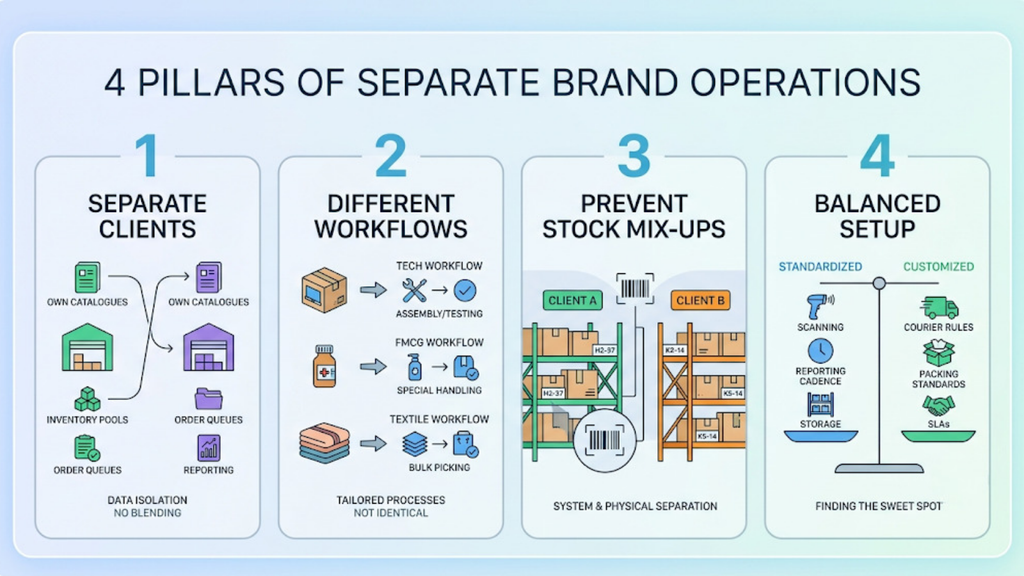
Everything downstream depends on how cleanly brands are separated inside your system. Get this wrong, and every later problem becomes harder to diagnose.
These four questions establish the structural foundation your operation sits on.
1. Can Each Client Operate as a Genuinely Separate Entity Inside One System?
Brands need their own catalogues, inventory pools, order queues and reporting, even inside a shared warehouse. Blended structures leak data and create disputes nobody can settle afterwards.
Base.com supports multi-seller and multi-client order management with separation maintained across catalogue, stock and fulfilment. One platform then holds many operations without merging them into one.
2. Do Your Workflows Differ by Client, Category and Product Type?
This is the defining agency requirement, and generic systems fail it immediately. A fragile FMCG order and a bulky textile order cannot follow the same process.
Base.com configures workflows by product, category, or client rather than routing every order identically. Variety stops being something your team absorbs each day manually.
3. How Do You Prevent One Client’s Stock From Touching Another’s?
Shared warehouse space invites shared mistakes, especially during peak weeks with temporary staff. Physical and system separation must reinforce each other.
Base.com assigns bin coordinates such as H2-37 and supports bulk barcode printing plus location label design. Client zones then exist on the floor exactly as they exist in the system.
4. Which Parts of Your Setup Should Be Standard Across All Clients?
Full customisation per client destroys scalability, while full standardisation loses the clients. The answer sits between the two.
Standardise your scanning discipline, storage structure and reporting cadence. Customise courier rules, packing standards and SLAs, since those are where client requirements genuinely diverge.
(Decision Area Two) To Manage Multiple Client Brands as an Ecommerce Agency: Daily Fulfilment Operations Across Different Client Requirements
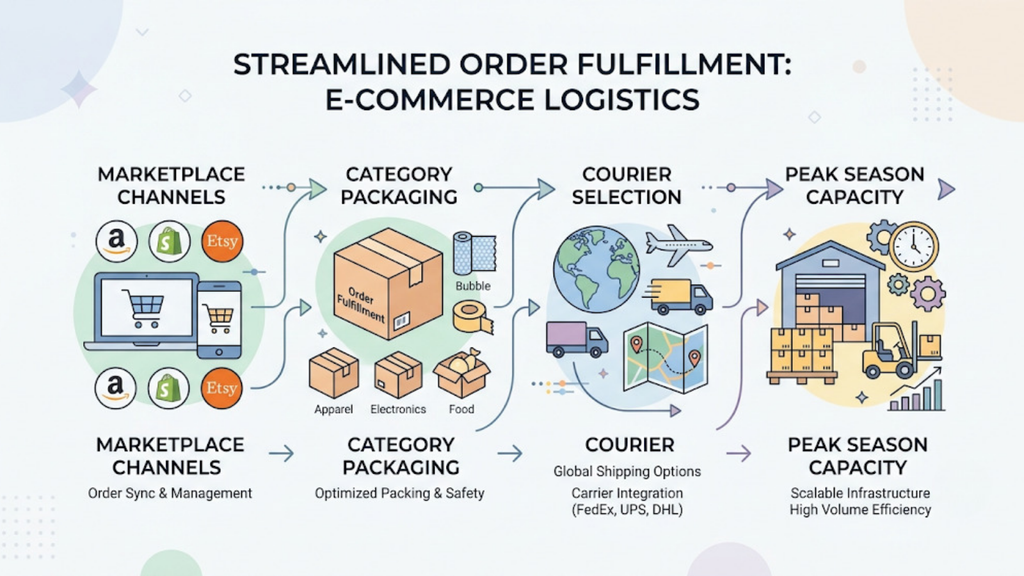
Once structure exists, daily execution becomes the constraint. Agencies lose margin in the gaps between one client’s process and the next.
These four questions govern how your floor actually runs each day.
5. How Should Courier Selection Vary Between Clients and Destinations?
Every brand arrives with carrier preferences, and every destination has its own serviceability reality. Manual reconciliation of both collapses at volume.
Base.com assigns the best courier per order by delivery PIN code and weight slab, with automatic failover when a partner cannot service the address. Client preference and deliverability are resolved together rather than sequentially.
6. Can Your Packing Process Handle Fragile and Bulky Goods Simultaneously?
A single packing standard fails an agency by definition. Glass-bottled skincare and bulky kitchenware need different handling on the same shift.
Base.com applies category-specific pick-and-pack rules, including careful multi-item packing to prevent in-transit damage. Packers follow instructions rather than improvising per brand.
7. How Do You Keep Dispatch SLAs Straight Across Several Marketplaces?
Each marketplace penalises late dispatch differently, and each client has commercial terms of their own. Missing one cutoff damages a listing you do not own.
Base.com brings every channel and seller account into one operations view with deadline tracking applied automatically. Prioritisation stops depending on whoever is watching the queue.
8. What Happens When Two Clients Peak During the Same Festive Week?
Indian ecommerce concentrates heavily into the October-November window, when volumes multiply several times over. Agencies feel that spike from every client at once.
Plan capacity brand by brand before the season, then pre-assign packing stations and staff. Agencies solving how to manage multiple client brands as an ecommerce agency treat peak planning as a client-level exercise, never a warehouse-level one.
(Decision Area Three) To Manage Multiple Client Brands as an Ecommerce Agency: Reporting, Reconciliation and Financial Separation
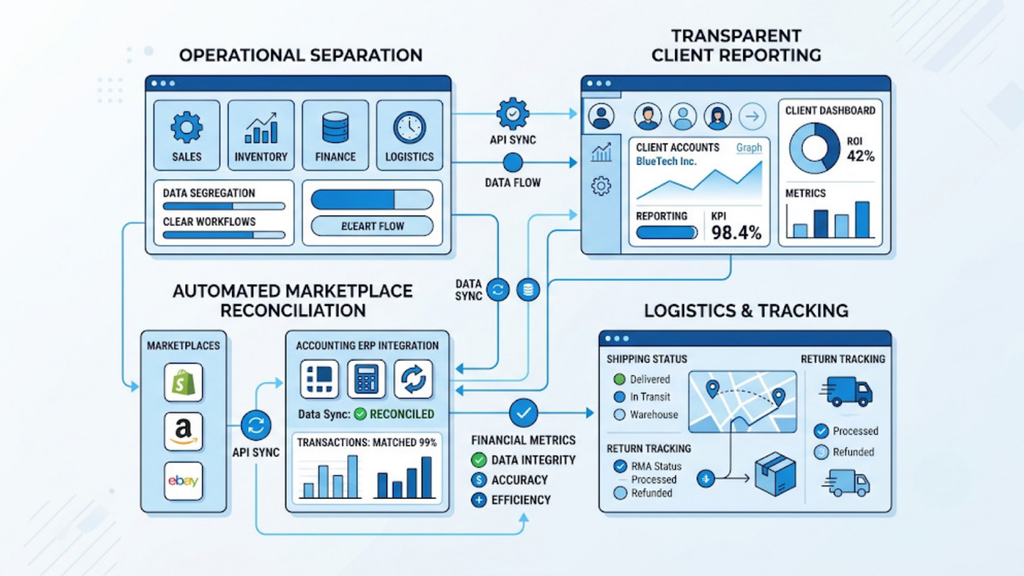
Operational separation means little if your reporting cannot prove it. Clients judge agencies on numbers they can verify independently.
These four questions determine whether your reporting survives scrutiny.
9. Can You Produce Client-Specific Reports Without Manual Assembly Work?
Building reports by hand each week consumes exactly the capacity that new clients require. It also introduces errors clients will eventually find.
Base.com delivers cron-based reports in customisable formats, scheduled per client. Your team reviews numbers instead of assembling them every Monday morning.
10. How Do You Reconcile Marketplace Payouts Across Many Seller Accounts?
Payout reconciliation is genuinely difficult across multiple accounts on multiple platforms. Clients notice discrepancies faster than agencies do.
Base.com provides payout and performance visibility across seller accounts, alongside invoicing and payment reconciliation. Deductions stop disappearing between platforms.
11. Does Your System Connect to Client Accounting and ERP Platforms?
Larger clients run SAP or dedicated accounting systems that must stay aligned with fulfilment. Manual reconciliation between the two consumes days each month.
Base.com integrates with accounting systems and SAP, plus GST e-invoicing and e-way bills. Back-office records then match what actually shipped.
12. How Do You Handle Returns Attribution Between Different Client Brands?
Returns arrive in mixed consignments and get attributed carelessly under pressure. Misattributed returns become billing disputes later.
Base.com scans returns into condition-level statuses such as damaged, recoverable, and return-to-store, recorded against the correct client. Given that reverse logistics eats 25-30% of order value on low-ticket Indian shipments, accuracy here protects real money.
(Decision Area Four) To Manage Multiple Client Brands as an Ecommerce Agency: Onboarding Speed and Long-Term Agency Scalability
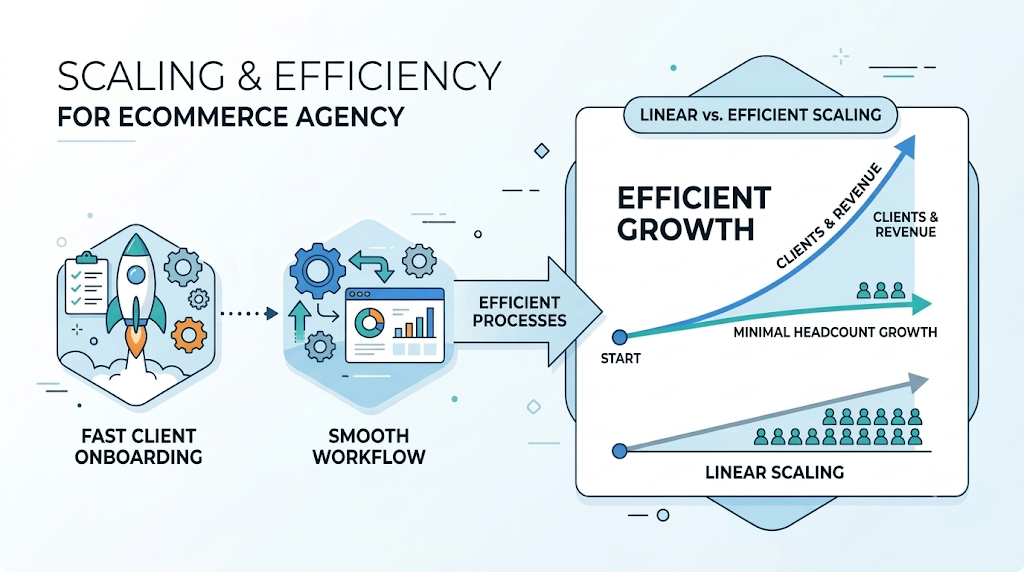
Your growth rate equals your onboarding rate. Everything above only matters if a new brand takes days rather than months.
These three questions decide whether your agency compounds or plateaus.
13. How Long Does Onboarding a New Client Brand Currently Take You?
Measure it honestly, from contract signature to first clean dispatch week. Most agencies discover the figure is longer than they quote prospects.
Base.com’s configurable workflows mean new clients consume configuration time rather than proportional headcount. Onboarding becomes a repeatable process instead of a project.
14. Which Client Requests Need Custom Development Rather Than Configuration?
Every agency eventually meets a requirement the standard build does not cover. The commercial question is which bucket it falls into.
Base.com offers add-ons including marketplace support, ticket management, offline-order POS, pre-order inventory separation, and bulk barcode printing. Clarify configuration versus development before quoting the client a timeline.
15. What Does Adding Your Next Five Clients Actually Cost in Headcount?
This single number tells you whether your operation scales. If five clients require five new hires, your model is linear rather than leveraged.
Agencies that answer how to manage multiple client brands as an ecommerce agency well add brands against existing capacity. The system carries the variety that people previously carried manually.
Comparing Manual Multi-Client Operations Against Configured Multi-Client Systems
The gap between these two models shows up in onboarding speed and margin per client. Mapping each failure to its cause makes the difference concrete.
Score your current operation against the table below, then count the rows sitting on the left.
| Operational area | Manual multi-client approach | Configured multi-client system | Cost of the gap |
| Client separation | Shared sheets with brand columns | Isolated catalogues, stock and queues | Cross-client errors and disputes |
| Workflow variation | One process bent per client | Rules by client, category or product | Wrong handling on mixed shifts |
| Courier selection | Per-client preference remembered manually | PIN-code and weight rules with failover | Higher freight, failed deliveries |
| Packing standards | Verbal instructions per brand | Category-specific packing rules | Damage on fragile client goods |
| SLA tracking | Watched by a supervisor | Automatic deadline prioritisation | Late dispatch penalties |
| Stock separation | Adjacent shelves, informal zones | Bin-mapped client zones | Wrong client’s stock shipped |
| Reporting | Rebuilt weekly per client | Scheduled per-client automated reports | Capacity lost to assembly work |
| Payout reconciliation | Spreadsheet matching after month-end | Account-level payout visibility | Unrecovered deductions |
| ERP alignment | Manual re-entry into client systems | Accounting and SAP integration | Month-end reconciliation drag |
| Returns attribution | Assigned from memory | Scanned against the correct client | Billing disputes and lost stock |
| Onboarding | Full setup built from scratch | Configuration from existing templates | Growth capped by headcount |
Rows on the left form your fix list. Address separation and workflow rows first, since everything else depends on them.
Mapping Base.com Capabilities Against Real Agency Operating Requirements
Most platforms are built for a single seller running a single brand. Agencies need multiplicity handled as a first-class design assumption.
Test each shortlisted platform against the capabilities below.
- Multi-seller and multi-client order management: Base.com runs different sellers and client brands through one platform without merging their operations.
- Configurable workflows by client and category: Base.com routes orders through genuinely different processes rather than one standard flow.
- PIN-code courier allocation with automatic failover: Base.com selects carriers per order and switches partners when serviceability breaks.
- Category-specific pick and pack: Base.com handles fragile FMCG differently from bulky textiles on the same shift.
- Warehouse management with client zoning: Base.com maps bins, barcoding, inwarding and outwarding across separated client areas.
- Accounting and SAP integration: Base.com keeps back-office systems aligned with actual fulfilment activity.
- Consolidated and per-client reporting: Base.com delivers cron-based reports in customisable formats for each brand separately.
- Payout visibility across seller accounts: Base.com surfaces marketplace deductions that usually stay invisible.
- Returns management with condition statuses: Base.com attributes returns correctly and restocks recoverable units.
- Marketplace ticket management add-on: Base.com handles platform-side support queries beside catalogue and fulfilment work.
These capabilities reinforce each other. Workflow configuration without client-level reporting leaves you unable to prove performance, and reporting without separation produces numbers clients will dispute.
Building an Agency That Adds Clients Without Adding Operational Drag
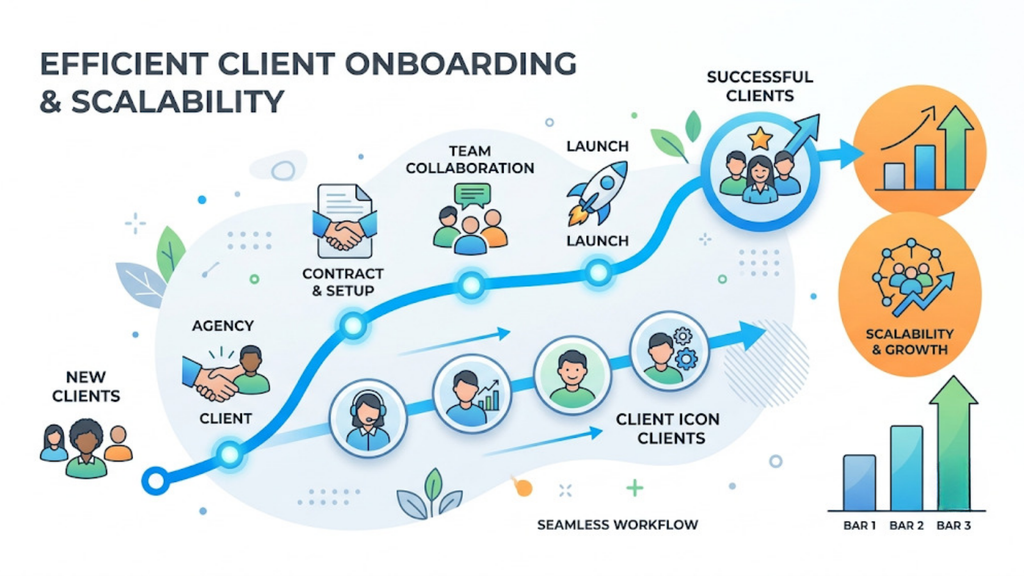
Agencies rarely fail because they cannot win clients. They fail because the eleventh brand takes as much setup as the first, and margin disappears into configuration work nobody billed for.
Answer the fifteen questions above in order, fix the structural gaps first, and treat onboarding speed as your core operating metric. If you want a clear plan for managing multiple client brands as an ecommerce agency across your exact client count, category mix, and warehouse footprint, book a Base.com operations review and map the setup to your own operation.
Frequently Asked Questions
These five questions come up in nearly every agency implementation. Each answer stands alone for quick reference.