

To plan promotions for Amazon and Flipkart sales, map each promotion type to a specific objective, nominate deals six to eight weeks before the event, allocate budget across deals, coupons, and ads rather than concentrating it in one, and set a contribution floor every promotion must clear.
Most sellers plan the discount and call it a promotion. They are different decisions.
Why How to Plan Promotions for Amazon and Flipkart Sales Starts With Placement, Not Price
The discount is what the customer sees. The promotion is what buys the visibility that makes the discount matter.
A 40% discount with no placement is a margin donation. The same discount attached to a deal slot, a coupon badge, and a supporting ad campaign is a traffic event. Same price, completely different outcome.
The scale justifies the effort. Redseer reported the first 11 days of the 2025 festive season at over ₹60,000 crore in GMV, roughly 3.5 times business-as-usual levels, with around 90 million shoppers participating at an average spend near ₹7,000, and horizontal players including Amazon and Flipkart accounting for close to two-thirds of festive transactions.
Understanding how to plan promotions for Amazon and Flipkart sales means treating placement, price and advertising as one connected plan with one budget, rather than as three teams making independent decisions.
The Indian Marketplace Sale Calendar That Shapes How to Plan Promotions for Amazon and Flipkart Sales
Amazon India’s major events cluster into a recognisable annual pattern: Republic Day in January, Prime Day in July, Great Freedom Sale in August, Great Indian Festival across September and October, and end-of-year events in November and December. Flipkart runs Big Billion Days in the same September-October window alongside its own calendar.
Amazon’s Great Freedom Sale 2026, per Amazon’s own press release, ran with up to 80% off across categories including smartphones, home, kitchen, everyday essentials, fashion and beauty, alongside instant bank offers, No Cost EMI and coupon discounts, with Prime members receiving 15% savings on a range of products.
Two planning implications follow.
The festive window is not one event. Redseer identified a dual-peak pattern in 2025, with GST slab simplification pushing high-ticket purchases past Diwali into a second wave. A single promotion plan covering September to October will underperform against two plans built for two distinct demand moments.
Prime early access shifts your day one. Prime members receive early access ahead of public availability, which means your promotion needs to be live and correctly configured before the sale’s public start, not on it.
Confirm current dates, mechanics, and eligibility in Seller Central and Seller Hub. Both platforms revise event structures annually, and this guide is not a substitute for the current seller documentation.
Match the Promotion Type to the Objective
The first real decision in how to plan promotions for Amazon and Flipkart sales is what each promotion is actually for.
The most common planning error is choosing a promotion because it is available rather than because it serves a purpose.
| Objective | Promotion type that fits | What success looks like |
| Win visibility on a hero SKU | Time-bound deal placement | Sessions and rank movement |
| Convert existing traffic | Coupon or on-listing discount | Conversion rate lift |
| Raise basket size | Bundle or threshold offer | AOV and units per order |
| Clear ageing stock | Deep discount, capped by recovery target | Units cleared, cash recovered |
| Acquire new customers | Entry-price SKU plus supporting ads | New-to-brand share |
| Defend share against a competitor | Targeted price move plus ads | Buy Box or rank retention |
| Launch a new SKU | Modest discount plus review generation | Review count and repeat rate |
Each row implies a different measurement. A deal placement judged on SKU-level margin will look like a failure even when it worked, because its job was traffic, not contribution on that SKU.
Decide the success metric before the promotion goes live. Deciding it afterwards guarantees you pick whichever number looks best, and it makes how to plan promotions for Amazon and Flipkart sales unmeasurable across cycles.
Deals, Coupons and Ads Do Different Jobs
- Deal placements buy reach. They put a SKU in front of people who were not searching for it. Typically the most competitive to secure and the most constrained by inventory and price requirements.
- Coupons and on-listing discounts buy conversion. They work on traffic you already have, which makes them cheaper per incremental sale but weaker at generating new demand.
- Sponsored advertising buys intent capture. It reaches people already searching, and it compounds with the other two rather than substituting for them.
The three also compound rather than add. A deal placement drives traffic that a coupon converts and an ad campaign retargets, and the same rupee spent on any one of them in isolation produces less. This is the practical case against the common pattern of putting the entire promotional budget into advertising because it is the easiest to measure.
A plan using only one of the three is leaving the other two mechanisms unused. Anyone working out how to plan promotions for Amazon and Flipkart sales should allocate across all three deliberately.
Working the Calendar Backwards: The Deadlines in How to Plan Promotions for Amazon and Flipkart Sales
Promotion planning has hard deadlines that inventory planning does not.
| Timing | Action |
| T-8 weeks | Select SKUs by role; calculate contribution floors; confirm inventory commitment |
| T-6 weeks | Submit deal nominations; confirm eligibility requirements per platform |
| T-5 weeks | Lock promotion budget split across deals, coupons and ads |
| T-4 weeks | Build creative and A+ content; confirm listing quality on promoted SKUs |
| T-3 weeks | Confirm nomination outcomes; rebuild the plan for anything rejected |
| T-2 weeks | Configure coupons and promotional price groups; do not activate |
| T-1 week | Ramp ad spend to build ranking signal before the event |
| T-3 days | Freeze all pricing and promotion configuration |
| T-0 | Verify every promotion is live and correctly priced within the first hour |
The T-3 weeks row is the one sellers skip. Deal nominations are not guaranteed acceptance, and discovering a rejection at T-1 week leaves no time to redeploy the budget.
Budget Allocation Across Promotion Types
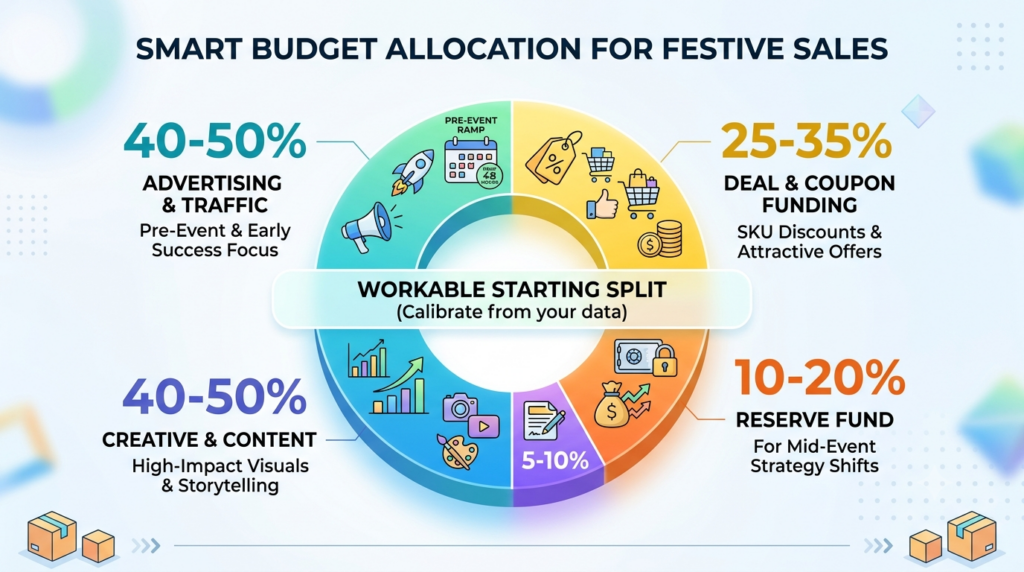
Budget is where how to plan promotions for Amazon and Flipkart sales becomes a set of trade-offs rather than a wish list.
A single promotion budget forces the trade-offs into the open. Separate budgets per team hide them.
A workable starting split for a festive event:
- 40-50% to advertising, weighted toward the pre-event ramp and the first 48 hours.
- 25-35% to discount funding on deal and coupon SKUs.
- 10-20% held in reserve for mid-event redeployment.
- 5-10% to creative and content, which is usually under-funded relative to its effect.
These are planning heuristics constructed for this guide, not published benchmarks. Calibrate from your own last two cycles.
Holding a reserve is the least intuitive part of how to plan promotions for Amazon and Flipkart sales, and the part most sellers omit and most regret omitting. Mid-event, you will discover one SKU converting far above plan and another far below. Without a reserve, you cannot act on either.
The Pre-Event Ad Ramp
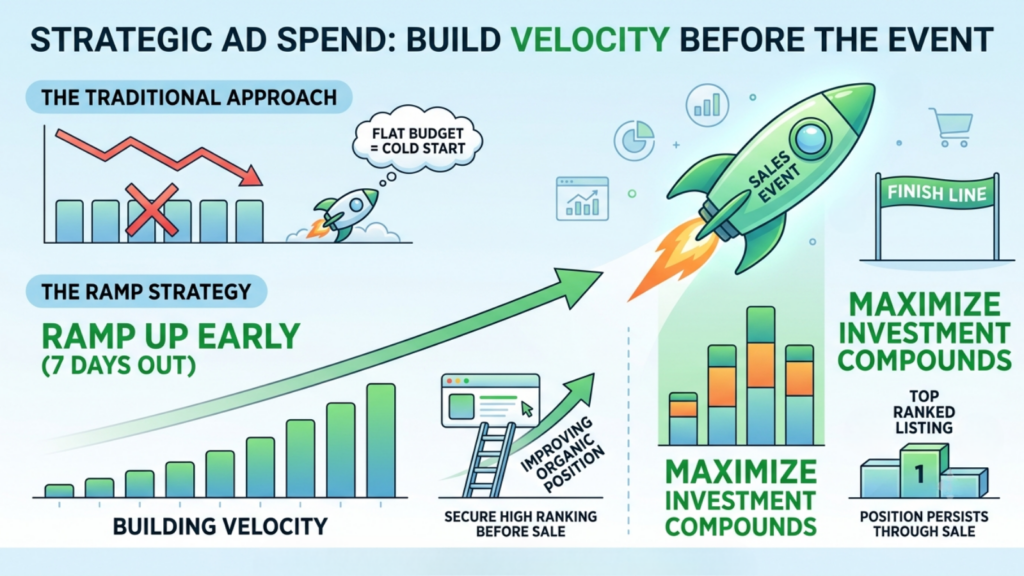
Ranking responds to velocity, and velocity built before the event carries into it.
Ramping ad spend in the week before a sale raises your organic position going into day one, which means the deal placement you secured lands on a listing that is already ranking rather than one starting cold.
This is why the ad budget should be weighted toward the ramp and the opening 48 hours rather than spread evenly. A flat daily budget across a nine-day window under-invests exactly when investment compounds.
Start the ramp seven days out rather than two. Ranking signals take days to register, and a ramp that begins forty-eight hours before the event buys traffic without buying position. The distinction matters because position persists through the sale while purchased traffic stops the moment the budget does.
Watch the ramp’s efficiency separately from the event’s. Ramp-period ROAS will look poor in isolation, because its return arrives during the event rather than during the ramp. Judging the two periods on the same metric leads teams to cut the ramp, which is the opposite of what the data supports.
Step by Step: How to Plan Promotions for Amazon and Flipkart Sales Using Base.com
Base.com bundles order management, product management (PIM), warehouse management, shipping, workflow automation, repricing and analytics into one platform. For promotion execution, the relevant machinery is price groups, bulk offer editing, price synchronisation, Price Automation and Automatic Actions.
Base.com handles the pricing, inventory and listing execution layer. Deal nomination and ad campaign management happen in Seller Central and Seller Hub; no OMS replaces those.
Step 1: Update Purchase Prices and Calculate Floors
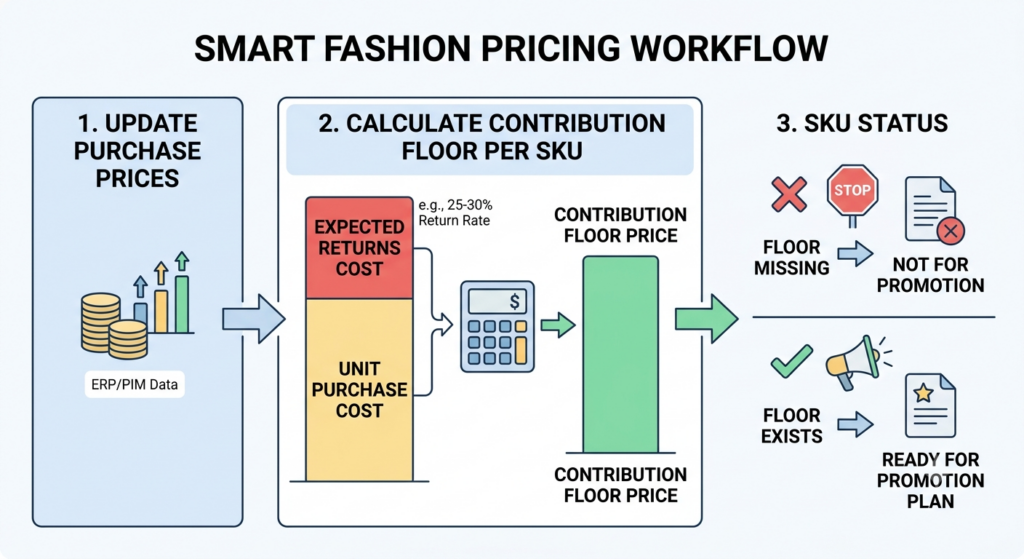
Base.com’s Product Manager combines ERP, WMS, and PIM functions and supports calculating price groups based on purchase price.
Update purchase prices first, then calculate a contribution floor per SKU including expected returns cost. In fashion, this matters most, since Indian return rates commonly reported at 25-30% mean the returns line often exceeds the negotiable portion of product cost.
No SKU enters a promotion plan before its floor exists.
Step 2: Build Promotion Price Groups by Campaign
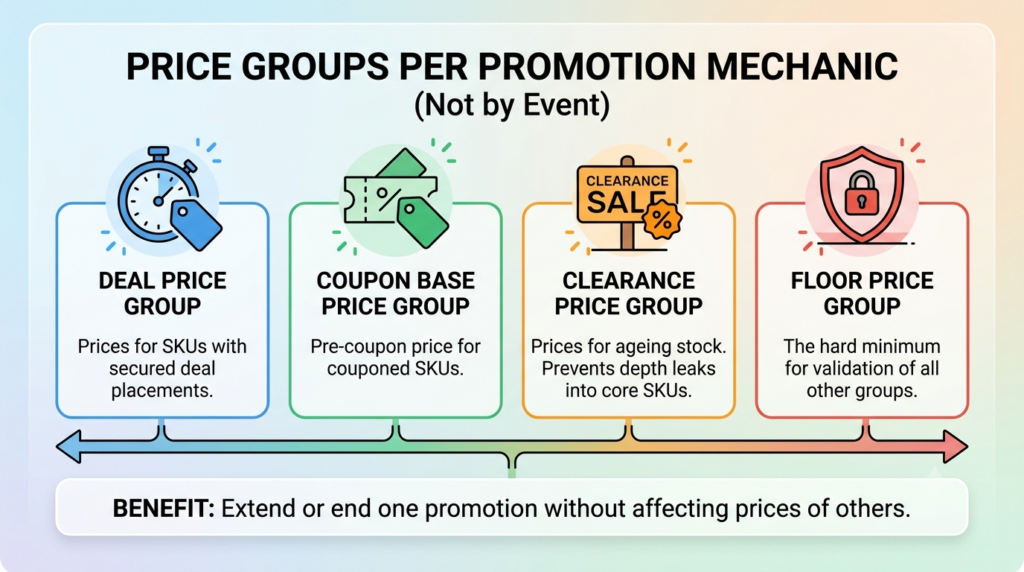
An inventory in Base.com can be assigned one or more languages, warehouses, and price groups, which function as separate price lists.
Build one price group per promotion mechanic rather than one for the whole event:
- Deal price group, prices for SKUs with secured deal placements.
- Coupon base price group, the pre-coupon price for couponed SKUs.
- Clearance price group, higher prices for ageing stock, kept separate so clearance depth never leaks into core SKUs.
- Floor price group, the hard minimum every other group validates against.
Separating by mechanic rather than by event is what lets you extend one promotion and end another without touching prices you did not intend to change.
Step 3: Tag SKUs by Promotion Role
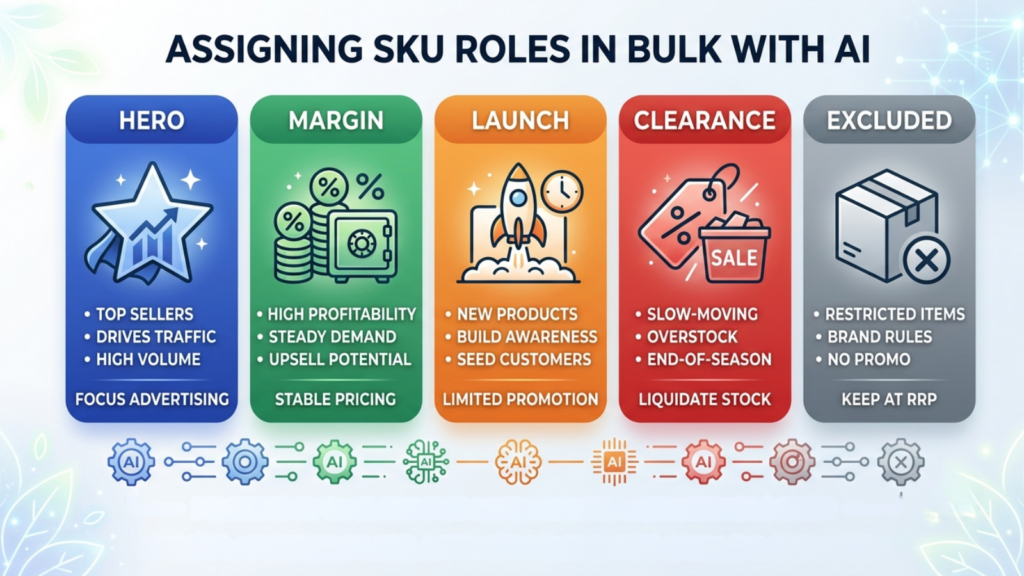
Assign each SKU to the role it plays: hero, margin, clearance, launch, or excluded.
Base.com supports bulk listing and editing of thousands of marketplace offers, with AI functions positioned for modifying many products or offers simultaneously. This is what makes role-based tiering workable on a large catalogue.
Work in bulk by role. A flat percentage across the catalogue is the single most common way promotion margin is lost.
Step 4: Validate Every Promotional Price Against Its Floor
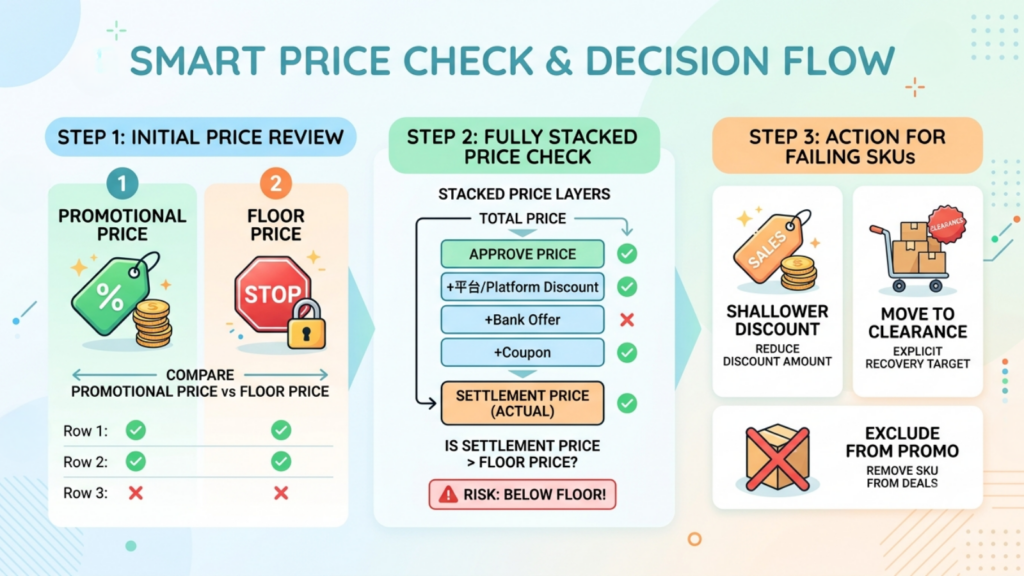
Export promotional price and floor price side by side and check every row.
Then model the fully stacked price, your discount plus any platform-funded layer plus coupon plus bank offer, and validate that against the floor too. The stacked price is what actually reaches settlement, and it is frequently well below the price that was approved.
Any SKU failing this check gets one of three treatments: shallower discount, move to clearance with an explicit recovery target, or exclude from the promotion.
Step 5: Configure Price Automation With Floor-Derived Minimums
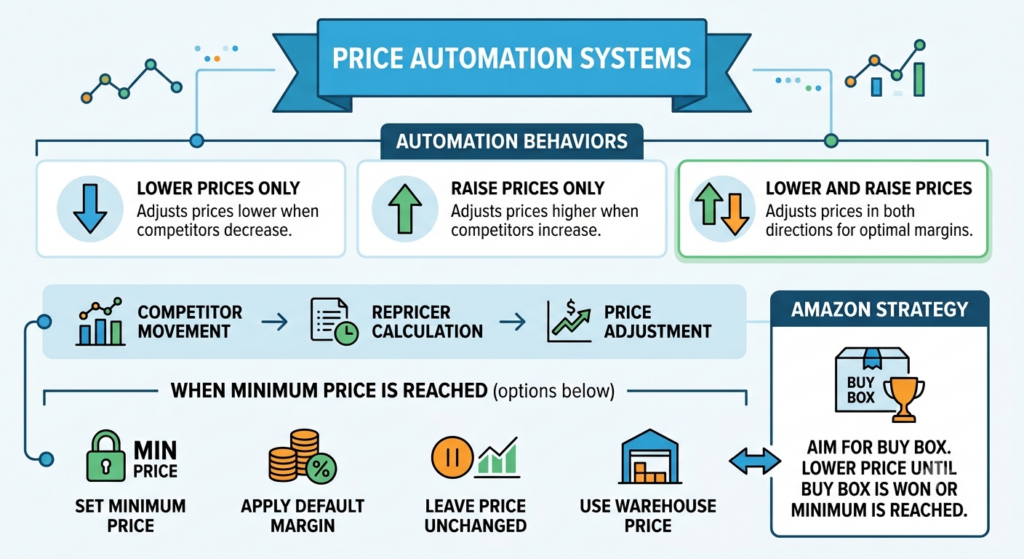
Base.com’s Price Automation adjusts prices in response to competitor movement, with three behaviours: lower prices only, raise prices only, or both. When the calculated price would fall below your minimum, the configurable options are to set the minimum price, apply the default margin, leave the price unchanged, or use the warehouse price.
For Amazon, the automation will attempt to lower the offer price until the Buy Box is obtained or the set minimum is reached.
Set that minimum from your calculated floor. A repricer running through a promotion without a floor-derived minimum hands your promotion strategy to whichever competitor is least disciplined.
Enable raise-prices behaviour as well. Competitor stockouts during a sale are margin opportunities a lower-only configuration cannot capture.
Step 6: Route Prices Through Target Price Groups Carefully
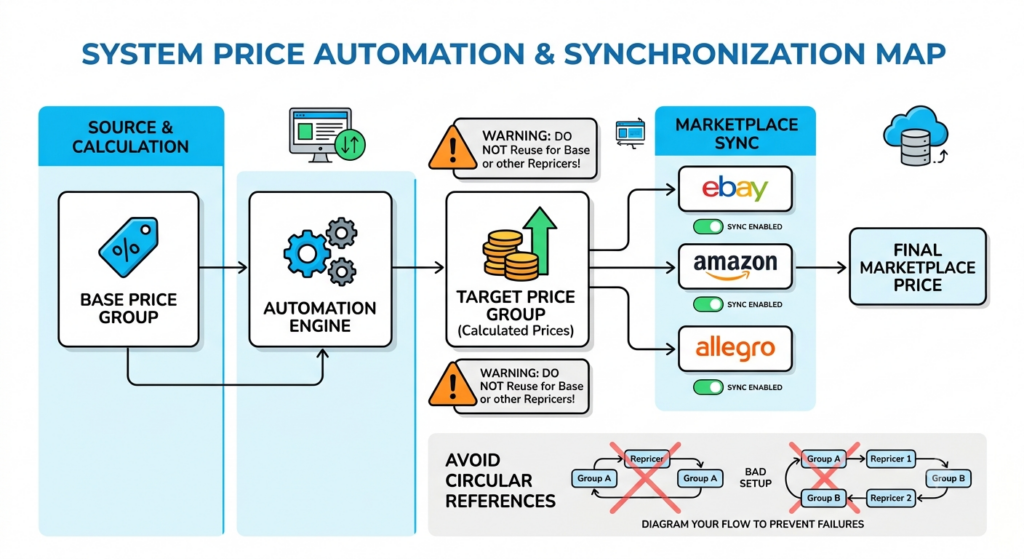
Price Automation saves calculated prices into a designated target price group, and reaching the marketplace requires price synchronisation enabled for that account.
Base.com’s documentation warns explicitly against selecting the same price group as the base price for this or any other repricer, and against a target group being used as a base group by a repricer on another marketplace.
Diagram the map before configuring: which group is base, which is target, which channel reads which. Circular references produce failures that are difficult to diagnose mid-promotion.
Step 7: Raise Synchronisation Frequency for the Event
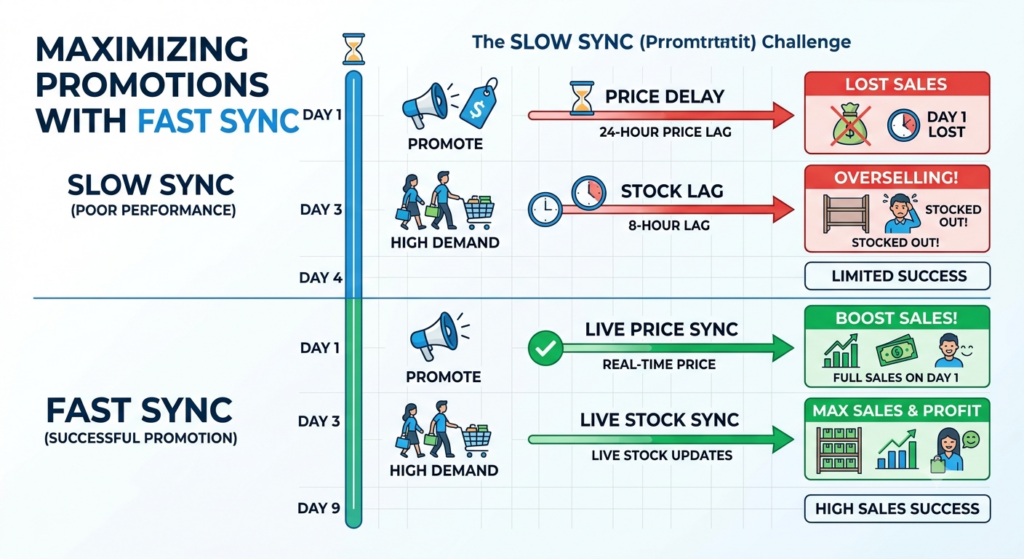
Base.com’s price synchronisation runs at 24-hour, 12-hour, four-hour, hourly or real-time intervals, and stock synchronisation at eight-hourly, hourly or live, with a dedicated Accelerations module that raises frequency for periods when higher sales are expected.
Raise both for the promotion window. A promotional price that takes 24 hours to reach a listing wastes a day of a nine-day event, and a stock position that lags produces overselling on exactly the SKUs you promoted hardest.
Step 8: Automate the Operational Response

Base.com’s Automatic Actions handle order routing, status updates, invoice generation, label printing, and shipment creation without manual steps, with conditions available on carrier, dimensions, parcel count, and weight.
Promotion success creates operational load. Configure before the event: auto-generate invoices and labels on payment confirmation, auto-route to the nearest warehouse with stock, and auto-alert on low stock for promoted SKUs specifically.
A promoted SKU that stocks out mid-deal loses the placement and the ranking signal together.
Step 9: Protect Promoted SKUs From Stockout

Enable automatic listing closure at zero stock and relisting on replenishment so a stockout never becomes an oversell and a marketplace defect.
More importantly, set stock alerts on promoted SKUs at a threshold calculated from projected zero hour rather than days of supply. At 3.5x festive velocity, “two days of stock” can mean fourteen hours.
Step 10: Freeze, Then Verify Live
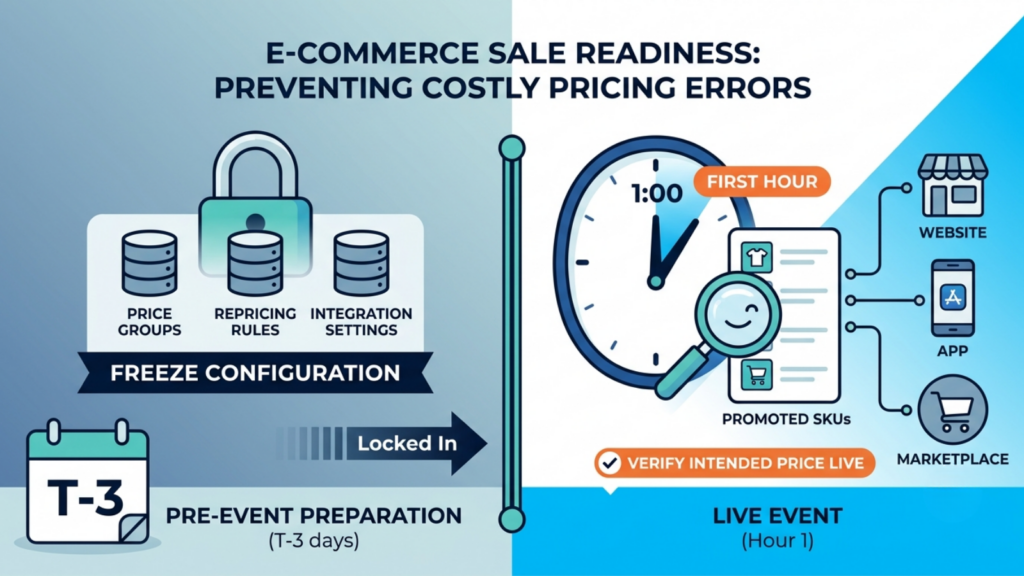
Freeze price groups, repricing rules, and integration settings at T-3.
Then verify in the first hour of the event that every promoted SKU is showing the intended price on every channel. Configuration that validates correctly in the system can still fail at the listing, and the first hour of a sale is the most expensive time to have a wrong price live.
Step 11: Plan the Restoration Before You Launch
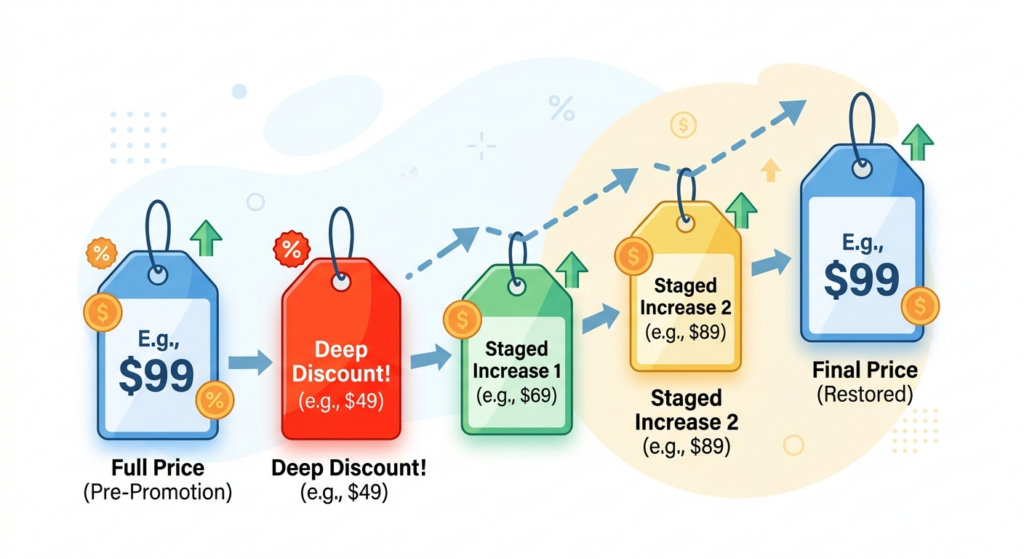
Decide now what happens when the promotion ends.
Snapping straight back to full price after a deep discount can suppress conversion, because the recent lower price becomes the buyer’s reference point. Build a staged restoration into your price groups before the event so it executes as a planned change.
A Caveat on Indian Marketplace Coverage
Base.com’s documented competitor-monitoring and repricing coverage names Amazon, Allegro, eMAG and Ceneo. Coverage for Flipkart specifically is not enumerated in public documentation.
The price group, bulk editing, synchronisation and Automatic Actions machinery described above is marketplace-agnostic. The competitor-monitoring and repricing layer may not extend to Flipkart. Confirm with Base.com directly before building a Flipkart promotion strategy that depends on automated repricing.
Platform-Specific Considerations in How to Plan Promotions for Amazon and Flipkart Sales
| Platform | What drives promotion performance | Plan around it |
| Amazon.in | Buy Box eligibility, listing quality, Prime early access | Be live before public start; protect Buy Box with floor-set minimums |
| Flipkart | Sales velocity and listing health feed ranking | Never let a promoted SKU stock out; velocity loss outlasts the stockout |
| Both | Inventory availability is usually a deal eligibility condition | Confirm stock commitment before nominating |
The Flipkart row carries the sharper warning. Because ranking responds to velocity, a stockout on a promoted SKU costs the placement, the velocity signal, and the recovery time after restocking. The units lost are the smallest part of it.
Measuring Whether the Promotion Worked
Measurement is what turns how to plan promotions for Amazon and Flipkart sales into a capability that improves rather than an annual guess.
Measure within 14 days, against the objective each promotion was assigned.
| Metric | What it tells you |
| Incremental units vs baseline | Whether the promotion generated demand or just discounted existing demand |
| Contribution vs equivalent baseline period | The actual financial answer |
| Required vs realised volume uplift | Whether the discount depth was earned |
| Attach rate on deal days | Whether traffic-driver SKUs did their job |
| New-to-brand share | Whether acquisition-objective promotions acquired anyone |
| Rank position, before and after | Whether the visibility persisted |
| Below-floor sale rate | Should be exactly zero |
The first row is the one that separates a real promotion from an expensive one. If you discounted 30% and sold 15% more units, you paid for volume you would have received anyway.
Revenue growth during a promoted sale is nearly meaningless as a success measure. Contribution against baseline is the number that tells you whether how to plan promotions for Amazon and Flipkart sales was done well.
Getting How to Plan Promotions for Amazon and Flipkart Sales Right Starts Eight Weeks Out
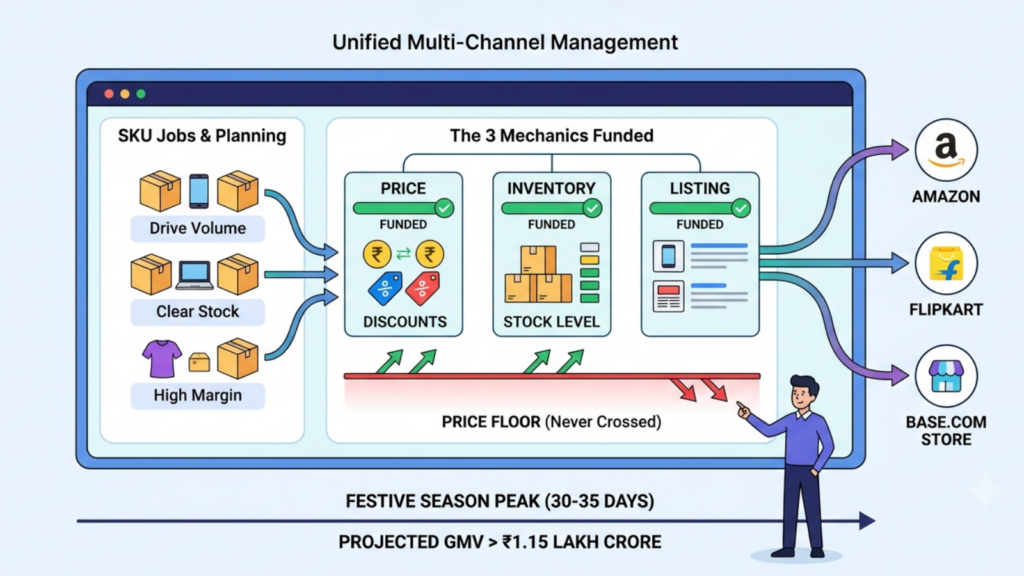
Promotions fail in planning far more often than in execution. The nomination was missed, the objective was never defined, the budget sat entirely in one mechanic, or the floor was calculated after the discount was agreed.
None of that is fixable during the event. What is fixable during the event is only whatever you built a reserve and a monitoring cadence to handle.
With Indian festive GMV projected to cross ₹1.15 lakh crore in a 30-35 day window and Amazon and Flipkart peaking together, the sellers who profit from promotions are the ones who assigned each SKU a job, funded all three mechanics, and set a floor nothing could cross. Base.com handles the pricing, inventory, and listing execution across channels from one platform, which is what makes a plan of that complexity survivable at scale.
Assign the objective. Nominate early. Fund all three mechanics. Hold the floor.
Frequently Asked Questions
How far in advance should I plan promotions for a festive marketplace sale?
Should I run the same promotions on Amazon and Flipkart?
How should I split my promotion budget?
What is the most common mistake in how to plan promotions for Amazon and Flipkart sales?
How do I know if a promotion actually worked?