

An OMS, or order management system, is the operational backbone that receives, processes, and tracks every order across every sales channel in one place. If you are building a D2C brand in India and selling on more than one channel, an OMS for D2C brands in India is not optional past ₹5 crore revenue. Without it, you are managing a scaling business on spreadsheets and WhatsApp.
This guide breaks down exactly what an OMS for D2C brands in India does, where manual operations break down, and how to evaluate whether you need one at your current stage.
What an OMS Actually Does
An OMS is not a fancy spreadsheet. It is not your Shopify backend. It is not your courier aggregator’s dashboard.
An OMS for D2C brands in India is a dedicated system that sits between your sales channels and your fulfilment operations. It pulls every order in, from Amazon, Flipkart, Shopify, your D2C website, and even offline B2B orders, into one unified queue. It then orchestrates everything that happens next: inventory allocation, warehouse routing, pick-pack instructions, label generation, courier assignment, and status updates back to the channel.
The core functions of an OMS for D2C brands in India:
| Function | What It Does |
|---|---|
| Order ingestion | Pulls orders from all channels in real time into one queue |
| Inventory sync | Decrements stock across all channels when any order is confirmed |
| Warehouse routing | Assigns each order to the optimal fulfilment node |
| Fulfilment execution | Generates pick lists, pack instructions, and shipping labels |
| Courier allocation | Assigns a courier based on serviceability, SLA, and cost rules |
| Status updates | Pushes tracking and order status back to the originating channel |
| Returns management | Receives, QCs, and restocks returned inventory automatically |
| Reconciliation | Matches settlements from multiple channels against dispatch records |
Without an OMS for D2C brands in India, each of these functions either happens manually, happens in isolation across different tools, or does not happen at all.
The Scale Problem: When Manual Operations Break
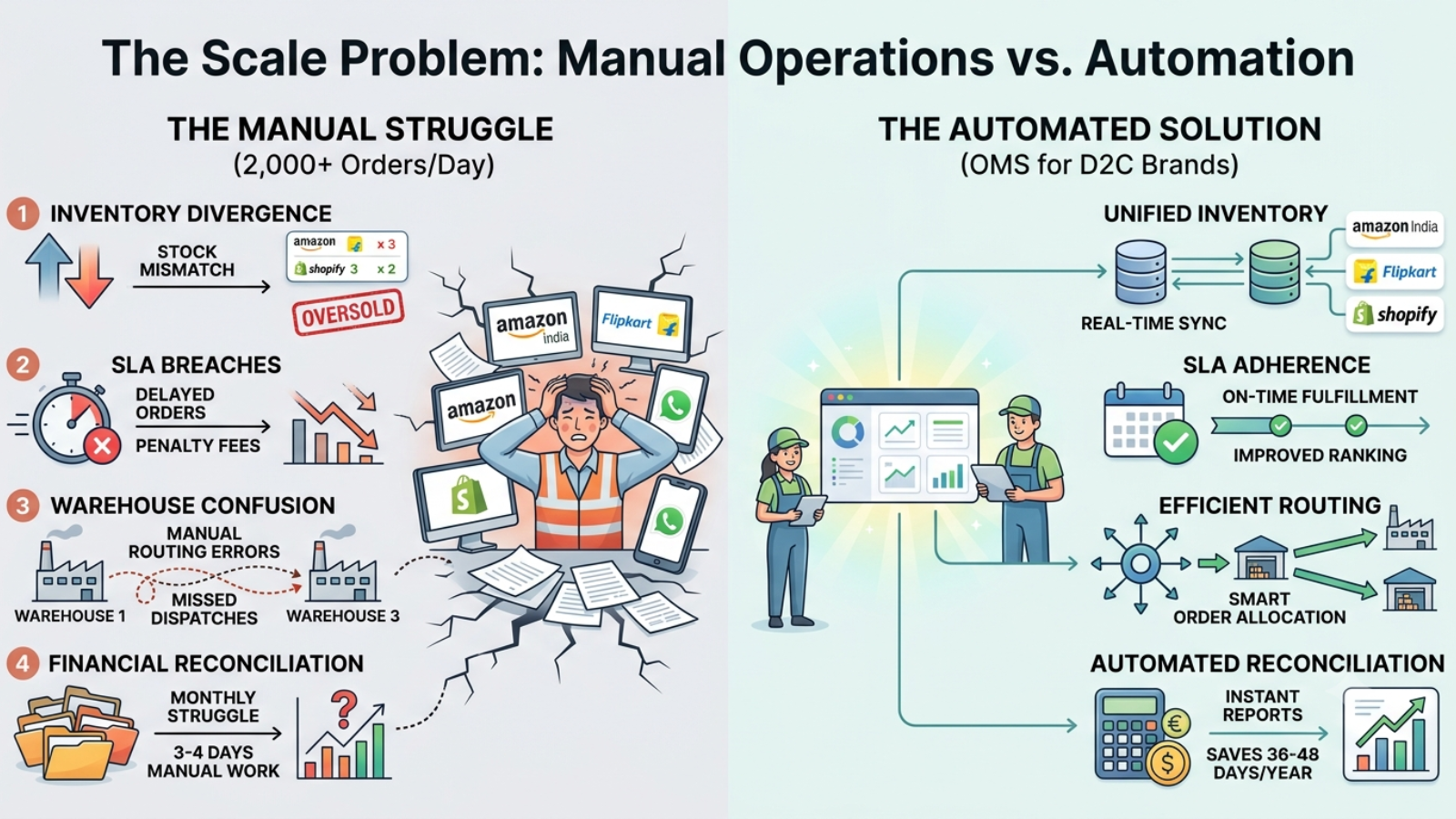 India’s D2C sector is growing at 40% CAGR. That growth does not arrive linearly; it arrives in spikes. A brand doing 200 orders a day in October does 2,000 orders a day during Diwali. Manual operations that held together at 200 collapse at 2,000.
The breaking points are predictable and consistent across Indian D2C brands.
- The inventory divergence problem. You have stock listed on Amazon, Flipkart, and your Shopify store. A product sells out on Amazon at 2 PM. By the time someone manually updates the other two channels, you have taken 15 more orders that you cannot fulfil. India’s ecommerce market is projected to reach $226 billion by 2026; at that scale, overselling is not a minor inconvenience. It is a seller score penalty, a customer trust problem, and a logistics cost you pay for every failed delivery.
- The SLA problem. Flipkart’s seller-fulfilled SLA is 24-48 hours, depending on the category. Amazon’s performance metrics are equally unforgiving. When orders live in three separate portals, and your warehouse team checks each manually, orders fall through gaps. Indian sellers without an OMS for D2C brands in India typically process 6-8% of orders outside SLA during peak periods, directly affecting marketplace ranking and buyability.
- The warehouse coordination problem. At ₹10 crore+ revenue, most Indian D2C brands operate from multiple fulfilment nodes, often for GST zone optimisation. Routing orders manually across two or three warehouses, coordinating over WhatsApp, and reconciling dispatch records at the end of the day is not a scalable operating model. It is a compounding source of errors.
- The reconciliation problem. At the end of the month, finance needs to match Amazon settlement reports, Flipkart payment advice, and Shopify payouts against actual dispatch records. Without an OMS for D2C brands in India, this takes 3-4 days of manual work every single month, 36-48 days per year on a task that an OMS handles automatically.
What Breaks First at Each Revenue Stage
Not every D2C brand needs an OMS for D2C brands in India on day one. The inflection points are specific to Indian ecommerce realities:
| Revenue Stage | What Breaks First | OMS Priority |
|---|---|---|
| Under ₹1 crore/year | Nothing critical, volume is manageable manually | Low |
| ₹1-5 crore/year | Inventory overselling starts; SLA misses begin on peak days | Medium, evaluate now |
| ₹5-20 crore/year | Multi-channel reconciliation fails; warehouse coordination breaks | High, implement immediately |
| ₹20-100 crore/year | Multi-node routing, COD reconciliation, and ERP sync become critical | Essential, growth stalls without it |
| Above ₹100 crore/year | Enterprise OMS with SAP/ERP integration, RPA, and custom workflows | Non-negotiable |
The ₹5 crore mark is the practical inflection point. Below it, the pain is manageable. Above it, the absence of an OMS for D2C brands in India becomes a direct constraint on growth, not just an operational inconvenience.
Why Generic OMS Platforms Fall Short for Indian D2C
 Most OMS platforms available globally are built for Western ecommerce. They handle Amazon US and Shopify well. And treat Flipkart as a secondary integration, if they support it at all. They do not understand COD. And do not generate GST-compliant invoices. They do not know what Delhivery or Xpressbees is.
Indian D2C brands that deploy a global OMS without India-specific capabilities spend the first six months building workarounds for the majority of their order volume. A genuine OMS for D2C brands in India must handle five India-specific requirements natively, not as paid add-ons or custom integrations.
- COD order management. India’s COD return rate runs at 25-30% across categories. COD orders are not financially confirmed until delivery. An OMS for D2C brands in India must track COD status separately, reconcile COD remittances from couriers, and flag non-delivery attempts for re-attempt or cancellation, not treat COD as just another payment method.
- Flipkart-native integration. Flipkart has its own order states, manifest formats, and returns flow that differ significantly from Amazon. An OMS for D2C brands in India handles Flipkart’s specific API behaviour natively, not through a generic marketplace connector that misses Flipkart-specific fields and creates manual exceptions daily.
- GST-compliant invoicing. Every order dispatched in India requires a tax invoice with HSN code, GSTIN, place of supply, and applicable tax rate. An OMS for D2C brands in India generates this automatically at dispatch, for every channel, every order, without manual input.
- Indian courier network integration. Delhivery, Bluedart, Xpressbees, Shadowfax, Ecom Express, and DTDC are the operational realities of Indian last-mile logistics. An OMS for D2C brands in India must integrate with all of them natively, support serviceability checks, and enable courier selection based on zone, weight, and SLA.
- Multi-node GST zone routing. Many Indian D2C brands maintain warehouses in multiple states for GST optimisation. Base.com is built specifically for these requirements. It handles Flipkart natively, generates GST invoices automatically, integrates with all major Indian couriers, and supports multi-node fulfilment routing, without requiring custom development or bolt-on workarounds.
OMS vs. What You Are Probably Using Right Now
Most Indian D2C brands at the ₹2-10 crore stage are using a patchwork of tools and calling it an order management system. Here is what that actually looks like, and where it breaks:
| What You Are Using | What It Does | What It Cannot Do |
|---|---|---|
| Shopify backend | Manages Shopify orders only | Cannot see Amazon or Flipkart orders |
| Amazon Seller Central | Manages Amazon orders only | No visibility into other channels |
| Flipkart Seller Hub | Manages Flipkart orders only | No inventory sync with other channels |
| Courier aggregator dashboard | Books shipments, generates AWBs | Cannot allocate inventory or route orders |
| Excel / Google Sheets | Manual inventory tracking | Real-time sync impossible at volume |
| WhatsApp groups | Warehouse coordination | No audit trail, no automation, no SLA tracking |
The combined output of these six tools does not equal an OMS for D2C brands in India. It equals six sources of truth that diverge under pressure, require constant human reconciliation, and collapse during peak volume.
Blue Tea was operating exactly this kind of patchwork before implementing Base.com. Order processing took 3 hours per batch. Packing errors ran at 3-4% of orders. After implementing an OMS for D2C brands in India through Base.com, processing time dropped to 30 minutes and packing errors reached zero. The improvement was not marginal; it was a structural change in how the business executed.
What a Modern OMS for D2C Brands in India Looks Like
A modern OMS for D2C brands in India is not just a software purchase. It is an operational infrastructure decision that changes how your entire order-to-cash cycle works.
1. Order Intelligence
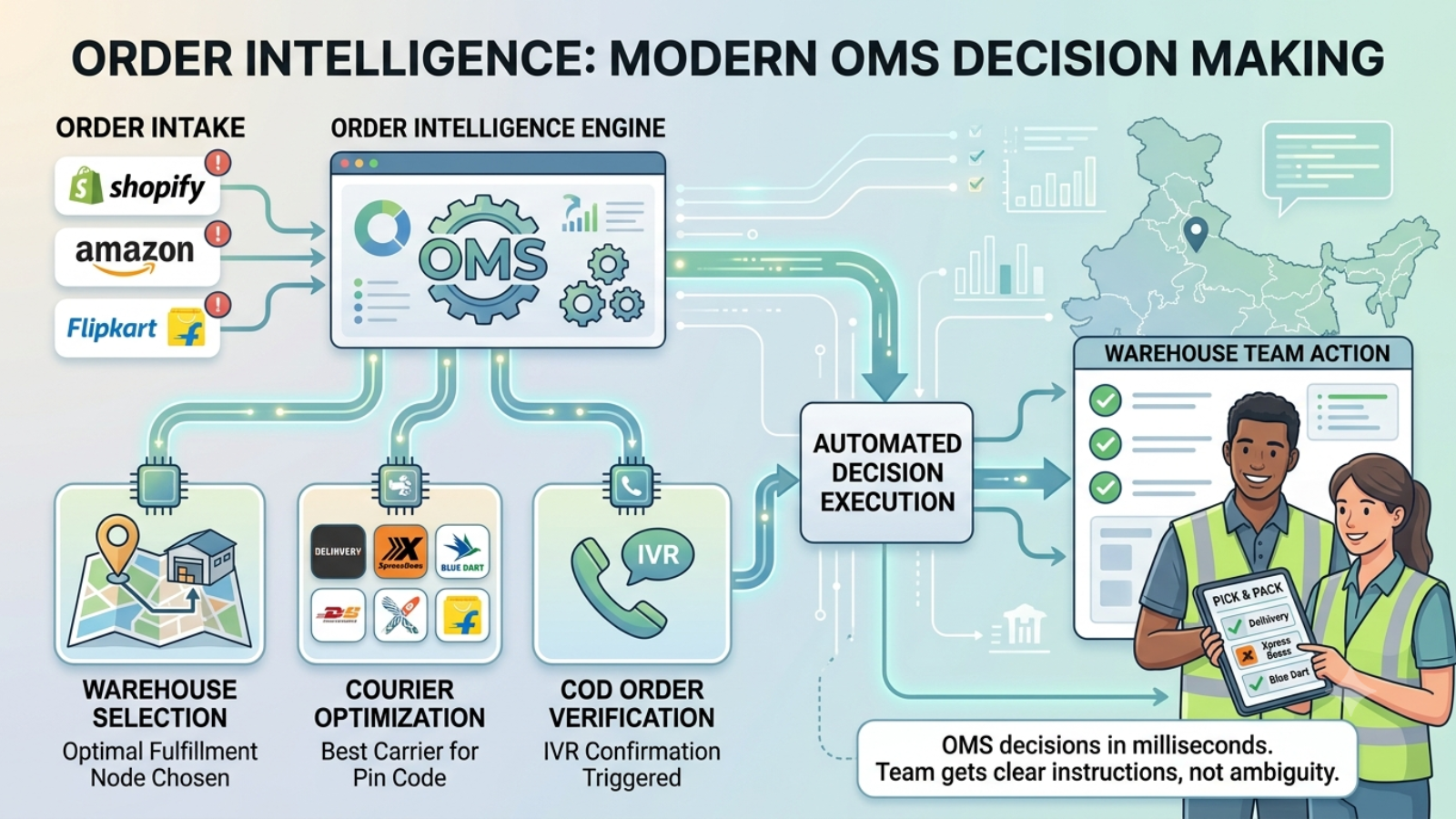 A modern OMS for D2C brands in India does not just receive orders; it makes decisions about them. Which warehouse should fulfil this order? Which courier has the best serviceability for this pin code? Is this a COD order that needs an IVR confirmation call before dispatch? These decisions happen automatically, in milliseconds, for every order. Your warehouse team receives clear instructions, not ambiguous order details requiring interpretation.
2. Real-Time Inventory Visibility
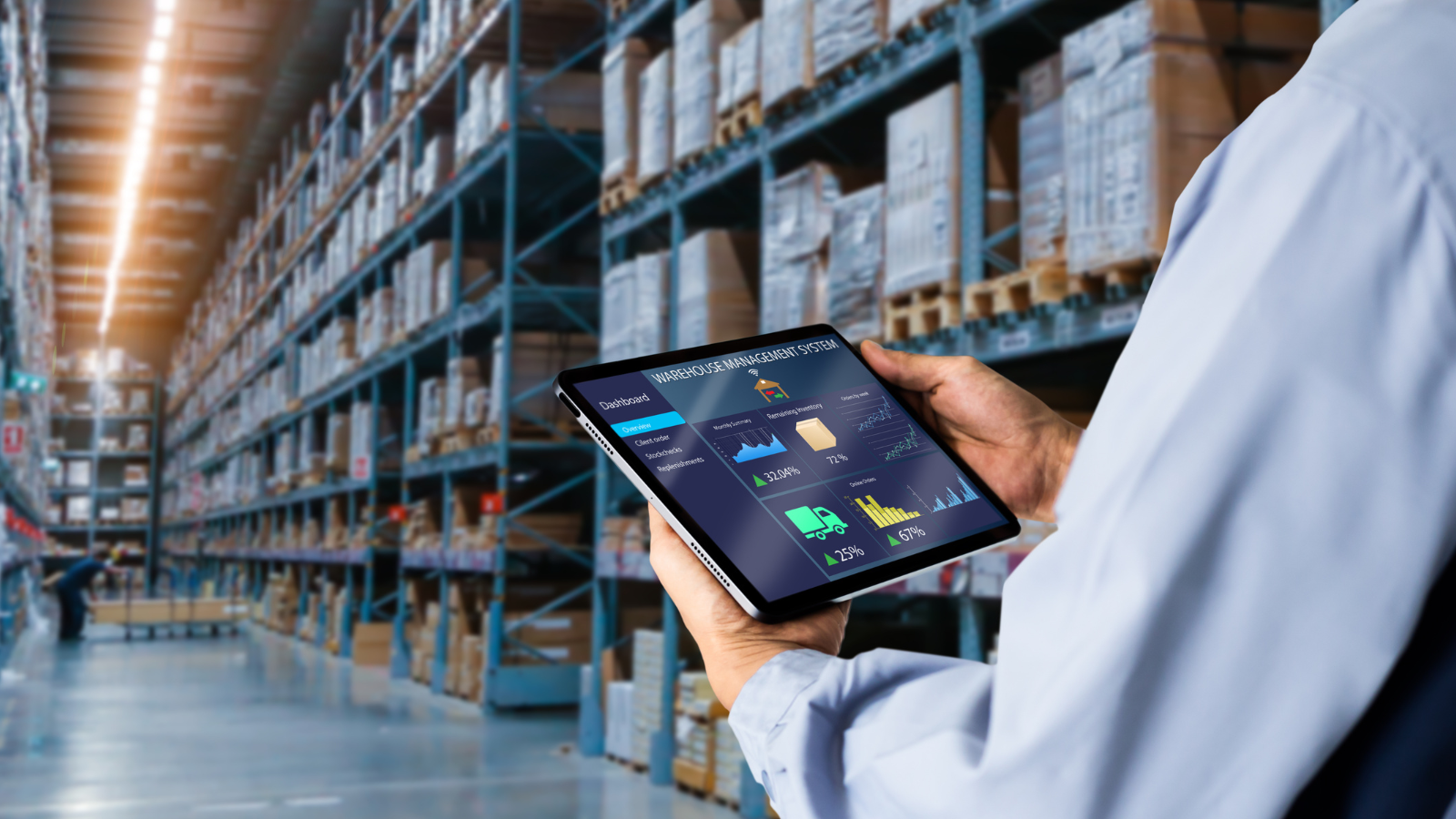 A modern OMS for D2C brands in India gives you one inventory number per SKU that is accurate across all channels at all times. Not a Shopify number, an Amazon number, and a Flipkart number that you hope add up to your actual stock. One number. Updated within 60 seconds of any sale, return, or stock adjustment on any channel.
For Indian D2C brands managing festive season inventory, where a 10x velocity spike can exhaust a month’s stock in 48 hours, real-time inventory visibility is not a nice-to-have. It is the difference between capitalising on a sale event and spending the week cancelling orders.
3. Warehouse Execution
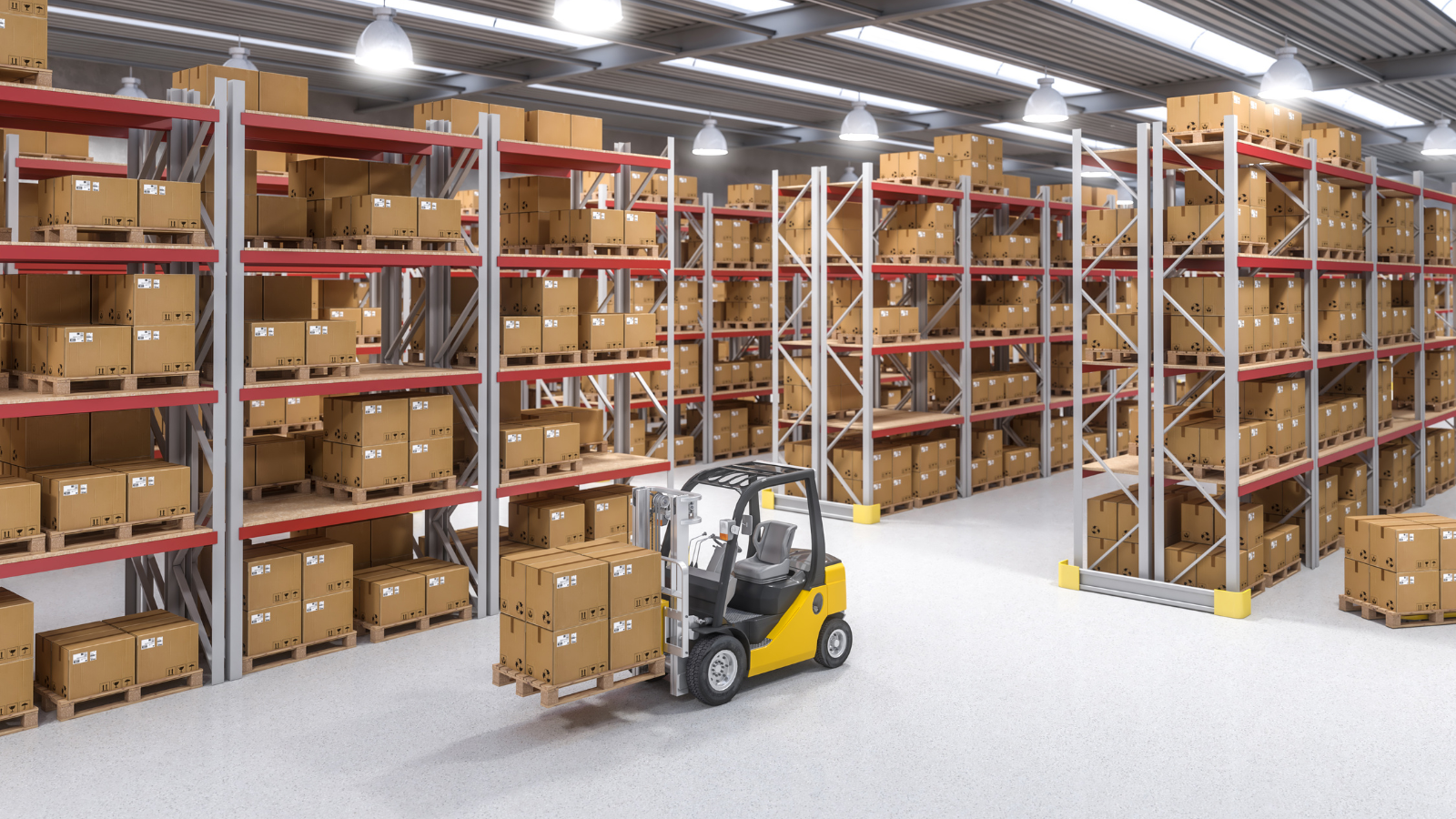 A modern OMS for D2C brands in India translates order data into warehouse actions. Pick lists are generated by bin location, not by order arrival sequence, so pickers take the most efficient path through the warehouse. Pack instructions specify the correct box size, include channel-specific inserts or invoices, and flag exceptions before they become errors.
VMSK Retail reduced its average dispatch turnaround from 3 days to under 6 hours after implementing structured warehouse execution through Base.com. That improvement is a direct function of what an OMS for D2C brands in India does at the warehouse execution layer.
4. Returns Automation
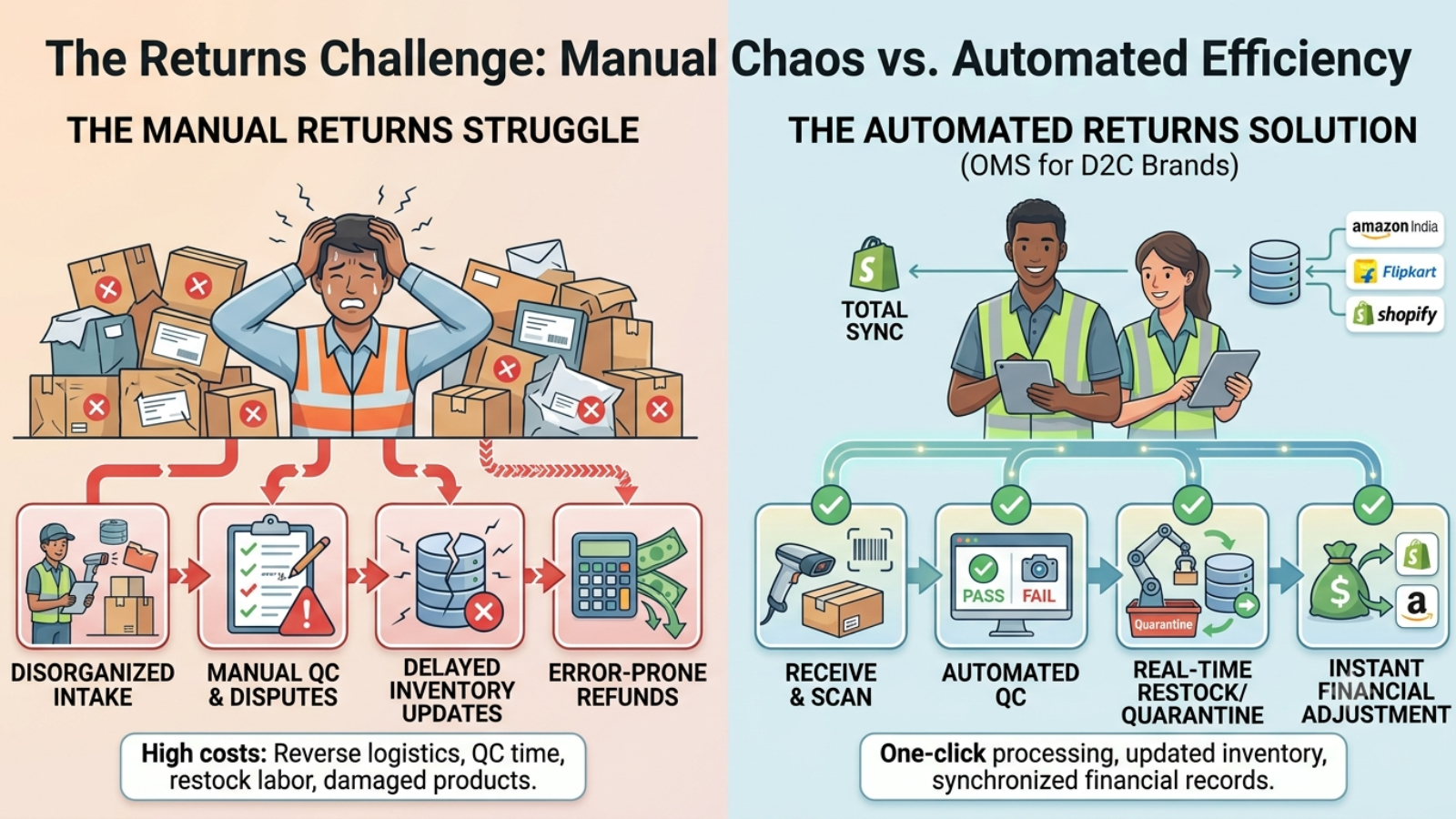 Returns in Indian ecommerce are operationally expensive. A return costs the brand the original shipping, the reverse pickup charge, the QC time, and restock labour, before accounting for any product damage. An OMS for D2C brands in India automates the entire returns workflow: receive, QC, restock or quarantine, update inventory, and trigger the appropriate financial adjustment, without manual coordination at any step.
5. ERP and Accounting Integration
 At ₹20 crore+ revenue, your OMS for D2C brands in India must connect to your ERP. Most Indian brands at this scale run SAP, Tally, or NetSuite. Order data, invoice data, and settlement data must flow into the ERP automatically. Manual data entry between your OMS and accounting system is a compliance risk and a reconciliation failure waiting to happen.
Base.com integrates with SAP via RPA-based transaction execution, with Tally via XML import, and with NetSuite via SuiteTalk REST API, covering the full ERP environment spectrum that Indian D2C brands operate in.
How to Evaluate an OMS for D2C Brands in India
Not all OMS platforms deliver equally on Indian requirements. Before committing to any OMS for D2C brands in India, evaluate against these eight criteria:
| Evaluation Criteria | What to Ask |
|---|---|
| Channel coverage | Native support for Flipkart, Amazon, Shopify, and your D2C website? |
| COD handling | Tracks COD separately from prepaid, including remittance reconciliation? |
| GST invoicing | Auto-generates compliant invoices at dispatch for every channel? |
| Indian courier integrations | Natively supports Delhivery, Bluedart, Xpressbees, Shadowfax, Ecom Express? |
| Multi-warehouse routing | Zone-wise inventory allocation and automatic order routing supported? |
| ERP integration | Connects to SAP, Tally, or NetSuite without custom development? |
| Implementation time | Go-live in under 2 weeks without an in-house engineering team? |
| Pricing model | Volume-based pricing that scales with your order growth? |
An OMS for D2C brands in India that scores well on all eight is the right platform. One that scores well on four and requires custom development for the rest will cost more in implementation than you save in operations.
The ROI Case for an OMS for D2C Brands in India
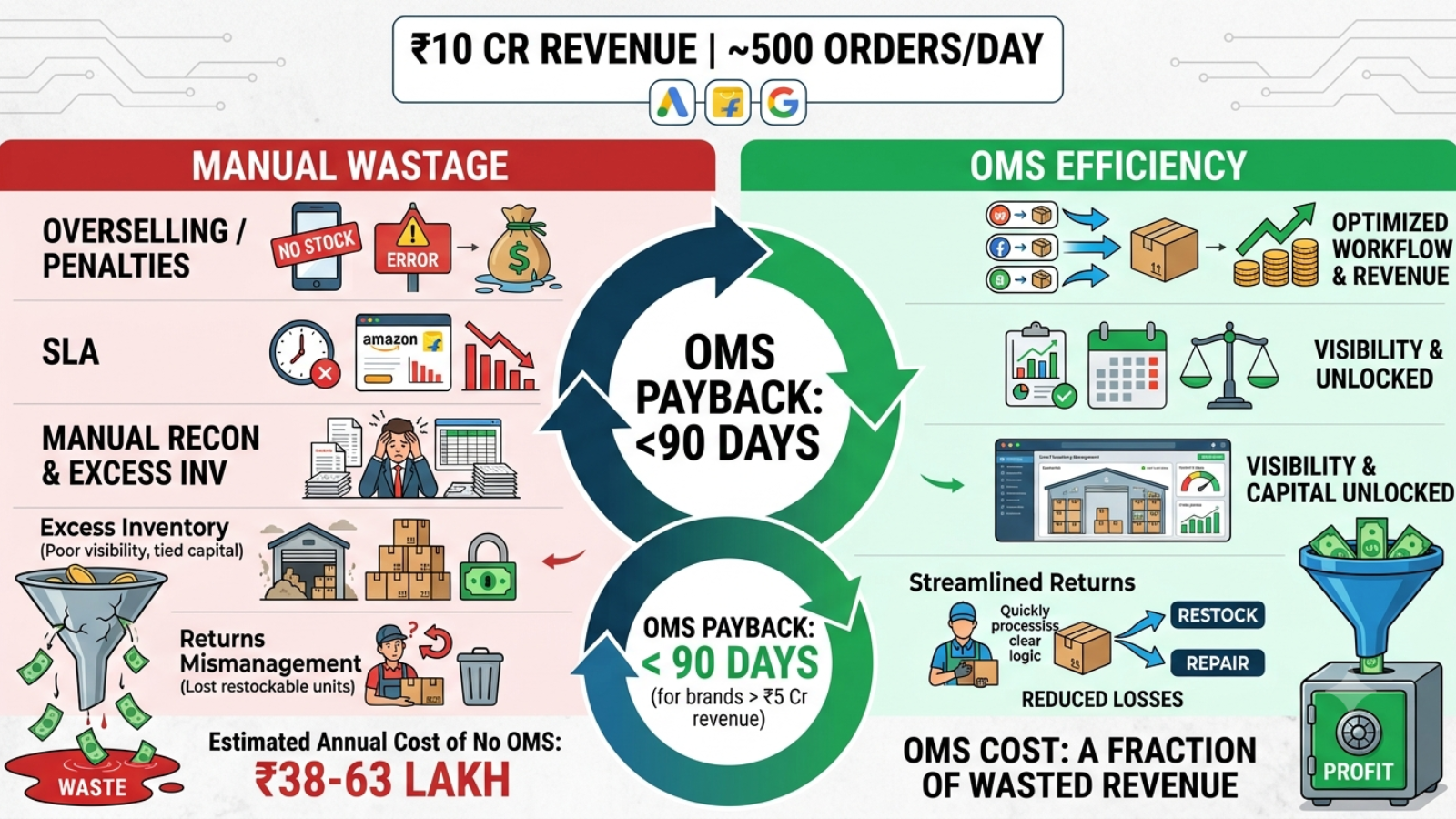 Indian D2C brands often delay OMS investment because it feels like overhead. The ROI math says otherwise.
Consider a brand doing ₹10 crore annual revenue across three channels, processing 500 orders per day:
| Cost Without OMS | Estimated Annual Impact |
|---|---|
| Overselling (2% of orders, courier + cancellation cost) | ₹8-12 lakh |
| SLA misses (penalty fees + seller score degradation) | ₹5-10 lakh |
| Manual reconciliation (3 days/month at operations manager cost) | ₹4-6 lakh |
| Excess inventory from poor visibility (tied-up working capital) | ₹15-25 lakh |
| Returns mismanagement (lost restockable units) | ₹6-10 lakh |
| Total estimated annual cost of no OMS | ₹38-63 lakh |
The right OMS for D2C brands in India at this scale costs a fraction of that figure annually. The payback period is typically under 90 days for brands with revenue above ₹ 5 crore.
Maran Exports eliminated multi-location coordination delays after implementing Base.com, reducing fulfilment errors that were creating direct costs and downstream customer service load simultaneously. Conceptkart standardised their packing and dispatch operations, reducing the exception handling that was consuming operations team bandwidth every day.
When You Do Not Need an OMS Yet
Not every brand needs an OMS for D2C brands in India today. If all of the following are true, you can wait:
- You are selling on one channel only
- You are processing under 100 orders per day consistently
- You operate from a single warehouse location
- You have no ERP or accounting integration requirements
- You are not planning a marketplace expansion in the next six months
If any of these conditions is false, or will be false within six months, start your OMS for D2C brands in India evaluation now. Implementation takes 2-4 weeks. Brands that implement before hitting the breaking point scale through it smoothly. Brands that implement after the breaking point spend their first 30 days firefighting while simultaneously onboarding a new system.
Base.com is an order and warehouse management platform purpose-built as an OMS for D2C brands in India. It connects Amazon, Flipkart, Shopify, and 50+ Indian logistics partners into one unified operations layer, with native COD management, GST invoicing, multi-warehouse routing, and ERP integration included.

[…] Browntape, EasyEcom, and FYND have no payment reconciliation capability at all. Among the major Indian OMS providers, Unicommerce and Increff have payment reconciliation features; Base.com delivers it as an […]
[…] an OMS does, where they differ across 15 specific operational dimensions, and why Base.com, as a unified OMS and WMS platform, is the correct starting point for most growing Indian D2C brands navigating this […]
[…] is an order and warehouse management platform built specifically for Indian D2C, marketplace, and B2B sellers. Multi-warehouse operation […]
[…] connects order execution, inventory, and procurement into one real-time system, so every technique on this list, from ABC […]
[…] order processing steps, quality check stages, or multi-location routing logic that does not fit a standard OMS status model. Base.com accommodates all of these through custom status configuration. Vinculum does […]
[…] brands scale past 300 orders per day, the gaps in what a shipping aggregator can do versus what a dedicated OMS like Base.com can do become the difference between controlled growth and operational […]
[…] 3: Technology. A WMS, OMS integrations, barcode scanners, label printers, packing station equipment, racking systems, and CCTV. Initial […]