
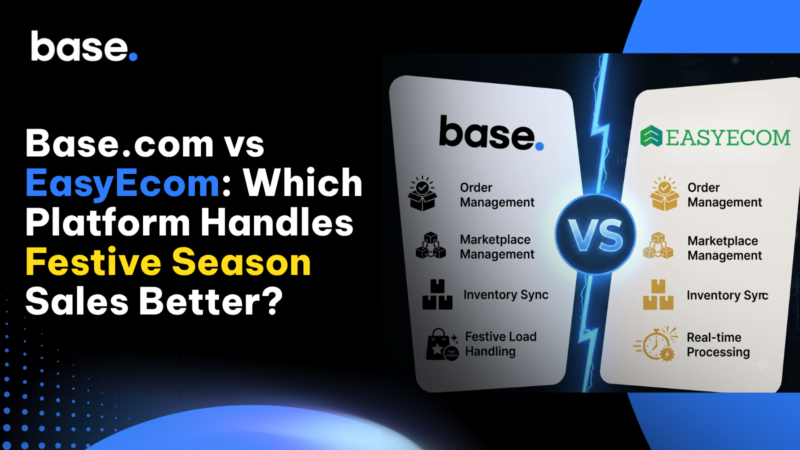
The Base.com vs EasyEcom question has a clear answer for Indian D2C brands operating above Rs 10 crore GMV: Base.com handles festive season sales better. Base.com’s real-time inventory sync, scan-based pack verification, automated COD reconciliation, and RTO intelligence are purpose-built for peak load.
EasyEcom is a capable mid-market platform, but its limited WMS depth, basic analytics, and partial COD automation create failure points precisely when order volumes spike 10-20x. For brands actively searching for the best alternative to EasyEcom, Base.com is the most complete answer in the Indian market.
The festive season in Indian ecommerce is not a growth opportunity. It is an operational stress test.
Big Billion Days, Great Indian Festival, and Navratri-to-Diwali sales windows compress months of order volume into 5-10 days. India’s ecommerce market crossed $226 billion in 2024, with the festive season accounting for 25-30% of annual D2C GMV in most categories. The brands that win are the ones whose operations do not break under that load.
The platform running your order management is the single biggest variable in whether you scale through the festive season or spend it firefighting. The Base.com vs EasyEcom comparison covers every operational dimension that determines festive season performance, specifically for Indian D2C brands. For brands already evaluating the best alternative to EasyEcom, this article provides the most detailed head-to-head available.
This is not a general features comparison. Every point in this article is evaluated through the lens of a single question: which platform keeps a 500-orders-per-day brand running at 5,000 orders per day without errors, delays, or reconciliation backlogs?
Platform Overview
Choosing the right ecommerce backend is critical as brands scale operations. Platforms like Base.com and EasyEcom address different stages of growth, operational complexity, and cost sensitivity.
While both offer OMS capabilities, their depth in warehouse management, automation, and India-specific features varies significantly, making platform selection a strategic decision rather than just a software choice.
1. Base.com
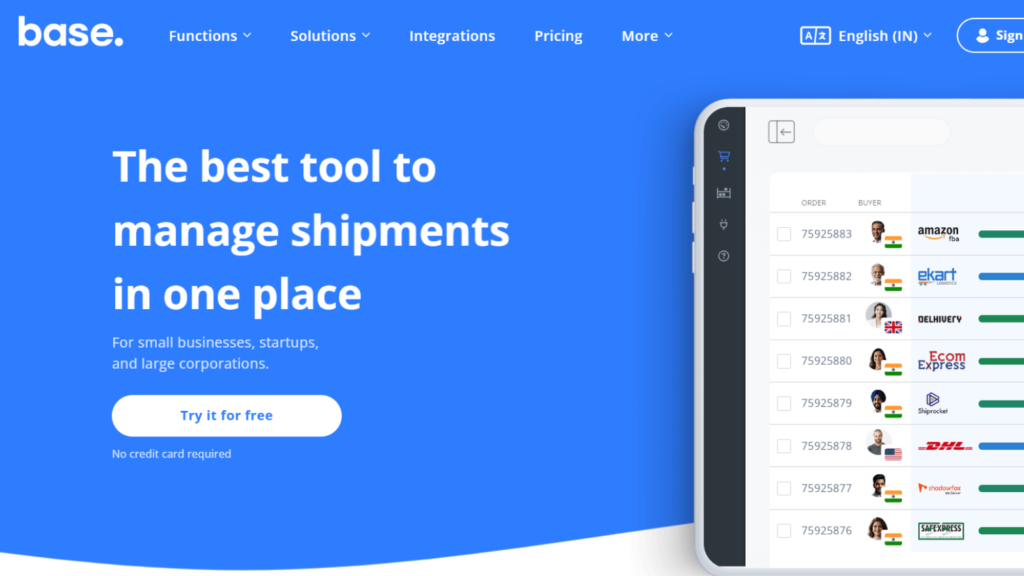
Base.com is a unified OMS and WMS platform purpose-built for Indian D2C and B2B ecommerce. It manages the complete fulfilment stack: multi-channel order ingestion, warehouse pick-pack-ship, courier dispatch, and COD reconciliation in a single integrated system.
Base.com is designed around the Indian operating environment from day one. COD reconciliation, RTO intelligence, Indian marketplace integrations, and multi-courier allocation are core platform features, not add-ons. It is the most frequently cited best alternative to EasyEcom among Indian D2C brands scaling past Rs 15 crore GMV.
Best fit: D2C brands at Rs 10-500 crore GMV, multi-warehouse operations, high COD mix, FMCG and B2B brands on SAP.
2. EasyEcom
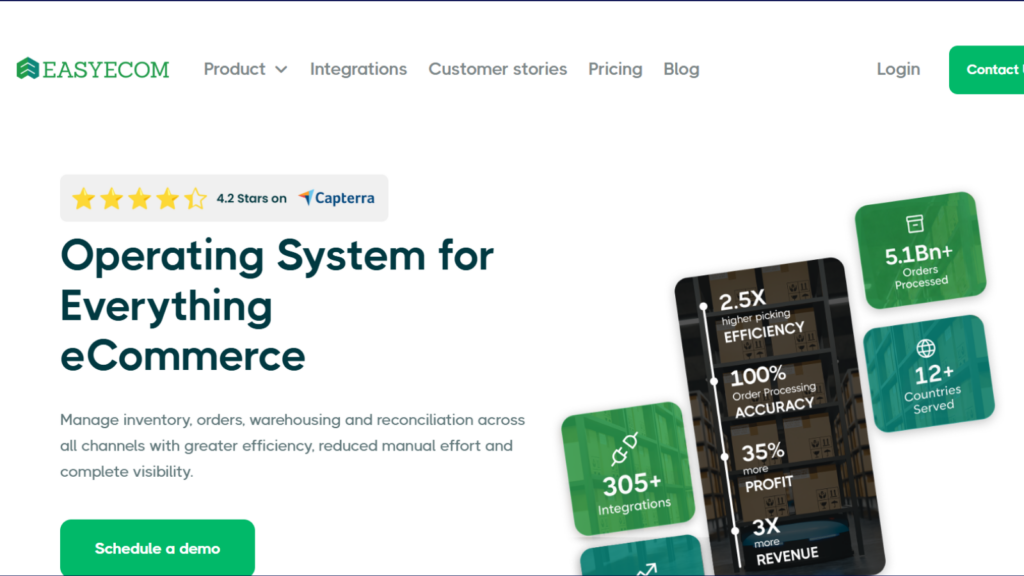
EasyEcom is an OMS-first platform popular with mid-market Indian ecommerce brands. It combines multi-channel order management with basic WMS capabilities, Tally integration, and GST invoice automation at a competitive price point.
EasyEcom is a strong tool for brands at Rs 5-30 crore GMV that need combined OMS and basic warehouse management without enterprise pricing.
Best fit: SME D2C brands, Tally users, brands prioritising fast onboarding and competitive pricing.
Head-to-Head: Full Feature Comparison
The Base.com vs EasyEcom feature gap is most visible in the capabilities that matter most during the festive season:
|
Capability |
Base.com |
EasyEcom |
|---|---|---|
|
OMS + WMS combined |
Single native platform |
Basic WMS only |
|
Real-time inventory sync |
Updates on every scan |
Near real-time, batch lag possible |
|
Scan-based pack verification |
Full scan verification |
Not available |
|
Peak load architecture |
Built for Indian sales events |
Tested at SME volumes |
|
Indian marketplace integrations |
50+ native connectors |
30+ connectors |
|
COD reconciliation |
Fully automated |
Partially automated |
|
RTO intelligence |
Pin code risk scoring + NDR |
Not native |
|
WhatsApp COD confirmation |
Native integration |
Not native |
|
Multi-warehouse routing |
Up to 20+ nodes |
Basic multi-location |
|
SAP integration |
Native S/4HANA connector |
Not available |
|
Tally integration |
Via connector |
Native, strongest in market |
|
GST invoice automation |
Auto-generated on dispatch |
Auto-generated on dispatch |
|
Analytics dashboard |
Real-time, live |
T+1 reporting |
|
Festive season uptime SLA |
Documented, enterprise-grade |
Not publicly documented |
|
Implementation time |
2-4 weeks |
1-2 weeks |
|
Typical pricing (Rs 10-30Cr GMV) |
Rs 25,000-50,000/month |
Rs 15,000-30,000/month |
|
G2 Rating |
4.6 / 5 |
4.0 / 5 |
Dimension 1: Order Ingestion at Peak Volume
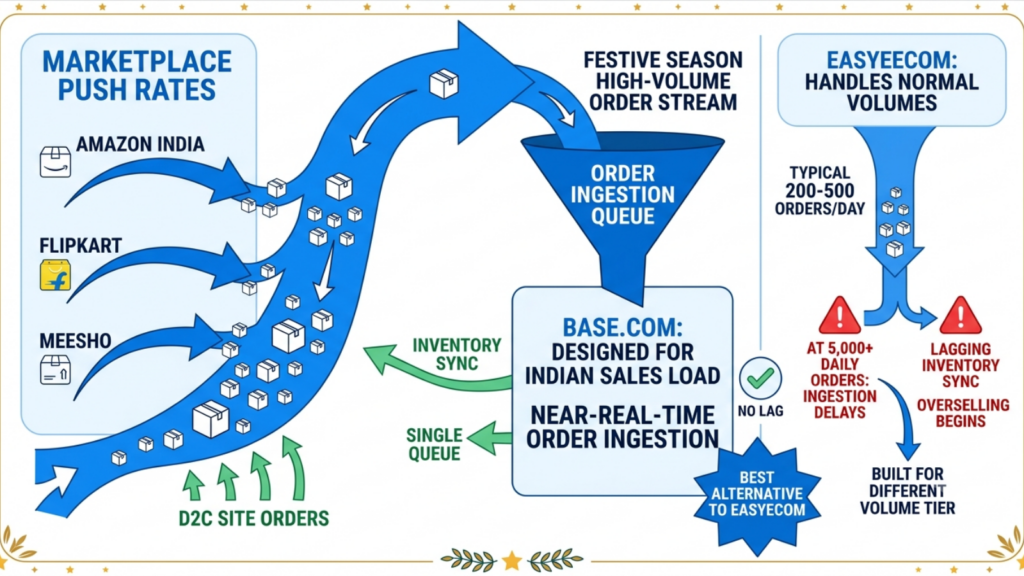
Festive season spikes order ingestion rates from a few hundred per hour to tens of thousands. If the OMS cannot keep pace with marketplace API push rates, orders queue up, inventory sync lags, and overselling begins.
Base.com is designed for the Indian sales event load. The platform maintains near-real-time order ingestion from all connected channels simultaneously, even when marketplaces themselves are under peak API stress. Orders from Amazon India, Flipkart, Meesho, and the brand’s own D2C site flow into a single queue without lag. This is one of the primary reasons Base.com is consistently identified as the best alternative to EasyEcom by brands managing high-volume festive season windows.
EasyEcom handles order ingestion well at normal volumes, typically 200-500 orders per day for its primary customer base. At 5,000+ daily orders, some users report ingestion delays during peak windows. This is not a failure. It is a scale question. EasyEcom is built for a different volume tier than festive season peaks at Rs 50 crore+ GMV brands.
Verdict: In the Base.com vs EasyEcom comparison on order ingestion, Base.com is the stronger choice for brands expecting 10x+ order volume spikes during festive windows.
Dimension 2: Real-Time Inventory Accuracy

Overselling during the festive season is one of the most damaging operational failures an Indian D2C brand can have. A marketplace cancellation for an oversold item hurts seller ratings, triggers penalties, and creates a customer service load at the worst possible moment.
Overselling happens when inventory sync lags. A unit sells on Flipkart. The inventory count on Amazon and the brand’s D2C site does not update fast enough. A second sale happens on the now-incorrect count. Both orders confirm. One cannot be fulfilled.
Base.com’s inventory engine updates on every warehouse scan action, not on a scheduled batch update or a database write delay. The moment a pick scan confirms an item is allocated to an order, that unit is removed from available inventory across all connected channels. This is the only reliable way to prevent overselling at high velocity.
EasyEcom provides near-real-time inventory sync with periodic batch updates. For brands at normal volumes, this is entirely adequate. At the festive season velocity, where 500 units can sell in 20 minutes on a single channel, even a 2-minute batch lag can create oversell situations on fast-moving SKUs.
Verdict: In the Base.com vs EasyEcom comparison on inventory accuracy, Base.com’s scan-triggered real-time inventory is meaningfully stronger for high-velocity festive season SKUs.
Dimension 3: Packing Accuracy Under Speed Pressure

The festive season creates high pressure on warehouse teams. When the pick queue grows faster than it can be cleared, packers rush. Rushed packing produces wrong items, wrong quantities, and wrong addresses, all of which become RTO and customer complaint load two to five days later.
India’s average packing error rate at scale is 2-4%. At 5,000 daily orders, 3% errors means 150 wrong-item deliveries per day. Each costs Rs 200-400 in reverse logistics plus the item value. Over a 7-day sale window, that is 1,000+ wrong deliveries and Rs 2-4 lakh in direct error costs.
Base.com’s scan-based pack verification requires every item to be scanned against the order at the packing station before the box is sealed. The system rejects the scan if the wrong item is picked. The Packers cannot bypass this step. Packing error rates drop to near zero, measurable within the first 30 days of activation. This capability alone makes Base.com the best alternative to EasyEcom for any brand where packing accuracy is a festive season risk.
EasyEcom does not have scan-based pack verification. Packing accuracy depends on manual process discipline, which degrades predictably under festive season speed pressure. This is the single largest operational gap in the Base.com vs EasyEcom comparison for high-volume sale events.
Verdict: Base.com wins decisively. Scan-based verification is a category-defining capability for festive season operations that EasyEcom does not offer.
Dimension 4: COD Order Management and Reconciliation
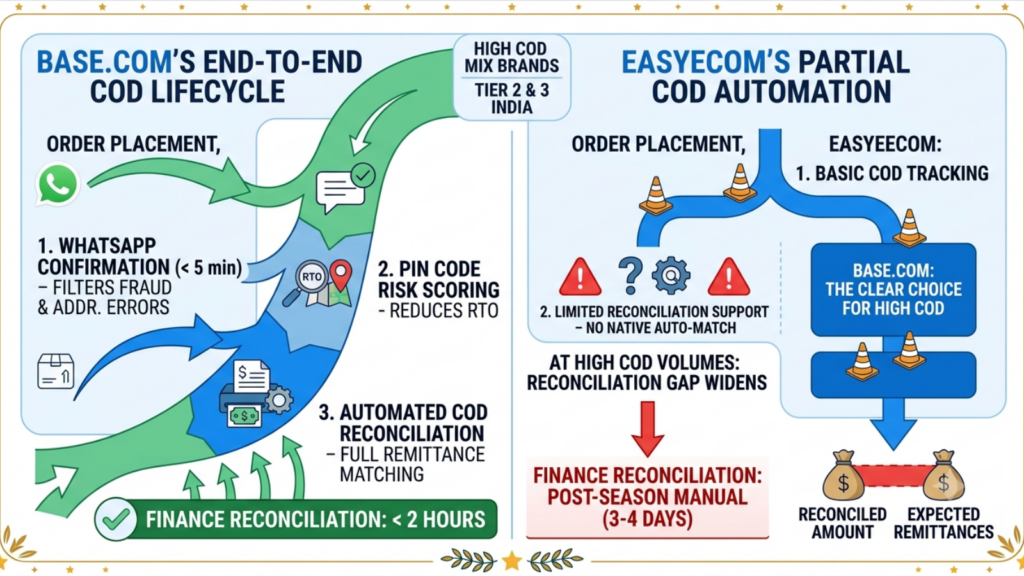
COD still accounts for 55-65% of orders in Tier 2 and Tier 3 India. During the festive season, COD order volumes can reach Rs 1-3 crore in a single day for a mid-size brand. Managing that COD load: confirmation, dispatch risk scoring, and post-delivery reconciliation, is a full-time operational problem during festive windows.
Base.com handles the full COD lifecycle:
- Pre-dispatch: WhatsApp COD confirmation triggered within 5 minutes of order placement, filters fraudulent, impulsive, and address-error orders before they enter the fulfilment queue.
- Risk scoring: Pin code-level RTO intelligence flags high-risk COD orders before dispatch, reducing avoidable RTOs at the source.
- Post-delivery: COD remittance files from all courier partners are ingested automatically, matched to order level, and discrepancies flagged for recovery. Finance teams complete reconciliation in under 2 hours instead of 3-4 days.
EasyEcom provides partial COD automation: basic COD tracking and some reconciliation support. Full automated remittance matching is not available natively. During the festive season, when COD volumes are 5-10x normal, partial automation means the gap between incoming remittances and reconciled amounts widens daily until a manual reconciliation catches it post-season. For brands with high COD mix, this is the most financially significant dimension in the Base.com vs EasyEcom decision, and the clearest reason Base.com is the best alternative to EasyEcom in Tier 2 and Tier 3 markets.
Verdict: Base.com’s end-to-end COD automation is a major operational advantage during the festive season for high-COD-mix brands.
Dimension 5: RTO Prevention During Sale Events
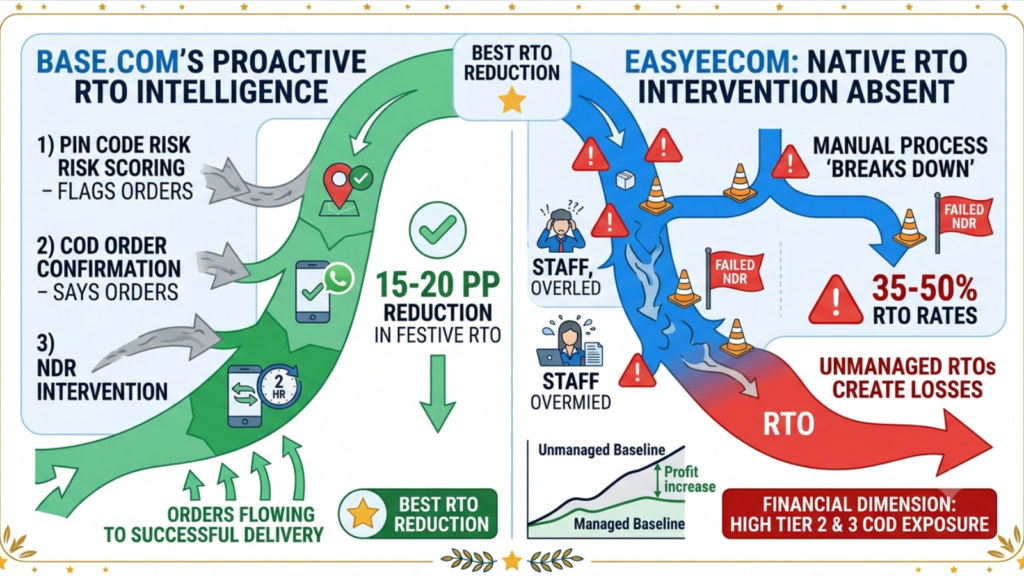
The festive season generates a specific RTO problem: a large percentage of orders are placed impulsively by first-time buyers, in Tier 3 markets, on COD. This combination, new customer, low commitment, cash on delivery, produces RTO rates of 35-50% in some categories during peak sale windows.
Managing this proactively, before the package leaves the warehouse, is the difference between a profitable festive season and one where 40% of your fulfilment cost goes into RTOs.
Base.com’s RTO intelligence module applies three interventions simultaneously:
- Pin code risk scoring: orders to historically high-RTO pin codes are flagged before dispatch.
- COD order confirmation: WhatsApp confirmation filters non-serious orders before pick.
- NDR intervention: failed delivery triggers automated customer re-engagement within 2 hours.
Brands using Base.com’s RTO module report 15-20 percentage point reductions in festive season RTO rates versus unmanaged baselines. This is the most financially impactful dimension of the Base.com vs EasyEcom comparison for brands with significant Tier 2 and Tier 3 COD exposure.
EasyEcom does not have a native RTO intelligence module. RTO management depends on courier partner NDR processes and manual team follow-up, both of which are slower and less consistent than automated intervention, and both of which break down under festive season volume when team bandwidth is fully consumed by order processing.
Verdict: Base.com’s proactive RTO management is a significant financial advantage during the festive season. At Rs 1 crore daily COD GMV with 30% RTO, preventing even 8 percentage points of RTO saves Rs 8 lakh per day.
Dimension 6: Analytics and Operational Visibility

During the festive season, operations managers need to make fast decisions: which warehouse is falling behind, which courier is accumulating unconfirmed NDRs, which SKU is about to stock out, and which channel is showing a dispatch breach risk.
These decisions require real-time data. A T+1 report tells you yesterday’s story. During a 7-day festive window, yesterday’s story is too late to act on.
Base.com’s analytics dashboard is live. Dispatch rates, pending order ageing, SLA breach risk, inventory health, and courier performance update continuously. Operations managers looking at the dashboard at 2 PM see the morning’s performance and can intervene before the afternoon shift makes the same mistakes. In the Base.com vs EasyEcom analytics comparison, this gap is most acute during the compressed time windows of a festive sale event.
EasyEcom’s reporting is primarily T+1; reports are generated for the previous day. During a normal operating week, this is adequate. During a 7-day sale event where every hour of dispatch delay creates a compounding SLA breach risk, T+1 reporting means teams are always reacting, never anticipating.
Verdict: Base.com’s real-time dashboard is a material operational advantage during time-compressed festive windows.
Dimension 7: Multi-Warehouse Routing

Indian D2C brands at Rs 50 crore+ GMV typically operate 2-4 fulfilment centres during the festive season, often adding temporary or third-party warehouse nodes to handle the volume spike. The OMS must route each order to the right warehouse automatically, based on inventory availability, geography, and courier serviceability.
Manual warehouse routing at 5,000 daily orders across 3 warehouses is not operationally possible.
Base.com handles up to 20+ warehouse nodes from a single operations dashboard. Routing logic considers live inventory, pin code geography, SLA requirements, and courier coverage. Adding a temporary festive season warehouse takes one configuration step, not a re-implementation. For multi-warehouse operations, Base.com is unambiguously the best alternative to EasyEcom.
EasyEcom provides basic multi-location support, but the routing logic is less sophisticated. For brands operating simple 2-warehouse configurations, EasyEcom is adequate. For brands routing across 3+ nodes during the festive season with complex SLA and geography rules, the routing gaps create manual decisions that eat into the operations team’s bandwidth.
Verdict: Base.com is significantly stronger for multi-warehouse festive season operations at 3+ nodes.
Dimension 8: Post-Season Reconciliation
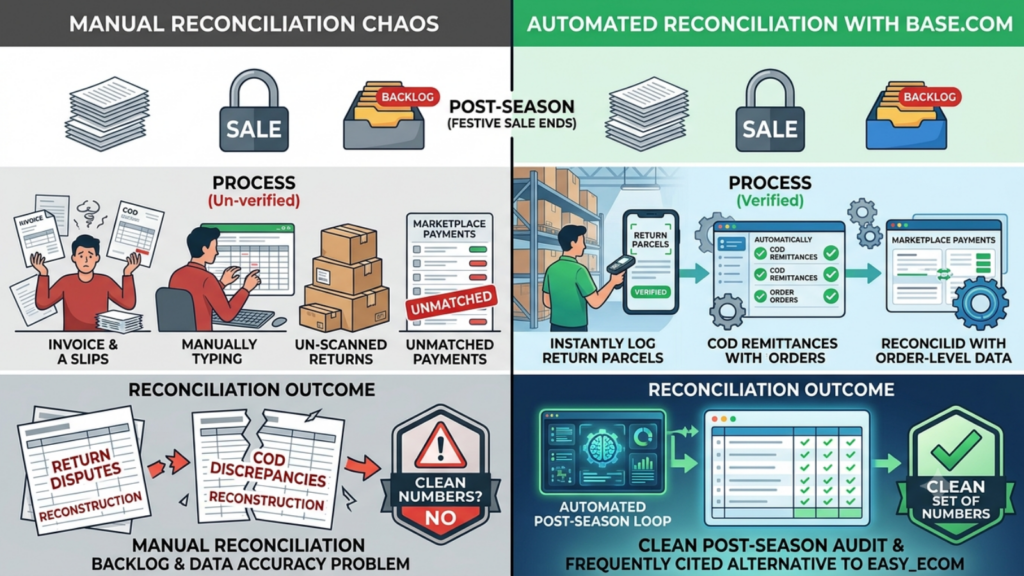
The festive season does not end when the sale window closes. The reconciliation backlog: COD remittances, marketplace payments, return disputes, courier invoices, lands in finance’s inbox the week after the sale ends.
How your OMS performed during the sale determines how painful the post-season reconciliation is. Platforms that allowed manual workarounds during the spike create a data accuracy problem that compounds during reconciliation.
Base.com closes the post-season loop automatically. COD remittances are matched, and discrepancies are flagged in real time. Returns are scan-verified at receipt. Marketplace payments reconcile against order-level data. The post-season audit produces a clean set of numbers because the in-season data was captured accurately. This is a frequently cited reason why brands name Base.com as the best alternative to EasyEcom after experiencing a manual reconciliation backlog on other platforms.
EasyEcom’s partial automation means some reconciliation categories remain manual. Finance teams report spending significant time post-festive season reconstructing records for COD discrepancies and return dispositions that were not captured systematically during the peak.
Verdict: Base.com’s automated reconciliation reduces post-season finance workload significantly, a cost that is easy to underestimate before it arrives.
Where EasyEcom Is the Right Choice
Honest comparison requires acknowledging where EasyEcom wins, and where the Base.com vs EasyEcom decision should go in EasyEcom’s favour.
Tally integration is EasyEcom’s clearest competitive advantage. For Indian D2C brands running accounts in Tally, which covers a large portion of the Rs 5-30 crore GMV segment, EasyEcom’s native Tally connector is the strongest available. Automated sales entry into Tally on order dispatch reduces accounting overhead significantly.
Price point. EasyEcom’s pricing starts lower than Base.com’s. For early-stage brands at Rs 5-15 crore GMV that are not yet running festive season spikes above 1,000 daily orders, EasyEcom delivers adequate functionality at a more accessible monthly cost.
Implementation speed. EasyEcom can be live in 1-2 weeks for standard configurations. For brands that need to get operational quickly and are not ready for a full WMS implementation, EasyEcom’s onboarding speed is a genuine advantage.
|
Situation |
Right Choice |
|---|---|
|
Rs 5-15 crore GMV, Tally-based accounting |
EasyEcom |
|
Rs 15-500 crore GMV, festive season 5x+ spike |
Base.com |
|
Fast onboarding, basic WMS |
EasyEcom |
|
Scan-based warehouse, COD automation, RTO management |
Base.com |
|
Multi-warehouse, 3+ nodes |
Base.com |
|
SAP ERP integration is required |
Base.com |
|
Cost-conscious, early-stage operations |
EasyEcom |
1. The Festive Season Cost of Choosing Wrong

This is not abstract. Here is what the wrong OMS choice costs during a festive season for a brand doing Rs 1 crore daily GMV across 7 sale days. In the Base.com vs EasyEcom cost comparison, the gap compounds with every day of the sales window:
|
Failure Type |
Without Scan Verification (EasyEcom) |
With Scan Verification (Base.com) |
|---|---|---|
|
Packing errors (3% on 5,000 orders) |
150 errors/day x Rs 350 = Rs 52,500/day |
Near zero |
|
Preventable RTO (8% reduction) |
400 orders/day x Rs 280 = Rs 1.12L/day |
Rs 0 |
|
COD reconciliation (manual, 3 days post-season) |
60+ hrs finance team time |
Under 4 hours total |
|
Oversell cancellations (0.5% at peak) |
25 cancellations/day, marketplace penalty risk |
Near zero |
|
Total 7-day festive season cost delta |
Rs 12-15 lakh |
Rs 0-1 lakh |
The Rs 12-15 lakh cost delta represents the difference in operational outcomes, not a theoretical projection. These are the failure modes that occur predictably when WMS depth, scan verification, and COD automation are absent at scale. For brands doing the Base.com vs EasyEcom cost calculation ahead of the festive season, this table is the most direct input.
2. Migration Consideration: Switching Before the Festive Season
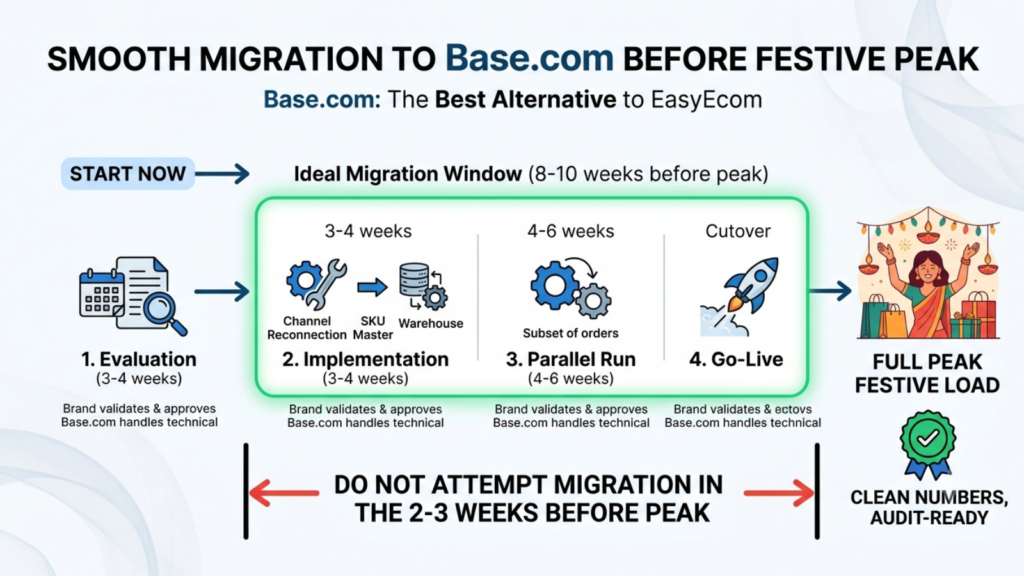
If you are currently on EasyEcom and evaluating Base.com as the best alternative to EasyEcom, the timing question matters.
Ideal migration window: 8-10 weeks before your peak festive season load begins. This allows 3-4 weeks for implementation and a 4-6 week parallel-run period where both systems operate simultaneously on a subset of orders before full cutover.
Do not attempt a platform migration in the 2-3 weeks before peak season. The risk of a data mapping error or integration issue during the spike is too high.
Base.com’s implementation team handles the technical migration from EasyEcom: channel reconnection, SKU master migration, warehouse configuration, and courier setup. The brand’s operations team validates data accuracy and approves go-live.
Most EasyEcom-to-Base.com migrations complete within 3-4 weeks. For brands that have identified Base.com as the best alternative to EasyEcom and are working against a festive season deadline, starting the evaluation now is the most important step.
Base.com is an order management and warehouse management platform purpose-built for Indian D2C and B2B ecommerce. If you are evaluating the Base.com vs EasyEcom decision ahead of the festive season, or if you have already concluded that Base.com is the best alternative to EasyEcom for your scale and operational model, book a 30-minute comparison walkthrough to see exactly how Base.com handles the operational scenarios in this article.