
Shiprocket vs OMS in India, like Base.com, is a comparison that every founder running a growing D2C brand eventually needs to make, usually when something breaks, and the shipping dashboard cannot tell them why.
Shiprocket is where most Indian D2C brands start their logistics journey. Its domestic shipping platform aggregates several courier partners into a single interface, allowing merchants to compare prices, delivery times, and ratings for every order. For a brand with 50-200 orders per day with a single warehouse and a straightforward Shopify or WooCommerce setup, Shiprocket works. It solves the courier access problem cleanly.
The problem is that courier access is one layer of a much larger operational stack. And as brands scale past 300 orders per day, the gaps in what a shipping aggregator can do versus what a dedicated OMS like Base.com can do become the difference between controlled growth and operational chaos.
This post explains what Shiprocket does, where it hits its ceiling, and why the Shiprocket vs OMS in India, like Base.com comparison, resolves decisively toward a dedicated OMS for brands with genuine scale ambitions.
What Shiprocket Actually Is, and What It Is Not
Shiprocket is one of India’s largest ecommerce shipping and fulfillment aggregators, bringing together 25+ courier partners and 42+ fulfillment centers nationwide. It helps brands simplify logistics by combining courier aggregation, fulfillment, and NDR automation within one platform.
That is an accurate description of Shiprocket’s core value proposition. Multi-courier access, branded tracking, COD reconciliation, and shipping analytics from one dashboard. For the problem it was designed to solve, giving Indian SMBs access to multiple courier networks without building direct courier relationships, it delivers.
Below 100 orders per month, Shiprocket’s simplicity is worth the trade-off.
The Shiprocket vs OMS in India, like Base.com, comparison becomes relevant when a brand outgrows that simplicity. The scalability wall hits around 1,000 orders per month. WISMO tickets, weight disputes, and manual NDR consume ops bandwidth faster than they scale revenue. This is the right moment to switch.
The reason the scalability wall exists is not that Shiprocket’s shipping capabilities are poor. It is that shipping is one function in a multi-function operational problem. Shiprocket was not designed to manage inventory across warehouses, route orders based on stock availability and fulfillment cost, generate GST-compliant invoices, sync ledger entries to Tally, manage warehouse bin locations, or produce a channel-level P&L. A dedicated OMS like Base.com was.
The Five Operational Layers Shiprocket Cannot Cover
As eCommerce operations grow, businesses need more than shipping automation; they need an operational platform that manages the entire order lifecycle from procurement to financial reconciliation.
Layer 1: Inventory Management Across Channels

Shiprocket shows you what was shipped. It does not tell you what is available to ship.
When a brand sells on Amazon, Flipkart, Meesho, and its own Shopify store simultaneously, every sale on every channel must immediately reduce the available count visible to all other channels. If that count update has a 15-minute lag, a brand selling 10 units per minute during a sale event is overselling for 15 minutes before the system catches up.
Shiprocket manages shipment creation after an order is confirmed. It does not manage the inventory pool that determines whether that order can be confirmed in the first place. A brand using Shiprocket for shipping is managing inventory separately, in a spreadsheet, in a separate inventory tool, or in a marketplace seller panel. Each of these creates sync risk.
The Shiprocket vs OMS in India, like Base.com comparison at this layer, is clean: Base.com manages a single live inventory pool synced in real time across all channels. Every sale, return, adjustment, and transfer updates the same count. Overselling from sync lag is eliminated by architecture, not by manual reconciliation.
Layer 2: Warehouse Operations

Shiprocket does not manage what happens inside a warehouse. It manages what leaves it.
For a brand operating its own fulfillment center, even a modest 2,000 square foot warehouse processing 300 orders per day, the absence of warehouse management in Shiprocket means the pick, pack, and verify workflow is either manual or managed in a separate WMS tool.
Without barcode-verified picking, wrong-item shipments generate returns. Without location-sorted picklists, warehouse teams walk inefficient routes, and throughput suffers. Without bin-level inventory visibility, the count in the system does not match the physical reality of the warehouse.
Base.com’s WMS provides the full warehouse operations layer: digital warehouse view with custom zones, racks, and bins; barcode scanning on location and cart; in-system barcode and MRP tag creation; pick pack assistant with location-sorted instructions; and packing station confirmation before label generation.
The Shiprocket vs OMS in India, like Base.com, comparison on warehouse operations: Shiprocket has no WMS. Base.com has a complete integrated WMS. For any brand managing its own physical warehouse, this is the most operationally significant difference in the comparison.
Layer 3: Order Intelligence and Routing
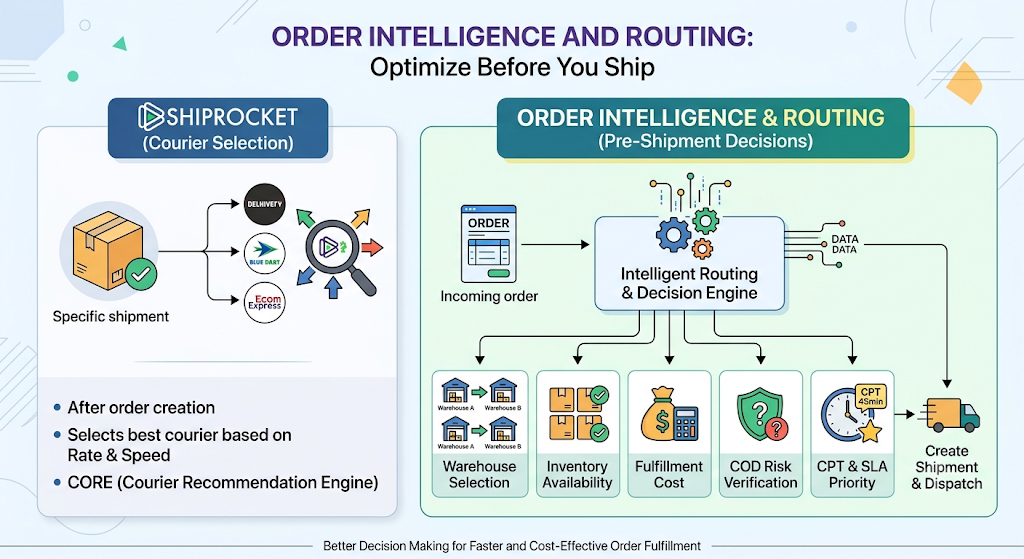
Shiprocket creates a shipment based on an order. Base.com routes an order based on inventory availability, warehouse proximity, fulfillment cost, SLA window, and carrier performance at the destination pincode, before the shipment is created.
These are different functions. Shiprocket’s courier recommendation engine (CORE) selects the best carrier for a given shipment based on rate and speed. That is useful. What it cannot do is decide which warehouse the order should come from, whether the order should wait for stock consolidation, whether this COD order is high-risk and should be routed to a verification queue, or whether this order is within 45 minutes of CPT and needs to jump the processing queue.
Base.com’s order management layer handles all of this. Custom order statuses, dynamic order prioritization by SLA urgency, automated fulfillment routing based on stock availability and location, order consolidation for multi-item orders, cross-location allocation for split-node fulfillment, and COD verification workflows, all configurable and automated.
The Shiprocket vs OMS in India, like Base.com, comparison on order intelligence: Shiprocket makes a shipment decision. Base.com makes a fulfillment decision. The difference compounds with the order volume.
Layer 4: Financial Operations and Accounting
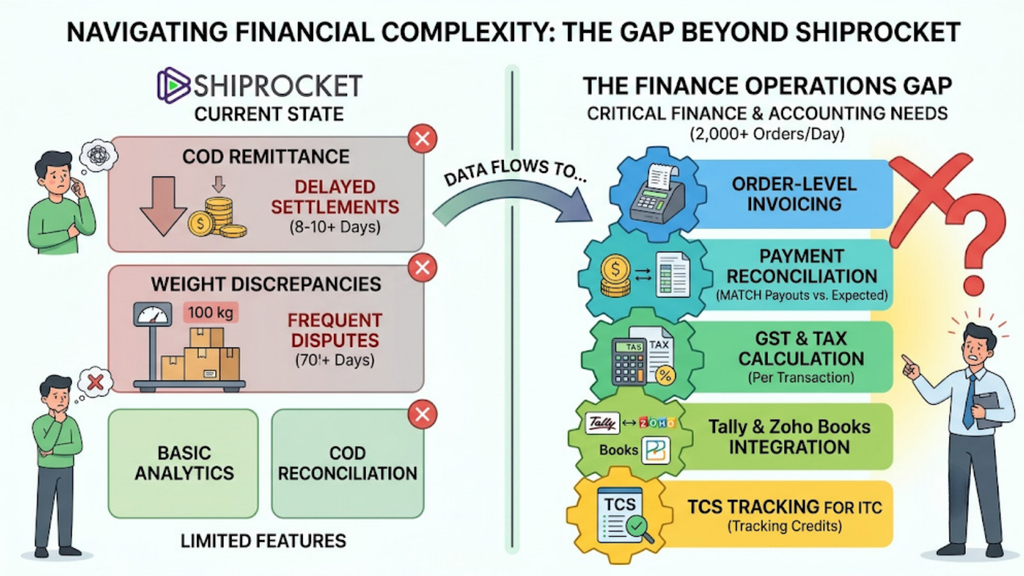
Sellers consistently flag Shiprocket for slow COD remittance, settlements take 8-10+ days, hurting cash flow for bootstrapped brands, and weight discrepancy headaches with frequent disputes where couriers charge higher weight with slow resolution.
Shiprocket does provide COD reconciliation and basic shipping analytics. What it does not provide: invoice generation, payment reconciliation at the order level, multi-currency support, tax calculation, Tally integration, or Zoho Books sync.
For a brand processing 2,000 orders per day, the finance function cannot be operated from Shiprocket. Invoices need to be generated per order. Marketplace settlement credits need to be matched against expected payouts at the order level. GST implications need to be calculated per transaction. TCS deducted by marketplaces needs to be tracked for ITC claims. The Tally ledger needs to reflect the day’s trading without a manual import.
None of this is Shiprocket’s problem to solve. It was not designed for financial operations. But the Shiprocket vs OMS in India, like Base.com comparison, reveals that brands on Shiprocket are running their financial operations either manually or in a separate accounting tool that is not connected to their order management. Every disconnection is a source of errors, delays, and monthly reconciliation pain.
Base.com covers the full financial stack: invoice creation and corrections, payment reconciliation, payment tracking, multi-currency support, tax calculation, automatic Tally sync, Zoho Books integration, and a Total Business P&L Dashboard that connects operational metrics to margin outcomes.
Layer 5: Catalog and Product Information Management
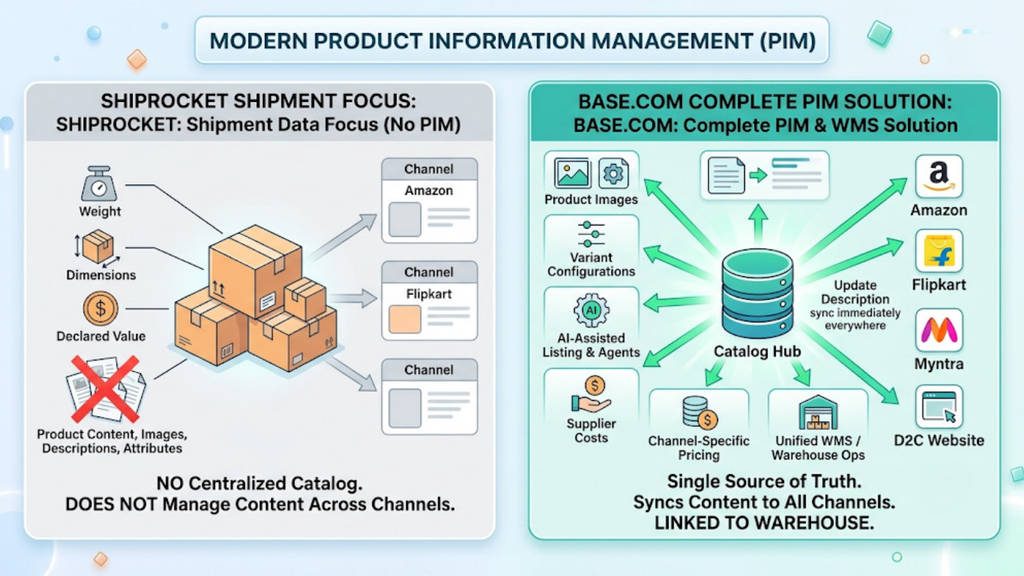
Shiprocket manages product data at the shipment level, including weight, dimensions, and declared value. It does not manage catalog content across channels.
A brand selling 200 SKUs across Amazon, Flipkart, Myntra, and its own D2C website needs to maintain product images, descriptions, attributes, variant configurations, and channel-specific pricing in one place and push them to all channels accurately. If a product description is updated, it needs to be updated everywhere simultaneously.
Shiprocket has no PIM. Base.com includes a complete PIM with AI-assisted listings to marketplaces, AI listing agents that automatically list new products across connected channels, supplier cost management, multiple price tier support (D2C, marketplace, B2B), and a unified catalog and WMS module that links product data to warehouse operations.
The Shiprocket vs OMS in India, like Base.com, comparison on catalog management: Shiprocket does not address this problem. Base.com solves it natively.
What Happens When a Brand Tries to Scale on Shiprocket Alone
The operational picture of a brand at 1,000+ orders per day using Shiprocket as its primary operations tool is a specific kind of chaos:
Inventory is tracked in a spreadsheet that is always a few hours behind. Oversells happen regularly, especially during sale events. Marketplace penalty notices arrive monthly.
The warehouse team picks and packs without system-enforced routing. Pick errors generate wrong-item returns. Wrong-item returns cost forward and reverse logistics with zero revenue.
The operations manager manually checks five marketplace seller panels every morning to get a picture of the day’s orders. Consolidating them into a dispatch list takes 60-90 minutes per day.
The finance team exports CSV files from Shiprocket weekly, reformats them for Tally, and manually imports them. GST reconciliation is a quarterly crisis. Marketplace settlement discrepancies are discovered months after the claim window has closed.
The founder cannot see the actual contribution margin per channel because the data to calculate it lives across five different systems.
This is not a failure of Shiprocket. It is a mismatch between a shipping aggregator and a problem that requires a dedicated OMS. The Shiprocket vs OMS in India, like Base.com comparison at this scale, has a clear answer.
How Base.com Addresses Each Gap
Base.com bridges these operational gaps by providing a unified platform that connects inventory, procurement, order management, shipping, returns, and financial reconciliation, enabling brands to scale efficiently without relying on multiple disconnected tools.
1. Unified Operations From One Platform
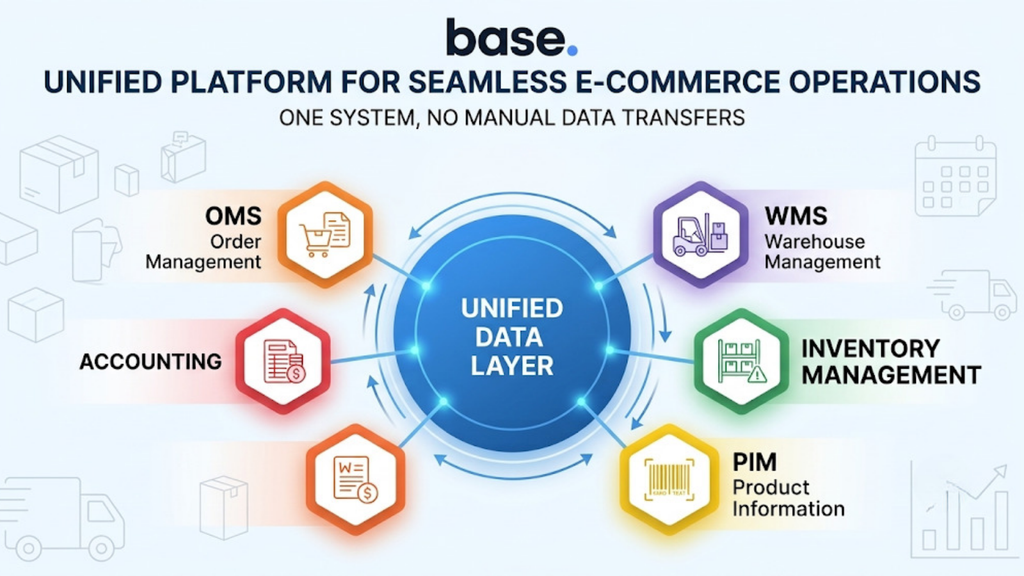
Base.com is a unified OMS, WMS, inventory management, PIM, and accounting platform. The reason this matters for the Shiprocket vs OMS in India, like Base.com comparison, is not just that Base.com has more features. It is that Base.com’s features share the same data layer.
When an order is confirmed in Base.com’s OMS, the inventory is reserved from the WMS layer immediately. When a courier picks up the shipment, the accounting syncs to Tally and records the sale entry. When a return arrives at the warehouse, the WMS inspection update restores the inventory count and creates a credit note in the accounting module. Every operation flows through the same system without a manual data transfer.
Shiprocket handles one node in that chain, the shipment. Every other node is managed elsewhere or not at all.
2. 1,500+ Integrations Including Shiprocket Itself
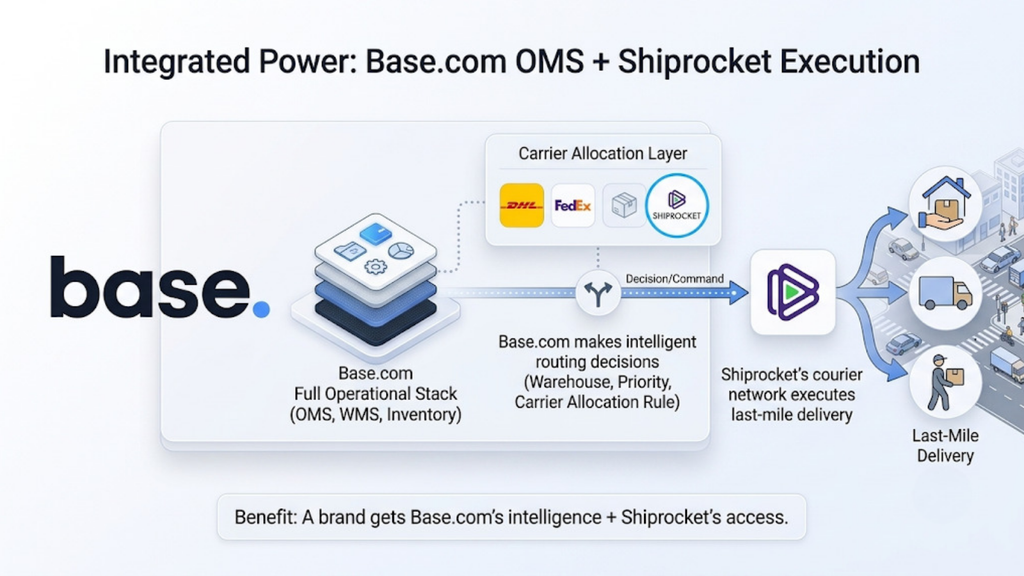
Base.com integrates with Shiprocket. The Shiprocket vs OMS in India, like Base.com comparison, is not an either/or; it is a question of where the operational intelligence lives. A brand can use Base.com as the OMS, with Shiprocket integrated as one of the shipping carriers in the Base.com carrier allocation layer.
In this architecture, Base.com makes the routing decision, which warehouse, which order priority, which carrier allocation rule, and Shiprocket’s courier network executes the last-mile delivery. The brand gets Base.com’s full operational stack plus Shiprocket’s carrier access, rather than choosing between them.
Base.com’s 1,500+ global integrations cover Shiprocket, Ecom Express, Amazon, Flipkart, Myntra, Meesho, Shopify, WooCommerce, Tally, Zoho Books, and 1,600+ additional channels globally.
3. Custom Order Workflows for Indian D2C Operations
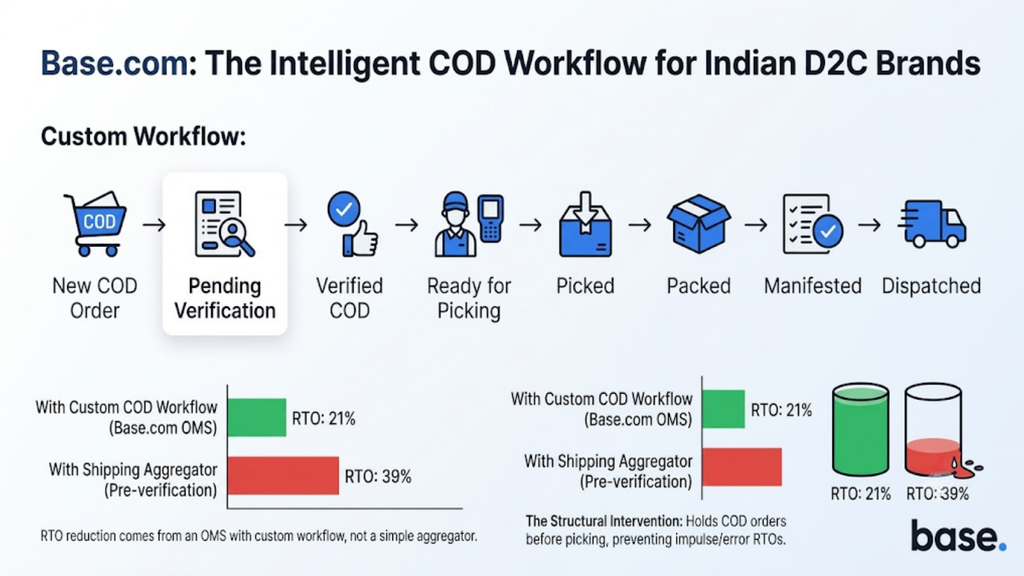
Base.com’s custom order status workflow is the specific capability that addresses the COD verification problem at scale. An Indian D2C brand can configure:
New COD Order → Pending Verification → Verified COD → Ready for Picking → Picked → Packed → Manifested → Dispatched
Each status transition triggers defined actions. The verification step holds COD orders before picking begins, reducing RTO from impulse orders and address errors. Only orders that clear verification enter the pick queue. This is the structural intervention that separates brands at 21% RTO from brands at 39% RTO, and it requires an OMS with custom workflow support, not a shipping aggregator.
Shiprocket’s workflow is: order synced → label created → shipment dispatched. There is no configurable pre-dispatch verification layer.
4. Barcode-Verified Picking and WMS Integration

Base.com’s pick pack assistant with barcode verification eliminates the wrong-item returns that are common in warehouses running manual pick processes. Every pick is scanned against the pick instruction. Cart-level scanning provides a second verification checkpoint before packing. Wrong-item shipments, the primary controllable source of CRETs, are eliminated before dispatch.
Shiprocket seller reviews on the Shopify App Store cite weight discrepancy issues where couriers charge higher weight with slow resolution, lost shipments with inadequate compensation, and non-transparent wallet settlement practices.
These are downstream problems; they occur because the order left the warehouse in a state that should have been caught earlier. Base.com’s WMS catches dimension recording errors at the pack stage (the system captures actual dimensions at packing), preventing the wrong dimensions from being submitted to the courier, which generates discrepancy charges later.
5. Financial Architecture That Scales
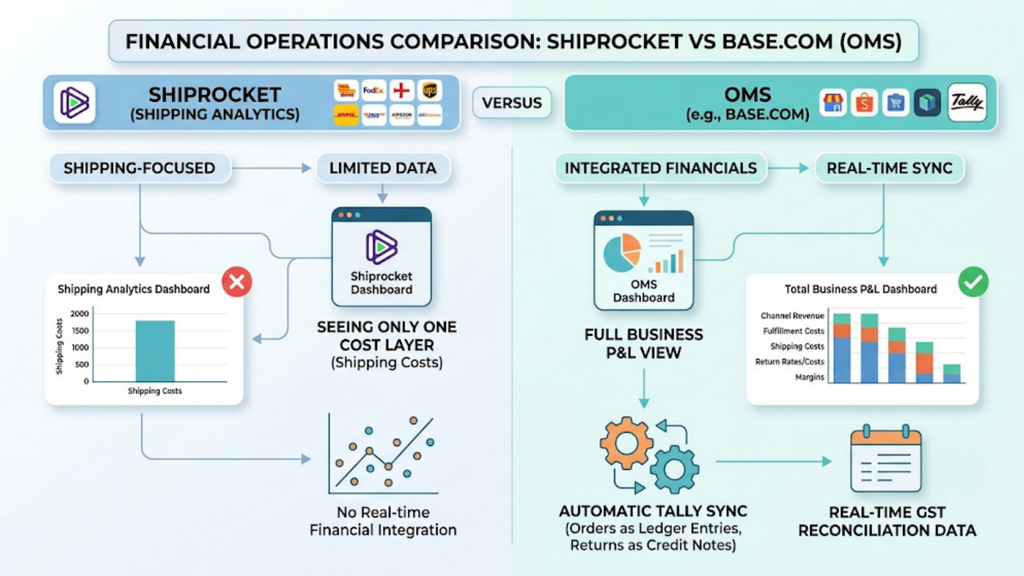
The Shiprocket vs OMS in India, like Base.com comparison on financial operations, is decisive for any brand doing meaningful revenue.
Base.com automatically syncs every order as a Tally ledger entry. Returns create credit notes. Invoice corrections are handled within the platform. The monthly GST reconciliation uses data that the OMS has been maintaining in real time throughout the month, not a batch CSV export the day before the filing deadline.
The Total Business P&L Dashboard connects channel-level revenue to the costs of fulfilling it, shipping costs per channel, return rates per channel, and fulfillment costs per channel, producing a margin-level view that Shiprocket’s shipping analytics dashboard cannot provide because it only sees one layer of the cost stack.
Who Needs the Shiprocket vs OMS in India, like Base.com Conversation
Not every brand needs this conversation. Shiprocket is the right tool for early-stage D2C brands that need affordable multi-courier access with minimal operational complexity. If you are shipping 50-200 orders per day from a single warehouse with no multi-channel catalog management requirements and a finance team that can handle manual reconciliation, Shiprocket solves your logistics problem.
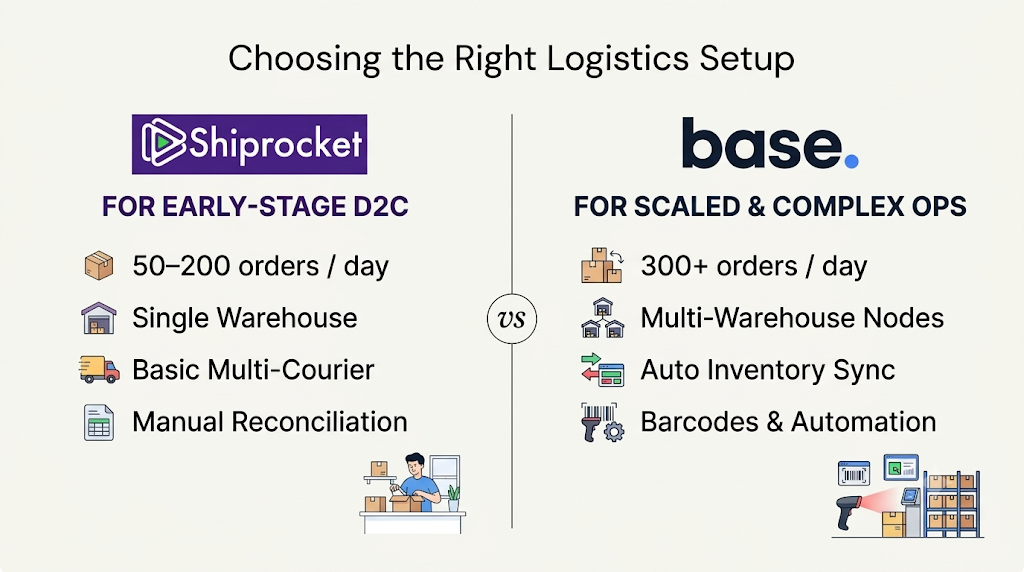
The Shiprocket vs OMS in India, like Base.com comparison, becomes urgent when:
The operations team spends more than 30 minutes per day reconciling inventory across channels. Marketplace oversell penalties arrive monthly. Wrong-item returns are generating more than 5% of CRET volume. The finance team is doing weekly manual Tally imports from a CSV export. The warehouse is processing 300+ orders per day without barcode-verified picking. The brand is expanding to a second warehouse node and needs cross-location routing. The founder cannot answer “what is my contribution margin per channel” without building an Excel model.
Each of these is a signal that the operational infrastructure has outgrown the shipping aggregator layer and requires the full OMS stack that Shiprocket vs OMS in India, like Base.com, puts on the table.
The Migration Path: From Shiprocket to Base.com
The Shiprocket vs OMS in India, like Base.com transition, does not require abandoning Shiprocket’s carrier network. As noted, Base.com integrates with Shiprocket, the brand can maintain Shiprocket as one of its carrier options within Base.com’s shipping allocation rules while gaining the full OMS, WMS, PIM, and accounting layer that Shiprocket does not provide.
The practical sequence:
- Catalog and product data are migrated to Base.com’s unified PIM first. SKU data, variant configurations, dimensions, and supplier costs are imported.
- Channel integrations are connected to Amazon, Flipkart, Myntra, Meesho, and the D2C website. Real-time inventory sync activates across all channels from the Base.com central inventory pool.
- Warehouse configuration is set up, zones, racks, bins, and barcode labels applied. Pick pack assistant workflow activated.
- Shiprocket and other courier integrations are connected to Base.com’s shipping allocation layer. Carrier rules are configured by zone, weight, and payment type.
- Tally or Zoho Books connected for automatic accounting sync.
The Shiprocket vs OMS in India, like Base.com transition, is a one-time investment in operational infrastructure. The ongoing benefit is an operations stack where every function, order management, warehouse operations, inventory control, catalog management, and financial reconciliation, shares the same data and updates in real time without manual transfers between systems.