

Returns are not a customer service problem. They are a margin problem, and in Indian ecommerce, they are an unusually large one.
India’s average ecommerce return rate is 20-30% across categories. In fashion D2C, that number climbs to 35-40%. In some COD-heavy Tier 3 markets, return-to-origin rates hit 50% on specific SKUs during peak season.
India’s D2C market is growing at 40% CAGR, but so is the absolute volume of returns that brands must process, absorb, and recover from. Ecommerce returns management in India at scale is now one of the most consequential operational disciplines a D2C brand can invest in.
The brands that build returns as a margin problem, not a customer experience problem, are the ones that scale sustainably. This article covers how to set up a returns management process from the ground up, with specific workflows, cost benchmarks, and platform recommendations for Indian D2C operations.
The True Cost of a Return in India
Most Indian D2C brands track their return rate. Very few track the full per-return cost. Before building a returns process, you need to know what you are actually spending. Ecommerce returns management in India starts with this cost audit, because you cannot optimise a number you have not measured.
| Cost Component | Typical Range (India 2026) |
|---|---|
| Forward logistics (already spent) | Rs 50-120 |
| Reverse logistics fee | Rs 80-150 |
| Returns handling at the warehouse | Rs 25-60 |
| Product inspection and repackaging | Rs 30-80 |
| Inventory write-off (unsellable units) | 5-15% of returned units x product cost |
| Customer service cost (query handling) | Rs 15-40 per return interaction |
| Marketplace penalty (if SLA breached) | Variable |
| Fully loaded per-return cost | Rs 200-450 |
At Rs 300 average per-return cost and 1,000 monthly returns, that is Rs 3 lakh per month in returns-related margin erosion. At 5,000 monthly returns, the volume a brand doing Rs 50 crore GMV in fashion D2C might see, that is Rs 15 lakh per month. Ecommerce returns managementf in India at this volume is a serious operational and financial discipline, not a back-office task.
Why Indian Returns Are More Expensive Than Global Benchmarks
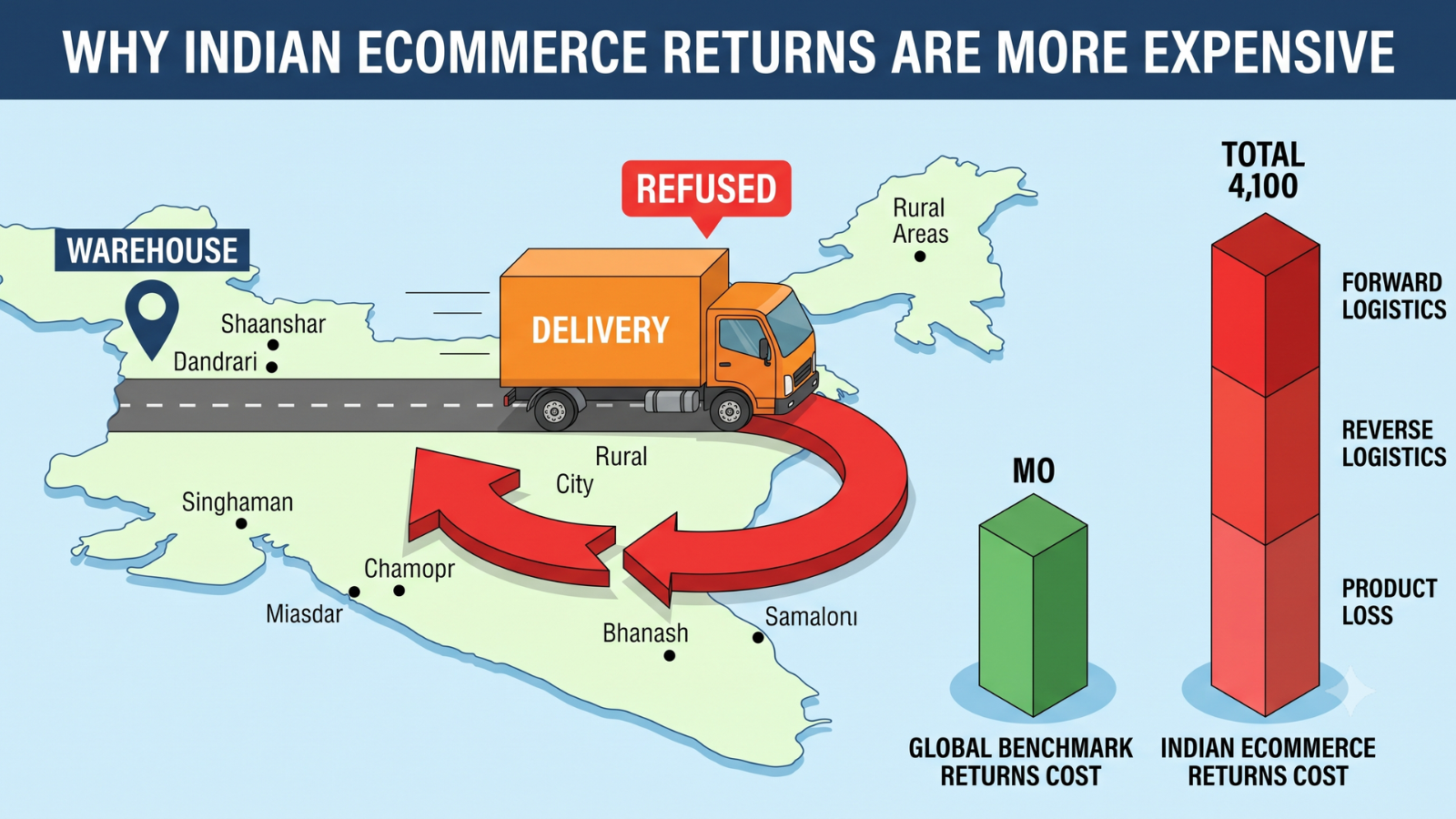 Ecommerce returns management in India is structurally more expensive than Western markets for three reasons.
COD-driven RTO. Return to Origin is a uniquely large problem in India. A COD order that the customer refuses at delivery costs the brand the full forward logistics fee, the reverse logistics fee, and, in some cases, the product, with zero revenue to offset it. COD RTO rates of 25-40% are standard in Tier 2 and Tier 3 markets. Any serious ecommerce returns management in India must address RTO as its primary cost driver.
Address and pin code quality. A significant proportion of Indian ecommerce returns happen because the delivery address was incomplete, incorrect, or in a pin code with poor last-mile coverage. These are not customer-initiated returns; they are logistics failures that still cost the brand full reverse logistics fees.
Ecommerce returns management in India that does not account for pin code-level performance data is operating blind on one of its biggest cost drivers.
Courier remittance gaps on returns. When a returned COD order is processed, brands should receive confirmation of the COD non-collection. In practice, courier remittance data often mismatches return status, creating COD recovery gaps that require manual reconciliation to identify and chase. This is a structural problem in ecommerce returns management in India that only automated reconciliation tools can solve at scale.
The Four-Stage Returns Management Framework
Indian D2C brands can protect margins from returns by building four sequential controls: a pre-dispatch filter that prevents avoidable returns before they happen, a reverse logistics workflow that minimises cost per returned unit, a warehouse QC process that restocks eligible inventory immediately, and a data layer that identifies which SKUs, channels, and pin codes are generating returns disproportionately.
Each control is addressable through the right order management software and warehouse workflow setup. Ecommerce returns management in India is not a customer service function; it is a margin protection function, and the brands that treat it that way outperform on unit economics at every GMV stage.
A margin-protective ecommerce returns management in India has four stages. Each stage has a different objective and a different set of tools.
Stage 1: Pre-Dispatch Prevention
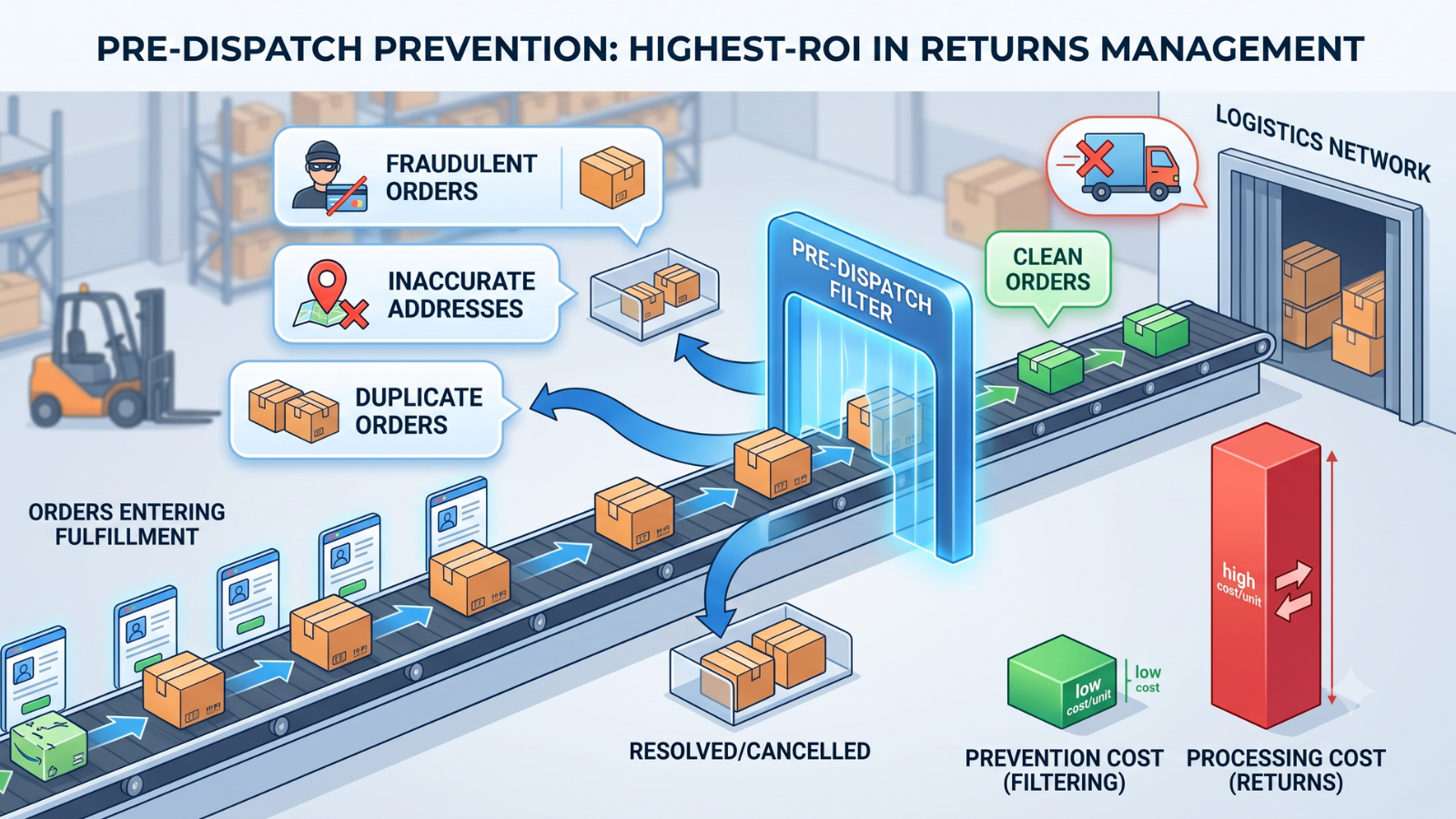 The most cost-efficient return is the one that never happens. A well-built pre-dispatch filter removes three categories of avoidable returns from your fulfilment queue before they enter the logistics network. This is the highest-ROI stage in ecommerce returns management in India; prevention costs a fraction of what processing costs.
1A: COD Order Confirmation
Send a WhatsApp confirmation message within 5-10 minutes of every COD order placement. Ask the customer to confirm delivery intent with a one-tap response. Orders where no confirmation is received within 6-8 hours should be held and followed up on before dispatch.
This single intervention filters out fraudulent, impulsive, and address-error orders. Brands implementing the COD confirmation report have achieved 15-20 percentage point reductions in COD RTO within 60 days. In the context of ecommerce returns management in India, COD confirmation is the single most impactful pre-dispatch intervention available.
Base.com triggers WhatsApp confirmation automatically on COD order creation, within 5 minutes, without manual intervention. Order state updates based on customer response: confirmed orders move to the warehouse queue, cancelled orders release inventory, and non-responses route to a configurable hold workflow.
1B: Pin Code Risk Scoring
Not all delivery pin codes perform equally. Some Tier 3 pin codes produce RTO rates above 50% on COD orders, driven by last-mile coverage gaps, limited courier re-attempt rates, and customer availability patterns.
Base.com’s RTO intelligence module applies pin code-level risk scoring to every COD order before dispatch. High-risk orders are flagged for confirmation or held for review.
This prevents the most expensive category of returns, COD RTOs from structurally problematic delivery zones, before the fulfilment cost is incurred.
For brands with significant Tier 2 and Tier 3 exposure, pin code risk scoring is the most data-driven tool available in ecommerce returns management in India.
1C: Product and Size Information Quality
In fashion D2C, size-related returns account for 40-60% of all customer-initiated returns. Customers return because the product did not match the description, size guide, or category expectation set at purchase.
This is a content problem, not a logistics problem. Accurate size charts, standardised fit descriptions, real-model photography, and fabric composition detail all reduce size-related return rates.
Brands that invest in product content quality report 8-12 percentage point reductions in fashion return rates, without changing their logistics setup. In ecommerce returns management in India for fashion categories, product content is as important as any operational workflow.
Stage 2: Reverse Logistics Optimisation
 When a return is initiated, the reverse logistics cost is the next controllable variable. In India, reverse logistics fees range from Rs 80-150 per shipment, depending on the courier, weight, and pin code.
Brands shipping 5,000+ returns per month have pricing leverage they rarely use. Ecommerce returns management in India at scale means treating reverse logistics as a negotiable cost, not a fixed one.
1. Negotiate Reverse Logistics Rates Separately
Most Indian D2C brands negotiate forward logistics rates and accept reverse rates as a fixed multiple of forward rates. Reverse rates are separately negotiable, particularly if your reverse volume is predictable and concentrated in specific pin codes.
At 3,000+ monthly reverse shipments, most Indian courier partners will engage on custom reverse rate cards. A Rs 15 reduction per reverse shipment at this volume saves Rs 45,000 per month, Rs 5.4 lakh annually. In ecommerce returns management in India, this is the recoverable margin that most brands leave on the table.
2. Use the Same Courier for Forward and Reverse Where Possible
Splitting forward and reverse logistics across different couriers creates a reconciliation problem. Return confirmation data comes from a different system than forward dispatch data, making it harder to match returned units to original orders.
Base.com manages forward and reverse logistics from a single order record. When a return is initiated, the original order data, including product, quantity, courier, and dispatch date, is all in one place. Return confirmation matches the original order automatically. This is how ecommerce returns management in India should work: connected data, not disconnected systems.
3. Track Returns in Transit Actively
Returns in transit are working capital tied up in your logistics network. For a fashion brand with a 20% return rate and Rs 500 average order value, a 3,000-unit in-transit return pool represents Rs 15 lakh in inventory that cannot be restocked until it arrives.
Base.com’s returns tracking module shows every in-transit return at the order level, when it was picked up, which courier is carrying it, and its estimated arrival date at your warehouse. This gives operations teams visibility to plan receiving capacity and forecast restocking timelines. In-transit visibility is a core component of mature ecommerce returns management in India operations.
Stage 3: Warehouse Receiving and QC
 This is the stage where most Indian D2C brands lose margin without realising it. Returns arrive at the warehouse. Someone puts them on a shelf. They stay there for days or weeks.
Eventually, they are reviewed, partially restocked, and partially written off, often without a systematic record of what happened to each unit. Ecommerce returns management in India, without a systematic warehouse QC process, is where the most avoidable margin loss occurs.
1. Scan-Based Return Receipt
Every returned unit should be scan-confirmed at receipt, matched to the original order, counted, and assigned a disposition status immediately. This does two things: it maintains an accurate inventory record (returned units appear as in-transit until scanned, then move to QC status) and it creates a timestamped audit trail for every return.
Base.com’s returns QC workflow requires every returned unit to be scanned at receipt. The scan matches the unit to the original order automatically. The warehouse team then assigns a disposition: restock, liquidate, or reject, based on the item’s condition. Inventory updates on disposition confirmation, not on return request initiation. Scan-based receipt is the operational foundation of rigorous ecommerce returns management in India at the warehouse level.
2. Three-Category Disposition Logic
Every returned unit falls into one of three categories:
- Restock: Item is in original condition, can be sold as new. Return it to the bin inventory immediately, same day if possible.
- Liquidate: Item shows wear, minor damage, or opened packaging. Cannot be sold as new, but has recovery value. Route to liquidation channel (marketplace B-grade, wholesale, or clearance sale).
- Reject: Item is unsellable, damaged beyond repair, missing components, or a non-matching return. Write off immediately and capture the financial entry.
The key is making this decision at receipt, not days later. Every day a resellable item sits in a returns pile instead of active inventory is a day it cannot generate revenue. Speed of disposition is one of the most underrated dimensions of ecommerce returns management in India; same-day restocking of eligible units is a material revenue recovery lever.
Base.com enforces the three-category disposition at the scan stage. The warehouse team cannot close a return without assigning a disposition. This creates a complete, queryable record of every return outcome, which feeds directly into the margin analysis layer.
3. Return Fraud Detection
Return fraud is a growing issue in Indian D2C, particularly for electronics, fashion, and beauty brands. Common patterns include: returning a different item from what was ordered, returning used products claiming they were delivered in damaged condition, and serial returners who purchase repeatedly with no intention of keeping.
Base.com captures return reason codes, condition notes, and photographic evidence at QC. Accounts with repeated return activity flag automatically for review. This creates a data layer that supports fraud identification without manual tracking.
Fraud detection is an increasingly important component of ecommerce returns management in India as D2C brands scale into new geographies and customer segments.
Stage 4: Returns Data Analysis
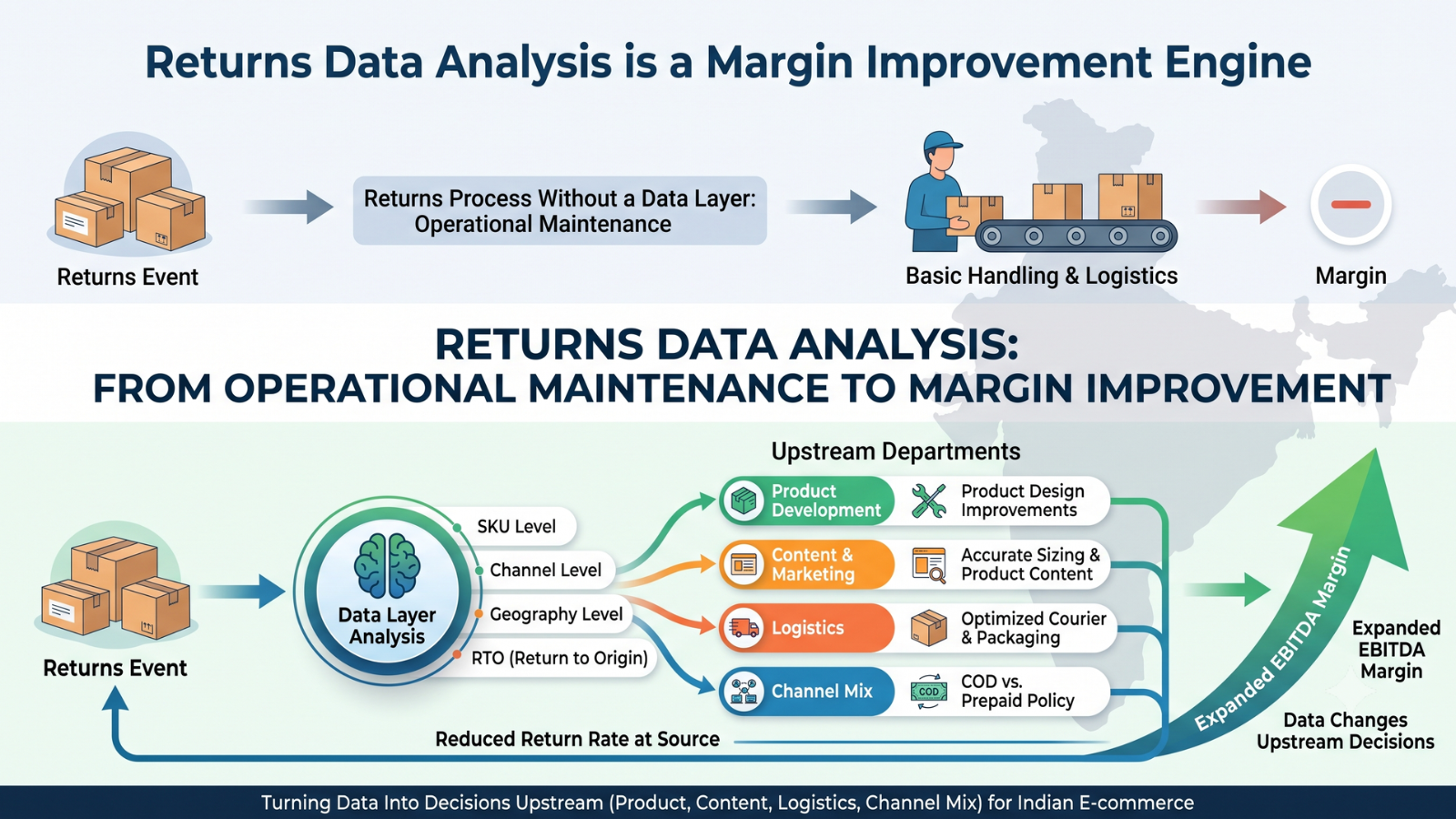 A returns process without a data layer is operational maintenance. A returns process with a data layer is a margin improvement engine. Ecommerce returns management India done properly produces data that changes decisions upstream, in product, content, logistics, and channel mix.
The goal of returns data analysis is to identify the root cause of returns at the SKU, channel, and geography level, and then change something upstream to reduce the return rate at source.
What to Track
| Data Point | What It Tells You |
|---|---|
| Return rate by SKU | Which products generate disproportionate returns |
| Return reason by SKU | Whether it is a product issue, sizing, or logistics failure |
| Return rate by channel | Whether marketplace returns differ from D2C website returns |
| Return rate by pin code | Where geography is driving RTO |
| RTO rate by courier | Which couriers are failing delivery disproportionately |
| Disposition split by SKU | Which products produce unsellable returns |
| Return rate by customer segment | Whether repeat returners are a material issue |
Turning Data Into Action
Return rate by SKU drives product and content decisions. If a specific fashion SKU has a 45% return rate and 70% of returns cite “size too small”, the fix is a product copy update, not a logistics intervention. Ecommerce returns management in India analytics should always connect return data to an upstream action.
Return rate by pin code drives pre-dispatch intervention. If a cluster of pin codes in a specific district produces 60% RTO on COD orders, those pin codes should trigger mandatory COD confirmation before dispatch, or be restricted to prepaid only.
Return rate by courier drives courier allocation decisions. If one courier partner produces significantly higher RTO rates on a specific route, that partner should be deprioritised for that pin code cluster.
Base.com’s analytics dashboard tracks all of these dimensions in real time. Operations teams can pull return rate by SKU, channel, pin code, and courier on any date range, without building a custom report. This is what ecommerce returns management in India platforms should do, not just track returns, but analyse them at a level that changes upstream decisions.
Building the Returns Policy That Reduces Return Volume
 Your returns policy is a lever on return volume that most Indian D2C brands underuse. Ecommerce returns management in India is not only about what happens after a return is initiated, but it is also about how policy design shapes return initiation rates in the first place.
- Time window. A 7-day return window generates lower return volume than a 30-day window; customers who need 30 days to decide were always ambivalent buyers. For most D2C categories, 7-10 days is sufficient and defensible.
- Condition requirement. Define “original condition” precisely: original packaging, tags attached, unused. Vague condition requirements produce disputes and increase unsellable return rates. Clear condition language is one of the simplest improvements in ecommerce returns management in India that brands consistently delay.
- Exchange-first policy. For fashion brands, offering exchange as the primary resolution (with return as a secondary option) reduces net return volume by 15-25%. A customer who wanted a different size was retained as a sale. A return request becomes an exchange, preserving the revenue.
- Prepaid-only for specific categories. High-RTO categories and pin codes can be restricted to prepaid at checkout, removing the ability to place a low-commitment COD order entirely. This is the most aggressive intervention, but it is appropriate for categories where COD RTO regularly exceeds 40%.
How Returns Management Integrates With Your OMS
Returns management is not a standalone function. It connects to order management, inventory management, courier management, and financial reconciliation. A platform that handles returns in isolation from these functions creates gaps that require manual bridging. Ecommerce returns management in India only delivers its full margin recovery potential when it is integrated into the complete OMS workflow, not bolted on as a separate tool.
Base.com integrates returns management into the complete order management software India workflow:
- Return request initiated: matched to original order automatically
- Reverse courier booked: tracked against the same order record
- Unit received at warehouse: scan confirmation updates inventory to QC status
- Disposition assigned: inventory updates (restock to bin, liquidate to clearance queue, reject to write-off)
- COD non-receipt confirmed: feeds into COD reconciliation workflow
- Return data: populates analytics dashboard at SKU, channel, and geography level
This is ecommerce returns management in India as a connected system, not a series of manual handoffs between separate tools. For Indian D2C brands managing 1,000+ monthly returns, this integration saves 40-80 hours of manual work per month and produces significantly more accurate financial records.
Returns Management at Different GMV Stages
The right level of investment in returns infrastructure scales with your GMV and return volume. Ecommerce returns management in India should match your operational complexity; under-investing creates margin leakage, and over-investing creates unnecessary overhead.
| GMV Stage | Monthly Returns Volume | Recommended Setup |
|---|---|---|
| Under Rs 5 crore/year | Under 500/month | Basic return tracking, manual QC, returns policy optimisation |
| Rs 5-30 crore/year | 500-3,000/month | OMS-integrated return tracking, basic disposition workflow, and COD confirmation |
| Rs 30-100 crore/year | 3,000-10,000/month | Base.com full returns module, scan QC, disposition tracking, analytics |
| Rs 100 crore+/year | 10,000+/month | Full integration + fraud detection + pin code restriction logic + reverse rate negotiation |
At every stage, the highest-ROI intervention is the one furthest upstream. Pre-dispatch prevention delivers more margin protection per rupee invested than post-receipt QC optimisation. This is the most important principle in ecommerce returns management in India: the earlier the intervention, the lower the cost.
The Margin Recovery Calculation
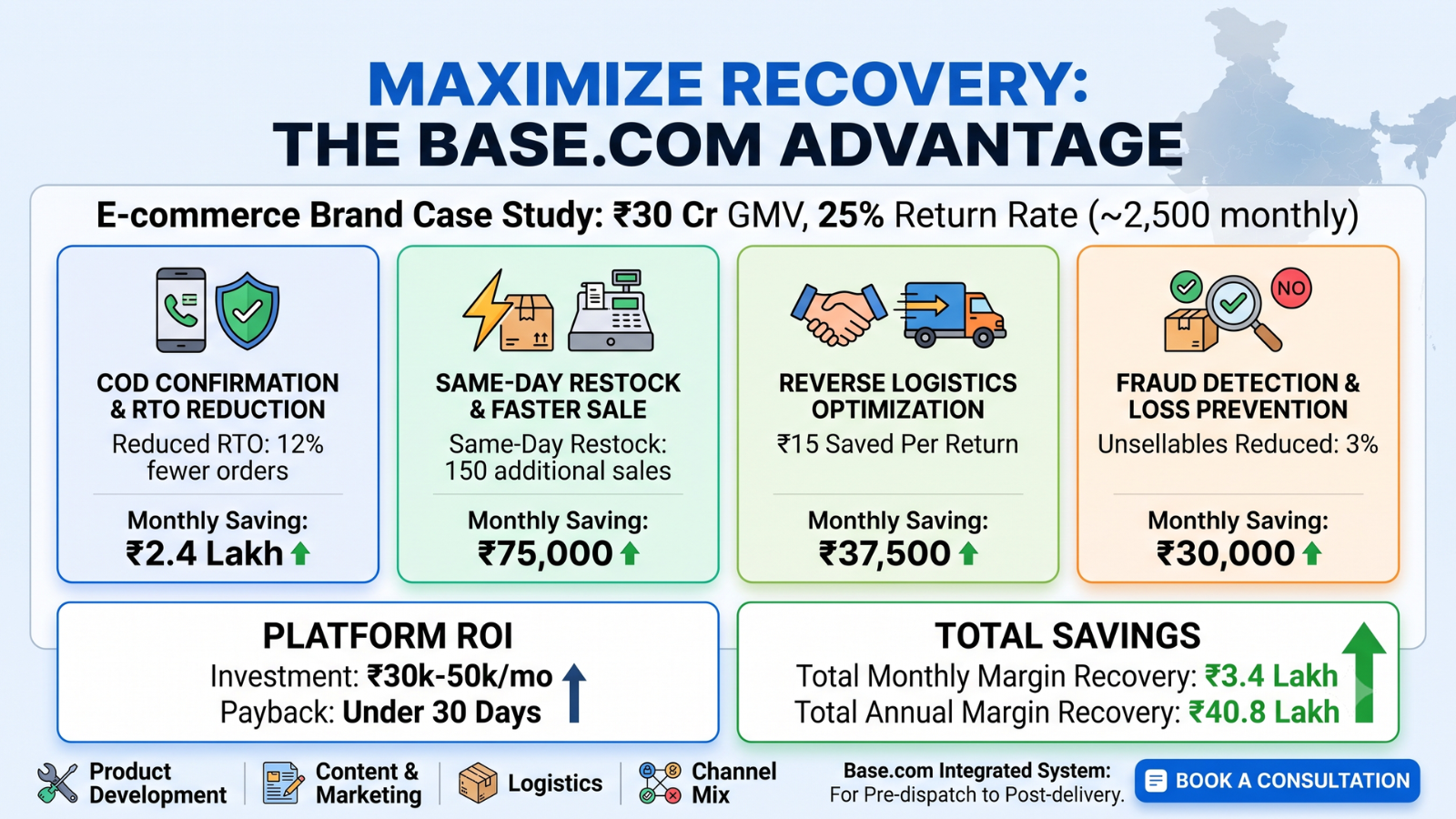 Here is what a fully implemented ecommerce returns management in India recovers for a brand doing Rs 30 crore annual GMV with a 25% return rate (approximately 2,500 monthly returns):
| Intervention | Monthly Saving |
|---|---|
| COD confirmation reducing RTO by 12% (800 fewer RTOs/month at Rs 300 cost) | Rs 2.4 lakh |
| Same-day restock of 60% of returns (vs 5-day average delay), 150 additional units sold | Rs 75,000 |
| Reverse logistics rate renegotiation (Rs 15 saving x 2,500 returns) | Rs 37,500 |
| Fraud detection reduces unsellable returns by 3% (75 units at Rs 400 product cost) | Rs 30,000 |
| Total monthly margin recovery | Rs 3.4 lakh |
| Annual margin recovery | Rs 40.8 lakh |
This is a recoverable margin that currently flows out of most Indian D2C brands without a structured ecommerce returns management process in India. The platform investment that enables it, Base.com at Rs 30,000-50,000/month, pays back in under 30 days.
Base.com is an order management and warehouse management platform built for Indian D2C and B2B ecommerce. Its returns management module handles the full lifecycle, from pre-dispatch RTO prevention through reverse logistics tracking, warehouse QC, and returns analytics, within a single integrated system.
Ecommerce returns management in India at this level of integration is what separates brands that scale sustainably from brands that absorb returns as a fixed, unmanaged cost. Talk to the Base.com team about your current returns rate and what the recovery potential looks like for your brand.


[…] COGS plus inbound freight and handling, marketplace referral and fulfilment fees, storage per unit, expected returns cost, and payment or COD […]
[…] a customer returns an order, the marketplace is supposed to credit the seller for the return. This credit should reflect the original sale amount minus applicable fees. In practice, return […]
[…] warehouse management system in India processes both in a unified returns workflow. The critical differentiator is what happens after the return arrives at the […]
[…] returns processing integrates directly with the inventory management system in India. A returned unit scanned at […]
[…] framing is wrong. Returns management in D2C India, handled with the right OMS infrastructure, is a margin recovery exercise. Every rupee […]